How Are Some of the Most Accomplished Writers and Poets Coping with the Digital Revolution? / Plus: My Own Logbook and Stopwatch for “Madam Mayo” Blog

BY C.M. MAYO — October 24, 2021
UPDATE: This blog was then entitled Madam Mayo (2006-2022).

This blog posts on Mondays. Fourth Mondays of the month I devote to a Q & A with a fellow writer. On occasion, as on this Monday, I look back over a compilation of responses to a specific question.

About a year ago I took a brief look back at how some of the most accomplished writers and poets (Katherine Dunn, Joanne Herschon, Barbara Crooker, Nancy Peacock, Bruce Berger, Sergio Troncoso, Eric Barnes, Joseph Hutshison, Mary Mackey, ) have been coping with the digital revolution. I’d say the responses were as unique as fingerprints. Time for an update.

C.M. MAYO: How has the Digital Revolution affected your writing? Specifically, has it become more challenging to stay focused with the siren calls of email, texting, blogs, online newspapers and magazines, social media, and such? If so, do you have some tips and tricks you might be able to share? 

Down with social media!

LYNNE SHARON SCHWARTZ: “I avoid social media as much as possible—I think it is destroying critical thinking, as well as print journalism. A lot of it is simply garbage. I do like email, though I miss getting personal letters in the mail.”
—From Q & A with Lynne Sharon Schwartz About Crossing Borders, Madam Mayo blog, August 23, 2021

MATTHEW PENNOCK: “I am not particularly prolific. I do not write every day, and I’m often distracted by all the shows I can stream, and podcasts I can listen to. Social media has never really appealed to me, so I am okay there, but other than that, someone needs to give me some tips about how to get a little more done.”
—From Q & A with Poet Matthew Pennock on The Miracle Machine
Madam Mayo blog, November 23, 2020

ALVARO SANTANA-ACUÑA: “While I am writing, I minimize interruptions, including turning off my cellphone and notifications. I only turn it back on when I am having a break. In general, I try to use social media as little as possible. What I do is to log in, scroll down a few posts, and, if I have to post something, I do it and then log off. The truth is that, when we are on social media, we easily loose ownership of our time, which we put for free at the disposal of these companies. We become their workers. I prefer to use my time for other things.”
—From Q & A with Álvaro Santana-Acuña on Writing Ascent to Glory: How One Hundred Years of Solitude Was Written and Became a Global Classic, Madam Mayo blog, December 28, 2020

It depends…

CHRISTINA THOMPSON: “I think this depends on what stage one is at in the writing process. When you’re actually writing a book, all this stuff is a distraction and you have to be very careful not to waste too much time on it. But once your book is published, it becomes a lifeline to your readership, and the more you participate the better. So, I think it’s really a matter of making all these opportunities work for and not against you, and that takes a certain amount of discipline.”
—From Q & A with Christina Thompson on Sea People: The Puzzle of Polynesia, Madam Mayo blog, January 25, 2021

Balance

JAN CLEERE: “While digital sources have made a writer’s job more efficient when it comes to finding pertinent sources, it has also taken away that spontaneous delight of uncovering a long lost letter or hidden journal that has not yet been digitized. I try to focus on the business of writing separate from the hours I spend actually writing. Not always possible but I have found by trying to compartmentalize the creative from the business end of writing, I am more productive. The trick is to balance these activities so that by the end of the day, you feel you have put out all the fires as well as progressed with your writing.”
—From Q & A with Jan Cleere on Military Wives in Arizona Territory: A History of Women Who Shaped the Frontier, March 22, 2021

No problemo!

SOLVEIG EGGERZ: “Actually I love writing on the computer. I am not one to long for life in a cabin on a mountaintop where I write on a yellow pad free of technology. I don’t like to be surprised by “emergencies” days after they occur. I resolve the issue of disturbances by keeping my phone next to me, so I can glance at a message without shutting down my story. Maybe I am exaggerating my equanimity!”
—From Q & A with Solveig Eggerz on Sigga of Reykjavik, February 22, 2021

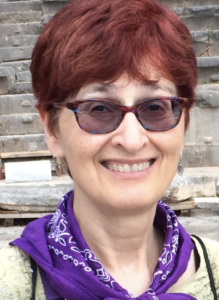
KARREN ALENIER: “I’m used to being interrupted. I grew up in house of six children. I was eldest. The point is when I am working, I am able to ignore the lure of online wonders like YouTube, blogs and newspapers. However, I like to work in silence and know that listening to radio, TV, or music is too distracting. Yes, my smart phone is an interrupter. Still I don’t turn that off because someone important to me might reach out and need me. Some of my friends get annoyed that I don’t read their Facebook pages except occasionally. The best way for me to get something done is to put it on my list of things to do. I take great pleasure in ticking off those items.”
—From Q & A with Karren Alenier on her New Book How We Hold On, the Word Works, Paul Bowles & More, Madam Mayo blog, September 27, 2021

DAVID O. STEWART: “For a lot of years, I was a trial and appellate lawyer with a dozen or more active cases at a time.  I used to describe my work as a life of interruptions.  Clients called.  Colleagues dropped by (remember offices?).  Opposing lawyers called.  Dumb firm meetings.  Interviewing job applicants.  I was constantly dropping one subject to pick up another.  I tried to be in my office by seven a.m. to get some uninterrupted time.  So these days, working at home by myself, I actually get antsy if I don’t have a few interruptions.  I’m used to working for a stretch, taking a few minutes off to do something stupid (see social media) or annoying (see call health insurer), and then getting back to work.  It’s normal.”
—From Q & A with Biographer David O. Stewart on the Stunning Fact of George Washington, Madam Mayo blog, June 28, 2021

Go into another world…

SUSAN J. TWEIT: “When I am writing, I am in another world. I turn off notifications on my phone and computer, so that I’m not distracted by the bing of email coming in or the ding of texts or news alerts. My daily routine is pretty simple: I post a haiku and photo on social media every morning (Facebook, Twitter, and Instagram), and answer any comments on my posts. After half an hour on social media—I set a timer—I read the news online. When I’ve finished with the news—which is research time for me, as news stories, especially those about science, are raw material for my writing—I write until the well runs dry. And then, usually at two or three in the afternoon, I allow myself to go back to social media, answer other comments, check the news. Then I close my laptop and go outside into the real world and walk for a mile or two on the trails around my neighborhood to clear my head. Getting outside into the “near-wild” of the greenbelt trails in my high-desert neighborhood keeps me sane in turbulent times, and refills my creative well. Nature is my medicine, inspiration, and my solace.”
—From Q & A with Susan J. Tweit on Her Memoir, Bless the Birds: Living with Love in a Time of Dying, April 26, 2021

KATHLEEN ALCALA: “All of this is terrible. I am so easily distracted. I will start laundry, open a file, take notes by hand, and forget what I had planned to do that day. For me, the best strategy is still the writing residency, away from home, where I don’t have any excuses and fewer distractions. This is especially needed when I am trying to organize large blocks of writing, such as the chapters in a novel.”
—From Q & A with Kathleen Alcalá on Spirits of the Ordinary, Madam Mayo blog, May 24, 2021

*

My Own Logbook and Stopwatch
for Work on Madam Mayo Blog
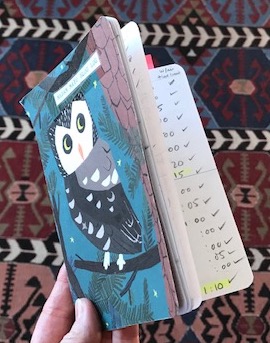
The ever-increasing and OMG-so-many siren calls to the Internet—as a writer, it’s something I’ve been struggling with and pondering on for the past many years. I’ve had some continuing frustrations, but also some successes, and I’ve blogged about the latter (see my writing workshop archive). Tips & Tricks for Coping with Digital Distractions, that’s a book I’m not going to write because I’m already writing another book, with two others contemplated after that, in addition to hosting this blog. Enough already!

But I will offer a word on my strategy for fitting Madam Mayo blog into my week. This blog has been ongoing since 2006, and since 2019, on a regular schedule of posting on Mondays. Although for years I resisted establishing a regular schedule, to my surprise, it has made the blog far easier to manage.

One of the biggest challenges to the sort of blogging I do is that because there’s no editor, no paying subscribers, it’s easy to have the whole show just ooze on out into who-knows-what-who-knows-when.

If you enjoy writing, watch out, blogging can take over your writing life!

Blogging then, for me, is what behavior modification expert B.J. Fogg, in his book Tiny Habits, terms a “downhill habit,” that is, a habit “that is easy to maintain but difficult to stop.” (Of course, on the other hand, for many people, blogging is, as per B.J. Fogg, an “uphill habit,” that is, one that requires ongoing attention to maintain but is easy to stop.)
Starting in January of 2021, I have been attending to the tiny habit of logging the time I spend on Madam Mayo blog, aiming for about two hours per week, never more than an hour a day, and also aiming for putting my attention on it (including dispatching any related emails) only on Sundays, Mondays, and Wednesdays. When I sit down to work on Madam Mayo blog, I open a digital stopwatch app. When I’m done, I note the date and time spent in the logbook. Was it as scheduled, and within the time limit? If so, I give the entry a check mark and do the B.J. Fogg prescribed “celebration.” Yes, it’s kind of nerdy, but I have been finding this system, or rather, set of tiny habits, balancing, energizing, efficient and, hey, just fun.

I welcome your courteous comments which, should you feel so moved, you can email to me here.

A Visit to El Paso’s “The Equestrian”

Fearless Fabian / 
Plus From the Archives: 
“The Vivid Dreamer” Writing Workshop 

from the Guadalupe Mountains National Park

This Writer’s PFWP and NTDN Lists: 
Two Tools for Resilience and Focus
“Julius Knows” in “Catamaran”

BY C.M. MAYO — October 18, 2021
UPDATE: This blog was then entitled Madam Mayo (2006-2022).

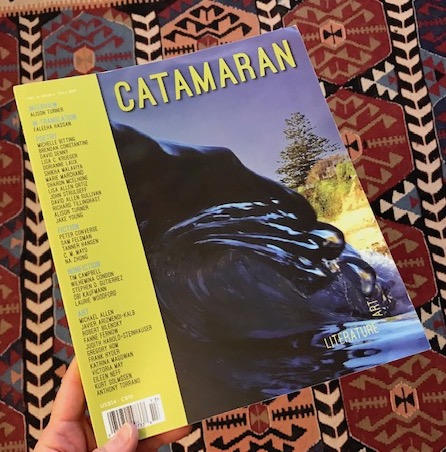
Yea verily, even in the doldrums of the present rhinocerosness, the American literary short story lives on. I must thank Richard Polt, author of The Typewriter Revolution, for the prompt that inspired me to write my latest typewriter short story, “Julius Knows,” which, I am honored to report, appears in the gorgeous new Fall 2021 issue of Catamaran.

I’ll post “Julius Knows” here on the blog, as soon as I get around to typing it up on my Hermes 3000. Meanwhile, you can read my previous typewritten short story about a typewriter, “What Happened to the Dog,” which originally appeared in the anthology edited by Richard Polt, et al., Escapements: Typewritten Tales from Post-Digital Worlds.

I welcome your courteous comments which, should you feel so moved, you can email to me here.

Conjecture: The Powerful, Upfront, Fair and Square Technique 
to Blend Fiction into Your Nonfiction

Spinning Away from the Center: Stories from the 
Flannery O’Connor Award for Short Fiction

Meteor, Influences, Ambiance

Itty Bitty But Bold! From the Archives: “Revision: Take a Chainsaw to Those Little Darlings, Prune, Do No Harm, Be an Archaeologist, Move the Furniture Onto the Front Lawn, Flip the Gender”

BY C.M. MAYO — October 11, 2021
UPDATE: This blog was then entitled Madam Mayo (2006-2022).

This blog posts on Mondays. Second Mondays of the month I devote to my writing workshop students and anyone else interested in creative writing. Welcome! 
> For the archive of workshop posts click here.

Be bold! Some wacky guys demonstrate the concept by taking an itty bitty step… off the top of a mountain.

Boldly nurture your creativity! Heed the call to your greatness, your highest self, ever and always! Even if you feel itty bitty! Because you know that first draft is crap! Herewith, a set of tips and tricks to, by the itty and by the bitty, get your revision mojo mojoing.

Revision: Take a Chainsaw to Those Little Darlings, Prune, Do No Harm, Be an Archaeologist, Move the Furniture Onto the Front Lawn, Flip the Gender

Originally posted on Madam Mayo blog, by C.M. Mayo, May 1, 2006

Revision on my mind… as I am revising the revision of the revision (of the revision) of my novel… which has already undergone a few chainsaw massacres… more than Texas-sized… Australia-sized (I’m talking 250 pages)… I am also gearing up to give a special one day workshop on Revision at the Writers Center this May 14th [2006]… So I recently asked a few writer friends for their thoughts on revision. Novelists Mary Kay Zuravleff and Carolyn Parkhurst were both in my writing group; first-hand I’ve seen how good they are with revision. Check out their websites to see what they’re up to– both have wonderful new novels out. Dinty W. Moore is the author of many books, most recently The Truth of the Matter: Art and Craft in Creative Nonfiction. Dawn Marano is fine writer of creative nonfiction and, bless her heart, the editor of my memoir, Miraculous Air. Known to all in literary Washington DC but the brain dead, Richard Peabody is a poet, fiction writer, editor, publisher and writing teacher. Check out his website– he’s offering a novel writing workshop.

Here’s what they had to say on revision:

“the smell pass, the hearing pass”

MARY KAY ZURAVLEFF
“The prose on my pages doesn’t match what I’ve envisioned for drafts and drafts. Near the end, I make a pass for each of the senses. There’s the smell pass, the hearing pass, etc., as I try to vivify every sidelong glance. Then it’s time to prune it back so readers don’t choke on details!”

“first, do no harm”

CAROLYN PARKHURST
“When facing revisions, I think it’s useful for a writer to begin from the same starting point as a doctor: first, do no harm. Revision is a vital part of the writing process, but it’s possible to revise all the life out of something if you’re not careful. Never lose sight of what was artful and compelling about the piece in its purest state: when it existed only in your imagination.”

“curiosity… questions”

DAWN MARANO
“Substantive revision—as opposed to line-editing, that is, moving commas around and such—begins when a writer returns to a draft of her work with the curiosity of, say, an archaeologist. Arrayed before her are the traces of a lost civilization—in this case, sentences and paragraphs instead of material artifacts—that are waiting for her to see them with the fresh and patient eye of possibility: ‘What larger meaning or context might this perplexing fragment of thought I left undeveloped be a part of? What is this clever demurral or summarization disguising or helping me avoid writing about? What story am I really trying to tell myself with this assemblage of words on the page?’”

“the conscious choice that it belongs”

DINTY W. MOORE
“Simply proofreading your second or third draft and fixing a few awkward sentences is similar to remodeling a room by dusting the end tables and rearranging the pillows on the sofa — not much changes. The true act of revision comes when a writer is willing to move each piece of furniture out onto the front lawn, roll up the area rugs, take the pictures down from the wall, and then, on a case by case basis, decide what returns to the room, and where it will be situated. Sometimes a favorite table has to be left out on the curb for recycling, because it just doesn’t fit anymore; maybe some new furniture is purchased (a new scene is written); perhaps the walls are painted a new color (voice or point-of-view shifts); or maybe all of the furniture is returned but in a different configuration — what’s important is that nothing goes back inside the metaphorical living room until and unless the writer makes the conscious choice that it belongs.”

“No fear”

RICHARD PEABODY
“I think revision is about testing the boundaries of what’s on the page, having no fear of pushing to the logical extreme. You need to jettison your baggage about plot, invest in your characters (and their voices), and trust your guts. When all else fails flip the gender.”

I welcome your courteous comments which, should you feel so moved, you can email to me here.

Recommended Books on the Creative Process

The Marfa Mondays Podcast is Back! No. 21: 
“Great Power in One: Miss Charles Emily Wilson”

Q & A with Bruce Berger on A Desert Harvest

Into the Guadalupe Mountains: Some Favorites from the Texas Bibliothek (Plus a Couple of Extra-Crunchy Videos)

BY C.M. MAYO — October 4, 2021
UPDATE: This blog was then entitled Madam Mayo (2006-2022).

This blog posts on Mondays. This year, 2021, I am dedicating the first Monday of the month to Texas Books, in which I share with you some of the more unusual and interesting books in the Texas Bibliothek, that is, my working library. Listen in any time to the related podcast series.

Texas is giant in so many ways, including its literature. However, the literature on its Guadalupe Mountains is relatively sparse. This isn’t surprising when you consider how remote these mountains are—by car from El Paso, only after an hour and half do they rise up to their full splendor from the floor of the Texas desert. They make for a “sky island,” watered woodlands surrounded by the salty desert of what used to be a vast sea. There were never any towns in the Guadalupes’ wooded valleys; into the 19th century these valleys were inhabited by the Mescalero Apaches for seasonal hunting camps, until they were driven out by the U.S. Army, and the railroad tracks laid down across the desert, alongside the telegraph lines. Suffice to say, without the aid of fossil fuels, first coal, then oil, it was brutally difficult to travel over this region. Even today most travelers blow on by the Guadalupes at 80 miles an hour towards points west or east. As one who has served as an artist-in-residence in the Guadalupe Mountains National Park, I well know what glories (and not a few rattlesnakes) these mountains hold. I am at work on my memoir / portrait of Far West Texas but of course, others have written about the Guadalupes, and their works inform mine. Herewith, a few favorites from my working library:

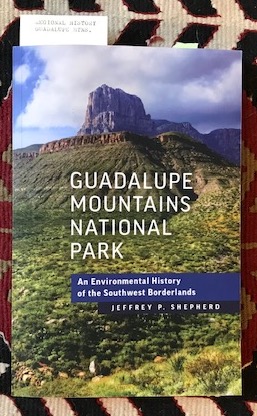
Jeffrey P. Shepherd’s Guadalupe Mountains National Park: An Environmental History of the Southwest Borderlands (University of Massachusetts Press, 2019) is the book I wish I’d had when I started my research some years ago. From the catalog copy:

“The Guadalupe Mountains stand nearly 9,000 feet tall, spanning the far western fringe of Texas, the border of New Mexico, and the meeting point of the Southern Plains and Chihuahuan Desert. Long an iconic landmark of the Trans-Pecos region, the Guadalupe Mountains have played a critical role for the people in this beautiful corner of the Southwest borderlands. In the late 1960s, the area was finally designated a national park.

“Drawing upon published sources, oral histories, and previously unused archival documents, Jeffrey P. Shepherd situates the Guadalupe Mountains and the national park in the context of epic tales of Spanish exploration, westward expansion, Native survival, immigrant settlement, the conservation movement, early tourism, and regional economic development. As Americans cope with climate change, polarized political rhetoric, and suburban sprawl, public spaces such as Guadalupe Mountains National Park remind us about our ties to nature and our historical relationships with the environment.”

*

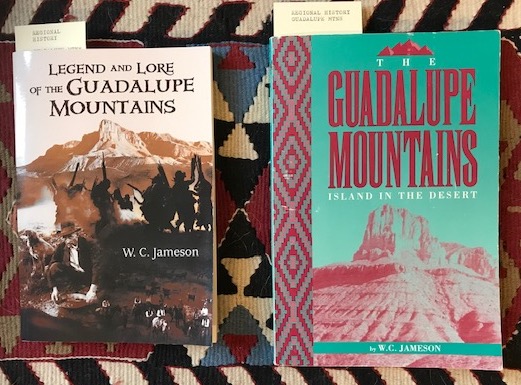
W.C. Jameson’s Legend and Lore of the Guadalupe Mountains (University of New Mexico Press, 2007) and The Guadalupe Mountains: Island in the Desert (Texas Western Press, 1994), with tales of Indians, wildest nature, secret gold mines and ghosts, are essential reading for any would-be Hollywood screenwriter.

*

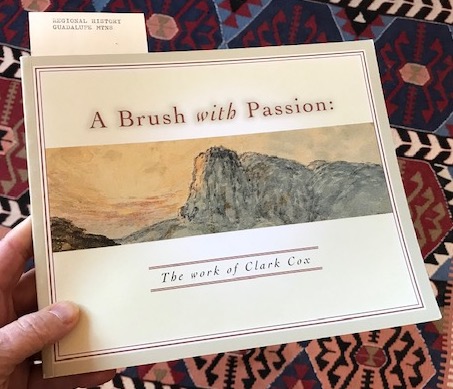
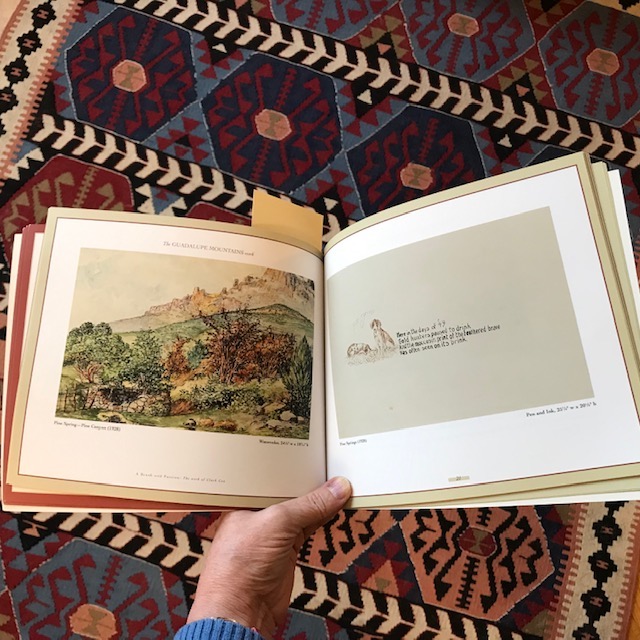
A Brush with Passion: The Work of Clark Cox, edited by Wendy Parish and Jeannie Sillis (Carlsbad Caverns-Guadalupe Mountains Association, 2003) is my personal favorite. Clark Cox (1861-1936) was a professional scene painter for opera and theater. For some time he worked out of New Orleans, then moved to Dallas, at which point he began to make annual pilgrimages to paint landscapes in the Guadalupe Mountains. His strike me as the kind of watercolors Beatrix Potter would have painted, had she ventured so far afield. And having hiked these landscapes myself, these many decades later, I so admire how Cox captured their subtle beauty.

*

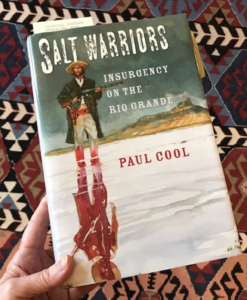
Paul Cool’s Salt Warriors: Insurgency on the Rio Grande (Texas A & M University Press, 2008) is a major scholarly history of the El Paso Salt War of 1877, a bloody conflict between newly-arrived Anglo businessmen and local Mexican salt harvesters. I had the honor of interviewing the author for this blog back in 2016.

*

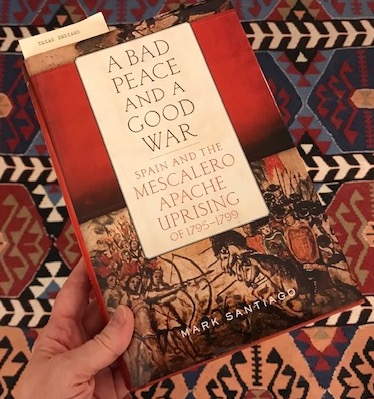
Mark Santiago’s A Bad Peace and a Good War: Spain and the Mescalero Apache Uprising of 1795-1799 (University of Oklahoma Press, 2018) is a superbly researched history of a war that had been, essentially, entirely forgotten. From the catalog copy:

“This book challenges long-accepted historical orthodoxy about relations between the Spanish and the Indians in the borderlands separating what are now Mexico and the United States. While most scholars describe the decades after 1790 as a period of relative peace between the occupying Spaniards and the Apaches, Mark Santiago sees in the Mescalero Apache attacks on the Spanish beginning in 1795 a sustained, widespread, and bloody conflict. He argues that Commandant General Pedro de Nava’s coordinated campaigns against the Mescaleros were the culmination of the Spanish military’s efforts to contain Apache aggression, constituting one of its largest and most sustained operations in northern New Spain. A Bad Peace and a Good War examines the antecedents, tactics, and consequences of the fighting.

“This conflict occurred immediately after the Spanish military had succeeded in making an uneasy peace with portions of all Apache groups. The Mescaleros were the first to break the peace, annihilating two Spanish patrols in August 1795. Galvanized by the loss, Commandant General Nava struggled to determine the extent to which Mescaleros residing in “peace establishments” outside Spanish settlements near El Paso, San Elizario, and Presidio del Norte were involved. Santiago looks at the impact of conflicting Spanish military strategies and increasing demands for fiscal efficiency as a result of Spain’s imperial entanglements. He examines Nava’s yearly invasions of Mescalero territory, his divide-and-rule policy using other Apaches to attack the Mescaleros, and his deportation of prisoners from the frontier, preventing the Mescaleros from redeeming their kin.

“Santiago concludes that the consequences of this war were overwhelmingly negative for Mescaleros and ambiguous for Spaniards. The war’s legacy of bitterness lasted far beyond the end of Spanish rule, and the continued independence of so many Mescaleros and other Apaches in their homeland proved the limits of Spanish military authority. In the words of Viceroy Bernardo de Gálvez, the Spaniards had technically won a ‘good war’ against the Mescaleros and went on to manage a ‘bad peace.'”

*

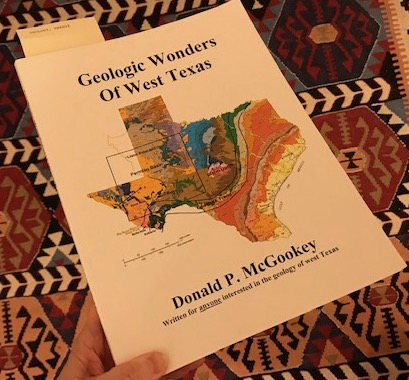
Last but not least of the favorites to mention, is Donald P. McGookey’s Geologic Wonders of West Texas (self-published, second printing, 2007). This is uber-nerdy geology, but essential reading for anything to do with the Guadalupe Mountains, for these are geologic wonders indeed. To quote McGookey, page 70:

“The Guadalupe Mountain rocks are of a very large and long barrier reef, the Capitan Reef. This type of barrier reef is very similar to the present day Great Australian and Belize Barrier Reefs. The continuity of sediments down the slope into the basin facies are the best found anywhere in the world. In places like McKitrick Canyon it is an easy hike from rocks of the top part of the reef to those deposited in the basin. Total relief between the reef and deeper parts of the basin is over 5,000 feet.”

*

Finally, two extra-crunchy videos:

Eleanor King’s video “Conflict Archaeology: The Untold History of the Buffalo Soldiers and the Apache in Texas”

*

This recent Zoom by archeologist Dr Bryon Schroder is not about the Guadalupe Mountains per se, but about cutting-edge research on paleolithic hunters in the larger Big Bend Region of Far West Texas. I include it here because it gives an overview of peoples who would have also hunted in the Guadalupe Mountains.

*

I welcome your courteous comments which, should you feel so moved, you can email to me here.

Selected Cabeza de Vaca Books, Part II: 
Notes on Narrative Histories and Biographies

Journal of Big Bend Studies: “The Secret Book by Francisco I. Madero”

Notes on Artist Xavier González (1898-1993), 
“Moonlight Over the Chisos,” and a Visit to
Mexico City’s Antigua Academia de San Carlos

Q & A with Poet Karren Alenier on her New Book “How We Hold On,” the WordWorks, Paul Bowles & More

“I have had numerous successful readings on Zoom. Check them out through my website at https://www.alenier.com/videos. I like the platform and I have been making opportunities for other poets through Zoom. Yes, of course, there is a future in online readings. You get a bigger more geographically diverse audience. It’s exhilarating.”— Karren Alenier

BY C.M. MAYO — September 27, 2021
UPDATE: This blog was then entitled Madam Mayo (2006-2022).

This blog posts on Mondays. Fourth Mondays of the month I devote to a Q & A with a fellow writer.

Karren Alenier

Karren Alenier is one of my very favorite poets, both for the quality of her poetry, but also for her enthusiasm for poetry and the generosity of her spirit. If memory serves, I met Karren 20 years ago when I was selected to read my work at the Joaquin Miller Cabin Poetry Series in Washington DC. And later I was delighted to learn that, in different years, an eon earlier, we had both studied with Paul Bowles in Tangiers. Karren has written about Paul and his wife Jane— read all about that in her The Anima of Paul Bowles. Since 2017 she also hosts a richly varied blog on publishing, https://alenier.blogspot.com.

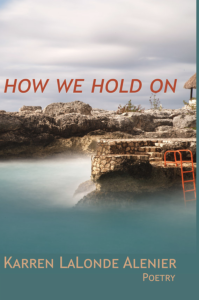
I’ve been meaning to get Karren here for a Q & A for some time now; her new book, How We Hold On, makes for the perfect occasion.

C.M. MAYO: What inspired you to write How We Hold On? Can you talk about its genesis?

KARREN ALENIER: The loss of my husband Jim Rich is what inspired this manuscript, especially the poems about Jamaica. Jim loved the Jamaican poems and urged me to get them published.  The model for this work was my prize-winning book Looking for Divine Transportation. Both have 4 sections beginning with family poems and a section where poems from another country are featured.

C.M. MAYO: As you were writing, did you have in mind an ideal reader?

KARREN ALENIER: Sometimes books of poetry are consciously written and other times, the work is collected. How We Hold On is a collected work driven by my desire to preserve the memory of my late spouse and the love we shared. Love poetry always has an audience. I also hoped that the poems would bring solace to some of Jim’s grieving friends. 

Other readers I hope to reach are those interested in poetic form. Grace Cavalieri, always a quick study, said that I had a different strategy for each poem and by that I took it that she meant I used a wide variety of poetic forms to contain what I was feeling and expressing. For audience interested in current events, I also managed to use very new work done as letters to my great grandfather who died in the 1918 pandemic flu.

C.M. MAYO: Which poets have been the most important influences for you? And for How We Hold On in particular?

KARREN ALENIER: Normally, I would say Wallace Stevens and Gertrude Stein have been important influences and they are over all, but for this work, I would say Elizabeth Bishop (form), Ed Hirsch (absurdity), Allen Ginsberg (passion), Guillaume Apollinaire (disconnected leaps).

C.M. MAYO: Which poets and writers are you reading now? 

KARREN ALENIER: Two poets who have caught my attention recently are Harryette Mullen (very Steinian) and Diane Seuss (lovely on absurdity). I read a lot of fiction. I’m currently reading Elena Ferrante’s The Lying Life of Adults. I love stories that take place in the countries of the Mediterranean. 

C.M. MAYO: How has the Digital Revolution affected your writing? Specifically, has it become more challenging to call down the Muse with the siren calls of email, texting, blogs, online newspapers and magazines, social media, and such? If so, do you have some tips and tricks you might be able to share? 

KARREN ALENIER: I’m used to being interrupted. I grew up in house of six children. I was eldest. The point is when I am working, I am able to ignore the lure of online wonders like YouTube, blogs and newspapers. However, I like to work in silence and know that listening to radio, TV, or music is too distracting. Yes, my smart phone is an interrupter. Still I don’t turn that off because someone important to me might reach out and need me. Some of my friends get annoyed that I don’t read their Facebook pages except occasionally. The best way for me to get something done is to put it on my list of things to do. I take great pleasure in ticking off those items.

C.M. MAYO: How has it been to read poetry on Zoom? Do you see the future all Zoom-y?

KARREN ALENIER: I have had numerous successful readings on Zoom. Check them out through my website at https://www.alenier.com/videos. I like the platform and I have been making opportunities for other poets through Zoom. Yes, of course, there is a future in online readings. You get a bigger more geographically diverse audience. It’s exhilarating.

C.M. MAYO: For those looking to publish a book of poetry, what would be your most hard-earned piece of advice?

KARREN ALENIER: If a publisher says s/he likes part of your manuscript, ask immediately if you can send a revision. Don’t delay by feeling sorry for yourself or thinking someone else might like the whole thing. Take your openings when they present.

C.M. MAYO: What’s next for you as a poet?

KARREN ALENIER: I’m currently working on poems in response to Tender Buttons (Gertrude Stein) and I’m taking others along for the experience.  I expect to announce the Tender Buttons anthology project in October 2021. The first of three books will be published by The Word Works in 2022.

C.M. MAYO: Can you share your most vivid memory of Paul Bowles?

KARREN ALENIER: In August 1982, I arrived for a writing appointment at his apartment door in Tangier wearing a djellaba over my clothes and purse to protect myself from pickpockets or other people interested in my things. I was hot and when invited in by Paul Bowles, I asked if he would mind if I took off my robe. He looked at me with surprise and said, “oh, I forgot my jacket.” He grabbed his jacket and put it on and then he said, “Of course, you may take your djellaba off.”

C.M. MAYO: Can you talk about your involvement with The Word Works? 

KARREN ALENIER: I was the first poet published by The Word Works in 1975. The next year, I started workshopping poetry with other members of Word Works at the Joaquin Miller cabin in Washington, DC’s Rock Creek Park. By 1978, I started the Joaquin Miller Cabin Poetry Series which has been running every summer since then. In 1986, I became the second president and chairperson of the board of directors. In 1987, under my leadership, the Washington Prize moved from a single poem contest to a book prize with a cash purse. In 1989, I founded the Capital Collection imprint (now known as the Hilary Tham Capital Collection) which awards book publication to poets who volunteer for literary organizations like The Word Works. In 1999, I started the Café Muse Literary Salon at Strathmore Hall in Bethesda, Maryland. The series has been running monthly ever since with the excellent help of many volunteers.  In 2009, Nancy White became the third president of Word Works. She leads the publishing and, while staying involved in the publishing, I spend more time on public programs. I have innovated many programs for The Word Works and pride myself on this strategy—I tell our volunteers I expect them to have fun and if they aren’t, they shouldn’t continue.

how we hold on

my mother kept a steamer trunk
with classic clothes immune to fad
my husband owned a cedar chest
packed with bits reins and riding whip

I am neither fashionista
nor ardent horse enthusiast
in my chest an aging heart brims
with blood both beautiful and swift

—Karren L. Alenier

when it drops you gonna feel it

we traded
Internet for mosquito
net cocooned
for sleep
under a halo
of white mesh
the sea beating
the coral cliffs
of Negril a lullaby
of dominoes geckos
the kingpins in the road
hawking anythingyouwant
the minstrel Fire improvising
Toots Hibbert’s “Pressure Drop”
a daughter hopeful that her father
in a Sav-la-Mar hospital would kick
lung cancer with an herbal medicine
something six chemo treatments
in Georgia couldn’t do

—Karren L. Alenier

Visit Karren Alenier’s website at www.alenier.com

I welcome your courteous comments which, should you feel so moved, you can email to me here.

Q & A with Diana Anhalt on Her Poetry Collection Walking Backward

Q & A: Joseph Hutchison, Poet Laureate of Colorado, on The World As Is

AWP 2019 (Think No One Is Reading Books and Litmags Anymore?)

Neil Postman’s 1997 Lecture “The Surrender of Culture to Technology”

BY C.M. MAYO — September 20, 2021
UPDATE: This blog was then entitled Madam Mayo (2006-2022).

I find it startling in the extreme, here in the present rhinocerosness, to reencounter Neil Postman’s lecture on “The Surrender of Culture to Technology” from 1997. Actually, I read Postman’s Technolopy: The Surrender of Culture to Technology a few years ago, but just this week I revisited his lecture apropos of that, archived on YouTube. Perhaps you, dear reader, will find it as eerie as I did.

P.S. So 2021: Wingwoman Géraldine Fasnacht jumps off the Eiger.

I welcome your courteous comments which, should you feel so moved, you can email to me here.

Marshall McLuhan (1911-1980): Some Notes 

Bruce Berger’s The End of the Sherry

Selected Cabeza de Vaca Books, Part II: 
Notes on Narrative Histories and Biographies

Fearless Fabian / Plus From the Archives: “The Vivid Dreamer” Writing Workshop from the Guadalupe Mountains National Park

This blog posts on Mondays. Second Mondays of the month I devote to my writing workshop students and anyone else interested in creative writing. Welcome! 
> For the archive of workshop posts click here.

BY C.M. MAYO — September 12, 2021 
UPDATE: This blog was then entitled Madam Mayo (2006-2022).

Well, gollygoobernation, it had seemed to me to have gotten a bit boring out there this summer with everyone everywhere all anxious about things, and everything else, too. But hark! I have found an exception! One self-described Swiss “sporty dude” whose name is Fabian, and who, a few days go, jumped clear off the Matterhorn in a wingsuit.

Dude! Danke sehr! Apropos of this week’s Madam Mayo blog writing workshop post, you have modeled the concept of precisely how it feels (among other things I could list but I won’t) to publish a book!

Be bold! Fearless Fabian models the concept.

This Monday finds me working on my Far West Texas book, so herewith, a post from the archives, which I hope might inspire you to prepare for your own eventual leap, metaphorically speaking, from your own personal Matterhorn. Stitch your wingsuit well.

NATURE & TRAVEL WRITING
FOR THE VIVID DREAMER

A handout with examples & exercises
from C.M. Mayo’s writing workshop given as Artist-in-Residence,
Guadalupe Mountains National Park, Texas, May 2017

We can think of the best writing about nature and travel, whether fiction or nonfiction, as instructions for the reader to form in his or her mind a “vivid dream,” an experience of the world. How do we, whether as readers, or as any human being (say, folding laundry or maybe digging for worms with a stick), experience anything? Of course, we experience the world through our bodies, that is to say, through our senses: sight, smell, taste, touch, hearing-and I would add a “gut” or intuitive sense as well.

From John Gardner’s The Art of Fiction:

“In the artist’s recreation of the world we are enabled to see the world.”

(See my post “Techniques of Fiction: The Number One Technique from the Supersonic Overview” and Recommended Books on Craft.)

From Kenneth White’s Across the Territories: Travels from Orkney to Rangiroa:

“[Y]ou have to go out. You have to open space, and deepen place.
Fill your eyes with the changing light.”

From a letter by Anton Chekov:

“In descriptions of nature one should seize upon minutiae, grouping them so that when, having read a passage, you close your eyes, a picture if formed. For example, you will evoke a moonlit night by writing that on the mill dam the glass fragments of a broken bottle flashed like a bright little star, and that the black shadow of a dog or a wolf rolled along like a ball…”

(See my post on emulation-permutation exercises.)

From Bruce Berger’s The Telling Distance: Conversations with the American Desert:

“Silence and slow time out of ancient seabeds, the sandstone heaved into red walls blackened with lichen and rain, stained with the guano of hawks and eagles.”

From Gary Paul Nabhan’s Desert Terroir: Exploring the Unique Flavors and Sundry Places of the Borderlands:

“I rub a few leaves between my thumb and forefinger, and their fragrance suddenly pervades the dry air, as if I had just broken a bottle of perfume against one of the sharp basalt rocks at my feet.” 

From Mariano Azuela’s The Underdogs (Los de abajo):

“Below, at the bottom of the canyon, through the veil of rain, could be seen straight, swaying palms, their angled tops rocking back and forth until a strong gust of wind blew their foliage open into green fans.”

From Ellen Meloy’s Eating Stone: Imagination and the Loss of the Wild:

“…day’s end pulls the buttery sunlight out of the canyon but does not lessen the furnace effect. High walls of stone hold a radiating heat that will last nearly until morning. I place my sleeping pad close to the river’s edge to make use of the swamp cooler effect. It is not usual to wake up, walk a few yards, and slip into the cool garment of night water.”

From Terry Tempest Williams’ The Hour of Land: A Personal Topography of America’s National Parks (from the chapter on Big Bend National Park):

“The desert is most alive at night… A flurry of moths becomes a white-winged blizzard; stalks of sotol glow like lit tapers on either side of the road. For eighty miles, we never pass a car.”

From Susan Shelby Magoffin’s diary of 1846-47, Down the Santa Fe Trail and into Mexico:

“Passed a great many buffalo, (some thousands) they crossed our road frequently within two or three hundred yards. They are very ugly, ill-shapen things with their long shaggy hair over their heads, and the great hump on their backs, and they look so droll running.”

(See my blog post about this extraordinary diary)

THREE BRIEF EXERCISES 
TO REV UP YOUR WRITERLY PERCEPTIONS

Here I provide my own answers from when I was walking a few days ago on Pine Springs Trail late in the afternoon. About half way down the trail, I stopped, sat down on a handy bench, and did these three exercises in my notebook. You can do this right now—or, perhaps at some moment while you are on a hike today.

Note: This is not necessarily about writing some splendid polished bit, but rather, simply noticing detail and capturing it on paper. In other words, you’re generating raw material you might use later.

HUNT THE COLORS
Pick an area that most people would decribe with one color, 
say, a yellow wall, or a green hillside. 
How many colors do you actually see?

Here’s what I got:

evergreen
kelly green
mint green
straw green
grey-green
lavender-green
khaki
silvery green

TRIANGLE IN SPACE
What two things do you notice in the distance?
What two things do you notice very close to you?
What two things do you notice behind you?

Here’s what I got:

In the distance: 
The hillside with bands of shadow

Nearby: 
Birdsong; shadow of the sumac tree

Behind: 
Sounds of cars and trucks on the highway;
a cloud that looks like a squished frog

LIGHT & DARK
Where is the light coming light?
What effects does it cause?

The sun is low, almost 2/3 of the way from the top of the sky to the edge of the mountains; it is on my left, which is west.

Shadows: falling to my right. Sumac tree casts a shadow that alsmot seems to have polkadots, like lace. It is shivering. The ovals of light shine like coins. One side of the sumac is sunny, bright, the other looks gray and cold.

The sotol plant across the path—it’s shivering. It’s tips are silvered as if wet.

*

See also “Giant Golden Buddha” & 364 More Free 5 Minute Writing Exercises and Recommended Literary Travel Memoirs and a whole cornucopia of other free resources for your writing.

I welcome your courteous comments which, should you feel so moved, you can email to me here.

Shake It Up with Emulation-Permutation Exercises

Selected Cabeza de Vaca Books, Part II: 
Notes on Narrative Histories and Biographies

Journal of Big Bend Studies: “The Secret Book by Francisco I. Madero”

From the Archives: My Review of Edward H. Miller’s “Nut Country: Right-Wing Dallas and the Birth of the Southern Strategy”

BY C.M. MAYO — September 6, 2021 
UPDATE: This blog was then entitled Madam Mayo (2006-2022).

This blog posts on Mondays. This year, 2021, I am dedicating the first Monday of the month to Texas Books, in which I share with you some of the more unusual and interesting books in the Texas Bibliothek, that is, my working library. Listen in any time to the related podcast series.

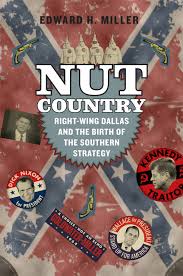
Here we are in the Present Rhinocerosness otherwise known as 2021, in which in the United States we are beginning to see some political realignments of epic proportion; thus, already, Edward H. Miller’s 2015 tome about the Republicans’ Southern Strategy of yore seems like it might have been penned on papyrus. All the same, some knowledge of history, with all its repetitions, rhymes and echos, can be most instructive for those who would speculate about what is to come. Although I object to the title (as I explain in the review), Nut Country is a worthy book I continue to recommend.

This review was originally published in the Washington Review of Books, October 1, 2015

NUT COUNTRY:
RIGHT-WING DALLAS AND THE BIRTH OF THE SOUTHERN STRATEGY
by Edward H. Miller
University of Chicago Press
2015
256 pp.

Reviewed by C.M. Mayo

Whither Texas in the Republican Party’s rise?

In the early 1950s, for most Texas voters, the party of Abraham Lincoln had about as much appeal as Rhode Island barbecue. In the Civil War, Texas, a slave state, had fought for the Confederacy. Reconstruction brought Republican Party-rule, with its emphasis on establishing and protecting rights for freedmen. The backlash from largely ex-Confederate “redeemers” took only a few years to flush the Republicans from power.

Attacking them as “the black man’s party,” these Democrats called for racial solidarity among whites and for rolling back the rights of African-Americans. For decades to come, Jim Crow Texas, like the rest of the South, was controlled by the so-called “yellow dog Democrats,” Democrats who would vote for their party’s candidate, even if he were a yellow dog. Yet by the 1960s, the Republican Party, now espousing conservatism, came roaring back in the Lone Star State.

What happened?

In the South of the 1960s, so the story goes, fiscal conservatives and segregationists were ill-at-ease and even outraged by the policies of liberal Democrats such as President John F. Kennedy and his successor, Lyndon B. Johnson. The Republican Party’s “Southern Strategy” was to coax those demoralized voters into its fold with an appeal to “states’ rights, lower taxes and less government regulation.”

In Nut Country, Edward H. Miller argues that this process began sooner, in the mid-1950s; not in the South, but the Southwest; that “it was in fact explicitly racial in motivation and application”; that the role of Dallas, a wealthy and growing city at the crossroads between South, West, and North, with “a powerful local conservative movement,” was particularly significant; and that Dallas’ ultraconservatives played a more essential role in the Republican Party’s rise than has been previously recognized.

The book’s title is taken from President Kennedy’s remark to his wife on the morning of his assassination in Dallas: “We’re heading into nut country today.” It is a tactless choice of title, as is its grab-‘em-by-the-collar opening line:

“President Kennedy’s exploded head was a mark of the beast, some said, even during Kennedy’s televised state funeral throughout the long, gray weekend of November 23 to 25, 1963.”

That some Americans entertain ideas bizarre and horrible to others— shall we say, to those of us who would write or read a book of political history published by the University of Chicago Press— is hardly news.

For the record, I was at the University of Chicago, in the cafeteria in Reynold’s Club, on the day President Ronald Reagan was shot, and several of the workers there, otherwise unremarkable denizens of the South Side, were watching the TV with glee, openly wishing he would die. What I mean to say is, however repugnant others’ ideas may seem, to so flippantly label them “nuts” makes their power and origins more, rather than less, opaque. This is my one quibble with this solidly researched, well-argued, and illuminating work.

Among a parade of others, Miller introduces H.L. Hunt, the richest man in the world, whose Facts Forum conflated liberalism with Communism and relished ferreting out Communist conspiracies; Ted Dealey, owner of the Dallas Morning News; John Bircher Gen. Edwin Walker; W.A. Criswell, pastor of the First Baptist Church of Dallas; and Bruce Alger, who was in 1954 elected the first Republican congressman from Dallas since Reconstruction, and who famously protested in the Adolphus Hotel against Lyndon Johnson — then JFK’s running mate — by pumping a placard that read, “LBJ SOLD OUT TO YANKEE SOCIALISTS.”

Despite its title, Nut Country is not only about Dallas’ ultraconservatives: Miller also considers the moderate conservatives in the Republican Party and delineates, episode by episode, how their positions on various issues were molded by their reactions against or alliances with ultraconservatives, on the whole, tilting further right.

By the 1950s, Dallas had a white-collar economy based on oil, aerospace, and financial industries. Its moderate conservatives, already members of (or ripe for the picking by) the Republican Party, included bankers, doctors, lawyers, and businessmen, and, as elsewhere in the United States, a vocal activist contingent influenced by philosopher Ayn Rand and economists such as Friedrich Hayek, championing small government, personal freedom (though not necessarily civil rights), and laissez-faire economics.

The city’s Southern traditionalist conservatism and Protestant evangelical heritage combined — sometimes easily, other times awkwardly — with the more pragmatic conservatism of immigrants from the Midwest. Many of the latter had “grand expectations for the future and good reason for optimism.”

Ultraconservatives, however, braced for cataclysm. Like their Maecenas, H.L. Hunt, many were premillennial dispensationalists; that is, they believed in the literal interpretation of the Bible’s Book of Revelation. They felt they were living in the end times, that the Antichrist would soon appear, or had already (some said he was Kennedy, others the Soviet Union or United Nations; certainly, there was no dearth of candidates), and this would signal the return of Jesus and the rapture, when He would raise the faithful to Heaven, leaving the rest of humanity to suffer the tribulation and the Apocalypse — the complete, final destruction of the world.

For the premillennial dispensationalists, you either believed or you didn’t; you were either saved or lost; you were either with Jesus or with Satan. This binary thinking, coupled with the thrilling conviction that, as Miller puts it, “Satan’s war against Christianity was history’s biggest and most long-standing conspiracy,” translated directly into secular matters — and a preoccupation with conspiracy theories about everything from Communist agents in the White House to the nefarious purposes behind adding fluoride to the water supply.

Whether in disgust or with a chuckle, it would be easy for most academics and the reasonably well-educated to dismiss the ultraconservatives’ ideas. In recent times, these include the Birthers’ claim that President Barack Obama was born in Africa. For scholars, the difficult but fascinating task is to dig down to the roots of such ideas and movements, evaluate their size and form, and identify what, precisely, nourishes them. Toward this end, Nut Country is a Texas-sized achievement.

I welcome your courteous comments which, should you feel so moved, you can email to me here.

Carolyn E. Boyd’s The White Shaman Mural

Q & A: Joseph Hutchison, Poet Laureate of Colorado, on The World As Is

Cal Newport’s Deep Work; Study Hacks Blog, and on Quitting Social Media

Newsletter & Cyberflanerie

BY C.M. MAYO — August 30, 2021 
UPDATE: This blog was then entitled Madam Mayo (2006-2022).

It’s the fifth Monday of the month, time for the newsletter. Since the last newsletter, it’s been a quiet time in the workshop & podcasting department (please note: Marfa Mondays will resume shortly). In case you missed them, recent blog posts include:

August 23, 2021 – Q & A:
Q & A with Lynne Sharon Schwartz About Crossing Borders
August 16, 2021
Trommelwirbel und Vorhang Auf! And a Bit About Adventures in Learning German
August 9, 2021 – WORKSHOP:
Writing More Vivid Descriptions (Start by Leaving the Smartphone Off)
August 2, 2021 – TEXAS BOOKS:
Texas Books / From the Archives: Claudio Saunt’s West of the Revolution

July 26, 2021 – Q & A:
From the Archives: Q & A with Mary S. Black on From the Frío to Del Río
July 19, 2021
My Interview About Francisco Madero a “Classic Reboot” on Jeffrey Mishlove’s “New Thinking Allowed”– Plus From the Archives: A Review of Kripal and Strieber’s The Super Natural (and Reflections on Mishlove’s The PK Man)
July 12, 2021 – WORKSHOP:
Tools for a Novel-in-Progress
July 6, 2021 – TEXAS BOOKS:
From the Archives: A Review of Pekka Hämäläinen’s The Comanche Empire

June 28, 2021 – Q & A:
Q & A with Biographer David O. Stewart on the Stunning Fact of George Washington
June 20, 2021
From the Archives: Sam Quinones’ Dreamland: The True Tale of America’s Opiate Epidemic 
June 14, 2021 – WORKSHOP:
From the Archives: “Giant Golden Buddha” & 364 More 5 Minute Writing Exercises
June 7, 2021 – TEXAS BOOKS:
Selected Cabeza de Vaca Books, Part II: Notes on Narrative Histories and Biographies

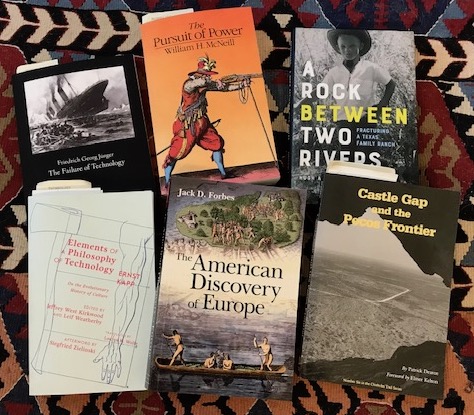
Meanwhile, I’ve been reading maybe not 17,894 books at a time, but sometimes it feels that way! A selection of current reading from the Texas Bibliothek:

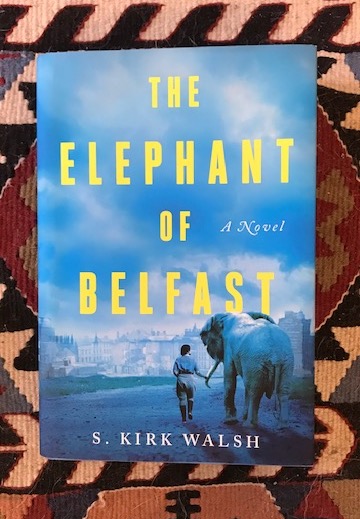
Also on my reading table: S. Kirk Walsh’s charming novel The Elephant of Belfast. I have a notion to finish it at the zoo… (by the elephant enclosure, of course…)

Cyberflanerie

Inspiring: Pat Dubrava’s translation journey.

Sergio Troncoso’s essay  “Dust to Dust,” in Texas Highways Magazine, August 2021.

Rose Mary Salum’s conversation with Sergio Troncoso about his anthology Nepantla Familias in Literal magazine.

Edward Luttwak’s “Goethe in China”in the London Review of Books— one of the strangest and most important things I’ve read this year.

Because I’ve been thinking about the clarifying power of fairy tales, I recently reread this classic one as told by Hans Christian Anderson. (What would you not venture to say that you see?)

Alberto Blanco, collage artist and one of Mexico’s finest poets, has a new website.

Alison Lurie’s memories of Edward Gorey which I found by way of a search, after I read (and so loved) Mark Dery’s bio, Born to be Posthumous.

“Miraflores at 100” in the San Antonio Botanical Garden this September 18th. More at Anne Elise Urrutia’s website, Quinta Urrutia.

Mexico’s mega-mega-MEGA bookfair, the Feria Internacional de Libros, is open for business and, notably, inviting translators. From David Unger, International Representative:
https://www.fil.com.mx/ingles/i_prof/i_traductores.asp
and  www.fil.com.mx November 27-December 5  Professional Days Nov. 29-Dec. 1. Peru will be the Guest of Honor.
(See my post about a FIL of olde—that post not yet migrated from the old platform.)

Mexican writer Araceli Ardón, whose superb story appears in my anthology Mexico: A Traveler’s Literary Companion, offers a series of free craft lectures (in Spanish) on creative writing. Check out her YouTube channel, which includes this excellent lecture on writing dialogue:

I welcome your courteous comments which, should you feel so moved, you can email to me here.

Q & A with Katherine Dunn on White Dog and 
Writing in the Digital Revolution

Who Was B. Traven? Timothy Heyman on the Triumph of Traven

Cal Newport’s Deep Work; Study Hacks Blog, and on Quitting Social Media

Q & A with Lynne Sharon Schwartz About “Crossing Borders”

BY C.M. MAYO — August 23, 2021 
UPDATE: This blog was then entitled Madam Mayo (2006-2022).

“The writers I most admired as I was starting out as a fiction writer were Henry James, Proust, Gabriel Garcia Marquez, Bruno Schulz, and Natalia Ginzburg, the great Italian writer whose essays I’ve translated, A Place to Live: Selected Essays of Natalia Ginzburg, also published by Seven Stories Press, as is the anthology.”—Lynne Sharon Schwartz

This blog posts on Mondays. Fourth Mondays of the month I devote to a Q & A with a fellow writer.

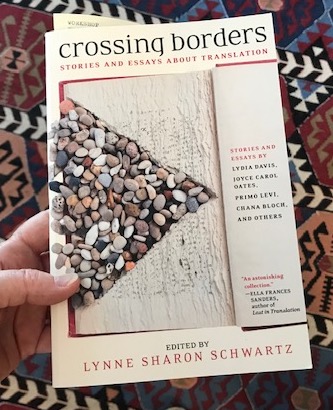
Because I am a writer and literary translator myself, Lynne Sharon Schwartz’s collection Crossing Borders: Stories and Essays About Translation popped up blinking brightly on my Super-Interesting Radar (tip o’ the fez to Ellen Prentiss Campbell). Nonetheless, Crossing Borders is a book I would warmly recommend to any and all readers who appreciate superb writing and literary adventure. I relished every one of the pieces Schwartz collected, but my personal favorites were two short stories, Michelle Hermann’s “Auslander” and Lucy Ferriss’ “The Difficulty of Translation.” Triple-extra fun: Harry Mathews’ essay “Translation and the Oulipo.”

It is a delight and an honor that, for this month’s Q & A, Lynne Sharon Schwartz agreed to answer some questions.

Lynne Sharon Schwartz

C.M. MAYO: In brief, what inspired you to edit Crossing Borders? As the editor of an anthology of literary translations myself, I am also curious to know how you found these many and varied pieces. I know it can be quite challenging to find good pieces and to secure the permissions. (Did you send out a call for submissions?) Can you talk a little about your process?

LYNNE SHARON SCHWARTZ: As a translator as well as a writer, I’ve always been interested in the translation process, and also in fiction written about translators, which is rare. I don’t recall how the idea for the anthology came to me, but it was quite a few years ago, in fact at a time when research could be done in the library with books, not solely online. So I used a large reference book organized by topic, and I simply looked through the section on Translation; that’s how I found several of the pieces. Of course I had many more than I could use, but it was fun reading them all.  Several of the stories I came across in my own personal reading, the ones by Joyce Carol Oates, Lydia Davis, Lucy Ferriss and Michael Scammell.  And sometimes one thing led to another.

I didn’t send out a call for submissions, simply worked from the listings I found, and the few I discovered on my own. Securing permissions was the most onerous part of the job.  Not that editors were unwilling, but in some cases finding the authors and editors, being referred from pillar to post, and that kind of thing.  But most of the authors and editors were pleased to have the work included, as why shouldn’t they be?

C.M. MAYO: Which of all the pieces that came your way was the biggest surprise for you?

LYNNE SHARON SCHWARTZ: I’d have to say the most surprising was the one by Svetlana Velmar-Jancovic, “Sima Street,” which I found in An Anthology of Contemporary Serbian Stories, published by the University of Pittsburgh Press.  I can’t even remember how I found it; it must have been listed in the reference book I used.  Not only is it a fine story, referring to Serbian history, but how many Americans know anything about Serbian literature?  It was an eye-opener and a thrill to track it down.

C.M. MAYO: As you worked to assemble this anthology, what are the one or two things about translation and/or about the process of assembling the anthology that most surprised you?

LYNNE SHARON SCHWARTZ: I was surprised by how many fine essays there are about translation, as well as the many stories whose protagonists are translators.  The whole process proved fascinating.  I learned a great deal by the various approaches to translation that  I found.

C.M. MAYO: Was there anything that turned out to be harder and/or easier than you expected?

LYNNE SHARON SCHWARTZ: The hardest part was tracking down the works and obtaining the permissions.

C.M. MAYO: Which writers have been the most important influences for you as a writer?

LYNNE SHARON SCHWARTZ: The writers I most admired as I was starting out as a fiction writer were Henry James, Proust, Gabriel Garcia Marquez, Bruno Schulz, and Natalia Ginzburg, the great Italian writer whose essays I’ve translated, A Place to Live: Selected Essays of Natalia Ginzburg, also published by Seven Stories Press, as is the anthology.

C.M. MAYO: Which writers are you reading now? 

LYNNE SHARON SCHWARTZ: I’ve read so much during this pandemic I can hardly recall them all. The one book I promised myself I would finish—and did— was the Letters of Nelson Mandela from prison. This was inspiring and brilliant, and seeing how he surmounted enormous difficulties helped me enormously.  After all, getting through the pandemic doesn’t compare to what Mandela endured and achieved, and it helped me put things in perspective.

C.M. MAYO: How has the Digital Revolution affected your writing? Specifically, has it become more challenging to stay focused with the siren calls of email, texting, blogs, online newspapers and magazines, social media, and such? If so, do you have some tips and tricks you might be able to share? 

LYNNE SHARON SCHWARTZ: I avoid social media as much as possible—I think it is destroying critical thinking, as well as print journalism. A lot of it is simply garbage. I do like email, though I miss getting personal letters in the mail.

C.M. MAYO: For those contemplating trying their hand at literary translation, do you have any advice?

LYNNE SHARON SCHWARTZ: Anyone trying to translate should read as much as possible in both the new language and the target language. And try to get to know the author being translated, that is by reading other works by them. I’ve always felt that my translations were successful not because of my knowledge of Italian, but rather because of my being good at writing in English!

C.M. MAYO: What’s next for you as a writer? And as a translator?

LYNNE SHARON SCHWARTZ: I’m in the middle of several things, a new novel, which seems to have stalled because of the pandemic.  I’m assembling my third collection of essays, and hoping to translate an Italian Young Adult novel set in Paris at the time of the 1893 World’s Fair.

Visit Lynne Sharon Schwartz’s website at www.lynnesharonschwartz.com

I welcome your courteous comments which, should you feel so moved, you can email to me here.

Daniel Chacón’s “Words on a Wire” Podcast Interview 
with Yours Truly About Francisco I. Madero’s Secret Book

Translating Contemporary Latin American Poets and Writers: 
Embracing, Resisting, Escaping the Magnetic Pull of the Capital

Q & A with Álvaro Santana-Acuña on Writing Ascent to Glory: How One Hundred Years of Solitude Was Written and Became a Global Classic