BY C.M. MAYO — August 16, 2021 UPDATE: This blog was then entitled Madam Mayo (2006-2022).
After two years of high school German with an excellent and demanding teacher; an intervening eon of forgetfulness (in which, while living in Mexico City, instead I learned Spanish); and then, more recently, three years of minimal but, bei Gott, daily German practice plus occasional classes, I have improved my German to the point where— Trommelwirbel und Vorhaung auf!—I now have a website in German:
For those of you who read German, I hope you’ll have a look. It is embryonic, nonetheless, it already has some content, including a fine translation by Ana-Isabel Aliaga-Buchenau of my University of Texas El Paso Centennial Lecture, “On Writing About Mexico: Secrets and Surprises,”and another fine translation by Rebecca DeWald, of my essay about Maximilian von Habsburg as a fictional character, “Tulpa Max.”
(You can find these and other works in English on my main website, www.cmmayo.com).
So why my interest in German, when most of my work is about Mexico and Texas? Both Mexico and Texas have a strong tradition of German immigration, and I expect I will have something to say about that in my work-in-progress on Far West Texas. Another motive was that, some years ago, I wrote a novel based on the true story, The Last Prince of the Mexican Empire, which is about Agustín de Iturbide y Green (1863-1925) but revolves around the childless ex-Archduke of Austria Maximilian von Habsburg, then, albeit briefly, and thanks to Napoleon III’s support, on the throne of Mexico. By means of a secret contract signed in 1865 with the Iturbide family, Maximilian made the half-American Agustín, then 2 1/2 years old, a prince of his Casa Imperial (Imperial Household). It was not an adoption as we would understand it today, but politically that’s what it amounted to for, many people, including the Iturbide family, then considered the child the heir presumptive to the Mexican throne. When I wrote the book, and so delved into many an archive, I was able to read German (although not, alas, the documents left to us in Gothic handwriting). Fortunately for me, however, the relevant documents and books were in Spanish, English, and French (which I could also read). I would like to see my novel translated into German (translated by someone more competent than myself, obviously), and when that happens, to be able to evaluate the translation, and discuss it in German. I also have on my horizon a couple of German-to-English translation projects, including a 19th century memoir, which I plan to annotate and introduce.
More than anything, however, as I know from learning Spanish, while acquiring a new language can oftentimes feel like an endless, pointless slog, in fact, if ever-so-slowly, one does begin to understand and to be able to express oneself… and eventually, the new language opens doors to endless wonders, adventures, understandings, and opportunities.
(Who’d a thunk my new favorite word would be Gartenzwergsammler?)
If you, dear reader, are interested in learning German—or any other language—I am hardly your go-to expert on rapid language acquisition—I still have a ways to go before achieving fluency— but I can tell you that what worked for me to get as far as I have was a tiny habit—an idea I took from B.J. Fogg‘s revolutionary Tiny Habits. (Fogg, by the way, is the head of Stanford University’s Behavioral Design Laboratory.) My tiny habit was—and remains—that, every day, directly after my morning coffee, I sit down and do at least 10 minutes (preferably more), and on average 30 minutes, of German. I might watch a short video on the Easy German YouTube channel and/or read aloud from a book in German (Rilke poems!), and/or do some homework exercises from a textbook and/or practice identifying genders (der, die, das) using the Seedlang app. It varies. I try to keep it fun. In addition, for improving my conversational and writing skills, I take an occasional private class, lately by Skype.
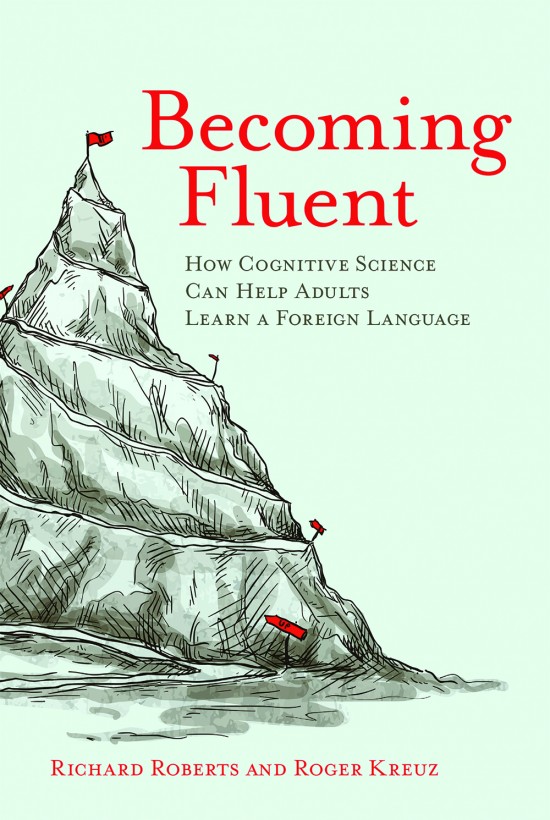
There are a number of demoralizing clichés retailed as the Wisdom of the Ages when it comes to language learning (for example, that adults cannot learn as quickly as children). A huge help in getting past all that nonsense was the book by Richard Roberts and Roger Kreuz, Becoming Fluent: How Cognitive Science Can Help Adults Learn a Foreign Language (MIT Press, 2015).
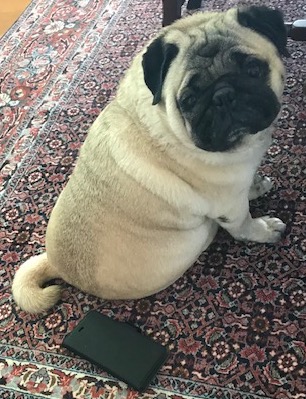
We’re leaving it right where it was. My writing assistant, who had been taking his siesta on top of it, demonstrates the concept, sort of.
The next time you find yourself in mid-conversation and about to whip out your smartphone to show something— your puppy, your nephew’s tattoo, the view from your hotel room—leave the danged thing off and instead find the words to paint the picture vividly for your listener.
Why, goodness yes, this old-fashioned technique does burn a bit o’ glucose.
When you constantly rely on the smartphone to show things, rather than describe them with words as, lo, only a decade ago, before the advent of smombiedom, people used to do, you may find that your verbal descriptive abilities tend to atrophy. For this reason— and for others—for writers, smartphones can be wicked dangerous.
Herewith, a few 5 minute description writing exercises:
“Clutter” Clutter can tell you a lot about a character. What exactly is it? And where is it? What is it blocking / obscuring? Describe the clutter of: ~ a bereaved widow who, 20 years after her husband’s death, cannot bring herself to go on a date ~ a doctoral student unable to complete his thesis ~ a yoga instructor who is addicted to Instagram ~ a chef who suffers from adult onset diabetes
“Barrel, Mirror, Telephone” In three sentences or less describe the barrel. In three sentences or less describe the mirror. Where is the telephone? Describe what happens.
“Foyer” Make a brief list of adjectives and nouns to describe each the following foyers: ~of an elderly society lady; ~of a college football player; ~of a convention center; ~of a funky city bookstore specializing in poetry; ~of a model condominium unit being marketed to hipsters.
For more exercises on writing descriptions, have a look at “Giant Golden Buddha” & 364 More Five Minute Writing Exercises, all free, right here.
I welcome your courteous comments which, should you feel so moved, you can email to me here.
This blog posts on Mondays. This year, 2021, I am dedicating the first Monday of the month to Texas Books, in which I share with you some of the more unusual and interesting books in the Texas Bibliothek, that is, my working library. Listen in any time to the related podcast series.
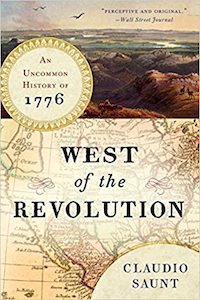
This week I’m away from the blog; herewith, from the archives, my review of a book that just might pop off the top of your head and expaaaand your mind. You can be sure, Texas history didn’t start with the Spanish, nor, for that matter, Davy Crockett growling, “You all can go to Hell and I will go to Texas.” Nothing in the conglomeration of regions we now call Texas makes a lick of sense without the broader historical context in the decades previous to its emergence as a republic in 1836, and that context would be a broad indeed: It includes the whole of the continent west of the Appalachians, innumerable intertribal conflicts and tribal migrations, European power games, as well as the impact of trends in international trade as far afield as Europe, Siberia, and China. Although it is only indirectly about Texas, I count Claudio Saunt’s West of the Revolution among the finest and most crucial works for approaching an understanding of Texas history.
WEST OF THE REVOLUTION: AN UNCOMMON HISTORY OF 1776 by Claudio Saunt W.W. Norton, 2014 pp. 283 ISBN: 978-0-393-24020-7 Review by C.M. Mayo originally published in Literal Magazine, July 14, 2018
Of late American readers have been well served by a veritable cottage industry of works about the Roman Republic and Empire, and their respective falls, and various aspects thereof, and what lessons we, with our republic (or empire, as some would have it), purportedly at the precipice of analogous fiscal, ecological, military, social and/or political Seneca Cliffs, might learn from them. History may not repeat itself any more than we can wade into the same river twice, but, of course, we can step into rivers that look more than a sight familiar. Sometimes a nicely behaved river—let’s dub it the Goth Swan—turns of a sudden into a drowning horror. Indeed, a close reading of Roman history does suggest, in blurriest outlines, some analogies with contemporary trends and conundrums. But there are perhaps more valuable insights to be parsed from our own little-known and, relatively speaking, recent history.
In West of the Revolution, Claudio Saunt, a noted scholar of early American and Native American history, spotlights nine places and formative events of 1776 that rarely raise a blip on the radar of even the most well-educated Americans. As Saunt writes in his introduction, “The American Revolution so dominates our understanding of the continent’s early history that only four digits—1776—are enough to evoke images of periwigs, quill pens, and yellowing copies of the Declaration of Independence.”
As for knowledge of what was going on west of the Appalachians in 1776, I can speak for myself, lo, many a decade ago, when I was a recent graduate of the University of Chicago. History out there west of the Appachalians had seemed to me then… like, totally vague. I’d heard of some of the tribes, those ones with interesting headgear, mainly from watching TV. Since I grew up in California, I had seen some of the Spanish missions. These had had struck me as absurdly drab and morbid. I was not Catholic, and the Spanish were well and gone, as were those Indians, I assumed. In elementary school, when we got our dose of state history, I must have been told the name of the local indigenous people—the Ohlone—but by the time I graduated from college, for 64,000 dollars, I could not have come up with it. Had I known the term terra nullius, I might have used it.
In the intervening years I had the opportunity to remedy my ignorance of California’s indigenous and mission history; perhaps the more for that, I found Saunt’s masterful historical narrative so rich and riveting.
Writes Saunt in his prologue:
“Between the continent’s far edge and the Appalachians stood thousands of towns and villages, whose millions of residents spoke diverse languages and belonged to a multitude of nations. On the eve of the War of Independence, even the most fervid of American speculators could not imagine the extraordinary events unfolding in the West.”
The events Saunt describes were indeed, extraordinary, and “in surprising ways,” he writes, “as pertinent to the twenty-first century as the better-known history of the American Revolution.”
To begin with, in 1776, the Russians, having pushed across Siberia—their Peru, their Mexico—were several years already in the Aleutian Islands, their main modus operandi, when attempts to trade beads and such failed, to seize Aleut hostages in exchange for payment in furs. The Russians were voracious for furs to sell, above all, to Beijing—fox, seal, and what was so abundant in the Aleutians, otter, what they called “soft gold.” Saunt tells us of seven Aleuts who, the better to comprehend this catastrophe that befallen them by the arrival of these strange men from the west, and having been promised the chance to see “the great Russian cities” and an audience with the Empress Catherine II, set out, along with a hold packed with pelts, on a fur trader’s ship across the Bering Sea. None of the seven Aleuts ever set eyes on a great Russian city, never mind that empress: four survived as far as grubby Irkutsk. We do not learn what they saw in Irkutsk, but Saunt tells us:
“Each year, thousands of pelts from the Aleutian Islands and millions from Siberia funneled into Irkutsk. The scale of the vast warehousing operation was out of proportion to anything the Aleuts could have imagined. In Irkutsk, the furs were sorted by quality and the best sent on to European Russia. The others [for the Chinese market] were floated across Lake Baikal to the mouth of the Selenga and then upriver to Kyakhta.”
Kyakhta, a tiny settlement on the Mongolian border, was the red-hot nexus of the global fur trade. Kyahkta not only received the furs from the west coast of North America, but, via London-St Petersburg-Arkhangelsk, from the Canadian Artic, from the Hudson Bay Company. Explains Saunt:
“Sea otter and beaver pelts, orginating in North America, had traveled in opposite directions around the world-nine thousand miles east or forty-five hundred west-only to converge at a remote outpost … From there, they were carried away on the backs of camels or in two-wheeled carts drawn by oxen, destined for Chinese royality in Beijing.”
Did those Aleuts see Kyahkta? Did they see a camel? Could they picture a Chinese princess in her fur-trimmed silk robe? Given the limits of their language’s vocabulary, not to mention what must have been the bizarrerie of crude translation from the Russian, could the Aleuts have begun to fathom the scale, the scope, the money, the power—could they have but begun to grok but an inkling of the tremendous systemic implications in all of this? (Can we?) We only know that the Aleuts were not far from Kyahkta, presumably on their way there, when they died in Irkutsk, presumably in 1776, of smallpox.
The Spanish, in 1776, were worried. Already the Russians were calling the northwest coast of North America “New Russia.” How far south would they venture? From previous exploratory expeditions the Spanish knew of the three excellent natural habors that lay north of Baja California: San Diego, Monterey, and San Francisco. If the Russians took those, they could dominate the Pacific, and so imperil the Spanish lifeline of trade with China (the famed Manila Galleons out of Acapulco, trading Mexican silver for silks, spices, and more). Meanwhile, the Franciscans, zealous to save souls for Paradise, lobbied to push north from the deserts of Baja California, to establish missions in more populated and better-watered lands along the Pacific coast. And so as the King in Madrid and his Viceroy in Mexico City commanded, in 1769, Franciscan missionaries under Father Junípero Serra, with soldiers, started moving into what they called Alta California (today the state of California).
In San Diego, the winter of 1776 was the aftermath of a bloody rebellion of the Kumeyaays. They had burned the mission, shot several soldiers full of arrows, and disemboweled one of the friars. As Saunt details, before the rebellion, and to punish and to staunch further rebellion, the Spanish beat, flogged and whipped many of their neophytes, including a Kumeyaay named Sajuil, whom they baptized as Diego, and who would die at the age of twenty-five, imprisoned and too sick to walk, two years later.
Further north, in the San Francisco Bay Area, in March of 1776, what is now Silicon Valley was the scene of first contact, in all its shock and confusion. It was also the year that Mission Dolores, now nestled in the shadows of San Francisco’s skyscrapers, was founded.
As archaeologists have discovered, in the pre-contact San Francisco Bay Area the indigenous peoples were already pushing hard against their resource limits. Saunt cites evidence of overhunted game and fish, increasing dependence on the labor-intensive acorn as a nutritional staple, widespread childhood malnutrition, and violence. After the arrival of the Spanish, with their disruptive mission system, animals and diseases, writes Saunt, “the demographic collapse that followed was swift and terrible.”
In California the missionaries’ modus operandi was to bring the Indians into the mission and punish any who tried to leave. Yet producing enough food was a challenge greater than the missionaries could manage. Bringing provisions by ship proved too expensive and risky. To support the California missions, therefore, the Spanish determined to establish an overland supply route from Santa Fe, New Mexico (which in turn, was already linked to the cities of the Mexican heartland by the Camino Real de Tierra Adentro). On July 4, 1776, a scouting expedition— known as the Domínguez-Escalante, after the two Franciscans who led it—set out from Santa Fe.
Madrid and Mexico City may have had their cathedrals and palaces, but in 1776, Santa Fe was little more than a huddle of abobes. It was also fragile, still, nearly a century later, recovering from the Pueblo Revolt of 1680, and beleaguered by the Apache and the Comanche. From Santa Fe, the Domínguez-Escalante Expedition zigzagged northwest over the high desert of the Colorado Plateau, a terra incognita that we know today as the Four Corners region, where the states of New Mexico, Colorado, Utah, and Arizona meet. The men crossed the Great Basin. They encountered Paiutes and Utes. It was a brutal march, beset with confusions, arguments, starvation and thirst. Their last guide had abandoned them when, on the edge of the snow-blanketed Great Basin, out of food, and with only the murkiest (and mistaken) notion of what still lay between them and the California coast, they turned around. They arrived back in Santa Fe on January 2, 1777—the day General George Washington withdrew, after his breakthrough victory, from Trenton, New Jersey.
The fruit of this otherwise failed Domínguez-Escalante Expedition was the map completed two years later by one of its members, the artist and cartographer Bernardo de Miera y Pacheco—a name that tinkles few bells outside the precincts of Southwestern history aficionados. But Miera’s map of wonders was a wonder in itself. If much of it was wishful guesswork and interpretations, many of them faulty, of what indigenous guides had told him, the man himself, as expert a mapmaker as might have been found in the Americas of his day, had trekked through hundreds of miles of these lands, he had seen strange peoples, strange animals and birds, and he had seen mountains, canyons, rivers, lakes, basins, and fantastic geological formations, all previously unknown to anyone other than the indigenous people.
Of the Miera map Saunt writes:
“Nearly three feet wide and more than two feet high, it charts over 175,000 square miles… Like other cartographers of the time, Miera inherited the medieval tradition of creating ‘visual encyclopedias of the world,’ and his map is bursting with illustrations, symbols, and narrative legends.”
Illustrations, for instance, of bare-breasted Paiute women, and the Pope of Rome in a carriage pulled by black lions…
The Spanish jealously guarded such intelligence; nonetheless, Miera’s map was copied and that copy consulted by Thomas Jefferson and Zebulon Pike, the early 19th century explorer. As Saunt argues, Miera’s map was “one of the most influential maps in American history,” for it “helped shape the geographic imagination” of the United States—a country born in Philadelphia in the same year of that expedition.
And that new nation was, already, in 1776, “intent on extending its sovereignty to the shores of the Pacific.”
The contest for the continent west of Santa Fe was on. There would be ferocious resistance from the peoples already there—many of them, too, fighting one another, as they had for generations, over grievances old and new, and especially for hunting and fishing grounds. Some tribes were as cousins, speaking the same language, or a related dialect; others spoke tongues and had customs as different from one another as Sardinians and Swedes, or, say, Belgians and Bulgarians.
Then, as now, North American trade with China played an indirect yet magnetic role.
And the future would be strange beyond imagining.
Having introduced the English colonists’ hunger to press past the Appalachians, Russia, Spain, the newborn United States, Aleuts, indigenous Californians, the roaring engine of the international fur trade, and a map, Saunt’s tour of 1776 then whirls us back to 1763 and across the Atlantic to the Continental Divide—the opening for the second half of his book.
Saunt refers not to the geological divide of North America, but “this enormous North American land transaction,” as if the continent were a Brobdingnagian buttercream, divvied up by so many knives and spatulas of solemn words and seals, by the European ambassadors congregated in Paris, after the Seven Years War.
France had lost to Britain what had been, in essence, a world war, involving, at various points, Austria, Saxony, Spain, Sweden and Russia for France, and for Britain, Prussia and Hanover. The Seven Years War was fought in Europe and, in proxy wars, from America to Africa, Asia, and India. The war in North America is remembered as the French and Indian War.
With spare but charmingly novelistic description, Saunt evokes 1763 in Paris: Aristocrats gambling, a ball in the Spanish ambassador’s palace, and then the meeting in the Duke of Bedford’s residence where, “under crimson draperies and a portrait of Britain’s King George III,” the treaty was signed. As for North America, in broad strokes, with the noted exception of New Orleans, Louis XV was out. His cousin, Carlos III of Spain, took the continent west of the Mississippi River; and from the east of the Mississippi to the Atlantic, dominion was now all George III’s.
Writes Saunt, “On the face of it, the claims of European monarchs to vast North American domains were absurd… Yet for local residents, the massive land transaction had very real consquences with complex and varying ramifications that took decades to unfold.”
Returning to his rhetorical device of funneling the narrative through the year 1776, Saunt proceeds to spotlight four of these “very real consequences.”
Firstly: In central Canada, with the oceanic prairielands newly claimed by the British, their Hudson Bay Company has moved inland to establish Cumberland House, a stunningly remote trading post, in winter, beset by jaw-locking cold. The Hudson Bay Company aims to defend its monopoly on beaver pelts—that monopoly quickly eroding with the influx of independent traders, many French but now with British backing.
Over the previous century, Europeans had adopted various styles of beaver-fur and beaver-felt hats, from the high-crowned and broad-brimmed Elizabethan courtier’s, to the French-style cavalier’s slouch hat with plume, then, by 1776, tricorn hats, and (this the style Benjamin Franklin favored) rustic fur caps. On the supplying side, Cree and Assiniboine trappers demanded rum, textiles, tobacco, and guns, gunpowder, and shot.
To give an idea of the dimension of the beaver trade, writes Saunt:
“Before the arrival of Europeans, it is estimated that there were between sixty million and four hundred million beaver industriously damming rivers and constructing lodges in North America. By 1900, the animals were nearly extinct.”
This near-extermination of the beaver may have had ecological consequences so huge and systemic that they may prove impossible for us, for all our modern science, to fully grasp. In building dams, Saunt explains, this large rodent becomes a “geomorphic agent.”
“The dams, made of alder, aspen, thicket, leaves, mud, stones, and other debris, can be enormous, regularly stretching 225 feet across with a thickness of six feet. One dam in Montana measured an astounding 2,300 feet. Another rose 16 feet high. In favorable environments, there may be as many as thirty dams per mile of stream, and up to 40 percent of all streams may be modified by the obstructions.”
One of many effects that “cascaded through Canada’s boreal forests in the eighteenth century” was the plaguing blackflies—for, as beaver dams collapsed, wetlands drained and water began to run swiftly. Blackflies prefer that.
Secondly: Some 800 miles south, in what is now western South Dakota, in 1776, Standing Bull arrived in the Black Hills—a sacred place and a founding event in the history of the people known as the Lakota Sioux. Standing Bull had led his people west from their homelands in what is now Minnesota. One reason they had pushed over the Missouri River and the plains was to hunt the bison; another, less understood, was that Pontiac’s War had cut off vital trade goods from the east.
By that 1763 Treaty of Paris, the British had taken the French territories around the Great Lakes and in Ohio country. The French had not governed there with absolute authority; they had long given the indigenous peoples generous scheduled gifts. In other words, they paid tribute to the Indians. Writes Saunt, “European armies were no match for native peoples in this part of the world.” The new British governor, Jeffrey Amherst, refused to give the customary gifts; this enraged the Delawares, the Miamis, Mississaugas, Ojibwas, Senecas, Shawnees, and Ottawas, and soon the British found themseves embroiled in that war named for a chief of the Ottawa.
Writes Saunt:
“Looking east from the Minnesota River, Pontiac’s War appeared a lot different than it did looking west from Manhattan Island. Where Amherst saw an unjustifiable challenge to British power launched by treacherous savages, Standing Bull’s people identified a grave threat to their access to Atlantic trade.”
Specifically, for the Lakota Sioux, what was imperiled was their annual trade fair, a fair attracting thousands of people, on occasion more than ten thousand, on the banks of the Minnesota River. With the war, who would trade with them? Without cloth, kettles, guns, powder, and shot, how would they eat, and continue to hunt? And defend themselves?
In a fascinating section, Saunt details the indigenous trade networks west of the Mississippi, “a hub-and-spoke system, formed not by airlines but by footpaths, horse trails, and river routes.” In 1776 there were three main centers: Taos in New Mexico; the Dalles, a series of cascades on the Columbia River in present-day Oregon; and on the Missouri River in what is now South Dakota. The latter, which became of increasing importance to the Sioux, was situated “at both the eastern edge of the Plains Indian horse market and the western edge of the European gun trade.”
A third consquence: In Spanish territory west of the Mississippi, in what is now central and western Missouri, “the heart of the continent,” 1776 found an empire expanding—that of the Osages, who had arrived “perhaps migrating from the Ohio River,” and with guns. By this time the Osages dominated the fur trade with St. Louis, and they were “stealing Indian women, kidnapping children, and rustling horses and mules.” European law held little sway in this frontier zone, the wild west of its day, filled with, writes Saunt, “deserters, robbers, rapists, and murderers. By trading with any and everyone, they freed native residents from Spanish dependence and underwrote Osage expansion toward the Red River.” The French, then the Spanish, could not control smuggling up, down, or across the Mississippi River any more than could the English. And the Osages, suddenly by that Treaty of Paris surrounded by new trading partners, played the one against the others, to their own advantage. At the time of the signing of the Declaration of Independence in distant Philadelphia, the Osages were about to “double the size of their empire, adding one hundred thousand square miles to their domain—a rate of expansion equal to that of the thirteen colonies and United States over the same period.”
In the nineteenth century, the Osages suffered many tribulations. Nonetheless, they retained what turned into an important asset: mineral rights on Oklahoma oil fields that to this day generate tens of millions of dollars in annual royalties. Writes Saunt, “The Osages had not forgotten the lessons of the eighteenth century.”
Fourthly, and finally, Saunt takes us to 1776 in the Deep South, and the saga of the Creeks, a people who, by that Treaty of 1763, suffered a very different fate. They had held large swaths of present-day Alabama, Florida, and Georgia. The coastal plains and pine forests were rich lands for hunting, gathering, fishing, and for growing corn. Creeks had some thirty villages each with “a central square, a council house, and numerous dwellings made of posts, wattle, and mud.” But instead of gaining trading partners, the Creeks lost their Spanish and French partners; the treaty left them surrounded by the British. Creek lands were not for the Spanish to give to the British, they said, as to the wind; British settlers began to move in, making it increasingly difficult for Creeks to hunt deer, the skins of which they traded for cloth, beads, and guns. And here, too, while the French and Spanish had given them gifts, the British refused. Worse, the British began trading guns to the Creeks’ enemies, the Choctaws and Chickasaws. Then British Georgia and Florida embargoed the Creeks. In desperation the Creeks attempted to turn to the Spanish: From the Florida coast, a group of Creeks sailed on a fishing boat to Havana, Cuba.
By 1776 Creek embassies had appeared in Havana at least nineteen times. What the Creeks could offer the Spanish was dried meat; what they wanted from the Spanish were, urgently, guns, powder, and shot. But the Spanish gave them only “stacks of hats, mirrors, and thread and professions of ‘paternal affection.'” Then the war between the British and their American colonies caused Creek trade opportunities to further shrink.
Things might have been different. As Saunt explains, Cuba was then a burgeoning slave economy producing sugarcane and aguardiente; it needed more food, and the Creeks could have helped provide that. In 1776 in a drunken fight over a woman, a Cuban boatman stabbed three of his Creek passengers. In fear of revenge, Cuban boatmen steered clear of the Creeks on the Florida coast. Marooned economically and politically, the Creeks continued losing ground. Their territories were swiftly encroached upon by slave-worked plantations of rice, tobacco, sugar, and cotton. In the next century, along wth several other tribes, the Creeks would be forcibly removed, walking the Trail of Tears to a reservation in Oklahoma.
Intriguingly, Saunt asks:
“What if the Creeks had become purveyors to the fastest-growing slave colony in the New World? Would they have had the economic clout to avoid removal in the 1830s and retain their homelands? Would their nation have become a part of the Confederacy in some form, perhaps as a member state that shared the Old South’s deep investment in slavery? How might the South and American history have been transformed?”
In the United States, for the most part, our pre-Revolutionary history west of the Appalachians has been a matter left to academic specialists and local and Indian history enthusiasts. Saunt’s West of the Revolution is an at-once engaging and compelling corrective, and more: these nine places and formative events suggest fresh ways of looking at our own times, and at the power by which trade, migration, technological change, ecological change, epidemics, and the gusts of fashion and sheer, crazy luck may impel us, or, beneath our full awareness, subtly nudge us, in strange directions. Above all, West of Revolution allows us to begin to perceive how these peoples of our own past were, to quote Saunt, “entangled in a web of environmental, political, and economic relationships that they could neither fully control nor completely understand”—as are we. Writes Saunt, “we are unavoidably and always interdependent.”
And to suggest that near-translucent but entangling mega-web, I conclude this review with one web of a question. Do we know, precisely, what has been harvested from the earth, and from where, and by whom, and in what way, and on what terms, for our smartphones?
I welcome your courteous comments which, should you feel so moved, you can email to me here.
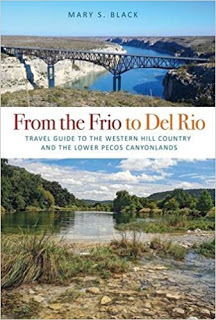
“Each year, more than two million visitors enjoy the attractions of the Western Hill Country, with Uvalde as its portal, and the lower Pecos River canyonlands, which stretch roughly along US 90 from Brackettville, through Del Rio, and on to the west. Amistad National Recreation Area, the Judge Roy Bean Visitors’ Center and Botanical Garden, Seminole Canyon State Park, and the Briscoe-Garner Museum in Uvalde, along with ghost towns, ancient rock art, sweeping vistas, and unique flora and fauna, are just a few of the features that make this distinctive section of the Lone Star State an enticing destination.
“Now, veteran writer, blogger, and educator Mary S. Black serves up the best of this region’s special adventures and secret treasures. From the Frio to Del Rio is chock-full of helpful maps, colorful photography, and tips on where to stay, what to do, and how to get there. In addition there are details for 10 scenic routes, 3 historic forts and 7 state parks and other recreation areas.”
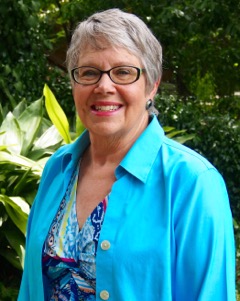
Mary S. Black
C.M. MAYO: What inspired you to write this book?
MARY S. BLACK: I think what inspired me was the land itself, and the history. The Lower Pecos Canyonlands are not well known by most people, but the landscape is incredibly majestic and unexpected. You can be driving 70 miles per hour down the highway through the desert, when, wham, a huge canyon veers off to the left like a sudden tear in the earth.
These canyons were inhabited by human beings for thousands of years. They lived off the land and made paintings on the canyon walls that illustrate their gods and belief systems. Over 300 of these paintings still exist, and you can visit some of them. They are a treasure of human culture, and I hope more people will learn to value them as something important for us to save. The people who settled this area historically were a diverse bunch with a lot of gumption. Do people know that word anymore? I guess in modern language, we might say they had a lot of guts.
C.M. MAYO: In your view, what is the most underrated place in this region?
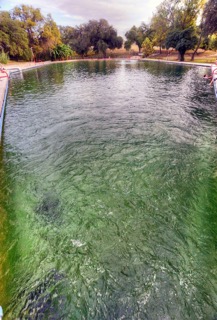
MARY S. BLACK: If I have to pick only one, I’ll say Las Moras Springs Pool at Ft. Clark in Brackettville. I’m always looking for great swimming holes. Las Moras Springs Pool is the third largest spring-fed swimming pool in Texas. Crystal clear water at a year-round temperature of about 70 degrees comes into the pool from a strongly flowing spring, yet very few people swim there because they don’t know how to get access.
The pool is located on Ft. Clark, and old U.S. Army fort originally built in 1849. You can get a day-pass for $5.00 at the guard house to enter the fort, enjoy the pool or play golf on either of two gold courses, and look at all the old stone buildings that remain from when the place was an active Army fort. There is also a really interesting museum there that is open on Saturdays.
C.M. MAYO: Which is your favorite place?
MARY S. BLACK: Hands down, the White Shaman Preserve. The best studied of all the ancient murals is located there. This is a polychrome painting about 25 feet long and 13 feet high done on a rock wall overlooking the Pecos River. This painting tells a story about creation and how the sun was born, according to Dr. Carolyn Boyd. You can visit the preserve on Saturdays at noon if you make a reservation online through the Witte Museum. Tours are two-three hours long, and require a fairly strenuous hike down a canyon to a rockshelter, then back up. But to be up there, to see the mural up close and in person, to look out over the river and imagine the people who made this painting, can change your whole perspective. It’s that powerful.
C.M. MAYO: Your favorite seasonal or annual event?
MARY S. BLACK: I have two: autumn color near Lost Maples State Natural Area near Vanderpool, and tubing in the cold Frio river in summer. Both are unique experiences in Texas and shouldn’t be missed. An isolated stand of bigtooth maple turns orange and red in Sabinal Canyon in late November. And swimming in the Frio at Garner State Park is like heaven on a hot day.
C.M. MAYO: What surprised you in researching this book?
MARY S. BLACK: How fascinating the area really is. The more I learned, the more I wanted to know. The region has seven state parks and natural areas, nine ghost towns, three historic Army forts, and many scenic drives. But the coolest part was reading about all the crazy things that have happened there, like train robberies and early airplane adventures. And Indian battles. When settlers from the US and Mexico started coming in after the Civil War, the native Apaches and Comanches were fighting for their lives. And of course the U.S. Army was trying to drive them out. It gets complicated, but there were many interesting people involved in all this, like the Black Seminole Indian Scouts at Ft. Clark, and others. One of the first settlers in the Nueces River valley was a woman named Jerusha Sanchez, who came in the 1860s. Later a widow named Elizabeth Hill and her three sons also pioneered in the area. Blacks, women, immigrants from Italy, Mexico, Germany, and other places, and Native Americans made the history what it is.
C.M. MAYO: You offer an excellent bibliography for further reading. If you could recommend only three of these books, which would they be?
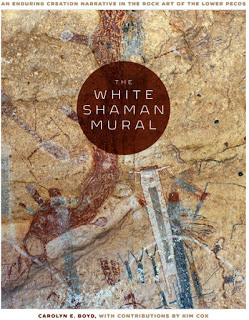
MARY S. BLACK: Hmm, they are so different, let me see. First I think Carolyn Boyd’s new book, which is called simply The White Shaman Mural, just published by University of Texas Press in 2016. She details her 25 years of research on the painting in this book and explains how she cracked the code on what it means, an amazing accomplishment.
Then I nominate Judge Roy Bean Country by Jack Skiles, published in 1996, which is a compilation of local stories of life in the Lower Pecos. The Skiles family has been ranching in the area for over 75 years and can tell stories about mountain lions and smugglers that will make you faint.
Finally, one I found fascinating was The Newton Boys: Portrait of an Outlaw Gang by Willis and Joe Newton as told to Claude Stanush, published in 1994. It tells how they became train robbers and learned to blow bank safes with nitroglycerin, which they did in Texas and the Midwest all through the 1920s. By the time they were captured, they had stolen more money than all other outlaws at the time combined.
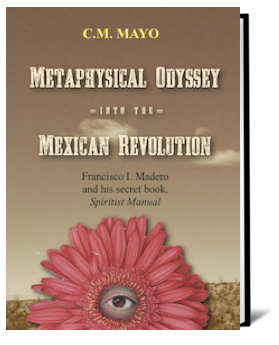
Delighted to note that earlier this month Jeffrey Mishlove’s interview (in three parts) with me about Metaphysical Odyssey into the Mexican Revolution: Francisco I. Madero and His Secret Book Spiritist Manual made his “classic reboot” list and for some days it was at the top of his YouTube channel—an honor indeed. For decades, first with his TV show “Thinking Allowed” and now with his YouTube channel “New Thinking Allowed,” Mishlove has been broadcasting his interviews with some of the most innovative and accomplished researchers and authors of works exploring consciousness.
Apropos of the subject of this interview and a just-before-taping conversation with Mishlove about his own research, I went home and directly wrote a review of the then recently published Super Natural by Whitley Strieber and Jeffrey J. Kripal. What could this possibly have to do with Mishlove and Madero? Read on.
SUPER NATURAL: A NEW VISION OF THE UNEXPLAINED by Whitley Strieber and Jeffrey J. Kripal Penguin Tarcher, 2015 ISBN 9781101982327 Review originally published in Literal Magazine, June 5, 2015
This book is a flying ax of apocalypse. But whoa, let’s first bring this identified flying thoughtform to Planet Earth: to Texas; Houston; Rice University; Department of Religion; and finally, the office of the J. Newton Rayzor Chair in Philosophy and Religious Thought, Jeffrey J. Kripal.
Professor Kripal, who describes his work as comparing “fantastic states of mind and energy and their symbolic expressions in human history, literature, religion, and art,” is one of two authors, alternating chapters, who have launched this catch-it-if-you-can metaphysical ax. The other is Whitley Strieber, a Texan internationally famous for his horror fiction and series of memoirs beginning with Communion: A True Story, the 1987 best-seller about his encounters with UFOs and entities he calls “the visitors.” Whether you indulge in Strieber’s shiver-worthy writings or not, you’ve no doubt seen the image of a “visitor” from the cover of Communion everywhere from the movies to cartoons: a bulbous rubber-like head with darkly liquid almond-shaped eyes.
If you’ve read this far and are tempted to stop, I urge you to take a breath—a bold breath. Should you still feel bristling hostility, as many educated readers do at the mere mention of such subjects as UFOs and “the visitors,” that’s normal. Soldier through the discomfort, however, and you may be able to open a door from the comfy cell of mechanistic materialism onto vast, if vertiginous vistas of reality itself—and not to the supernatural but, as Kripal and Strieber would have it, the super natural.
That door does not open with a key but with what Kripal terms a cut—as provided by Immanuel Kant, that most emminent of bewigged German philosophers. More about the “Kantian cut” in a moment.
Never mind the remarkable contents of The Super Natural, the fact that two such authors would write a book together is remarkable in the extreme. Strieber, while building a passionate following for Communion, his many other works and esoteric podcast, “Dreamland,” has also attracted widespread ridicule for his memoirs which go beyond retailing his perceptions of his abductions by “the visitors” to adventures, both in and out of body, with orbs, hair-raising magnetic fields, blue frog-faced trolls, and the dead. Nonetheless, Kripal, as one steeped in the literature of the world’s religions, identifies Strieber’s Communion as “a piece of modern erotic mystical literature,” and indeed, nothing less than a litmus test for his own academic field:
“[i]f we, as scholars of religion, cannot take this text seriously, if we cannot interpret it in some satisfying fashion, if we cannot make some sense of this man’s honest descriptions of his traumatic, transcendent experiences, then we have no business trying to understand his spiritual ancestors in the historical record. We either put up here, or we shut up there. I decided to put up.”
Now to the Kantian cut. It is to distinguish between the appearances of things and what may actually lie behind them. In making that cut, we recognize that while our physical senses provide us with essential survival-oriented information, in no way do they even begin to convey to our consciousness awareness the totality of reality. As Kripal writes, this cut “is a very reasonable and appropriate response to our actual situation in the cosmos.” Furthermore, “Once one makes such a cut, one can, in principle, take any religious experience or mythical world seriously and sympathetically without adopting any particular interpretation of it, much as one suspends disbelief to enjoy a good novel or watch a science-fiction movie.”
In other words, we don’t need to accept nor reject Strieber’s reports of UFOs and “the visitors”— yes, we can keep the lids on our coconuts while adopting the stance of radical empiricism in considering large-scale quantum phenomena!
Put yet another way: if we can simply look at such experiences as Strieber’s, sit with them, consider them “seriously and sympathetically, without adopting any particular interpretation,” we can then, to quote Kripal again, “begin to study their patterns, histories, narrative structures, sexual dimensions, and philosophical implications.” The Kantian cut thus gives us the power to then spiral up to a broader, richer view. It is an astonishing power.
I know precisely what Kripal means— not that I have any stories about “the visitors”; my encounter was with a mystical text. Nearly a decade ago, in the Francisco I. Madero archive in Mexico’s National Palace, I happened upon his secret book, Manual espírita (Spiritist Manual).
Given that Madero was the leader of Mexico’s 1910 Revolution— the first major Revolution of the 20th century and a crucible of modern Mexico— and that he served as President of Mexico from 1911 to 1913, it struck me like thunder that, after two decades of living in and writing about Mexico, I had not known that Madero was a Spiritist medium. I was entirely unfamiliar with his Manual espírita, which, as I soon learned, Madero began writing in 1909, finished the following year—the same year he launched the Revolution—then, in 1911, the year he assumed the presidency, he printed 5,000 copies under his pseudonym “Bhima.”
Manual espírita, or Spiritist Manual, is an evangelical work proclaiming that, in my words summarizing Madero’s:
“We are not our physical body; we are spirits, and as such we are immortal and we are destined, lifetime by lifetime, not by any ritual intermediated by clerics, but by freely chosen good works, to evolve into ever higher levels of consciousness and so return to God.”
An offshoot of American Spiritualism, Spiritism was codified by French educator Hippolyte Léon Denizard Rivail, aka Allan Kardec, and his disciples in the second half of the nineteenth century. Madero, scion of a wealthy family from Coahuila in northern Mexico, was a student in France in 1891 when he encountered Kardec’s magazine and books.
According to Spiritism, because we are spirits it follows that we can communicate with other spirits, embodied or not. Spiritism is a religion but also the most modern of modern science, Kardec argued; as a scientist might peer through a microscope to perceive the detail in a leaf, so a scientist could employ a medium to learn from the spirit world.
Both in France and on his return to Mexico, Madero met with a circle of fellow Spiritists to develop his psychic abilities, in particular, for receiving communications from the dead by means of automatic writing. In 1907, a militant spirit named “José” began to advise Madero on writing the book that would serve as his political platform: La sucessión presidencial en 1910 (The Presidential Succesion of 1910), a work well-known to scholars of the 1910 Revolution. Then, so we learn from Madero’s mediumnistic notebook, José informed Madero that he would write Manual espírita, a work “which will cause an even greater impression.”
By the time I began to leaf through Manual espírita in Madero’s archive nearly a century later, quite the opposite seemed to have been its destiny.
It turns out that there are, albeit astonishingly few, Mexican historians who have written in some depth and seriousness about Madero’s Spiritism: Manuel Guerra de Luna, Enrique Krauze, Alejandro Rosas Robles, and Yolia Tortolero Cervantes. Although, at the time I happened upon Manual espírita in the archive, it was nigh impossible to buy a copy, Alejandro Rosas Robles had included it in his 10 volume compilation, Obras completas de Francisco Ignacio Madero, published in 2000. I should also note the esteemed Mexican novelist, Ignacio Solares, whose Madero, el otro delved, and knowingly, into his esoteric philosophies.
All that said, in Mexico, where Madero has the stature of an Abraham Lincoln, celebrated in every textbook of national history, and the Revolution he proclaimed in his Plan de San Luis Potosí commemorated every November 20th, Bhima’s Manual espírita lay murky leagues below the cultural radar, and the nature and historical and philosophical context of its contents were terra incognita to most historians of the Mexican Revolution. It had never been translated.
I was a translator—and one keenly aware of how little Mexican writing sees publication in English. And I knew enough to know that, whatever its contents, the fact that Francisco I. Madero had written this book gave it importance, for it would illuminate the character and personal and political philosophies of the leader of the 1910 Revolution. It bears repeating that Madero took the trouble to write it in the same year he declared and led that Revolution, and he published it in 1911, the year of his nation-wide campaign that resulted in his election to the presidency of the Republic. Whatever this book contained, it must have been exceedingly important to him.
From the first page of my self-appointed task, however, my instinct was to wince. Nervous laughter, eye-rolling… It was obvious to me that most educated readers, including most historians of Mexico, would regard Madero’s Spiritist Manual with puckerlips of disgust.
What had I taken on?
Madero was murdered in the coup d’etat of 1913. As I read deeper into that terrible episode, I was flummoxed to learn from U.S. Ambassador Henry Lane Wilson’s memoir that, after arresting President Madero, General Victoriano Huerta sent his first communication to the U.S. Legation, asking the ambassador, should he lock Madero in the lunatic asylum?
I soon realized that to merely translate this century-old book would be a disservice not only to its author, but to myself and to the reader—the latter, as were those archvillians of 1913, General Huerta and Ambassador Wilson, presumably as unlettered as I was on the history of metaphysical religion and subjects as various as the afterlife, angels, astral planes, automatic writing, bilocation, and the teachings of Lord Krishna in the Hindu wisdom book, the Bhagavad-Gita.
What Spiritist Manual needed was a book-length introduction, a framing context for English language readers who know little or nothing of Madero, and/or of Mexican history, and, most crucially, of the metaphysical philosophies Madero had embraced and espoused.
And so, beginning with Kardec, I began a marathon of reading. There was much to glean from the works of the aforementioned handful of Mexican historians; also, to my happy surprise, from recent scholarly works about nineteenth and twentieth century metaphysical religion, parapsychology, and occult traditions— serious considerations of what many historians still dismiss, as Dame Frances Yates, leading scholar of the esoteric traditions of the Renaissance, archly dismissed nineteenth and twentieth century Rosicrucians as “below the notice of the serious historian.” These works include Catherine Albanese’s A Republic of Mind & Spirit: A Cultural History of American Metaphysical Religion (Yale University Press); Joscelyn Godwin’s The Theosophical Enlightenment (State University of New York Press); John Warne Monroe’s Laboratories of Faith: Mesmerism, Spiritism and Occultism in Modern France(Cornell University Press); Janet Oppenheim’s The Other World: Spiritualism and Psychical Research in England, 1850-1914 (Cambridge University Press), and, neither last nor least, Jeffrey J. Kripal’s Authors of the Impossible: The Paranormal and the Sacred (University of Chicago Press).
In addition, I combed through Madero’s personal library, which is preserved in the Centro de Estudios de Historia de México in Mexico City. As I could now appreciate, Madero had assembled a large and sophisticated collection of turn-of-the-last century European and Anglo-American esoterica, including two English translations and J. Roviralta Borrell’s Spanish translation of the Bhagavad-Gita, the latter heavily annotated in Madero’s own handwriting.
Thus: Metaphysical Odyssey into the Mexican Revolution: Francisco I. Madero and His Secret Book, Spiritist Manual. The odyssey I recount is not only Madero’s, but my own into that vast and vertiginous view made possible by my having made, and inviting the reader to make, the Kantian cut— although I did not use that term. I cracked open the door to greater understanding, not by embracing, nor by rejecting Madero’s philosophies and assertions, but by accepting—simply accepting— that what I understand to be reality and what it actually is are not necessarily the same thing because I, like any human being, with wondrous yet rangebound senses and brain, cannot comprehend the fullness and every last quarky detail of the cosmos. What we know is a nano-slice, if that.
In other words, we don’t have to accept nor reject Madero’s ideas—yes, we can keep the lid on our coconuts while seriously considering a whole lot of super freaky stuff!
Although Madero’s Spiritist Manual is radically different in its content and tone from Strieber’s Communion, like that mystical text, if encountered with historical and philosophical context and with the power of the “Kantian cut,” considering it “seriously and sympathetically, without adopting any particular interpretation” can open up vistas. For one thing, Madero’s Spiritist Manual makes Mexico’s 1910 Revolution look glitteringly uncanny, like a prism ferried from the back of a closet to a window. Or, shall we say, to an open door.
To return to Strieber and Kripal’s The Super Natural, writes Kripal: “History is not what we think it is.”
Writes Strieber: “[T]his world is not what it seems, and we do not know what it is, only that we are in it… I am reporting perceptions, and what that means.”
Was Madero really communicating with spirits of the dead? Well, that’s one hypothesis.
Many people know Strieber as “that guy who wrote about being abducted by extraterrestrials.” In fact, Strieber reports his perceptions of his experiences, but as to what they actually are, he says, “I am a wanderer, lost in a forest of hypotheses.” Strieber also echoes Kripal in arguing that, “it is not necessary to believe in such things as flying saucers, aliens, ghosts, and other unexplained phenomena in order to study them.”
But to study such things without puckerlips, and all brain cells firing, one must make that Kantian cut—and one needs courage to persist, for that Kantian cut must be made again and again in the face of our inclination towards easy polarities, to either believe or, more commonly, reject, bristling with hostility or scornful laughter.
As Kripal puts it, one must “learn to live with paradox, to sit with the question.”
But again, this sitting in the gray zone of maybes, this repeated Kantian cutting—it becomes a kind of mowing—takes nerve, both intellectual and social. It can prove hellishly uncomfortable.
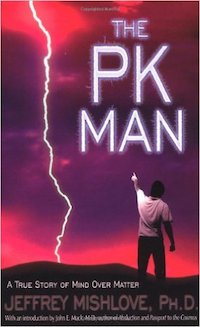
Elegantly written and engaging as it is, it takes nerve to read The Super Natural—not to mention Strieber’s Communion. However, in my experience of reading for my book about Madero’s book, it gets easier. So much ectoplasm, so many floating trumpets, fairies and tulpas, psychic surgery… ho hum! It seemed I could tackle anything, whether a purported download from the Akashic records of Jiddu Kirshnamurti’s incarnations wending back to 22,662 B.C. (C.W. Leadbeater’s Lives of Alcyone, inscribed by its Spanish translator to Mrs. Madero), Joan of Arc’s autobiography (as channelled by medium Léon Denis, one of Madero’s favorite authors) or, for instance, a modern parapsychologist’s story about a sociopathic psychic named Ted Owens and his hyperdimensional rain-making confreres “Twitter” and “Tweeter” (Jeffrey Mishlove’s The P.K. Man, which I picked up for late 20th century context).
Speaking of Jeffrey Mishlove’s The P.K. Man, I am not sure I could have appreciated Kripal and Strieber’s The Super Natural so much as I do without having read that first. On its face, like Strieber’s Communion, or Madero’s Spiritist Manual, The P.K. Man would no doubt strike most readers as outrageous, indigestible bizarrerie. Yet having read The P.K. Man twice now, I concur with Harvard University Medical School Professor John W. Mack, who writes in that book’s forward, “Mishlove’s powerful true story may greatly help to clear the way for new creative human visions and achievements.”
Mishlove concludes his story of mind over matter: “We must move toward honest, authentic integration of the depths within us and the facts before us.” He holds the flag high. Yet Mishlove confesses, it took him more than two decades to summon the courage to publish The P.K. Man.
I myself procrastinated mightily in translating and writing about Madero’s Spiritist Manual. And I had assumed that I was at the end of that years’-long road, with my book and the translation edited, formatted, and an index prepared, when in an antiquarian bookstore in Mexico City, I chanced upon Una ventana al mundo invisible (A Window onto the Invisible World). Published in 1960, this exceptionally rare book contains the detailed records of séances performed by ex-President Plutarco Elías Calles, other prominent Mexicans, and a medium named Luís Martínez, from 1940 to 1952 for the Instituto Mexicano de Investigaciones Síquicas (IMIS). Its dust jacket features a “spirit photograph” of “Master Amajur,” a 10th century astronomer who had much to say and many a rose petal to materialize in many a dark night’s séance. After dipping into those spooky accounts, I could not sleep, and my manuscript and galleys, which needed to be modified in light of that book, sat untouched on a shelf for more than a month.
The first sentence Kripal writes in his own first chapter of The Super Natural is, “I am afraid of this book.”
When we make the Kantian cut, we can consider stories that might seem not only ludicrous, but frightening—perchance beyond frightening. Beyond one’s world view by a galaxy.
For instance: As Strieber writes in The Super Natural, after publishing Communion, he started receiving letters from readers, “at first by the hundreds, then the thousands, then a great cataract of letters, easily ten thousand a month, from all over the world.” They too had seen the haunting face on the cover of Communion. Writes Strieber, “I was deeply moved, not to say shocked, to see that I had uncovered a human experience of vast size that was completely hidden.”
And for instance: that Kripal himself, while in Calcutta during the Kali Puja festivities, experienced an explosive out of- and in-body state that he believes resonanted with some of Strieber’s—and thousands of others who gave similar testimony. And: Kripal finds striking correspondences between American UFO abduction literature and—who’dathunk?—Indian Tantric traditions.
And, finally, for instance: As his library and voluminous correspondence attest, Francisco I. Madero did not come up with his ideas by his lonesome; Spiritist Manual is not evidence of schizophrenia, but a unique synthesis of what was in his time in the West the cutting edge of a well-established literature of Spiritist / Spiritualist, Buddhist, Catholic, Hindu, and occult philosophies.
But if, as Kripal and Strieber, Mishlove, and Madero all suggest, we seriously consider these stories of anomalous phenomena—communication with disembodied consciousnesses, out-of-body travel, psychokinesis, telepathy, “the visitors,” and so on and so forth, how do we live our lives with dignity while entertaining the notion that, say, someone, anyone, might read our thoughts, game the financial markets, or, say, impel a pilot, of a sudden, to crash his plane? And how do we avoid sinking into primitive credulities, viscious paranoias, and, ultimately, barbarities such as the burning alive of witches?
I think I mentioned, it can get uncomfortable.
Kripal writes, “many of the things that we are constantly told are impossible are in fact not only possible but also the whispered secrets of what we are, where we are, and why we are here.” But neither are Kripal and Strieber saying, believe this or believe that. On the contrary; Kripal says, make that cut. “Do not believe what you believe.”
But whatever you believe, or not, that is a story. And stories are what make us human. And being human— for that matter, being able to read and write books, and so catch and hurl packages of thought from across one axis of time and space to multiple others— is both super and natural. As Kripal and Strieber insist: super natural.
I welcome your courteous comments which, should you feel so moved, you can email to me here.
Back in 2009 I wrote this introduction to an article for the online edition of Foreword Magazine:
With several books published, including a big fat historical novel forthcoming this May, it might seem that I just karate-chop my way through any writer’s block. In fact, for me as well as for many more prolific writers, it’s a daily struggle. Writer’s block can have a multitude of sources, but one that is almost universal is disorganization. It’s difficult to start on chapter 15 when you can’t find your notes— or when you’re facing such a Himalaya of notes that, well, to say the same thing, you’d have to spend an eon sorting it all out before you could sit down to write. I don’t think we need Dr. Freud to analyze this one. It’s a pedestrian problem with pedestrian solutions. Here are mine.
I’d link to that article but it’s gone dark and, in the many years of the meantime, I’ve modified and improved my list of tools. Right now I’m working on a nonfiction book which necessitates a working library and extensive filing system; in this post however I’m spotlighting the subset of tools I also find useful—and recommend— for writing a novel. (And, in case you were wondering, yes, I will be working on another novel soon enough.)
1. The logbook
This is my witness, my “shoulder-to-cry-on,” my champion, and if nothing else, once I’ve finished, an illuminating record.
2. The Kanban
The basic idea of the Kanban is here. My system is very simple. I tape together two file folders so that, when opened, they fold out to one ridiculously large rectangle with three sections. I use Scotch tape to tape it to the window behind my desk. The three sections are: 1— tasks I need to do; 2—tasks I am working on now (2 tasks at most); 3—tasks I have accomplished
Each task has its own Post-It. I move the individual Post-Its from one section of the Kanban to the next in accord with my progress.
3.A small notebook and / or 1/4″ stack of blank index cards
These I always carry with me to jot down ideas, words, overheard dialogue, and sometimes even drafts of paragraphs or outlines of plots. By writing things down, I don’t lose them and also— this is subtle, but crucial— by keeping pen and paper with me at all times, I signal to my “artist self” that I am ready to write.
Yes, one can use a smartphone to capture things when out and about, but think about it for, like, a nanosecond. When you are trying to write a book, should you be picking up your smartphone / aka portal to the world wide web of hyper-palatable distractions? For many well-considered reasons I purposely and rigorously minimize my smartphone use.
4. Plenty of Post-Its
I buy the canary-yellow 1 / 12″ x 2 ” blocks in bulk. I use them for the same purpose as the notebook and blank cards (and I sometimes carry these in my purse as well). Post-Its have the added advantage that I can stick them on drafts, other notes, and inside the covers of the books I’m reading, to note any vocabulary or syntax I’d like to use in my own writing. They also work beautifully for Kanbans.
It’s important to keep these organized and at-hand. I keep mine gathered together on a tray— having them all together makes it easier to find them and easier move.
6.Pens, Colored Pens, and Big Fat Yellow Highlighters
These require their own a special mug.
7. Index Cards Filesaka Recipe Card Holders
This is where the index cards go. Organization ongoing…
8.A Filing Cabinet (or 10)and Hanging Files
The more filing cabinets the better, but if you don’t have the room, filing tubs (plastic boxes with handles) and “banker’s boxes,” inexpensive cardboard boxes for files, work well. It really is astonishing how much paperwork flies around a book. There is the book research itself, but also all that goes into its physical production and marketing. That would be another post. Trust me, make sure you have the filing space, otherwise piles of unfiled papers will bottleneck whatever it is you’re aiming to do.
9.A Labeler Typewriter
The benefits of using tabbed hanging folders I understood, but a labeler? What was wrong with neatly hand lettering a label, for heaven’s sake? But when I finally took David Allen’s advice in Getting Things Done and started using a labeler — mine is a Brother PT-18R— I realized what I had was— I’m not kidding— a mental health tool. Chapter 4? Labeled. Notes on Minor Characters? Labeled. Very Zen.
UPDATE 2021: Forget the labeler, which requires cartridge refills, a battery and/or electricity. A few years ago I bought myself a restored Hermes 3000 typewriter and I use that for making labels. (It’s also handy for typing up letters and manuscripts, among other things, and especially when I want to do so definitively away from the Internet.)
For any files that get too fat and filled with too many Post-Its and index cards. When I’m ready to sort through it all, there it is. Meanwhile, the envelope gets labeled.
11. Some Way to Physically Grok the Whole—or at Least Sizable Chunks of the whole
Originally I had recommended cork boards and tacks. I still think that can be a good idea, however, my current office has no place to nail up cork boards. On the other hand, I have four large windows, so I can just tape up manuscript pages to those. I have also seen some writers string washline from one end of their office to the other, and pin up pages with clothespins. You could also array your pages flat on a dining room table. Whatever works.
12. Manuscript Box
Or were you planning to lose it in a pile? Felted with dust? Blown about in a breeze from the window? Eaten by the dog?
13. Limboland: A Place, Albeit Temporary, for Discarded Pages and Old Drafts
The wastepaper basket is not a good place to stuff your old drafts and cuts, because what if you change your mind? On the other hand, if you hold onto every precious word you’ve written, you’ll never feel confident making the surgical incisions, never mind the blood-spurting amputations that, well, you’ll probably have to make if you want your book to be any good. In other words, don’t toss those pages, don’t keep those pages, park them in Limboland, that is, out of sight, out of mind—but retrievable. I find it helps me as I am writing to know that it’s all still there. I find might dig around in there once, maybe twice. Once the book is published, if I don’t have space for these old drafts, then I make a fire to grill some smores.
Yes, you could leave digital versions on your computer. I don’t. Why? That would be another post, but suffice to say, there are immense benefits to seeing a draft printed out.
For my last book, Limboland was a series of cardboard bankers boxes. For my current work-in-progress, it’s the bottom shelf of a voluminous old cabinet down in the basement. What works for you? Watch out, though, if you stuff the pages under your bed your dreams might get squirrely.
This blog posts on Mondays. This year, 2021, I am dedicating the first Monday of the month to Texas Books, in which I share with you some of the more unusual and interesting books in the Texas Bibliothek, that is, my working library. Listen in any time to the related podcast series.
The plan for this first Monday of the month was to post Part III of my series on Cabeza de Vaca books (for Parts I and II click here and here). Force majeure! Look for it later. In lieu of that, herewith, from the archives, my review of a mind-bending masterpiece, Pekka Hämäläinen’s The Comanche Empire.
THE COMANCHE EMPIRE by Pekka Hämäläinen Yale University, 2008 ISBN 978-0-300-15117-6 Review originally published in Marfa Mondays Blog, August 1, 2016
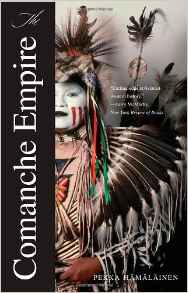
The cover of Pekka Hämäläinen’s The Comanche Empire, of a ghost-white warrior with a trio of blood-red slashes down his cheek, is as arresting as the argument that, as it opens, the Comanches’ was “an American empire that, according to conventional histories, did not exist.”
In the United States public discourse conflates wildly heterogenous groups into easy categories— Native American, white, black, and so on and so forth— and then, with school board-approved narratives as mortar, we construct colossal political edifices. In their shadows, alas, many of us are blind to the complexities in our society and history. The complexities are riotous. And when we shine a light on but one of them— as Finnish historian Hämäläinen has in this brilliant study of Comanche hegemony— suddenly our easy categories and well-worn narratives may look strange, deeply wrong.
As those of you who follow this blog well know, I am at work on a book about Far West Texas, that is, Texas west of the Pecos River. Anyone who heads out there, especially to the remote Big Bend, hears about Comanches, e.g., they crossed the Río Grande here, they watered their horses there. But the Comanches, an equestrian Plains people who hunted the buffalo, were latecomers to the Trans-Pecos. They did not settle there; they trekked through it on the Comanche Trail (more aptly, network of trails) on their way to raid in northern Mexico. They returned driving immense herds of horses and kidnapped Apache and Mexican women and children in tow, for markets up north around Taos, New Mexico, and Big Timbers on the Arkansas, which garnered them metal tools, cooking pots, corn and other carbohydrates, textiles, and above all, guns and ammunition.
The Comanche were raiding south of the Río Grande as early as the 1770s, but their large-scale raiding in northern Mexico commenced in the 1820s, plunging deep into Chihuahua, Coahuila, Tamaulipas, Durango, Zacatecas and, in the 1840s, as far as Jalisco and the major central market and manufacturing city of Querétaro. This systematic “mass violence” which left the northern realm of the Mexican economy crippled and its people demoralized, turned it into what Hämäläinen terms “an extension of Greater Comanchería.” Hence, by the late 1840s, when the U.S. Army invaded Mexico, what they were really invading was, to quote Hämäläinen, “the shatterbelt of Native American power.” But this is to get ahead of the story.
CIRCA 1750-1850: THE COMANCHE CENTURY
The imperialists of the 19th century: wouldn’t that be Yankees, the English, the French, the Spanish, the Portuguese, the Germans and Belgians and Dutch— “white” people, so-called? Hämäläinen’s is an audacious argument: “In the Southwest, European imperialism not only stalled in the face of indigenous resistance; it was eclipsed by indigenous imperialism.”
Specifically, from about 1750 to 1850, the Comanches aggressively expanded their territory to eventually dominate what we now call the Southwest. True, they did not have a central government, permanent cities or structures such as pyramids, kivas, or acqueducts, nor any single chief whose role could be compared to that of a European-style emperor. Moreover, as nomads for much of the year, their aim may not have been to conquer and colonize, but they were an identifiable group whose aim was to “control and exploit.” As given by the Merriam-Webster’s Dictionary, one of the definitions of “empire” is “an extensive territory or enterprise under single domination of control,” hence, unnerving as it may strike some readers, Hämäläinen’s use of the word is apt. He argues:
“[Comanches] manipulated and exploited the colonial outposts in New Mexico, Texas, Louisiana, and northern Mexico to increase their safety, prosperity, and power. They extracted resources and labor from their Euro-American and Indian neighbors through thievery and tribute, and incorporated foreign ethnicities into their ranks as adopted kinspeople, slaves, workers, dependents, and vassals. The Comanche empire was powered by violence, but, like most viable empires, it was first and foremost an economic construction.”
The Spanish, French, Mexicans and Anglo-Americans, as they contested the heart of the North American continent, were “restrained and overshadowed” by Comanches. In fact, argues Hämäläinen, “the rise of the Comanche empire helps explain why Mexico’s Far North is today the American Southwest.” Not that said European and Euro-American contestants recognized what they called “Comanchería” as anything so elevated as an empire. They considered the Comanches savages, indios bárbaros, requiring extermination or, failing acceptance of their invitation, a frog-march into “Christian civilization,” Catholic or Protestant, end of story.
But here, in Hämäläinen, unfolds the many-chaptered story.
ARRIVAL AT THE EDGE OF THE KINGDOM OF NEW MEXICO
A Spanish report of 1706 is the first written mention of the Comanches, who called themselves the Numunu. With their then-allies, the Utes, they were preparing to attack Taos, at the mountainous edge of the Kingdom of New Mexico.
Sometime before, this nomadic Uto-Aztecan speaking people had broken away from the Shoshones, then in the central plains in present-day Wyoming, to head south, skirting the eastern edge of the Rocky Mountains, in search of game and horses.
Horses had arrived in Mexico in 1519 with the conquistadors and, along with the Spanish colonists, spread north. In New Mexico the Spanish prohibited indigenous Puebloan peoples’ access to horses, but the corrals blew open, as it were, with the Pueblo Revolt of 1680, and horses and equestrian know-how quickly spread north across the plains.
For the Comanches, the horse changed everything, economically, militarily, and down to the marrow of their culture. With the horse, writes Hämäläinen, “In almost an instant, the world became smaller and its resources more accessible.” On the one hand, the horse allowed the Comanches to more efficiently harvest the buffalo, which roamed in herds of tens of thousands on the shortgrass plains. On the other hand, the horse enabled them to fight and raid more effectively. And more: for the Comanches, horses served as a store of value, a signal of status, and a trade commodity.
Within a few decades, Comanches were specializing in hunting buffalo and stealing horses and taking captives, and trading these to provide for their other needs. While this allowed them to thrive— in 1740 Athanase de Mézières wrote, “They are a people so numerous and so haughty that when asked their number, they make no difficulty comparing it to the stars”— in reality, with an unsustainable resource base plus severe external shocks to come, they were on the rise of a Seneca Cliff.
THE COMANCHES AND SLAVERY
In the contemporary American imagination the word “slave” conjures images of African-Americans in the old South, their bondage cemented by a legal system that defined and enforced racial identity. Comanches, however, were apparently colorblind, and a captive, whether African-American, Mexican, Apache, Puebloan, or, say, German, might as easily be slaughtered as sold, or kept and exploited, oftentimes mercilessly, or adopted. One child captive, Cynthia Ann Parker, kidnapped from her family’s Texas frontier farm, ended up the wife of a leading Comanche chief, and mother of the incandescently famous chief, Quanah. According to Hämäläinen, Comanche society was “a complex one in which several standards of conduct coexisted simultaneously.” Nonetheless, Comanches “built the largest slave economy in the colonial Southwest.” Numbers are guess-work, however, based on multiple and diverse anecdotes.
Initially, in and around New Mexico, Comanches took captives as they warred on Apaches, Pueblo Indians, other indigenous peoples, and Spanish and mestizo colonists. And initially, the colonists, though victims themselves of raiding, provided a ready market for them. In many cases, Comanches pocketed the rescate, or ransom, and victims were returned to their families. Although since the mid-16th century Spanish law prohibited slavery, for the colonists of New Mexico, trading in Indian slaves was too lucrative to resist. Writes Hämäläinen, “In theory, these ransomed Indians were to be placed in Spanish households for religious education, but in practice many of them became common slaves who could be sold, bought, and exploited with impunity.” By the late 18th century, large numbers of Apache and other Indian captives purchased from Comanches had been sent to the silver mines in Mexico and Caribbean tobacco plantations.
Comanche slaving began to change in the early 19th century when, smallpox having devastated Comanche and other Indian populations, Euro-American fur traders and other traders moved onto the plains. In response to richer trading opportunities, Comanches began to make greater use of captives to tend their larger horse herds and to scrape and prepare buffalo robes.
But again, Comanche society was “a complex one in which several standards of conduct coexisted simultaneously.” There were several notorious cases of gang rape and torture-murder of captives, including of children, as well as several cases when captives, assimilated into the Comanche way of life and kinship networks, refused the opportunity to return to their original families.
EXPANSION IN THE 18th AND EARLY 19th CENTURIES
Early in 18th century, in search of buffalo and captives, the Comanches roamed east onto the Plains. Empowered by the horse, and enriched by the bounty of the buffalo and both tribute from New Mexico and stolen horses and captives, throughout the century Comanches continued pushing east, north, west, and south on the Great Plains with what Hämäläinen calls “a vigorous diplomatic and commercial expansion, forging a far-reaching trade and alliance network that in time dwarfed Spain’s imperial arrangements in North America.”
By the 1750s, having displaced the Apaches, the Comanches controlled the western Great Plains below the Arkansas River. In 1762, when by the Treaty of Fountainbleau Carlos III took Louisiana off of Louis XV’s map, writes Hämäläinen, “the transfer was, in effect, imaginary.” The following year, the Treaty of Paris confirmed Spain’s North American expansion, refining its border against what was now British territory to the east— again, ignoring the mammoth and dangerous reality of an expanding Comanchería.
But the Comanches did not settle permanently in any one place; they moved with the buffalo and, with lightning speed, towards raiding opportunities, primarily in New Mexico and other Spanish colonies. For the Spanish, already stretched thin in the north, then weakened by the wars for Independence that began in 1810, Comanche raids proved devastating. Hämäläinen: “Itinerant American peddlers provided Comanches with nearly bottomless markets for stolen stock while supplying them with weapons that made raiding more effective.” The result: “Rather than New Spain’s absorbing the southern plains into its imperial body, Comanches had reduced the Spanish borderlands to a hinterland for an imperial system of their own.”
TEXAS
Spanish Texas, which lay north of the Nueces River and hugged the Gulf Coast into Lousiana, was subject to so many Apache, Comanche, Tawakoni, and other indigenous depredations of its missions, presidios, and ranches that it seemed it might not survive, never mind prosper. When he visited San Antonio in 1821, Stephen F. Austin described the whole country from the Sabine River west a “wild, howling, interminable solitude.” To make a convoluted story short, by invitation of the Mexican government, Austin, now a Mexican citizen, would sign a contract as an empresario, receiving land in exchange for the commitment to colonize it. Mexico City’s aim was to both counter Anglo-American colonization by effectively absorbing it qua Mexican, and, crucially, to establish a buffer between Apache and Comanche raiders and its other northern ranching and population centers. To give an idea of how urgent that latter project was, in 1825 over 300 Comanches arrived in San Antonio to settle in for six days looting the town.
By the 1830s, for fear of Indian depredations, the “Anglo” settlers or Texians, as they came to be known, had still refused to settle east of the Colorado River. South and east Texas, largely under Comanche vassalage, remained Tejano, and was so poor and terrorized that, writes Hämäläinen, “basic economic functions began to shut down.” Farmers did not dare venture into their own fields or onto the roads.
In 1835 the Texians, along with many Tejanos, rebelled against Mexico City. The Texas Revolution is a foundational story told and retold in an overwhelmingly triumphalist literature, both academic and popular, emphasizing the manliness of the “Anglo” heroes of the Alamo, Goliad, and San Jacinto, and the weakness of the Mexicans under the cruel and corrupt Antonio López de Santa Anna. Hämäläinen’s bucket-of-cold water revisionism:
“Texas independence may have been predetermined by geography— Texas was simply too far from Mexico City and too close to the United States— but the event can be fully understood only in a larger context that takes into account the overwhelming power and presence of the Comanches in the province in the years leading to the revolt.”
MEANWHILE, IN NEW MEXICO
The distance between what was then Texas and New Mexico was almost inconceivably vast and extremely perilous to cross. Even today at full speed on a major highway it takes eleven hours to travel from San Antonio, Texas to Santa Fe, New Mexico. Unsurprisingly, developments in 19th century Texas and New Mexico differed. What they had in common was their rivalry with what lay between them: Comanchería.
Texians, their ranks growing rapidly with ambitious and color-conscious immigrants from slave states such as Kentucky, South Carolina, Tennesssee, Virginia, and elsewhere, took a largely belligerent stance against the Comanches, while New Mexicans, increasingly isolated and impoverished, “looked to Comanchería for the necessities that kept them alive.”
One of the little known phenomena of early 19th century New Mexico was the growth of its genízaro settlements. The word genízaro is the Spanish translation of Janissary, the early 16th century term for a kidnapped Christian boy trained to become a Turkish elite soldier. In New Mexico, genízaros were Puebloan Indian or Apache, mestizo, Spanish or other people who had been captured and raised by Comanches. Many retained close friendship and family ties to Comanches. Notes Hämäläinen, “The rise of genízaro settlements did not signify New Mexico’s expansion into the Comanche realm but rather the colony’s persisting gravitation toward the economic and cultural power of Comanchería.”
This was when and where the “comanchero” commerce began to develop, and the “ciboleros,” New Mexican bison hunters, emerged on the plains. Comancheros specialized in trading with the Comanches—and so meeting “the needs of two societies across a narrowing cultural gulf,” one narrowing so quickly that, writes Hämäläinen, “[m]any nineteenth century observers found it impossible to differentiate ciboleros, comancheros, and Comanches from one another.”
Comanchería’s frontier with New Mexico then was a trading and tribute zone, while other frontiers were assigned to the collection of tribute, other types of trade, and raiding. Raiding depended in part on whether tribute was paid and that, in turn, depended in part on resources forthcoming— and often they were not— from Mexico City. By the 1830s, as Comanche raiding in Mexico stepped up, “New Mexicans had resigned themselves to purchasing peace from the Comanches, even if it meant inflicting death and suffering for the rest of northern Mexico.” Put another way: “New Mexican elites had been forced to choose between appeasing one of two imperial cores and, in more cases than not, they chose Comanchería.”
COMANCHERIA’S “TRADE PUMP” AND THE EXPLOSION INTO NORTHERN MEXICO
Having pushed the Apaches out of the southern Plains, in the 1830s, using Texas as a byway, Comanches now pushed the Apaches west and south out of some of the richest raiding zones of northern Mexico. The door had been left open, so to speak, for in the wake of two decades of war for its independence from Spain, then the bloody contests among monarchists, federalists, and republicans, Mexico did not have the material nor political resources to protect its northern frontier. But as Hämäläinen explains, the Comanches were drawn into northern Mexico not only by their own vitality, the clamor of young warriors seeking status in action and booty, but because of the “vulnerability of their power complex.”
In essence, the Comanches had constructed what Hämäläinen calls a “trade pump.” By thievery, they suctioned into the southern plains massive herds of horses and then, via trade with comancheros and others in New Mexico and around Big Timbers on the Arkansas, released them into the maw of what seemed an insatiable demand.
The vulnerability was that their “productive foundation”—Hämäläinen’s euphemism for the territory they had been raiding— was becoming exhausted. Texas had been scoured of easy-pickings, and impoverished New Mexico was now locked into a tribute relationship.
Demand for horses had three wellsprings. First, northern Plains Indians such as the Arapahoe, Assiniboine, Blackfoot, Cheyenne, Crow, Pawnee, and Sioux, among others, needed horses for hunting, and to replenish the stock that could not survive or reproduce in the harsh winters north of the Arkansas River. Secondly, demand came from the Five Civilized Tribes (Cherokee, Chickasaw, Choctaw, Creek, and Seminole) that had been forced out of the southeast United States and into Indian Territory by President Andrew Jackson’s Indian Removal Act of 1830. Thirdly, demand came from pioneers, those heading from all points east into the fringes of the Plains and overland to California, Oregon, and Colorado. If a dollar was to be made, there were traders, such as the Bent Brothers and Holland Coffee, who would eagerly deal in horses stolen from Mexico. Texas officials even supplied Comanches with provisions, the better to speed them through on their way to and from Mexico.
From the 1830s Comanche raiding in Mexico became an annual late-summer migration, “a veritable industry”; “carefully planned and organized”; and “extraordinarily profitable.” South of the Río Grande, in the rainy season when the grasses grew, the Comanches often camped in the plateau spanning parts of Coahuila, Chihuahua and Durango known as the Bolsón de Mapimí. Generations later, Mexicans have not forgotten the terror of the Comanches’ “avalanche-like expansion.” As Hämäläinen describes it:
“Sometimes in small parties, sometimes in big war bands, they moved from one target to another, living off the land while sacking ranches, haciendas, villages, towns, and mining communities. They drove off entire horse and mule herds; captured women and children; and butchered cattle, pigs, sheep, and goats for food. To suppress resistance, they killed Mexican men, burned houses, destroyed food storages, and slaughtered animals they could not take and did not need.”
Shocking expanses of northern Mexican soon lay in waste, its farms and ranches abandoned. “The all-important Chihuahua road had become an Indian plunder trail, commerce was paralyzed, and mines languished unused.”
By the end of the 1840s, the U.S. Army marched down through northern Mexico, encountering surprisingly little resistance, and in some cases, assistance, and occupied Mexico City itself. By the 1848 Treaty of Guadalupe Hidalgo, Mexico ceded to the United States territories that are today the states of Arizona, California, Nevada, New Mexico, Utah, and parts of Colorado and Wyoming. And here again, asserts Hämäläinen, it was “Native American expansion that paved the way for the Anglo-American one.” The US-Mexican War was in fact, “a display of both United States and Comanche power.”
CHILDREN OF THE SUN
The sixth chapter, sandwiched in between that on “Greater Comanchería” and “Hunger,” the beginning of the collapse, is “Children of the Sun,” wherein Hämäläinen offers a monograph-like examination of Comanche every day and seasonal life, family, social, military, political, and religious structure, including slavery and polygyny, and how these changed as trade expanded and the Comanches increasingly specialized in buffalo hunting and horse raiding. If somewhat lumpily placed in the middle of the book, “Children of the Sun” is a fascinating and illuminating chapter.
As the Comanches specialized in moving stolen horses and processing buffalo robes for trade, they also moved toward a more “highly structured and competitive warrior cult” and, for the extra household labor it could provide, polygyny. The latter reinforced the former, as young warriors, obstructed by older chiefs, found it difficult to accumulate horse herds and obtain wives. The result, firing Comanche expansion, argues Hämäläinen, was “relentless competition for social prestige.”
This chapter also includes an intriguing albeit brief look at the Comanches’ political councils, “massive, ordered, hierarchical and democratic all at once,” which met at the high elevation points of Medicine Mounds, the Wichita Mountains, and the Caprock Escarpment, in the general vicinity of present-day Amarillo and Wichita Falls, Texas.
COMANCHE COLLAPSE
The United States en route to its Manifest Destiny, and the fall of the Comanches: it would seem that the one was the Juggernaut that rolled over the other. Hämäläinen is careful to underline, however, that “the American expansion did not trigger their decline”; by the end of the 1840s the Comanches’ decline was already underway, and the cause was ecological.
The buffalo were being overhunted by Comanches and other indigenous peoples, many of whom had been granted hunting priviledges in Comanchería as part of trading agreements. Rising demand for buffalo robes—a new fashion— came from urban centers in the northeast; to satisfy it, many of the Indians newly arrived in Indian Territory took to mounted buffalo hunting. In addition to the Comanches, others, including ciboleros, and Arapahoe and Cheyenne hunters, brought into Bent’s Fort— the main trading post near Big Timbers on the Arkansas—”tens of thousands” of robes. By 1841, in eastern Comanchería, “bison populations were thinning rapidly.”
Yes, the “white” buffalo hunters came in with their buffalo guns to wipe out what was left of the herds—leaving a horrific photographic record of stupendous mountains of bones and hides—but that was later, primarily in the 1870s and early 1880s. In the 1850s, it was indigenous overhunting, combined with the destruction of the buffalos’ prime winter riverine habitat by horses, and a sudden and severe onslaught of drought that had begun in 1845, that left the Comanches starving.
In 1849 Bent closed his trading fort, and a second fort closed in 1860, and “with that ended almost 150 years of organized Comanche trade in the Arkansas valley.” With ever fewer buffalo to hunt, Comanches warred over hunting rights with ciboleros, the indigenous newcomers to Indian territory, and with Osages and Kiowas. From the east, immigrants to Texas, many from Germany, were settling in Comanchería, and from the west, in New Mexico, new settlers were establishing sheep and cattle ranches. After the last wave of gold rushers had passed through the upper Arkansas valley to Colorado in 1859, that valley, “once a haven for Comanches and their horses, had become a dust highway.” In short, “the great Comanche trading empire had collapsed.” And when it collapsed, the Comanches had lost their easy access to corn and other vegetables, guns and ammunition. When they tried to raid, the Texas Rangers and the U.S. Army went after them. And then, suffering from malnutrition, they were decimated by smallpox and cholera. Trading, raiding, and their own numbers collapsed. By 1860, it seemed the sun was setting on Comanchería.
But then, in the mid-1860s, there came a “dramatic revival.” The rains returned to the Great Plains and the buffalo herds rebounded, and in the chaotic aftermath of the U.S. Civil War, the Comanches renewed their lucrative practice of stealing horses, and now also cattle, and kidnapping women and children. Post-bellum Texas began to disintegrate.
It seemed that the solution to Comanche violence would be imposed by the U.S. Army under such as General William Tecumseh Sherman, famed for his March to the Sea and burning of Atlanta. It would, eventually, but in 1869, President Ulysses S. Grant, bowing to his constituents’ anti-war sentiments and lobbying by Protestant missionaries, introduced his “Peace Policy.” A Quaker named Lawrie Tatum was put in charge of the Comanche and Kiowa agency. Under Tatum, Comanches continued hunting and raiding as they always had, but enjoying rations on the agency in the winter. As Hämäläinen so originally puts it:
“Comanches incorporated the reservation into their traditional yearly cycle as a kind of river valley: like river bottoms, the reservation provided food and shelter during the cold months, and like the river valleys, it never held the appeal of the open grasslands. Essentially a new resource domain, the reservation helped Comanches preserve their nomadic way of life on the plains rather than easing into a sedentary existence.”
Tatum made a practice of ransoming Comanche captives, both American and Mexican, paying out as much as a hundred dollars each, then a staggering sum.
Tender-hearted Tatum could not last. For General Sherman and other veterans of the U.S. Civil War who had fought for the Union and the end of slavery, it was outrageous to permit Comanches to engage in stealing livestock and what amounted to slave trading on U.S. soil. In 1871 General Sherman was authorized to unleash war on the Comanche. But it was not by battles so much as strategic sabotage that the U.S. Army crushed the Comanches. Beginning in 1872, breaking the Medicine Lodge Treaty, the U.S. Army permitted the “white” hunters onto tribal lands. With powerful new long-range guns, they began an industrial butchery of what was left of the buffalo—and, as at the two battles of Adobe Walls, fought off and deeply demoralized the Comanches and their allies. With a string of forts and camps, U.S. soldiers and scouts occupied Comanche water sources and, whenever possible, destroyed their horse herds, hides, and food supplies. Over the course of what came to be known as the Red River War, the Comanches were harried off the plains and into the reservation in Indian Territory. In the autumn of 1874, U.S. Army surprised the last substantial holdout of Comanches in Palo Duro Canyon in the Texas Panhandle. Only three Comanche warriors died in that encounter, however the army destroyed over 1,000 of their horses and made a bonfire of their tipis and winter food stores, rendering them unable to survive outside the reservation. By the following June, the last of the free Comanches, including Quanah, surrendered at Fort Sill.
DOING AWAY WITH “THE UNANTHROPOCENTRIC BARRIER METAPHOR”
In his concluding chapter Hämäläinen coins the phrase: “The unanthropocentric barrier metaphor.” He means the image served up by earlier historians, among them, Frederick Jackson Turner (“The Significance of the Frontier in American History”) and Walter Prescott Webb (The Great Plains), of the Comanches as blood-thirsty savages, like the cacti and the mountain lions and the eagles, a part of the landscape, altogether representing, to quote Hämäläinen, an “essentially nonhuman impediment to the U.S. empire.” In plain English: monsters in feathers blocking our way.
Beginning with Buffalo Bill’s Wild West Show in the late 19th century, American and world culture have been bombarded with cartoon-like images of Comanches. John Wayne movies, dime novels by the dozen, “Rawhide” and other TV shows, and more recently, novels such as Cormac McCarthy’s Blood Meridian continue the tradition of portraying Comanches as, to quote Hämäläinen again, “beastlike… on the other side of humanity.”
To be sure, as far as the victims of their raids were concerned, the Comanches were not Sisters of Charity. Hämäläinen’s point, and an enormously valuable one, is that “the unanthropocentric barrier metaphor” trivializes the Comanches both as a society and as historical actors. It blinds us to the existence of an entire civilization, its multifaceted rise, its decline, and its scorched-earth eradication.
It takes rare curiosity and steady focus to see the Comanches as historical actors when the most visible images of them are so romanticized, confections for another culture’s self-aggrandizement and/or for-profit entertainment. In The Comanche Empire, Hämäläinen provides a masterful corrective, and more: he has shown the Comanches to have been “a penetrating cutural power” in the heart of the North American continent, and as such, absolutely fundamental to understanding the historical relationship between the United States and Mexico.
*
I welcome your courteous comments which, should you feel so moved, you can email to me here.
“We usually think of him as this marble man, this cold image on dollar bills and coins, but part of his great success was his emotional intelligence and accessibility.” — David O. Stewart
Just in time for the 4th of July, this last Monday-of-the-month Q & A features acclaimed biographer David O. Stewart and his latest work, George Washington: The Political Rise of America’s Founding Father which, by the way, just won the coveted History Prize from the Society of the Cincinnati. I am very much looking forward to reading this biography for, I would suggest, dear writerly reader, that the qualities of George Washington’s leadership in the American Revolution and in the founding of the United States, and his personal evolution, are something vital to both comprehend and contemplate in this covid year when a good portion of our society— on all sides of the political rhombozoid— smombified by screens, self-delivered serfs to the tech lords and their algorithms, tweeting fury to the cyber-winds— seems to be stumbling towards the edge of…
But on to the Q & A.
“[A]n outstanding biography that both avoids hagiography and acknowledges the greatness of Washington’s character… Mr. Stewart’s writing is clear, often superlative, his judgements are nuanced, and the whole has a narrative drive such a life deserves.” — Wall Street Journal
C.M. MAYO: In brief, what inspired you to write George Washington?
DAVID O. STEWART: I wanted to understand a stunning fact about him: that he won four critical elections (twice as president, and also as commander-in-chief of the Continental Army in 1775 and as president of the Constitutional Convention in 1787), but also that he won them UNANIMOUSLY. Who does that? Howdid he do that? The book is an attempt to answer those questions.
C.M. MAYO:As you were writing, did you have in mind an ideal reader?
DAVID O. STEWART: I always try to write for curious readers, not for specialists or history enthusiasts. Some of the best stories are true—it would be hard to invent a fictional Washington, someone that complex, brave and impressive, yet also with significant flaws that he struggled to repair yet (because he was human) never entirely fixed. So my best reader is someone who wonders about this world and how we struggle to make our way.
C.M. MAYO:In your researches, what are the one or two things that most surprised you to uncover?
DAVID O. STEWART: With George Washington, I wasn’t prepared for how frankly emotional he was. Much of his leadership was based on his ability to connect with others on an almost pre-cognitive level. Sure, he was large and usually calm and centered, but he also had the gift of listening to others (John Adams called it his “gift of silence”). Contemporaries called him “affable.” At highly-charged moments in his life, Washington wept in public. When he lost loved ones, he wrote movingly about the pain. We usually think of him as this marble man, this cold image on dollar bills and coins, but part of his great success was his emotional intelligence and accessibility.
C.M. MAYO:Which writers have been the most important influences for you as a writer of narrative nonfiction (biography)? And for George Washington in particular?
DAVID O. STEWART: I read for entertainment and enlightenment, and am not usually looking for instruction. I can be knocked out by someone else’s book— any of Robert Caro’s, for example— without ever thinking that I should write that way. I may pick up a tip here or there (Joseph Ellis’ American Sphinx teaches that you can write a fine biography that overtly skips the dull stuff). But other writers have their own magic. It’s not mine. I try to figure out the best way to tell well the story I’m working on. As for Washington, many writers have taken him on with great success —Freeman, Flexner, Chernow, even Washington Irving— but I think I learned the most about Washington from some less-well-known writers like Don Higginbotham, Paul Longmore, Peter Henriques.
C.M. MAYO:Which writers are you reading now?
DAVID O. STEWART: I’m halfway through Ted Widmer’s Lincoln on the Verge, which is a remarkable snapshot of America careening into the Civil War; it’s digression as an art form. Since I also write fiction, I usually have a novel or two going. I’ve recently discovered Tana French’s Irish police stories, which are wonderfully written, and very much admired Maggie O’Farrell’s Hamnet. I’m resolved to read a couple of Barry Unsworth’s historical novels; I read two of them a while back and enjoyed them immensely.
C.M. MAYO:How has the Digital Revolution affected your writing? Specifically, has it become more challenging to stay focused with the siren calls of email, texting, blogs, online newspapers and magazines, social media, and such? If so, do you have some tips and tricks you might be able to share?
DAVID O. STEWART: For a lot of years, I was a trial and appellate lawyer with a dozen or more active cases at a time. I used to describe my work as a life of interruptions. Clients called. Colleagues dropped by (remember offices?). Opposing lawyers called. Dumb firm meetings. Interviewing job applicants. I was constantly dropping one subject to pick up another. I tried to be in my office by seven a.m. to get some uninterrupted time. So these days, working at home by myself, I actually get antsy if I don’t have a few interruptions. I’m used to working for a stretch, taking a few minutes off to do something stupid (see social media) or annoying (see call health insurer), and then getting back to work. It’s normal.
C.M. MAYO:For writers of narrative nonfiction keeping notes and papers organized can be more than tremendously challenging. Would you have any tips to share / lessons learned?
DAVID O. STEWART: I have a very boring organizational system because I want to spend the least amount of time maintaining the infrastructure. With each new project, I usually start a timeline but then give it up after a few weeks as more trouble than it’s worth. I like maps. I keep a list of sources I want to consult and sometimes remember to cross off the ones I’ve read. I take notes on EVERYTHING, even if I have the source in hard-copy. And I type all my notes in Word so it’s all word-searchable. That’s it. No index cards. No file cabinets overflowing with stuff. No cellphone photos of key passages. No Scrib’d files. No diagrams on cork boards.
C.M. MAYO:For those looking to publish, what would be your most hard-earned piece of advice?
DAVID O. STEWART: Nobody asked you to write that book. You’re doing it for you. If you can’t get it published, accept that they’re all a bunch of morons and move on.
C.M. MAYO:What’s next for you as a writer?
DAVID O. STEWART: I’ve been working on a trilogy of novels inspired by my mother’s family’s history, starting when the first ones came to the Maine coast in the 1750s. It’s called The Overstreet Saga, and the first one (The New Land) should come out in November.
Excerpt from David O. Stewart’s George Washington (Dutton Books, 2021)
There was a real man named George Washington, one who stuffed his sixty-seven years with remarkable achievements. This book examines a principal feature of his greatness that can be overlooked: a mastery of politics that allowed him to dominate the most crucial period of American history. For the twenty years from 1776 to 1796, he was a central force in every important event in the nation; often, he was the determining factor. A former British soldier, far from an admirer, wrote in 1784 that Washington’s “political maneuvers, and his cautious plausible management,” had raised him “to a degree of eminence in his own country unrivalled.”One measure of Washington’s political skill was that when he denied having political talent or ambitions, people mostly believed him, and have continued to believe him ever since.
That those denials were disingenuous is beyond dispute. Washington won several major elections in his life: in 1775, the Second Continental Congress selected him as commander-in-chief of the Continental Army; his colleagues at the Constitutional Convention in 1787 made him presiding officer of that pivotal effort to invent a system of self-government; then the new nation elected him as its first president, and re-elected him. As pointed out by others, the fact to linger over is that Washington did not merely win those four critical contests; he won them unanimously. Unanimous election was no more common in the late eighteenth century than it is today.
Washington did not achieve such preeminence due to natural advantages or happy accidents, or because he was tall, rich, brave, and married a rich woman. Nothing about Washington’s success was easy. He had modest inherited wealth, so had to acquire the money that made his career possible. He had a meager education, a temper that terrified those who saw him lose it, a cockiness that could make him reckless, and a deep financial insecurity that could lead him close to greed.
Washington studied his flaws. From a young age, he struggled against his own nature. His early missteps might have crippled the prospects of a person with less dogged commitment to self-improvement. He ruthlessly suppressed qualities that could hinder his advancement and mastered those that could assist it. Washington’s story is not one of effortless superiority, but one of excellence achieved with great effort.
That Washington was the paramount political figure of the turbulent founding era may be enough to deem him a master politician. Yet the appellation applies even more firmly because of the restraint and even benevolence with which he exercised the power his contemporaries placed in his hands. Acclaimed at countless public ceremonies through the last quarter-century of his life, he never became grandiose or self-important. Often called “affable” by those who knew him, despite a personal reserve he maintained in public, his intense modesty and sense of his own fallibility allowed him to seek the advice of others on difficult decisions without preventing him from following his own judgment. As the embodiment of the republican ideals of his time and place, he defined the expectations that Americans would have of their leaders for many generations.
Read more about David O. Stewart and George Washington at davidostewart.com
I welcome your courteous comments which, should you feel so moved, you can email to me here.
This finds me working on my Far West Texas book and, by the by, pondering multitudinous things cross-border & pharmaceutical… ergo, this week’s post is from the archives: my review, originally published in Literal Magazine, of Sam Quinones’ must-read book, Dreamland.
DREAMLAND: THE TRUE TALE OF AMERICA’S OPIATE EPIDEMIC by Sam Quinones Bloomsbury Press, 2015 / ISBN 978-1620402504
This is a grenade of a book. Based on extensive investigative reporting on both sides of the U.S.- Mexico border, Sam Quinones’ Dreamland tells the deeply unsettling story of the production, smuggling, and marketing of semi-processed opium base— or “black tar heroin”— originating in and around Xalisco, a farm town in the state of Nayarit, and in tandem, the story of the aggressive marketing of pain pills in the U.S.— in particular, of Purdue Pharma’s OxyContin—and the resulting conflagration of addiction and death.
Unlike previous drug epidemics—heroin in the 70s, crack in the 90s— this one involved more deaths and more users, and not so many in urban slums but “in communities where the driveways were clean, the cars were new, and the shopping centers attracted congregations of Starbucks, Home Depot, CVS, and Applebee’s.”
Mexican black tar heroin trafficking isn’t anything like what you’ve seen on TV or in the movies or, for that matter, most books about narcotrafficking. It’s a small-time and customer-centric business: smugglers carry small high-quality batches over the border, and then drivers, using codes received on their cell phones, deliver tiny balloons filled with heroin directly to individual customers. The smugglers and drivers, “Xalisco Boys,” for the most part— friends, neighbors, brothers, third cousins— are not ready-for-prime-time “narcos” but otherwise ordinary young men from an otherwise ordinary farm town.
Nor are these Mexicans crossing the border because they are drawn by the light of “a better life” in the U.S. Their goal is a short period of hard work—and if that work happens to be delivering balloons filled with some drug to gringo addicts, so be it—and then to return home with the cash to peel off for a house, a wedding banquet with a live band, a stack of Levi’s jeans for the clan.
The number of English language reporters who could have written such a book can be counted on one hand— if that. Quinones draws on two decades of covering remote corners of Mexico and Mexican immigrants to the U.S. His two previous books, both superb, are True Tales from Another Mexico: The Lynch Mob, the Popsicle Kings, Chalino, and the Bronx and Antonio’s Gun and Delfino’s Dream: True Tales of Mexican Migration. In Dreamland, Quinones writes about the “Xalisco Boys” with unusual insight and compassion; nonetheless, in their numbers and moral blindness, they have an ant-like quality. As one DEA agent told Quinones, “We arrest the drivers all the time and they send new ones up from Mexico… They never go away.”
Neither are their customers, “slaves to an unseen molecule,” what one might expect: oftentimes well-off people living in places like Salt Lake City, Charlotte, Minneapolis or say, Columbus, Ohio. Writes Quinones:
“Via pills, heroin had entered the mainstream.The new addicts were football players and cheerleaders; football was almost a gateway to opiate addiction. Wounded soldiers returned from Afghanistan hooked on pain pills and died in America. Kids got hooked in college and died there. Some of these addicts were from rough corners of rural Appalachia. But many more were from the U.S. middle class… They were the daughters of preachers, the sons of cops and doctors, the children of contractors and teachers and business owners and bankers. And almost every one was white.”
As Quinones explains, the use of opiates is ancient, going back to the Mesopotamians who harvested poppies—“joy plants”— for their pods containing opium. The Egyptians produced opium as drug. In the early 19th century, a German chemist came up with the extract known as morphine; later in that same century, another German chemist brought us heroin, and China lost its two Opium Wars to the British, arriving at the turn of the century with a prodigious number of addicts. In the U.S. in the early twentieth century, a government-led campaign to outlaw addictive drugs may have decreased the number of “dope fiends,” but it resulted in the growth of illegal drug dealing by mafias and gangs, many of them prone to extreme violence.
The game-changer has been the Xalisco Boys’ marketing and distribution model for black tar heroin—Quinones likens it to pizza delivery— coinciding with the aggressive marketing of legal opiates such as OxyContin—which are more expensive than, but in terms of effects, close substitutes for Mexican tar heroin.
As for the marketing of pharmaceuticals, Quinones devotes an illuminating chapter to marketing guru Arthur Sackler and his work for Charles Pfizer and Company back in the 1950s, when he turned Pfizer “into a household name among doctors.” Things took a bum turn in the mid-1980s when two pain specialists, Russell Porteney and Kathy Foley, published a paper in a medical journal, Pain, suggesting that opiates might not be inherently addictive. In a footnote they cited a letter to editor of the New England Journal of Medicine from Jane Porter and Hershel Jick. Soon thereafter, Portenoy assumed a prestigious position: Director of the Pain Medicine and Palliative Care department at Beth Israel Medical Center in New York City. Writes Quinones: “From this vantage point, and with funding from several drug companies, he pressed a campaign to destigmatize opiates.”
Enter Purdue Pharma with its new painkiller, OxyContin, an opium derivative with a molecular structure similar to heroin. Somehow in all the hoopla, Porter and Jick’s letter to the editor of the New England Journal of Medicine— not a report, and certainly not a study, but a mere one-paragraph note that less than one percent of hospitalized patients receiving opiates for pain became addicted— “had become a foundation for a revolution in U.S. medical practice.”
It seems few troubled to read said letter; armies of sales reps marched out citing “Porter and Jick” and—magic gong— the New England Journal of Medicine. As one nurse told Quinones, “Everybody heard it everywhere. It was Porter and Jick. We all used it. We all thought it was gospel.”
Quinones is careful to note that OxyContin “has legitimate medical uses, and has assuaged the pain of many Americans, for whom life would otherwise be torture.” But in fact, like heroin, its close chemical cousin, it is highly addictive. As one addict, a prison guard who had started off with OxyContin for back pain and, in agony from withdrawal, ended up on black tar heroin, told Quinones,
“You think you’re doing stuff the way it’s supposed to be done. You’re trusting the doctor. After a while you realize this isn’t right but there really isn’t anything you can do about it. You’re stuck. You’re addicted.”
Dreamland, a football-field-sized private swimming pool in Portsmouth, Ohio is the touchstone for Quinones’ narrative. For decades after it opened in 1929, Dreamland served as a center for the community, whose prosperity was based on a steel mill and shoe factories. Anyone who has traveled through the U.S. in recent years will have seen the same decline Quinones describes here and in so many other towns: the Mom and Pop diner replaced by a Subway sandwich shop or an Applebee’s or a Jack in the Box; the family-run hardware store and grocers, overtaken by Walmart and Home Depot; ye olde bookshop shuttered and scribbled with graffiti. (There might be, but probably isn’t a Barnes & Noble.) And the big box stores are not wedged into in the now decrepit downtown but sit on the outskirts where real estate is cheap, zoning whatever, and parking an easy swing.
As jobs went abroad, Portmouth’s businesses began to close, and “pill mills,” that is, pain clinics specializing in dispensing drugs such as OxyContin, began to open. In 1993, Dreamland was razed to make a parking lot. Writes Quinones:
“After Dreamland closed, the town went indoors. Police took the place of the communal adult supervision that the pool had provided. Walmart became the place to socialize. Opiates, the most private and selfish of drugs, moved in and made easy work of a landscape stripped of any communal girding.”
It was the historian of Mexico John Tutino who said, “We need Mexico as an other. We cannot deal with it as an us.” Too many U.S. policymakers and pundits are quick-on-the-trigger to blame the drug trade on Mexican corruption. But supply responds to demand and the corruption that makes the drug trade possible thrives on both sides of the border. Yes, even in the nicely appointed offices of a major pharmaceutical company. In 2005 Purdue Pharma pleaded guilty to a felony count of “misbranding” OxyContin as less addictive than other pain medications. None of its executives went to jail, but three paid a USD $34.5 million fine and the company itself paid a US $634.5 million fine.
Dreamland should be read—and more than once— by anyone who would make or attempt to influence policy on the drug trade, whether legal or illegal. Moreover, Dreamland should be read by every citizen who would visit a doctor. As Quinones wrote in a recent New York Times opinion piece, apropos of Dreamland, “we need to question the drugs marketed to us, depend less on pills as solutions and stop demanding that doctors magically fix us. It will then matter less what new product a drug company—or the drug underworld—devises.”
*
I welcome your courteous comments which, should you feel so moved, you can email to me here.
A little housekeeping going on over at the official homepage, www.cmmayo.com, which is still (eeee) in the verily Mezozoic software program Adobe PageMill, but about to make the move over to WordPress. I’ve got a good start by moving the writing workshop page resources, including the ever-popular “Giant Golden Buddha” & 364 More 5 Minute Writing Exercises, over to a new dedicated page here at Madam Mayo blog—appended to the archive of workshop posts from the main archive menu.
Today’s 5 minute writing exercise:
June 14 “Bob’s Front Page” What if Bob appeared on the front page of his local newspaper, but he didn’t know about it until the following day?