Consider the Typewriter (Am I Kidding? No, I Am Not Kidding)

Perhaps, dear writerly reader, you have heard of Freedom, the app that blocks the Internet so you can focus on your writing (or whatever offline task). It is not cheap; prices have gone up more than a smidge (ayyyy!) since I purchased it some years ago for a mere USD 10. Nope, I don’t use it. End of review.

[UPDATE: As of March 2019 I use the latest version of the Freedom app and can recommend it. I plan to post about my experience with the Freedom app on one of the second Monday of the month workshop posts in 2021.]

Of course, a more economical alternative for those who work at home would be to simply switch off the wi-fi signal. 

But never mind, there you are, glued to your computer, same screen, same keyboard, same desk, same chair, and whether you’re using the Freedom app or you’ve turned off the wi-fi signal, either can be reversed (that is, the Freedom app turned off, or the wi-fi switched back on) in a matter of the slight inconvenience of a moment. Staying off-line when you’re working on a computer is akin to trying to diet with an open box of chocolates within reach! As they say, Don’t think about the pink elephant. Or, elephant-shaped chocolates with a cherry in the middle! Or, for a more au courant Internetesque analogy, Don’t think about cats! And certainly not cats wearing hats!

YE OLDE NONELECTRIC TYPEWRITER 

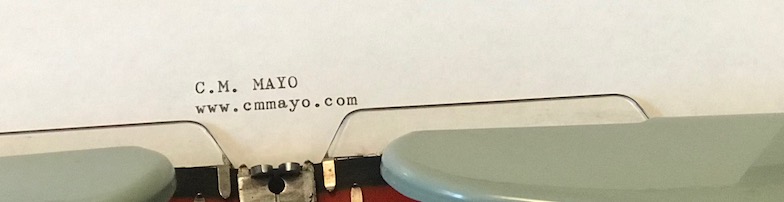
Yet another strategy for diminishing the pull of the Internet, at least for some writers some of the time, would be to get up from the computer, aka the distraction machine, and hie thee over to ye olde typewriter.

My typewriter went to Goodwill years ago. But now, with a book to complete, I am seriously considering going back to using a typewriter. I am old enough to remember typing up my papers for school and college, that satisfying clackety-clack and the little ding at the end of the right margin… The calm. The focus.

Speaking of analogerie, I am also, as those of you who follow this blog well know, massively, as in an-entire-parade-ground-filled-with-dancing-pink-elephants-and-cats-in-hats-all- under-a-rain-of-chocolates, massively, relieved to have deactivated my Facebook account. That was back in August of 2015. Yes indeed, having eliminated that particular bungee-pull to the Internet, I have gotten a lot more writing done, and I am answering my email in a more consistently timely manner. 

So, typewriters. I spent an afternoon of the Thanksgiving weekend doing some Internet research. Herewith:

Five Reasons to Still Use a Typewriter 
By Gerry Holt, BBC News Magazine

The Hidden World of the TypewriterBy James Joiner, The Atlantic

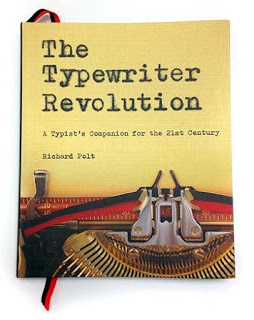
The Typewriter Revolution: A Typist’s Companion for the 21st Century
By Richard Polt
A superb reference written by a professor of philosophy. His blog is The Typewriter Revolution

WHERE TO FIND A GOOD OLD (AND MAYBE REALLY OLD) NONELECTRIC TYPEWRITER

Why nonelectric? It might be nice to type in the tipi! But also, it seems that some of the best workhorse typewriters are nonelectrics made back in the mid-20th century. The only nonelectric typewriters currently being manufactured are from China and although cheap, they’re crap, so if a nonelectric typewriter is what you want, think vintage. 

For a rundown on vintage brands and models, both nonelectric and electric, Polt’s The Typewriter Revolution is an excellent resource. On his website Polt also maintains a list of typewriter repair shops.

You could start combing through the cheapie listings on EBay and Goodwill, and if you have the time and can stand the skanky vibes, peruse the stalls in your local flea market. You might even grab a typewriter for free– perhaps the one gathering cobwebs in your parents’ garage… 

But it seems to me that, if you want to start typing ASAP on a good vintage machine, the best strategy would be to shell out the clams to a dealer who specializes in refurbishing or “reconditioning” quality typewriters, and who offers his or her customers a guarantee. I should think you would also want to confirm that it will be possible to source ribbons. 

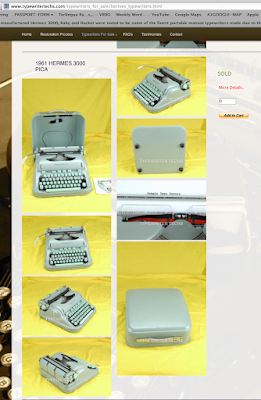
UPDATE: Behold! My 1961 Hermes 3000 Pica from Typewriter Techs

A few US dealers who look like promising possibilities:

Olivers By Bee
Oliver Typewriters Manufactured from 1890-1930s. An Etsy shop for antique typewriters.

Los Altos Business Machines Online Shop
Based in Los Altos CA.

Mahogany Rhino
Another Etsy shop.

Typewriter Techs
Based in Riverside IL.

TYPEWRITER-RELATED SHOPS

Typewriter Decal Shop
Etsy shop.

Typewriter Pads for Sale 
(via Polt’s The Typewriter Revolution blog)

AND FOR TYPEWRITER ENTHUSIASTS

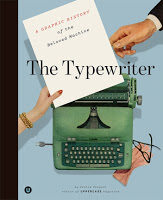
The Typewriter: A Graphic History of the Beloved Machine by Janine Vangool

ETCetera online
Home of the Early Typewriter Collectors’ Association

The Typewriter: A Graphic History of the Beloved Machine
By Janine Vangool

> Check out the trailer for the book— an outstanding book trailer, by the way.

The Virtual Typewriter Museum


Blast Past Easy: A Permutation Exercise with Clichés

This Writer’s Distraction Free Smartphone (Plus an App Evaluation Flowchart to Tailor-Make Your Own

Meteor, Influences, Ambiance

Find out more about C.M. Mayo’s books, shorter works, podcasts, and more at www.cmmayo.com.


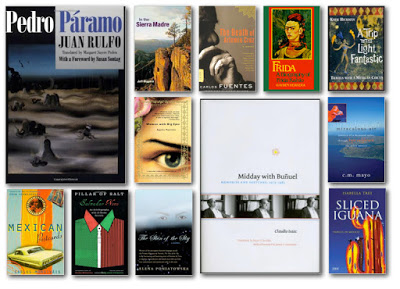
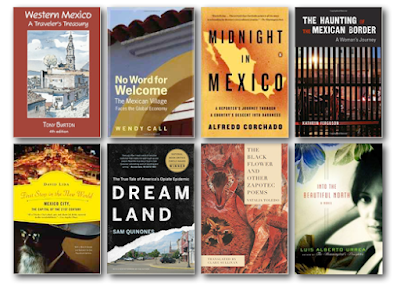
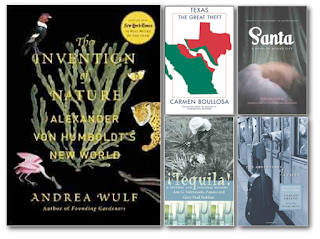
Reading Mexico: Recommendations for a Book Club of Extra-Curious & Adventurous English-Language Readers

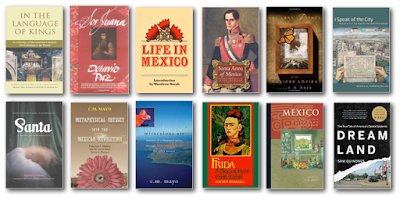
Just a few selections from the chocolate box of English language books on Mexico 

In recent days, I am delighted to report, more than one American has asked me for a list of recommended reading on Mexico for their book clubs. Before I present my correspondents, and you, dear reader, with my list, herewith a big fat flashing neon-lime caveat: 

This list is unlikely to coincide with most English language writers’ and readers’ ideas of what might be most appropriate. Nope, no Graham Greene. No D.H. Lawrence, no Malcolm Lowry, nor John Steinbeck. Most of the usual suspects have gone missing from my list. I packed the bunch of them off, as it were, to Puerto Vallarta for margaritas (a drink invented by a Texan, by the way) and a purgatory of reading juicy crime-novels. About crime novels, I am not your go-to gal.

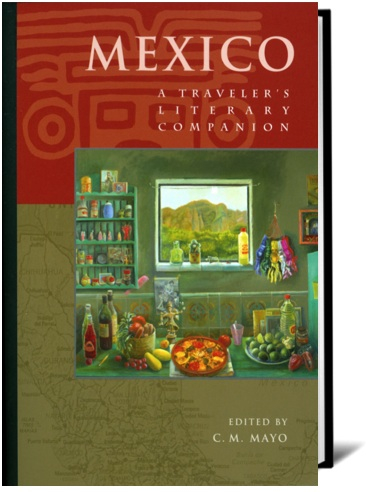
For those of you new to this blog, let me introduce myself. I am a US citizen who has been living in Mexico City on and off for over three decades, and not in an expat community, but as a part of a Mexican family. Over these many years I have written several books about Mexico, most recently, the novel based on the true story of Mexico’s Second Empire, The Last Prince of the Mexican Empire, and Metaphysical Odyssey into the Mexican Revolution: Francisco I. Madero and His Secret Book, Spiritist Manual. I have also translated a long list of Mexican writers and poets, and am the editor of an anthology, Mexico: A Traveler’s Literary Companion, which is not a guidebook but a selection of 24 Mexican writers on Mexico, many in translation for the first time. All of which is to say that although I have not read each and every last thing ever published on Mexico (a feat for a bot!), I am indeed familiar with both the Spanish and the English language literature on Mexico, fiction and nonfiction. 

TWO CHALLENGES: SAD! VERY SAD!

But to make a list of recommendations for an English-language book club there are challenges. First, a number of Mexican works have been translated into English, but this amounts to only a tiny percentage of what has been published in Mexico over the centuries. To quote DJT completely out of context, “Sad!”

Second, also sadly, many of the best-known and easily available originally-in-English works on Mexico strike me as superb examples of a south-of-the-border species of what Edward W. Said termed “orientalism.” Translation: toe-curling. Steinbeck’s The Log from the Sea of Cortez, to take but one example, while a deserved classic for its lyric beauty (count me a fan), will tell you little about Mexico, never mind the Baja California peninsula that stretches for nearly a thousand miles along the Sea of Cortez; much of what Steinbeck says about it is either flat wrong or rendered through a filter of commonplace prejudice and presumption.

Much of the best of contemporary English language literature on Mexico covers the border, mainly focusing on illegal immigration, drug trafficking, and violence. There are several excellent works under that voluminous tent, but I’d like to get to those last. I submit that for a deeper sense of Mexico, one has to dig past the sorts of stories one can easily encounter in the mainstream news, television, and cinema, to go both deeper into the country and deeper into its past.

For a deeper sense of Mexico, one has to dig past the sorts of stories one can easily encounter in the mainstream news, television, and cinema, to go both deeper into the country and deeper into its past. 

Nope, that sad little shelf in the back room of your local big box bookstore is not the place to look. Unfortunately, and head-scratchingly—for the United States shares a nearly 2,000 mile border with Mexico, and all the cultural, economic, ecological, historical, and political intertwinings that would suggest— the selection of such works in English, enticing a “box of chocolates” as it may be, is limited. Moreover, whether because of their scarcity, high prices, length, and/or academic prose-style replete with reams of footnotes, few English language works on Mexico lend themselves to a felicitous selection for a book club.

A NOTE ON (MORE THAN) A FEW TITLES NOT ON MY LIST FOR BOOK CLUBS

Historian John Tutino’s Making a New World, for example, is a scholarly doorstopper of a tome, so I wouldn’t recommend it for a book club; however, I do believe it is one of the most important books yet published about Mexico. Read my review of Tutino’s Making a New World here and listen in anytime to my extra crunchy podcast interview with Tutino here.

Seriously, if you want to start getting an idea of Mexico beyond the clichés, stop reading this right now and listen to what Tutino has to say.

… RESUME HERE

Also, I would have recommended the magnificent The Mexican Treasury: The Writings of Dr. Francisco Hernández, edited by Simon Varey, but (sigh), Stanford University Press has priced it at USD 72 a copy. You might ask your university or local public library to order a copy, if they do not already have one. 

Another wonder not on my list for book clubs— but do have a look at the digital edition free online— is Franciscan missionary Bernardino de Sahagún’s Historia general de las cosas de Nueva España, or General History of the Things of New Spain. The original 16th century manuscript, which contains 2,468 colorful illustrations and text in both Spanish and Nahuatl (the language spoken by the Aztecs phonetically transcribed using Latin), is also known as the Florentine Codex because it is in the Medicea Laurencziana Library in Florence, Italy. 

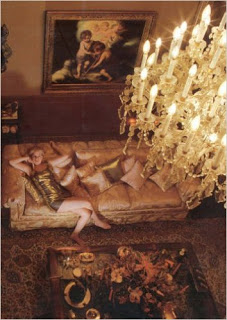
Then there is Daniela Rossell’s hilariously outré take on Mexico City’s, as the title says, Rich and Famous, but at over USD 100 for a used paperback copy, that title did not make it to my list, either. (But if you and your book club have wheelbarrows of cash to spare for no better purpose than to rain down upon amazon.com for some dozen copies of Rich and Famous, well, pourquoi pas? Read it while eating your cake, too!)

Numerous Mexican fabulosities, including Rich & Famous,  which cover is shown here, are not on my list.

My list, therefore, focuses on works in a variety of genres, from biography to history to poetry, that are not only illuminating but could be enjoyable reading for avid and thoughtful readers, and lend themselves to a spirited book club discussion. And, crucially for most book clubs, these are titles currently available at more-or-less-reasonable prices from major online booksellers and/or, as in the few instances when a work has lapsed into the public domain, as free downloads from www.archive.org. 

Toss a tomato if you like, but I also recommend my own works, else I would not have troubled to write them.

> For those looking for more complete and scholarly lists of recommended reading on Mexico, as well as several more fine anthologies, click here.

PREHISPANIC, CONQUEST, COLONY
(IN ALPHABETICAL ORDER BY AUTHOR)

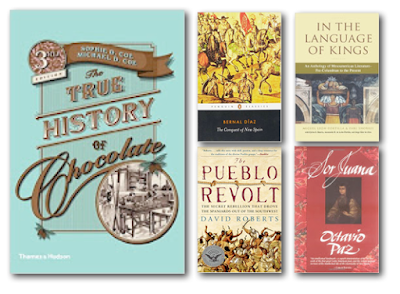
Coe, Sophie D., and Michael D. Coe. The True History of Chocolate
A scrumptuously sweeping history of Mexico’s most delicious bean by a noted food historian and anthropologist. This one should be an especially popular pick for any book club.

Díaz, Bernal. The True History of the Conquest of New Spain
One of the greatest books every written about one of the greatest adventures of all time. And that is no exaggeration.
> Also available on archive.org

León-Portilla, Miguel, and Earl Shorris. In the Language of Kings: An Anthology of Mesoamerican Literature, Pre-Columbian to the Present
León-Portilla is one of Mexico’s leading historians and intellectuals and this collection, the first to offer a comprehensive overview of this literature, is magnificent. 

Paz, Octavio. Sor Juana or, The Traps of Faith
Translated by the exceptional Margaret Sayers Peden. Catalog copy: “Mexico’s leading poet, essayist, and cultural critic writes of a Mexican poet of another time and another world, the world of seventeenth-century New Spain. His subject is Sor Juana Inés de la Cruz, the most striking figure in all of Spanish-American colonial literature and one of the great poets of her age.”

UPDATE: See my blog post of March 20, 2017, “What the Muse Sent Me About the Tenth Muse, Sor Juana Inés de la Cruz”

Roberts, David. The Pueblo Revolt: The Secret Rebellion that Drove the Spanish Out of the Southwest
The Pueblo Revolt of 1680 took place in what was then the Kingdom of New Mexico and is now within the United States; nevertheless, this is an crucial episode for understanding the history of the North American continent, including, of course, Mexico. 

NINETEENTH CENTURY 
(IN ALPHABETICAL ORDER BY AUTHOR)

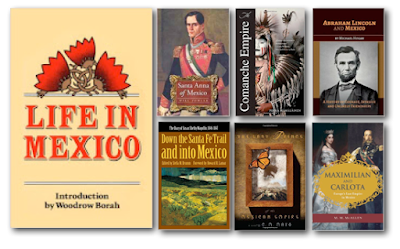
Calderón de la Barca, Madame (Frances Erskine Inglis). Life in Mexico
This delightfully vivid memoir of 1842 by the Scottish-born wife of Spain’s first ambassador to Mexico should go at the top of the list for any Mexicophile. 
> Also available on archive.org
> Read my review for Tin House

Fowler, Will. Santa Anna of Mexico
A new and revisionist history of that tremendous and mercurial personality who dominated the first half of 19th century Mexico, the “Napoleon of the West.”

Hämäläinen, Pekka. The Comanche Empire
A mite heavy-going for a book club, but essential for understanding the historical relationship between the U.S. and Mexico and the US-Mexican War. 
> Read my review of this book.
> For a less rigorous but more entertaining and elegantly-written work on the Comanches, see S.C. Gwynne’s Empire of the Summer Moon.

Hogan, Michael. Abraham Lincoln and Mexico: A History of Courage, Intrigue, and Unlikely Friendships
In this shining contribution to the literature on Abraham Lincoln and that of the US-Mexican War, Michael Hogan illuminates the stance of a young politician against that terrible war, telling a story that is both urgently necessary and well more than a century overdue.

Magoffin, Susan Shelby. Down the Santa Fe Trail and into Mexico
Now considered a classic of mid-19th century Americana, as a work of literature, this book has its limits and faults, for it was written as a private diary by a Missouri trader’s bride who was only 19 years old. I warmly recommend it for US book clubs because it is easy to find an inexpensive copy, and if it has faults, it also has many charms; and moreover, it provides an unforgettable glimpse of historical context for US-Mexico trade. Y’all, US-Mexico trade did not start with NAFTA. 
> See my blog post of notes about this book.

Mayo, C.M. The Last Prince of the Mexican Empire
A novel based on extensive archival research into the strange but true story of the half-American grandson of Agustin de Iturbide, Agustin de Iturbide y Green, in the court of Maximilian von Habsburg. A Library Journal Best Book of 2009.
> Visit this book’s website for excerpts, reviews, photos and more
> Related: From Mexico to Miramar or, Across the Lake of Oblivion
A nonfiction novela about a fairytale: a visit to the Emperor of Mexico’s Italian castle. An award-winning long-form essay now available in Kindle.

McAllen, M.M. Maximilian and Carlota: Europe’s Last Empire in Mexico
A deeply researched book about a period of Mexican history that, while vital for understanding modern Mexico and its relations with the United States and Europe, is of perhaps unparalleled cultural, political, and military complexity for such a short period.
> Listen in anytime to my extra-extra crunchy conversation with M.M.McAllen about her splendid book, the first new major narrative history of this period in English in nearly forty years.

Solares, Ignacio. Yankee Invasion: A Novel of Mexico City
Translated by Timothy G. Compton
In 1848 a young man named Abelardo witnesses the Yankee Invasion of Mexico City. When it came out I gave this one a blurb: “Bienvenido to this translation of a searing work by an outstanding Mexican writer.”

LATE 19th CENTURY, REVOLUTION, EARLY 20th CENTURY
(IN ALPHABETICAL ORDER BY AUTHOR)


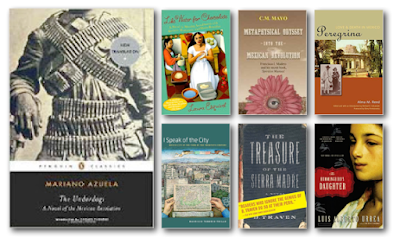
Azuela, Mariano. The Underdogs: A Novel of the Revolution
This is the first and classic Mexican novel of the Revolution, translated by Sergio Waisman and with a foreword by Carlos Fuentes. The original title in Spanish is Los de abajo. Not everyone’s slug of mescal, but a century on, it remains a cult fave, especially around the border.

Cooke, Catherine Nixon. The Thistle and the Rose: Romance, Railroads, and Big Oil in Revolutionary Mexico
This family history of Scotsman John George McNab and Oaxacan Guadalupe Fuentes Nivon McNab not only gives an overview of the transformation of the Mexican economy in the late 19th and early 20th centuries, but some of Mexico’s ethnic, social, and regional diversity, both of which are far greater than U.S. media and Mexican tourist industry narratives would suggest.

Esquivel, Laura.Like Water for Chocolate: A Novel in Monthly Installments with Recipes, Romances, and Home Remedies
The charming novel that was made into a major motion picture. 

Mayo, C.M. Metaphysical Odyssey Into the Mexican Revolution: Francisco I. Madero and His Secret Book, Spiritist Manual
Knocks the huaraches off most people’s understanding of the 1910 Revolution, and its leader, Francisco I. Madero, who was elected President of Mexico in 1911 and served until his assassination in the coup d’etat of 1913. Someone described Metaphysical Odyssey as The Underdogs turned upside down, inside out, and with a cherry orchard on top. Anyway, Metaphysical Odyssey into the Mexican Revolution is nonfiction and it includes the first and complete translation of Madero’s Spiritist Manual of 1911. 
> Visit this book’s website for excerpts, reviews, interviews, podcasts, and more.

Reed, Alma. Peregrina: Love and Death in Mexico
Edited by Michael K. Schuessler with a foreword by Mexican writer Elena Poniatowska, who knew Alma Reed back in the 1960s. Reed was a journalist from San Francisco who came to Yucatan on assignment and ended up engaged to marry the governor, Felipe Carrillo Puerto. Just before the wedding Carrillo Puerto was assassinated.
> Listen in to my podcast interview with Michael K. Schuessler. 

Tenorio-Trillo, Mauricio, I Speak of the City: Mexico City at the Turn of the Twentieth Century
A leading scholar of Mexico takes on Mexico City from 1880 to 1940 in this beautifully written work. If you have ever visited or ever plan to visit Mexico City, this rich-as-a-truffle read is a must.

Traven, B. The Treasure of the Sierra Madre
Although it seems he may have been born in Germany, one must count the mysterious B. Traven, who escaped a death sentence in Germany in the 1920s, as a Mexican writer. Little is known about his early life. According to his Mexican stepdaughter, the “B.” stands not for Bruno as some biographers have asserted, but for “Plan B.” Mexico City’s Museo de Arte Moderno recently closed its B. Traven show which featured clips from the movie “The Treasure of the Sierra Madre” directed by John Huston and starring Humphrey Bogart, as well as clips from several other major movies inspired by Traven’s novels, and displays of his papers, photographs, guns, and typewriters. 

UPDATE: See my Q & A with Timothy Heyman, co-administrator of the B. Traven Literary Estate; also Heyman’s guest-blog post “Traven’s Triumph.”

Urrea, Luis Alberto. The Hummingbird’s Daughter
The novel based on the true story of his great aunt, the folk saint and mediumnistic healer Teresita Urrea, la Santa de Cabora (Cabora is in Chihuahua). 

MID TO LATE TWENTIETH CENTURY
(IN ALPHABETICAL ORDER BY AUTHOR)

Biggers, Jeff. In the Sierra Madre
Adventure writing at its finest.

Fuentes, Carlos. The Death of Artemio Cruz
New translation by Alfred MacAdam. The famous novel by the famous author. Muy macho. Dark. Bitter. Ayyy a real jaw-cruncher.  

Herrera, Heyden. Frida: A Biography of Frida Kahlo
The best introduction to Mexico’s most famous and uniquely flamboyant artist of the 20th century.

Hickman, Katie. A Trip to the Light Fantastic: Travels with a Mexican Circus
A spellbinding memoir by a noted British writer. 

Isaac, Claudio. Midday with Buñuel: Memories and Sketches, 1973 – 1983
Mexican filmmaker Claudio Isaac’s very personal and poetic recollection of his friendship with his mentor, the Spanish surrealist Luis Buñuel, a major influence on Mexican (and world) cinema, who died in Mexico City in 1983. I do not have the original Spanish for a comparison, but the English is so vivid and smoothly elegant, I am sure that Brian T. Scoular’s must be a superb translation. 

Mastretta, Angeles. Women with Big Eyes
Short stories about “aunts” translated by Amy Schildhouse Greenberg. A best-seller in Mexico and widely read in Spanish in the United States as well. (A story from this book is in my anthology, Mexico: A Traveler’s Literary Companion.)

Mayo, C.M. Miraculous Air: Journey of a Thousand Miles through Baja California, the Other Mexico
LA Times: “A luminous exploration of Baja California, from its southern tip at Los Cabos to its ‘lost city’ of Tijuana…. a work of nonfiction that elides into modern myth.” 
> Visit this book’s website for excerpts, photos, podcasts, and more
> More recommended reading on Baja California, including titles by Bruce Berger, Harry Crosby, and Graham Mackintosh.

Mayo, C.M., ed. Mexico: A Traveler’s Literary Companion
A portrait of Mexico in the work of 24 contemporary Mexican writers, many translated for the first time. Among them: Agustín Cadena, Rosario Castellanos, Fernando Del Paso, Ricardo Elizondo Elizondo, Laura Esquivel, Carlos Fuentes, Mónica Lavín, Angeles Mastretta, Carlos Monsiváis, Juan Villoro.
> Visit this book’s website for excerpts, podcasts, and more.
> NPR interview about this book.

Monsiváis, Carlos. Mexican Postcards
Edited, Introduced and Translated by John Kraniauskas. A collection of essays by Mexico City’s most beloved social commentator. (His essay “Identity Hour or, What Photos Would You Take of the Endless City?” is included in my anthology, Mexico: A Traveler’s Literary Companion.)

Novo, Salvador. Pillar of Salt: An Autobiography, with 19 Erotic Sonnets
Introduced by Carlos Monsiváis; Translated by Marguerite Feitlowitz. The memoir of a major and controversial figure in 20th century Mexican letters. Never a dull moment with Sr. Novo.

Poniatowska, Elena. The Skin of the Sky.
Poniatowska is one of Mexico’s most respected journalists and literary writers. Her better-known works include Massacre in Mexico, and Here’s to You, Jesusa. For a book club seeking a fresh and unexpected look at Mexico, however, I would recommend first reading The Skin of the Sky.

Rulfo, Juan. Pedro Paramo
The surrealist novel of the 1950s now translated by Margaret Sayers Peden. 

Schuessler, Michael K. Elena Poniatowska: An Intimate Biography
> Listen in to my interview with Michael K. Schuessler.

Sullivan, Rosemary, Villa Air-Bel: World War II, Escape, and a House in Marseilles.
You might not guess it from the title, but Villa Air-Bel is essential reading for understanding modern art in post-WW-II Mexico. My article about the author and this book, “A Traveler in Mexico: A Rendezvous with Writer Rosemary Sullivan,” appeared in Inside Mexico, March 2009.

Tree, Isabella. Sliced Iguana: Travels in Mexico
One of my favorites for armchair traveling. Crisp, observant, original.
> Isabella Tree offers this guest-blog post on her five favorite books on Mexico. 

MEXICO POST-2000 & THE BORDER(IN ALPHABETICAL ORDER BY AUTHOR)

Burton, Tony. Western Mexico: A Traveler’s Treasury
A unique guidebook by an English geographer that is chock full of surprises, plus illustrations and many maps. Yes, I am recommending a guidebook for a book club; it is that special. 

Call, Wendy. No Word for Welcome: The Mexican Village Faces the Global Economy
A passionate look at Mexico’s Isthmus of Tehuantepec, a little known and yet culturally, economically, historically, and politically vital part of Mexico. Winner of the Grub Street National Book Prize for Nonfiction. 

Corchado, Alfredo. Midnight in Mexico: A Reporter’s Journey through a Country’s Descent into Darkness
Like the title says. 

Ferguson, Kathryn. The Haunting of the Mexican Border
Ferociously personal reporting on both sides of the border.

Lida, David. First Stop in the New World: Mexico City, the Capital of the 21st Century
A long-time resident of Mexico City and a prolific writer in both English and Spanish, Lida is one of the most knowledgable Americans writing about Mexico. 
>Visit Lida’s blog

Quinones, Sam. Dreamland: The True Tale of America’s Opiate Epidemic
Dreamland should be read—and more than once— by anyone who would make or attempt to influence policy on the drug trade, whether legal or illegal. Moreover, Dreamland should be read by every citizen who would visit a doctor. > Read my review of this book in Literal Magazine.
> See also his beyond-outstanding collections of essays on Mexico: True Tales from Another Mexico and Antonio’s Gun and Delfino’s Dream.

Toledo, Natalia. The Black Flower and Other Zapotec Poems
Translated from Zapotec, a major indigenous language in Mexico, by Clare Sullivan.

Urrea, Luis Alberto. Into the Beautiful NorthYou can’t go wrong with Luis Alberto Urrea, pick any one or more of his titles.
> Visit his website.

PLUS! PLUS! PLUS! PLUS! PLUS!
FIVE BOOKS ON MEXICO THAT I HAVE NOT YET READ,
BUT IF I WERE IN A BOOK CLUB I WOULD VOTE TO READ THEM

Boullosa, Carmen. Texas: The Great Theft 
Translated by Samantha Schnee. Why I would vote to read this book: Boullosa is one of Mexico’s best-known literary writers; Schnee is a respected literary translator, and the flip-side of the story of Texas is one Americans rarely if ever hear.

Gamboa, Federico. Santa
Translated and edited by John Charles Chasteen. Why I would vote to read this book: It was a racy best-seller of its day in Mexico and its author, Federico Gamboa, was a noted literary figure and politician.

Prieto, Carlos. Adventures of a Cello
It is a Stradivarius and Prieto is one of the best cellists in the world. From the catalog: “To make the story of his cello complete, Mr. Prieto also provides a brief history of violin making and a succinct review of cello music from Stradivari to the present. He highlights the work of composers from Latin America, Spain, and Portugal, for whose music he has long been an advocate and principal performer.”

Valenzuela-Zapata, Ana G. and Gary Paul Nabhan. Tequila: A Natural and Cultural History
From the catalog: “Ana G. Valenzuela-Zapata, the leading agronomist in Mexico’s tequila industry, and Gary Paul Nabhan, one of America’s most respected ethnobotanists, plumb the myth of tequila as they introduce the natural history, economics, and cultural significance of the plants cultivated for its production.”

Wulf, Andrea. The Invention of Nature: Alexander von Humboldt’s New World
German naturalist Alexander von Humboldt wrote about his research and explorations in Mexico; it would be difficult to overestimate his influence on how Mexican scientists saw their own country, and how Europeans saw Mexico in the 19th century. Friends have raved about Wulf’s book, so it would get my vote for a read. 

Una Ventana al Mundo Invisible (A Window to the Invisible World): 
Master Amajur and the Smoking Signatures

From the B. Traven Conferences in Berlin / Plus Cyberflanerie

José N. Iturriaga’s Mexico in US Eyes 
(México en las miradas de Estados Unidos)

#

Find out more about
C.M. Mayo’s books, articles, podcasts, and more.

On Seeing As An Artist: Five Techniques for a Journey to Einfühlung

Edited transcript of remarks by C.M. Mayo for the Panel on “Writing Across Borders and Cultures,” Women Writing the West Conference, Santa Fe, New Mexico, October 15, 2016

How many of you have been to Mexico? Well, viva México! Here we are in New Mexico, Nuevo México. On this panel, with Dawn Wink and Kathryn Ferguson, it seems we are all about Mexico. I write both fiction and nonfiction, most of it about Mexico because that is where I have been living for most of my adult life— that is, the past 30 years— married to a Mexican and living in Mexico City.

But in this talk I would like to put on my sombrero, as it were, as an historical novelist, and although my novel, The Last Prince of the Mexican Empire, is about Mexico, I don’t want to talk so much about Mexico as I do five simple, powerful techniques that have helped me, and that I hope will help you to see as an artist and write across borders.

I start with the premise that truth is beauty and beauty is truth, and that seeing clearly, seeing as an artist, is what brings us towards truth.

My second premise is that through narrative we become more human—and that sure beats the alternative.

My third premise is that writing about anyone else, anywhere, is to some degree writing across a border. The past is a border. Religion is a border. Gender is a border. Social class is a border. Language. Physical conditions— people who have peanut allergies are different than people who do not have peanut allergies.

“writing about anyone else, anywhere, is to some degree writing across a border”

THE CHALLENGE

The challenge is this: As Walter Lippman put it, “For the most part we do not first see and then define, we define first and then see.” And I would agree with Lippman that in our culture, for the most part, and of course, with oodles of exceptions, we are not educated to see, then define. Ironically, the more educated we are, the more we as literary artists may have something to overcome in this respect.

The poet e.e. cummings put it this way: “An artist is no other than he who unlearns what he has learned, in order to know himself.”

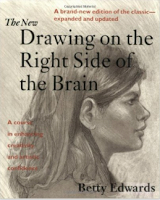
Betty Edwards, the artist who wrote Drawing on the Right Side of the Brain, calls seeing as an artist “a different, more direct kind of seeing. The brain’s editing is somehow put on hold, thereby permitting one to see more fully and perhaps more realistically.”

How many of you are familar with Drawing on the Right Side of the Brain?

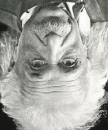
How many of you have tried that exercise where you take a black and white photograph of a face, turn it upside down, and copy it?

Turning the picture upside down tricks your brain to get past the labels of that is a nose, or, say, that is an eyelid, a wrinkle, a cheek… You are just drawing what you actually see, this weird jumble of shapes and shadows.

You turn it right side side up and, wow… it’s Albert Einstein!

And why is seeing this way, seeing as an artist so important? Because if we as writers cannot see as artists, with that wide open, innocent sense of attention and wonder that would see first, and then, maybe, define, whether we are writing about a Mexican or a Korean ballet dancer or a Texas cowboy or the old lady who died in the house next door one hundred years ago— whomever we are writing about, if we cannot see that human being with the eyes of an artist, our writing about them will not be fresh, it will be fuzzy, blunt, stale, peculiarly distorted. In a word: stereotypical.

It will be distorted in the same way that people who do not know how to draw will make the eyes too big, the foreheads too small, and ignore most of the shadows—the face they draw looks like a cartoon, not the way the face actually looks, because the left side of their brain was busy labeling things.

Seeing as an artist, on the other hand, is seeing without filters. Radical seeing. For us as writers this means seeing without prejudice, without bias, without the… shall we say, enduring presumptions.

It is, to quote the artist Betty Edwards again, “an altered state of awareness.” And “This shift to an altered state enables you to see well.”

So how do we get to that altered state? And then see?

FIVE TECHNIQUES FOR RADICAL SEEING

Technique #1
It starts with slowing down, being here now, in your body. Breathe in and breathe out, slowly, keeping your attention on following each breath, in and out. In and out. Five to 10 of these usually works just fine. If you’re really stressed out and distracted, maybe more. Whatever works for you.

Technique #2
This quiets the so-called “monkey mind.” Using a pen and paper, and using the present tense—using the present tense is key—simply writing down what you want to set aside for the duration of your writing session.

I write:

For now I’m not going to worry that
The phone might ring.
I am concerned that the front tire of my car looks low.
I am worried that so and so will say thus and such…

Whatever. You just write them down and set them aside. And because you are writing them down, no worries, they will be there for you when you need to pick them up again.

Really, it is that simple. And incredibly powerful.

Now to actually seeing as an artist. I think of it as adopting the mindset of a four year old child. A four year old is old enough to speak and maybe even read and write a little bit, but young enough to have no presumption, no bias, no definitions, no worry about time, no social status to defend. No need to be “cool.” It’s just, you’re four and you’re noticing things, playfully. Innocently. Dangerously. Like that little boy who asked, Why isn’t the emperor wearing any clothes?

So we can start noticing things. Like, ooooh, the person sitting next to us.

What is the shape of her hair?

What’s on her left hand?

If you could touch her sleeve what would it probably feel like?

Other people may inform us that a wall is, say, pink. But if we can see as an artist, get past all the filters, we will see that the wall is cotton candy pink, over there. Down in the corner, away from the window, it might be more of an ash rose. Over there, where it catches the glow from the reflection, it’s a salmon pink. Up near the ceiling light, almost white. It’s gray, it’s lavender. That wall might have hundreds of different colors.

As Matthew B. Crawford writes in The World Beyond Your Head:

“The uniformity of the wall’s color is a social fact, and what I perceive, in every day life, seems to be such social facts, rather than the facts of optics… To perceive the wall as variously colored, I have to suspend my normal socially informed mode of perception. This is what an artist does.”

Other people may inform us about other people, such as, say, Mexicans. Mexicans are like this or, Mexicans are like that. But if we can see as an artist, we may see something, someone who does not fit into, shall we say, the enduring presumptions.

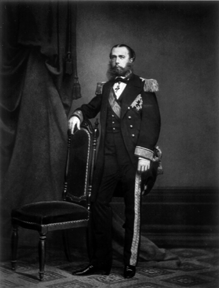
Such as Maximilian von Habsburg.

Maximilian von Habsburg

Speaking of emperors, Maximilian wore some very nice clothes. Beautifully tailored suits and uniforms.

Who has heard of Maximilian?

Most Mexicans will tell you that Maximilian was not Mexican, that he was Austrian, he was the Archduke of Austria, he was a puppet monarch imposed by the French Imperial Army. But at the time Maximilian died, executed in Mexico by firing squad in 1867, there were many Mexican monarchists, a minority of Mexicans certainly, but many, who considered Maximilian Mexican, as he did himself—he considered himself the mystical embodiment of his people, his subjects, the Mexicans.

His skin was very pale and he had this down-to-here red beard. As you might recall, the Habsburgs had once ruled Spain. So to Louis Napoleon and the Mexican monarchists, for the throne of Mexico, Maximilian seemed a logical and very apt choice. And the Pope thought so, too, by the way.

Technique #3
Do your reading and research, and I could talk for an hour or more just about reading and research…archives and handwriting and photographs and newspaper clippings… but the clock is ticking.

One thing I would urge you to consider is to read for perspectives outside your comfort zone. For example, I am the last person who would pick up the memoir of Princess Di’s butler. But in fact, that memoir, Paul Burrell’s A Royal Duty, as well as many other dishy English and European palace memoirs that have oozed out over the past couple of centuries, helped me see palace life in ways I might not have been able to otherwise—to crack its brittle surface of glamour and glimpse some of those oh-so-very human beings.

Technique #4
Always, always question the source. You might be surprised— I certainly was— by how many “facts” rendered in standard histories turn out to have originated in wartime propaganda or were complete fictions tossed off by political enemies. Whenever someone says something about someone, ask, what was their aim? What was the information they had at the time? Their biases? And what were their incentives?

Finally:

Technique #5
Visit relevant places, if you can, always trying to see them from the point of view of your characters. When you’re there, put yourself in their shoes. You may or may not have sympathy for them, but your artist’s imagination, your artist’s eye, must.

MAXIMILIAN’S POV

I’d like to end with a brief reading from the novel, The Last Prince of the Mexican Empire, from a flashback in Maximilian’s point of view.

When he was a twelve year-old boy, there was a distinct moment of a gray winter’s day in the Hofburg when he looked up from his schoolwork, the endless hieroglyphics of trigonometry, and caught sight of his reflection in the window. Four o’clock and it was nearly dark outside. He had been horrified: how old he looked. The life drained out of him! In a whisper that neither his older brother Franz Joseph nor their tutor could hear, he solemnly swore: I shall not forget who I truly am.

Adults, it seemed to Max, were as butterflies in reverse: they too, had been beautiful and free, but they had folded in their wings, cocooned themselves, and let their appendages dissolve until what they became was hard, ridged, little worms. One’s tutor, for example, reminded one of a nematode.

Twiddling concern with numbers, “practicality” in all its Philistine guises makes Maximilian stupendously bored. He needs vistas of sky, mountains, swift-running, sun-sparkled water; he needs— as a normal man must eat— to explore this world, to see, to touch its sibylline treasures: hummingbirds. The red-as-blood breast of a macaw. The furred and light-as-a-feather legs of a tarantula. God in all His guises: mushrooms, lichens, all creatures. As a boy, Max had delighted in his menagerie: a marmoset, a toucan, a lemur. The lemur had escaped, and left outside overnight, it had died of the cold. A footman had opened the door in the morning, and there the thing was, dusted with snow and stiff as cardboard.

“I detest winter,” Max had declared. Franz Joseph, Charlie, and the little brothers, bundled in woollens and furs, they could go ice-skating or build fortresses for snow-ball fights; Max preferred to stay inside with his pets, his books, and the stoves roaring. The one thing he relished about winter, for it was a most elegant way of thumbing his nose at it, was to go into the Bergl Zimmer and shut the door behind him. Its walls and its doors were painted with murals, trompe l’oeil of the most luxuriant flora and fauna: watermelons, papayas, cockatoos, coconut trees, hibiscus. Where was this, Ceylon? Java? Yucatan? Sleet could be falling on the other side of the Hofburg’s windows, but this treasure of the Bergl Zimmer, painted in the year 1760 for his great-great-grandmother the Empress Maria Theresa, never failed to transport one into an ecstasy of enchantment.

Mexicans, walls, in the news. Couldn’t resist.

So in this excerpt I am writing across multitudinous borders and cultures: about a man, when I am a woman; about an Austrian turned Mexican, when I was born in Texas and grew up in the suburbs of California, then moved to Mexico, remaining a legal resident, not a Mexican citizen; someone whose native language was German, when mine is English; one of Europe’s highest ranking aristocrats, when I have no title nor did any ancestor I know of; someone who was born more than a century before myself; furthermore, someone whose personality, religious beliefs, political values, pastimes, intellectual interests and aesthetics were all dramatically different than my own.

Did I get Maximilian “right”? I don’t know. There is no triple-certified committee of quadruple-authorized red-bearded blue-blooded Austrian-Mexican monarchist-Catholic-sailing-and-botany-enthusiasts to tell us. And even if Maximilian himself were available to provide feedback by means of time travel or, say, a credible séance, would that Maximilian, plucked out of 1866 or disembodied orb of some 150 years of floating about the astral, have the self-awareness, confidence, and good will to communicate to us a valid yea or nay?

What I do know is that what I wrote, that bit I just read to you, is the product of my applying these five techniques, including heaps of reading, archival research, and a visit to Vienna’s Hofburg Palace, and however good it may or may not be— let the gods and the reader decide— it is a mammoth stretch beyond what I could come up with in my first drafts.

EMPATHY

The stretch is towards empathy. But be careful: Empathy is not the same as sympathy. I do not have sympathy for Maximilian von Habsburg, Archduke of Austria and so-called Emperor of Mexico and all that he represented and fought for; but for Maximilian the human being, I do have empathy. That empathy was something I achieved because I wanted to see him.

In The Faraway Nearby Rebecca Solnit tells us that,

“Recognizing the reality of another’s existence is the imaginative leap that is the birth of empathy, a word invented by a psychologist interested in visual art. The word is only slightly more than a century old, though the words sympathy, kindness, pity, compassion, fellow-feeling, and others covered the same general ground before Edward Titchener coined it in 1909. It was a translation of the German word Einfühlung, or feeling into, as though the feeling itself reached out… Empathy is a journey you travel, if you pay attention, if you care, if you desire to do so.”

In other words, such seeing takes heart and the writing that results is a journey of the heart, both for the writer and for the reader— although the latter may not choose, or perhaps may not be able to take such a journey. One can proffer “the pearls of the Virgin,” as they say in Mexico, and there will always be unhappy souls who loudly proclaim that they do not like hard little white things.

In the spirit of seeing past stereotypes, I would like to leave you with a quote not from an artist nor a beloved poet nor an esteemed literary writer but a Harvard Business School Professor of Marketing. In her wise and provocative Different: Escaping the Competitive Herd, Professor Youngme Moon writes, “Wherever you go, what matters less is what you are looking at, but how you have committed to see.”

Thank you.

Blast Past Easy: A Permutation Exercise with Clichés

Translating Across the Border

Peyote and the Perfect You

Find out more about C.M. Mayo’s books, shorter works, podcasts, and more at www.cmmayo.com.


Five 2 Word Exercises for Practicing Seeing as a Literary Artist in the Airport (or the Mall or the Train Station or the University Campus or the Car Wash, etc.)

This blog posts on Mondays. As of 2019 the second Monday of the month is devoted to my workshop students and anyone else interested in creative writing. (You can find my workshop schedule and many more resources for writers on my  workshop page.)

Wherever there be a parade of people, there’s an opportunity for a writerly exercise. This is a quick and easy one, or rather, five. The idea is to look– using your artist’s eye, really look at individuals and come up with two words (or 3 or 4 or 7) to describe them.

Yep, it is that easy. 

It helps to write the words down, but just saying them silently to yourself is fine, too. The point is to train your brain to pay attention to detail and generate original descriptions. This helps your writing reach beyond stereotypes (e.g., she was a short Asian woman or, he was a tall black man, or she was a blonde— and other such staples of workshop manuscripts) and so offer your reader something more original, more memorable, and definitively more vivid. “The vivid dream,” that’s what it’s all about.

So, there you are in the airport and, as some random person walks by:

1. Come up with one word to describe the shape of this person’s hair; a second word (or two) for the color of his or her shoes, naming a food item of that same color. For example:

knife-like; chocolate pudding

Now I have the raw material to string together a brief but extra-vivid description, for example:

She wore a knife-like bob and slippers the color of chocolate pudding

Again, find one word for the shape of the hair, and one word for the color of the shoes, referring to a food item.

curve; pork sausages

His head was a curve of curls and he wore pinkish clogs, a pink that made me think of pork sausages

sumptuous; cinnamon candy

She had a sumptuous Afro and sandals the red of cinnamon candy

stubbly; skinned trout

He had stubbly hair and tennis shoes the beige-white of skinned trout.

(Is “stubbly” a shape? Oh well! Don’t tell anybody.)

By the way, it doesn’t matter if the words you come up with are any good or even apt; the point is to practice coming up with them. (Why the color of a food item for the color of the shoes? Welllll, why not? Make it the color of some sand or rock, whydoncha.)

2. Is this person carrying anything? If so, describe it with one adjective plus one noun, e.g.:

fat purse

She carried a fat purse

lumpy briefcase

He leaned slightly to the left from the weight of a lumpy briefcase 

crumpled bag

She clutched a crumpled bag 

Dixie cup

On his palm he balanced a Dixie cup

3. Gait and gaze

loping; fixed to the ground

He had a loping gait, eyes fixed to the ground

shuffling; bright

She had a shuffling gait but bright eyes

brisk; dreamy

Her walk was brisk, her gaze dreamy.

tiptoe; squinting

She seemed to tiptoe, she was squinting at the monitor

4.  Age range

older than 10, younger than 14

perhaps older than 20

I would believe 112

obviously in her seventies, never mind the taut smile 

5. Jewelry? Tattoos?

a gold watch; a silver skull ring

feather earrings; a toe ring

eyebrow stud; hoop earrings

a wedding band on the wrong finger; an elephant hair bracelet

a tattoo of a bracelet 

#

When you sit down to write you certainly do not need to use all this detail; again, the point is to generate it in the first place. (How then to select detail and discard clutter? That would be a separate blog post. See On Respecting the Integrity of Narrative Design: The Interior Decoration Analogy.)

So with the benefit of this wild mélange, here’s what I came up with for a fictional character:

She wore a knife-like bob and slippers the color of chocolate pudding. She carried a fat purse. Her walk was brisk, her gaze dreamy. Perhaps she was older than twenty. She had a wedding band on the wrong finger and an elephant hair bracelet.

Hmmm, maybe that’s the opening for a story. Or something.

By the way, if you’re stuck standing around in an airport, or some such place / situation, these little exercises, silly as they may seem, are better for your writing game than ye olde pulling out the smartphone. The former trains your brain to do what a writer naturally does. The latter gives you the shallows, and so makes the former even more difficult.

Thirty Deadly-Effective Ways to Free Up Bits, Drips & 
Gimungously Vast Swaths of Time for Writing: 
A Menu of Possibilities

Diction Drops and Spikes

Seeing as an Artist or, Five Techniques for a Journey to Einfühlung

Find out more about C.M. Mayo’s books, shorter works, podcasts, and more at www.cmmayo.com.


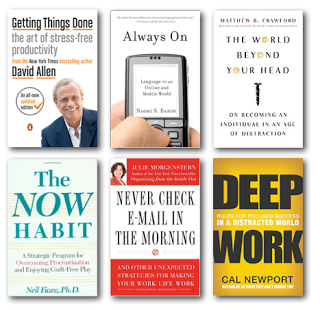
Cal Newport’s “Deep Work,” “Study Hacks” Blog, and On Quitting Social Media

Find out about a must-read book, a must-read blog, and a must-watch TED Talk by Georgetown University Associate Professor of Computer Science Cal Newport, all in one handy post at his Study Hacks Blog, “Quit Social Media.”

What Newport says in that post is provocative– undoubtedly just the title will rub many people’s fur the wrong way, and no surprise, it already has many commenters a-huffing & puffing. 

Here is my comment on Cal Newport’s post:

Thank you for this blog, for your TED Talk, and for your books, especially Deep Work. I am a writer with 2 finance books published under another name, plus 4 literary books, plus an anthology– all of which is to say, I understand the nature and immense benefits of deep work. 

But dealing with the Internet… that has been a challenge for me over the past several years, and especially when all these shiny new social media toys seemed to be so necessary and (apparently) effective for promoting one’s books. Every publicist, marketing staff, my fellow writers, all seem slaves now to social media. I can assure you, every writers conference has a panel on book PR and social media. 

For a while, at the enthusiastic urging of one of my writer-friends (by the way, a best-selling and very fine historical novelist), I maintained a Facebook page, but when I realized what a time-suck it was, and how FB made it intentionally and so deviously addictive, I deactivated my account. I had also come to recognize that people addicted to FB, as seemed to be not all but most of my “FB friends,” often as they might “like” and comment on my posts there, are probably not my readers. (My books require sustained focus; I admit, they can be challenging.) I deactivated my FB more than a year ago, and I breathe a sigh of relief about it every blessed day.  

As for your book, Deep Work, much of what you say was already familiar to me from my own experience as a writer, but I appreciated the reminders, especially in light of these contemporary challenges to sustaining focus. What was especially interesting and intriguing to me was the new cognitive research you mention. Next time I teach a writing workshop you can be sure that Deep Work will be on the syllabus.

Do I miss interacting with friends and family on FB? Yes, but now I have more time for higher quality interpersonal interactions, such as, say, emails, telephone conversations, and–Land o’ Goshen!!– actually getting together in person.

However, for the record, I’m not (yet) giving up the three social media tools I still use, LinkedIn, Twitter and YouTube, because:

(1) With LinkedIn and Twitter I appreciate having a way to contact certain individuals when email is not a workable option (nieces and nephews, you know who you are!);  

(2) I appreciate the broadcast opportunity, modest as it is. Check out my YouTube channel here. As for Linked In and Twitter, usually I just zip in to tweet a blog post or a podcast, then out, and not every day;

UPDATE: Twitter, meh. Now, with the rarest of exceptions, I tweet once a month, as a courtesy to the authors who do a Q & A for Madam Mayo blog.

UPDATE Sept 2021: The world would be a better place without Twitter. As for YouTube, it has a lot to answer for its ham-handed censorship in 2020-2021. My channel is still there only because it hasn’t been a priority for me at this time to move the content to another platform.

(3) I turned off their notifications; 

(4) I do not find these services addictive, as I did Facebook, hence, I am not tempted to constantly check them. 

In sum, for me– and of course, this might be different for you– at this time– and no guarantees for the future– the benefits of maintaining my LinkedIn, Twitter, and YouTube accounts outweigh the costs. 

SPEAKING OF COSTS

Speaking of costs, one of the vital arguments Cal Newport makes in Deep Work is that pointing out the benefits of utilizing any given social media tool is not enough; one must also take into full account its opportunity costs in your actual practice. Oftentimes these costs are devastating. But fear of “missing out,” fear of admitting that one could have done so much better than to have spent weeks, months, even years of precious hours agog at mindless trivia– in short, the fear and pride behind cognitive dissonance– make many otherwise highly intelligent people blind to this simplest of common-sense arguments. 

>> Speaking of cognitive dissonance, I have plenty to say about that in my wiggiest book review yet.

DOES “SOCIAL MEDIA” INCLUDE BLOGS?

One question that popped up in the comments there at Study Hacks blog was about the definition of “social media”: Does it include blogs? Ironically, since he publishes comments and on occasion responds to them, I consider Cal Newport’s “Study Hacks Blog” to be social media. I do not consider this blog,  “Madam Mayo,” to be “social media,” however, because an eon ago I closed the comments section. 

That said, dear thoughtful and civilized reader, your comments via email are always welcome. I invite you to write to me here.

P.S. My recommended reading lists for my writing workshops are here. You will find Cal Newport’s excellent Deep Work on my list of works on Creative Process. And you can read my review of Cal Newport’s earlier book, So Good They Can’t Ignore You, here.

This Writer’s Distraction Free Smartphone (DFS):
First Quarter Update

Poetic Listing

Great Power in One: Miss Charles Emily Wilson

Find out more about C.M. Mayo’s books, shorter works, podcasts, and more at www.cmmayo.com.

Literary Travel Writing: Notes on Process and the Digital Revolution

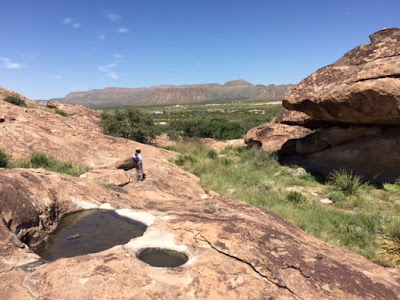
Photo by C.M. Mayo. Hueco Tanks State Park and Historic Site in Far West Texas. Confession: After I snapped this photo with my iPhone I checked my email, just to see if I could! Alas, I could.

The aim of literary travel writing was– and remains– to bring the reader to deeply notice, that is, get out of her head and into the world of specific sounds, smells, tastes, textures, colors, ideas, histories, geographies, geologies… In the words of Kenneth Smith, “You have to open space, and deepen place.” 

Start with escape velocity: from wherever you are, whoever you are in your known world, you rocket out, beyond the orbit of ordinary life. You float around out there– there being your own backyard or, for that matter, the island of Molokai– for a spell. Then, with a story to tell, you splash back to earth.

Next step: craft the narrative, rendering your experience in and understanding of that time and place as vividly, as lyrically, and engagingly as possible. I’ve had plenty to say about the craft of literary travel writing; what I want to touch on here are some of the steps in the process and how they have or have not changed with the lure of digital technologies and the tsunami of the Internet.

HEREWITH SOME NOTES, 
FIRSTLY, ON TAKING NOTES:

THEN: In olden times of yore, I mean in the 1990s, when traveling in Baja California for my travel memoir Miraculous Air, I carried around a pen and bulky notebook, and a camera with so many lenses and dials that if I were to pick it up today I wouldn’t remember how to operate it. To get every raw thing down that I would need for my book, I had to scribble-scribble-scribble, and during interviews and/or at the end of a day’s driving and hiking or whatever, boy howdy, I felt like a squeezed-out sponge and my hand like an arthritic claw. Once home, I spent hours upon hours typing up my field notes. And neither film nor film processing was cheap. Such was the first step of the process.

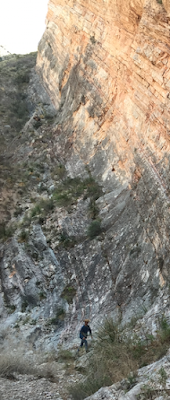
Charlie Angell, expert guide, in the Solitario, Big Bend Ranch State Park, Far West Texas. Listen in anytime to my podcast interview with Angell here.

NOW:These days, for my book in-progress on Far West Texas, I carry a pen and a slim Moleskine to jot down this-and-that, but my main tool is my iPhone. Rather than scribble my field notes and interview notes, I simply turn on my iPhone’s dictation app and press “record” — when finished, I have a digital file. I also take loads of photos and videos. Oh yes, this is infinitely easier on me as I am traveling, and as far as the pictures and video go, the cost is zip. Once home, however, transcribing the audio field notes takes me hours upon hours, and it is exhausting.[*] 

[*]Yep, I have voice recognition software but it doesn’t work well enough– in the time it would take me to correct the gobbledygook I might as well transcribe from scratch. I expect this to change. For some of my podcasts I have used a transcription service, but field notes are another matter– too detailed, too personal. Furthermore, as tedious a job as it may be, transcribing my field notes helps me hyper-focus, recall more details, and gain further insight.

I am the first to admit, were I to do another literary travel memoir, while I would dictate my notes, I would need a better strategy for getting them transcribed. So I’m working on this mid-way. Ayyy.

ON UTILIZING / PROCESSING / PUBLISHING PHOTOS & VIDEO

THEN: Photos stayed in a box. A few ended up in the book. (Several years after the book on Baja California was published I uploaded a few to my website. You can view those here.)

NOW: Photos and videos can be amply shared on this blog, the website, Twitter, etc. A few will end up in the book, I expect.

Is this aspect of the process really that different because of the Internet? A few years ago I would have said so– I got very excited about the multimedia possibilities in ebooks. But I now believe that while our culture is increasingly oriented towards visual media, as far as books go, not much has changed, nor will it because what readers want is text. 

I’ll grant that some literary travel memoirs might offer a few more images and color images than might have been economically feasible before. I’ll grant that ebooks can include video or links to video. And I’ll grant that a few people may find out about and read my book because of a photo or video they Google up on my websites. A few. Most people surfing around the Internet don’t read books, never mind literary travel memoir. And there is nothing new about that.

ON FINDING BOOKS

THEN: To find books on Baja California, I scoured the shelves at John Cole’s in La Jolla, El Tecolote in Todos Santos, and a very few other bookstores and libraries, including the Bancroft at UC Berkeley. I thought the bibliography on Baja California was enormous, and I ended up owning a wall of books.

NOW: Amazon!!!! Although the other day I bought a rare book about the town of Toyah on www.abebooks.com. Over the past few years I have also bought a few books from bricks-and-mortar shops including the Marfa Book Company and Front Street Books in Alpine, and more from the bookstores in various state and national parks. And I go to the always fabulosa Librería Madero in Mexico City for out-of-print Spanish language books. I have consulted a few archives and collections… But I get most of my books from amazon.*

*I hasten to add that for research purposes I am mainly buying paperbacks and used reading-quality books, the kind I’ll take a highlighter to, not rare books. Buying rare books from amazon is not the best idea for many reasons, one of them being that the multitudinous sellers of used books  oftentimes describe a book as “new” when it is actually a stamped review copy, stained, or missing a dust jacket, and so on. For quality rare books from reputable sellers, I can recommend www.abebooks.com , www.abaa.com , and www.biblio.com. 

(Why am I buying so many books? Because I need to read and consult them and, alas, I do not live anywhere near a good English language library. And I admit, I do have a thing for rare books, especially on the Mexican Revolution, Baja California, Mexico’s Second Empire, or Far West Texana. Uh oh, that’s a lot.)

Bottom line: Not only is it easier to find books now, but the bibliography on Far West Texas and Texas makes that on Baja California look puny. Um, I think I’m going to need a new house.

Is this aspect of the process of writing a literary travel memoir really that different because of the Internet? It would seem so, but I’m contrasting an apple and a Durian, as it were. Baja California is a very different subject than Far West Texas. Many of the books I found useful on Baja California are not easy to find online, even today, while, so it seems to me now, if I sneeze someone hands me a book on the Great State of Lonestarlandia. 

I do miss ye olde brick-and-mortar bookstores. But I do not miss being unable to find what I was looking for. 

Anyway, not every travel memoir requires such intensive reading. 

And yet another consideration– and a topic for another blog post– is that it’s always easy to under- or over-research any given book.

ON THE INCONVENIENT LUXURY OF BEING INCOMMUNICADO 

THEN: Traveling in remote places on the peninsula I more often than not found myself incommunicado. (Back then, many small towns in Baja California did not yet have telephones.)

NOW: Few stretches of any highway, anywhere, including the most offbeat corners Far West Texas, are without cell phone reception. Many campgrounds and all hotels, properly so-called, have wifi. Digital distractions are legion. Or, another way to put it: the digital leash stays on– unless one is willing to confront friends, colleagues, and family. That takes energy. Or, another way to put it: that takes training. 

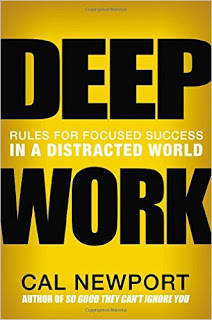
Deep Work by Cal Newport. Highly recommended.

While traveling, no, I do not text, no, I do not email (except when I fall into temptation!), and no, I do not answer my cell phone while I am driving or possibly fending off mountain lions! Sounds easy. Sounds curmudgeony. But for the kind of travel writing I do, trying to immerse my consciousness in an unfamiliar place, and come back with a vivid narrative, very necessary. 

Is it really that different? Not so much as it might appear. It has always taken a strategy plus herculean effort against formidable economic, physical, psychological, and social pressures to protect uninterrupted stretches of time for deep work. 

>> See Cal Newport’s Deep Work. Highly recommended.

ON FINDING (NONBOOK) RESEARCH MATERIALS

THEN: If it wasn’t in a book or a paper file, usually, for all practical purposes, it didn’t exist.

NOW: Whatever, Google.* And the Texas State Historical Association’s Handbook of Texas is a fabulously rich– and free- resource. 

*Don’t get me started about the Maoist Muddle, aka Wikipedia. 

Is it really that different? Yes. 

To take but one example, it is radically different to be able to look at all the real estate on the Internet. I can be sitting in Mexico City and with my iPad and surf around, looking at all these places for sale in Far West Texas– whether a luxury ranch or a humble hunt box / trailer— I can see the kitchen, the bedrooms, ayyy, the bathrooms… I hasten to add I am not looking for anything in the Texas real estate market, but those listings, the descriptions and photos, constitute a window onto a people and place– in the not-so-distant past, this sort of at-hand detail was available only to licensed local real estate agents. 

ON ANONYMITY & KARMA

THEN: In the 90s in Baja California I talked to a lot of people who wouldn’t know me from a denizen of the fifth moon of Pluto and who would probably never learn about, never mind pick up and read my book. I found that very freeing.

Everyone will be famous for, like, 2 seconds, LOL

NOW: Still true in 2016 in Far West Texas, but almost everyone who feels moved to do so can whip out his or her smartphone and Google up my name for scads of links from my webpage to podcasts to this blog to academia.edu to LinkedIn, Twitter, blah blah blah, and all about my book on Baja California, my novel, my stories, and my book on the Mexican Revolution with the uber-crunchy title! I Google other people, too. I can follow the Twitter feed for the Food Shark in Marfa! I interview Lonn Taylor for my podcast! Lonn Taylor writes about me for the Big Bend Sentinel! Sometimes when I go out to Far West Texas I want to wear a wig and dark glasses a la Andy Warhol! But seriously, human nature hasn’t changed; most people respond very generously when asked sincere questions about their art, their business, their research, and/or their opinion, and I believe this will remain the case whether people know about my works and/or Google me or not. Moreover I expect that it will remain the case long into the future that the majority of Texans, and for that matter, denizens of the planet, will not be avidly reading literary travel memoir and couldn’t care a hula-whoop about the oeuvre of moi. (Oh well!)

Is it really that different because of the Internet? Having published several books, one thing I do appreciate, although my ego does not, is that books go out to a largely opaque response. You can talk about sales numbers, “big data,” reviews, and prizes, and it doesn’t change the fact that an author does not know when any given person is actually reading or talking about or feeling one way or the other about his or her book– and anyway, the readers of some books will be born long after their authors have passed to the Great Beyond. 

Still, I think it best to assume that there is karma with a capital “K” — opaque as it may be. In other words, you might not have to, but be prepared to live with the consequences of what you have written. Translation: truth is beauty but cruelty is stupid.

ON DISTRACTIONS

THEN: The main distractions were the television and the telephone.

What Technology Wants by Kevin Kelly. Strange, wonderful, and kinda creepy.

NOW: It’s the magnetic rabbit holes-o-rama of the Internet. In some ways this is more difficult for me as a writer because I use the same machine, the laptop, for writing as for research, for email, and for social media and surfing. (Oh, so that’s the problem! Well, at least I don’t watch television anymore.)

Is it really that different? Yes, because technology really is taking us somewhere very strange, and in some ways, for many people, smartphones are beginning to serve as an actual appendage. But no, because since the dawn of written history we have ample evidence that people have been tempted continually by hyper-palatable distractions of one kind or another and have been taken advantage of by those with the wherewithal to take advantage. Hmmmm…. religion…. slavery…. alcohol… opiates…. cigarettes…. casinos…. spectator sports…. mindless shopping…. television… or even, as they did even back in the days of the atl-atl, lolling around the campfire and indulging in idle & malicious gossip…

>> See also Steven Pressfield’s The War of Art: Winning the Creative Battle.

ON PUBLISHING EN ROUTE

THEN: As work progresses, I would publish an occasional article in a magazine or newspaper such as, say, the Los Angeles Times, the Wall Street Journal— and I would actually get paid. I also published a number of longform essays in literary magazines. I got paid, a bit, and I treasure the beautiful copies.

NOW: Although I continue to publish in magazines, mainly I post digital media– articles on this blog, guest-blogs, and text, photos, videos and podcasts on my websites, plus I send out my emailed newsletter a few times a year. Downside: My short works make less money. Upside: publishing articles is quick, easy, and I retain control. Further upside: when people Google certain terms, they get me. For example, try “Sierra Madera Astrobleme.”

Is it really that different? Alas, yes. See Jaron Lanier’s You Are Not a Gadget. 

I would tell any young writer getting started today that if you want the freedom to write things you will be proud of, first find a reliable alternative income source and from there, always living below your means, build and diversify your sources of income away from the labor market. (Getting an MFA so you can teach in a creative writing program? That might have made a smidge of sense two decades ago. Now you’d be better off starting a dog grooming business, and I am not joking.) Yes, if you are brilliant, hard-working and lucky, you might one day make a good living from your creative writing. But why squander your creative energy for your best work worrying about generating income from, specifically, writing? Quality and market response only occasionally coincide. Jaw-dropping mysteries abound. 

FURTHER NOTES: WHAT ELSE HASN’T CHANGED (MUCH)? 

The Call to Dive Below the Surface

One might imagine that with all the firehoses of information available to the average traveler, literary travel writing now needs to offer something get-out-the-scuba-gear profound. But this has been true for decades– long before the blogosphere and Tripadvisor.com & etc. thundered upon us. 

As V.S. Naipaul writes in A Turn in the South– waaay back in 1989:

“The land was big and varied, in parts wild. But it had nearly everywhere been made uniform and easy for the traveler. One result was that no travel book (unless the writer was writing about himself) could be only about the roads and the hotels. Such a book could have been written a hundred years ago… Such a book can still be written about certain countries in Africa, say. It is often enough for a traveler in that kind of country to say, more or less, ‘This is me here. This is me getting off the old native bus and being led by strange boys…’ This kind of traveler is not really a discoverer.”

Organizational Challenges

Another thing that has not changed is the need to keep things organized– whether digital or paper. When I sit down to bang out a draft and then polish (and polish & polish & polish) a literary travel narrative, I need to constantly refer to my field notes, books, photos and videos, so it is vital that I have these resources where I can easily find them– and when done for the day, or with that section, that I have a place to easily put them back (and from where I can easily retrieve them as need be). This might sound trivial. It is not. 

Here’s what works for me: 

BOOKS: Shelve by category, e.g., Texas history, geology; regional; rock art, etc, using big, easy-to-read labels on the shelves; 

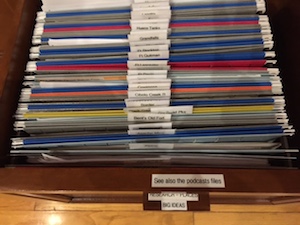
PAPERS: File in hanging folders in a cabinet, e.g., travels by date, editorial correspondence, other alphabetical correspondence, people (as subjects), places;

PRINT-OUT OF THE MANUSCRIPT: Shelve at eye-level in a box (along with a large manila envelope for miscellaneous scraps and Post-Its).

TRANSCRIBED FIELD NOTES AND INTERVIEWS: Store in three-ring binders; 

DIGITAL FILES: Save in folders on the laptop, e.g., audio by date and place, photos and video by date and place;

WEBSITES, PODCASTS, VIDEOS: For websites and etc, I often use posts on this very searchable blog as a way of filing notes that I can easily retrieve (here’s an example and here’s another and another and another and another);

Notes on Peyote, for example.

PRINT-OUT OF THE MANUSCRIPT: Shelve at eye-level in a box (along with a large manila envelope for miscellaneous scraps and Post-Its).

Sounds like I know what I’m doing! The truth is, no matter how often I declutter, books and papers tend to mushroom into unwieldy piles and ooze over any and all horizontal expanses. Piles make it easier to procrastinate. And procrastination is the Devil. I have been struggling mightily with getting my field notes transcribed. All that said, a book gets written as an elephant gets eaten– bit by bit. It’s happening. Stay tuned.

It Can Be Done! This Writer’s Distraction Free Smartphone
(Plus an App Evaluation Flowchart to Tailor-Make Your Own

Q & A: Sara Mansfield Taber, on
Chance Particulars: A Writer’s Field Notebook

Notes on Wolfgang Schivelbusch’s The Railway Journey:
The Industrialization of Time and Space in the NIneteenth Century

Find out more about C.M. Mayo’s books, shorter works, podcasts, and more at www.cmmayo.com.


Cymru & Comanche: Cyberflanerie

So “Cymru,” the name for Wales in the Welsh language, is pronounced kum-ree. (Whodathunk?)


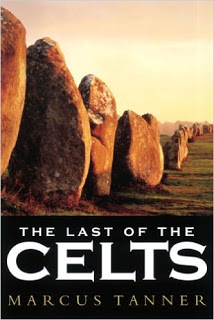
I have finished reading the excellent albeit doorstop-esque The Last of the Celts by Marcus Tanner. If you have been following this blog, you know that I am at work on a book about Far West Texas, so you might be wondering, why the interest in the Celts? Of course, many Texans are descendants of Celts– Scottish, Welsh, and Irish, above all. 

But it’s more than this.

Sometimes one’s thinking, stuck in a cultural rut, needs to unlimber.  Reading into deep and/or lateral history gives one a freshly off-kilter look at what it means to be human, and it highlights forgotten or overlooked connections among now diverse peoples. Such as among, oh, say, Texians and Comanches.

(If you’re not familar with the term Texian, the Texas State Historical Association defines it thus: “[G]enerally used to apply to a citizen of the Anglo-American section of the province of Coahuila and Texas or of the Republic of Texas… As President of of the Republic, Mirabeau B. Lamar used the term to foster nationalism… In general usage after annexation [to the United States] Texan replaced Texian.” As you might guess, Texians and Comanches did not sit around the campfires together singing the 19th century equivalent of “Kumbaya.”) 

I’ve been reading piles of books on Texas. So much of this literature tends to fall into broadly categorizing people– e.g., “Anglos” over here, “Spanish” or “Mexican” or “Tejano” or “Native American” or there. Or, for that matter, “white” or “black.” Such categorizations might be convenient, and I grant, at times necessary for some modicum of understanding, but in fact, many individuals’ ancestries and cultural identities are not so simple, nor is there anywhere near as much uniformity within such categories as many authors assume, or seem to imagine. (I was born in Texas but I did not grow up there. I still find peculiar the Texan notion of  “Anglo” someone who might as easily be of English as of French, Czech, or, say, Irish extraction.)

Similarly, much of the literature on Mexico, whether in English or Spanish, discusses mestizaje as if the only mix were of Spanish and indigenous. But in fact, many Mexicans, like many Mexican Americans, for that matter, are part African, part Arab, Chinese, Russian, Swedish, Irish, you-name-it. (See also the preface to my anthology, Mexico: A Traveler’s Literary Companion.)

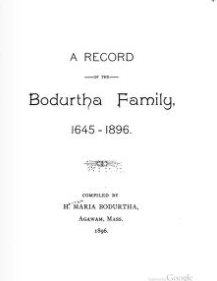
A Record of the Bodurtha Family. I trace my line back to Reice Bodhurtha via my great great great grandmother, Lucy Morris Pope.

My own ancestry is a mix of Irish, Scottish, English, German, plus a sprinkling of Welsh– in other words, plenty of Celt in there. (For those of you new to this blog, in case you were wondering, why my interest in Texas, Mexico, and the US-Mexico  border? I have been married to a Mexican and living in Mexico City for nearly 30 years, and I was born on the border, in El Paso, Texas.)

As far as I know, my own bit of Cymru goes back to a great-great-great-etc-etc-etc-great grandfather, one Reice Bodurtha, a founder of the Agawam Plantation (now Springfield), a Puritan colony in Massachusetts in the 1600s. (Not the Mayflower, but close! Not that I put too much stock in this sort of thing. Going back that many generations, say, twelve, to get to Reice Bodhurtha, we’re talking about a few thousand direct ancestors. The numbers of ancestors double with each generation back. Do the math– and keep your sombrero on: just about everyone alive today of European descent may be descended from Charlemagne!)

Reading The Last of the Celts inspired me consider connections in unlikely directions. One example: The story of indigenous peoples in Texas is a tragedy of extinction by disease, extermination in some instances, and finally, in the wake of the US Civil War, U.S. Army-directed conquest and removal to reservations in Arizona or Oklahoma. Strange but true to say, there are some– I say only some– parallels in the ancient and not-so-ancient world of the Celts, for over the centuries, they were pushed out by the dominant cultures to the edges of the European Continent and the British isles– and beyond, to Iceland (yes, Icelanders have a lot of Celt in them) and the Americas— and you betcha, that includes the Great State of Texas.

Then, under the sway of another dominant culture, there comes the loss of languages. As Tanner recounts, on the Celtic fringe, as increasing numbers of younger people preferred to communicate in English, indigenous languages began to degrade and then disappear as a living language. As for the medley of Celtic languages once spoken in Europe– Breton, Cornish, Irish, Manx, Scottish Gaelic, and Welsh– with the exception of the latter, all have disappeared or become for the most part relics, mainly used for a few phrases sung or recited for special occasions. Marcus Tanner’s The Last of the Celts recounts many a sad story.

And this is a story similar to that of the multitude of indigenous languages once spoken in Texas, including Comanche, or Numu Tekwapu, an Uto-Aztecan language. According to Omniglot.com, Numu Tekwapu is still spoken by several hundred mostly elderly Comanche.

Apropos of Comanche, or  NɄMɄ TEKWAPɄ, a few links and videos:

> Comanchelanguage.org

> The Comanche Code Talkers of World War II by William C. Meadows

> The Comanche National Museum and Cultural Center in Lawton, Oklahoma


How to say “I love you” in Comanche:

Comanche National Museum Dance Demonstration:

Book review: The Comanche Empire by Pekka Hämäläinen

Apropos of Cymru:

The Widders with the Druids– interestingly, this is a traditional Welsh border area dance with much in common with the Matachines, which I have seen in Mexico. (No Welsh spoken– or I didn’t catch it…) Things get interesting at about one minute in:

If you’re not familiar with Matachines, have a look:

> Bodacious 360 view of some Widders— looking like they’re ready for some Comanches! 

What does the Welsh language sound like?

Diana, Princess of Wales, offers a token phrase of Welsh in her first public speech at 1:30:

The title of the following video is “Cymry enwog a phroffesiynol yn sôn am sut mae’r Gymraeg yn allweddol i lwyddiant eu gyrfa neu fusnes. Famous and professional Welsh speakers talk about how the Welsh language has been key to their career or business success.”

It is an uncanny experience to listen to people speak a language that my ancestors must have spoken, and yet I do not understand a word of it.

P.S. Wee synchronicity du jour: The Big White Guy of Agawam has a cousin: Texas’ Second Amendment Cowboy.

Looking at Mexico in New Ways: An Interview with Historian John Tutino

The Strangely Beautiful Sierra Madera Astrobleme

Global Migration: People and Their Stories (Transcript of Introduction to Panel at the San Miguel Writers’ Conference)

Find out more about
C.M. Mayo’s books, articles, podcasts, and more.

Q & A: Shelley Armitage on “Walking the Llano: A Texas Memoir of Place”

Shelley Armitage, author of Walking the Llano: A Texas Memoir of Place

The week before last, I posted a brief but glowing note about Shelley Armitage’s Walking the Llano: A Texas Memoir of Place. This week I am delighted to share with you the author’s answers to my questions about her lyrical and illuminating memoir of growing up in and later returning to explore the area around Vega, Texas. Vega sits on the Llano Estacado about half way between the eastern New Mexico / Texas border and the Texas Panhandle city of Amarillo. [Click here to see Vega, Texas on the map.] 

As you will see, some of my questions are with my students in mind (I teach literary travel writing and creative nonfiction), while others are apropos of my abiding interest in Texas (my own work-in-progress is on Far West Texas— next door, as it were, to the Llano Estacado). Whether you are interested in writing travel and personal memoir or learning about this unique yet little known place, I think you will find what Shelley Armitage has to say at once fascinating and informative. 

C.M. MAYO: You have had a very distinguished career as an academic. What prompted you to switch to writing in this more literary and personal genre? 

Walking the Llano by Shelley Armitage

SHELLEY ARMITAGE: I haven’t really switched but shifted my focus. I’ve tried in all my previous books to write well and evocatively and they all required research and imagination as a foundation. I never believed that scholarly writing couldn’t be readable, even possess literary qualities. But it’s true that because I was an academic I was always steered away from personal/creative writing, something I wanted to do from a young age on.

As I mention in the book, an elementary school friend and I wrote a novel together, a kind of mystery using local characters. When I was young I also admired the writing in National Geographic though I had no idea how to prepare myself to write such. Now as a retiree, I have time (though shortened!!) to explore what I’ve always yearned to do, though I still struggle to write things that are personal; I am more comfortable as a participant/observer.

C.M. MAYO: In your acknowledgements you mention the Taos Writers Conference and the Wurlitzer Foundation in Taos, New Mexico “where the book found a second life.” Can you talk about Taos and the book’s evolution?

Animal, Mineral, Radical, by BK Lauren

SHELLEY ARMITAGE: Taos is a special place in terms of environment and history–and many other things. So being in Taos (high desert, mountains, verdant valley) combined with focus on writing was special. I was fortunate to study with BK Loren, a novelist and essayist, at the writers’ conference. She gave me permission, through her suggestions and assignments–though not related to the memoir– to work with narrative in fresh ways.

I came to think about time in terms of what memory does with it, not something chronological. I spent lots of time in the Taos area hiking, just exploring the art scene, talking with other artists (particularly at the Wurlitzer Foundation). I’ve always found hanging out with other creative people, not writers, to be very stimulating and fun. Ditto looking at art, attending musical events, etc.

At the Wurlitzer I was able to get a rough draft. A couple of years later when I studied with BK, I went home and started again. 

C.M. MAYO: Which writers and works would you say have most influenced you in writing Walking the Llano? You mention Southwest poet Peggy Pond Church and Southwest writer Mary Austin, as well as contemporary writers, including Rudolfo Anaya, Patricia Hampl, Leslie Marmon Silko, and Barry Lopez’s writers retreat. Can you talk about some of these influences? 

Bones Incandescent: The Pajarito Journals of Peggy Pond Church, edited with essays by Shelley Armitage

SHELLEY ARMITAGE: As a scholar I worked with the writings of both Austin and Church. I was Church’s literary editor, worked with her until her death, and helped get her books published posthumously

Austin I knew from research I’ve done on women in the West, once (and maybe still) an incredibly under-researched and represented woman of Western writing and history.

Both women were extremely talented and independent but also faced assumptions about women’s “place” at the time and credibility as writers. Austin did claim the tag feminist, though Church denied it. I think I saw in their talent and their battles something of myself. After all, when I received my Ph.D in 1983, someone in the English Department actually asked me if I intended to get a job with it.

The same perhaps ironically is true for Silko and Anaya, both writers whom I’ve taught with great enthusiasm and deep appreciation, both ground-breaking writers in a time when writers of color had a difficult time getting published. I don’t mean to politicize their work but simply to point out their contribution to establishing a canon of work not available for my generation when we were students.

Rudy also writes about the llano and Leslie will forever be influential for writing Ceremony and most recently her memoir.

Ceremony by Leslie Marmon Silko

Patricia Hampl I’ve never met, unfortunately, but her memoirs are among the best in the genre, in my opinion. She is a seamless writer, moving among time periods, places, memories. A beautiful storyteller.

And Barry Lopez who led a writer’s retreat, the first I ever attended, is a well-known “nature” writer. I like best his short stories which I’ve also written about. Though I am writing creative nonfiction, each of these writers has impressed me through their use of so-called fictional elements. That can be the beauty of nonfiction. These elements can make a memoir sing.

C.M. MAYO: Do you have any favorite literary travel / creative nonfiction books / writers?

SHELLEY ARMITAGE: I really don’t have any favorites. I read lots of contemporary fiction (much of it immigrant writers or international writers in translation) and am drawn to books like Sally Mann’s recent autobiography in which she uses photographs.

I’ve written a lot on photography and find thinking about photos as connected to creating memorable but subtle images in writing. As a critic I’ve written some essays speculating on how photography connects with story, such as one on the photographs of Eudora Welty, called “The Eye and the Story.”

C.M. MAYO: Any favorite Texan books / writers?

SHELLEY ARMITAGE: I really haven’t kept up with “Texas” writers as such. I don’t think about writers in this category. Frankly, I tried to talk University of Oklahoma Press out of using the word Texas in my subtitle of Walking. For me, the book was about a geographic area, not a state.

Goodbye to a River by John Graves

I often don’t think of myself being in a state when I am in Texas but rather in a place which may or may not have commonalities with other places. That said, I did long ago admire the Texas book, Say Goodbye to a River, also the work of Elmer Kelton as a western writer who was a sage observer of the south plains, and occasionally the work of writers for Texas Monthly.

C.M. MAYO: Not many people outside of Texas have heard of the Llano Estacado, or Staked Plains, and yet it is an area bigger than New England and of considerable historical and ecological importance. Why do you think that is? (And how do the people who live there pronounce Llano Estacado?) 

SHELLEY ARMITAGE: Sad to say, many Texans neither know the area nor how to pronounce it!!! It is Spanish, so llano is yano, with a soft “a,” and estacado, just as it’s spelled. I think most contemporary folk do not know much about geography, either in the present or historically.

El Llano Estacado: Exploration and Imagiation on the High Plains of Texas and New Mexico, 1536-1860 by John Miller Morris

I’ve found people who know most about the llano have spent time living within it (or on it?); cowboys, ranchers, local historians, wildlife biologists, etc. The llano suffers the same fate as most of the southwest except for the popularized places like Santa Fe: it’s rural, not sublime (except in some of our eyes), and appears boring unless one can get off the main highways. 

That’s actually not true if you are a lover of big skies and boundless horizons. It can appear inconsequential if identifying everything according to urban human life is most important. 

And yes, most pronounce it lano. 

C.M. MAYO: West Texas, which includes the Llano Estacado and the Far West Texas city of El Paso, where you lived for some years, is very different from the rest of Texas. In a sentence or two, what in your experience are the most substantial differences?

SHELLEY ARMITAGE: In one sense the areas are like ethnic and cultural islands, separated from so-called mainstream Texas both in economics and history. In another sense, in regard to El Paso, there is the everlasting influence of Mexico and Central America.

There’s also not the same commercial influences overall, that is, of the kind of characteristics Larry McMurtry might have spoofed. In the west of Texas we are mostly closer to other countries and state capitols than Austin.

To drive from El Paso to Austin would take 8 hours 29 minutes
To drive from Austin to Vega, Texas would take about 8 hours.

C.M. MAYO: For someone who knows nothing about Texas, but seeks understanding, which would be the top three books you would recommend?

A House of My Own: Stories from My Life by Sandra Cisneros

SHELLEY ARMITAGE: I’d suggest T.S. Fehrenbach’s Comanches: The History of a People, Stephen Harrington’s The Gates of the Alamo, and works by Sandra Cisneros.

C.M. MAYO: Ditto, books about the Llano Estacado?

SHELLEY ARMITAGE: In terms of the llano, I’d recommend John Miller Morris’s El Llano Estacado: Exploration and Imagination on the High Plains of Texas; Fred Rathjen’s The Texas Panhandle Frontier; and Rick Dingus’s forthcoming Shifting Views and Changing Places (a photographic collection with focus on the llano). I have an essay in Dingus’s book called “On Being Redacted,” which addresses his depiction of space, place, etc.

C.M. MAYO: One of the things I especially appreciated about Walking the Llano is your eye for the detail of the deep past– rock art, arrowheads, potsherds, some many thousands of years old, and how earlier peoples inhabited the landscape not as square feet measured off with a fence, but as a shape. And the Llano Estacado is shaped by draws– what people elsewhere would call a creek bed or an arroyo. The draw you focus on is the Middle Alamosa Creek. Having written this book, your eye for the shape of a landscape– any landscape– must be far sharper. Am I right? If so, can you give an example?

SHELLEY ARMITAGE: Thanks for mentioning this! I have always liked Mary Austin’s comment that to appreciate the desert, you needed “a noticing eye.” The draws that become the Middle Alamosa Creek are my so-called backyard and yet I was amazed to discover what had transpired there. Spending time, listening, looking, being open to discovery I think is important wherever we find ourselves.

Right now I am in the Chihuahuan desert and very interested in learning more and perhaps writing about it. In Poland, I spent lots of time walking and looking, going into the forests that bordered Warsaw. 

In fact, I think being conscious of shapes, as you say, rather than man-made or distinguished borders can awaken us to a different kind of understanding of how we are part of these environments. It’s a kind of personal ecology.

I like to look without language, by which I mean a kind of openness before we name something and thus categorize it. 

C.M. MAYO: Popular imagery of Texas often differs immensely from reality, and yet at the same time, in so many instances, stereotypes and reality intertwine, sometimes unconsciously, sometimes ironically, perhaps playfully. For example, the other day I happened to visit the website of the vast La Escalera Ranch and, as I recall, one of the videos was playing the theme song to the movie “Giant.” In Walking the Llano you mention that, a child growing up in Vega, you were “steeped in the cowboy films of my childhood…Dale Evans… Roy Rogers… Then there were Gene Autry and The Lone Ranger, which led to records, sheet music, and magic rings.” Later you write, “In elementary school, I kept writing about the other Wests, as if they were more important than my own.” In this regard, what do you see happening for children in Vega, Texas, and similar places, now?

SHELLEY ARMITAGE: I’d like to think the kids in Vega could revel in the mixture of fact and fantasy in a state and on a llano fairly amazing! And I was hopeful when I had the chance to speak to a 4th grade class at Vega schools about my book. I used a Power Point of some of the photos in the book, but of course in much more gorgeous color.

They responded with great questions about the flora and fauna mainly, but when I asked if any of them realized this canyon country existed just north of town, only one little boy said “Ma’am, I live out on one of those ranches.” Everyone else seemed clueless, happy to connect the area with something else they knew, but not familiar with it themselves. 

I think their world is more daily defined as Stars Wars or Frozen and of course through that little object influencing us all, the cell phone. Viewing the world through frames, television, computer screens, cell phones is no doubt more defining than the big star their parents put on their houses. 

Do they consider themselves “Texans”? I would guess yes, when the situation calls for it. Still when I was a kid I think I was more aware of being a westerner than a Texan. 

> Visit Shelley Armitage’s website

Notes on Tom Lea and His Epic Masterpiece of a Western,
The Wonderful Country

Review of James McWilliams’ The Pecan: A History of America’s Native Nut

Blood Over Salt in Borderland Texas:
Q & A with Paul Cool, Author of
Salt Warriors

Find out more about C.M. Mayo’s books, shorter works, podcasts, and more at www.cmmayo.com.

The Strangely Beautiful Sierra Madera Astrobleme

The Sierra Madera Astrobleme. Photo: C.M. Mayo

As those of you who have been following this blog know, I am at work on a book about Far West Texas and, apropos of that, hosting the Marfa Mondays Podcasting Project. So in addition to reading about Far West Texas and related subjects, and interviewing artists and many other interesting people, I’ve been doing a heap of driving all over the place out there. 

Driving east or west on I-10 or I-20 or 90 is to barrel along with the steady flow of big rigs, pickup trucks, RVs and SUVs; driving north-south, on the other hand, it gets very lonely, very strange, very fast.

Here is a photo* I took with my iPhone through the windshield while heading south on US-385 from Fort Stockton to Marathon. That jumble of hills over to the left is the Sierra Madera, which sits on the vast La Escalera Ranch, one of the largest ranches in Texas. Although I did not know it at the time, the highway was about to blaze me right through the Sierra Madera Astrobleme.

[*Normally I would never fool around with my smartphone while driving, but I had been driving out here for sometime and not seen a single vehicle, in either direction. I daresay I could have taken got out of the car and taken a siesta in the middle of the road.]

The Sierra Madera Astrobleme in Far West Texas
The Sierra Madera Astrobleme, off US-385 between the towns of Fort Stockton and Marathon

The Sierra Madera is indeed on Google maps, but neither of the maps I carried with me that day, the AAA and the Geological Highway Map of Texas, noted it, so I was wholly unprepared for the sight, on the open plains, well before the Glass Mountains, of the strange-looking huddle of the Sierra Madera off to the east–  and all bathed in the golden-orange glow of sunset. Alas, my photo does not do its stunning gorgeousness a shred of justice. 

It turns out that the Sierra Madera is an extremely rare “cryptoexplosion structure,” in this case, a crater with a central mountain range raised not by volcanic or tectonic forces, but by the rebound from the impact of an unknown extraterrestrial object. The mountains and the approximately 6 mile-in-diameter crater, so eroded over some nearly 100 million years that I did not recognize it as I drove through it, are together known as the Sierra Madera Astrobleme. 

An astrobleme is an eroded remnant of a large crater made by the impact of a meteorite or comet. The term, first used in the mid-20th century, is from the Greek astron, star, and blema, wound. 

What was that object that slammed into the earth those nearly 100 million years ago? I searched the literature but could not find any description beyond “approximately spherical.” So I wrote to Dr. Robert Beaufort, who host the United States Meteorite Impact Craters website. He kindly answered:

“Identifying the class of meteorite that caused a particular impact crater is a genuinely difficult task… Because we are talking about gargantuan numbers of nuclear bombs worth of heat and shock energy, the impacting body itself, which is pretty tiny compared to the size of the crater, winds up distributed as parts per million or billion among the melted and/or redistributed target rocks remaining in and around the crater.  Finding traces of the impactor is pretty straightforward if you have a mass spectrometer to play with (which I don’t), but actually telling which specific type of asteroid and associated meteorite you are dealing with is much more difficult.  Scientists have looked at differences in bulk elemental ratios and at differences in isotope ratios in different classes of meteorites, and found cases where the same characteristic ratios could be discerned, even though they were diluted to parts per gazillion in the earth rock at an impact site.  It is tricky work, and depends upon being able to clearly evaluate terrestrial background abundances, and so forth, but we are getting better at it with each passing decade.  I don’t think it has been done for Sierra Madera.  There is a very good chapter on the subject in Osinski and Pierazzo’s book, Impact Cratering: Processes and Products.  Dr. Christian Koberl springs to mind as one of the world’s notable authorities on the subject of projectile identification at impact crater sites.”

What was going on 100 million years ago? This would have been the Late Cretaceous or Early Tertiary, when Tyrannosaurus roamed and Quetzalcoatlus northropi, a pterosaur the size of a small jet airplane, cast his shadow from overhead. (Seems the flora and fauna had a few more million years to go… 66 million years ago came Chicxulub and the great extinction.)

The literature I could Google up on the Sierra Madera Astrobleme has a great deal of detail on shatter cones and various types of rock, as well as gravitational and magnetic anomalies. But as for a description for the layman, or shall we say, the average Tyrannosaurus Rex, of what the impact might have sounded like and how it might have affected the atmosphere, or caused mega-tsunamis, no dice. 

Would the Sierra Madera have appeared as an island? It seems that those many millions of years ago the area was then underneath the so-called Western Interior Seaway. The Davis Mountains— the Texas Alps– lying beyond the horizon to the northwest, would not emerge until the volcanic frenzy of (gosh, only) 35 million years ago.

Dear reader, if you have more information about the Sierra Madera Astrobleme, please do write.

Informative links:

> “When Texas Was at the Bottom of the Sea” by Olivia Judson, Smithsonian Magazine, January 2015.

> University of Texas of the Permian Basin webpage on the Sierra Madera Astrobleme

All the crunchy geology. Plus the hypothetical reconstruction of the event.

> “Hydrocone Modeling of the Sierra Madera Impact Structure” by Tamara J. Goldin et al. Meteoritics and Planetary Science, 2006.
Extra-crunchy.

> “Geology of the Sierra Madera Cryptoexplosion Structure, Pecos County, Texas” by H.G. Wilshire, et al. U.S. Geological Survey Professional Paper No. 599, 1972.
Extra-extra-crunchy with shatter cones.

> United States Meteorite Impact Craters: Page on the Sierra Madera Crater
Good variety of photographs and information by Robert Beauford, PhD. He writes: 

“This is one of the largest impact craters in the United States, and even after having worked on 4 to 5 km craters for several years, I found it challenging to take in the scale of the structure.  It defines the shape of the vast, open landscape in every direction.”

> Purdue University’s Impact Earth! Famous Craters page. 
Alas, it does not include the Sierra Madera Astrobleme. But fascinating nonetheless.

> Astronaut’s Guide to Terrestrial Impact Cratersby R.A.F. Grieve, et al. LP Technical Report Number 88-03, Lunar and Planetary Institute, NASA, 1988
(See Sierra Madera, p. 13.)

#

P.S. Wiggy synchronicity du jour: Given that the Sierra Madera Astrobleme is near the Glass Mountains, it raised my eyebrows to come upon this webpage with the Ames Astrobleme Museum and the Gloss Mountains of Oklahoma:

Notes on Wolfgang Schivelbusch’s The Railway Journey:
The Industrialization of Time and Space in the Nineteenth Century

Q & A: Amy Hale Auker, on Ordinary Skin: Essays from Willow Springs

Find out more about
C.M. Mayo’s books, articles, podcasts, and more.

Another One Hundred Foreigners in Morelos: José N. Iturriaga (and Yours Truly) in Cuernavaca’s Historic Jardín Borda

The two volume anthology by José N. Iturriaga, a collection of writings by foreigners in Morelia, from the 16th to the 21st century. 

To see one’s own country through the scribbles of foreigners can be at once discomfiting and illuminating. Out of naiveté and presumption, foreigners get many things dead-wrong;  they also get many things confoundingly right. Like the child who asked why the emperor was wearing no clothes, oftentimes they point to things we have been blind to: beauty and wonders, silliness, perchance a cobwebby corner exuding one skanky stink. And of course, there are things for foreigners to point at in all countries, from Albania to Zambia.

As an American I have to admit it’s rare that we pay a whit of attention to writing on the United States by, say, Mexicans, Canadians, the Germans or the French. True, we have the shining example of Alexis de Tocqueville’s Democracy in America, which every reasonably well-educated American may not have waded through but has at least heard of (and if you haven’t, dear reader, now you have.) But de Tocqueville’s tome is a musty-dusty 181 years old (the first of its four volumes was published in 1835, the last in 1840– get the whole croquembouche in paperback here.)

José N. Iturriaga, signing copies of his anthology, July 1, 2016, Centro Cultural Jardin Borda, Cuernavaca, Morelos, Mexico.

This past Friday, July 1, 2016, I participated in the launch of novelist and historian José N. Iturriaga’s anthology Otros cien forasteros en Morelos [Another One Hundred Foreigners in Morelos], the companion volume to Cien forasteros en Morelos [One Hundred Foreigners in Morelos], from the 16th to the 21st century.

(For those rusty on their Mexican geography, Morelos is a large state in central Mexico that includes Cuernavaca, “the city of eternal springtime,” which it actually is, and Tepoztlán, a farm town surrounded by spectacular reddish bluffs that, despite an influx of tourists from Mexico City and abroad, still has a strong indigenous presence, and has been designated by Mexico’s Secretary of Tourism as a “pueblo mágico.” The most famous resident of the state of Morelos was Revolutionary leader Emiliano Zapata.) 

The launch was held in the Centro Cultural Jardín Borda (Borda Gardens Cultural Center), an historic garden open to the public in downtown Cuernavaca– about an hour and a half’s drive from Mexico City. 

Jardín Borda, entrance patio. 

As Iturriaga said in his talk, for almost forty years he has been studying the writings of foreigners on Mexico, precisely for the fresh, if not always kind nor necessarily accurate, perspective they offer on his own country. 

I admire Iturriaga’s work, and his curiosity, open-mindedness, and open-heartedness more than I can say. It was a mammoth honor to have had an excerpt from my novel included in his anthology, and to have been invited to participate on the panel presenting his anthology. The other two panelists, whose work is also in the anthology, were poet, novelist and essayist Eliana Albala and journalist and poet María Gabriela Dumay, both of whom came to live in Cuernavaca in the early 1970s, political exiles from Pinochet’s Chile.

Mexican book presentations tend to be more formal affairs than those in US (the latter usually in a bookstore with, perhaps, a brief and informal introduction by the owner or a staff member. I have war stories.) In Mexico, in contrast, there is usually a felt-draped dais, always a microphone, and two to as many as five panelists who have prepared formal lectures about the book. The author speaks last, and briefly. Another difference is that the Mexican reporters, photographers, and oftentimes television cameras crowd the dais, lending the affair a glamor and gravitas rare for a US book presentation. Afterwards, there is a party with white-gloved waiters pouring “vino de honor”– in this case, for Iturriaga’s  Otro cien forasteros en Morelos, whoa, mezcal.

C.M. Mayo, Eliana Albala, María Gabriela Dumay, José N. Iturriaga, July 1, 2016, Centro Cultural Jardín Borda, Cuernavaca, Morelos, Mexico

>> Where to buy Otros Cien Forasteros en Morelos? I hope to be able to provide a link shortly.

Here is my talk for the panel, translated into English.

Dear José Iturriaga; fellow panelists, Eliana Albala and María Gabriela Dumay; everyone in this beautiful Centro Cultural Jardín Borda who made this event possible; Ladies and Gentlemen:

First of all, heart-felt congratulations to José Iturriaga on this extraordinary anthology in two volumes, a magnificent and opportune cultural contribution that, no doubt, required endless hours of reading, not to mention the tremendous labor of love that went into selecting and then translating so many writers. 

Between the covers of this second volume, Otros cien forasteros en Morelos, I find my fellow Americans Jack London, Katherine Anne Porter, and John Steinbeck– among the most outstanding figures in US literature. There is also the great novelist who arrived, so mysteriously, from Germany: B. Traven; and artists such as Pedro Friedeberg; and distinguished historians such as John Womack, author of Zapata and the Mexican Revolution, Michael K. Schuessler, biographer of the eccentric poetic genius Pita Amor; and the Austrian Konrad Ratz, whose meticulous research on Maximilian von Habsburg was essential, in fact a parting of the seas, in our understanding of the personality, education, and politics of the Archduke of Austria.

In three words, José Iturriaga’s anthology is eclectic, fascinating, and illuminating.

It is a great honor for me to participate in this presentation and an even greater honor that this second volume, Otros cien forasteros en Morelos, includes excerpts from my novel, The Last Prince of the Mexican Empire. [In the anthology, excerpts are taken from the Spanish translation by Mexican novelist and poet Agustín Cadena, El último príncipe del Imperio Mexicano.]

My novel is about the grandson of Agustín de Iturbide,* Agustín de Iturbide y Green (1863-1925) whom Maximilian “adopted” in 1865, making this half-American two-year old, briefly, Heir Presumptive to the Mexican throne.

(*Agustin de Iturbide (1783-1824) led the final stage of Mexico’s war for independence from Spain, and supported by the Catholic Church, was crowned Emperor of Mexico in 1822, deposed in 1823, and executed in 1824. )

In the winter of  1866, Maximilian brought his court here, to the Jardín Borda. And since we are within those very walls and surrounded by those very gardens, in celebration of José Iturriaga’s work, I would like to invoke those foreigners of the past, that is to say, I would like to read the few very brief excerpts from the novel, The Last Prince of the Mexican Empire, as they appear in this anthology. 

This bit from the novel is the imagined point of view of José Luis Blasio, a Mexican who served as Maximilian’s secretary:

Depend on it: Maximilian is shepherding Mexico into the modern world— so José Luis Blasio, His Majesty’s secretary, has told his family and tells himself. And this is no small task when His Majesty must grapple not only with our backwardness and ingratitude, but that thorn in his side, General Bazaine. The rumor is that, abetted by his Mexican wife’s family, Bazaine schemes to push aside Maximilian; they aim to have Louis Napoleon make Mexico a French Protectorate with himself in charge—  not that José Luis would give that a peso of credence. But José Luis does consider it an outrage, the latest of many, that he would wire a complaint that Maximilian has removed his court to Cuernavaca, rather than “attend to business in the capital.”

Yes, they are here in the Casa Borda amongst gardens and fountains, fruit trees, palm trees, parrots of every size and color—  a world away from Mexico City. But does not Louis Napoleon go to Plombières and Biarritz? Queen Victoria, who has sterner blood, travels as far as Balmoral in the Scottish Highlands. Dom Pedro II of Brazil retires to his villa in Petropolis. And did not the empress’s late father, Leopold, absent himself from Brussels in the Château Royal at Laeken? It is natural that for the winter, His Majesty should hold court in a healthier clime. 

But even here where he siestas in a hammock, drinks limeade from a coconut shell, and wears an ecru linen suit with an open-necked blouse, Maximilian’s work never ceases. It is a wide, rushing river that José Luis can only hope will not overspill its banks. In the past year, José Luis has come to appreciate the uncompromising necessity of working long hours; indeed, his eyesight, never strong, has deteriorated from so much reading in the dim of early mornings. Maximilian arises at four; his valet attends him, and though he might linger over breakfast, by no later than six, he is at “the bridge,” as he says, that is, his desk—  or, as here in Casa Borda, a folding table on the veranda. His Majesty’s dispatch box is heavy, and growing ever heavier… 

And now Pepa de Iturbide, daughter of the Emperor Agustín de Iturbide, godmother to Agustin de Iturbide y Green, and member of Maximilian’s court:

It is a holy miracle that she got a wink of sleep at all! So appalled she is by Maximilian’s whim to uproot the court to this hamlet two bone-jarring days travel up and down the sierra— good gracious, this is no time to abandon the capital, and go gallivanting about with butterfly nets and beetle jars! Matamoros is under siege; the whole state of Guerrero, from Acapulco to Iguala, is in thrall to guerrillas. And Pepa got it from Frau von Kuhacsevich, who got it from Lieutenant Weissbrunn, that whilst the empress was in Yucatan, Maximilian fancied a visit to Acapulco, but General Bazaine nixed it because it would have been impossible to maintain security for his person. That is the sum of things!

Oh, but in Mexico City Maximilian felt cramped, “an oyster in a bucket of ice,” he said. Over the past two months, the few times Pepa chanced to see Maximilian, he had spoken of the empress’s dispatches from Yucatan proudly but with— Pepa recognized it when she saw it— a glint of green. If Maximilian could not have his expedition to Yucatan, by Jove, he was going to go some place tropical! And Maximilian could not be outshone by his consort, oh no. A mere visit to Cuernavaca would not do; he had to serve himself  the whole enchilada with the big spoon: an Imperial Residence with landscaping, fountains, an ornamental pond stocked with exotic fish, and furnishings and flub dubs aplenty, comme ça and de rigueur. Whom did he imagine he was impressing with this caprice? Poor Charlotte, exhausted after Yucatan.  And as if the von Kuhacseviches were not already foundering in their attempts to manage the Imperial Household in Mexico City! As if the Mexican Imperial Army could offer its officers anything approaching a living wage! Or keep its depots stocked with gunpowder! It is a monumental waste of time, of effort, of money, and to boot, Casa Borda is a-crawl with cockroaches, beetles, earwigs, and moths—  a bonanza for Professor Bilimek!

And now the Austrian Frau von Kuhacsecvich, Mistress (chief administrador) of the Imperial Household: 

On the steps to the next patio, Frau von Kuhacsevich must pause to fan herself. Cuernavaca is not the Turkish bath of the hot lands, more, as Maximilian put it, an Italian May. Pleasant for the men, and Prince Agustín, perhaps, but a trial for those who must encase themselves in corsets and crinolines. Oh, poor Charlotte that her father has died, but Blessed Jesus, what would Frau von Kuhacsevich have done had she been obliged to wear mourning black! The thought simply wilts her. She is afraid her face has gone red as a beet. Her back feels sticky, and under her bonnet, she can feel her scalp sweating. Taking the bonnet off is out of the question: her roots have grown in nearly an inch— in all the rushing to and fro, there has not been a snatch of time to touch up the color.

An Italian May: in that spirit, for luncheon, Tüdos has concocted an amuse-gueule of olives, basil, and requeson, a cheese too strong to pass for mozzarella, but toothsome. In addition to coffee, he will be making a big pot of canarino: simply, the zest of lemons steeped as tea. Well, here it has to be made of limes, ni modo, no matter, as the Mexicans say.

Finally, Maximilian himself:

Here, this moment in Cuernavaca, one is happy: perfumes in the air, colors from the palette of Heaven, birds, flowering trees and vines and oranges, the music of the orchestra and of the fountains, this bone-warming sunshine…

Thank you.

Daniel Chacón’s “Words on a Wire” Podcast Interview 
with Yours Truly About Francisco I. Madero’s Secret Book

Spotlight on Mexican Fiction: “The Apaches of Kiev”
by Agustín Cadena in Tupelo Quarterly and Much More

A Visit to the Casa de la Primera Imprenta de América 
in Mexico City

#

Find out more about
C.M. Mayo’s books, articles, podcasts, and more.