Methuselah of Blogdom here. Why am I still blogging? I am heartened to say, dear readers, that I know you’re there, more of you each year, and I appreciate your visits and your comments (as always, I welcome comments via email, see below.)
As for the granular whys and wherefores of this blog, I wouldn’t say much that I didn’t say last year, on its tenth anniversary, which echoed much of what I had to say on its eighth anniversary. The latter link goes to my talk for the 2014 AWP Conference panel on “Homesteading on the Digital Frontier: Writer’s Blogs.” To quote from that:
Madam Mayo blog is not so much my so-called “platform,” but rather, a net that catches certain special fish— the readers who care about the things I care to write about.
As ever, I aim to provide posts on a variety of topics that might be, in turn, of use and/or interest for my writing workshop students, and/or for Mexicophiles, and/or for Far West Texasphiles (is that a word?), adventurous readers, and myself.
One of my many motivations for blogging is to iron out my own thoughts, especially on subjects that tend to come up in my correspondence with other writers and in my writing workshops, for example:
P.S. For those of you who are writers / bloggers, herewith the top five things I would have done differently back in 2006 had I known what I know now: 1. Use WordPress 2. Post once per week, something verily crunchy, otherwise take a vacation; 3. Post interviews with other writers more often; 4. Maybe tweet the link to a post once or twice; otherwise do not waste time with social media; 5. When possible and when there is substantive content, upload the bulk of that content to the webpage, not the blog itself (because of those scraper sites).
P.P.S. Yep, one of these days I will move the whole enchilada over to WordPress. It’s still on my to-do list… [UPDATE JANUARY 2019: This blog is now on self-hosted WordPress at www.madam-mayo.com]
I welcome your courteous comments which, should you feel so moved, you can email to me here.

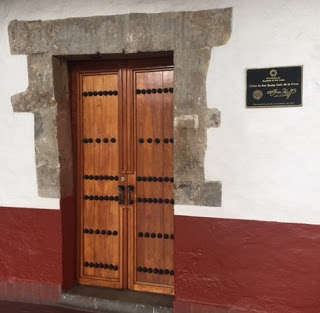
Door to the quarters of Sor Juana Inés de la Cruz, “the Tenth Muse.” Photo by C.M. Mayo, 2017.
Late last year my amiga the brilliant short story writer Paula Whyman invited me to send a “Dispatch from Mexico City” for her new magazine, Scoundrel Time. So I dialed in to Muse HQ…
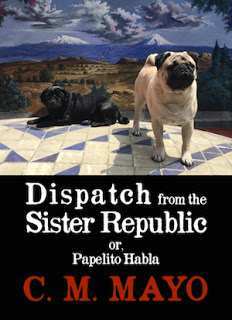
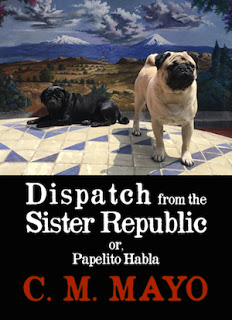
As I told Paula, woefully past the deadline, I had asked the Muse for a slider, a yummy little note about books in Mexico, but she delivered the whole ox. In other words, my “Dispatch from the Sister Republic or, Papelito Habla”is a novela-length essay about the Mexican literary landscape, from prehispanic codices to contemporary writers. It is what it is, I don’t want start chopping (there would be blood!!), but of course, a 30 page essay is too long for a magazine.
Scoundrel Time will be publishing an excerpt about Alvar Nuñez Cabeza de Vaca’s Relación-– a nearly 500 year-old memoir little known outside of Mexico and Texas, yet that stands as one of the most astonishing and important books ever written. (As soon that goes on-line, I will be sure to link to it from here. Read the piece about Cabeza de Vaca in Scoundrel Time here.)
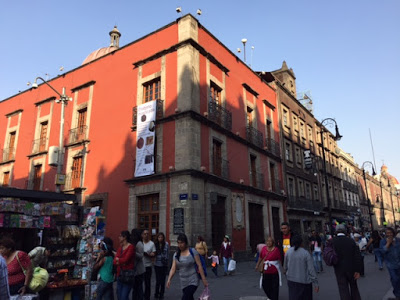
For rare book collectors, Mecca is Mexico City’s Colonia Centro, and for such aficionados of mexicana as myself, its sanctum sanctorum, the Librería Madero—by the way, recently relocated from the Avenida Madero to the Avenida Isabela La Católica, facing the the formidable wedding cake-white corner of the 16th century ex-convent of San Jerónimo, known today as the Claustro de Sor Juana, that is, the Convent of Sister Juana.
And if you would not know Sor Juana from a poinsettia, gentle reader, with all respect, you must crowbar out that boulder of ignorance, for which you will be rewarded by a glimpse of the diamond of the Mexico’s Baroque period, the first great Latin American poet and playwright, “the Tenth Muse,” a cloistered nun.
Texan poet John Campion was the first to translate Sor Juana’s magnum opus, “Primero sueño,” as “The Dream,” in 1983. (Alas, that date is not a typo.) Campion’s translation is out of print, but he offers a free PDF download of the text on his website, worldatuningfork.com. The first lines of Campion’s translation beautifully capture Sor Juana’s uncanny power:
Pyramidal death-born shadow of earth aimed at heaven a proud point of vain obelisks pretending to scale the Stars
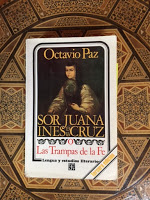
In her time Sor Juana was one of the most learned individuals, man or woman, in the New World, and her prodigious oeuvre, from love poems to polemics, comedies to enigmas to plays to villancicos, was exceptionally sophisticated, so much so that its interpretation is today the province of a small army of sorjuanistas. As Mexico’s Nobel laureate poet Octavio Paz writes in Sor Juana: Or, the Traps of Faith (translated by Margaret Sayers Peden), “A work survives its readers; after a hundred or two hundred years it is read by new readers who impose on it new modes of reading and interpretation. The work survives because of these interpretations, which are in fact resurrections.”
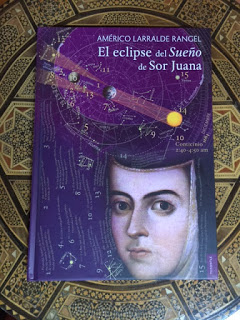
And perchance startling discoveries. In his 2011 El eclipse del Sueño de Sor Juana, Américo Larralde Rangel makes a radiant case that her “Primero Sueño” describes the dawn over Mexico City after a lunar eclipse on the solstice of the winter of 1684.
In the Librería Madero I find on the first shelf, facing out, two new books by sorjuanistas: one about Sor Juana’s family, another, just published by a Legionario de Cristo, that purports to decipher her twenty enigmas. The latter work incorporates a series of contemporary paintings of Sor Juana in the baroque style—dim backgrounds, crowns and scepters of flowers, and afloat above her head, fat-tummied cherubs, flounces, unspooling bundles of draperies. But these Sor Juanas look too pert, make too coy a tilt of the head. It seems to me as if, session over, the model might have just tossed off that habit to wriggle into some yoga wear.
Yes, just as in the United States, in Mexican cities yoga studios have been popping up like honguitos.
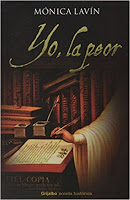
But if a vision of modern Mexico would have been obscure to Sor Juana, by no means is Sor Juana obscure in modern Mexico. She has inspired scores of poets and musicians; there have been movies, documentaries, and novels, most recently, Mónica Lavin’s 2009 best-seller Yo, la peor (I, the Worst—yet to be translated into English—fingers crossed that Patricia Dubrava will do it).
Ex-convento of San Jerónimo, now the Universidad del Claustro de Sor Juana, Mexico City. Photo by C.M. Mayo, 2017.
As I write this in 2017, Sor Juana graces the celadon-green 200 peso bill. From the portrait by Miguel Cabrera in the Museo Nacional de Historia: a serenely intelligent young woman’s face framed in a wimple, and behind her, her quills and inkpot and an open book of her poetry—and a few lines:
Hombres necios que acusáis a la mujer sin razón, sin ver que sois la ocasión de lo mismo que culpáis.
I cannot pretend to render the music of Sor Juana’s lines into English. But here’s a rough go at their literal meaning: You pig-headed men who accuse women unjustly, blind to the fact that you are the cause for that which you cast blame.
UPDATE: “Dispatch from the Sister Republic or, Papelito Habla,” my long essay on the Mexican literary landscape and the power of the book, is now available in Kindle.
#
P.S. You will find more Mexico-related posts on this blog’s Mexico page. As you will see, there are a few posts that have been migrated, and many more to go– and more as yet unlisted. Plus, ayyy, there is the whole Maximilian – Carlota blog (History of Mexico’s Second Empire / French Intervention) to do…. It will happen.
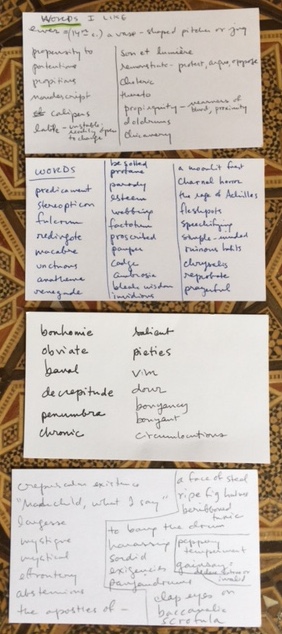
As writers, albeit human creatures of habit, we tend to use only a woefully limited portion of our vocabularies. Hence our first drafts may be stiff, dull, and vague. To add verve, freshness, and focus, it helps to loosen up our mental joints, as it were, and reach for a greater variety of words.
The challenge is not necessarily to expand your vocabulary –I am not talking about trying to sound fancy– though perhaps you or one of your characters may want to do that– but to bring more of your writerly attention to words you know but do not normally use.
Towards that end reading is vital– but not reading passively, as a consumer of entertainment, nor reading for facts and concepts, as would a scholar. Instead, read as a writer, with a pencil or pen in hand, noting down any words that strike you as especially apt or somehow, for whatever reason, attractive to you.
These might be simple words such as, say, brood; caprice; crackpot; pall; nougat; persimmon.
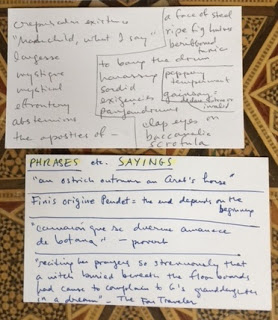
When I read I keep a notebook, PostIt, or index
card handy so I can jot down any words and phrases that I like. I used to worry
about keeping all these notebooks and bits of paper in some semblance of order,
but I now believe that most of the benefit is in simply noticing what it is
that I like; and second, writing it down. (In other words, when it comes time
to declutter, I will, as I have, and so what?) Of late I toss these index cards
in a recipe box that I keep on a shelf behind my desk. When one of my drafts
needs an infusion of energy, I pluck out a random batch of cards, shuffle
though them, and see if anything might be of use. Often it is.
From another card plucked out at random:
shrewd sagacious “intrigue and shifting loyalties” surmise astute console relentless do not relent never relent; pout nuanced verdict deadly banal banalities dejected munificence fail to grasp thieving toad
Thieving toad! I don’t know why, that
makes me laugh. And it makes me want to start (or perhaps end?) a short story
thus:
She failed to grasp that he would never relent,
he was a thieving toad.
I also note phrases and sayings I like, e.g.:
“Trust in Allah, but tie your camel.”
“Birds of prey don’t sing”
“the apostles of — ”
“camarón que se duerme amanece de botana” (the shrimp that sleeps wakes up as an appetizer– that’s a variation on the old Mexican saying, “the shrimp that sleeps is carried off by the current.”)
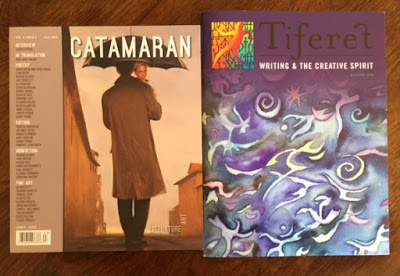
While it is a joy to be able to publish without gatekeepers– joy enough that I for one have been blogging every Monday and oftentimes more often since 2006– a curated presentation of poetry and prose, that is, the traditionally edited literary magazine on ye olde paper, has not disappeared, nor will it, and thank goodness.
As an ex-literary magazine editor myself (Tameme), I have a big heart full of appreciation for such magazines. And when they are as unique, and as beautifully edited and exceptionally well-designed as these two, I want to get up on the top of the roof and toot a tuba– or something!
CATAMARAN LITERARY READER
Founding editor Catherine Segurson describes Catamaran
as “pages full of color, inviting images, and engrossing stories, poems and
essays—all from curious and inventive minds.”
Indeed: standouts in this issue include a poem
and an essay by Richard Blanco, and the
several paintings by Bo Bartlett, whose “Via
Mal Contenti” graces the cover. More about artist Bo Bartlett in this
brief video:
Catamaran makes a special effort to
include literary translation in every issue. N.B.: Catamaran’s contributing
editors include essayist and translator Thomas Christensen and
poet, teacher, and noted translator Zack Rogow.
“Thank you for this journal which combines spiritual issues, imaginative issues, esthetic issues. All of those, I think, need to be in the mix for the richly lived life, the richly observed life.”
This Fall 2016 issue opens with a splendid essay
by poet Mark Doty, “Luckier / Rowdyish, Carlacue, Wormfence and Foosfoos.” Just
for that yonder-galaxy-beyond-the-Cineplex-title: Another thank you!
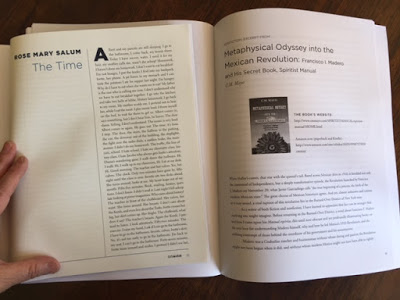
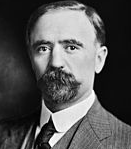
ABOUTFRANCISCO I. MADERO, Leader of Mexico’s 1910 Revolution; President of Mexico, 1911-1913
My piece in Tiferet about Madero’s 1911 Spiritist Manual did not include any of my translation, but you can read some of that here. Caveat: If you are unfamiliar with metaphysics you might find Madero’s Spiritist Manual… oh, I guess I would say… wiggy-zoomy.
In which case, I invite you to read my book about that book, my own wiggy-zoomy attempt to give it some cultural-historical-political context, which is available from amazon and other major sellers, and the website offers several lengthy excerpts, as well as extentive Q & A, a podcast of my talk for the University of California San Diego US Mexican Studies Center, the Centennial Lecture for University of Texas El Paso, and several other talks and interviews here. (My personal fave is Greg Kaminsky’s Occult of Personality.)
P.S. & P.S.S.
P.S. For those of you, dear readers, looking to
publish in literary magazines, everything I have to say about the oftentimes
crazy-making lottery-like ritual is here. If
you are audacious enough to start your own journal, I say, go for it! Please!
(But bring a case of apirin and a few wheelbarrows of dough. The green kind.) I
have more to say about literary magazines, past, mine, and future, here.
And for an interview with an editor who managed to establish an unusual level
of financial viability, be sure to check out my podcast
interview with Dallas Baxter, founder of Cenizo Journal.
P.S.S. If you’re wondering what’s up with Marfa Mondays, stay tuned,
the long overdue podcast 21 is still in-progress. Listen in to the other 20
podcasts posted to date here.
Mexico has been very much on my mind these past days because I have been working on some translations of works by Mexican writers Agustín Cadena and Rose Mary Salum... more news about those soon… and also (not entirely a digression from the book in-progress about Far West Texas) I have been working on an essay about books in Mexico entitled “Dispatch from the Sister Republic.”
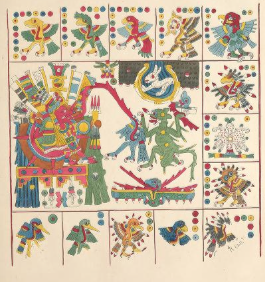
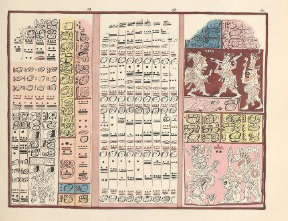
The Dresden Codex was water-damaged in the firebombings of World War II. Fortunately for us, around 1825, a facsimile had been made by the Italian artist Agostino Aglio, commissioned by the Irish peer Edward King, Lord Kingsborough—the latter a believer in the theory, to become an article of faith for the Mormons, that the Mesoamericans were descendants of one of the Lost Tribes of Israel.
Aglio’s facsimile is included in Kingsborough’s colossal multi-volume Antiquities of Mexico. And when I say “colossal” I do not exaggerate. In those days before photography, Lord Kingsborough sent Aglio all over Europe, to the Vatican Library, the royal libraries of Berlin, Dresden, and Paris, and the Bodleian Library at Oxford, among many others, to copy their Mexican codices, painstakingly tracing the elaborate diagrams and glyphics, and then coloring them in. Aglio also made paintings of Mexican sculptures and other artifacts in European collections. The whole project, from making the fascimiles to the state-of-the-art color printing and luxury binding, was at once a visionary contribution to world culture and an extravagance beyond folly. It could be said that Antiquities of Mexicokilled Lord Kingsborough; having exhausted his liquidity before paying for the paper, he was imprisoned in Dublin, where he contracted typhoid.*
[*Sylvia D. Whitmore, “Lord Kingsborough and His Contribution to Ancient Mesoamerican Scholarship: The Antiquities of Mexico,” The PARI Journal,Spring, 2009]
Lord Kingsborough never made it to Mexico, but it was in Mexico City, on a tour of the Biblioteca Vasconcelos, that I saw one of those volumes of Antiquities of Mexico up close. That particular volume was part of the personal library, then recently acquired, of Carlos Monsiváis, one of Mexico’s most esteemed journalists and leftist social critics, who died in 2010. I could not tell you which volume of Antiquities of Mexico it was nor why nor how it was separated from its fellow volumes in its set, nor why nor how Monsiváis, famous for his witty musings on Mexican popular culture, had acquired it.
The librarian, wearing white gloves, strained to lift the volume off its shelf. Bound in navy-blue Morrocco leather, it was the size of a small suitcase. With the grimace of a weight-lifter, he slowly lowered it onto the table. He levered up the cover, then turned a couple of the pages. The colors of the prints of Aglio’s paintings of the leaves from a codex— red, yellow, turquoise, ochre— were as bright as if painted that morning.
I later learned that that single volume weighed some 65 pounds.
UPDATE: “Dispatch from the Sister Republic or, Papelito Habla,” my longform essay on the Mexican literary landscape and the power of the book, is now available in Kindle.
This finds me working
on the
book on Far West Texas, and about to resume the Marfa Mondays podcasts (20
podcasts posted so far, 4 more to go, listen in anytime). I just
posted a brief video of my visit last November to see, among other wonders and
curiosities, a most extraordinary and controversial statue at the El Paso
International Airport.
Because of the way it is placed, directly behind a grove of extra-fluffy trees,
and at the entrance where most drivers, speeding in, are on the lookout for
signs, such as rental car return, departures, arrivals or parking, I
daresay few passersby would even notice the statue. I myself drove by it more
times that I would like to admit before I realized it was there.
Here’s my 3 minute video:
My video mentions “The Last Conquistador,” a magnificent documentary about this statue and the controversy. Watch the trailer:
POV Interactive offers the first clip of “The Last Conquistador” documentary:
For “Behind the Lens POV PBS”
Cristina Ibarra and John Valadez Talk about the Juan de Oñate Sculpture:
I’ll give the sculptor, John Sherrill Houser, the last word, quoting him from the documentary:
“Here it is, look at this and think about it, good and bad, the whole thing. The history.”
I am the featured member interview this month in the Biographers International newsletter. Herewith:
BIOGRAPHERS INTERNATIONAL: What is your current project and at what stage is it?
C.M. MAYO: I’m at work on World Waiting for a Dream: A Turn in Far West Texas, not a biography properly so-called, but the narrative weaves in some history and so encompasses a number of biographical vignettes from Alvar Nuñez Cabeza de Vaca, the conquistador who got lost, to some of the contemporary artists working in Marfa. Stage: still banging out the first complete draft.
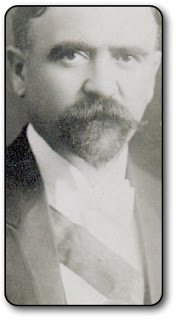
Francisco I. Madero, leader of Mexico’s 1910 Revolution and President of Mexico, 1911-1913.
Madero was the leader of Mexico’s 1910 Revolution and President of Mexico from 1911-1913, so the fact that he was a Spiritist medium and, albeit under a pseudonym, author of a book of Spiritism published in—yes—1911, is a dramatic twist in the paradigm of how we understand the spark of the Mexican Revolution.
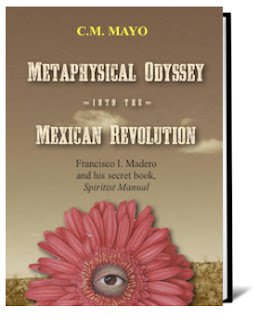
My book, which includes my translation of Madero’s book, was published in 2014, so I am well into the promotion stage. (I’m delighted to report that Metaphysical Odyssey into the Mexican Revolutionwon the National Indie Excellence Award for History, and to date, I’ve given talks about it at Mexico City’s Centro de Estudios de la Historia de México, Rice University, Stanford University, UCSD’s Center for US-Mexico Studies, and the University of Texas El Paso, among other venues.)
> Listen to and/or read some of my talks about this book here.
BI: What person would you most like to write about?
C.M. MAYO: At the moment, because I’m writing about Far West Texas, pioneer petroleum geologist Wallace E. Pratt. I am especially intrigued that he would choose to live for many years in a such an isolated place as McKittrick Canyon, deep in the Guadalupe Mountains. It is, in large part, thanks to Pratt’s visionary gift that we now have the Guadalupe Mountains National Park. I am very honored to say that I will be one of the artists-in-residence in the Guadalupe Mountains National Park this spring, so I will have the chance to retrace his steps and visit his house.
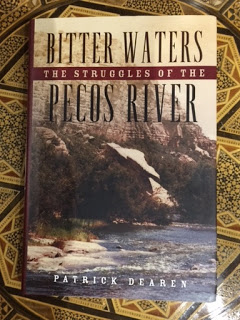
BI: Who is your favorite biographer or what is your favorite biography? C.M. MAYO: As far as my Far West Texas reading goes, I both admired and especially relished the biography of the 20th century bard of Texas, J. Frank Dobie: A Liberated Mind, by Stephen L. Davis. Many of the popular ideas we take for granted about Texas and Texans have their roots in Dobie’s works.
BI: What have been your most satisfying moments as a biographer?
C.M. MAYO: I’ll answer this for my book on Francisco I. Madero, Metaphysical Odyssey into the Mexican Revolution. After many years of reading and archival research, it was tremendously satisfying to be able to fit together the pieces of what had been a humdinger of a puzzle—how could Madero be rifle-toting revolutionary and a Spiritist, a savvy political organizer and victim of a coup d’etat?— into a narrative of high strangeness but relative sense. Suddenly Mexico itself looked very different.
BI: One research/marketing/attitudinal tip to share?
C.M. MAYO: As a biographer I have only published the one title, however, I have published several other works of fiction and nonfiction, so I do have more than a little experience about this perennially mystifying and consternating topic.
My short answer is three words: sports psychology helps.
My long answer is: take consistent resilient actions, answer the email that deserves an answer, write an op-ed if you can, and be generous (what goes around comes around, albeit willynilly). The true reward is in the writing itself. It is a wondrous privilege to be able to write at all. Don’t ignore the “publishing business,” but don’t take it too seriously, either. Books can have deeply strange destinies. After all, they are magical time travelers.
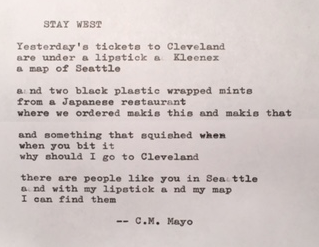
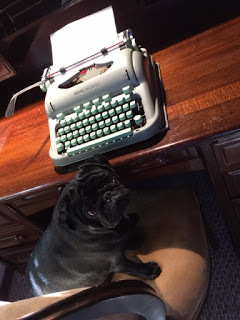
My first attempt at typing on a typewriter in nearly thirty years. From: Meteor.
My writing assistant denies any and all responsibility for slipshod typing or head-scratching sushi poetry.
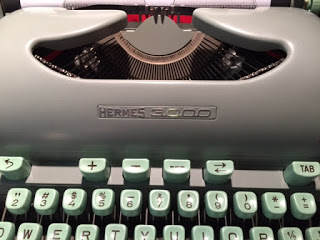
Thank you, Typewriter Techs!My refurbished 1961 Hermes 3000 typewriter has arrived in Mexico City. Typewriter Techs, the Riverside, Illinois company that refurbished it, shipped it to California in a box so well padded it could have survived a Mars landing; having discarded the packing materials and box, I then grew some new biceps carrying it on board my flight home. I’d say it weighs about the same as a wet brick. It was a loooooong way from the security screening area to the gate. Jack LaLanne, watch out.
No, not the French scarf and tie and stupendaridiculously-expensive-whatnots company. This Hermes was of Swiss manufacture of yore.
The color is just as I had hoped, a foamy celadon (although it looks gray in this photo— too strong a flash).
LIKE TIME TRAVELING
I’m old enough to have had nearly two decades of experience with typewriters, both manual and electric, before I started using a computer in the late 1980s. It was an eerie experience to type on a typewriter again… like time traveling.
My first attempts at typing on this antique were clumsy, since I am, as are we all, so used to letting fingertips fly over a laptop’s keys and making scads of corrections en medias res and whatever whenever wherever and with the benefit of, after penicillin and sliced bread, the bestest thing ever invented: CNTRL Z!
Madam Mayo says, The Anti-Digital Revolution will be Youtubed! And blogged! And, when I get around to it, tweeted! Git yer iron-knee right here, on a spatula! But seriously, check out this fine trailer for philosopher Richard Post’s excellent and thought-provoking resource The Typewriter Revolution.


“The 3000 model is a Swiss segment-shifted typewriter with excellent alignment, smooth carriage return, and quality manufacturing, introduced in the fifties. You’ll find it in a wonderfully bulbous body, painted in a color that some call “sea-foam green”… Not the very fastest or snappiest typewriter, but “buttery” in its smoothness, as fans like to say… Users include Larry McMurtry, Sam Shepard, Eugene Ionesco, and Stephen Fry.”
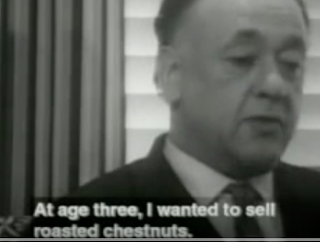
A tip of the Stetson to my fellow Texan Mr. McMurtry. As for Monsieur Ionesco, voila l’entrevue:
Watch the interview with English subtitles here. No, alas, Ionesco’s Hermes 3000 does not make an appearance. Mais nous pouvons utiliser notre imagination.
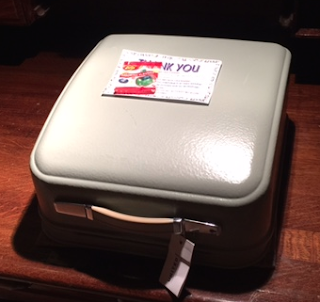
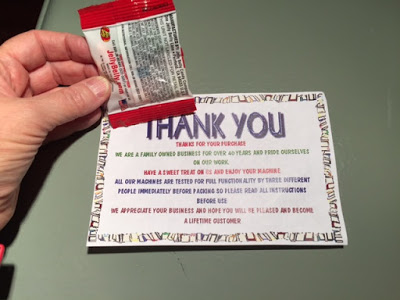
My 1961 Hermes 3000 arrived in its original carrying case along with, LOL, total yay, a packet of jellybeans!!
Under the jellybeans, a message from Typewriter Techs…
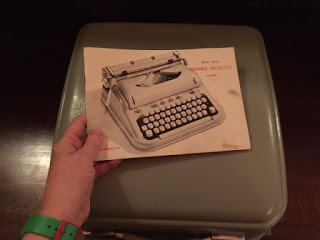
The original 1961 Hermes 3000 instruction manual. (Ha! Will those websites and YouTubes still be available and playable in 55 years? You reeeeeeaaaaaaalllly think so…?)
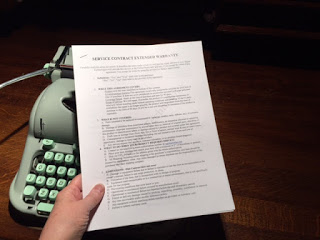
The warranty, yay, from Typewriter Techs.
I WILL NOT PANIC ABOUT TYPEWRITER RIBBONS NO I WILL NOT PANIC
Although we now inhabit a consumersphere rife with such ecologically exploitative poppycock as single-serve Nespresso capsules… it is nonetheless easy-peasy to find typewriter ribbons that work for multitudinous models and makes of typewriters. I knew that from reading Polt’s The Typewriter Revolution, and a quick Google. Furthermore, Typewriter Techs included this with their shipment:
In case you cannot read the image and/or your
brain, like mine, goes into blur mode WITH ANYTHING WRITTEN PLEASEGODWHY
ALL IN CAPITAL LETTERS, it says:
“ALL ABOUT RIBBONS
“In the 1950s ribbon sales topped 50 million annually, they were the toner of their day. But unlike toner most typewriters will take the same ribbons. There are several direct replacement ribbons available for most machines. If you cannot find one, don’t panic. The ribbon itself is identical, only the spool changes. We recommend you purchase the genetic black., or black and red ribbon and rewind it onto your current spools. This is the least expensive and guarantees a correct fit. You can also contact us we stock a large variety if replacement ribbons.
“Cloth ribbons will hold more ink than nylon. Cotton will soak up the ink, nylon it just lays on top of it. A typical ribbon should last about 900,000 characters or about 180,000 words… That’s around 500 pages. A good quality ribbon will transfer the ink without leaving excessive ink on the type bars or pages. If the entire type slug is covered in blue, it’s probably not a good ribbon to use again. Black only ribbons can be turned upside down and doubled in life.”
YE PAD
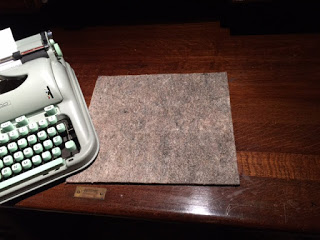
A related and most felicitous purchase was the Jackalope typewriter pad. Definitely it cuts the noise.
The typewriter pad. Land o’ Goshen, why didn’t I use one of these before?
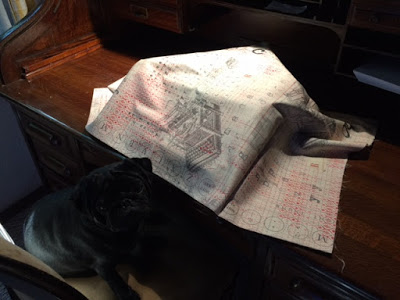
LAST BUT NOT LEAST, YE LOVELY TYPEWRITER FABRIC
My writing assistant remains confused but pugfully blasé.
A most thoughtful holiday gift from my sister’s dog (yes, in our family the dogs give presents): this yardage of neat-o typewriter fabric and I do like it draped over the Hermes, just so. Nope, I am not going to attempt anything on a sewing machine, the typewriter is my own personal Mount Everest for the moment. Must get typing.
Strange, muscled, riven with grief, Blume Lempel’s short stories, many set in the U.S., are for the ages. Yet because Lempel wrote in Yiddish, few aficionados of the form have had the chance to read her— until now, with the translation by Ellen Cassedy and Yermiyahu Ahron Taub, Oedipus in Brooklyn and Other Stories.
“Lempel (1907–1999) was one of a small number of writers in the United States who wrote in Yiddish into the 1990s. Though many of her stories opened a window on the Old World and the Holocaust, she did not confine herself to these landscapes or themes. She often wrote about the margins of society, and about subjects considered untouchable. Her prize-winning fiction is remarkable for its psychological acuity, its unflinching examination of erotic themes and gender relations, and its technical virtuosity. Mirroring the dislocation of mostly women protagonists, her stories move between present and past, Old World and New, dream and reality…
“Immigrating to New York when Hitler rose to power, Blume Lempel began publishing her short stories in 1945. By the 1970s her work had become known throughout the Yiddish literary world. When she died in 1999, the Yiddish paper Forverts wrote: ‘Yiddish literature has lost one of its most remarkable women writers.'”
Ellen Cassedy, translator, is author of the award-winning study We Are Here, about the Lithuanian Holocaust. With her colleague Yermiyahu Ahron Taub, they received the Yiddish Book Center 2012 Translation Prize for translating Blume Lempel.
Yermiyahu Ahron Taub is the author of several books of poetry, including Prayers of a Heretic/Tfiles fun an apikoyres (2013), Uncle Feygele (2011), and What Stillness Illuminated/Vos shtilkayt hot baloykhtn (2008).
Translators Yermiyau Ahron Taub and Ellen Cassedy
C.M. MAYO: Can you tell us more about Yiddish as a language, and specifically, its roots and connections with other languages, including German and Ladino?
ELLEN CASSEDY & YERMIYAHU AHRON TAUB: Yiddish is a Germanic language written in the Hebrew alphabet. For hundreds of years, it was the everyday vernacular spoken by Jews in Eastern Europe. While Ladino became the Spanish-inflected language of Jews in the Mediterranean region, Yiddish was the everyday language among Jews living farther north, in Germany, Russia, and Eastern Europe.
YERMIYAHU AHRON TAUB: There is an alternative theory that Yiddish is essentially a Slavic language, but most scholars believe it’s a Germanic language.
ELLEN CASSEDY: For me, Yiddish is a holy tongue. Translating Yiddish connects me to a history, an enduring cultural legacy. Yiddish is precious to me for its outsider point of view, its irony, its humor, its solidarity with the little guy, its honoring of the everyday.
YERMIYAHU AHRON TAUB: The Yiddish language has been a crucial tool for my literary work. As a bridge to the past and an enhancement of my literary and social present, Yiddish opens a vibrant linguistic plane, full of texture, play, and reference. Yiddish is for me a place of primal connection and, for all its and my “baggage,” a source of strange comfort. Writing, reading, and translating Yiddish also allows me to learn new Yiddish words and re-learn forgotten ones.
Blume Lempel
C.M. MAYO: You write in the introduction that for Blume Lempel the “decision to write in Yiddish was a carefully considered choice.” What do you think motivated her to write for what was already a quickly shrinking readership?
ELLEN CASSEDY & YERMIYAHU AHRON TAUB: For Lempel, Yiddish was a portable homeland that served her well as she encountered new circumstances and new languages. Born in 1907 in a small town in Eastern Europe, she immigrated to Paris and then fled to New York with her family just before World War II. Until her death in 1999, writing in Yiddish enabled her to express her connection to those who had perished in the Holocaust – as she put it, to “speak for those who could no longer speak.”
Writing in Yiddish also afforded a kind of “privacy.” Lempel wrote about subjects considered taboo by other writers – abor—ion, rap—, erot— imaginings, even inc—st.* Would she have felt free to exercise the same artistic freedom in English? Perhaps not.
*[C.M.: Massive apologies for inserting these ridiculous dashes but if left in plain English, which I am sure that you, gentle reader, can figure out, the Google bot may, in the Byzantine wisdom of its algorithms, send this blog into SEO netherworlds.]
But if Lempel needed privacy for artistic freedom, she also wanted recognition and worked hard to get her work out to a wider audience. Her efforts paid off. Over the years, she won widespread admiration among Yiddish writers and readers and received numerous Yiddish literary prizes.
C.M. MAYO: What do you think would have been lost in these stories had Lempel written in English? This is another way of asking, what were the biggest challenges for you as translators?
ELLEN CASSEDY: I don’t put much stock in the idea that some literary qualities can be expressed only in their original language. For me, what’s important is the fluidity and freedom that Lempel herself experienced, which resulted in the extraordinary richness of her prose. I’m not sure she could have attained such heights in a language that was not part of her very being from girlhood on.
YERMIYAHU AHRON TAUB: As we translated, we encountered surprises at every turn—in virtually every paragraph, and on every page. Lempel’s prose is so poetic and rich that we had to exercise special care to capture her unique melody.
Sometimes we had to accept uncertainty, realizing we wouldn’t be completely certain of Lempel’s meaning even if her text had been written in English. It was immensely satisfying to work with a partner, to be able to bounce ideas off each other, and to know that our interchange would strengthen the final version.
ELLEN CASSEDY: Lempel’s narrations move between past and present, often several places on the same page, from Old World to New, from fantasy to reality. Imagine the conversational matter-of-factness of a Grace Paley combined with the surreal flights of a Gabriel Garcia Marquez.
C.M. MAYO: Can you also talk about how it was to work together as co-translators?
ELLEN CASSEDY: Working together was a joy. Once we’d selected the stories, each of us chose our favorites and produced first drafts. Then the other one carefully went over those drafts and made suggestions.
I was brought up to pay very close attention to the wonders of the English language. Every family dinner included at least one trip to the dictionary. I brought that intense involvement with English to the translation table.
YERMIYAHU AHRON TAUB: Working together has been joyful, yes… but also humbling. One had to be open to another’s suggestions and feedback throughout the process. There was a lot of give and take, back and forth about meaning, the best turn of phrase, etc. Of course, every book, even one by a single author (and no translators), is a collaboration of some kind—with the publisher, editor, cover artist, designer, etc. But collaboration on the text— of every word of it—is much more so. I’ve learned a great deal from this process—about translation, about myself … and about Ellen!
Of course, this collaboration is still an ongoing process, as we complete interviews and embark on speaking engagements on behalf of the book. I feel so fortunate to be working with Ellen.
ELLEN CASSEDY: Back at you, dear partner!
C.M. MAYO: Do you think Lempel’s visibility as a literary artist, and her life, might have been different had she written in English?
ELLEN CASSEDY & YERMIYAHU AHRON TAUB: Absolutely. The Yiddish literary circle after World War II was far-flung but cohesive, and she thrived within it. Yiddish publications all over the world carried her work. She received prizes in Israel, Canada, and the U.S. When she died, the Yiddish paper Forverts wrote: “Yiddish literature has lost one of its most remarkable women writers.”
Despite her success within the Yiddish literary sphere, though, she always dreamed of an English-language readership. Although a few individual stories of hers appeared in journals and anthologies, there has been no full-length collection in English until now. It’s a joy for us to help her unrealized dream come true.
C.M. MAYO: What inspired you to translate Yiddish?
ELLEN CASSEDY: Years ago, when my Jewish mother died, I decided to study Yiddish as a memorial to her and a way to sustain ties with my Jewish forebears on both sides of the Atlantic. I was also looking for a home within Jewish culture, and I hoped Yiddish language and literature would provide that home. And indeed it has!
YERMIYAHU AHRON TAUB: Yiddish was a part of the ultra-Orthodox yeshiva world in which I was raised. I studied it formally as an adult and have been engaged in Yiddish culture since the early 1990’s.
C.M. MAYO: What brought you to translate Blume Lempel?
ELLEN CASSEDY: Early on, when I told my Yiddish teacher I wanted to try my hand at translation, he went to his bookshelf and pulled out a little volume– Blume Lempel’s first collection, personally inscribed to him by the author. When I met Yermiyahu Ahron Taub in a Yiddish reading group, we decided to look into this volume. We were astounded to find truly unique writer with a dazzling lyrical style, an unparalleled compassion for her characters, a startling diversity of settings, and a daring range of subjects.
YERMIYAHU AHRON TAUB: It didn’t take long for us to decide we had to translate these splendid stories so that they could reach the wider audience they so richly deserve.
C.M. MAYO: If you could select one short story as the most representative of her work, which one would it be, and why?
ELLEN CASSEDY: It’s hard to choose, because Lempel’s range of settings and characters is huge. She tells truths about women’s inner lives that I’ve never encountered anywhere else.
“Waiting for the Ragman” is particularly rich in its description of life in a small Eastern European hometown, including a loving description of preparation for the Sabbath.
And I have to mention the title story, “Oedipus in Brooklyn.” Lempel masterfully draws you into the story of a contemporary Jewish mother and her blind son as they move inexorably toward their doom.
YERMIYAHU AHRON TAUB: “Her Last Dance” tells the story of a Jewish woman forced to rely on her wits and beauty to survive wartime Paris. Despite its small scale, it evokes for me the work of Irène Nemirovsky and Nella Larsen (Passing). In capturing the desperation of a woman on the edge, it reminds me of Edith Wharton’s The House of Mirth.
“The Invented Brother” captures the poignant emotions of a young girl whose beloved older brother is swept away into revolutionary activity.
C.M. MAYO: In one of the many blurbs for this collection, Cynthia Ozick calls Blume Lempel “a brilliantly robust Yiddish-American writer. Why should Isaac Bashevis Singer and Chaim Grade monopolize this rich literary genre?”
Can you tell us more about some of the writers Blume Lempel would have been reading and corresponding with in Yiddish? (Did she know Menke Katz?)
ELLEN CASSEDY & YERMIYAHU AHRON TAUB: Avrom Sutzkever, the “dean” of postwar Yiddish poetry, was an admirer, and a mentor. She was admired by other leading Yiddish writers as well, including Yonia Fain, Chaim Grade, Malka Heifetz-Tussman, Chava Rosenfarb, and Osher Jaime Schuchinski.
And yes, she did know the New York poet Menke Katz. We found several warm letters from him within her papers.
C.M. MAYO: Of those writers not writing in Yiddish, which were important influences for Lempel?
ELLEN CASSEDY & YERMIYAHU AHRON TAUB: She was one of a kind. When an interviewer asked which writers had influenced her, she mentioned Sigmund Freud, the father of psychoanalysis, and the philosophers Spinoza and Bergson, but only in passing. She didn’t feel part of any school or tendency.
The key to reading this amazing writer is to approach her work without preconceived expectations of what fiction should be. Open yourself up to the twists and turns, the possibilities. You’re in for a wild and wonderful ride.
C.M. MAYO: How do you see the future of Yiddish?
YERMIYAHU AHRON TAUB: That’s a big question. Yiddish is still the lingua franca of various Hasidic communities in Israel and the Diaspora. One can see Yiddish signs, for example, in Monroe, N.Y., Monsey, N.Y., and Williamsburg, Brooklyn, among numerous other places. Of course, Hebrew encroaches in Israel, and English encroaches in the United States. Still, I don’t foresee Yiddish fading away in those communities any time soon. Hasidic communities believe in Yiddish as a bulwark against the encroaching “dominant” culture.
In terms of secular Yiddish culture, a small number of families are committed to raising their children in Yiddish. And there is considerable artistic and intellectual activity in the realm of Yiddish culture – panels on Yiddish at Association for Jewish Studies conferences, concerts, gatherings, and festivals dedicated to Yiddish, and releases of books and compact discs.
Translation is a particularly rich area of contemporary Yiddish culture. A recent anthology called Have I Got a Story for You: More Than a Century of Fiction from the Forward (Norton, 2016), edited by Ezra Glinter, demonstrates the work of numerous Yiddish translators active today. Of course, some would argue that that itself is a sign of demise. I don’t see it that way. Translation requires knowledge of both linguistic contexts.
Do I think all of this qualifies as a rebirth? Not exactly, but nor do I see Yiddish as dead, dying, or even endangered really.
C.M. MAYO: Have Lempel’s stories had an influence on you as a writer, and if so, how?
YERMIYAHU AHRON TAUB: It’s hard to know if Lempel’s stories have influenced me as a writer or if I was drawn to her because of my pre-existing interests. Certainly, we both share an interest in the realms of the marginal and the “outsider,” although we might have differing perceptions of who is marginal or an outsider. We also share an interest in poetry and poetic language, and the blurring of the line between poetry and prose. I certainly consider Blume Lempel to be a kindred writerly spirit and an inspiration.
C.M. MAYO: What’s next for you as writers and translators?
ELLEN CASSEDY: I’m currently seeking a publisher for my translation of fiction by the Yiddish writer Yenta Mash, who grew up in Eastern Europe not far from Blume Lempel. I’m excited to have won a PEN/Heim translation grant – the first ever for a Yiddish book – to support this work.
YERMIYAHU AHRON TAUB: A new collection of my poems is currently in the publication process. Six of the poems also have a Yiddish version, which raises all sorts of translation and design challenges.
ELLEN CASSEDY & YERMIYAHU AHRON TAUB: And of course we’re getting the word out about the Blume Lempel collection. It’s exciting to introduce English-language readers to these stories with their dazzling prose and their bold approach to storytelling.
Visit Ellen Cassedy at her webpage here. Visit Yermiyahu Ahron Taub at his website here.
And if you’re in the Washington DC area, don’t miss the launch at Politics & Prose Bookstore:
Sunday, January 8, 1 pm Politics & Prose Bookstore 5015 Connecticut Ave NW Washington, DC 20008 The event is free with no reservation required. Oedipus in Brooklyn and Other Stories by Blume Lempel Translated by Ellen Cassedy & Yermiyahu Ahron Taub Mandel Vilar Press & Dryad Press, 2016
BIG FAT CAVEAT: If you have a job and/or family situation that oblige you to use your smartphone like a bodily appendage, dear reader, a shower of metaphorical lotus petals upon you, but this post is not for you. Perhaps you might enjoy reading this post from 2012 instead. See you next Monday.
The challenge in a pistachio shell: How to maximize the quality of one’s email, both incoming and outgoing, while minimizing the time and effort required to dispatch it— all the while maintaining the blocks of uninterrupted time necessary for one’s own writing?
What works for me may not work for you, dear reader, but I know that many of you are also writers, and a few of you are artists and/or scholars, so perhaps—and here’s hoping— my time-tested 10 point protocol for dealing with email will be of as much help to you as it has been to me.
A PRELIMINARY NOTE ON CONTEXT: EMAIL!!!!!!!!!!!!!!!!!!!!!!!!!!RRRRRRR
How is a writer to cope with this snake-headed conundrum-o-rama that just about everyone everywhere has been wrestling with since it first emerged out of the DARPA-depths of this rapacious fabulosity we call the Internet?
I’ve been slogging it out with email for more years than I care to count. It was sometime in the mid-1990s when I logged on to my first account; I but fuzzily recall the roboty-dialup-and-connection sounds and an inky screen with neon-green text. A few years after that, I was using this cutting-edge thing called an AOL account. (Whew, AOL, Paleolithic!) Now I use a nearly-as-ancient yahoo account plus a pair of gmail accounts all funneled into ye olde Outlook Express inbox, into which pour… pick your metaphor…
(a) Rains! (b) Niagaras! (c) Avalanches! (d) Gigazoodles of emails!
As anyone who remembers the late 1990s will attest, it seemed that overnight email blossomed into a hot-house monster—or, I should say, a Macy’s Parade of monsters— and for me, by 2009-2010, when I was on tour for my novel, The Last Prince of the Mexican Empire at the same time that my father was in his last days, trying to cope with email, both professional and personal, had become a nightmare.
In 2011-2012 I was tempted to follow the example of “Swiss Miss” blogger Tina Roth Eisenberg after her three months of maternity leave: Declare email bankruptcy. Many a time I was also tempted to remove my email address from my website. Neither of those strategies appealed to me, however; I appreciated so many of those messages, and I also appreciated that, apart from spam and the occasional bit of nonsense, behind those messages were relationships that I sincerely valued, even cherished.
I also realized—and this is something I am writing about in my book on Far West Texas— that hyper-connectivity along with endless carousels of hyper-palatable distractions are now woven into the very fabric of modern life. As long as the electric grid continues functioning, I doubt these forces impinging on one’s experience of work, family, social life, politics, and travel, will diminish; on the contrary.
“hyper-connectivity along with endless carousels of hyper-palatable distractions are now woven into the very fabric of modern life.”
Over the past several years, chip by chip, I managed to whittle down that ghastly backlog (not to zero, but on some days it gets razor-close). More importantly, by trial, error, research, and mental muscle, I formulated a more workable strategy for dispatching the ongoing flow.
Again, that caveat: this post is not for those who need to be continually available to a boss, colleagues, clients, friends, or family.
IT STARTED WITH SOME ILLUMINATING READING… THEN THE FLOODLIGHTS SWITCHED ON WITH “THE MACHINE STOPS”
I gleaned many an insight and tip for managing email from:
For me the most enlightening reading of all, however, and strange to say, was a work of fiction from 1909: E.M. Forster’s “The Machine Stops.”Astonishingly, that short story written more than a century ago by an Edwardian Englishman best known for his novel A Passage to India, envisions email, texting, Facetime, and the like. It also seems Forster anticipated the American diet built around corn-syrup heavy fast food. The main character, cocooned in technology, has turned into a heartless, incurious, yet hyper-connected blob.
On reading this sci-fi horror, I realized that one needs to evaluate a technology not by its gee-whiz-what-would-Steve-Jobs-say factor, but by how it affects the body. I mean, by how it affects one’s human body, brains to toenails, now, here, on Planet Earth.
THE BODY AND TECHNOLOGY IN THE THEATER OF SPACE-TIME
(1) Assuming one can afford it, does a given technology help one realize one’s conscious intentions born of free will?
(2) Does using said technology cause one to serve or to neglect the body?
(3) Is there a better available alternative?
These are the key questions to answer for a sense of the true and full (both monetary and nonmonetary) net cost / benefit of utilizing a given technology because if your body, which by the way, includes the brain, ends up not working the way it was meant to, well, in terms of going anywhere or doing anything or interacting with other people, that more than kind of sucks.
Some metaphysicians argue that we are not our bodies, but in essence,immortal pinpoints of consciousness. It seems to me that if they’re right, after we finish up here on Planet Earth, we have forever and eternity to do what immortal pinpoints of consciousness do; and if those metaphysicians are wrong, well, then they’re wrong, and we won’t be here anymore to argue with them about it anyway.
Either way, as I write this and you read this, we are conscious, each in our place in the Theater of Space-Time. We did not arrive here encased in technology, but in our human bodies, with all their pain and joy and bones and squishiness and awkwardness and grace. Why then would we want machines to do everything and our breathing for us— unless, of course one has the crap-awful luck to require an iron lung?
I want to utilize technology not to supplant but to enhance living this life— this human life on Planet Earth. Or, to use my new favorite metaphor, to enhance my experience of being here now in the Theater of Space-Time.
Technology is not bad per se, of course; it can help us survive and even thrive. But last I checked, a quality human life requires being able to breathe, walk, see, hear, exercise, sleep, eat nutritious food and drink adequate clean water, soak up some beauty, and interact in multitudinous ways with other people. What good is a technology that turns us into blobs staring at and fiddling with screens all day, even as we neglect our relationships? (Or walk into oncoming traffic?)
On the other hand, email, like pen-and-paper-correspondence of old, is one technology, a powerful one, that when properly employed can help us work with / get along with other people. And like pen-and-paper-correspondence of old, for a writer email can be a joy.
Dead-simple observations, I’ll grant you, gentle reader.
Another dead-simple observation: Email is like any other tool in that it can be used to good or bad purpose. For example, you could use a hammer to pound down a nail that might otherwise snag your sweater, or, say, pulp your neighbor’s pet goldfish (not recommended).
And on the scale of expertise, one can use email poorly, or with world-class finesse. Let’s say, my very Aristotelian aim has been to employ email reasonably well so that it may prove useful— and without the mental drag of noodathipious flooflemoofle!
DOWN WITH NOODATHIPIOUS FLOOFLEMOOFLE!
Finally, after years of frustration and experimentation… drum roll…. I am no longer overwhelmed by email. I have not arrived at “inbox zero” because….drum roll… I am not dead!
And knowing that I am not dead, other human beings in the Theater of Space-Time continually send me emails, and I, in turn, write them back. Ping, pong. And that Medusa’s hair of a conundrum-o-rama about pinging the pongs and pongings the pings, and which pings to pong, etc., is now wrestled down, at least in my own mind, to a pretty little pretzel.
YEAH, PUT SOME MUSTARD ON IT.
Now I can sincerely say that I welcome my correspondence (ahem, email). I love to hear from friends (lunch, yeah!), family (weddings, yay!), colleagues (congrats on your new book, lotus petals upon you!), and from readers, known to me or not, I always appreciate a kind and/or thoughtful word about my books / some subject of interest / relevant to my work. I even appreciate cat videos! (Just kidding about the cat videos. But cousin A., I don’t mind if you send me a cat video.)
Herewith:
1. SCHEDULED BATCHING
For me, of all the 10 points in my method, processing emails not one or two or three at a whim, but in scheduled batches was the game-changer.
I usually do 20 minutes of email processing with a stopwatch. It’s not that I am trying to hurry through my email, but rather, I am respecting the limits of my brain’s ability to effectively focus on it. I’m a speed-reader and I can type faster than lickety-split, but on most days I can deal with email for only about 20 minutes before my brain cells run low on glucose and I end up scrolling up and down the screen, dithering, feeling scattered— in short, procrastinating. (You might be able to do 10 minutes, or, say, an hour in one go— of course, not everyone’s energy to focus on their email is the same, or the same every day and in every circumstance. One can always set the stopwatch for a different amount of time.)
Don’t believe me about batching? Check out the extra-crunchy research at MIT (PDF).
By processing email in 20 minute batches, when the sessions all add up over the arc of the day, I find that I accomplish more in, say, one hour of three separate 20 minute sessions than I would have had I plowed on for an hour straight.
When the stopwatch dings, I do not expect to have finished— “inbox zero” is a fata morgana! And that’s OK, because I have another email batch session already scheduled (a few hours later, or five minutes later. It’s important to take a break, at the very least stand up and stretch.)
Above all, because I am focussing on email at my convenience, on my schedule, my attention is no longer so fractured. I need not attempt to wrestle with each and every email as it comes in; and of course, some emails cannot or should not be answered immediately. I aim to dispatch the average daily inflow. In other words, if, net of spam, I receive an average of 30 emails per day, then I should be averaging 30 emails dispatched per day— they need not be one and the same emails. One day I might dispatch 50, and another day, 10.
The point is, there’s no there there, as long as my email account is working, barring volcanic explosions of a geological nature, I’m probably never in this lifetime going to get to inbox zero. What matters is maintaining a consistently adequate dispatching process.
The easiest way to keep track of the process is to keep a running tally of all undispatched emails as of the close of the last session of the day. (In Outlook Express, for each folder of undispatched email, select all, go to the main menu, click edit, select “Mark all unread,” and it will automatically generate a tally for that folder.)
(And by the way, when the batching session is done, I close my Outlook Express. I never, ever leave it open. And would I never, ever, use any alarm for new email.)
I used to download email into an undifferentiated inbox at random moments and, oftentimes, even as email was still downloading, start answering willynilly. How about that for an attention-fracking technique!
Now I begin each email session as I would with a haul of paper mail: first,by taking it all in; second, deleting the junk; and third, organizing the correspondence I want to look at and/or answer into precisely labeled files.
Files are easy to create and, when emptied of their contents, to delete, or rename or whatever— a powerful tool within a tool. And I cannot overemphasize how effective a simple and flexible filing system has been for helping me focus and more quickly dispatch my email.
Of course, just like a paper filing system, too many files can be counterproductive. For me, the best filing system is one that holds 15 or fewer emails per file. So if I have a bunch of files with one or two emails, I might consolidate those; if I have, say, 50 emails in one, I might to break that up into, say, two to four more files.
My filing system changes depending on what I’m working on or dealing with in my life. This week, nearing the holidays, it looks like this:
INBOX (this has whatever I’m going to tackle now, preferably never more than 11 emails)
BACKLOG: TEXAS (anything to do with my book in-progress) BACKLOG: FAMILY BACKLOG: FRIENDS & COLLEAGUES BACKLOG: FINANCIAL BACKLOG: OTHER
I do not respond to rude or certifiably ultra-weird messages, and as with businesses that spew spam,* I add those email addresses to my “block sender” list. Happily, there are not many of those, and happily, once I’ve blocked them, with lightning ease, I never see their emails again!
Out of sight, out of mind.
*(Phishers tend to use one-time only emails; those I just delete.)
Many of my writer friends agonize over emails (as well as social media comments) from trolls and nuts and spammers. I tell them as I tell you, dear reader, it really is this simple to make them all go away. The challenge is, your ego, prompted by its its arch sense of justice, might jump-up-and-down-insist on responding to them, but your ego, if it’s like most people’s, including mine, should not be in driver’s seat here. Surely you have better things to do with your time and attention than engage with emotionally stunted, social-skill-challenged, and possibly dangerously disturbed individuals. (If you lived in a big city, would you leave your kitchen’s back door open to the alleyway 24/7?)
If you relish unnecessary fights and pointless thrills, well, as they say in Mexico, dios los hace y ellos se juntan (God makes them and they get together.) I prefer the Polish saying, Not my circus, not my monkeys.
[ VIDEO ]
Viva Moti Nativ! (Seriously, I took Moti Nativ’s Feldenkrais workshop, it was a blast.)
4. PRIORITIZE & TACKLE
Stopwatch ticking, after having done the DDO, then I prioritize emails (and other related tasks as noted below), and then I tackle them.
There’s no magic formula here: I might think about it for a moment or three, then decide what should come first.
(Once dealt with, I archive each email by year. Some people just delete them; in my repeated experience, however, that is not a good idea.)
5. SWEEP OUT THE SPAM FOLDER ONCE PER DAY
I check the spam folder once per day because that is precisely about how often I find an important email in there. These days floods of spam are coming from phishers (easy to spot for many reasons, also because they vary their email addresses); those I don’t touch, I just delete them.
(I remain perplexed by correspondents who do not check their spam folders. On the other hand, checking too often wastes time—small amounts, but they add up.)
.
6. APPLY & ADJUST “SENDER FILTERS” AS NEEDED
I’m not talking about an app or programming or anything complicated. By “sender filter,” a concept I grokked an eon ago but a term I first encountered in Cal Newport’s Deep Work, I mean some specific information on one’s contact page that, ideally in a kind and generous spirit, encourages potential senders to not send email— so that, for the few emails that do squeeze through, I am able to respond quickly, politely, and thoughtfully.
My contact page includes a long lineup of sender filters: First, a newsletter signup (mainly for those who want to know when I will be teaching a workshop or post a new podcast); then it answers FAQs, such as “where can I find your books?” (I am ever-amazed by that question in this day of amazon and Google, but I do get such emails fairly often); for book club inquiries; the best way to reach me for media and speaking inquiries; answers to writerly questions (“how to find a publisher,” etc.); rights inquiries; press kits including high res images; and finally…
… (few indeed seem to have the attentional snorkel gear to arrive there at the bottom)….
… if someone still wants to email me, he will find my email address.
Like many other writers, back in pioneer days, once I had a live website showing my email address, I found myself receiving so many messages from people seeking my advice about / feedback on / encouragement of their writing, it would have been impossible to answer them all individually. As a solution, many authors have opted for what I think of as “The Wall of Silence”— no email address at all—and/or what seems to me a snotty-sounding third-person notice along the lines of “Wiggy Blip is so famous and busy being fabulously famous, he cannot possibly deign to acknowledge your email.”
Cal Newport’s various sender filters conclude as follows— I quote from his book, Deep Work: “If you have an offer, opportunity, or introduction that might make my life more interesting, e-mail me at interesting (at) calnewport.com For the reasons stated above, I’ll only respond to those proposals that are a good match for my schedule and interests.”
Of course, some emails, even from perfectly civilized and well-meaning people, do not merit a response— they presume too much, they’re eye-crossingly vague or, as in a few cases, they clearly neither expect nor invite a response. But as for myself, because my own sender filters work beautifully, my stance is that I will do my darnedest, most reasonable best to answer everyone, whether family, friends, students, literary colleague, or mysterious Albanian, who takes the trouble to write to me a civilized email.
On occasion a sender blazes past or perhaps never saw the relevant sender filter, so I reply with the link or paste-copy the text of my long-ago posted answer to their question. (For example, I am often asked by students, friends, relatives, neighbors and utter strangers if I will read their manuscript. Here’s my answer to that one.)
If you want to comment on this blog, which I sincerely welcome, click hereand what you’ll see the simplest of sender filters, stating that I read but do not usually publish comments. It works blazingly well. Trolls and their ilk took a hike, never to return! (As for my fierce-looking writing assistant, I assure you, dear reader, Uliberto Quetzalpugtl only bites cheese.)
P.S. Cal Newport’s take on some industrial-strength sender filters. Personally I would not want to use such forbidding sender filters, but for some writers, and some people, that might be the right strategy. In any event, a sender filter beats the daisies out of the Wiggyesque Wall of Silence.
UPDATE: For a good example of a strong but both friendly and polite sender filter, see publishing consultant and blogger Jane Friedman’s contact page.
FURTHER UPDATE: For a Groucho Marx-esque example of sender filters by someone whose religious ideas seem to attract trolls like bananas do fruit flies, see John Michael Greer’s page for his Druidical Order of the Golden Dawn.
7. FUNNEL IT ALL INTO MOOOOOOOOOOOORE EMAIL!
Over the past year and some I have freed up chunkoids of time and energy for email by deactivating my Facebook account, minimizing Twitter and LinkedIn (including turning off email notifications), and closing this blog to published comments.
In other words, I have reduced the number of channels for people to communicate with me, funneling as many communications as possible into ye olde email.
I tell everyone who asks, the best way to find me is by email.
Yes, I receive more email as a result, but interestingly, many of my “friends” who were so chatty & likey on Facebook rarely if ever trouble to send me email. I have also found that many of the younger generation do not respond to email. Hmmm, also interesting! (Have a nice life, kiddos!)
Well, at least we still have telephones. But sorry, don’t count on me to retrieve my voicemail, I am too busy answering email!
(What about texting and Whatsapp? Ask me again after I’ve lugged home my taxidermied hippopotamus.)
8. BE QUICK & CLEAR, MY DEAR, BUT ADD DETAIL TO CUT THE CLUTTER
The emails I send myself have a clear subject line and the text clearly calls for or implies expected action or inaction. For example, some of the younger generation in my family prefer to text rather than use email, and getting them to answer an email, such has been my experience, requires laser-like focus in this regard. Hence, subject lines like this:
Re: Super Quick URRRRRgent Question about X—
or, say:
Re: Confirming dinner at at 9 PM this Saturday
What do I mean by “add detail to cut the clutter?” Minimize the number of emails needed to arrange things by politely making specific actionable proposals and provide websites, addresses, phone numbers and any other information that your correspondent might need, and hence avoid further emails. For example, instead of blah blah blahing about when and where to maybe kind of sort of meet for coffee, go ahead and make a specific proposal, e.g., “How about if we meet for coffee at 4:30 PM this Tuesday or, if you would prefer, 5:30 next Wednesday at Café Thus-and-Such, 123 Avenue ABC.”
Cal Newport offers more detailed advice about this brain power-saving email tactic on his blog, Study Hacks and his book, Deep Work.
9. WHEN CALLED FOR, FOR HEAVENSSAKES, JUST APOLOGIZE (BRIEFLY)
10. AT THE END OF THE LAST EMAIL SESSION FOR THE DAY, REPEAT AFTER SCARLET…
[ VIDEO ]
It is a fact that for me, as well as for everyone who uses email, night falls in this Theater of Space-Time… and falls again, and again…. Funny how that happens once every 24 hours… until it doesn’t. I guess. In the meantime, some emails fall through the cracks of all good intentions.
Anyway, as Cal Newport writes in Deep Work,
“[I]n general, those with a minor public presence, such as authors, overestimate how much people really care about their replies to their messages.”
Newport’s bluntness may sound cruel. I don’t think it is; rather, he points to a cruel fact: that even when surrounded by other people, in fundamental ways we are each of us in this Theater of Space-Time alone. Writing is a technology that permits us to send thoughts from one axis of space-time to multiple others. And this is precisely why I write books— and why I read books, and why I welcome correspondence, albeit in electronic form.
And no, I am not worried that one day, should my one of my books be made into a movie starring Brad Pitt, or something, I might need to raise the Wall of Silence, or else bring on a bucket brigade of secretaries to cope with cannon-hoses of incoming emails.
Why am I not worried, pray tell?
(1) Because my 10 point system works splendidly well.
(2) Furthermore, should the need arise, it would be a simple matter to add more sender filters / templates, and perhaps, now and then, an autoresponder.
(3) Moreover, I need only note the numbers of smombies I see on city streets to conclude that, alas, the world of those of us who still have the cognitive focus to actually read the sorts of literary books I write and to engage in thoughtful correspondence is, and seems destined to remain, a cozy one.
And if I turn out to be wrong, so what? Then I will get a secretary! In the meantime, I shall make do with my writing assistants (although, alas, with emails, those two are all paws).