Driving east or west on I-10 or I-20 or 90 is to
barrel along with the steady flow of big rigs, pickup trucks, RVs and SUVs;
driving north-south, on the other hand, it gets very lonely, very strange, very
fast.
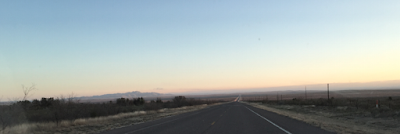
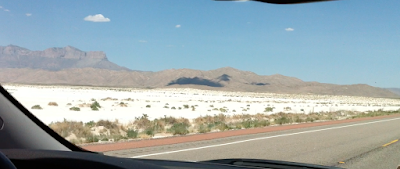
Here is a photo* I took with my iPhone through
the windshield while heading south on US-385 from Fort Stockton to
Marathon. That jumble of hills over to the left is the Sierra Madera, which
sits on the vast La Escalera Ranch, one of
the largest ranches in Texas. Although I did not know it at the time, the
highway was about to blaze me right through the Sierra Madera Astrobleme.
[*Normally I would never fool around with my smartphone while driving, but I had been driving out here for sometime and not seen a single vehicle, in either direction. I daresay I could have taken got out of the car and taken a siesta in the middle of the road.]
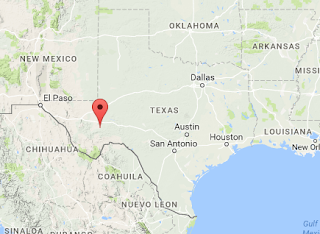
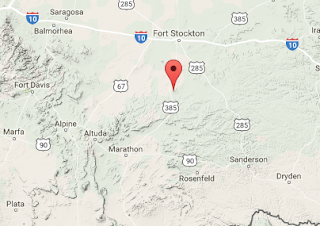
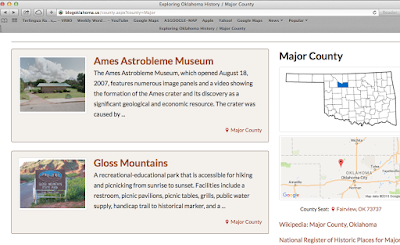
The Sierra Madera Astrobleme in Far West Texas
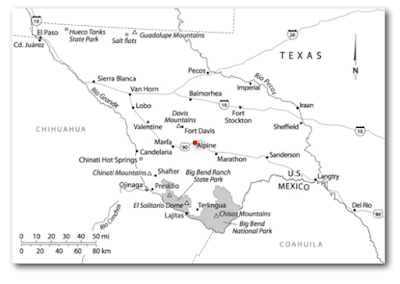
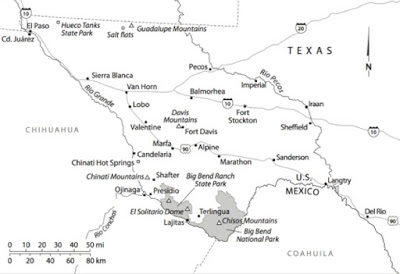
The Sierra Madera Astrobleme, off US-385 between the towns of Fort Stockton and Marathon
The Sierra Madera is indeed on Google maps, but
neither of the maps I carried with me that day, the AAA and the Geological
Highway Map of Texas, noted it, so I was wholly unprepared for the sight, on
the open plains, well before the Glass Mountains, of the strange-looking huddle
of the Sierra Madera off to the east– and all bathed in the
golden-orange glow of sunset. Alas, my photo does not do its stunning
gorgeousness a shred of justice.
It turns out that the Sierra Madera is an
extremely rare “cryptoexplosion structure,” in this case, a crater
with a central mountain range raised not by volcanic or tectonic forces, but by
the rebound from the impact of an unknown extraterrestrial
object. The mountains and the approximately 6 mile-in-diameter
crater, so eroded over some nearly 100 million years that I did not recognize
it as I drove through it, are together known as the Sierra Madera Astrobleme.
An astrobleme is an eroded remnant of a large
crater made by the impact of a meteorite or comet. The term, first used in the
mid-20th century, is from the Greek astron, star, and blema, wound.
What was that object that slammed into the earth
those nearly 100 million years ago? I searched the literature but could not
find any description beyond “approximately spherical.” So I wrote to
Dr. Robert Beaufort, who host the United States Meteorite Impact
Craters website. He kindly answered:
“Identifying the class of meteorite that caused a particular impact crater is a genuinely difficult task… Because we are talking about gargantuan numbers of nuclear bombs worth of heat and shock energy, the impacting body itself, which is pretty tiny compared to the size of the crater, winds up distributed as parts per million or billion among the melted and/or redistributed target rocks remaining in and around the crater. Finding traces of the impactor is pretty straightforward if you have a mass spectrometer to play with (which I don’t), but actually telling which specific type of asteroid and associated meteorite you are dealing with is much more difficult. Scientists have looked at differences in bulk elemental ratios and at differences in isotope ratios in different classes of meteorites, and found cases where the same characteristic ratios could be discerned, even though they were diluted to parts per gazillion in the earth rock at an impact site. It is tricky work, and depends upon being able to clearly evaluate terrestrial background abundances, and so forth, but we are getting better at it with each passing decade. I don’t think it has been done for Sierra Madera. There is a very good chapter on the subject in Osinski and Pierazzo’s book, Impact Cratering: Processes and Products. Dr. Christian Koberl springs to mind as one of the world’s notable authorities on the subject of projectile identification at impact crater sites.”
What was going on 100 million years ago? This
would have been the Late Cretaceous or Early Tertiary, when Tyrannosaurus
roamed and Quetzalcoatlus
northropi, a pterosaur the size of a small jet airplane, cast
his shadow from overhead. (Seems the flora and fauna had a few more million
years to go… 66 million years ago came Chicxulub
and the great extinction.)
The literature I could Google up on the Sierra
Madera Astrobleme has a great deal of detail on shatter cones and various types
of rock, as well as gravitational and magnetic anomalies. But as for a
description for the layman, or shall we say, the average Tyrannosaurus Rex, of
what the impact might have sounded like and how it might have affected the
atmosphere, or caused mega-tsunamis, no dice.
Would the Sierra Madera have appeared as an
island? It seems that those many millions of years ago the area was then
underneath the so-called Western Interior
Seaway. The Davis Mountains—
the Texas Alps– lying beyond the horizon to the northwest, would not emerge
until the volcanic frenzy of (gosh, only) 35 million years ago.
Dear reader, if you have more information about
the Sierra Madera Astrobleme, please do write.
> United States Meteorite Impact Craters: Page on the Sierra Madera Crater Good variety of photographs and information by Robert Beauford, PhD. He writes:
“This is one of the largest impact craters in the United States, and even after having worked on 4 to 5 km craters for several years, I found it challenging to take in the scale of the structure. It defines the shape of the vast, open landscape in every direction.”
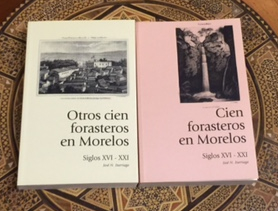
The two volume anthology by José N. Iturriaga, a collection of writings by foreigners in Morelia, from the 16th to the 21st century.
To see one’s own country through the scribbles of foreigners can be at once discomfiting and illuminating. Out of naiveté and presumption, foreigners get many things dead-wrong; they also get many things confoundingly right. Like the child who asked why the emperor was wearing no clothes, oftentimes they point to things we have been blind to: beauty and wonders, silliness, perchance a cobwebby corner exuding one skanky stink. And of course, there are things for foreigners to point at in all countries, from Albania to Zambia.
As an American I have to admit it’s rare that we pay a whit of attention to writing on the United States by, say, Mexicans, Canadians, the Germans or the French. True, we have the shining example of Alexis de Tocqueville’s Democracy in America, which every reasonably well-educated American may not have waded through but has at least heard of (and if you haven’t, dear reader, now you have.) But de Tocqueville’s tome is a musty-dusty 181 years old (the first of its four volumes was published in 1835, the last in 1840– get the whole croquembouche in paperback here.)
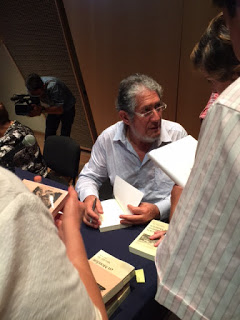
José N. Iturriaga, signing copies of his anthology, July 1, 2016, Centro Cultural Jardin Borda, Cuernavaca, Morelos, Mexico.
This past Friday, July 1, 2016, I participated in the launch of novelist and historian José N. Iturriaga’s anthology Otros cien forasteros en Morelos [Another One Hundred Foreigners in Morelos], the companion volume to Cien forasteros en Morelos [One Hundred Foreigners in Morelos], from the 16th to the 21st century.
(For those rusty on their Mexican geography, Morelos is a large state in central Mexico that includes Cuernavaca, “the city of eternal springtime,” which it actually is, and Tepoztlán, a farm town surrounded by spectacular reddish bluffs that, despite an influx of tourists from Mexico City and abroad, still has a strong indigenous presence, and has been designated by Mexico’s Secretary of Tourism as a “pueblo mágico.” The most famous resident of the state of Morelos was Revolutionary leader Emiliano Zapata.)
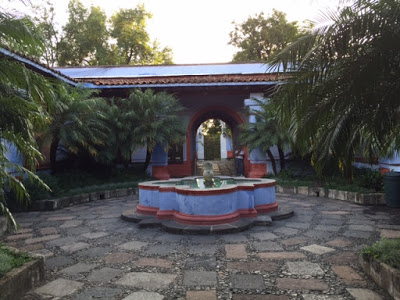
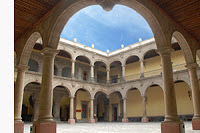
The launch was held in the Centro Cultural Jardín Borda (Borda Gardens Cultural Center), an historic garden open to the public in downtown Cuernavaca– about an hour and a half’s drive from Mexico City.
Jardín Borda, entrance patio.
As Iturriaga said in his talk, for almost forty years he has been studying the writings of foreigners on Mexico, precisely for the fresh, if not always kind nor necessarily accurate, perspective they offer on his own country.
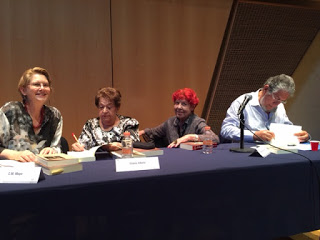
I admire Iturriaga’s work, and his curiosity, open-mindedness, and open-heartedness more than I can say. It was a mammoth honor to have had an excerpt from my novel included in his anthology, and to have been invited to participate on the panel presenting his anthology. The other two panelists, whose work is also in the anthology, were poet, novelist and essayist Eliana Albala and journalist and poet María Gabriela Dumay, both of whom came to live in Cuernavaca in the early 1970s, political exiles from Pinochet’s Chile.
Mexican book presentations tend to be more formal affairs than those in US (the latter usually in a bookstore with, perhaps, a brief and informal introduction by the owner or a staff member. I have war stories.) In Mexico, in contrast, there is usually a felt-draped dais, always a microphone, and two to as many as five panelists who have prepared formal lectures about the book. The author speaks last, and briefly. Another difference is that the Mexican reporters, photographers, and oftentimes television cameras crowd the dais, lending the affair a glamor and gravitas rare for a US book presentation. Afterwards, there is a party with white-gloved waiters pouring “vino de honor”– in this case, for Iturriaga’s Otro cien forasteros en Morelos, whoa, mezcal.
C.M. Mayo, Eliana Albala, María Gabriela Dumay, José N. Iturriaga, July 1, 2016, Centro Cultural Jardín Borda, Cuernavaca, Morelos, Mexico
>> Where to buy Otros Cien Forasteros en Morelos? I hope to be able to provide a link shortly.
Here is my talk for the panel, translated into English.
Dear José Iturriaga; fellow panelists, Eliana Albala and María Gabriela Dumay; everyone in this beautiful Centro Cultural Jardín Borda who made this event possible; Ladies and Gentlemen:
First of all, heart-felt congratulations to José Iturriaga on this extraordinary anthology in two volumes, a magnificent and opportune cultural contribution that, no doubt, required endless hours of reading, not to mention the tremendous labor of love that went into selecting and then translating so many writers.
Between the covers of this second volume, Otros cien forasteros en Morelos, I find my fellow Americans Jack London, Katherine Anne Porter, and John Steinbeck– among the most outstanding figures in US literature. There is also the great novelist who arrived, so mysteriously, from Germany: B. Traven; and artists such as Pedro Friedeberg; and distinguished historians such as John Womack, author ofZapata and the Mexican Revolution, Michael K. Schuessler, biographer of the eccentric poetic genius Pita Amor; and the Austrian Konrad Ratz, whose meticulous research on Maximilian von Habsburg was essential, in fact a parting of the seas, in our understanding of the personality, education, and politics of the Archduke of Austria.
In three words, José Iturriaga’s anthology is eclectic, fascinating, and illuminating.
It is a great honor for me to participate in this presentation and an even greater honor that this second volume, Otros cien forasteros en Morelos, includes excerpts from my novel, The Last Prince of the Mexican Empire. [In the anthology, excerpts are taken from the Spanish translation by Mexican novelist and poet Agustín Cadena, El último príncipe del Imperio Mexicano.]
(*Agustin de Iturbide (1783-1824) led the final stage of Mexico’s war for independence from Spain, and supported by the Catholic Church, was crowned Emperor of Mexico in 1822, deposed in 1823, and executed in 1824. )
In the winter of 1866, Maximilian brought his court here, to the Jardín Borda. And since we are within those very walls and surrounded by those very gardens, in celebration of José Iturriaga’s work, I would like to invoke those foreigners of the past, that is to say, I would like to read the few very brief excerpts from the novel, The Last Prince of the Mexican Empire, as they appear in this anthology.
This bit from the novel is the imagined point of view of José Luis Blasio, a Mexican who served as Maximilian’s secretary:
Depend on it: Maximilian is shepherding Mexico into the modern world— so José Luis Blasio, His Majesty’s secretary, has told his family and tells himself. And this is no small task when His Majesty must grapple not only with our backwardness and ingratitude, but that thorn in his side, General Bazaine. The rumor is that, abetted by his Mexican wife’s family, Bazaine schemes to push aside Maximilian; they aim to have Louis Napoleon make Mexico a French Protectorate with himself in charge— not that José Luis would give that a peso of credence. But José Luis does consider it an outrage, the latest of many, that he would wire a complaint that Maximilian has removed his court to Cuernavaca, rather than “attend to business in the capital.”
Yes, they are here in the Casa Borda amongst gardens and fountains, fruit trees, palm trees, parrots of every size and color— a world away from Mexico City. But does not Louis Napoleon go to Plombières and Biarritz? Queen Victoria, who has sterner blood, travels as far as Balmoral in the Scottish Highlands. Dom Pedro II of Brazil retires to his villa in Petropolis. And did not the empress’s late father, Leopold, absent himself from Brussels in the Château Royal at Laeken? It is natural that for the winter, His Majesty should hold court in a healthier clime.
But even here where he siestas in a hammock, drinks limeade from a coconut shell, and wears an ecru linen suit with an open-necked blouse, Maximilian’s work never ceases. It is a wide, rushing river that José Luis can only hope will not overspill its banks. In the past year, José Luis has come to appreciate the uncompromising necessity of working long hours; indeed, his eyesight, never strong, has deteriorated from so much reading in the dim of early mornings. Maximilian arises at four; his valet attends him, and though he might linger over breakfast, by no later than six, he is at “the bridge,” as he says, that is, his desk— or, as here in Casa Borda, a folding table on the veranda. His Majesty’s dispatch box is heavy, and growing ever heavier…
And now Pepa de Iturbide, daughter of the Emperor Agustín de Iturbide, godmother to Agustin de Iturbide y Green, and member of Maximilian’s court:
It is a holy miracle that she got a wink of sleep at all! So appalled she is by Maximilian’s whim to uproot the court to this hamlet two bone-jarring days travel up and down the sierra— good gracious, this is no time to abandon the capital, and go gallivanting about with butterfly nets and beetle jars! Matamoros is under siege; the whole state of Guerrero, from Acapulco to Iguala, is in thrall to guerrillas. And Pepa got it from Frau von Kuhacsevich, who got it from Lieutenant Weissbrunn, that whilst the empress was in Yucatan, Maximilian fancied a visit to Acapulco, but General Bazaine nixed it because it would have been impossible to maintain security for his person. That is the sum of things!
Oh, but in Mexico City Maximilian felt cramped, “an oyster in a bucket of ice,” he said. Over the past two months, the few times Pepa chanced to see Maximilian, he had spoken of the empress’s dispatches from Yucatan proudly but with— Pepa recognized it when she saw it— a glint of green. If Maximilian could not have his expedition to Yucatan, by Jove, he was going to go some place tropical! And Maximilian could not be outshone by his consort, oh no. A mere visit to Cuernavaca would not do; he had to serve himself the whole enchilada with the big spoon: an Imperial Residence with landscaping, fountains, an ornamental pond stocked with exotic fish, and furnishings and flub dubs aplenty, comme ça and de rigueur. Whom did he imagine he was impressing with this caprice? Poor Charlotte, exhausted after Yucatan. And as if the von Kuhacseviches were not already foundering in their attempts to manage the Imperial Household in Mexico City! As if the Mexican Imperial Army could offer its officers anything approaching a living wage! Or keep its depots stocked with gunpowder! It is a monumental waste of time, of effort, of money, and to boot, Casa Borda is a-crawl with cockroaches, beetles, earwigs, and moths— a bonanza for Professor Bilimek!
And now the Austrian Frau von Kuhacsecvich, Mistress (chief administrador) of the Imperial Household:
On the steps to the next patio, Frau von Kuhacsevich must pause to fan herself. Cuernavaca is not the Turkish bath of the hot lands, more, as Maximilian put it, an Italian May. Pleasant for the men, and Prince Agustín, perhaps, but a trial for those who must encase themselves in corsets and crinolines. Oh, poor Charlotte that her father has died, but Blessed Jesus, what would Frau von Kuhacsevich have done had she been obliged to wear mourning black! The thought simply wilts her. She is afraid her face has gone red as a beet. Her back feels sticky, and under her bonnet, she can feel her scalp sweating. Taking the bonnet off is out of the question: her roots have grown in nearly an inch— in all the rushing to and fro, there has not been a snatch of time to touch up the color.
An Italian May: in that spirit, for luncheon, Tüdos has concocted an amuse-gueule of olives, basil, and requeson, a cheese too strong to pass for mozzarella, but toothsome. In addition to coffee, he will be making a big pot of canarino: simply, the zest of lemons steeped as tea. Well, here it has to be made of limes, ni modo, no matter, as the Mexicans say.
Finally, Maximilian himself:
Here, this moment in Cuernavaca, one is happy: perfumes in the air, colors from the palette of Heaven, birds, flowering trees and vines and oranges, the music of the orchestra and of the fountains, this bone-warming sunshine…
SOME NOTES & ETC ON PEYOTE FROM THE RESEARCH FOR MY BOOK IN-PROGRESS ON FAR WEST TEXAS >> Read about my book in-progress >> Listen in to the 20 “Marfa Mondays” podcasts (mainly interviews) posted to date >> View my maps of Far West Texas
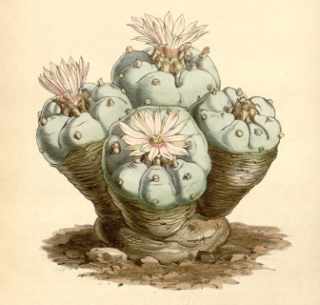
Lophohora williamsii, or peyote
Far West Texas, an area approximately the size of West Virginia, includes a goodly patch of the territory that stretches deep into Mexico where peyote, or lophophora williamsii grows… oh so very… very… very… v-e-r-y… slowly. A runty, dull-gray spineless cactus with wispy white hairs, when found, peyote– an Anglicization of the original Nahautl name, peyotl— is usually growing in clusters. What certain indigenous peoples have done for an eon is slice off the tops– the “buttons”– and eat them. Calories and dietary fiber are not the point; apparently the taste is puckerlips nasty. But adepts claim that this humble-looking plant is no less than “the divine cactus,” and eaten as a sacrament, as “holy medicine,” it can bring one’s mind into a mystical realm where psychedelic visions can help one see across time and space and heal one’s thoughts about oneself and the cosmos. As one participant in a peyote ritual reported, echoing so many others, he found “profound gratitude for his life” as it was.
PEYOTE AND THE HUICHOLS The Huichols, who live in Mexico’s Sierra Madre, are the indigenous group best known for their peyote ritual.
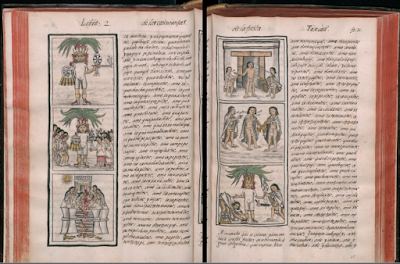
PEYOTE IN FRAY BERNARDINO SAHAGUN’S GENERAL HISTORY OF THE THINGS OF NEW SPAIN The first known written mention of peyote is in Franciscan missionary Bernardino de Sahagún’s Historia general de las cosas de Nueva España, or General History of the Things of New Spain. The original 16th century manuscript, which contains 2,468 colorful illustrations and text in both Spanish and Nahuatl (the language spoken by the Aztecs phonetically transcribed using Latin), is also known as the Florentine Codex because it is in the Medicea Laurencziana Library in Florence, Italy.
>> To view the digitized manuscript which contains many intriguing and colorful illustrations, but, alas, not one of peyote, click here.
Pages from the Florentine Codex. This does not show peyote, alas.
“On him who eats it or drinks it, it takes effect like mushrooms. Also he sees many things which frighten one, or make one laugh. It affects him perhaps one day, perhaps two days, but likewise it abates. However, it harms one, troubles one, makes one besotted, takes effect on one.”
(By the way, you may have noticed that I never link to wikipedia, aka The Maoist Muddle, unless there is absolutely, but absolutely, nothing else and a link really would be better than none. FYI: When I checked wikipedia for this post on the Florentine Codex, the images shown were from the wrong book.)
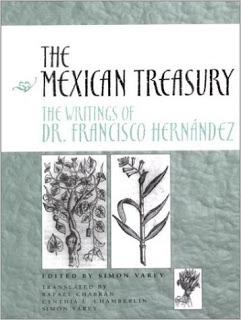
PEYOTE ALSO MENTIONED IN DR. FERNANDO HERNANDEZ’S DE LA HISTORIA PLANTARUM NOVAE HISPANAE In 1570 King Felipe II sent medical doctor Fernándo Hernández (1514-1587) to New Spain to survey and report on the natural resources of the colony, including plants that might be put to medical uses. In his seven years in the Valley of Mexico (Mexico City and environs), Dr. Fernández documented a multitude of plants and a long-standing and elaborate tradition of Aztec herbal medicine. Dr. Fernández’s report on 3,000 plants, in various editions and languages, did not appear in print until some decades after his death.
“Hernández died before he could publish his Natural History, and the materials were placed in the Escorial, where they were extensively consulted, copied, abstracted, and translated by generations of scientists, medical specialists, and natural philosophers before they were destroyed by fire in 1671. Hernández’s work was still regarded as authoritative on a number of New World botanical topics as late as the nineteenth century, and his writings remain in use in popular form in Mexico today.”
I have yet to get my hands on a copy of The Mexican Treasury, but as quoted in Stewart’s Peyote Religion, in turn quoting a translation from a 1916 article by William E. Safford in Annual Report of the Smithsonian Institution, of peyote Dr. Fernández writes:
“Wonderful properties are attributed to this root… It causes those devouring it to be able to foresee and predict things; such, for instance, as whether the weather will remain favorable; or to discern who has stolen from them some utensils or anything else; and other things of like nature which the Chichimecs really believe them have found out. On which account this root scarcely issues forth but conceals itself in the ground, as if it did not wish to harm those who discover and eat it.”
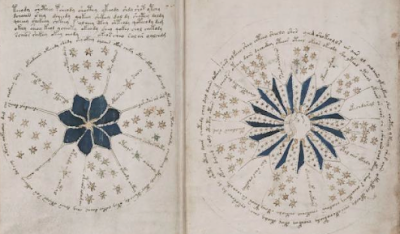
FIRST IMAGE OF PEYOTE IN DR. HERNANDEZ’S MAGNUM OPUS, POSSIBLY… OR IN CURTIS’ BOTANICAL MAGAZINE — OR, POSSIBLY, IN THE VOYNICH MANUSCRIPT?
According to Stewart in Peyote Religion, the earliest known botanical illustration of peyote is from 1847, in Curtis’ Botanical Magazine. Hat tip to peyote and cactus blogger Lophophora, here is that very illustration, a lovely one, from the Botanicus Digital Library, Missouri Botanical Garden.
>> See the utterly fascinating 2013 paper by John D. Comegys, “The Voynich Manuscript: Aztec Herbal from New Spain.” Comegys
also notes some possible influence from the work of Dr. Hernández.
Comegy’s paper is fascinating read, and I highly recommended it for
anyone interested in rare book history, botany and/or Mexico.
From the Voynich Manuscript. Peyote? Possibly…
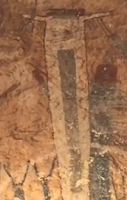
PEYOTE IN THE LOWER PECOS CANYONLANDS
The archaeological
record shows that peyote has been used many groups and many thousands
of years into the past in what is today northern Mexico and remote areas
along the Rio Grande on both sides of the US-Mexico border in Texas.
>>
For a novelist’s take on ancient peyote ritual in what is now the Lower
Pecos Canyonlands of Texas, see Mary S. Black’s Peyote Fire.
>>And
for more about the Lower Pecos Canyonlands and the magnificent rock art
there, see my guest-blog post for Mary S. Black here.
PEYOTE IN THE INQUISITION It is often said that the Mexican Inquisition focused on heretics, in particular conversos secretly practicing Judaism, but not indigenous. But the Inquisition did prosecute some indigenous and their use of peyote was often the issue.
Quoted in Stewart’s Peyote Religion (p. 20), in New Spain, in 16th and 17th century Catholic priests asked their parishioners:
Hast thou eaten the flesh of man? Hast thou eaten the peyote? Do you suck the blood of others? Do you adorn with flowers places where idols are kept?
(For
those not familiar with Mexican history, the first and third questions
might seem extreme. All I can say is, read the history.)
And, according to Stewart, in 1620 “the Inquisition was brought to bear against peyote.”
From American Anthropologist 44, 1942:
Irving A. Leonard, “Peyote and the Mexican Inquisition, 1620”
A quote from Leonard’s translation of a Spanish document:
“We, the Inquisitors against heretical perversity and apostasy in the City of Mexico, states and provinces of New Spain, New Galicia, Guatemala, Nicaragua, Yucatan, Verapaz, Honduras, Philippine Islands, and their districts and jurisdictions, by virtue of apostolic authority, etc. Inasmuch as the use of the herb or root called Peyote has been introduced into these Provinces for the purpose of detecting thefts, of divining other happenings, and of foretelling future events, it is an act of superstition condemned as opposed to the purity and integrity of our Holy Catholic Faith.
“This is certain because neither the said herb or any other can possess the virtue or inherent quality of producing the effects claimed, nor can any cause the mental images, fantasies and hallucinations on which the above stated divinations are based. In these latter are plainly perceived the suggestion and intervention of the Devil, the real author of this vice, who first avails himself of the natural credulity of the Indians and their tendency to idolatry, and later strikes down many other persons too little disposed to fear God and of very little faith.
“Because of these efforts the said abuse has increased in strength and is indulged in with the frequency observed. As our duty imposes upon us the obligation to put a stop to this vice and to repair the harm and grave offense to God our Lord resulting from this practice, we, after consultation and conference with learned and right-minded persons, have decreed the issuing of the present edict to each of you, one and all, by which we admonish you and summon you to obedience by virtue of your holy submission [to the Church] and under penalty of anathema…and other pecuniary and corporal penalties within our discretion. We order that henceforth no person of whatever rank or social condition can or may make use of the said herb, Peyote, nor of any other kind under any name or appearance for the same or similar purposes, nor shall he make the Indians or any other person take them, with the further warning that disobedience to these decrees shall cause us, in addition to the penalties and condemnation above stated, to take action against such disobedient and recalcitrant persons as we would against those suspected of heresy to our Holy Catholic Faith.”
In Peyote Religion, Stewart also includes a map (p.23) of the Inquisition hearings that specifically involved peyote, which were concentrated in Mexico City and surroundings, as well as scattered around what is now the main trunk of the Mexican republic (excluding the Baja California and Yucatan peninsulas). There were two cases in Manila (Philippines) in 1617 and 1639, as well as a case in 1632 as far north as Santa Fe. The case in Santa Fe involved someone who took peyote in order to divine who had stolen some of his clothing.
(For those wondering, why Manila? The answer is the China trade, wherein Spanish merchants brought the Manila Galleon or Nao de China, across the ocean to Acapulco on the Pacific Coast, and from there, by burro train and tameme, brought the goods inland to Mexico City, parts elsewhere, and via Veracruz on the Gulf, across the Caribbean and Atlantic to Spain.)
Mexico City’s Palacio de la Inquisition is now the Museo de la Escuela de Medicina (part of Mexico’s National University). You can visit that museum, see the original building, and also an exhibition on cells used by the Inquisition.
The Inquisition on Youtube — who needs The Texas Chainsaw Massacre when you can surf around for all that infinitely more creative and toe-curlingly wicked gross-out stuff about Inquisition torture now on the Internet? For those with blood pressure issues, may I suggest Monty Python instead:
Mexico’s Archivo General de la Nación also has a large collection on the Inquisition. Alas, at the time of this writing the website was down.
PEYOTE IN THE NATIVE AMERICAN CHURCH North of the US-Mexico border– into Texas and beyond– peyote is used as a sacrament in the ritual of the Native American Church (NAC). Is this legal? Yes, for members of the NAC, and only after a century of bitter struggle, with the 1994 amendment to the American Indian Religious Freedom Act, which protects the use of peyote in religious ceremonies. (Not that you, dear presumably non-Native American reader, can commence cultivating, selling, and scarfing down peyote as you please. For details, check out the current DEA status.)
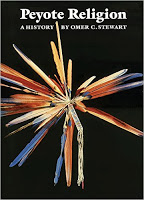
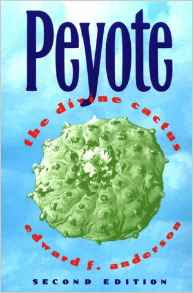
Omer C. Stewart’s Peyote Religion: A History and Edward F. Anderson’s Peyote: The Divine Cactusboth provide a a history of the founding of the “peyote church” on Plains Indian and other Indian reservations in the United States.
THE PEYOTE RITUAL ARRIVES FROM MEXICO IN TEXAS AND OKLAHOMA
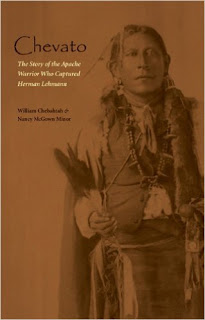
Chevato was a Lipan Apache born in northern Mexico who, long story short, became a member of the Mescalero Apaches roaming both Mexico and Texas, and later, of the Comanches on that tribe’s reservation in Oklahoma, thanks to his friendship with chief Quanah Parker.
His 2007 biography by his grandson, William Chebahtah, and Nancy McGown Minor, Chevato: The Story of the Apache Warrior Who Captured Hermann Lehman is both a major contribution to Comanche, Lipan Apache and Mescalero Apache history, and a gem-packed fascinating read– a must for any collection on the history of Northern Mexico and the Southwest.
Apropos of peyote, Minor writes (p.73) that the Lipans stayed near Zaragosa (in Coahuila, northern Mexico) because of its proximity to a hill where peyote grew in abundance. “The Western Lipans had been using peyote in their ceremonies since at least the 1780s, and as the Lipans were dispered out of Coahuila and into New Mexico, they brought with them their special peyote rituals.”
Apart from doing all the Wild West things Apache warriors did in those days, Chevato was a shaman and a “peyote singer,” singing special songs during the all-night ritual. Chevato’s great-grandfather was the first Lipan to make use of peyote in Mexico. Minor:
“Although the Mescaleros had used peyote in their religious ceremonies… it was the Lipan Apaches who created the form of ceremony practised by the Mescaleros by 1870 and the Comanches after 1875.”
Why 1875? The year prior to that the Quahada and other bands of Comanches had been defeated in a contest over “Anglos” taking the buffalo hunting grounds at The Second Battle of Adobe Walls, which was in the Texas Panhandle, prime buffalo hunting country. This defeat was the end of the end for the Comanches, and I believe that Quanah Parker’s adoption of the peyote ritual needs to be seen in this context.
So who was Quanah Parker? One
cannot write about Far West Texas without writing about Comanches, and
one cannot write about Comanches without writing about Quanah Parker,
and one cannot write about Quanah Parker without writing about the
Native American Church and peyote. So you can be sure, in my book I will
be writing about them.
It seems that everyone in Texas and Oklahoma already knows about Quanah Parker, the son of Comanche Chief Peta Nocona and Cynthia Ann Parker, who had been kidnapped as a child from her family’s farm in Texas and raised as a Comanche.
(The John Wayne / Natalie Wood movie The Searchers is loosely based on the novel that was, in turn, loosely based on the story of Cynthia Ann Parker.)
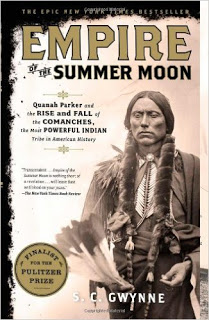
Although
it has little to say about peyote, one of the best books on the
Comanches and Quanah Parker and an all-star crunchy fun read is S.C.
Gywnne’s Empire of the Summer Moon. Humongously recommended.
Quanah Parker in the first two-reel western ever filmed (in 1907): “The Bank Robbery”
(zip about peyote as far as I can tell)
Screenshot of Quanah Parker from “The Bank Robbery,” 1908
UPDATE September 2, 2016 Thanks to Gene Fowler, none other, who very kindly sent me the link, I have added to that blog post this link (embed rather) to “Amada of the Gardens” a fascinating documentary on peyotera Amada Cardenas (1904-2005).
ON THE SPREAD OF PEYOTE RELIGION From the article “The Native American Church” in the Encyclopedia of the Great Plains, hosted by the Center for Great Plains Studies at the University of Nebraska-Lincoln.
“While the exact origins of the Native American Church and its incorporation of peyote as a sacrament of communion are shrouded in oral history, Native believers generally agree that it began in the Southwest and worked its way up from Mexico. Among the Plains Indians, the Omahas, Poncas, Winnebagos, and Sioux readily accepted the belief system of the Native American Church.”
>>“With the Peyoteros” by Karen Olsson for The Texas Observer, March 2, 2001. Strong demand, plus fences and ranches plowed over for deer hunting, make finding peyote in the wild increasingly challenging.
“Indians from Mexico would come across hunting medicine plants and, above all, the cactus peyote. Six or seven of these men would walk up to the house wanting something to eat or water. The Indians were great beggars and always wanted you to give them anything that they could carry off. Sometimes they’d show me the different medicine plants they’d gathered and what each plant was for in curing. I learned lots from them and also from the old men and women that were my neighbors living in Mexico that came to see me at different times. One bunch of Indians came to see me from Oklahoma. They were looking for the cactus peyote. And as we talked, one said, ‘If you have faith, an ordinary rock could cure you.'”
PEYOTE TESTIMONY: YOUTUBERIE AND MORE
“Sacred Peyote”: a short documentary film about peyote and the Native American Church.
GERMAN-MEXICAN AMIGO GIVES TESTIMONY
My friend Hans Lens’ memoir. More about this anon.
GRINGOS GIVE TESTIMONYTara from “40BelowFruity” on her experience ingesting peyote
“Not
as easy experience… I was feeling a lot of nausea… deep-seated,
buried issues… I was resisting it… I started to become
overwhelmed… peyote brought [memories] to the surface…I felt like I
had been completely ripped apart and put together again… like a new
person, reborn… It has the power to heal people.”
“The Mind Divided” shares his reflections on his peyote experience and what he believes was the beautiful lesson: “Lighten up… embrace and enjoy life.”
Blogger Sara Brooke shares her experience with peyote in this post. A quote:
“It is conscious medicine, a consciousness that is far more intelligent than our own. It needs to be treated with respect and care and it honestly is something that isn’t for everyone. Psychologically, mentally, emotionally, physically and spiritually you have to be ready for it. It gives you an opportunity to face ALL parts of yourself, especially the shadow aspects. It is one of the most confronting, yet profound and worthwhile experiences I have ever had. I am eternally changed.”
(WHAT ABOUT CARLOS CASTANEDA? He did write about peyote in his several best-sellers. Alas, dude, not on my wavelength.)
AN ESOTERIC HYPOTHESIS
ABOUT PEYOTE WHICH I DO NOT INTEND TO TEST
My drug is coffee! My own
ventures into the esoteric have not been psychedelic but literary–
primarily by way of the Himalayas of reading I did for my most recent
book, Metaphysical Odyssey into the Mexican Revolution: Francisco I. Madero and His Secret Book, Spiritist Manual. Indeed
I read so much esoterica that my sense of cognitive dissonance went
from geyser to sputter, then a little puddle, then, well… that dried
up. So now, no problemo, I could read about oh, say, aliens tokin’ peyote. That doesn’t mean I am saying anything about aliens tokin’ peyote. I am unaware of any such report.
Scion of a wealthy family in Coahuila, Francisco I. Madero was
the leader of Mexico’s 1910 Revolution and President of Mexico from
1911-1913. I am often asked what he knew about indigenous shamanistic
traditions. I
did not find any evidence that Madero had any interest in or experience
with peyote nor, indeed, with indigenous healing traditions other than
an association, late in his short life, with his Masonic brother and
fellow Spiritist and doctor, the Mexican-German spy Dr Arnoldo Krumm-Heller, aka “Maestro Huiracocha,” author of a number of works, including El zodiaco de los incas en comparación con los aztecas, 1910.
Madero’s personal library
contained mainly French and Ango-American (some in the original, some
in Spanish translation) literature on Spiritualism, Spiritism,
Theosophy, hypnotherapy, French occultism, the Bhagavad-Gita, adventures
into Tibet, and the like. His work that I translated, Manual espiritaof 1911, references many of these works.
Educated
in France, where he discovered Spiritism and other esoteric ideas then
in vogue, Madero would have been familiar with the Hindu concept, as
conveyed to the West through the writings of various Theosophists, of
the human body as having interpenetrating “energy bodies” and specific
energy vortices known as “chakras.” Under this paradigm, my hypothesis–
and take this with a truckload of salt, I am not sure I have a clue
what I am talking about– is that ingesting peyote removes certain
neuro-filters in the pineal gland and actives a chakra so that one can clearly perceive blockages and other auric debris, and one’s own emotional body. Which chakra might that be? Heart– I guess. Just a guess.
Continuing
to follow my understanding of what could have been Madero’s
hypothetical paradigm for understanding peyote, there may also be one or
more conscious and intelligent astral entities / spirit guides
associated with the plant. This concept is eloquently articulated in
Eliot Cowan’s Plant Spirit Medicine.
Most
modern doctors and scientists would focus on peyote’s botanical,
chemical, medicinal pharmacological aspects, and specifically, their
measurable effect on the brain and body. Several chapters are devoted to
these topics in Anderson’s Peyote: The Divine Cactus.
Extra-Astral Texiness. First, what do I mean by “astral”? I don’t mean “of the stars,” but the old-fashioned esoteric concept of the imaginal realm. Yes, I am a mite old-fashioned, and apropos of my most recent book, about the secret book by the leader of Mexico’s 1910 Revolution, I plowed through a sizable library of antique tomes on various aspects of the astral. So that’s a word I like to sling around!
Whether you believe in the astral or not, I think you will agree that (1) everyone has an imagination and (2) the imaginal realm, aka the astral– or whatever you have a notion to call it– includes works of fiction and movies. Imagine those works, if you will, floating like little bubbles through the ether. (Well, porquoi pas?) Or big baggy-wobbly monsters– (duck, here comes War and Peace...)
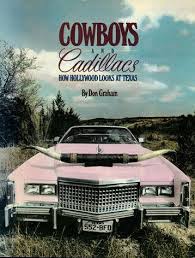
Speaking of Texas-sized astral bubblies, apropos of my book in-progress about Far West Texas, of course my horse (as they say in Mexico) I have a long list of “to dos” that includes grokking Giant, the Rock Hudson-Elizabeth Taylor-James Dean mashup filmed in Marfa and parts thereabouts. I have watched it and read the Edna Ferber novel it was based on, too. And now I’ve finished reading Don Graham’s Cowboys and Cadillacs: How Hollywood Looks at Texas, in which I first came across the term “Texiness.” Writes Graham:
“The Texas Chic-urban cowboy version of the old Western legend offered a sexier version of Texas. Call it Texiness. Frontier values, however romanticized they might have been in Red River or Giant, were supplanted by fashion value, by hype.” (p.6)
I hereby redefine “Texiness”:
I say all that hyper-appealing high-heeled cowboy boot clickin’ movie fah-shun goes back to Giant’s Rock Hudson and James Dean, and indeed, decades yonder: the Founding Pope of that Whole Hamburger-Helper Enchilada was John Wayne. And a big tip of the sombrero (along with a shake of the pepper flakes), to Italian director Sergio Leone for corralling Clint Eastwood. (Maestro of the concept, Leone himself was definitely not Texi.)
(Film historians: sorry, Tom Mix looks
pasty-faced and nerdy, and antiques including Gene Autrey and Roy Rogers don’t
count. Nope, movies based on Karl May and Louis L’Amour novels and Buffalo Bill
shows neither.)
In The Air-conditioned House of Mirrors
If you’re at all familiar with my work on Mexico, you know that I like to take cliches, stuff them in a cannon, and light the fuse. That this “Texiness” stuff exemplifies the real world of Texas…. let’s just say I am preparing to launch that idea, along with its ostrich-leather Luccheses, into orbit around, say, one of the moons of Neptune.
Says Graham, and rightly: “Texans have two
pasts: the one they lived in and the one Hollywood created.”
What I’m saying is, Astral Texas isn’t Texas, exactly; it’s a bunch of fancies about “Texas” concocted by a jostling Chinese puzzle of a crowd of screenwriters, novelists, costume designers, executives, and bean-counters of all stripes, many of them New Yorkers, or Danes or Germans or Italians or whatever, who aimed to put butts in seats from Rome to Tokyo and all parts in between, or, to put it in more elegant terms, sell their product, which was international entertainment. The Alice-in-Wonderland thing about it is that Texans watched those movies too, with consequences for their ideas about themselves– or at least concepts of fashion.
(Yes, the house of mirrors goes back to Zane Gray
dime novels. Who was Zane Grey? Never mind. He’s hanging out with Mr Mix &
Co. in the astral.)
Ten Tropes in Pictures Drippin’ with Astral
Texiness
1. The leading character is a man of apparent
western European descent who wears dusty boots, a hat, and more often than not
a pistol and holster on a second belt slung around the hips;
2. He has a languid gait;
3. He squints a lot and says little;
4. With counted exceptions he and other leading
characters are of reproductive age, and any leading female characters are of
prime reproductive age;
5. Frequent sudden loud noises (mainly from
gunshots but also oil gushers, cars exploding, cannon blasts, dynamite,
galloping, train whistles, and miscellaneous ferocious banging);
6. There may be guitar music, preferably languid
but with some loud banging;
7. Multitudinous scenes of extreme physical peril
(enhanced by frequent and sudden loud noises);
8. Ditto extreme emotional peril;
9. Ditto super fast motion (on horses, in cars,
on planes and/or trains);
10. Characters not of apparent western European
descent may or may not be played by Jewish or Italian actors and with counted
exceptions, said characters are helpless victims, cyphers, comic relief, or
else very bad.
(My actual experience of non-astral Texas is that
it involves highways where drivers generally stay within the speed limits and
there are lots of exits to lots of shopping malls. On the Texas highways, even
in Far West Texas, it is always possible within about an hour to find either a
gas station with hot coffee and Snickers bars and/or a Dairy Queen and/or a
McDonald’s. As for all them guns, I’ve spent a lot of time in Far West Texas
over the past few years and the one and only occasion anyone took out their gun
was when, on a private ranch, after touring some rock art, a lawyer and a
professor of medieval history commenced popping targets from the back porch.
The BBQ expert I
interviewed in Pecos carried a pistol in a holster, but that
was because he was also the sheriff. Last I checked, among sheriffs that
practice is not exclusive to those of the great state of Texas.)
Herewith, in chronological order, my top bakers
dozen of trailers for movies with Extra-Astral Texiness. (I’m not necessarily
recommending these; just pointing out a characteristic.)
1. Giant (1956)
James Dean steals the show. Based on Edna
Ferber’s novel, Giant. Ferber was born in
Kalamazoo, Michigan and was a long-time resident of New York City’s Park
Avenue.
#
2. The Searchers (1956)
John Wayne versus the Comanches with the incongruous albeit magnificent scenery of Arizona, California, Canada, and Utah. Loosely based on a novel by Indiana native Alan LeMay which was in turn loosely based on the true story of Cynthia Ann Parker, who was captured by Comanches in Texas.
#
3. The Alamo (1960)
John Wayne as Davy Crockett. Do not have a mouthful of popcorn in process when he tells his Mexican sweetheart, “There’s right and there’s wrong, you got to do one or the other. You do the one and you’re living. You do the other and you’re walking around but you’re dead as a beaver hat.” Filmed in Brackettville, Texas.
#
4. The Man Who Shot Liberty Valance (1962)
Another shoot ’em up directed by John Ford, starring John Wayne (very Extra-Astral Texi), James Stewart (not Texi) and Lee Marvin (eww).
#
5. Hud (1963)
An actor’s actor Paul Newman was, though Millennials know him better as that old gent who, though passed away, still lends his name and handsome visage to the Newman’s Own brand of salad dressings and dog food. As the bully Adonis Hud, Newman exudes Extra-Astral Texiness in the extreme. Based on Larry McMurtry’s novel Horseman, Pass By.
#
6. The Sons of Katie Elder (1965)
“Four brothers who met gunfire with gunfire!” More John Waynerie.
#
7. A Fistful of Dollars (1964)
“The man with no name: Danger fits him like tight black glove.” Not lacking for firearms! The first Sergio Leone “spaghetti western” starring Clint Eastwood in that poncho was a remake of Akira Kurosawa’s samurai flick Yojimbo.
#
8. The Good, the Bad, and the Ugly (1966)
The ultimate Spaghetti western. Pow, boom, whack,
crack, pow! The ne plus ultra in Extra-Extra-Uber-Astral Texiness!
Californian Clint Eastwood does the hat-poncho-gun-cigar thing in Spain. Watch
out, the music by Italian composer Ennio Morricone — a
masterpiece–can turn into an earworm. (Listen to the score here.)
#
9. The Life and Times of Judge Roy Bean (1972)
There was a Judge Roy Bean but his biography was more than a bit different from that of the movie character played by Paul Newman. If you can get past Jacqueline Bissette shouting that she is a Bean (oof), you’ll hear Anthony Perkins, his hair ablowin’ in the wind, assert that “This land abounds in ruffians and varmints.”
#
10. Lone Star (1996)
A deft and complex film by writer-director John Sayles, starring Chris Cooper, Kris Kristofferson, and Matthew McConaughey, the then Prince Imperial of Extra-Astral Texiness.
#
11. The Three Burials of Melquiades Estrada (2005)
This is by a section the best of all the films about and filmed in Texas– a much longer list than this one. Directed by Tommy Lee Jones. Screenplay by Guillermo Arriaga. Filmed in the Big Bend.
#
12. No Country for Old Men (2007)
Shooting, more shooting, even more shooting and loud crashes plus some more shooting with Texan Tommy Lee Jones, and Spanish actor Javier Bardem with creepazoid hair. Based on the Cormac McCarthy novel.
#
13. There Will Be Blood (2007)
Once again, radiating super human intensity, English actor Daniel Day Lewis nails the accent. Gushers o’ the black stuff! And the red stuff!
So where are The Wild Bunch (William
Holden, too old) and Urban Cowboy (John Travolta, too silly)? Alas, they
lack Extra-Astral Texiness.
UPDATE: I
debated about The Magnificent Seven, which was filmed in Mexico.
Steve McQueen, yes.
UPDATE:
Texan friends recommend Lonesome Dove. I didn’t count it because it was
a TV series about taking cattle north and the leads, Tommy Lee Jones and Robert
Duvall, struck me as a couple of very un-astral-Texi granpaws. But my opinion
isn’t the only one. You can check out the trailer for Lonesome Dovehere.
UPDATE: I might have included The Wonderful Country starring Robert Mitchum. But having read the novel by Tom Lea, which I greatly admire, I found the movie jarringly small and the lead miscast.
It was in 2012, when I started on my still in-progress book about Far West Texas, that I first encountered the paintings of Xavier González in the Museum of the Big Bend on the Sul Ross University Campus in Alpine, Texas. I was there to see “The Lost Colony,” an exhibition of works by painters associated with the summer Art Colony of the Sul Ross College (now Sul Ross State University). The works were from 1921-1950; the Art Colony, formally so-called, spanned the years 1932-1950.
Curator Mary Bones gave me a fascinating interview about “The Lost Colony,” which you can listen to here.)
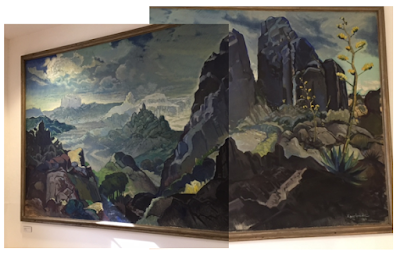
“MOONLIGHT OVER THE CHISOS,” 1934
The artwork by Xavier González that most enchanted me was his magnificent “Moonlight Over the Chisos” of 1934. It was not in the show itself, however, but tucked into the top of the stairwell leading down to the museum’s map collection– not an ideal location, but no doubt one of the few available walls large enough to accommodate the massive 6 x 14 feet canvas.
“Moonlight Over the Chisos” is in the tradition of Mexican murals of the 1930s, although technically not a mural, as it is painted on canvas. (In no way do these two photos, snapped with my iPhone and pasted together with a screenshot, do this masterpiece justice. Alas, the painting is so large, I couldn’t back up far enough to fit the whole of it into one shot.)
(Dear reader, if you haven’t hiked the Chisos, you have yet to live.)
XAVIER GONZÁLEZ IN MEXICO CITY (RESEARCH UNDERWAY…)
What also caught my attention was that González had studied art in Mexico City and precisely during the time of great muralists, among them, Diego Rivera. Mary Bones told me: “Xavier González spent many summers down in Mexico and Mexico City looking at the muralists.”
Born in Almería, Spain in 1898, as a child Xavier González immigrated with his family to Mexico.
An important influence on his development as an artist was his maternal uncle, the academic painter José Arpa (1858-1952), a native of Spain who later divided his time between Mexico City and San Antonio– and became a leading figure in the art community of the latter, running an art school out of the Witte Museum. According to the notes for “The Three Worlds of Jose Arpa y Perea” exhibition of 2015 from the website of the San Antonio Museum of Art, Arpa won the Rome Prize three times and had been offered the directorship of the Academia de San Carlos, but instead worked independently. In my notes from a visit to González’s archive in the Smithsonian (box 4, unattributed article):
“[José Arpa] received his early art training at the School of Fine Arts in Seville… His first success was in 1891, when his painting of Don Miguel de Manarra won first prize in the Madrid exhibition. Travels in Africa and Europe followed… the Spanish government sent for of his paintings to the first World’s Fair held in Chicago in 1893 as representative of the best of Spain…. shortly after that time the Mexican government sent a man-of-war to Spain and brought him to Mexico to assume charge of the academy of Fine Arts in Mexico City. He later declined the appointment, but remained for many years becoming enthralled with the light and color and movement of the country…”
At age thirteen (circa 1911) Xavier González was studying at the Academia de San Carlos in Mexico City. This was the same time that 15 year old David Siquieros, who was to became one of Mexico’s greatest muralists, was also beginning his studies at San Carlos. (Did they take the same classes?)
In 1913 the violent stage Revolution intervened… I’m still a little foggy on the details of González’s early life…
The Lost Colony catalog notes that González studied and worked as a mechanical engineer. In 1922 he was working in Iowa for a railroad. Later he studied at night and graduated from the Chicago Art Institute. In 1925, he was assisting his uncle José Arpa in his art school in San Antonio’s Witte Museum and from 1927-29 he was teaching classes himself. González became a US citizen in 1930 and the following year took a faculty position at Sophie Newcomb, the women’s college now folded into Tulane University in New Orleans.
From “The Lost Colony” catalog:
“…much of the work was to be done en plein air with frequent trips to the Davis and Chisos Mountains”
> 1932 González conducted the first summer Art Colony at Sul Ross (along with Julius Woeltz and Aline Rather) > 1933 González in Paris, and also Mexico City (on a leave of absence from Sophie Newcomb College.) > 1934-1939 González conducted sessions of the summer Art Colony. > 1935 González married his student Ethel Edwards.
I hope to be able to dig into the archives at the Academia de San Carlos to find out when exactly González attended and with whom he studied. I am also curious to learn why his uncle José Arpa, after coming all the way from Spain, did not take the helm at the Academia de San Carlos.
#
A VISIT TO THE ANTIGUA ACADEMIA DE SAN CARLOS (Not to be confused with the Museo San Carlos, different building, different neighborhood. Uyy, Mexico City is endlessly endless.)
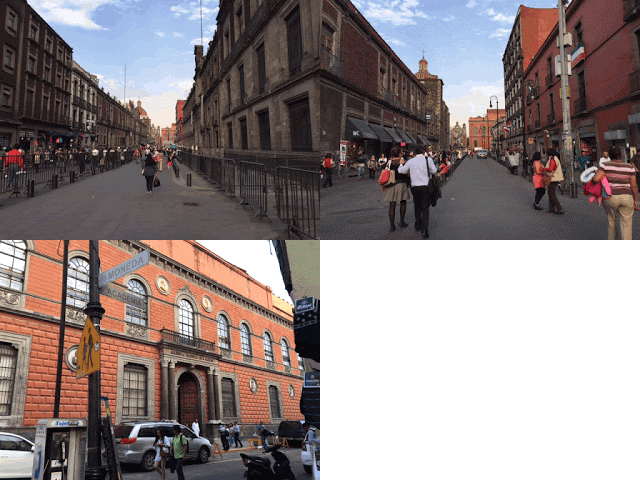
You’ll find the Antigua Academia de San Carlos a short walk behind the National Palace, at the corner of Moneda and Academia Streets (Calle Moneda y Calle Academia). This GIF shows my approach from Moneda, the National Palace along the right, then the terracotta-colored neoclassic Italianate façade of the Academia de San Carlos.
APPROACHING THE ANTIGUA ACADEMIA SAN CARLOS FROM CALLE MONEDA
The site of the Academia de San Carlos has been continually occupied for almost 500 years. The land once backed the Aztec emperor Moctezuma’s palace, Casas Nuevas. After the Conquest the parcel became the property of the Church; the original building arose as a hospital specializing in syphilis patients.
In the late 18th century King Carlos III sent his chief engraver to New Spain– Mexico wasn’t yet Mexico– to establish an academy and so improve the production of coins– hence the Academia de San Carlos’ location, only steps from the Casa de Moneda, the mint for the colony which was founded in 1535.
Classes began in 1781 and the Academia de las Nobles Artes de San Carlos de la Nueva España, offering instruction in architecture, engraving, painting, and sculpture, was officially inaugurated in 1785.
The oldest fine arts academy in the Americas, San Carlos has been in almost continuous operation for 235 years. It closed in 1822, during the cash-strapped years of the First Empire, and not until 1843 did it reopen, when Santa Anna, in a moment of inspiration, joined it to the lottery which became known as the Lotería de San Carlos. According to the Mexican Lottery website (my translation):
“The San Carlos Lottery utilized its income to acquire important artworks, provide scholarships for the Academia de San Carlos, and to bring important teachers to Mexico among them, the painter Pelegrín Clave, sculptor Manuel Vilar, landscape painter Eugenio Landesio and architect Javier Cavallari… Thanks to this lottery’s economic success it was possible to address other large and urgent needs of the general population in a time of foreign invasions and civil wars that left in the country in circumstances of chronic poverty.”
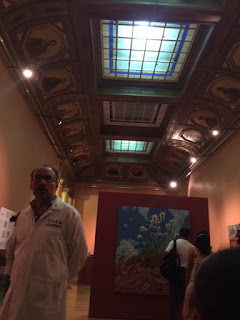
My 49 second video below shows the entrance, then the central patio before “Winged Victory” and brief look at glass dome which was installed by Antonio Rivas Mercado in 1913. According to Mauricio Tenorio-Trillo in I Speak of the City: Mexico City at the Turn of the Twentieth Century(high recommended):
“Antonio Rivas Mercado was one of the few Mexican architects favored with contracts for major national construction projects. But he was a French-trained architect, a follower of the Paris beaux-arts style, who had lived in London and Paris for many years.” (p. 22)
The dome was manufactured in France. Note the Art Nouveau ojos de buey or oval windows, also designed by Rivas Mercado for the section added to help support the dome’s weight. Part of the tour included a jazz concert by Los Cuatro Saxofones (The Four Saxophones).
Here is a much better video made by the university (about 7 minutes, in Spanish):
Winged Victory represents the goddess Nike. Most Mexicans, familiar with the American sports shoe brand, pronounce Nike to rhyme with bike. Professor Díaz Mendieta set his audience straight. In Spanish Nike is pronounced Nee-keh. She is the symbol of the Academia de San Carlos. The other 19th century plaster casts of iconic Greek and Renaissance sculptures, including Michelangelo’s Moses and head of David, are not for decoration but for the students to copy.
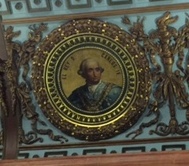
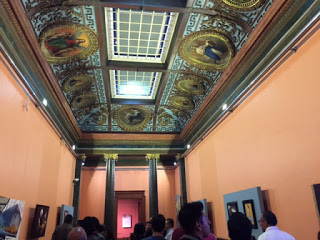
This handsome gallery of walnut wood and gold leaf features a ceiling decorated with portraits of artists and scientists including Copernicus and Raphael. A few of the heads fell off during the 1985 earthquake. There was little light by this time, alas; the colors in this room are actually rich and brilliant.
And this is the Centennial Gallery, decorated in the then fashionable Frenchified festoonerie for the academy’s 100th anniversary:
Voilà, Weltschmerzerie and sparkly donuts:
Finally, here is a GIF of Professor Díaz Mendieta wrapping up the tour in the torreo or bullring, an original classroom. The torreo was used not for making art but teaching theory and history of art. No doubt Diego Rivera addressed students here, as did his professor, Santiago Rebull, and many more in a long list of Mexico’s greatest artists.
PROFESSOR DANTE DIAZ MENDIETA IN EL TORREO, OR THE BULLRING, THE CLASSROOM AT THE ANTIGUA ACADEMIA DE SAN CARLOS
The desks are notably narrower than in classrooms today. The room (was it windowless?) felt a smidge creepy.
SIDEBAR (FROM ONE VERY MACHO MUNDO): A FEW OF THE NOTABLE ARTISTS OF THE ACADEMIA DE SAN CARLOS, BY DATE OF BIRTH
MANUEL TOLSA, AN ARCHITECT AND SCULPTOR WHO MERITS AT LEAST 378 BLOG POSTS
The great glass dome had gone dark when Professor Díaz Mendieta concluded on the wicked note that of course there are ghosts in here: a little girl who laughs; loud knocks; and, as the nightwatchman swears, on occasion in the wee hours of the night, moving from one side of the entrance foyer and disappearing into the opposite wall, a procession of monks holding torchlights.
Recently the National Institute of Anthropology and History (INAH) conducted an excavation that turned up 17 bodies. Presumably these were not of art students but syphilis patients of the 18th, 17th, or even 16th century.
¿Y LA FRIDA?
It’s impossible to talk about Mexican artists without mentioning Frida Kahlo. No, Professor Díaz Mendieta answered the question, Frida did not take classes at the Academia de San Carlos; at that time it was for men only, but Frida hung out here (andaba aquí) with her sweetheart, Diego Rivera.
In a future blog post I will talking about González’s wife Ethel Edwards; also about noted Texas regionalist painter Julius Woeltz (1911-1956), a student of González’s who taught at the summer art colony at Sul Ross and who accompanied González on some of his trips to paint in Mexico City in 1934 and 1935. (Woeltz also served as best man at González’s wedding.) I hope to also unearth more about Woeltz in the archives of the Academia de San Carlos. Stay tuned. Curator Mary Bones also talks about these and many other artists of the “Lost Colony” in my “Marfa Mondays” podcast interview. Again, that recording and transcript are available free here.
#
HOW TO GET THE TOUR
On the last Wednesday of every month, at 7 PM, UNAM art history professor Dante Díaz Mendieta offers a free tour, no reservations required. (In Spanish, of course.) Check for updates on the Facebook pages “Difusión San Carlos” or “GestionCulturalSanCarlos” or call tel. 5522-0630 ext 228.
I wasn’t planning to post this since it’s not a complete essay, only an introduction to a panel at the San Miguel Writers’ Conference, but it has come up in so many conversations since the panel was held this past February that I thought I’d offer it here— and with links in case you’d like to learn more about these extraordinary writers.
TRANSCRIPT OF INTRODUCTORY REMARKS BY MODERATOR C.M. MAYO
Good morning, Buenos días! Bienvenido! Welcome! What an joy of a conference this is. If my memory serves me, I participated in what was the very first of these conferences. I know it was more than 10 years ago. And that was an outstanding conference, but wow, it has gotten not only bigger but better and better. What we have here in this conference is unique: A gathering in the heart of Mexico, of writers from Mexico, writers who may or may not be Mexican living in Mexico, writers visiting Mexico, writers from so many different cultures.
The day before yesterday, here, over there by one of those big white tents, I ran into one of my favorite Mexican writers, who happens to be a native of San Miguel de Allende, and baptized in the Parroquía, that otherwordly gothic church that is impossible to miss. Araceli Ardón. She was on the faculty last year, and some other years. So I mentioned to Araceli that I was going to moderate this panel today on Global Migration: People and their Stories.
Well, why do we write?
And Araceli told me that in his writing workshop, years ago, Carlos Fuentes—who was, without a doubt, one of Mexico’s greatest writers— Carlos Fuentes said something that, like a beacon in the night, had guided her as as writer. In Spanish, Fuentes said: “La literatura tiene que dar voz a los silencios de la historia.”
Literature must give voice to history’s silences.
As we go on with this panel, I would like to invite you to keep those words of Carlos Fuentes present in your mind.
Global Migration: it’s in the news. We see it, we hear it, we read about it every day. Those of us who are from the US and Canada are keenly aware , on many levels, of our histories with migration, and this includes, in most cases, our own family histories.
For those who are new to Mexico— and I know that quite a few if you are—an extra special welcome to you.
I’d like to underline something that could be… shall we say… fruitful to keep in mind as we proceed, and that is that Mexico, too, has had and continues to accept important numbers of immigrants. For example, Mexico’s literary figures include many who were immigrants or descendants of immigrants from Spain, of course, but also from Germany— and that includes Carlos Fuentes—from France, Italy, Ireland, Japan, China, Africa, Central America, Cuba, Argentina, Poland (Elena Poniatowska!) and Russia— it’s a long list.
And it also includes immigrants from the Middle East– that flow of immigrants, from the Middle East, by the way, goes back many, many decades.
Rose Mary Salum, a Mexican writer of Lebanese descent, recently published a visionary anthology entitled, in Spanish, Delta de las arenas, cuentos árabes, cuentos judíos, a title I would translate as Delta of Sands: Arab and Jewish Short Fiction from Latin America. Itis a large and splendid and very interesting book, by the way.
There are also notable flows of migration within Mexico itself. Just to give one example, many people have come from small towns and farms to live in large cities, and in so doing making them larger: Mexico City, Querétaro, Monterrey, Guadalajara, Tijuana… Farm workers, migrant workers, who might go north to Oregon or Florida, also go to the Mexican states of Baja California or Sinaloa.
Another example: Many Mexican artists, professionals and retirees have come from Mexico City have come to live here in San Miguel de Allende—there is quite a bit less traffic, among other attractions.
And Mexico has indigenous groups from Mayas to Nahuas to Zapotecs, and members of these communities have moved all over the map of the Mexican Republic, and beyond. Of course, thousands of years ago, the ancestors of these peoples immigrated to what is now Mexico by way of the bridge under what is now the Bering Straight. And they too have important and rich storytelling, poetic, and literary traditions.
I myself am an immigrant to Mexico. I came from the US to live in Mexico City 30 years ago. So that’s why all my books are about Mexico. And I also translate Mexican writers, which brings me to a Mexican writer I am very proud to say I have translated: Juan Villoro. It was his short story about Mexican punk rockers that appears in my collection, Mexico: A Traveler’s Literary Companion.
Juan Villoro is one of Mexico’s most outstanding writers, and it is truly a privilege, a stellar privilege, to have him here with us.
So now I am going to formally introduce him, as our first speaker. And then, in turn, I will introduce each one of our panel. And then, after each has had the opportunity to speak, for about 10 to 12 minutes, we will take your questions and comments.
The questions at hand are: Why are stories of migration, or stories in some way inspired by migration, so vital? And what is it that elevates them to the level of “literary”? What are the challenges for writers who may be far removed from the culture in respecting their subjects, respecting their own creative process, and, ultimately, respecting their readers? And how is literature itself changing with such infusions?
If you would like to buy an MP3 recording of the entire panel, that is available from the San Miguel Writers Conference here.
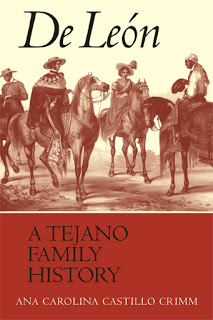
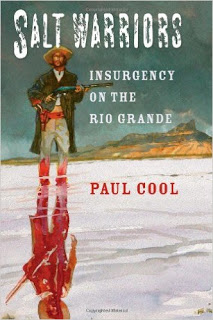
As those of you following this blog well know, I’m at work on a book about Far West Texas (that’s Texas west of the Pecos) and so reading deep into the history of the wider region that is now Texas and northern Mexico– for it all connects. I’m not reporting on each and every book I come across, but now and then I read one that, in taking both my understanding and my curiosity to a fresh level, prompts me to order my thoughts with a review and/or interview the author, should he or she be alive and willing. (See for example, Q & As with Raymond Caballero, Paul Cool, and John Tutino). Carolina Castillo Crimm’s deeply researched De León: A Tejano Family History is one of those.
We often hear about the Tejanos (Mexican Texans or, as you please, Texan Mexicans) in Mexican and Texas history, but who were they? Crimm’s De León provides an intimate glimpse of one of the first and most influential Tejano families though several generations, beginning with Don Martín de Léon and his wife Doña Patricia de la Garza, the founders of the de Léon colony and the town of Victoria on the coastal plains of Texas in the early 19th century. They and their descendants weathered Mexican civil wars; Comanche attacks; cattle rustlers; cholera; the Texas Revolution of 1835-36; the massive influx of “Anglo” immigrants; exile and legal battles to reclaim their land; the US Civil War and Reconstruction; and, into the late 19th century, the rise of the railroads and the cattle ranching industry.
C.M. MAYO: As historian Arnoldo de León commented, your study of a Tejano family “confirms what other historians have said (but not buttressed with this kind of detail) about Mexican Americans in history: that they are resilient in the face of adversity, that they adjusted to an Anglo American political environment after 1836 with a degree of success, and that their absence in Texas history books is explained by a neglect of the primary sources.”
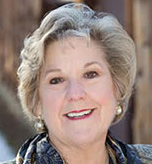
CAROLINA CASTILLO CRIMM:
Thank you for the opportunity to talk about the De León family of Victoria,
Texas, one of the early founding families of Texas. As far as I know, Arnoldo
de León is not related to the De León family of Victoria although you never
know. He has been influential in encouraging many students to study the
Hispanic world both past and present.
I am grateful to be part of a growing field of
historians focusing on early Hispanic settlement in Texas. These so-called
Borderlanders were originally inspired by Arnoldo de León and David
Weber. Since then, there have been many more scholars who have delved into
this area and produced excellent studies on this period. Among them are Dr.
Frank de la Teja, Dr. Andrés Tijerina, Dr. Armando Alonso, Dr. Francis X.
Galan, among many others.
There are also dozens of new, up-and-coming young
historians working in the field of the Borderlands. It is thrilling to see so
many people searching through primary sources to discover the histories of
these early settlers.
C.M. MAYO: And a related question: You mention in your acknowledgements that Nettie Lee Benson had been one of your mentors. She was such a towering figure among historians of Latin America that the University of Texas Library’s Latin American collection is named after her. Can you share a memory or two about Nettie Lee Benson, how you met her, what you remember of her?
CAROLINA CASTILLO CRIMM: I
was fortunate enough to arrive at the University of Texas at Austin in 1989
while Dr. Benson, or Miss Nettie as one of my fellow students called her, was
still teaching her course on Mexican History and the Borderlands. I had
mistakenly assumed that the Latin American Collection at UT had been named for
her because she was the wife of some oilman who had donated millions to the
University. I was wrong.
As it turned out, she had been a librarian at UT
during the 1940s. She made it her mission to take the funds she was given by
the university and invest the money in books and materials from Mexico and
Latin America. Each summer, she would take what, in reality, was a pittance and
travel throughout Mexico. She bought, traded or salvaged materials everywhere
she could. On one occasion she found a stack of old dissertations from the UNAM
at a pawn shop. They were about to be destroyed but she bought them for fifty
cents each, thereby rescuing a precious heritage. Each evening, she would go
back to her room and wrap up her finds in brown paper and string and send them
back to the library at UT. She did this every summer for years.
At last, Eugene C. Barker (for whom the Texas
collection was named) encouraged her to begin work on a Ph.D. in Mexican
History. Working part-time, she completed her degree and became a professor in
the History Department. She continued to work at the library and to add to the collection
which eventually was renamed in her honor. Students still remember her falsetto
voice echoing through the stacks as she asked what each of us was working on
then led us directly to some seminal book on our particular topic. She spent
her life helping students explore the stacks that she created.
Dr. Benson was awarded the Aguila Azteca by the
Mexican government, the highest honor that can be given to a foreigner, for her
work on the Provincial Deputations of the 1820s. Her on-going encouragement of
students working in the field has led to the production of hundreds of works on
Mexican and Borderlands History.
There have been some Mexican scholars who have
resented the removal of so much material from Mexico. They maintain that the
books should be in Mexican libraries, not in the United States. As I have seen,
however, Mexican libraries often do not have the funding to protect these
priceless treasures. I have been in archives in Matamoros where there are bugs
eating away at the paper, or in Saltillo where burned archives were only
rescued by accident when a historian/diner at an out-door restaurant noticed
the bits of burning paper sifting down from next door. The material at the University
of Texas has been preserved and protected and is accessible to scholars from
all over the world. Admittedly, Mexicans do have to travel to Austin to find
the materials, but at least it is available.
C.M. MAYO: You also write that Nettie Lee Benson set you on your path. Can you talk more about that, and what inspired you to write De León?
CAROLINA CASTILLO CRIMM: I
started on my Ph.D. at the University of Texas without any sure direction or
goal in mind. As a Mexican, I wanted very much to focus on the early Hispanics
of Texas. Miss Nettie Lee suggested I work on Martín de León, the only
successful Hispanic Empresario in early Texas. The problem then, and now, was
the lack of sources. There were no diaries or letters, but with Nettie Lee’s
help, I began to discover court records, county records, land records, and the
last will and testament of Doña Patricia de León. I was also fortunate to find
many of the descendants of the De León family who provided invaluable
assistance in writing the book.
C.M. MAYO: You tell the story of the matriarch of the de León clan, Doña Patricia, who lived a long life filled with success but also struggle and heartbreak. And one of the key contributions of De León is to underline the role of Hispanic women settlers in Texas and, by their example, their influence on Texas laws pertaining to women. Can you talk about that a bit?
CAROLINA CASTILLO CRIMM: I
had not originally focused on Doña Patricia or the women of the De León clan.
As with many studies of Texas history, the women were often relegated to
background roles. As I explored the sources, however, I began to see that the Victoria
settlement would not have existed without the efforts of Doña Patricia and her
daughters and daughters-in-law.
Patricia, evidently from a very good family at
Soto la Marina, had received an immense dowry of $9,000 pesos. This was at a
time when most dowries in Monterrey averaged less than $5,000. Some might say she
gave up the money to her husband, Martín, to fund the ranches in Texas.
Considering her later careful use of money, I prefer to think she invested the
money in the future of her family. And it paid off handsomely. She was able to
recoup the money when she needed it most by selling the Texas family ranch in
1836 to a New Orleans real estate broker for a handsome profit. But Patricia
also donated land. The lovely St. Mary’s Catholic Church sits on land donated
by Doña Patricia to the Catholic Church.
Doña Patricia taught her daughters to fight for
their rights when they returned to Texas in 1845. Not only did she enter the
American courts to regain family land, but she encouraged her offspring to
regain land that had been usurped by unscrupulous settlers. She held mortgages
on land and taught her daughters to do the same. Luz Escalera, wife of
eldest-son Fernando, and Matiana Benavides, a grand-daughter, held a mortgage
on land owned by an uncle. When he didn’t pay up, family or no, they foreclosed
on him, leaving him only the 20 acres around his ranch house.
At a time when Hispanics could not borrow from
Anglo banks, Hispanic women were often the money-lenders within the Mexican
community. They learned to be tough business women. It will remain a mystery
why she turned on her eldest son, Fernando. In her will, she forgives all the
debts owed to her by her descendants, except for the money owed her by
Fernando. That money was to be collected by his brothers and sisters.
C.M. MAYO: What comes through clearly to me in De León is that the early Tejano settlers, such as Martín de León, were neither wealthy nor campesinos (peasants), but part of an emerging and literate middle class. Yet throughout many decades of the 19th century the Tejanos had to fight both the Comanches and, depending on where they placed their loyalties, various factions for or against Spain, Mexico City, the Texians, and then the Confederacy. What stands out is that these decisions were not unanimous in the Tejano community, and they were fraught with terrible risk.
CAROLINA CASTILLO CRIMM: Yes,
as Dr. de la Teja has pointed out, the Texas ranchers were not wealthy but they
were not poverty-stricken either. The de León family employed a teacher on the
ranch to educate their children. And not all the children agreed on which side
to choose. I suspect Patricia’s Christmas gatherings were a trifle tense during
the years of Mexican Independence when some of her offspring sided with the
Liberals while others chose the Conservatives. Things got even worse during the
Texas Revolution.
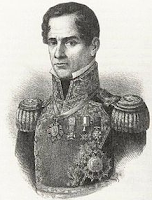
Antonio López de Santa Anna
C.M. MAYO: Until recent times the story of the fall of the Alamo came across as a simple story of brave Texians vs dastardly Santa Anna. Do you see your book as part of the impetus to enrich that particular narrative?
CAROLINA CASTILLO CRIMM: Yes,
certainly. During the Texas Revolution, half the De León family sided with the
Texians while others supported the legally constituted Mexican government, even
if it was Santa Anna.
The decades from 1800 through the Civil War,
were a time during which there were dangerous decisions to be made. The wrong
decision could result in being shot by one side or the other. Many of the
Mexican ranchers learned from bitter experience to keep their heads down and
their mouths shut or get out of the way. General Joaquín de Arredondo’s 1813
attack at the Battle of Medina and the later executions of Liberals, or
Revolutionaries, in San Antonio was a difficult time for everyone in Texas.
Doña Patricia had good reason to insist on removing her family to Soto la
Marina for safety during these years, and again in 1836 to escape to New
Orleans during the lawlessness of the Republic of
Texas. But she always came back.
C.M. MAYO: You mention that during the US Civil War many Tejanos, including members of the de León family, engaged in the cotton and transport trades to benefit the Confederacy. I note that Evaristo Madero, grandfather of the subject of my recent book, also made his first fortune in this trade. My question is, do you see the de Leóns as part of the broader fabric of a culture of entrepreneurship found throughout the north of Mexico?
CAROLINA CASTILLO CRIMM: The
Spanish and then the Mexican government had restricted trade for generations
(1713 to 1821) thereby preventing much in the way of entrepreneurship for the
ranchers of Texas. They could sell hides and lard but there was little else of
value in Texas that could be transported and sold. The Anglo settlers, in
particular the Irish from the Refugio area, learned to profit from the sale of
cattle from their Mexican rancher neighbors.
Once the borders were opened to trade after 1836,
the Mexicans improved on their cattle trade and profited by selling corn and
vegetables to the incoming colonists. They also made a profit by carrying goods
in carts to the coast. As soon as the Texians saw there was a profit to be
made, however, the Cart Wars of
the 1850s broke out, and the Tejanos were cut out of the trade. They continued
to profit wherever they could, and wherever the Texians would permit.
C.M. MAYO: It is impossible to read Texas history without the mention of the strains and struggles between the so-called Anglos and Tejanos, as if the two communities were sealed off from one another under two bell jars. Yet of course they were not. You mention the tensions and the struggles the de León family faced in defending their dignity and their land titles against Anglo newcomers at various points in the 19th century, but you also mention their long-time friendship with the Linn family.
Can you talk a little more about the Linns?
CAROLINA CASTILLO CRIMM: Martín
de León needed settlers to establish his Empresario grant. He brought some from
Mexico, but there were some settlers already squatting on the land he had been
granted. Rather than get rid of them, he simply incorporated them into his
colony. Although some said he was a “cranky old man” as an Empresario (he was,
after all, in his 60s), he accepted people of all nationalities into his
colony. Fernando, his eldest son, became very close to the Linn family. Just as
the De León family helped the Linns during the Mexican period (Edward Linn
became their surveryor), they returned the favor when Texas became a State.
Fernando was able to count on the Linns (John Linn
became a Texas Senator) for help with legal problems.
I found that the early settlers, both Texian and
Tejano, who had helped each other survive Indian raids and droughts and hard
times in the years from 1821 to 1836 became loyal friends, regardless of
nationality. The arrival of new settlers after 1836, however, who had not
had those close relationships, created an atmosphere of antipathy and racial hatred
against the Mexicans. Fortunately, there were still a few of the supportive old
Texian families who protected their Tejano friends and called them the “Old
Spanish Families.” This didn’t prevent the killings of the Mexican families by
mobs during the 1870s or the mass murders by the Texas Rangers
during the 1920s.
C.M. MAYO: At various points you mention a slave owned by Fernando de León and later inherited by his adopted son Frank, and that Frank tried to manumit him but the laws of Texas at that time would not permit it. Do you know his name and what became of him?
CAROLINA CASTILLO CRIMM: Unhappily,
I do not know what happened to the slave. It is possible that Frank’s will, if
one were able to find it, might indicate a name or what happened to him. Most
Mexicans were opposed to slavery which made the years of the Civil War
difficult for them. Unlike the Germans, however, they kept their opinions to
themselves and avoided getting hung. They created guard units to protect the
coast from Union troops, but only one of the de León grandsons actually fought
with the Confederate troops.
C.M. MAYO: You managed to keep straight several generations of a sprawling family. I can only begin to imagine how much work it must have been just to keep your research in order! For readers who may be working on their own opus, can you offer your best organizational tip?
CAROLINA CASTILLO CRIMM: Any
genealogical study that covers several generations is challenging. Rather than
just tracing one line, where one can safely ignore all but one of the children
of each generation, I created a large wall chart with all of the various
children, each of their spouses, and their descendants. Where it gets
complicated is with the families of the in-laws who are equally important as
brothers- or sisters-in-laws. More charts, more wall space.
As anyone in South Texas will tell you: “Todos
somos primos.”* And it is true. Once you connect in-laws and
godparents, the network of relations is truly a Gordian knot. I found out, to
my surprise, that my Castillo family who lived in the Refugio area from the
1790s to the 1870s, were distantly related to the de León family as well.
*We’re all cousins.
C.M. MAYO: Your book came out in 2003. What are the reactions that surprised you, and what are the ones that gratified you?
CAROLINA CASTILLO CRIMM: I
was very pleased to receive several awards from the Sons of the Republic of
Texas, from the San Antonio Conservancy, and from the Catholic scholars. To
have Arnoldo de León say such kind things about the book was a real
honor.
I should probably not have been surprised to find
that some Tejano scholars were opposed to my book. They felt that a blonde
Gringa should not be writing books about Mexican land loss. I don’t “pass”
since I don’t look Hispanic. I had a rather heated altercation with one of my
colleagues at a conference about whether I understood how difficult it had been
for Mexicans in Texas at the time. They were certain I was just another
do-gooder Anglo trying to put a better light on the challenges facing Tejanos
during the 1800s and their survival in spite of the difficulties. I was glad to
be able to prove them wrong.
In the course of my research, I had learned that
my Castillo family had lost their Refugio land in an 1870s court case to a
(now) wealthy Texan family. A gunfight resulted in which one of the Anglos was
shot. A lynch mob was formed and the Castillo brothers had to make a run for
the border to avoid the noose. The Castillo family left Texas and lost their
land. Some say it was sold, others that it was stolen. They reestablished a
large ranch outside Reynosa at Charco Escondido on the Mexican side and
continued to prosper as ranchers until the Mexican Revolution when they
returned to the United States. So, yes, I may not look Mexican, but my family
does understand land loss.
C.M. MAYO: What are you working on now?
CAROLINA CASTILLO CRIMM: As you can imagine, my interest is still focused on writing about Hispanics on the border and in Texas. I have started to write the story of the Castillo land loss and have already gotten several chapters into it. However, inspired by Americo Paredes, I wanted to go back and look at what formed the early Tejanos. Luis Alberto Urrea’s The Hummingbird’s Daughter has certainly helped.
Bernardo de Gálvez
Scandalizing though it is for a historian, now
that I am retired, I have kicked over the traces and turned to fiction. I am
working on a series of three novels on the 1770s in New Spain and the impact of
the Bourbon Reforms. I’ve based my characters in large part on the social gulf
that existed between the criollos
or mestizos,
like Martín who may have been a low class muleteer who made good, and
Patricia, the daughter of a wealthy Spanish family. Since the story (in the
third book) carries us into 1777, Bernardo de
Gálvez and his defense of the American Revolution plays a part as
well. The first two novels are finished and are in the editing stages. The
third should be done soon. Now, I just need to find an agent and publisher. My
usual publishers–the university presses–don’t do fiction.
Thanks for the opportunity to share the story of
the De León saga with your readers. My website is at www.carolinacastillocrimm.com
and De León is available through my web site or through amazon.
C.M. MAYO: Immense thanks to you, Carolina, and mucha suerte with your novels.
I am still turtling along in writing my book about Far West Texas, which has involved not only extensive travel in the Trans-Pecos and some podcasting but reading– towers of books!– and what a joy it was to encounter one so fascinating as Paul Cool’sSalt Warriors: Insurgency on the Rio Grande.
A meticulously researched and expertly told history of the El Paso Salt War of 1877, Salt Warriors is essential reading for anyone interested in US-Mexico border and Texas history, and indeed, anyone interested in US history per se.
The El Paso Salt War of 1877 was sparked by
“Anglo” businessmen staking claim to the massive salt
bed that lies just west of what is now the Guadalupe Mountains National Park. Local
Mexican-Americans, known as Paseños, considered the salt deposits community
property, in accord with Spanish Law.
While the salt may have been free to anyone who
would shovel it up, that required an arduous journey across the desert with
carts pulled by oxen, and under constant threat of Indian attack. For
Paseño farmers who eked out a living in this drought-prone region, the salt
they could harvest was vital for curing food, pelts, for livestock licks, and
above all, as a cash commodity– much of it sold to mines in Mexico, where it
was used for refining silver. The Paseños were outraged when Judge Charles H.
Howard, a recent arrival from Virginia, informed them that they would have to
start paying his father-in-law, a German businessman based in Austin, for the
salt.
From behind the windshield, approaching Guadalupe Mountains National Park from US 62, which goes through the salt lake. Photo by C.M. Mayo
In the wake of the El Paso Salt War, several people on both sides of the conflict had been killed, some horribly (Judge Howard was murdered, and his body mutilated and thrown down a well), the town of San Elizario sacked, several reputations ruined– some fairly and others unfairly, as Cool argues– and a wedge of suspicion and resentment driven between communities that is still, more than a century later, not entirely healed.
Paul Cool is a former Army Reserve officer and resident of Arizona with an avid interest in the US-Mexico borderlands. He kindly agreed to answer my questions via email.
C.M. MAYO: When and why did you develop your avid interest in the US-Mexico border?
PAUL COOL: It came late in life, but traces back to growing up in Southern California and marrying a young lady whose paternal grandparents came to El Paso during the Mexican Revolution. Unfortunately, I spent nearly two decades trying to write a book about the French Revolutionary/Napoleonic era, and only recently turned to the borderlands for material.
C.M. MAYO: What prompted your interest in the Salt War?
PAUL COOL: I have always been drawn to historical eras marked by the collapse or relative absence of order, justice, and social restraint, periods when ambitious or unscrupulous individuals are more able to give free rein to their personal desires and vices at the expense of the larger community. The late Roman Republic. Revolutionary France. The frontier West.
In 1999, I drove from Seattle to
Baltimore via El Paso, where I happened to purchase Walter Prescott Webb’s
history of the Texas Rangers. His book contains a chapter on the Salt War. It
was obvious there was an interesting story here, but it was buried beneath the
ethnic bigotry running through Webb’s take. I then read C. L. Sonnichsen’s
little book on the Salt War. The writing was vivid, and his account grabbed me
in a way Webb’s had not. I felt closer to what happened, but the characters
were still archetypes and stereotypes.
C.M. MAYO: Outside the region this conflict is almost unknown. Why do you think this is?
PAUL COOL: Several reasons. The Spanish-speaking losers in the conflict disappeared into Mexico, and were in no position to write the history. As for the Anglos, many of the protagonists died, and they were soon replaced as by others who came to El Paso with the railroad, lacking any concern for the past. The story was buried because it was about a world that no longer existed, and no one cared about.
Second, the story did survive as a
chapter in Texas Ranger history, but since the Rangers surrendered to an enemy
repeatedly characterized as a “howling mob,” Texans generally considered the
Ranger performance a thing of shame and no one made any effort to expand our
knowledge of the episode for that reason.
Third, from the perspective of
Anglo sources, no iconic Anglo figure arose to grab our attention and turn the
story into the stuff of legend north of the border. I think the 1916-1918 Arab
Revolt illustrates what can happen with a hero. Think of Lawrence of Arabia’s
impact on Western understanding of the Arab Revolt. Without Lawrence, no
newspaper coverage by Lowell Thomas, no Seven Pillars of Wisdom, no
David Lean film, no Omar Sharif as Ali or Zhivago! Lawrence’s story, and
all that followed, is a misreading, to be sure, but corrective history is now
available. It is possible that Mexican sources will reveal the existence of a
hero, possibly Barela, possibly someone who we don’t yet know, and the
information needed to provide the foundation of a heroic narrative. The
romantic in me hopes that further research uncovers such a figure who can raise
awareness of this popular yet tragic rebellion, south of the border first, then
migrating up here.
Latino historians are and have long
been aware of the Salt War and its place in Mexican American history. When I
asked Dr. Arnoldo De
Leon, a preeminent authority on Tejano history, why Latino scholars
had never tackled the subject, he explained that they are playing catch-up,
that there are so many stories still in need of telling, so many that continue
to wait their chance.
C.M. MAYO: Of the results of the war, you write (p. 4) “In the long term, the distrust and marginalization of Paseño citizens by Anglos was deepened.” Your book does an excellent job of showing why this was but at the same time, you show that the insurgency was not “a bloody riot by a howling mob but in reality a complex political, social, and military struggle.” After your book came out, did your argument meet any notable resistance?
PAUL COOL: The academic community has generally applauded the appearance of Salt Warriors, although some reservations about my approach have been expressed. For example, one reviewer justly criticized the book for its reliance on north-of-the-border sources, to the exclusion of any archival material inside Mexico. I do not speak or read Spanish, and did not have the resources to hire others to dig through material that might or might not tell the story I wanted to tell. I had a choice: I could leave the story untold because I could not do a so-called “definitive” version (which is always elusive anyway), or I could tell this story to the best of my ability and hope that others would follow up to provide new perspectives.
One other criticism I will mention
is that I gave my opinion of the key participants, of their individual
responsibility for the chaos and destruction that took place, and even of their
moral failings. Some said that is not the historian’s job. It is best to just
state the facts and let the reader decide. That may be true, but in this case,
I felt that the story of the Salt War had been so repeatedly twisted over time
that a clear statement of who was responsible was in order. One can never
really know the hearts and minds of people who died more than a century before,
but I feel confident in my opinion of who was most responsible for the tragedy.
C.M. MAYO: What lessons does the Salt War offer us today? I am thinking of some of the dynamics we see played out with other insurgencies and their repression, and the dynamics that ensure. On p. 235 you write “‘Throughout history,’ today’s U.S. Army and Marine Corps officers learn, many defeated insurgent movements ‘have degenerated into criminality.'” My understanding is that this would apply both to some of the defeated Mexican-American and allied Mexican insurgents, as well as to many ex-Confederates who were then coming into the Southwest and taking up careers as rustlers, and bank and train robbers.
PAUL COOL: Any population is always going to include “hustling individualists” who are most interested in getting what they want, whether it is inordinate power or wealth at the expense of the larger population, or the satisfaction of some baser need, including taking something from someone else in a violent or disturbing manner.
The question is, does the presence
of an equally applied law and a just order prevent or at least put a damper on
that?
In the first instance, one group,
whether it’s Gilded Age entrepreneurs and their political allies, or their 21st century heirs on Wall Street and
in government, uses “law” to corral wealth and power at the expense of the
general population.
In the second, violent criminals
trade on the lack of “order” to achieve much the same ends, perhaps more
bloodily, but not necessarily on a smaller scale.
What transpired in post-Salt War El
Paso, in terms of increases in criminal activity by gangs and individuals, was
probably not much different in nature than what happens any place the authority
structure collapses, whether in Iraq, Revolutionary France between Louis XVI
and Napoleon, or the Soviet Union after Gorbachev.
But something additional happened
in El Paso, new to the American West but not uncommon in world history. There,
the sheriff hired mercenaries to enforce order against perceived enemies, in
this case the Mexican American population. Those mercenaries included career
criminals led by John Kinney. What happened in El Paso became, for a few years,
the way sheriffs did business in the American borderlands, and was repeated
during the Lincoln County War (again with Kinney leading a band of criminals)
and in Cochise County, Arizona during the final stage of the so-called
Earp-Cowboy troubles.
C.M. MAYO: You were a former Army Reserve officer. How did this inform and color how you saw some of the individuals in this story?
PAUL COOL: The event had largely been treated as an ugly civil disturbance requiring military policing. I decided to approach it as a “war” brought on by clashing cultures, economic drivers, and untrammeled ambition.
My own military career was slender,
but my first thirty years were spent as the son of a decorated combat hero and,
as a Reserve officer, in close association with officers and men who also met
that definition. The military is made up of people from the general population.
Soldiers, sailors, and airmen are, in that sense, much like the rest of us. But
in addition to military knowledge, i.e., how to fight and win, the military honestly
attempts to inculcate certain ideal qualities, including honor, integrity,
reliability. People, whether the population you’re sworn to protect or your
buddy in the next foxhole, suffer and die unnecessarily when these qualities
are forgotten or ignored. The military I knew does try to adhere to them.
There is, of course, so much more
to the military ethos, but I mention these factors because they influenced the
course of the Salt War. There were army officers, such as Lieutenant Rucker and
Colonel Hatch, who attempted to use their influence and authority to prevent
violence and to quickly, peacefully put a lid on it. But it just so happened
that, at the critical point, the officer on the scene, Captain Thomas Blair,
possessed probably less integrity than any other officer in the U.S. Army. He
was a smooth charmer, and no one realized his lack of character. Had Rucker not
been replaced by Blair, or had Blair possessed ordinary integrity, it seems to
me likely that some of the violence might have been short-circuited. Who knows?
It was only later, through Blair’s bigamy, that the value of his word was
revealed to all.
The military also attempts to
instill discipline, to convince young soldiers to follow the rules, something
that goes against the grain for many, from teenagers to independent-minded
middle-age men. Discipline enables a unit to carry out its missions and
prevents the naked exercise of power in service to personal wants. The Salt War
illustrates the importance of discipline and leadership. We read that the
various companies of the Ninth Cavalry occupying the Mexicano towns
carried out their pacifying mission without any complaints, whereas soldiers
from the company of the Tenth Cavalry engaged in a variety of violent personal
and property crimes. The difference was the discipline instilled by the leaders
of the Ninth Cavalry, but not the Tenth, both prior to and during the military
action.
C.M. MAYO: A modern recounting of the Salt Wars usually makes Judge Charles H. Howard into a simple character, an arrogant, stubborn and greedy villain, the outsider who swiped the community’s salt and then, even to the point of endangering both himself and others, insisted on pressing his client’s claim. One of the things I appreciated about your book is that you explained in more depth some of Howard’s probable motivations and, in particular, the mid-19th century Virginian concepts of honor to which he would have ascribed. The fact that he was bereaved after the death of his wife and deeply indebted to his father-in-law, the purported owner of the salt lakes, was another crucial factor you point out.
It seems to me that you have made a powerful effort to objectively present the different points of view in the conflict. Was this something that came easily or did it take a while?
Were there any individuals whose motivations were particularly obscure to you, or even now remain so?
PAUL COOL: While I don’t subscribe to the “great man” theory of history, I do believe that individuals make a difference, whether it’s Jean-Paul Marat steering the French Revolution along a more violent course or young Charlotte Corday who feels bound to save France from Marat. I believe that the Salt War was filled with such characters, whose personalities and behaviors were instrumental in leading the county into a downward spiral. That was not fully evident from the published record, because Salt War history was for decades largely a matter of historians regurgitating the same tale: largely nameless, faceless, hapless Texas Rangers surrender to a Mexican mob led by the evil Chico Barela. Nothing worth investigating further. But once I dug into sources not previously used, such as the federal government’s records, or personal correspondence that popped up in newspapers or located in the governor’s records, a different story emerged. At some point, for some reason, I decided to investigate the lives of key players before and after the Salt War. And that’s where I found the keys to their actions in 1877, most notably in the cases of Blair and Kerber.
Howard is a figure out of Greek
tragedy. He wore his arrogance on his sleeve, but arrogance is a trait, not a
motive. What was his motive? What impelled him to send a county over a cliff?
It had to be something deep and personal. Howard himself spoke and wrote of his
debasement by the Paseños, of his overriding debt to his father in law, of his
depression after the loss of his wife. Losing his honor, he wanted only to
regain it, and it did not matter who he harmed in the process. He was raised in
a society that educated him to believe that personal honor trumped all. I
don’t believe that he saw that he had any choice. He could only act as he
did.
I am afraid that, despite the best
efforts of New Mexico historian, Dr. Rick Hendricks, I never quite got a handle
on Father Antonio Severo Borrajo, the man most demonized by contemporary Anglo
sources. Toward the end of my work, I did add a paragraph that attempted to
make sense of Father Borrajo, based on Dr. Hendrick’s guidance, but then in the
final flurry of chopping and editing the manuscript, the passage got deleted
from one spot and not replaced in another. I didn’t notice until the book was
published. I tell myself that these things happen, but it’s a mistake I’d
rather sweep under the rug. I’d love to revise Salt Warriors after Dr.
Hendricks publishes his Borrajo biography. I think that would fill a large gap
in the story I’ve told.
The Paseños were a tough nut to
crack. They did not write the histories, their thoughts are largely absent from
the written record, and the victors universally denigrated their motives and
characters. I got past that in two ways. First, I decided to make the Paseño
community a character. Who were these people at the Pass of the North?
Faced with a century-long relative isolation from Spanish, Mexican, and
American authorities and support systems, what kind of community did they
establish and build? How did it function? What did that maintenance and
development of a community say about its leadership? Guesswork on my part was
necessary, but traits did present themselves and a portrait I trust did emerge.
Second, in the case of the Paseno’s
leaders, I was able to draw conclusions about their leadership skills based on
their military actions, which were quite elaborate. One thing that the evidence
revealed is that the Paseños had a long history of self-defense, whether
against Apache raiders or the demoralized Confederates who retreated from New
Mexico. It was obvious that the Paseño community had a core of leaders they
turned to, men who had previously considered how best to respond to threats,
and had put their lives on the line to lead those efforts. I had no direct
evidence enabling me to get inside the minds of Chico Barela (or “Varela”),
Sisto Salcido, or other leaders, but the reports of what actions they took was
very revealing. For example, the traditional Anglo account is that Barela was a
man not given to keeping his word. A different reading is that he was a master
of using deception to misdirect his enemy’s attentions and actions. He could
spot an opponent of weak resolve and then guide his actions by telling that
opponent what he wanted to hear. He played his opponents no less than Napoleon,
Robert E. Lee, or Rommel. That’s something you do in war, if you can.
Ultimately, Barela and his little army bit off more than they could chew, but
they conducted a skillful military operation that achieved short-term results
no one among the Anglos expected.
C.M. MAYO: About Father Antonio Severo Borrajo, who as you say was “most demonized by contemporary Anglo sources,” would you like to share the lost paragraph?
PAUL COOL: Unfortunately, whatever paragraph I had on Borrajo was in some unknown spot in some unknown draft that never got indexed. However, whatever I put in was influenced by this 2002 corrective view by Dr. Hendricks, who, since 2010, has been New Mexico’s State Historian. I do think Borrajo’s intolerance of the Protestants and the French-based Catholic teachings of the then current parish priest, Father Pierre Bourgade (later archbishop of Tucson), helped to keep the population stirred up, even if he was not the greedy demon falsely portrayed by his enemies. Unfortunately, Borrajo’s appearances during 1877, the climax of the crisis, are few and references to him at that point are probably less reliable than usual.
C.M. MAYO: Louis Cardis, the Italian-born businessman and stagecoach owner is a most intriguing character. Was it possible to find out more about his origins other than that he was from Piedmont and might have served as a captain in Giuseppe Garibaldi’s army?
PAUL COOL: There was more about his life story and others that just had to come out to get the book down to size. Anything I found that explains his actions did stay in the book. He is another character who, where the written record is concerned, is largely seen through the eyes of others. I detect no bigotry toward his constituents, none, but he did not do all he could to protect them from the power structure that was moving to seize their grandfathered rights in the salt lakes. For example, he signed his name to the 1876 Texas Constitution that enabled private citizens to own saline deposits, but never after, as far as I can tell, spurred his constituents to take legal action to forestall Anglo ownership.
C.M. MAYO: As you proceeded with your research, what most surprised you?
PAUL COOL: This project started as a planned 2-3 chapters in another book. I was surprised by the complexity and the epic sweep of the story, and by the characters who could leap off the page in the hands of writers much better than me. (If there were a viable market, this story deserves a ten-hour TV miniseries starring Russell Crowe and Edward James Olmos, among others.) If I could have made Salt Warriors twice as long, I would have. Pity the poor reader had I owned my own publishing house.
C.M. MAYO: You were able to talk to several of the descendants on both sides of the conflict. Were you surprised by how they saw it?
PAUL COOL: The families that remain in San Elizario knew they had reason to be proud of their ancestors, but over the years, exposed only to increasingly vague oral tradition and the Anglo-centric writings of later historians, they had largely lost the details of what really happened. In some cases, I had to reject the tradition, but in other instances, I thought tradition held up and explained what the records obscured. It was the first time I had to make sense of oral tradition, to treat it as evidence that deserved to be weighed rather than ignored.
On an early visit to San Elizario,
a leader of the local historical and genealogical society showed me where
tradition said certain key events happened. My research often showed otherwise,
and a few years later I was happy to return the favor, incorporating the
written evidence. We still had doubts about this and that event and had a great
time trying to make sense of the surviving evidence, including tradition.
C.M. MAYO: In reading about the organized crime in El Paso in the wake of the Salt War– in particular of cattle rustler John Kinney and his alliance with Sheriff Kerber– it’s tempting to make modern day comparisons with modern day drug trafficking, etc. Would you? Or was it something very different?
PAUL COOL: Well, it was much, much, less organized, and the crimes much more impromptu than we see with modern drug traffickers. My subsequent research has led me to believe that a better analogy would be the Bahamian pirates of the early 18th century, those who established a base of operations on Nassau temporarily free of British authority. (El Paso had a government, but totally ineffective keeping order.) There were criminal leaders (Blackbeard, for example), but individual pirates were more or less free to sign on to this piratical raid or that. They had to strictly follow orders during any voyage—at sea, everyone’s life depends on it—but otherwise were independent contractors who, between “jobs,” had no duty to follow anyone. Likewise, men might follow Kinney or not. That they raided with Kinney today did not prevent them from riding off to commit their own crimes tomorrow, or just sit around playing cards and drinking rot-gut till they went broke.
C.M. MAYO: One of the most astonishing things to me about the entire episode is that nearing the end of the book (p.280) we learn that the government never granted Zimpleman ownership of the salt lakes! So what happened after that? Who took possession of them? Who owns them now?
PAUL COOL: I too was astonished by that. I did learn that some business did extract salt into the 20th century, but more than that could not tell you. I simply had to move on.
C.M. MAYO: Anyone who drives east out of El Paso en route to Carlsbad NM passes right through the salt lakes. But to really see them, what is the best place to view them?
PAUL COOL: If one is simply traveling east or west, on the way to or from El Paso, one can get a good view at several points along Highway 62/180. My book’s cover painting, by artist Bob Boze Bell, is based on a photograph (found inside on the page facing the Introduction) that I took from this highway. A more immersive experience can be gained at the Gypsum Salt Dunes inside Guadalupe Mountains National Park. The lakes stretch for 100 miles, so I imagine there are any number of good sites for viewing.
C.M. MAYO: One of the stops on one of the routes from the Rio Grande out to the salt lakes is Hueco Tanks, an oasis with some important rock art that is now a State Park and Historic Site. For anyone interested in the history of the Salt War, is there any place there that would be especially relevant to see?
PAUL COOL: Among the signatures carved into the rocks of Hueco Tanks is that of Santiago Cooper, one of the Texas Rangers who survived the siege and battle of San Elizario.
A walking tour of San Elizario is essential. Many of the buildings date from 1877 and before.
With the benefit of the bird’s eye view painting in my book, it is possible to
follow the course of the actual fighting, as well as place other events that
took place in town. A walking tour guide is also available at the museum,
giving historic and architectural details on surviving structures.
In the city of El Paso, a very few
buildings survive, most notably the Magoffin House. One should also visit
nearby Mesilla, New Mexico, near Las Cruces, where A. J. Fountain published the
newspaper that gave the fullest, if one-sided, reporting of the events inside
El Paso County. The town square dates from before the salt war.
C.M. MAYO: Anything else you think I should have asked?
PAUL COOL: There was one other sound criticism of my book that deserves comment. In part because I did not use Mexican sources, I did not link the Paseños to Mexican national thinking and traditions regarding liberty, property, justice, and the right to rise in defense of one’s rights. Instead, I quite clearly linked them to traditions of New England’s minute men and the adoption of the U.S. Constitution.
I did that for two reasons. First, I know more
about U.S. traditions, and can stand on more solid ground. Second, I
intentionally attempted to make a point to an American audience. The
political philosophy driving the Paseños was of a universal nature but could be
and was expressed at the time by them (page 141) in terms that New Englanders
of 1775, Continental Congress delegates of 1789, and the Anglos who moved to El
Paso could understand, had their minds been open. However much the Paseños
acted within the traditions of the long Mexican quest for justice within the
law, they certainly acted within the U.S. tradition.
John B. Kachuba has just published a novel from Sunbury Press that promises to be a riveting and very rich read: The Savage Apostle. Here’s the catalog copy:
In 1675, when the body of Christian Indian John Sassamon is dragged up from beneath the ice of Assowampsett Pond, speculation is rife as to who murdered the man. Sassamon was a man caught between two worlds, that of his Wamponaug ancestry and that of his adopted English society; people on both sides could find cause to kill him.
John Eliot, missionary and founder of the Praying Villages where Christianized Indians lived among the colonists of the Plymouth and Massachusetts Bay colonies is particularly grieved by his protégé Sassamon’s death. Eliot had converted the young Sassamon, educated him at Harvard, and trusted him as missionary to the Indians, especially to the Pokanoket and their sachem Metacom. Eliot knows that converting Metacom and his people could be the key to lasting peace between the colonists and the Indians, a fifty-year peace that is dangerously unraveling.
Metacom finds his authority and sovereignty once again undermined by the Plymouth authorities when three of his closest advisors are arrested for the murder of Sassamon. Pressured by his people to retaliate, but knowing the disastrous consequences war with the English would bring, Metacom struggles to find a way out, just as Eliot tries to keep the two sides from falling into a war that could only end in ruin for English and Indians alike.
Thoroughly grounded in years of research, The Savage Apostle, is an exciting and colorful account of the events leading up to King Philip’s War, the costliest war per capita ever fought on American soil. Moreover, it is an exemplary lesson for today’s world where divisiveness and conflict are so often brought about by racial and religious intolerance.
John Kachuba is the award-winning author of twelve books and numerous articles, short stories and poems. Among his awards are the Thurber Treat Prize for humor writing awarded by The Thurber House and First Place in the Dogwood Fiction Contest. John teaches Creative Writing at Ohio University, Antioch University Midwest and the Gotham Writers Workshop. He is a member of the Historical Novel Society, the Horror Writers Association, and the American Library Association’s Authors for Libraries.
John frequently speaks on paranormal and metaphysical topics and is a regular speaker at conferences, universities and libraries and on podcasts, radio and TV. He has been a repeat guest on radio’s “Coast-to-Coast AM with George Noory” and appeared in the Sundance Channel’s TV production, “Love/Lust – The Paranormal.” His blog is The Metaphysical Traveler.
C.M. MAYO: The Savage Apostle is grounded in years of research. What sparked this work?
JOHN KACHUBA: I grew up in New England and the region’s history has always fascinated me. In addition, I have had a lifelong interest in Native American history and culture, so this novel, which combines both interests, is a natural for me. Still, it was a long time in the making.
The actual “spark to the fuse,” though, was some research I as doing for a novel in-progress which deals, in part, with the 19th-century Indian boarding schools. As I read about the often disastrous attempts to ”civilize” Native Americans by stripping them entirely of their culture and heritage, I wondered how that idea had originated. That speculation led me back to New England and the Harvard charter of 1650 that promoted education for the youth of the Massachusetts Bay Colony, both Indian and White. From there it was a quick link to Harvard-educated John Sassamon’s murder and the subsequent terrible events that resulted in King Philip’s War.
C.M. MAYO: What was the nature of your research? Can you mention a few key archives, visits, and/or books and how they influenced your novel?
JOHN KACHUBA: Having grown up in New England, living in Connecticut and Rhode Island, I had already visited some of the sites associated with King Philip’s War. I relied heavily on other books for my research. I am especially indebted to Russell Bourne’s The Red King’s Rebellion: Racial Politics in New England, 1675-1678, long regarded as the “bible” on that war.
A fascinating book dealing with the trial of the three Wampanoag accused of murder Sassamon was Igniting King Philip’s War: The John Sassamon Murder by J. Yasuhide Kawashima. This last book, in particular, exposed some of the superstitious beliefs that still existed at that time, beliefs that were even more in evidence during the Salem witch trials that took place roughly fifteen years after the events recounted in The Savage Apostle.
C.M. MAYO: Having done so much research, you chose to write the story as fiction. Of course, the novel may the most powerful way we have to convey emotional truth. Is there an emotional truth here that only fiction can convey? (And why is that?)
JOHN KACHUBA: The reason why I wrote this book as fiction is precisely because only fiction can reveal the emotional and psychological truths of those involved in the events. Since the Native American population of which I write was almost entirely illiterate, depending upon oral tradition to tell and pass on their histories and beliefs, there are no written records from them concerning the war and what befell them as a people. The only written accounts we have are from English chroniclers of the time who were writing from a place that held their own biases and cultural and religious beliefs. I thought the onlyway I could fairly relate Metacom’s version of the events and that of his people was through fiction.
C.M. MAYO: In our national consciousness King Philip’s War pretty much draws a blank. Why was this such a crucial period in the history of North America? And do you see parallels and/or echoes in other periods of our history, other regions?
JOHN KACHUBA: Yes, King Philip’s War is one of the “forgotten wars,” like the War of 1812 or the Spanish-American War. Even in New England, it’s possible for schoolchildren to graduate without ever hearing of it. Yet, the war was the costliest war, per capita, ever fought on American soil; dozens of English towns were destroyed, the Native American population was almost entirely wiped out, and the New England economy was so devastated that it too almost a century for it to recover.
But one of the war’s legacies remains with us today. How the English colonists ruthlessly dealt with their Indian neighbors after nearly fifty years of peaceful coexistence set the policy for all future dealings between White authorities and Indians, a policy that extended westward and led to the attempted extinction of Indians, the stealing of their lands, and the destruction of their culture. Indian schools, albeit far more humane that their earlier predecessors still remain and an outdated and broken reservation system continues to keep Native American as wards of the state.
I also believe that The Savage Apostlecan serve as a cautionary tale for today’s world where divisiveness and conflict are so often brought about by racial and religious intolerance. That is why I have included a Discussion Guide in the back of the book in hopes that teachers and book clubs may use it as a tool to explore these topics.
C.M. MAYO: You have an impressive background as an expert on metaphysical subjects and in particular, on ghosts. Did this inform this work and if so, how so? (And in your researches, did you encounter any ghosts?)
JOHN KACHUBA: This book is something of a departure from my usual paranormal haunts, so to speak, but maybe not as far afield as one would think. Like many indigenous people, Native Americans have a strong belief in the spirit world and its paranormal denizens. For them, spirts are real and are with us all the time, whether we know it or not, whether we acknowledge them or not.
There are two scenes in The Savage Apostle in which Metacom is visited by the ghosts of his brother, Wamsutta, and father, Massasoit. Did that actually happen? History does not tell us, but given Metacom’s culture and beliefs it is possible that such visitations could have occurred, or he could have believed that they occurred ( a subtle difference, but one that does not matter to the person experiencing the visitations).
In addition to the ghosts, there is also mention of various spirits that would have been consistent with Metacom’s religious beliefs.
Now that I’m working on my 54th podcast, I’ll admit, I love podcasting almost as much as writing. Starting back in 2009 I’ve podcasted many of my lectures, readings, and other events for my books, plus I created and continue to host two podcast series, “Marfa Mondays” and “Conversations with Other Writers.” It remains just as awesome to me now as it was with my first podcast that, whether rich or struggling, famous or new, we writers can project our voices instantly all over the world, while making them available to listeners at any time.
But first, what is a podcast? I often say it’s an online radio show. But the truth is, it’s a much wilder bouquet of possibilities.
A “podcast” is just an online audio (and, less commonly, video) file. It could be of a deeply probing interview; of a bunch of kids singing “Kumbaya”; or of say, you reading your epic poem about belly dancing in the grocery store. It could be a single file—your reading at your local bookstore on March 17, 2015, or, say, a radio show-style series of interviews with fellow horror novelists, one posted each Saturday upon the toll of midnight.
There may be an eye-crossing number of ways to categorize these things, but if you’re writer thinking about getting started with podcasting, I would suggest that you first clearly identify the level of commitment you are willing to make to your listeners who— lets hope—are going to be eager for your next podcast.
My podcasting assistant checks out the PORTA-BOOTH
1. No Commitment
This would be a single, stand-alone podcast. Such is my first, which is simply a recording of my lecture at the Library of Congress back in 2009 about the research behind my novel, The Last Prince of the Mexican Empire.
I call my podcast series “Conversations with Other Writers” an “occasional series” because, as I state on the webpage, I post these “whenever the literary spirits move me and the planets align.” Right now, that’s about once a year… maybe. By the way, I just posted the eighth podcast in this series, a conversation with historian M.M. McAllen about a mind-bogglingly transnational period in Mexican history.
This would be my “Marfa Mondays Podcasting Project,” 24 podcasts to run from January 2012 – December 2013, apropos of my book in-progress on Far West Texas. Not all but most of these are of interviews, and although I have posted 20 so far, my self-imposed deadline of December 2013 did not hold, alas. For reasons too complex to go into here, in the middle of this project, I went and wrote a biography. And that’s OK. I may be slow, but with only four more podcasts to go, I’ll get there soon enough!
This would involve high production values, a regular, strictly respected, and ongoing schedule, and would surely necessitate and perhaps even command fees from listeners by way of “memberships.” Into this last straight jacket of a category I quake to venture, for I really do love writing more than I love podcasting.