Recommended Literary Travel Memoirs

This blog posts on Mondays. Second Mondays of the month I devote to my writing workshop students and anyone else interested in creative writing. Welcome!

> For the archive of workshop posts click here.

This is a list, not of any so-called cannon of the genre, but of the books that have been my teachers as I learned to write literary travel memoir. It also includes those I have read relatively recently and greatly admire. The ones that are starred are those that I have read and reread time and again; each, in its own way, has been vitally helpful to me, whether for shorter pieces such as A Visit to Swan House; longer ones such as From Mexico to Miramar or, Across the Lake of Oblivion, or my books, among them, Miraculous Air: Journey of a Thousand Miles through Baja California the Other Mexico. I aim to read many more literary travel memoirs, learn much more about the craft, and write more essays and books (indeed my book in-progress is a travel memoir of Far West Texas), hence I consider this an embryonic list.

If you, dear writerly reader, are writing literary travel memoir or anything in the realm of “creative nonfiction,” I would encourage you to read the books on this list; may you enjoy and learn from them as I did. 

At the same time, I would encourage you, if you have not already, to make your own list of works that you have already read and— never mind what anyone else thinks— that you admired and loved. Then ask yourself: What do these works you so love and admire have in common? How do they handle descriptions of nature, or animals, of crowd scenes? Transitions? Dialogue? Sandwiching in the exposition? Narrative structure? Throw whatever writerly questions you can think of at these, your True Faves, and I’ll betcha bucks to buttons, they will teach you something valuable.

A final note: “Literary travel writing” can be defined in myriad ways. How far does one have to travel to consider it travel writing? The Pushkar camel fair would be fab, but I say, your own backyard will do. The idea is to see with new eyes and an open heart, then tell a good story.

Armitage, Shelley. Walking the Llano: A Texas Memoir of Place

Bain, David Haward. Sitting in Darkness: Americans in the Philippines

Berger, Bruce. Almost an Island 

—. The End of the Sherry

—. The Telling Distance: Conversations with the American Desert.

—. A Desert Harvest
This splendid anthology collects selected essays from Bruce Berger’s masterwork of a desert trilogy, The Telling Distance, Almost an Island, and There Was a River. P.S. Read my Q & A with Bruce Berger apropos of the publication of this collection here.

Bogard, Paul. The End of Night: Searching for Natural Darkness in an Age of Artificial Light.

*Brown, Nancy Marie. The Far-Traveler: Voyages of a Viking Woman

Buford, Bill. Among the Thugs

*Byron, Robert. The Road to Oxiana

Calderón de la Barca, Frances. Life in Mexico

*Chatwin, Bruce. In Patagonia

Childs, Craig. Atlas of a Lost World: Travels in Ice Age America

—. The Secret Knowledge of Water: Discovering the Essence of the American Desert

*Conover, Ted. Coyotes

—. Whiteout: Lost in Aspen

—. New Jack: Guarding Sing Sing (not precisely travel writing, but who’s to say? A masterpiece)

Ehrlich, Gretel. This Cold Heaven: Seven Seasons in Greenland

Ellis, Hattie. Sweetness and Light: The Mysterious History of the Honeybee

*Fergus, Charles. Summer at Little Lava: A Season at the Edge of the World

*Fisher, M.F.K. Long Ago in France: The Years in Dijon

Ford, Corey. Where the Sea Breaks Its Back

*Frazier, Ian. Great Plains

*Fussell, Paul. Abroad: British Literary Traveling Between the Wars
Not a travel memoir, rather its about travel memoir, nonetheless…

Gibson, Gregory. Demon of the Waters: The True Story of the Mutiny on the Whaleship Globe
(Yes, I’m calling this a literary travel memoir. Here’s why.)

Godwin, Peter. When a Crocodile Eats the Sun

*Iyer, Pico. Video Night in Kathmandu

Karlin, Wayne. Wandering Souls: Journeys with the Dead and Living in Viet Nam

Kapuscinski, Ryszard. Travels with Herodotus

Klindienst, Patricia. The Earth Knows My Name

Larkin, Emma. Finding George Orwell in Burma

Martínez, Rubén. Desert America

*Mowat, Farley. Walking on the Land

*Morris, Jan. Trieste and the Meaning of Nowhere

Morris, Mary. The River Queen

*Naipaul, V.S. Among the Believers: An Islamic Journey

*—. A Turn in the South

Nickerson, Sheila. Disappearance: A Map

Peasley, W.J., The Last of the Nomads

*Poncins, Gontran de. Kabloona

Quinones Sam. True Tales from Another Mexico

*Seth, Vikram. From Heaven Lake, Travels through Sinkiang and Tibet

Steinbeck, John. The Log from the Sea of Cortez

SwainJon. River of Time: A Memoir of Vietnam and Cambodia

Synge, J.M. The Aran Islands

Taber, Sara Mansfield. Born Under An Assumed Name: The Memoir of a Cold War Spy’s Daughter

—. Bread of Three Rivers: The Story of a French Loaf

—. Dusk on the Campo: A Journey in Patagonia

Toth, Jennifer. The Mole People: Life in the Tunnels Beneath New York City

Tree, Isabella. Sliced Iguana

Turner, Frederick. In the Land of the Temple Caves
Read my post about this book here.

Tweit, Susan J. Barren, Wild, and Worthless: Living in the Chihuahuan Desert

Wheeler, Sara. Terra Incognita: Travels in Antarctica

*White, Kenneth. Across the Territories: Travels from Orkney to Rangiroa

Whynot, Douglas. Following the Bloom: Across America with the Migratory Beekeepers

Wright, Lawrence. God Save Texas: A Journey into the Soul of the Lone Star State

*

See also:
From the Writer’s Carousel: “Literary Travel Writing”

Related:
Recommended Books on Craft;
Recommended Books on Creative Process

Q & A: Ellen Cassedy, Translator of On the Landing by Yenta Mash 

Why I Am a Mega-Fan of the Filofax 

Texas Pecan Pie for Dieters, Plus from the Archives:
A Review of James McWilliams’ 
The Pecan

*

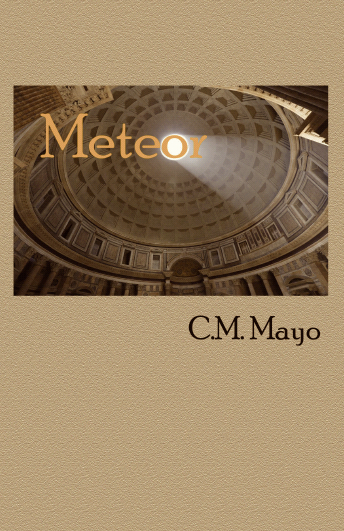
My new book is Meteor

The Texas Bibliothek’s Digital Doppelgänger: My Online Working Library of Rare Books

This blog posts on Mondays. This year, 2021, I am dedicating the first Monday of the month to Texas Books, in which I share with you some of the more unusual and interesting books in the Texas Bibliothek, that is, my working library. Listen in any time to the related podcast series.

Texas history aficionados, welcome and bienvenido! I invite you to check out these three fascinating—and free—digitalized rare books:

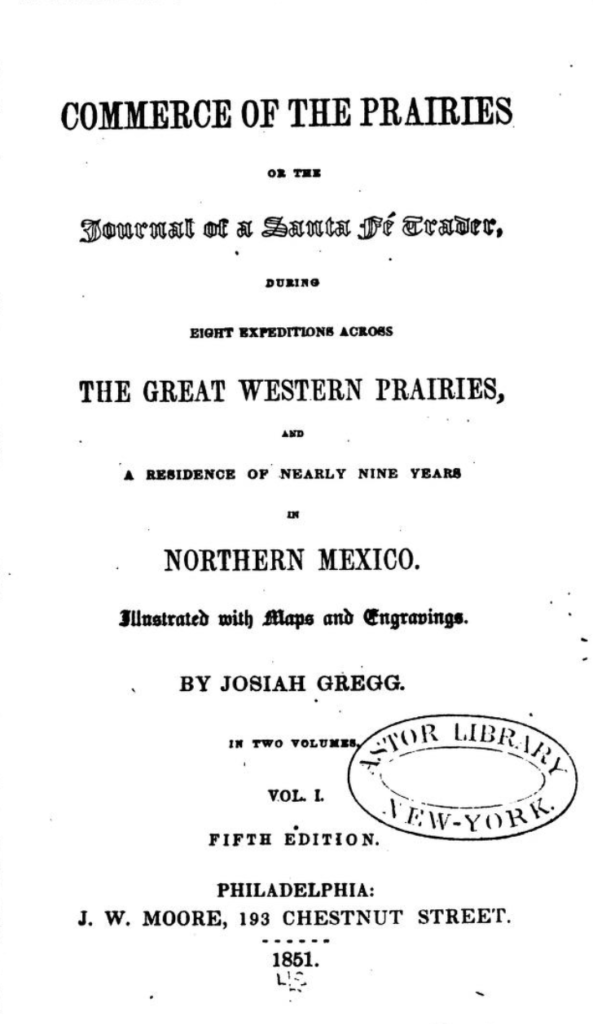
Gregg, Josiah. Commerce of the Prairies: Or the Journal of a Santa Fe Trader During Eight Expeditions Across the Great Western Prairies and a Residence of Nearly Nine Years in Northern Mexico. Two Vols, J.W. Moore, 1851. Fifth Edition.
A best-seller of its day. The editor was none other than John Bigelow, who later became the US ambassador to France during the US Civil War—the time of Mexico’s French Intervention / Second Empire. Gregg’s memoir is vital reading for anyone interested in the history of the West, the Southwest, and the history of US-Mexico trade.

Domenech, Abbé Emmanuel. Missionary Adventures in Texas and Mexico: A Personal Narrative of Six Years’ Sojourn in Those Regions. Longman, Brown, Green, Longmans, and Roberts, 1858.
A few years after its publication, Abbé Dommenech served as Maximilian’s press secretary. Here he recounts his travels in the parts that might more properly be called Apachería and Comanchería. Grim stuff.

Sherman, William T. The Memoirs of General William T. Sherman. D. Appleton and Co., 1886
One of the greatest memoirs of the 19th century. Some mighty strange stories in here.

If this finds you, dear writerly reader, working on a biography, history, or historical fiction, whether Texas-related or not, the rest of this post is also for you. Normally I post for my writing workshop the second Monday of each month, but on occasion I make an exception. (In any event, look for the regular workshop post next Monday.)

Hot Diggety Digital!

Is it practical to go all digital with your working library? Probably not. But partially, yes. It depends on your project and your daily capacity for screentime & scrollin’. As I continue with my book in-progress on Far West Texas which, of all my several books to-date, has required the largest working library, this finds me still a-huffin’ & a-puffin’ up the learning curve for utilizing and managing my working library. But I can say that I’ve achieved some oxygen-tank-worthy altitude! Three things about working with working libraries that I learned the “ouch” way:

(A) buy the book whenever possible (else I may not get my hands on it again);

(B) make space, more space than you will ever think you could possibly need for the working library because… you will need it; and

(C) in some way, ruthlessly, keep the books organized (for this I use categories and bookmarks. See A Working Library: Further Notes and Tips for Writers of Historical Fiction, Biography, History, Travel Memoir / Essay, etc.).

I cannot say it too often, a book I cannot find is a book I might as well not own.

A BOOK I CANNOT FIND
IS

A BOOK I MIGHT AS WELL NOT OWN

Kindles?

Only when I don’t have another option. For this particular book project, I have not found Kindles of much use. In my experience, for the most part, where there is a Kindle, there is also a paperback and I ever and always prefer the paperback.

What About Using (Um, Actually Going to) a Library or Three?

Yes, of course, I have used both public and research libraries. That would be another blog post (such as this one). That said, for independent scholars with limited travel options, relying on libraries is not ever and always nor even usually the best option when it comes to consulting a given book. Let me put it this way: I don’t cook spaghetti one noodle at a time, either.

Rare Books Out of Reach?

But what about when a needed book is impossible to find and/or too expensive to buy? A fine copy of certain classic 19th works can go for hundreds, even (I’m talking about you, Josiah Gregg) thousands of dollars. Happily, many such classics are now in the public domain, that is to say, they are out of copyright and some publisher somewhere has brought out an affordable paperback edition. My working library has many such paperbacks purchased for a few bucks each from my go-to online booksellers. I’ve also purchased used and ex-library books of later editions, many of which books, not being in such good shape, are generally inexpensive (sometimes the book is cheaper than the shipping), these mainly from www.abebooks.com. And finally, on a few special occasions, I have shelled out a pile of clams for a rare book (see my posts on rare books here and here, for example). For rare books, stay away from amazon and ebay because many used book sellers on those platforms do not know how to properly describe a rare book (you’ll think you’re getting the elephant, but what shows up is a three-legged alpaca). It is best to buy from a member-in-good-standing of the Antiquarian Booksellers Association of America, or similar association, for those dealers based in other countries.

Free!

Fortunately for this writer’s pocketbook, many out-of-copyright oldies are now available in ***free*** digital editions on the nonprofit Internet Archive archive.org and/or the Gutenberg Project gutenberg.org. Lo and behold, many of the books I need in my working library fall into this category.

For example, the English translation of the French Abbé Emmanuel Domenech’s memoir Missionary Adventures in Texas and Mexico was one I had been looking for several years (it was relevant to an earlier book of mine, as well.) When a copy finally popped up, alas, its price was well out of my budget. But I can now access Domenech’s memoir for my working purposes, thanks to the free online edition.

And Searchable!

Yep, digital books are also searchable and that can come in handy.

Behold:
The Digital Döppelgänger

So, after some time working on this Far West Texas book, I have accumulated what I think of as the digital Doppelgänger to my physical working library, the Texas Bibliothek.

As I noted in a previous post about how I organize my (physical) working library, I shelve the physical books under categories that work for me— categories that may not necessarily make sense to anyone else. I also include books which inclusion may not make sense to anyone else. And that is OK: Anyone Else is not the name of the person writing my book. Nor is Anyone Else writing your book, I would imagine…

And what about when, as is oftentimes the case, a book falls into two or more categories? Well, la de diddly da, I just pick one category, and go with that. My working library may be large, but I don’t need to put on rollerskates to go in there.

How to keep an online working library
organized for one’s writerly purposes?

For the online library originally I kept a list, by author in alphabetical order, on a blogger blog (treating it as basically a free, oft-updated webpage). But I have since moved to a system that works much better for me: I categorize the links to the online books in the same way as I do my physical working library, using a photo for quick reference, on a private page of my very own self-hosted WordPress blog, Madam Mayo.

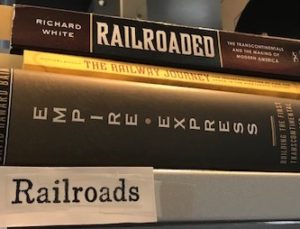
Herewith, one example of the approximately 30 categories in my online working library (that is to say, a photo of the physical working library ‘s label and shelf + any online titles):

Davis, Richard Harding. The West from a Car-Window, Harper & Brothers, 1892.

*

Q & A with Sergio Troncoso, Author of A Peculiar Kind of Immigrant’s Son 

A Review of Claudio Saunt’s West of the Revolution: 
An Uncommon History of 1776

The Solitario Dome

*

My new book is Meteor

Q & A with Solveig Eggerz on “Sigga of Reykjavik”

“My interest in the 20th century history of Iceland led me to write. I wanted to show how Iceland struggled for independence from Denmark, how isolated Iceland was from the rest of the world until May 10, 1940 when Churchill’s occupation force arrived, and how Iceland’s independence hung in the balance during World War II.”—Solveig Eggerz

This blog posts on Mondays. Fourth Mondays of the month I devote to a Q & A with a fellow writer.

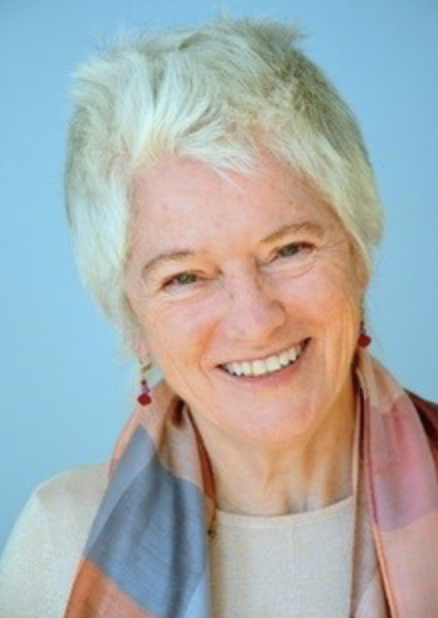
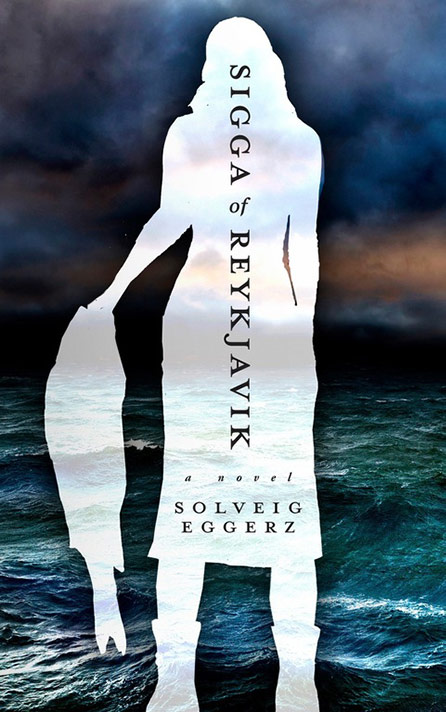
One of my very favorite writers is Solveig Eggerz. Waaaay back in 2011 I interviewed her about her novel The Seal Woman for my Conversations with Other Writers occasional podcast series (listen in to that interview anytime here.) Although she has been living in the Washington DC area for many years, Solveig Eggerz is from Iceland, so of course she speaks Icelandic and she writes about Iceland in a knowing way. Her work is so fresh, like a sea breeze and it will carry you right to the shores of that far, fantastic isle. Her novel Sigga of Reykjavik is recently out in a new edition from Bacon Press Books, apropos of which she agreed to answer some questions. But first, here is the catalog copy for Sigga of Reykjakik:

Meet Sigga, a spirited young woman who flees the abusive conditions on an Icelandic farm, only to face grinding poverty in Depression-era Reykjavik. Her struggle for independence runs parallel to Iceland’s quest for freedom from Danish dominance. Born a century before the Me-Too movement, Sigga supports her family, working among men who learn never to touch her without her permission. Adventurous, optimistic, and always practical, Sigga is thrilled when World War II brings Iceland out of centuries of isolation. Thousands of Allied forces occupy the country, bringing money and work. But moral dilemmas abound as Sigga seeks to financially exploit the occupation while at the same time protecting her young and beautiful red-headed daughter from soldiers.

C.M. MAYO: In brief, what inspired you to write Sigga of Reykjavik?

SOLVEIG EGGERZ: My interest in the 20th century history of Iceland led me to write. I wanted to show how Iceland struggled for independence from Denmark, how isolated Iceland was from the rest of the world until May 10, 1940 when Churchill’s occupation force arrived, and how Iceland’s independence hung in the balance during World War II.

C.M. MAYO: As you were writing, did you have in mind an ideal reader?

SOLVEIG EGGERZ: My ideal reader would be excited about little known history and charmed by quirky characters.  

C.M. MAYO: Now that it has been published, can you describe the ideal reader for this book as you see him or her now?

SOLVEIG EGGERZ: An ideal reader loves my protagonist despite her flaws and sees the logic in gaining one’s personal independence through sewing corsets.

C.M. MAYO: Can you share any surprises for you about your book’s reception? (Andf has it been different in different countries?)

SOLVEIG EGGERZ: I have been surprised when readers do not discern Sigga’s anger as a cloak for the intense love she felt for those closest to her.  

C.M. MAYO: Which writers have been the most important influences for you?

SOLVEIG EGGERZ: The writers that set me free from the ordinary are Annie Proulx (The Shipping News) and the Icelandic writer, Halldor Kiljan Laxness (Independent People).

C.M. MAYO: Which writers are you reading now? 

SOLVEIG EGGERZ: I Know Why the Caged Bird Sings by Maya Angelou, even better on second reading; Survival on the Edge: Seawomen of Iceland by anthropologist, Margaret Willson; and a trilogy about a brave and wise woman of the Viking era, Auður Djúpúðga by Vilborg Davíðsdóttir

C.M. MAYO: How has the Digital Revolution affected your writing? Specifically, has it become more challenging to stay focused with the siren calls of email, texting, blogs, online newspapers and magazines, social media, and such? If so, do you have some tips and tricks you might be able to share? 

SOLVEIG EGGERZ: Actually I love writing on the computer. I am not one to long for life in a cabin on a mountaintop where I write on a yellow pad free of technology. I don’t like to be surprised by “emergencies” days after they occur. I resolve the issue of disturbances by keeping my phone next to me, so I can glance at a message without shutting down my story. Maybe I am exaggerating my equanimity!

C.M. MAYO: For those looking to publish, what would be your most hard-earned piece of advice?

SOLVEIG EGGERZ: Don’t waste years seeking an agent, a large publisher, a small publisher, or anything. Instead invest time and money in getting your work read and vetted 1) by your favorite writers group and 2) by an excellent developmental editor or mentor. Once you feel confident that you’ve written a good book, do what feels right regarding publishing.

C.M. MAYO: What’s next for you as a writer?

SOLVEIG EGGERZ: I’m returning to my toughest task, assigning coherence to my collection of personal stories, so that I might honestly call them a memoir.

*

Visit Solveig Eggerz and learn more about her novels at solveigeggerz.com

Q & A with Álvaro Santana-Acuña on Writing Ascent to Glory: How One Hundred Years of Solitude Was Written and Became a Global Classic

Donald M. Rattner’s My Creative Space

Q & A: Sara Mansfield Taber on Chance Particulars: A Writer’s Field Notebook

*

My new book is Meteor

Upcoming Virtual Lecture on Francisco I. Madero and Spiritism at the Centro de Estudios de Historia de México

Back in 2014 my book on the leader of Mexico’s 1910 Revolution, Francisco I. Madero, came out and, shortly thereafter, its Spanish translation was formally presented at the Centro de Estudios de Historia de México (CEHM) in Mexico City. I am very honored that the CEHM has asked me back to give a lecture (in Spanish) on the topic of Madero and Spiritism this March 10th at 12 PM Mexico City time (that would be the same as 12 PM USA Central Time). In these times of the pandemic it will be virtual, via the Mexican equivalent of Zoom. Of note, the CEHM has in its archives Francisco I. Madero’s personal library, which has many rare esoteric texts, some of which I will be discussing in my talk. If this piques your interest, zap me an email and I should be able to get you the link for the virtual event.

This video (below) gives a flavor of some of what I will be discussing.

My book, Metaphysical Odyssey into the Mexican Revolution is my book-length essay of creative nonfiction about my translation, plus my translation— the first—of Madero’s secret book, the 1911 Manual espírita, or Spiritist Manual. Metaphysical Odyssey into the Mexican Revolution is also available in Spanish translation (an excellent one by a writer I much admire, Agustín Cadena) as Odisea metafísica hacia la Revolución Mexicana, together with a complete transcript of Madero’s 1911 Manual espírita.

My scholarly paper about my research, with a little forest of footnotes, “Francisco I. Madero and His Secret Book,” was published in the Journal of Big Bend Studies in 2017.

You can also find Jeffrey Mishlove’s interview with me about the book on his YouTube channel, New Thinking Allowed. There is also a Biographers International Newsletter “Interview with C.M. Mayo: Strange Spark of the Mexican Revolution“; a podcast of my talk for the Center for US-Mexican Studies at the University of California San Diego; Greg Kaminsky of Occult of Personality’s podcast interview (this being the most focused on the occult); and finally, you can also listen in to Daniel Chacón’s “Words on a Wire” Podcast Interview with Yours Truly About Francisco I. Madero’s Secret Book.

This finds me still working on the podcast about Sanderson, Texas, that podcast series, “Marfa Mondays,” being apropos of my book in-progress on Far West Texas. During the Mexican Revolution some crucial battles and incidents took place on the US-Mexico border, so the ever-charismatic and unusual Don Francisco will make an appearance in this book as well.

P.S. Next Monday’s post will be the fourth-Monday-of-the-month Q & A with another writer.

Reading Mexico: 
Recommendations for a Book Club of Extra-Curious 
& Adventurous English-Language Readers

Peyote and the Perfect You

Cartridges and Postcards from the US-Mexico Border of Yore

*

My new book is Meteor

Recommended Books on the Creative Process

This blog posts on Mondays. Second Mondays of the month I devote to my writing workshop students and anyone else interested in creative writing. Welcome!

> For the archive of workshop posts click here.

For updates to this list, see the dedicated page Recommended Reading on Creative Process.

Last month I posted my list of recommended books on the craft of creative writing. This month, herewith, my list of recommended books on the creative process. May they prove as useful and inspiring for you as they have been for me.

By the way, many of these books are not about creative writing per se. As writers we can learn not only from other writers, but from painters, filmmakers, musicians, athletes, computer science professors— in sum, anyone who sets out to do, and keep on doing, extraordinary things when the world, alas, does not always respond in a timely nor generous manner.

TOP PICKS ON CREATIVE PROCESS

*Gilbert, Elizabeth. Big Magic: Creative Living Beyond Fear
Wondrously, brilliantly wonderful.

*Newport, Cal, Deep Work: Rules for Focused Success in a Distracted World.
Outstanding and oftentimes surprising advice from a successful academic and best-selling author. Read my post about this book here.

—— Digital Minimalism
Ye Bible.

*Pressfield, Steven, The War of Art: Winning the Creative Battle
The best. If you’re blocked and you want to buy one book to help yourself, this is the one. P.S. be sure to check out his website and blog.

*Ricco, Gabriele Lusser, Writing the Natural Way: Using Right-Brain Techniques to Release Your Expressive Powers
Revolutionary.

AND BY THE WAY,
THIS IS WHAT I HAVE TO SAY ABOUT CREATIVE PROCESS
(NOT A BOOK BUT THE TRANSCRIPT OF A TALK):

*Mayo, C.M. “On Seeing as an Artist or, Five Techniques for a Journey to Einfuhlung.”
Not a book but a transcript of remarks for the panel on “Writing Across Borders and Cultures,” Women Writing the West conference, Santa Fe, New Mexico, October 15, 2016.

MORE RECOMMENDED READING:

Brown, Rita Mae: Starting From Scratch: A Different Kind of Writer’s Manual

Burnham, Sophy, For Writers Only
Easy to dip into. Wise words.

Baum, Kenneth, The Mental Edge: Maximize Your Sports Potential 
with the Mind-Body Connection

Read my mini-review here.

Benke, Karen, Rip the Page! Adventures in Creative Writing
For creative children— of all ages. Read her guest-blog post for “Madam Mayo” here. (Link goes to old blogger platform, will be corrected shortly.)

Cameron, Julia, The Artist’s Way

New Agey (and so not for everyone) but also highly practical. Her concept of the “artist date” I have found brilliantly effective.

— , The Sound of Paper: Starting from Scratch
Thoughtful, elegant, and inspiring mini-essays.

Dillard, Annie, Living by Fiction
A book about the world.

Flack, Audrey, Art & Soul: Notes on Creating
Deep. The artist as shaman.

Friedman, Bonnie, Writing Past Dark: Envy, Fear, Distraction, and Other Dilemmas in the Writer’s Life
From the trenches.

Goldberg, Natalie, Writing Down the Bones: Freeing the Writer Within
A very popular book. Packed with fun writing exercises.

Iglesias, Karl, The 101 Habits of Highly Successful Screenwriters: Insider Tips from Hollywood’s Top Writers
Useful tips for any writer.

Kingston, Karen, Clear Your Clutter with Feng Shui
Because… maybe… that’s what you need to do!

Lamott, Anne, Bird by Bird: Some Instructions on Writing and Life
Hilarious. For anyone at any stage in their writing.

Leonard, George, Mastery: The Keys to Success and Long-Term Fulfillment
Zen.

Maisel, Eric, PhD., Fearless Creating: A Step-by-Step Guide to Starting and Completing Your Work of Art
Dr Maisel specializes in helping artists, and he’s a prolific writer himself. Wise advice.

Palmer, Amanda, The Art of Asking: How I Learned to Stop Worrying and Let People Help
It might seem that this book is about about asking for help and money and then, as Palmer puts it, “taking the donuts,” but it’s really about the artist as shaman. 

Rattner, Donald M. My Creative Space: How to Design Your Home to Stimulate Ideas and Spark Innovation
Read my post about this book here.

Rhodes, Richard, How to Write: Advice and Reflections
Good advice from a highly accomplished and prolific writer.

See, Carolyn, Making a Literary Life
Good advice from another highly accomplished and prolific writer — this one from LA. It’s a hoot.

Soojung-Kim Pang, Alex, Rest: Why You Get More Done When You Work Less
Read my post about this book here.

Ueland, Brenda, If You Want to Write: A Book About Art, Independence and Spirit
A classic that has proven especially popular with my writing workshop participants.

This Writer’s PFWP and NTDN Lists: 
Two Tools for Resilience and Focus

Q & A with Timothy Heyman on the Incomparable Legacy 
of German-Mexican Novelist B. Traven

Translating Across the Border

*

My new book is Meteor

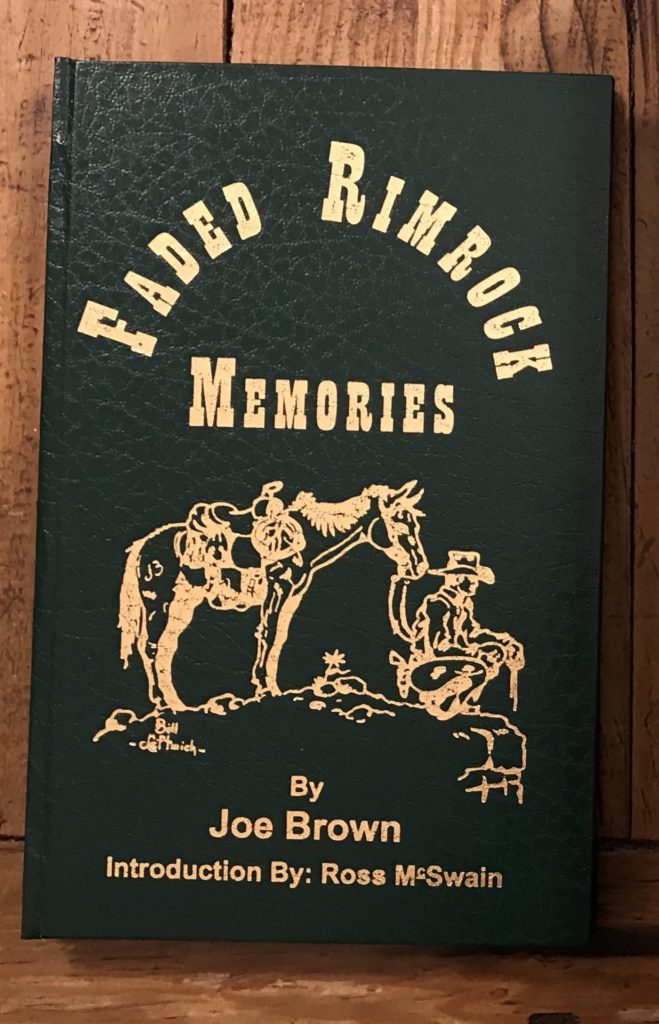
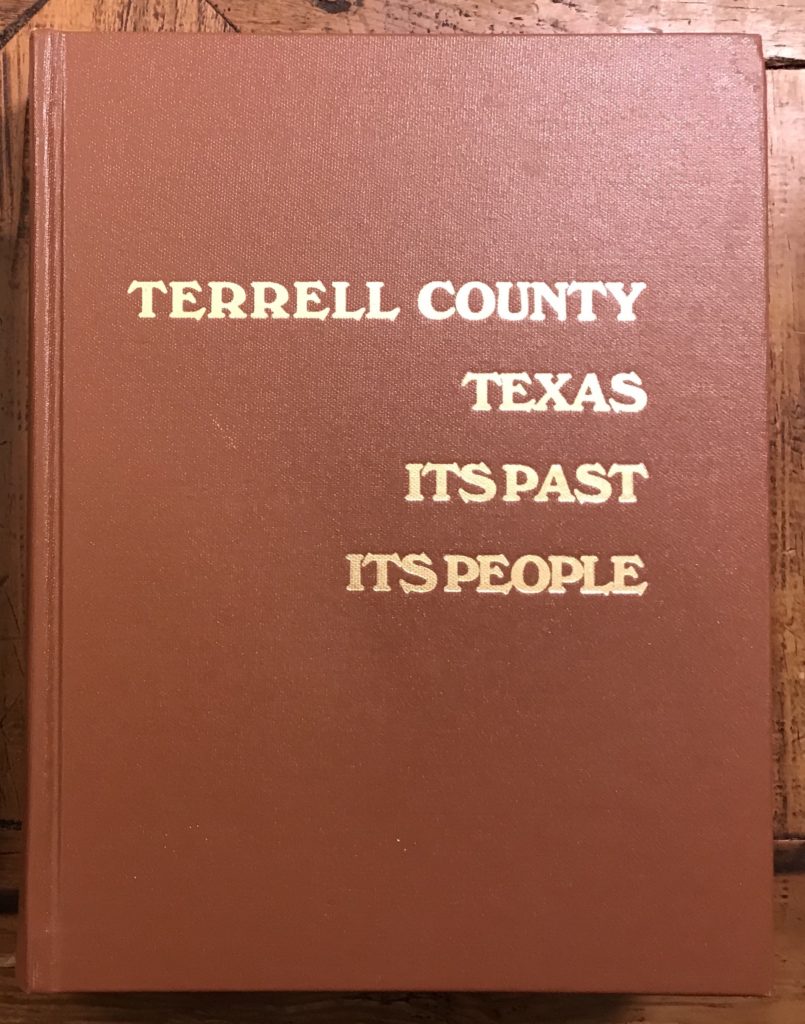
From the Texas Bibliothek: The Sanderson Flood of 1965; Faded Rimrock Memories; Terrell County, Texas: Its Past, Its People

This blog posts on Mondays. This year, 2021, I am dedicating the first Monday of the month to Texas Books, in which I share with you some of the more unusual and interesting books in the Texas Bibliothek, that is, my working library. Listen in any time to the related podcast series.

Writes Craig Childs in his masterful The Secret Knowledge of Water, “There are two easy ways to die in the desert: thirst and drowning.” It does indeed rain in the desert, not often of course, but when it does, with so little vegetation to catch it, water can rage through canyons with killing power. In Far West Texas a standout tragedy of the 20th century was the June 11, 1965 flash flood that killed 26 people and devastated the little railroad town of Sanderson.

But this post isn’t about the Sanderson flood, rather, the matter of books in a writer’s working library. Back when I was writing Miraculous Air: Journey of a Thousand Miles through Baja California, the Other Mexico, my first book of creative nonfiction, I learned the painful way to never, as in, never ever, let pass the chance to snap up a book of local history. These histories, which often offer the richest of detail, unique voices, and personal memories, are vital reading for such a work as mine—as those of you who follow this blog well know, I’m now working on a book about Far West Texas.

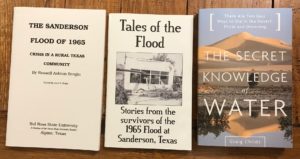
Oftentimes local histories are self-published, and in the days before amazon and print-on-demand, only available locally and in limited numbers. Try to find such a book later, and chances are… you won’t. So when I wandered into the Sanderson Visitors Center and saw them, I snapped up Tales of the Flood, a collection of oral histories by C.W. (Bill) Smith, along with Russell Ashton Scogin’s history, The Sanderson Flood of 1965: Crisis in a Rural Texas Community (Sul Ross State University, 1995), and Terrell County, Texas: Its Past Its People (Rangel Printing, Fourth Printing, 2008).

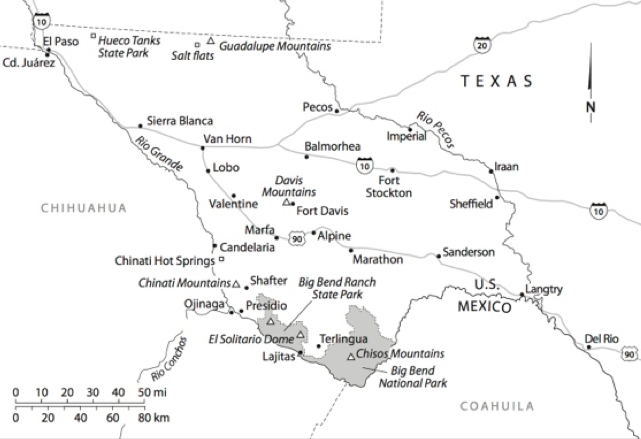
Sanderson is the seat of Terrell County, a county best known for its hunting ranches with fabulous vistas, its cactus, and sheep ranching. One of the more remote towns in Texas, from El Paso Sanderson lies a 4 and a half hours drive east, and from Austin a 5 and a half hours drive west. If you live anywhere in the county outside of Sanderson, you’ll want a rifle. It’s infested with rattlesnakes.

Here’s my map of Far West Texas (that is, Texas west of the Pecos River), showing Sanderson just above the US-Mexico border between Langtry and the Big Bend National Park.

In the Sanderson Visitors Center C.W. (Bill) Smith granted me a fascinating and wide-ranging interview on Sanderson’s history–which of course included much discussion of the 1965 flood. The podcast of this interview has been a long while in production, but I’ll be posting it shortly. (You can listen in to the other 21 podcasts apropos of this book posted to date here.)

From C.W. (Bill) Smith’s Tales of the Flood, from “Genaro’s Story”:

Sometimes a moment of mirth turns to disaster in seconds. Genaro Valles and his wife of Del Rio were just in town visiting. They had found an older wooden house near the Dairy King to stay in while there and spent a restless night from the pounding rain and the roar of the nearby creek. Early that morning Genaro awoke to the sound of water running. He teased his wife for letting the water run in the old toilet. But as he turned over to return to sleep his hand dropped by the side of the bed and fell into cold water…

If memory serves me, I found Joe Brown’s Faded Rimrock Memories in one of the Big Bend National Park ranger station bookstores. A Sanderson, Texas native, Brown grew up “all over West Texas, doing whatever to survive.” His ranch stories and cowboy poetry are lively examples of the genre, and his rattlesnake stories alone are worth the price of the book.

From Faded Rimrock Memories by Joe Brown:

A Texans Version of Jesus Birthplace

Jesus was born in Texas, this I know,
Listen and tell me this is not so.
His mother rode into town on an ass,
His father walked, they had no cash

(end of excerpt)

As for the Terrell County book, a hardcover that clocks in at over 700 pages, that was a bit pricier, and dicier to pack into my luggage. But I’m glad I did, for it is a superb reference on the region, with innumerable family and business histories, and it includes local newspaper clippings from the 1965 flood—and earlier and also devastating floods.

So what is the Texas Bibliothek? That’s what I call my working library for my book-in-progress, tentatively titled World Waiting for a Dream: A Turn in Far West Texas. Texans are rather more prolific on the literary front than bajacalifornianos, so keeping the Texas Bibliothek in order has been, shall we say, a learning experience. But my bookmark organizing method, which I blogged about here, is keeping me away from the Advil.

Next month for my first-of-the-month post on Texas books I’ll be blogging about using archive.org and assembling an online library for out-of-copyright books, that is, books that are now in the public domain. Reading a book online is never the ideal option, but oftentimes necessary.

A Trio of Texas Biographies in the Texas Bibliothek

Lone Star Nation: How Texas Will Transform America by Richard Parker

“Dear Mother, Am feeling hard as a rock and brown as an Indian”:
More Postcards from the US-Mexico Border Circa 1916

*

My new book is Meteor

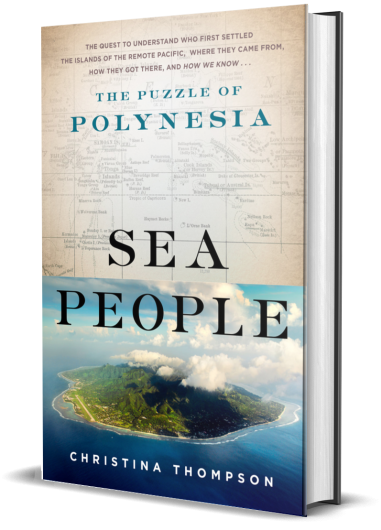
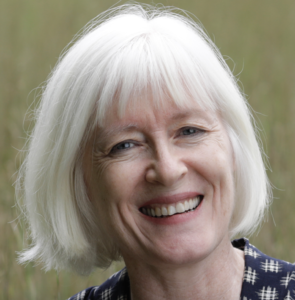
Q & A with Christina Thompson on “Sea People: The Puzzle of Polynesia”

A very clever agent once told me to write for the smartest person I know who knew nothing about my subject. I thought this was great advice, and I have both kept it in mind for myself and passed it along to my students ever since
— Christina Thompson

This blog posts on Mondays. Fourth Mondays of the month I devote to a Q & A with a fellow writer.

Splendidly written and deeply researched, Christina Thompson’s Sea Peoples will appeal to not only specialists on Polynesia but any discerning reader with a broad interest in history—or, I should say, the enduring question of what it means to be human. What brought me to read Sea People is my interest in what historian David M. Wrobel calls the “global frontier.” My own work in-progress is on Far West Texas, which, like Polynesia, saw its first European explorers, then Euro-American colonizers, within roughly the same time frame. One might call Far West Texas a sort of reverse Polynesia: it is a desert land with widely scattered oases. Like Polynesia, anyone who would attempt to travel through it risked mortal danger. When and how did the Polynesians sail into that vast watery expanse of the globe and settle the islands from New Zealand to Hawai’i to Easter Island? Thompson uncovers a riveting and profoundly important story.

C.M. MAYO: In brief, what inspired you to write Sea People?

CHRISTINA THOMPSON: There’s a chapter in my previous book in which I describe the experience of staying behind in Honolulu while my husband traveled with our young son to NZ for his father’s funeral. My husband is Maori and, of course, I knew the big story about Polynesia—how the Islanders in Hawai‘i and Easter Island and New Zealand and everywhere in between were all part of one big family. But the breathtaking reality of what that actually entailed came home to me in a new way when I looked out at the Pacific from Honolulu and thought about how far away New Zealand was. Sea People is an attempt to work out the implications of that understanding.

C.M. MAYO: As you were writing, did you have in mind an ideal reader?

CHRISTINA THOMPSON: A very clever agent once told me to write for the smartest person I know who knew nothing about my subject. I thought this was great advice, and I have both kept it in mind for myself and passed it along to my students ever since. 

C.M. MAYO: Now that it has been published, can you describe the ideal reader for this book as you see him or her now?


CHRISTINA THOMPSON: I learned a lot of things in the course of writing this book, and I ended up explaining some fairly esoteric subjects, like the theory behind coral atoll formation, or how radiocarbon dating actually works, or what a reconstructed proto-language is. My working assumption was always that if I found these things fascinating, my ideal reader most likely would too. 

C.M. MAYO: In your researches, what are the one or two things that most surprised you to uncover?

CHRISTINA THOMPSON: I was amazed to learn that a very tiny number of potsherds had been discovered in the Marquesas, 3,500 miles from the nearest island in which pottery is known to have been made. The implication is that those sherds were likely carried there nearly 1000 years ago by some very early voyager.

I was also fascinated by the fact that European explorers sometimes found signs that islands had once supported significant populations which had since disappeared, leaving us to wonder what happened to those people.

C.M. MAYO: Can you share any surprises for you about your book’s reception?


CHRISTINA THOMPSON: I definitely did not anticipate how many male readers I would have. A great deal of the enthusiasm for this book has come from men, many of whom work in technical fields. I was so surprised by this that I wrote a little essay about it for the American Scholar.

C.M. MAYO: Which writers have been the most important influences for you as a writer of narrative nonfiction? And for Sea People in particular?

CHRISTINA THOMPSON: Bruce Chatwin’s In Patagonia is one of my touchstones; it opened my eyes to what could be done with travel narratives and history and a geographical perspective. Another writer in a similar vein who had a great influence on me is Jonathan Raban, author of the very wonderful Bad Land. Theoretically I am very indebted to a profoundly creative Australian historian named Greg Dening, and when I want to be reminded how to write about the islands, I look to Somerset Maugham and Robert Louis Stevenson’s masterful descriptive passages. 

C.M. MAYO: Which writers are you reading now? 

CHRISTINA THOMPSON: I’m currently reading Julia Blackburn’s Time Song, T. M. Luhrmann’s When God Talks Back, and Daniel Mendelsohn’s Three Rings, plus a Brodie Jackson novel by Kate Atkinson.

C.M. MAYO: How has the Digital Revolution affected your writing? Specifically, has it become more challenging to stay focused with the siren calls of email, texting, blogs, online newspapers and magazines, social media, and such? If so, do you have some tips and tricks you might be able to share? 

CHRISTINA THOMPSON: I think this depends on what stage one is at in the writing process. When you’re actually writing a book, all this stuff is a distraction and you have to be very careful not to waste too much time on it. But once your book is published, it becomes a lifeline to your readership, and the more you participate the better. So, I think it’s really a matter of making all these opportunities work for and not against you, and that takes a certain amount of discipline. 

C.M. MAYO: For writers of narrative nonfiction keeping notes and papers organized can be more than tremendously challenging. Would you have any tips to share? 

CHRISTINA THOMPSON: I have a bad system. I take notes on what I’m reading in a series of composition notebooks (the black and white marbled kind). I am always reading several books at once and the notes get all jumbled, a few pages about this book, then a few pages about something else, then some pages about a third thing. I never know where anything is. But then when I read back through the notebooks, it’s like a narrative of my reading history and I can see the threads of ideas and themes that interest me. One thing I am scrupulous about, however, is keeping track of page numbers and bibliographic citations. 

C.M. MAYO: For those looking to publish, what would be your most hard-earned piece of advice?

CHRISTINA THOMPSON: Don’t be too impatient and don’t try to publish work that isn’t ready. Also, I do recommend having some readers for your work-in-progress: a writing group or a class can really help you identify weaknesses in your writing that you might not be able to identify on your own. 

C.M. MAYO: What’s next for you as a writer?

CHRISTINA THOMPSON: I’m working on a book about early 19th century missionaries in the Pacific. They are a very polarizing group and they had a very big impact on island societies. I want to try to understand their experience, as well as the experience of the people they set out to evangelize, and the lasting consequences of these encounters. 

> Visit Christina Thompson’s website and learn more at www.christinathompson.net

Q & A with Timothy Heyman on the Incomparable Legacy of 
German-Mexican Novelist B. Traven

From the Writer’s Carousel: Literary Travel Writing

Lord Kingsborough’s Antiquities of Mexico

*

My new book is Meteor

Melanie Kobayashi’s Champagne Kegger — Plus From the Archives: Ruth Levy Guyer’s “A Life Interrupted: The Long Night of Marjorie Day”

This finds me working on my Far West Texas book and, after hours, bit by itty bit, that is, post by post, still migrating my old Blogger blog over here to self-hosted WordPress, a project I began a couple of years ago because… hmm, yes, deplatforming, in the news! The potential for deplatforming has been a concern for me, although not because I blog on touchy political subjects. Some years ago I started to feel uncomfortable with Google’s ever-changing and opaque algorithms (one of which, for reasons known only to itself, temporarily froze access to my blog) and Google’s outsize power. Therefore, rather than continue to rely on Google’s free Blogger platform for Madam Mayo blog, I opted to shell out for a domain name and hosting, all under my own control here at www.madam-mayo.com. I’ve been blogging 2006, so it has been quite a job* to select the posts worth the bother to migrate, and then, of those selected posts, update the links.

It has been a sobering education to find so many links that I had pointed to now dead. Yes, some webpages can be retrieved on archive.org. But a lot of things, from home pages to individual essays to interviews, are just… poof.

By the way, might this Monday find you yearning for post-pandemic fun times? Well, who needs a “bucket list” of things to see and do when you can have, à la Melanie Koyabashi, a champagne kegger! Check out her post and see if doesn’t make you feel better. (Ooh, that even rhymes, sort of.) You can also watch her dispatch, in her unique manner, a sculpture made of Cheetos.

*(Yes, I know about the software that could help me, and to those of you have pointed to various programs, though these are not going to work for my particular situation at this point, please know that you have my very sincere thanks.)

The rest of this Monday’s post is from the archives– a short post about an excellent and haunting biography of the victim of an epidemic. …hmm, yes, epidemics, in the news!

Ruth Levy Guyer’s
A Life Interrupted: The Long Night of Marjorie Day

By C.M. MAYO
Originally posted on Madam Mayo blog September 26, 2012

A few weeks ago I happened to be wandering around Politics & Prose Bookstore, Washington DC’s venerable go-to place for the latest chewy policy tomes, when, in the second room, I came upon Opus, the book-making contraption. It struck me rather as a beached whale. Not breathing. But there was a little stack of books that had come out of its maw… I picked up the one on top, A Life Interrupted by Ruth Levy Guyer,and began reading. By the time I got to page 10 or so, I realized, ah, time to buy it and go finish it over a cup of coffee. Or three. Or four.

Wow.

First of all it’s beautifully written, very deeply researched, and strange. It’s the true story of Marjorie Day, “Daysey,” a bright Wellesley graduate studying in England in the 1920s who came down with sleeping sickness which left her zombie-like and beset by delusions. And then… seventeen years later, after a horrifying odyssey of hospitals and mental institutions, she woke up. Permanently. She then proceeded to have a very nice and very long life as a teacher and then retiree in Georgetown, DC. Even more bizarrely, she never knew that what she’d been suffering from all those years was encephalitis lethargica– neither her doctor nor her family told her.

The author wrote to Oliver Sacks, whose book and the movie based on his book, tell the story of the victims of sleeping sickness who were woken up, decades later, but only temporarily, by L-dopa. To quote:

I asked Sacks if he had ever seen a patient like Daysey, who had recovered completely and permanently.

“I have never seen anything like this in my own practice,” he wrote back.

(What in blazes is the state of U.S. publishing that a book of this quality is self-published?)

UPDATE: Interesting 2014 essay about the 1915-1927 epidemic of encephalitis lethargica.

Q & A with Timothy Heyman on the Incomparable Legacy of 
German-Mexican Novelist B. Traven

A Writerly Tool for Sharpening Attentional Focus or, The Easy Luxury 
of a Lap Desk

A Review of Claudio Saunt’s West of the Revolution: 
An Uncommon History of 1776

*

My new book is Meteor

Recommended Books on the Craft of Creative Writing

This blog posts on Mondays. Second Mondays of the month I devote to my writing workshop students and anyone else interested in creative writing. Welcome!

> For the archive of workshop posts click here.

For updates to this list, see the page “Recommended Reading on the Craft of Creative Writing”

To learn how to write fiction and creative nonfiction you need teachers, however, they need not be local, Zoomed in, nor even living, because, happily for us all, so many have written books on the craft of writing. Here is my list of favorites. May one or some or even all of these prove as helpful to you as they have been for me.

Boorstin, Jon, Making Movies Work: Thinking Like a Filmmaker
Also helpful for thinking about how and why a reader enjoys a novel or memoir.

Butler, Robert Olen, From Where You Dream: The Process of Writing Fiction
Brilliant.

Chiraella, Tom, Writing Dialogue: How to Create Memorable Voices and Fictional Conversations that Crackle with Wit, Tension and Nuance
Expert and thorough.

Field, Syd, Screenplay: The Foundations of Screenwriting
Excellent for plot. 

Fussell, Paul, Poetic Meter & Poetic Form
More than a little bit crunchy and most of it won’t interest the average prose writer, but the chapter on scansion is worth the price of the book, and, for any prose writer aiming to achive vividness in their writing, worth rereading multiple times.

Gardner, John, The Art of Fiction: Notes on Craft for Young Writers 
Forget the subtitle, “for young writers,” this is a book for writers of any age, and not necessarily beginners. I read the chapter “On Common Errors” so many times my copy fell apart and I had to buy another. Also highly recommended for writers of creative nonfiction.

Gerard, Philip, Creative Nonfiction: Researching and Crafting Stories of Real Life 
Writing a memoir or a longer, more thoughtful piece of journalism? Use this book as your project’s road map.

Glover, Douglas, Notes Home from a Prodigal Son
This includes the essay “The Novel as Poem.” All the essays are excellent but the book is worth the purchase for this one alone. Also recommended: The Erotics of Restraint: Essays on Literary Form

Goodman, Richard, The Soul of Creative Writing
Highly recommended. Especially strong on language.

Hills, Rust, Writing in General and the Short Story in Particular
The best book I’ve found on writing short stories.

Jackson, Bruce, The Story Is True: The Art and Meaning of Telling Stories

McKee, Robert, Story: Substance, Structure, Style, and the Principles of Screenwriting
A profound and essential book about narrative structure, also useful for writers in other genres, including the short story, novel, creative nonfiction, and more.

Oliver, Mary, A Poetry Handbook
This one is short and sweet. Finally, an articulate answer to the question, Why is a rock not a stone? An excellent resource for poets, as well as prose writers, who should never – ever – underestimate the importance of the poetry in their prose.

Piercy, Marge, and Ira Wood, So You Want to Write: How to Master the Craft of Writing Fiction and the Personal Narrative 
The chapter on dialogue is the best I’ve read yet. My workshop students praise this one highly.

Prose, Francine, Reading Like a Writer: A Guide for People Who Love Books and for Those Who Want to Write Them
Divine.

Ricco, Gabriele Lusser, Writing the Natural Way: Using Right-Brain Techniques to Release Your Expressive Powers
The first and biggest barrier to writing quality literature is your Left Brain, or your “Sign Mind.” This book shows you how to quiet the Sign Mind and let your Design Mind emerge to play.
> See my talk On Seeing as an Artist or, Five Techniques for a Journey to Einfühlung

Scarry, Elaine, Dreaming by the Book
Essential for understanding how and why specific sensory detail “works” to create a vivid picture in the reader’s mind.

Sims, Norman, and Mark Kramer, editors, Literary Journalism: A New Collection of the Best American Nonfiction 
A bit dated now, but nevertheless an outstanding selection. The introduction on the art of literary journalism (the more fashionable term these days is “creative nonfiction”) is vital.

Smiley, Jane, Thirteen Ways of Looking at the Novel
Includes her reviews of 100 novels. A treasure of a book by one of our greatest contemporary novelists.

Pamela Jaye Smith, Inner Drives: How to Write and Create Characters Using the Eight Classic Centers of Motivation
Esoterically fabulous and supremely practical.

Snyder, Blake, Save the Cat!
A snazzy book that reads like, well, your buddy explaining the ropes. It’s for screenplay writers but the basics on story structure are useful for short story writers and novels as well.

Tufte, Virginia, Artful Sentences: Syntax as Style

Wood, James, How Fiction Works
Glorious, delectable, and practical.

Zinsser, William K., On Writing Well: The Classic Guide to Writing Nonfiction

Do you have a book on craft that you don’t see here but that you would recommend? Please let me know.

> For the archive of workshop posts click here.

Thirty Deadly-Effective Ways to Free Up Bits, Drips 
& Gimungously Vast Swaths of Time for Writing: 
A Menu of Possibilities to Consider

Blood Over Salt in Borderlands Texas: 
Q & A with Paul Cool About Salt Warriors

Consider the Typewriter (Am I Kidding? No, I Am Not Kidding)

*

My new book is Meteor

A Trio of Texas Biographies in the Texas Bibliothek

Happy New Year! This first Monday of 2021 finds me rolling along at 80 MPH with writing my book about Far West Texas and, concurrently, editing the Marfa Mondays Podcasting Project episode # 22 about Sanderson (listen in to the other 21 Marfa Mondays podcasts here). Those of you who follow this blog well know that I’ve been at work on this book and the related podcast series for a whale of a while. One of many reasons for that is, to quote J.P. Bryan, a past president of the Texas State Historical Association, “More books have been written about [Texas] than any state in the union. In fact, there are more books about Texas than all the rest of the states combined.” Having been reading intensively about Texas for some years now, I believe it.

Starting this year, 2021, I’ll be dedicating the first Monday of the month to sharing with you some of the more interesting books in my working library. This post features a trio of biographies, two recent, and one I’d call an oldie but yummie.

Michael Vinson’s Bluffing Texas Style: The Arsons, Forgeries, and High-Stakes Poker Capers of Rare Book Dealer Johnny Jenkins (University of Oklahoma Press, 2020).
Splendidly well-written and deeply researched, this page-turner about criminal rare book dealer Johnny Jenkins is by none other than Michael Vinson, a leading rare book dealer himself, and so a biographer with an insider’s knowledge of the business. Rare books and documents are the DNA of the stories we tell about our history; burning them or presenting forgeries is to mess with something sacred. This is not a simple story, and the subject was an extremely unusual person.

Gene Fowler’s Mavericks: A Gallery of Texas Characters (University of Texas Press, 2008). I cannot recall how I first came upon Fowler’s work, but whenever it was, count me a fan. He writes high faultin’ art criticism and is himself a performance artist (e.g., “Astroturf Ranchette”). Now that I think about it, it may have been his wild-ride of a book, Border Radio… Or maybe it was Mystic Healers and Medicine Shows… or Crazy Water? (P.S. Maverick Bobcat Carter just might decide to pop into my book.)

Brad Rockwell’s The Life and Times of Alberto G. Garcia: Physician, Mexican Revolutionary, Texas Journalist, Yogi (Alegría Press, 2020)
I was delighted to give this book a blurb:
“Dr. Alberto G. Garcia was Texas’ pioneer yogi, and so much more… This first biography of this extraordinarily accomplished man opens a new and strange window onto Austin history, Texas history, Mexican-American history, the Mexican Revolution, and the transnational development of esoteric movements and philosophies.”–C.M. Mayo


*

What can you find here at ye olde Madam Mayo blog in 2021? As noted above, this year I am dedicating the first Monday of the month to selected treasures in the Texas Bibliothek, that is, my personal working library. As in 2020, the second Monday of the month will be for my writing workshop students and anyone else interested in creative writing; the third Monday for my podcasts and publications, should I happen to have a new one; the fourth Monday Q & A with a fellow writer; and the fifth Monday, when there is one, for my newsletter and cyberflanerie.


A Visit to El Paso’s “The Equestrian”

Q & A: Carolina Castillo Crimm, 
Author of De León: A Tejano Family History

In Memorium: 
William C. Gruben and his “Animals in the Arts in Texas”