This blog posts on Mondays. This year, 2021, I am dedicating the first Monday of the month to Texas Books, in which I share with you some of the more unusual and interesting books in the Texas Bibliothek, that is, my working library. Listen in any time to the related podcast series.
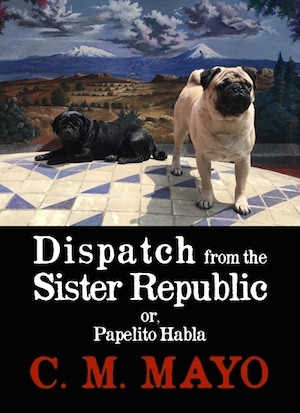
(By the way, my own longform essay available on Kindle, “Dispatch from the Sister Republic or, Papelito Habla,” discusses Cabeza de Vaca’s odyssey and La Relación within a broader meditation on the Mexican literary landscape—not the usual take for a work in English.)
*
MORRIS BISHOP
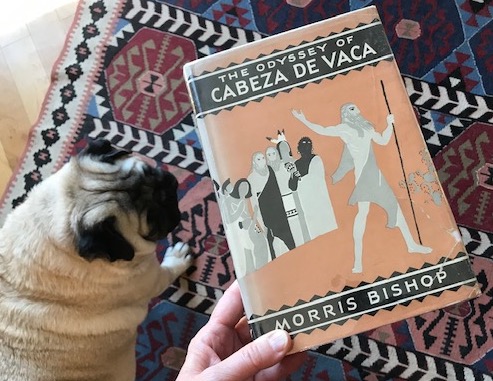
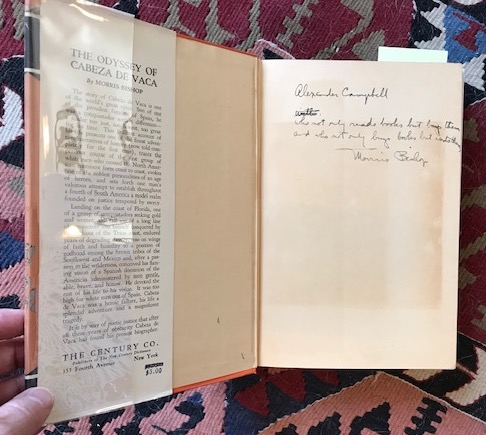
Morris Bishop’s The Odyssey of Cabeza de Vaca (The Century Company, 1933) isn’t really necessary for my working library because, for all practical purposes, for the work of creative nonfiction I am writing, I can rely on the more recent and excellent scholarship of Adorno and Pautz and Reséndez. But I recognize the cultural / historical importance of Bishop’s work and so, for a relatively reasonable price, I wanted to have a first signed edition in my collection. (So, is what I have a working library or a rare book collection? I ask myself that every other day!)
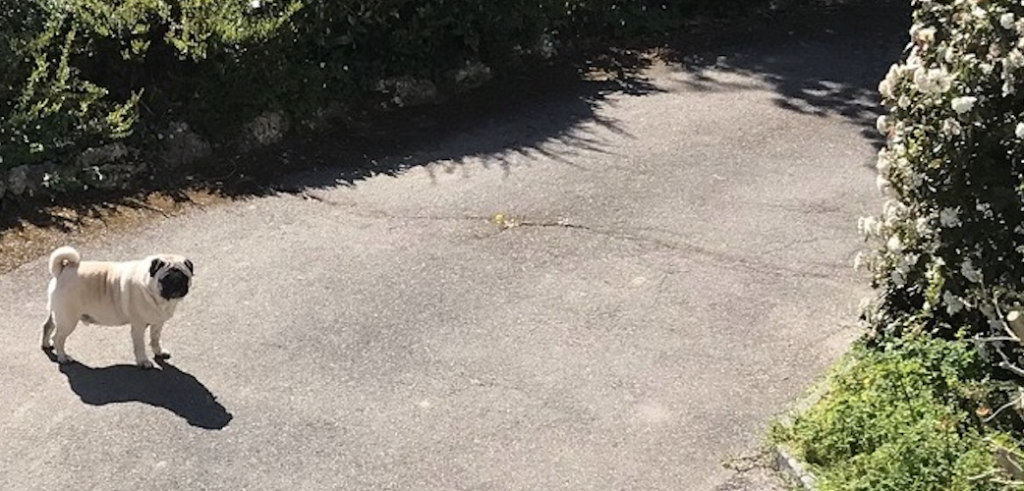
My copy of the Morris Bishop is a first edition in, thank goodness, a mylar cover. That’s my writing assistant, Uliberto Quetzalpugtl, who gave it the sniff test, and a paws up.
Signed by the author to one “Alexander Campbell who not only reads books but buys them and who not only buys books but reads them.”
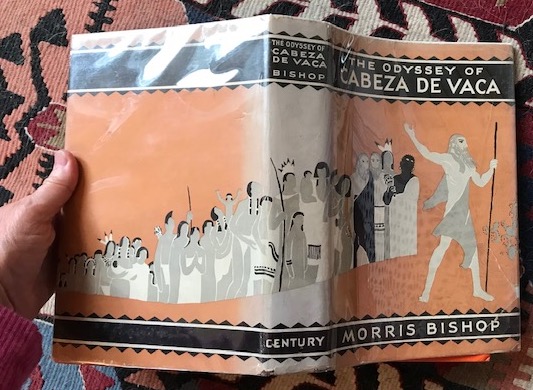
Edward Toledano’s cover illustration portrays Cabeza de Vaca leading Estevanico, the slave; his two fellow Spaniards, Dorantes and Castillo; and a retinue of hundreds of Indians.
CLEVE HALLENBECH
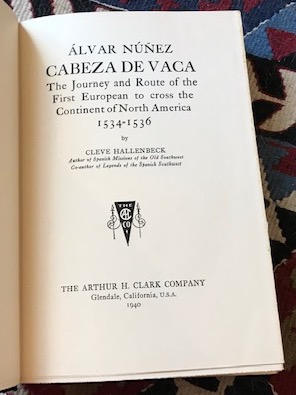
Cleve Hallenbech’s Alvar Núñez Cabeza de Vaca: The Journey and Route of the First European to Cross the Continent of North America 1534-1536 (The Arthur H. Clark Company, 1940) is another work I do not absolutely require for my working library but which, in recognition of its cultural and historic importance, and the very reasonable price for a near-fine first edition, I wanted to have in my collection.
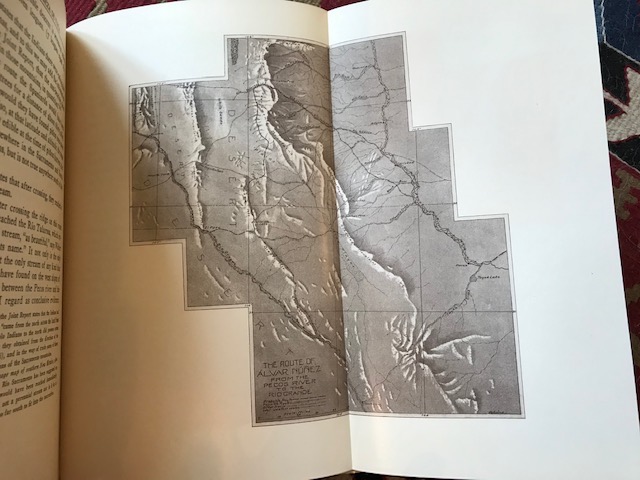
That said, the maps are a wonder! I’ll be talking about these in my post, Part III, for the first Monday of next month, when I discuss the routes various scholars have proposed for Cabeza de Vaca.
The Arthur H. Clark Company was known for its high quality books on the West. (By the way, the University of Oklahoma Press has a book for collectors of works published by the Arthur H. Clark Company, which you can have a blink at here.)
One of the several pull-out maps in the Cleve Hallenbech, this one showing his version of Cabeza de Vaca’s route through Far West Texas. Crazy-hard to read, I know. I’ll be talking more about the route through Far West Texas, and showing some more readable maps, in Part III, to be posted on the first Monday of July 2021.
JOHN UPTON TERRELL
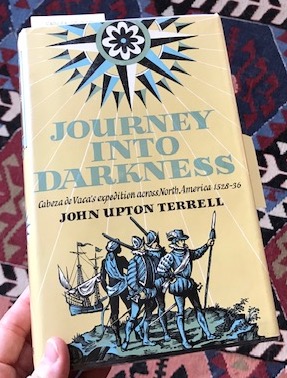
John Upton Terrell’s Journey Into Darkness: Cabeza de Vaca’s Expedition Across North America 1528-36 (Jarrolds Publishers, 1964) is well-researched, given the resources the author had access to back in the early 1960s, and aimed at the general reader.
The back of this first edition carries an ad for Erle Stanley Gardner’s The Hidden Heart of Baja, which for me was like coming across an old amigo. I had a bit to say about the ever-roving eccentric Hollywood screenplay writer in my own book on Baja California, Miraculous Air.
DAVID A. HOWARD
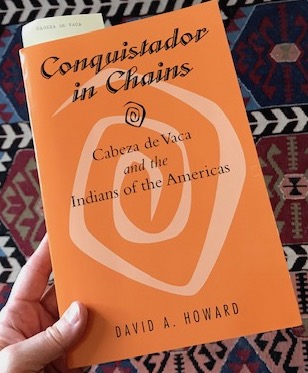
David A. Howard’s Conquistador in Chains: Cabeza de Vaca and the Indians of the Americas (University of Alabama Press, 1997) —currently reading. I was tremendously curious to learn more about Cabeza de Vaca’s later adventures in South America, which are rarely considered in-depth, lying as they do in the shadow of his epic journey in North America.
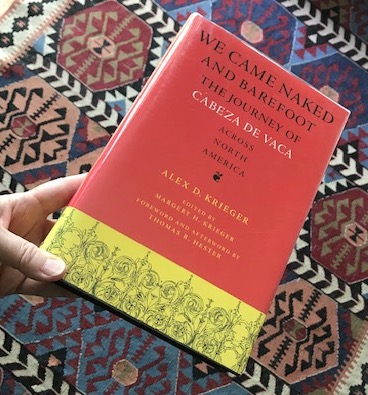
“Perhaps no one has ever been such a survivor as Álvar Núñez Cabeza de Vaca. Member of a 600-man expedition sent out from Spain to colonize ‘La Florida’ in 1527, he survived a failed exploration of the west coast of Florida, an open-boat crossing of the Gulf of Mexico, shipwreck on the Texas coast, six years of captivity among native peoples, and an arduous, overland journey in which he and the three other remaining survivors of the original expedition walked some 1,500 miles from the central Texas coast to the Gulf of California, then another 1,300 miles to Mexico City.
“The story of Cabeza de Vaca has been told many times, beginning with his own account, Relación de los naufragios, which was included and amplified in Gonzalo Fernando de Oviedo y Váldez’s Historia general de las Indias. Yet the route taken by Cabeza de Vaca and his companions remains the subject of enduring controversy. In this book, Alex D. Krieger correlates the accounts in these two primary sources with his own extensive knowledge of the geography, archaeology, and anthropology of southern Texas and northern Mexico to plot out stage by stage the most probable route of the 2,800-mile journey of Cabeza de Vaca.
“This book consists of several parts, foremost of which is the original English version of Alex Krieger’s dissertation (edited by Margery Krieger), in which he traces the route of Cabeza de Vaca and his companions from the coast of Texas to Spanish settlements in western Mexico. This document is rich in information about the native groups, vegetation, geography, and material culture that the companions encountered. Thomas R. Hester’s foreword and afterword set the 1955 dissertation in the context of more recent scholarship and archaeological discoveries, some of which have supported Krieger’s plot of the journey. Margery Krieger’s preface explains how she prepared her late husband’s work for publication. Alex Krieger’s original translations of the Cabeza de Vaca and Oviedo accounts round out the volume.”
*
ANDRÉS RESÉNDEZ
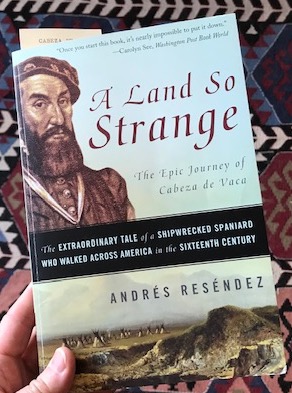
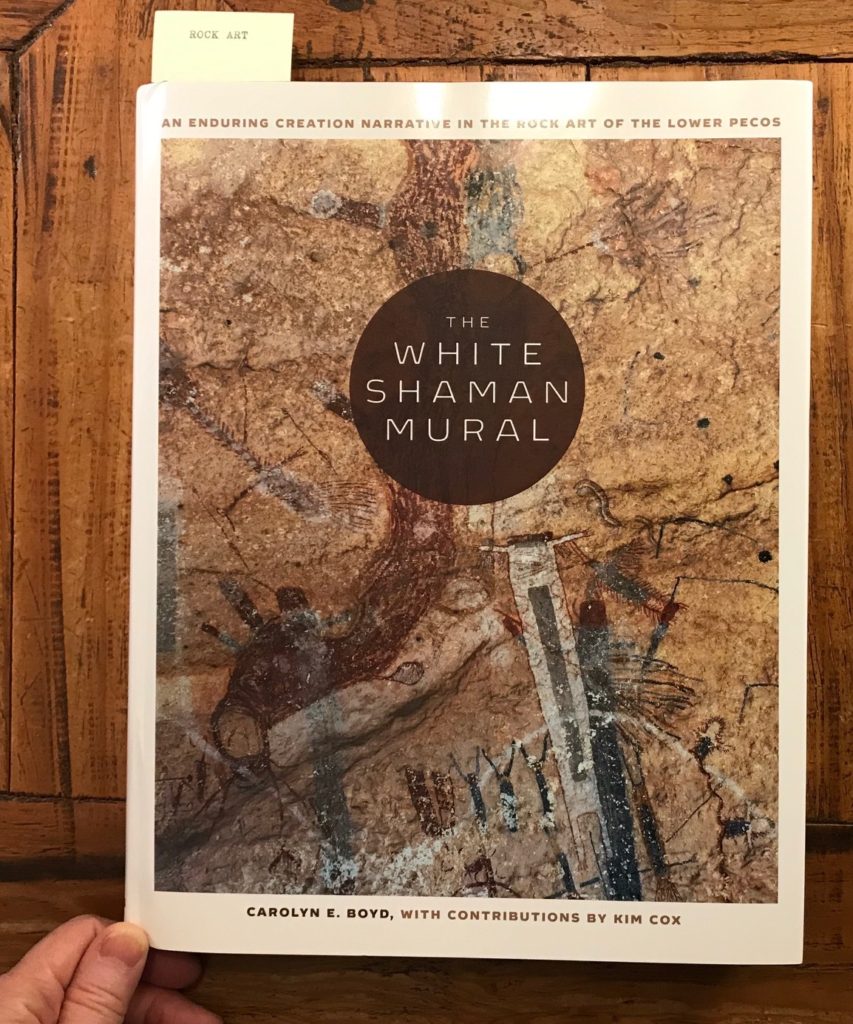
Ring-a-ling to Dr. Jung! Reséndez and Schneider (below) both published their narrative histories about Cabeza de Vaca’s epic journey in North America in the same year, 2007. Andrés Reséndez’s A Land So Strange: The Epic Journey of Cabeza de Vaca (Basic Books, 2007) is an award-winning historian’s beautifully written and extensively footnoted narrative history. No one writing about Cabeza de Vaca, whether creative writer or serious scholar, should overlook Reséndez’s masterwork. I went for the paperback so that I could mark it up with my pencil all whichways.
That is not actually Cabeza de Vaca there on the cover, and it ever & always annoys me to see it. Oh well! I don’t know what he looked like, no one does, and I don’t think he looked like this rather sharp-eyed character who keeps on getting recycled as “Cabeza de Vaca.” HMPH!
*
PAUL SCHNEIDER
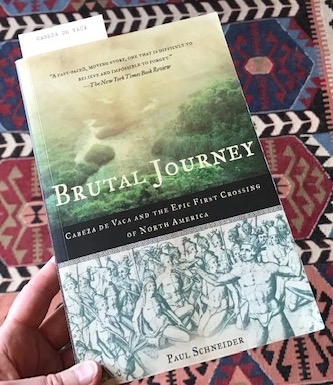
Paul Schneider’s Brutal Journey: Cabeza de Vaca and the Epic First Crossing of North America (Henry Holt, 2007) is a riproaring adventure read, well-researched and elegantly written, and one I would warmly recommend to the general reader.
The catalog copy gives the explosive flavor:
“A gripping survival epic, Brutal Journey tells the story of an army of would-be conquerors, bound for glory, who landed in Florida in 1528. But only four of the four hundred would survive: eight years and some five thousand miles later, three Spaniards and a black Moroccan wandered out of the wilderness to the north of the Rio Grande and into Cortes’s gold-drenched Mexico. The survivors of the Narváez expedition brought nothing back other than their story, but what a tale it was. They had become killers and cannibals, torturers and torture victims, slavers and enslaved. They became faith healers, arms dealers, canoe thieves, spider eaters. They became, in other words, whatever it took to stay alive.”
*
DONALD E. CHIPMAN
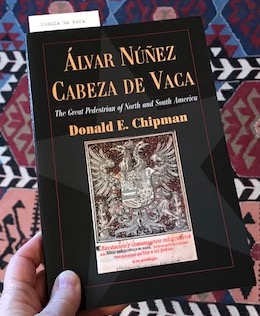
Donald E. Chipman’s Álvar Núñez Cabeza de Vaca: The Great Pedestrian of North and South America (The Texas State Historical Association, 2012) offers a short (only 70 pages), albeit authoritative overview by an academic historian for those with an interest also in Cabeza de Vaca’s South American odyssey. From the book’s back cover:
“Between 1528 and 1536, explorer Alvar Núñez Cabeza de Vaca trekked an estimated 2,480 to 2,640 miles of North American terrain from the Texas coast near Galveston Island to San Miguel de Culiacán near the Pacific coast of Mexico. Later he served as the royal governor of Asunción, Paraguay. His mode of transportation, afoot on portions of two continents in the early decades of the sixteenth century, fits one dictionary definition of the word ‘pedestrian.’ By no means, however, should the ancillary meanings of ‘commonplace’ or ‘prosaic’ be applied to the man, or his remarkable adventures. This book examines the two great ‘journeys’ of Cabeza de Vaca—his extraordinary adventures on two continents and his remarkable growth as a humanitarian.”
A 70 page paperback available from the Texas State Historical Association. (Sorry, but I just cannot get over the use of the word “pedestrian” in the subtitle. It always makes me think of the Beattles’ Abbey Road album cover.)
ROBIN VARNUM
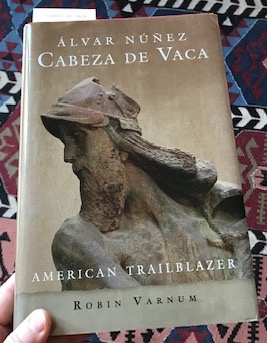
Robin Varnum’s Álvar Núñez Cabeza de Vaca: American Trailblazer (University of Oklahoma Press, 2014) is an accomplished and, as best I can ascertain, the latest scholarly biography.
The cover of Varnum’s excellent biography features the sculpture of Cabeza de Vaca by Eladio Gil Zambrana, which is in Jerez de la Frontera, Spain. (I’ll say it again: although we see him portrayed on many book covers, we do not actually know what Cabeza de Vaca looked like.)
JAMES J. (PETE) DREXLER
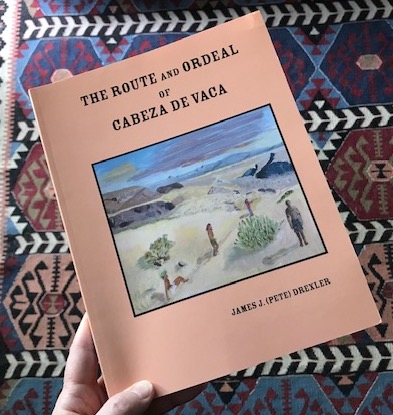
The Route and Ordeal of Cabeza de Vaca (self-published, 2016)—currently reading.
Cabeza de Vaca’s adventures as passed on to us from his La Relación have spawned a small but enduring cottage industry of books, essays, documentaries, websites, and more, which started picking up serious steam over the 20th century. My own sense is that we will see books about Cabeza de Vaca being published for as long as we have books, and I expect books to go on, at one scale or another, for many hundreds of years more. Movies and videos and websites and electronic whatnots? That, too. How about an opera?
*
In “Selected Cabeza de Vaca Books, Part III,” to be posted the first Monday of next month, July 2021, I will be discussing the wackadoodle differences in the various maps of Cabeza de Vaca’s epic journey, with a focus on his route through what we know now as Far West Texas.
I welcome your courteous comments which, should you feel so moved, you can email to me by simply clicking here.
It’s the fifth Monday of the month; herewith, my newsletter. This finds me working on the Far West Texas book and its related 24 podcast series—for podcast 22, stay tuned. Meanwhile, I invite you to listen in any time to the 21 podcasts posted so far.
In case you missed them, Madam Mayo posts since the last newsletter include:
TEXAS BOOKS (POSTED FIRST MONDAY OF THE MONTH THROUGHOUT 2021)
For those writing in Spanish—and I know that many of you writerly readers do— I warmly recommend the talented Mexican writer Araceli Ardón’sYouTube channel, where she is currently offering a series of excellent tutorials on creative writing.
My esteemed amiga Ellen Prentiss Campbell has a new novel out, Frieda’s Song. You can read her Q & A with me about her other recent book, Known by Heart,here.
“My three novels address the very different parts of my ancestry. I also hope to have this book in particular picked up by the Jewish reader interested in the Jewish diaspora from Spain, someone who realizes that an Eastern European background is not the only one.”— Kathleen Alcalá
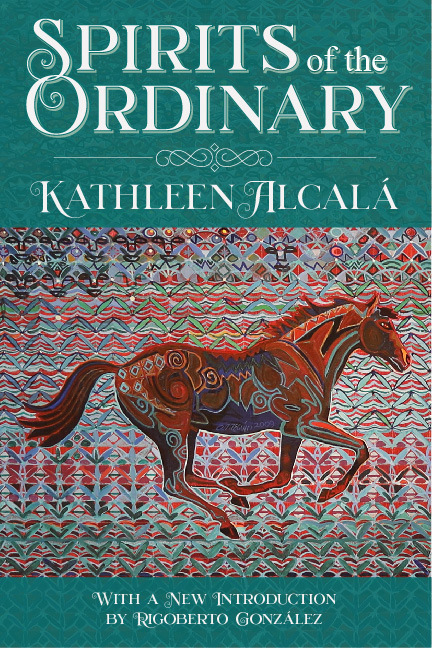
A couple of decades ago, when I was beginning to publish my own work about Mexico, and editing Tameme, a bilingual English/Spanish journal of new writing from Canada, the US and Mexico, I had the immense fortune to meet some of the most accomplished and innovative literary writers from the US-Mexico borderlands, among them, Kathleen Alcalá. The author of several books of fiction and nonfiction, Alcalá’s work has been recognized with Western States Book Award, the Governor’s Writers Award, and a Pacific Northwest Booksellers Association Book Award. In 2014 she was honored by the national Latino writers group, Con Tinta, and she has been designated an Island Treasure in the Arts on Bainbridge Island, where she lives in the state of Washington. When I first met Alcalá, her novel set in northern Mexico in the 1870s, Spirits of the Ordinary, based on the true history of Mexican Jews practicing their religion in secret, was then relatively recently published, and a sensation it was, for the history of the conversos of northern New Spain (Spanish Jews who had converted to Christianity at the time of the 15th century expulsion of the Jews) and the crypto-Jews (those who practiced Judaism in secret) was then little known. Spirits of the Ordinary received high praise, for example, from Publisher’s Weekly, which called it “A fecund fable about the convergence of cultures—Mexican, American and Jewish—along the Mexico/Texas border…. Alcalá’s seductive writing mixes fatalism and hope, logic and fantasy.” And no less a literary heavyweight than Larry McMurtry called it “continually arresting—a book in which passions both ordinary and extraordinary are made vivid and convincing.”
How delighted I was to learn from Kathleen that, for its 25th anniversary, Spirits of the Ordinary is back in print in a lovely new edition from Raven Chronicles Press, introduced by one of my favorite poets, Rigoberto González. Apropos of that, Alcalá agreed to answer some questions.
C.M. MAYO: What inspired you to write Spirits of the Ordinary?
KATHLEEN ALCALÁ: My first book was a collection of short stories in the manner of the stories told by my mother’s family. When I finished the last, long story I realized that I knew much more about these characters, based on my family’s history, enough for at least one novel. It turned out to be three novels.
C.M. MAYO:As you were writing, did you have in mind an ideal reader?
KATHLEEN ALCALÁ: I don’t know if I should be embarrassed to say that I expected my readers to be much like myself, people who grew up in the United States, but with our cultural roots firmly in Mexico. This comprises some of my audience. But a bigger part of it is the American readership that has good associations with Mexico as a vacation destination and the site of some of their fantasies.
Toni Morrison described this as writing under “the white gaze.” I had no idea how important this was for BIPOC (Black or Indigenous People of Color) writers. I was not writing the “poor farmworker makes good” narrative that was expected of me in the publishing world. As a result, around 25 publishers rejected the novel before Chronicle Books took a chance on it.
C.M. MAYO:Now that some years have gone by, can you describe the ideal reader for this book as you see him or her now?
KATHLEEN ALCALÁ: The ideal reader is now a generation younger than I am. It is a young professional or student who wants to broaden their perspective to include fore parents who loved the land, fought for it, died for it, and were often discriminated against by their own society. My three novels address the very different parts of my ancestry. I also hope to have this book in particular picked up by the Jewish reader interested in the Jewish diaspora from Spain, someone who realizes that an Eastern European background is not the only one.
C.M. MAYO:Can you share any surprises for you about the reception of your book’s first edition? (And has it been different in different countries?) Do you expect it to be different in 2021?
KATHLEEN ALCALÁ:Spirits received a number of awards right out of the chute. From manuscript rejection to publication and great reviews in a year really floored me. I was not prepared for the embrace provided by readers. I have to thank writers like Ursula K. Le Guin and Larry McMurtry, as well as booksellers like Rick Simonsen at Elliott Bay Books and Paul Yamazaki at City Lights for their kind words that helped propel this book out into the world.
C.M. MAYO:What inspired you to bring Spirits of the Ordinary back into print?
KATHLEEN ALCALÁ: Almost twenty-five years later, crypto-Jews are no longer a secret. When I was researching and writing, no one knew what I was talking about except for a few Sephardic Jews. Now there is a substantial body of writing about the events leading to this condition, as well as critical analysis of both the events and the literature. I feel as though this topic has come full circle now that Spain has offered expedited citizenship to descendants of the Expulsion. This provides a much more complete context for my work.
C.M. MAYO:Which writers have been the most important influences for you when you were writing Spirits of the Ordinary— and subsequently?
KATHLEEN ALCALÁ: I have always read science fiction along with mainstream fiction. Some people look down on “genre” fiction as not true literature, but alternate worlds and points of view fit perfectly with my upbringing in the southwest, with cousins on both sides of the border. Our reality has always been alternative.
Other writers will tell you it is comics that sustained them when they were young, but that’s really the same thing, except in pictorial form: narratives willing to address the “what if.”
I studied with Ursula K. Le Guin, Joanna Russ, and Charles Johnson. I read Elena Poniatowska and Juan Rulfo in Spanish, and later my age peers, Ana Castillo, Sandra Cisneros and Denise Chávez, although they were way ahead of me in achievements.
More recent writers who have knocked me dead include Roberto Bolaño, Ruth Ozeki, Sabrina Vourvoulias, Isabel Quintero and NK Jemison. There are so many more. Books are my vice.
C.M. MAYO:Which writers are you reading now?
KATHLEEN ALCALÁ: I’ve read a lot of Greg Bear’s books because we are friends and he is very prolific. Nisi Shawl is an up and coming writer even though she has already received a lot of accolades. I have been reading a lot of indigenous writers recently, mostly poets like Laura Da’, but also fiction and essayists like Rebecca Roanhorse and Elissa Washuta. Every time I meet a new writer whose work I like, I try to let them know how great their writing is. I probably scare people at conferences because I am not cool— I am enthusiastic, especially with writers of color or those who otherwise don’t fit into the mainstream narrative.
This is one reason that, Phoebe Bosché, Philip Red-Eagle and I started Raven Chronicles Press. We wanted to provide a showcase for these wonderful writers. Currently, you can see much of this work in an anthology called Take a Stand: Art Against Hate. I am also working with Professor Norma Elia Cantú on an anthology of stories, essays and poetry about La Llorona— again, because there is so much talent, so many ideas that need to be published and shared.
C.M. MAYO:How has the Digital Revolution affected your writing? Specifically, has it become more challenging to stay focused with the siren calls of email, texting, blogs, online newspapers and magazines, social media, and such? If so, do you have some tips and tricks you might be able to share?
KATHLEEN ALCALÁ: All of this is terrible. I am so easily distracted. I will start laundry, open a file, take notes by hand, and forget what I had planned to do that day. For me, the best strategy is still the writing residency, away from home, where I don’t have any excuses and fewer distractions. This is especially needed when I am trying to organize large blocks of writing, such as the chapters in a novel.
C.M. MAYO:For those looking to publish, what would be your most hard-earned piece of advice?
KATHLEEN ALCALÁ: Before submitting anything, research the market. If looking to publish in a magazine, purchase half a dozen or so that seem to be likely venues for your work. Look at them carefully and see if you fit in. This is a good place to start, rather than submitting book length manuscripts to publishers, because book editors read these magazines, too. It also gives you a chance to learn how to work with an editor, to receive suggestions and shape the best possible piece for the magazine.
C.M. MAYO:What’s next for you as a writer?
KATHLEEN ALCALÁ: Surprisingly, after all these years, Spirits of the Ordinary and Treasures in Heaven (my third novel, which is about the feminist movement in Mexico) have been optioned for movie and television rights! We will see where that goes. In between distractions, I am foolishly working on two novels at the same time – one is set in 10th Century Spain, and one in a near-future west coast and Mexico. Oh yes, and I owe someone a short story!
A TRAVELER IN MEXICO: A RENDEZVOUS WITH WRITER ROSEMARY SULLIVAN C.M. MAYO Originally published in Inside Mexico, March 2009
Mexico City’s Coyoacán neighborhood has become inextricably linked with the Surrealist painter Frida Kahlo, so what better place to rendezvous with poet, writer, and biographer of Surrealists, Rosemary Sullivan? A professor of English at the University of Toronto, Sullivan had just alighted in Mexico City and would soon be on her way to meet with Surrealist painter Leonora Carrington, when we met over cappuccinos at the sun-drenched Café Moheli to talk about her latest book.
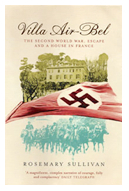
Villa Air-Bel: World War II, Escape, and a House in Marseilleis a page-turner of a deeply researched history about the rescue of artists and intellectuals trapped as the Nazis closed in. The effort, fomented by the New York-based Emergency Rescue Committee and led by their agent in Marseilles, Varian Fry, managed to save André Breton, Marc Chagall, and Max Ernst, among others, and found refuge for them in the United States. But some came to Mexico. These included the Russian novelist Victor Serge, and his son Vlady; and most famously, Surrealist painters Leonora Carrington and Remedios Varo, who (along with Frida Kahlo), are today among Mexico’s most revered artists. For this reason, Villa Air-Bel is a work important to the history of modern art in Mexico.
But the book’s connection to Mexico goes deeper.
“Villa Air-Bel started here,” Sullivan said. She explained that, back in 1995, she had come to Mexico City to write about the intense friendship of three women artists Leonora Carrington, Remedios Varo, and the Canadian poet P.K. Page (also known as the painter Pat Irwin), which commenced in 1960 when Page, already the author of several books and a winner of Canada’s prestigious Governor General’s Award, arrived with her husband, Arthur Irwin, then Canada’s ambassador to Mexico.
Sullivan, then two years out of graduate school, met Page in Victoria in 1974. As Sullivan recalls in the essay “Three Travellers in Mexico,” “For me P.K. is one of the searchers, ahead of the rest of us, throwing back clues. She encouraged me to believe I might become a writer.” Varo had died of a heart attack in 1963. But thanks to an introduction from Page, Sullivan met Carrington in Mexico City.
The English-born Leonora Carrington had a harrowing but triumphant story. She was living in France when the Germans invaded. Her lover, the Surrealist painter Max Ernst, was arrested, first as an enemy alien and then a second time as an enemy of the Nazis. Leonora fled to Spain, where she had a mental collapse and was put in an insane asylum, a searing experience she wrote about in The House of Fear: Notes from Down Below. Her family got her out, but thinking they wanted to put her in another asylum in South Africa, she escaped in Lisbon en route. Ernst, miraculously, reappeared in Lisbon, but the pair parted ways, Ernst going to New York with Peggy Guggenheim, and Leonora, in a marriage of convenience to her rescuer, Mexican diplomat-poet Renato Leduc, to Mexico. Here she remarried, produced two sons, and an extraordinary body of work as a painter, sculptor, poet and writer. (Still active in her 90s, last month [February 2009] Carrington attended an event in her honor at Mexico City’s Museo José Luis Cuevas.)
In 1995, Carrington showed Sullivan some of Varo’s playfully dreamlike and delicately-rendered paintings. Later, while reading Unexpected Journeys, Janet A. Kaplan’s biography of Varo, Sullivan came upon the story of Varian Fry and the Villa Bel-Air, a château outside Marseille where so many of the outstanding figures involved either lived or visited. For a time, though they were in terrible danger and lacked such basics as coal and meat, with André Breton hosting a Sunday open house and leading Surrealist games in the drawing room, Villa Air-Bel had all the joyous spirit of an artists colony.
While in Mexico City that time, Sullivan also wrote the short story that became the nucleus of Labyrinth of Desire, an exploration of the myths women live out when they fall in love, from Rhett Butler and Scarlett O’Hara (“Don Juan / Doña Juana”), to Diego Rivera and Frida Kahlo (“Self-Portrait with Mirrors”). In that short story, Sullivan said, “The man is named Varian, but just because I loved the name. I never imagined I’d write this book! He just sat at the bottom of my mind…”
While reading The Quiet American, Andy Marino’s biography of Varian Fry, Sullivan saw the image that made her decide to write about the refugee artists and intellectuals and their rescuers. In the photo, like a pair of children, Fry and Consuelo de Saint Exupéry perch high in the python-like branches of an plane tree.
“This was war-time France!” Sullivan exclaimed. “What were they doing in the tree?” They were hanging paintings. “That refusal to be cowed by Fascism… “
But how to tell such a huge and sprawling story? In a flash, Sullivan realized that she could organize it around a year in the life of Villa Air-Bel.
Other than Carrington, however, few of those who had been at Villa Air-Bel were still alive.
One of the most important sources had to be Vlady Serge, the painter who, as a young man had been rescued from France along with his father. From Canada, Sullivan made an appointment for an interview in Cuernavaca, where he had his house and studio. She then flew to Mexico. She settled into Las Mañanitas hotel, and when she telephoned that she was on her way, she was informed he was not there. It turned out Serge had been rushed to the hospital with a fatal stroke. Sullivan had missed him by a matter of minutes; nonetheless, he had left her detailed instructions on whom to meet and where to find archives.
Here in Coyoacan’s Café Moheli, the snortle of the cappuccino machine interlaced with birdsong, conversations, and the occasional passing car, I said, what had most struck me about Villa Air-Bel was the way she described the confusion at the time, and how, throughout the 1930s, people had a sense of normalcy, until—I quoted her—”in a moment, the world collapsed like a burnt husk.”
“I meant people to read this book in terms of now,” Sullivan said. “Because it can always happen.”
I welcome your courteous comments which, should you feel so moved, you can email to me by simply clicking here.
Originally posted on Madam Mayo blog, March 28, 2011
One of the most powerfully vivid ways to show character, relationship, conflict and/or mood is through the use of dialogue. Herewith, one dozen five minute exercises. Use an egg-timer if you must.
#1. Sprinkle in ze French An American who was resident in Paris for many years gives a tour of the local art museum to some friends who are mighty impressed (but do they admit it?). Write the scene with dialogue.
#2. Echoing in Dialogue From Henry James’s novel The Portrait of a Lady, here’s an example of “echoing” in dialogue:
“She has offered to take her— she’s dying to have Isabel go. But what I want her to do when she gets her there is give her all the advantages. I’m sure all we’ve got to do,” said Mrs. Ludlow, “is to give her a chance.”
“A chance for what?”
“A chance to develop.”
“Oh Moses!” Edmund Ludlow exclaimed. “I hope she isn’t going to develop any more!”
In this example, echoing works well to show the two characters’s easy going affection for one another. So, try writing a similar scene with echoing in the dialogue. If you need a prompt: a boss and his/ her ingratiating subordinate planning the new furniture arrangements for the office.
#3. Larry & Saul Bake a Cake Larry and Saul are elderly brothers. Larry is jealous of Saul. Saul thinks Larry is full of himself. They are in Larry’s kitchen making a cake. Write the scene with dialogue.
#4. The Control Freak, the Liar & the Narcissist Three characters, all members of the same family, sit down to dinner. Show by the things they say to one another that one is a control freak, one a liar, and one a narcissist.
#5. Good Cat, Bad Cat In a pet store: he wants a cat; she does not. Write 5 lines he could say; then, write 5 lines she could say. Briefly describe the cat in question. If you have time, write the scene.
#6. So Terrible. So Awful. I was in the women’s locker room in a health club when I happened to overhear this scrap of dialogue:
A: “Therapists, what they charge—” B: “Horrible, that’s why I quit.” A: “So terrible.” B: “So awful.”
I love the shape of this, the way the women echo the sounds and rhythms of each other’s words. Notice the rhyme of “horrible” and then “terrible”; the repetition of “So” (“So terrible; “So awful.”)
Another interesting aspect is B’s interruption of A.
Here’s the exercise: take this dialogue; add some names, descriptions, gestures, etc., and flesh out the scene. You might change “therapists” to “dentists” or, say, “contractors” or “piano teachers”–what have you.
#7. Three Jackets, Three Men & a Joke Describe three jackets. Describe the three men who are wearing them. One man tells a joke. How do the other two react?
#8. When in Rome Do as the Romans do: speak Italian. Have your characters, who are arguing about something (whatever you like) use some or all of the following words and phrases:
Dove? (Where?) Buona notte (Good night) Ha un gelato? (Have you any ice-cream?) una crema de barba (shaving cream) E compreso il servizio? (Is service included?) E sulla strada sbagliata (You’re on the wrong road)
#9. Class Envy Your character hates rich people. Give him 3-4 lines of really nasty dialogue. Then, in two sentences or less, identify the specific source of his feelings.
#10. ##&%#@*!!! One of the fun things about writing fiction is that you can assume the voice of characters who would do and say all sorts of naughty, slobby things. Here’s the exercise: two characters (give them names and a little description) are sitting on a back porch drinking beer. They are arguing over which is the better sports team, and a good portion of their vocabulary consists of swear words. Write the scene with dialogue.
#11. Wedding Dress Dialogue Mother and daughter are in a changing room, before a floor-length mirror, arguing over one more wedding dress. The mother is thrilled about this wedding; the daughter is tempted to call the wedding off— but show don’t tell. That is, do not have the characters state their feelings, but show them through tone, gesture and indirect comments. Write the scene with dialogue.
#12. Sorry Cindy, a highly educated, experienced, and competent professional, peppers her conversations with, “I’m sorry” (and then she wonders why she’s not been promoted). Sketch a few scenes for Cindy with dialogue.
This blog posts on Mondays. This year, 2021, I am dedicating the first Monday of the month to Texas Books, in which I share with you some of the more unusual and interesting books in the Texas Bibliothek, that is, my working library. Listen in any time to the related podcast series.
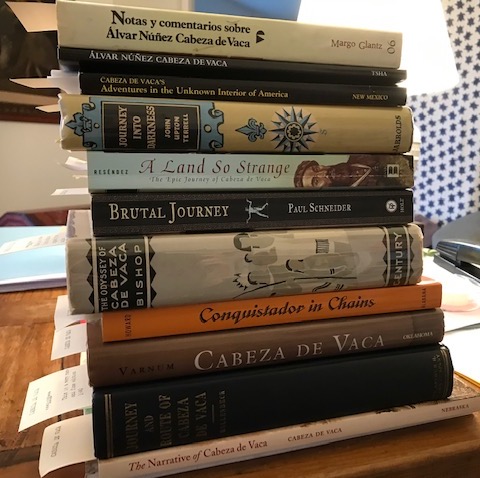
Just a small election of the translations of La Relación, as well as paraphrases of the Relación, commentaries, histories, and biographies of Cabeza de Vaca.
Yes, that most memorable of conquistadors’ names, Cabeza de Vaca, means Cow Head. Alvar Núñez Cabeza de Vaca was, among many things, the author of the first printed book on what is now the American Southwest and the great state of Texas— back when it was terra incognita, the 1500s. I have already written about Cabeza de Vaca and his book, La Relación, in a longform essay about the Mexican literary landscape, “Dispatch from the Sister Republic or, Papelito Habla.”
My longform essay about the Mexican literary landscape is now available as a Kindle.
Now that I’m writing about Far West Texas, Cabeza de Vaca pops in again, but where in Far West Texas was he, exactly? Towards answering that question, for my working library, which I have dubbed the Texas Bibliothek, I’ve accumulated a hefty stack of Cabeza de Vaca biographies, histories, and translations of his La Relación. (I do read Spanish, and in fact I’m a translator myself, however I specialize in contemporary Mexican writing, not 16th century Spanish, large chunks of which can float by me like so much Gabbahuaque.) The consternating thing is, in these various tomes the various routes mapped out for Cabeza de Vaca’s travels differ wildly.
As recounted in La Relación, Cabeza de Vaca’s travels encompass, from southern Spain, the Canary Islands, Cuba, Florida, the Galveston area, his enslavement in the general region we call South Texas and what is now northern Mexico, also his trek through Far West Texas, and thence a jog southwest to the Pacific coast, where he was rescued by Spanish slavers, and on to Mexico City-Tenochtitlan, where he was received by Hernán Cortez, conquistador of the Aztec Empire, the Marqués del Valle, himself. (Subsequently, after writing his Relación, Cabeza de Vaca was sent to Argentina, and from there, for being much too nice to the Indians, returned to Spain in chains.)
There is indeed a library’s-worth to say about the life and times of this most unusual conquistador and his fantastic travels and ghastly travails.
THE TWO EDITIONS, 1542 and 1555
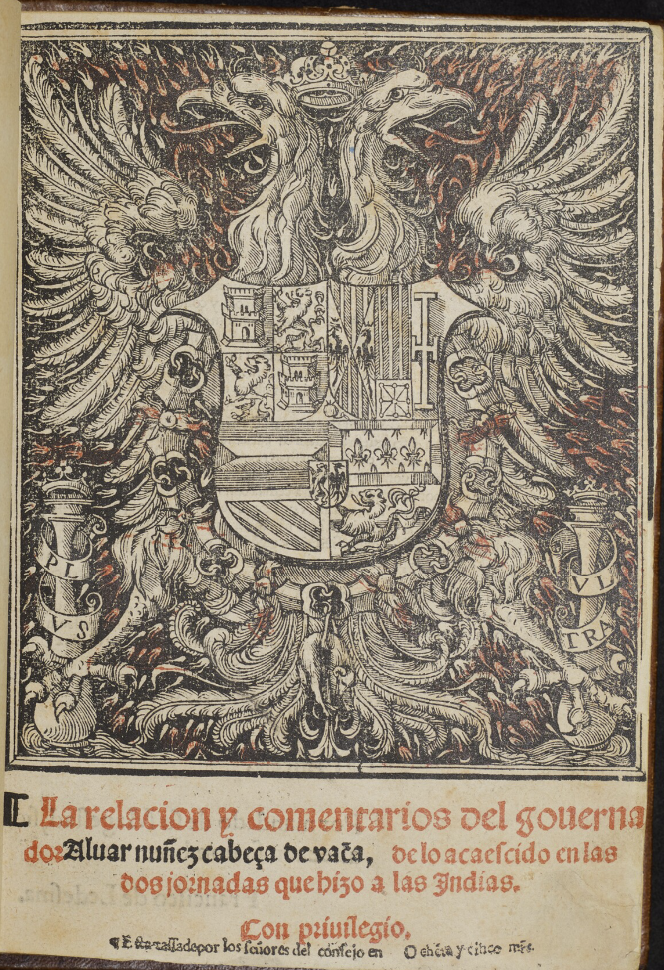
A first edition of La Relación appeared in Zamora, Spain in 1542; a second, slightly different, edition in 1555. The latter is available for viewing online at the Witliff Collections— have a look here. To bamboozle matters, some English translations are of the 1542 edition; others of the 1555; some a medley of both.
Of the differences between the two editions, in his introduction to the Penguin Classics edition of the Bandelier translation (discussed below), Ilan Stavans says:
“Whereas the [edition] of 1542 is an attempt to show his courage and achievements to Charles V, the 1555 edition seeks to present the author in a good light so as to cleanse his reputation from charges against him after his forays in South America. Therein lies the difference: the first is a report, the second is an engaging, persuasive act of restoration.”
In addition there was a testimony known as The Joint Report given by Cabeza de Vaca and the other two Spanish survivors of the Narváez Expediton upon their return. The original of The Joint Report has been lost, however a partial transcription was made by historian Gonzálo Fernández de Oviedo (1478-1557), and included in his Historia general y natural de las Indias— a verily massive collection of 19 books not published in its entirety until (not a typo) 1851. There is a good website in English on Oviedo’s Historia general y natural at Vassar which you can view here. The notable biographies of and narrative histories about Cabeza de Vaca also incorporate the Joint Report from Oviedo. (I’ll be doing a post on some of those works next first Monday.)
NOTES ON SELECTED ENGLISH TRANSLATIONSOF CABEZA DE VACA’S LA RELACIÓN
SAMUEL PURCHAS, 1625
The first English translation, by Samuel Purchas, came out in 1625—nearly a century later— sandwiched into a collection of exploration narrativesentitled Purchas His Pilgrimes. You can read about that at the Witliff Collections Cabeza de Vaca website. Purchas’ source was the Italian translation of 1556, which explains his calling the author “Capo di Vaca.” Not in my working library, last I checked. If you ever happen to come upon an original edition of Purchas His Pilgrims on offer, and perchance have the clams to buy it, I would suggest that, forthwith, you donate it to a worthy institutional library.
THOMAS BUCKINGHAM SMITH, 1851and 1871
Astonishingly, no English translation was made directly from the Spanish original of Cabeza de Vaca’s La Relación, until Thomas Buckingham Smith‘s in 1851, of the 1555 edition. That it would take over three centuries for a stand-alone English translation of such a major work in the history of the Americas to appear is, in itself, telling— as was the historical moment: the wake of the 1848 Treaty of Guadalupe, which ended the US-Mexican War and considerably expanded the territory of the United States at the expense of its sister Republic.
The New York Historical Society, which has Smith’s papers, offers this brief, albeit most interesting, biographical sketch of the far-traveling translator:
“Thomas Buckingham Smith was a lawyer, diplomat, antiquarian, and author. Smith was born on October 21, 1810 on Cumberland Island, Georgia. The family moved to St. Augustine, Florida in 1820, when Smith’s father was appointed U.S. Consul to Mexico. Smith attended Trinity College in Hartford, Connecticut and earned a degree from Harvard Law School in 1836. Following graduation, Smith worked in the Maine office of Samuel Fessenden, a politician and abolitionist. He returned to St. Augustine in 1839 and served as a secretary to Robert R. Reid, governor of the Territory of Florida from 1839-1841. Smith served as a member of the Florida Territorial Legislative Council in 1841. He married Julia Gardner of Concord, New Hampshire in 1843.
“Throughout his life, Smith was a devoted student of North American history, specifically Spanish colonialism and Native American cultures and languages. In order to further his studies, Smith lobbied U.S. government officials for diplomatic appointments abroad. He was successful in obtaining positions in the U.S. embassies of Mexico (1850-1852) and Spain (1855-1858).
“While abroad, Smith actively purchased, transcribed and translated manuscripts related to the Spanish colonization of North America. Smith also supplemented his income by selling rare books and manuscripts to collectors in the U.S., including Peter Force, an editor and politician, whose collection was purchased by the Library of Congress in 1867. During the 1850-1860s, Smith translated and edited several publications, including Colección de varios documentos para la historia de la Florida y tierras adyacentes (1857), A grammatical sketch of the Heve language (1861), Narratives of the career of Hernando de Soto in the conquest of Florida (1866), and Relation of Alvar Nunez Cabeca de Vaca (1871).
Smith died in New York City in 1871 and was buried in St. Augustine.
Note that the New York Historical Society biography is mistaken: A first edition of Smith’s translation of La Relación appeared in 1851; the second edition, edited by J.G. Shea, was published posthumously in 1871. I am sorry to say that I have not yet seen a copy of this translation; I will have to remedy that. I note that inexpensive reprints are widely available.
MRS. FANNY BANDELIER, 1905
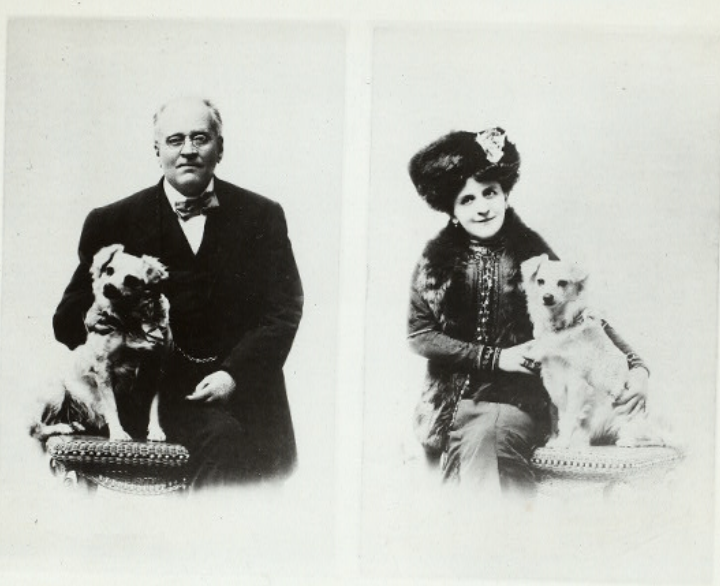
Mr and Mrs Bandelier, she the esteemed translator of Cabeza de Vaca’s Relación. From the NYPL archive (which notes that this image can be freely used).
This second translation of La Relación– from the 1542 edition– was made by Mrs. Fanny Bandelier, and originally published in 1905 as The Journey of Alvar Nunez Cabeza de Vaca. Mrs. Bandelier’s translation held its ground for many decades. According to Cleve Hallenbeck, in his Journey and Route of Cabeza de Vaca, published in 1940:
“Of the two English translations I, in common with nearly all other students, prefer the Bandelier. The Smith translation was admittedly defective, and Smith was engaged in its revision at the time of his death in 1871. It was the need for a more accurate translation that prompted Mrs. Bandelier to undertake the task.” (p.24)
Cyclone Covey, on the other hand, has this to say about the Smith and the Bandelier, in his introduction to his 1961 translation (notes on that below):
“The translation that follows has been checked against both of these and is deeply indebted to the more literal Smith version.”
Go figure.
The Briscoe Center at University of Texas, Austin has a collection of documents transcribed from those in the Archivo General de las Indias in 1914-1917 by Fanny and her husband, Adolphe Francis Alphonse Bandelier. From that website, we have a biographical note for Mr. Bandelier but, alas, not Mrs:
“Adolph Francis Alphonse Bandelier (1840 – 1914) was an American archaeologist after whom Bandelier National Monument in New Mexico is named. Bandelier was born in Bern, Switzerland, and emigrated to the United States in his youth. After 1880 he devoted himself to archaeological and ethnological work among the Indians of the southwestern United States, Mexico and South America. Beginning his studies in Sonora (Mexico), Arizona and New Mexico, he made himself the leading authority on the history of this region, and — with F. H. Cushing and his successors — one of the leading authorities on its prehistoric civilization. In 1892 he abandoned this field for Ecuador, Bolivia and Peru, where he continued ethnological, archaeological and historical investigations. In the first field he was in a part of his work connected with the Hemenway Archaeological Expedition and in the second worked for Henry Villard of New York, and for the American Museum of Natural History of the same city.”
Says Hallenbech, p. 24:
“[Mrs. Bandelier] was a recognized Spanish scholar, and Adolphe F. Bandelier, who wrote the introduction and annotated the text, certainly subjected the work to the closest scrutinity; some of his notes lead one to believe that he actively participated in the translating. His qualifications for such work are widely recognized.”
Well, ring-a-ling to Gloria Steinem!!
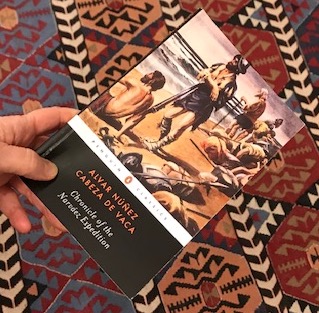
My much marked-up copy of the Bandelier translation is a Penguin Classics paperback edition of 2002 with an introduction by Ilan Stavans, revised and annotated by Harold Augenbraum, shown here:
An inexpensive paperback reprint of the Bandelier translation.
CYCLONE COVEY, 1961
Not until 1961, with Cyclone Covey’s, did another complete translation of La Relación appear, this one under the title Cabeza de Vaca’s Adventures in the Unknown Interior of America. His translation, Covey writes in his preface, “is deeply indebted to the more literal Smith translation,” and he consulted both the 1542 and the 1555 editions. In the afterword professor William T. Pilkington calls Covey’s “the most accessible” translation for the present-day reader. It is moreover, “thoughtful and balanced, avoiding an archaic tone as well as twentieth-century colloquialisms.”
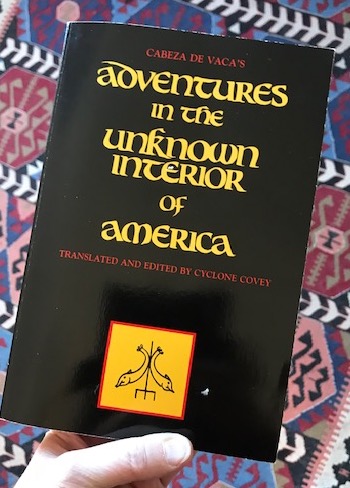
My copy of the Covey is a 1997 University of New Mexico Press reprint, shown here:
Cyclone Covey, by the way, is also the author of a book about a Roman Jewish colony in Arizona in the time of Charlemagne—you read that right. I’ve yet to read it— the title is Calalus—but it’s extremely rare, although I delightedly note that his son has just this year, 2021, made a print-on-demand facsimile edition available on amazon. Covey had few adherents to his Romans-in-Arizona hypothesis, but I give him major points for the courage to stand by his catapult, as it were, and publish Calalus. (And strange as some things may strike me, I always try to remember that the past is a strange and ever-changing country… ) In any event Covey had a long and otherwise distinguished career as an historian at Wake Forest. You can read Covey’s obituary here.
MORE TRANSLATIONS, 1993
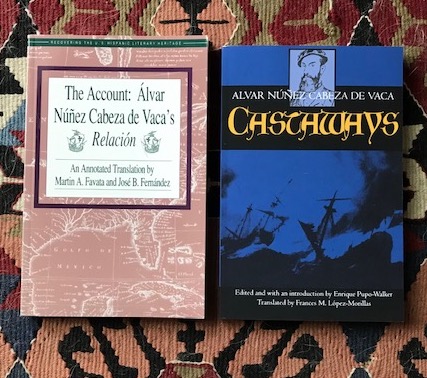
Nearing the 400th anniversary of Columbus’ arrival in the Americas, more translations appeared, including Martin A. Favata and José B. Fernández’s The Account: Alvar Núñez Cabeza de Vaca’s Relación (Arte Público Press, 1993) and Frances M. López-Morillas’ Castaways (University of California Press, 1993, edited by Enrique Pupo-Walker).
ROLENA ADORNO AND PATRICK CHARLES PAUTZ, 1999
At present it would seem that most English-speaking Cabeza de Vaca scholars look to the Adorno and Pautz translation of 1999. Leading scholar of the Spanish Conquest Andrés Reséndez, in his A Land So Strange: The Epic Journey of Cabeza de Vaca (Basic Books, 2007), has this to say about the Adorno and Pautz, in his notes (p.251):
“I wish to single out the landmark, three-volume set published in 1999 by Rolena Adorno and Patrick C. Pautz, Alvar Núñez Cabeza de Vaca: His Account, His Life, and the Expedition of Pánfilo de Narváez. This work constitutes yet another edition and translation of Cabeza de Vaca’s Narrative plus—literally—two and a half volumes of “notes.” These volumes have taken our understanding of this survival experience to a new level. The book contains biographical information of the protagonists, a detailed study of Cabeza de Vaca’s genaeology, relevant historical backrgound, and a textual analysis of the different accounts of ghe expedition, among other things. It constitites the single most important source for the present book project. I have also relied on their transcription of Cabeza de Vaca’s Narrative, first published in 1542, and often cite their translations.” (p.251)
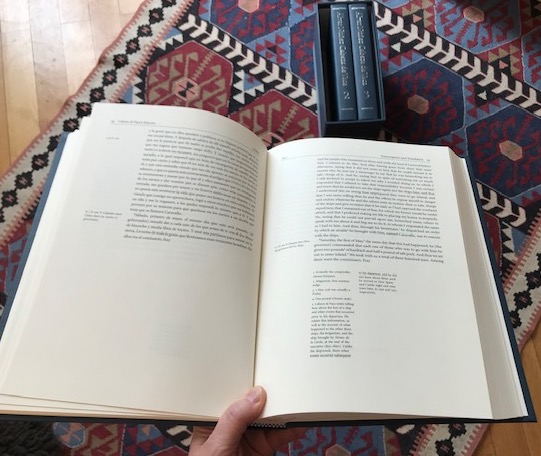
The three volume boxed set published by the University of Nebraska Press, which you might be able to consult in a library, or hunt down on Abebooks.com, is an heirloom of a doorstopper, and yep, it calls for serious clams. (Ouch.) I did buy the three-volume set, very belatedly, and I only wish I had started with it because it is indeed the most authoritative translation and history and biography; moreover, Volume I contains the original text of the original 1542 La Relación side-by-side with Adorno and Pautz’s English translation, with notes on the same page.
The three volume set ALVAR NÚÑEZ CABEZA DE VACA, University of Nebraska Press. Shown here is the side-by-side 1542 original and Adorno and Pautz’s translation, with notes. Simply splendid!
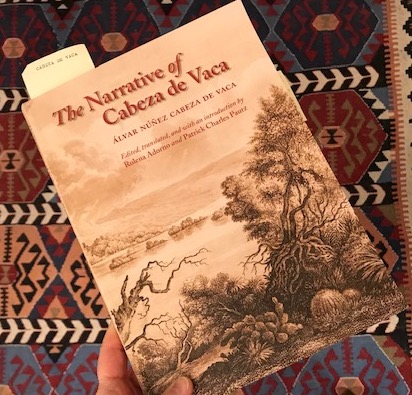
In addition, I have been working from, and freely penciling in my underlines in Adorno and Pautz’s much less expensive paperback edition of their translation of La Relación, separately published by the University of Nebraska Press. Here’s a photo of my copy of that:
*
Dear writerly reader, if you are looking for a rollickingly good armchair read about Cabeza de Vaca’s North American odyssey, there are two narrative histories I would especially warmly recommend: Andrés Reséndez’s A Land So Strange, and Paul Schneider’s Brutal Journey.I will be talking about these and other narrative histories and biographies in next month’s first Monday Texas Books post.
Next Monday, look for my monthly post for my writing workshop students and anyone else interested in creative writing.
P.S. I welcome you to sign up for an automatic email alert about the next post, should you feel so moved, over on the sidebar.
I welcome your courteous comments which, should you feel so moved, you can email to me by simply clicking here.
“My ideal reader is someone who recognizes that someone they love will die, and wonders how to make that journey with them in a way that is honest and open, supportive and loving.” —Susan J. Tweit
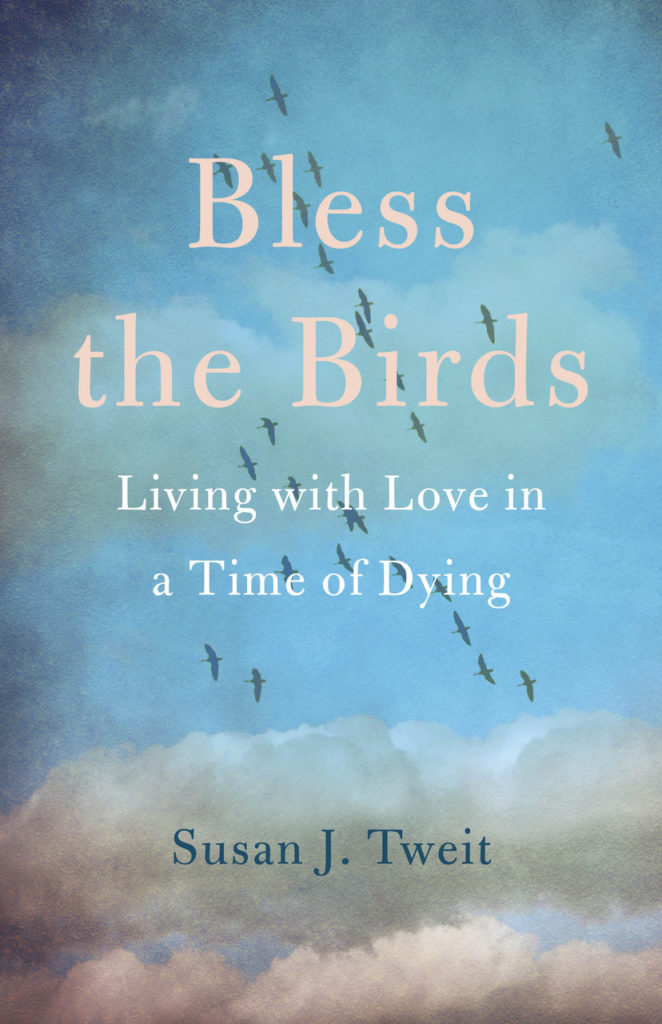
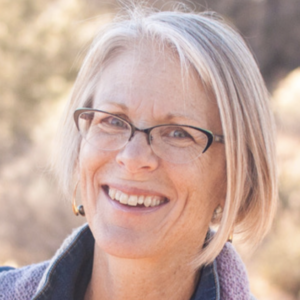
My writing students have often asked me if I think it worth the time, expense, and trouble to attend a writer’s conference. The older I get the less certain I am about what would be best for other writers, but I can say that for me the writers conferences I’ve attended have all been well worthwhile, and for many reasons, one of the most important being the chance to meet other writers and become acquainted with their work. One of these wonderful writers, whom I met some years ago at Women Writing the West, is Susan J. Tweit. I relished her splendid essays about the Chihuahuan Desert collected in Barren, Wild and Worthless. Her new memoir, Bless the Birds: Living with Love in a Time of Dying, out this week from She Writes Press, promises to be a beautiful, mind- and heart-opening read.
“Writer Susan Tweit and her economist-turned-sculptor husband Richard Cabe had just settled into their version of a “good life” when Richard saw thousands of birds one day―harbingers of the brain cancer that would kill him two years later. This compelling and intimate memoir chronicles their journey into the end of his life, framed by their final trip together, a 4,000-mile-long delayed honeymoon road trip.
“As Susan and Richard navigate the unfamiliar territory of brain cancer treatment and learn a whole new vocabulary―craniotomies, adjuvant chemotherapy, and brain geography―they also develop new routines for a mindful existence, relying on each other and their connection to nature, including the real birds Richard enjoys watching. Their determination to walk hand in hand, with open hearts, results in profound and difficult adjustments in their roles.
“Bless the Birds is not a sad story. It is both prayer and love song, a guide to how to thrive in a world where all we hold dear seems to be eroding, whether simple civility and respect, our health and safety, or the Earth itself. It’s an exploration of living with love in a time of dying―whether personal or global―with humor, unflinching courage, and grace. And it is an invitation to choose to live in light of what we love, rather than what we fear.”
C.M. MAYO: What inspired you to write Bless the Birds?
SUSAN J. TWEIT: The subtitle explains it: Living with Love in a Time of Dying. Bless the Birds is a love story about the journey my husband, Richard, and I took with his brain cancer. Those two-plus years of “bonus time” after he was diagnosed with terminal cancer were our time to live, laugh, love, create, rail at fate, grieve, and travel—literally and metaphorically—through the tierra incognita of life’s ending. I wrote the memoir with the idea that our journey could be useful to others.
What I find compelling about memoir is that it is a way to make use of my life experiences, “composting” them, as it were, into stories that inspire, inform, or guide others, whether or not they will ever encounter similar situations. At its best, memoir proves the truth of the saying, “The personal is the political.” Meaning how we live offers wisdom to illuminate national and world events, whether the generational trauma of racism, the struggle to live through the COVID-19 pandemic, or the long-term planetary crisis of climate change.
After this year of COVID-shutdown, with elders isolated in care homes and the acutely ill isolated in ICUs, we desperately need to return personal contact and loving care to life’s ending. And we must learn to accept normal death as a part of life, a turn in the cycle that carries us to whatever is beyond this world, and recycles the elements of what was “us” into other existences. Learning to embrace life’s ending in an open way frees us to live more fully in whatever time we have, to love more, and to be more compassionate citizens of this numinous blue planet.
C.M. MAYO:As you were writing, did you have in mind an ideal reader?
SUSAN J. TWEIT: Not really. When I write, I work first at finding the deepest parts of the story, and weaving a tight narrative. Then I think about who might read it.
C.M. MAYO:Now that it has been published, can you describe the ideal reader for this book as you see him or her now?
SUSAN J. TWEIT: My ideal reader is someone who recognizes that someone they love will die, and wonders how to make that journey with them in a way that is honest and open, supportive and loving. Not fearless, but without being paralyzed by fear. Perhaps they’re a caregiver for an aging parent, a friend who tends to the ailing, or simply a person of any age who wants to learn a healthier relationship with life’s ending time, what the German poet Rainier Maria Rilke called, “life’s other half.”
C.M. MAYO:Which writers have been the most important influences for you? And for Bless the Birds in particular?
SUSAN J. TWEIT: I am drawn to writers who understand landscape and the other lives, human and moreso, we share this planet with, and how those relationships shape our humanity. Those writers include the late and much-missed Barry Lopez, plus Tempest Williams, Kathleen Dean Moore, Craig Childs, Louise Erdrich, Linda Hogan, Robert Michael Pyle, Denise Chávez, Anne Hillerman, Robin Wall Kimmerer, and Priscilla Stuckey.
C.M. MAYO:Which writers are you reading now?
SUSAN J. TWEIT: I am re-reading Barry Lopez’ Winter Count and other short stories for their magical realism, David Abrams (The Spell of the Sensuous), and Kati Standefer’s new memoir, Lightning Flowers.
C.M. MAYO:How has the Digital Revolution affected your writing? Specifically, has it become more challenging to stay focused with the siren calls of email, texting, blogs, online newspapers and magazines, social media, and such? If so, do you have some tips and tricks you might be able to share?
SUSAN J. TWEIT: When I am writing, I am in another world. I turn off notifications on my phone and computer, so that I’m not distracted by the bing of email coming in or the ding of texts or news alerts.
My daily routine is pretty simple: I post a haiku and photo on social media every morning (Facebook, Twitter, and Instagram), and answer any comments on my posts. After half an hour on social media—I set a timer—I read the news online. When I’ve finished with the news—which is research time for me, as news stories, especially those about science, are raw material for my writing—I write until the well runs dry. And then, usually at two or three in the afternoon, I allow myself to go back to social media, answer other comments, check the news. Then I close my laptop and go outside into the real world and walk for a mile or two on the trails around my neighborhood to clear my head. Getting outside into the “near-wild” of the greenbelt trails in my high-desert neighborhood keeps me sane in turbulent times, and refills my creative well. Nature is my medicine, inspiration, and my solace.
C.M. MAYO:Another question apropos of the Digital Revolution. At what point were you working on paper? Was working on paper necessary for you or problematic?
SUSAN J. TWEIT: I still work on paper. I write first on my laptop, and then when I’m ready to edit, I print a copy out, read it aloud, and edit as I go. The next round of editing is on screen, and then after that, I go back to paper and reading aloud, and so on. That way I “hear” my piece in different ways on the different media.
C.M. MAYO:For those looking to publish a memoir, what would be your most hard-earned piece of advice?
SUSAN J. TWEIT: In the writing stage, be honest. When you get to a scene or place or event you want to skip over, stop and ask yourself, what am I afraid of? And then go there. Find the universal threads in your personal story—memoir works when it reaches beyond the personal into the territory that anyone can learn from. And when looking for an agent or publisher, be perseverant. Memoir is a crowded field these days, and yours has to be the best it can possibly be to stand out, and it also has to be so compelling that an editor or agent simply cannot put it down.
C.M. MAYO:What important piece of advice would you give yourself if you could travel back in time ten years?
SUSAN J. TWEIT: Believe in yourself. Don’t compromise. You can survive this (Richard, my late husband, was beginning his journey with terminal brain cancer ten years ago).
C.M. MAYO:What’s next for you as a writer?
SUSAN J. TWEIT: Right now, my writing is mostly answering interview questions related to Bless the Birds! When I have time for other work, I will start on the next book, which I call Sitting with Sagebrush. It’s a memoir about the native plants I have loved and worked with my whole life, and what these rooted, green beings can teach us about being human.
Visit Susan J. Tweit and learn more about her work at susanjtweit.com
Contemplating going forward into year 16. My writing assistant demonstrates the concept.
First of all, thank you, dear readers. I can hardly believe it but Madam Mayo blog has been zinging around the planet for 15 years.
It feels peculiar to say it, but it is a fact: with Madam Mayo blog I am one of the pioneers of literary blogging, so I thought I’d take this occasion to offer a few reflections on how Madam Mayo has evolved along with the blogosphere, and where it’s all going.
I started posting in 2006, keeping at it steadily ever since, even while persistently scratching my head over the nature of the genre and pondering my own motivations for continuing. Suffice to say, Madam Mayo blog started as a wee adventure born of curiosity one lazy afternoon, then as I was promoting my anthology Mexico: A Traveler’s Literary Companion and a new paperback edition of my travel memoir, Miraculous Air, it quickly morphed into near-daily posts that resembled tweets—this before the advent of Twitter. Younger readers who do not recall the pre-Internet age of publishing might find it hard to believe, but writers such as myself actually got paid, sometimes hundreds of dollars, for their articles, plus a few fork loads more for accompanying photographs. In 2006 it therefore did not occur to me to craft a proper article and serve it up for free on my (the word then pronounced with disdain) blog.
Then came Twitter. As I experimented with Twitter and other social media, and then slowly…. backed…. away…. from social media, and the publishing world went warp speed into gawdnozewhut, Madam Mayo blog, which I quite enjoyed writing, began to develop into something a little meatier.
# 1. Maybe not everyone else is, but I remain charmed by the name of my blog, Madam Mayo.
#2. Whoa, blogging has an opportunity cost!
#3. But on the plus side, like a workout sprints for a marathoner, blogging helps me stay in shape as a writer.
#4. Although my ego would like Madam Mayo blog to draw legions of passionate followers, all perched at the edge of their seats for my next post, ready to fly to their keyboards with their hailstorm of comments… The fact is, writing that strives for an ever-larger following is not the best strategy for me as a literary artist or as a person.
#5. Not all, certainly, but a sizable number of people who trouble to comment on blogs seem stuck in Emotional Kindergarten.
#6. Blogging is very much like publishing a literary short story or book— it goes out into the world to an opaque response.
#7. More on the plus side: sharing what I call cyberflanerie and celebrating friends and colleagues and books and all wonder of things is a delight.
#8. Madam Mayo blog is not so much my so-called “platform,” but rather, a net that catches certain special fish— the readers who care about the things I care to write about.
Of course I do have a few things to add to those 8 conclusions, another 7 years having moseyed on by, to wit:
Madam Mayo blog is: -a form of service– to my readers, my workshop students, and fellow writers -a broadcast of news of my works via both RSS feeds and search engines -a showcase for my works (excerpts from my books, articles, translations, and podcasts) -a record of sorts (my reading, publications, thinking on various topics)— ye olde “weblog” -a virtual filing cabinet for some of my notes and other research (for example) -a yoga -an exercise in will -just playing in the editor-and-“house style”-free fun zone
It seems that, with noted exceptions, most of the literary bloggers active back in 2006-2010 have quit the game or turned to posting only infrequently. On the other hand, it has not escaped my notice that many of the more popular bloggers now invite donations via PayPal, Patreon, or some other corporate intermediary. Some have established paywalls. Substack seems to be the platform du jour.
As a reader, I keep a reading list of go-to blogs, and I even, gratefully, pay for a few of them (and for a few—very few— I even abide the Google ads). Plus I subscribe to a wild and ever-changing variety of emailed newsletters. (What’s the difference between a blog and an emailed newsletter? Sometimes there isn’t.) Some of these blogs and newsletters might surprise you, no matter where you might expect to find me on the political spectrum. I do a lot of triangulation, shall we say. Put another way, I make a practice of doing intellectual triangle poses—and backbends and headstands! I believe it’s vital to always strive to truly see, and that requires not only limberness, but willingness to look outside and beyond one’s comfort zone, outside and beyond convention and, relatedly, outside and beyond the click-bait and the rest of the slop served up on mainstream media. But that would be another post.
Anyway, none of those, Patreon, PayPal, Substack, Google ads, et al, are for Madam Mayo blog, which is ever and always my gift— a gift some readers appreciate, a gift some readers don’t (to them, I say, tootle-oo!). What I, C.M. Mayo, offer up for the clams are my books. And sometimes writing workshops.
Another point: As for those financial intermediaries such as Patreon and free platforms such as Medium and Blogger, I am loath to build up my content and subscriber base sharecropping on some corporation’s turf—and only moreso in this brave new world that too often strikes me as Gleischschaltung meets Lord of the Flies meets 1984. Therefore, a good while ago, I started migrating Madam Mayo blog from its free Google-owned Blogger platform to self-hosted WordPress (read about that here). In other words, I own the domain name, I pay for hosting—and I can move to another hosting company anytime I please with a few clicks on my keyboard. I keep both digital and print-out backups of the posts, should anything go wiggy with WordPress.
For email subscriptions I use Mad Mimi, and I’m a happy customer, however, as I learned the hard way after my previous email service, the-monkey-with-the-banana one, deleted my account for reasons known to itself, I export and download my blog’s mailing list on the last day of each and every month.
GOING FORWARD IN 2021
My sense is that from the get-go, the blogosphere has been a noodle fest with some clods thrown in, and it will remain so. True, most kidz these dayz don’t wanna hafta read—they’ll smombie on to the visual candy on Instagram, TikTok, and the like. (Well, yeah, complaining about kids, it’s been a thing since before the fall of Troy.) Nonetheless, certain individual writers and journalists’ blogs will become increasingly influential, for various different reasons, with various niche audiences, some tiny, some impressively large. However without an editorial board to oversee these cowboys & cowgirls (cowpersons?), curating a reading list of them falls to the reader. This is not an easy task. Nonetheless, as a reader, I can attest that it has its rewards.
What can you expect from Madam Mayo blog going forward in 2021? Monday posts, as ever: first Mondays on Texas Books; second Mondays something chewy for my writing workshop students and anyone else interested in creative writing; third Mondays something of or about my work (past or in-progress, mainly focusing on Mexico and Texas); and fourth Mondays, a Q & A with another writer. Come on back next Monday when literary essayist Susan Tweit, author of the memoir Bless the Birds, offers her fascinating As to my Qs.
This year is sweet sixteen for Madam Mayo blog. I plan on having fun and offering to you, dear reader, new things to ponder in this beautiful Tilt-A-Whirl world.
This month’s workshop post is the transcript of a talk I gave for the Writer’s Center Seminar “Publish Now!” on June 23, 2012. Looking back after nearly a decade, I would say the advice is solid, however I was then more admiring of and optimistic about multimedia ebooks. Suffice to say I am considering a Vandercook.
So you’ve written your first book. Now what to do with it? It might appear that you’re about to enter the labyrinth, but no worries, we’re going to take three easy steps, and then a bird’s eye view at what is less a labyrinth than a conveyor belt. Finally, for those looking for commercial publication, we’ll look at three key areas to consider working on immediately, if not already.
THREE EASY STEPS
1. IDENTIFY YOUR INTENTIONS
Why did you write this book? How do you envision your book reaching its reader? (Airport bookstore? Amazon.com download? Limited edition or print-on-demand? Multimedia iBook or Vook? Gifted by you personally? Sold to your clients at workshops and seminars?) What do you want this book to do for you personally and professionally? How far are you willing to go, and how much time and money can you spend, to make your ideal publishing experience happen?
Many writers, agents and editors will happily give you iron-clad prescriptions but the appropriate level of investment of your time, money (and angst) depends on your intentions.
Some authors have no intention of doing anything more for their book. For example, my dad completed his final draft of Captured: The Forgotten Men of Guam, about the prisoners taken by the Japanese in World War II, just as he was in the final stages of terminal cancer, so the right thing for him was to let it go. He turned it over to his colleague, historian Linda Goetz Holmes, and let her edit and shepherd it to publication (it will be out in fall 2012 from Naval Institute Press). Like many people towards the end of their lives, having written his book, it did not make sense for him to invest in further effort. I can think of several books in this category— and not necessarily by people facing immanent death (!): a perfectly healthy grandmother leaving a memoir or children’s book or family history for her family; a survivor of a war or some long-ago event, leaving testimony; and, on a happier note, there are also cookbooks intended for only family, friends and maybe neighbors.
Some writers, well, they just wanna have fun. Like me with the piano: I’m OK with banging out “Chopsticks” and “Greensleeves” once in a while. I don’t have to be Vladimir Horowitz.
Some more grittily determined types want to check “write book” off their to-do list, along with, say, “plant a tree” and “climb the pyramids of Egypt,” and once they’ve typed “THE END,” they’re ready to slap a cover around the pages, whatever whichway, and move on to the next item.
A writer might be facing a deadline. How about a book written in order to influence an local election? One wouldn’t want to publish a book about the Mayan prophecies of 2012 in 2013!
A writer who aims to publish a thriller available in airport bookstores, however, had better be prepared to do what is necessary—possibly months or years of work— to find an agent who can place it with an appropriate commercial publisher. He or she had also better be prepared to do a marathon’s worth of promotional legwork. (When you hear stories from self-publishing companies about some self-published novel that made it to best-sellerdom, that, believe me, is the nano-tip of the iceberg of books you have never, and will never, ever, not even in Oz, hear about.)
Similarly, a writer who aims for a place in the literary pantheon with Edgar Allen Poe, Edith Wharton, Ernest Hemingway, James Joyce, Eudora Welty, and so on, had also better be prepared to do a toe-curling amount of revision. Readers, even the most cultivated ones, rarely guess at how many times a quality literary novel or memoir has been revised. The reason is simple: when the writer goes out on tour to flog their book, they have zero incentive to confess how much work went into it, no more indeed than the leading ballerina dancing the Sugar Plum Fairy would halt, mid-twirl, to shout to the balcony, “AYYY, my bloody feet!!”
Some writers’ goals are business and professional success, so they don’t necessarily see their book as an end in itself, but as something that supports that—a calling card, as it were, for more prestige, more clients, and, perhaps, speaking opportunities. Some examples of this would be feng shui consultant Carol Olmstead’s Feng Shui for Real Life and David Allen’s Getting Things Done. Dr Daniel G. Amen’s popular series of books on improving brain health come to mind, and my own (long ago) finance books which, verily, did wonders for my career as an economist in Mexico. Whether self-published or commercially published, these books, to achieve such goals, need to be exquisitely well-edited.
Alas, many self-published writers, in taking on the job of professional publishers without realizing the full nature and scope of the process, make big mistakes here… more about that in a moment.
Then there are the academics aiming to share their research and, usually, also gain stature in their field and, in particular, tenure. They will most likely find a university press the answer to their needs, and so their manuscript’s path through the steps we’ll see below may be a little different. Mainly, they probably won’t be using an agent. (Why? Because the advances against royalties for such books are too small to make them worth an agent’s time.)
Many authors will find their intentions for their book in more than one of these categories— and, no doubt, there are categories I haven’t thought to mention. It’s certainly possible to change your intentions once you change or, as often happens, you find out how dagnabbit tough it can be to publish. Then again, for some people it’s easy to publish a best-selling book, or, say, place their PhD thesis with Harvard University Press on their first submission. (Some people do win the lottery, too. And as far as I know, J.K. Rowling is a real person.)
2. WHILE ACTIVELY SEEKING OUT INFORMATION ABOUT THE PUBLISHING PROCESS, CULTIVATE YOUR SELF-AWARENESS.
There are no formulas in this “business.” You need to figure out what’s right for you, so you need to find your balance between humility and arrogance, overpessimism and overoptimism, fear and naiveté. What works for one writer and her manuscript may be wildly inappropriate for another. So stay curious, but trust your intuition.
Guys, that means, educate yourself but in the end, go with your gut.
One part of educating yourself is to read widely and, in your genre, deeply. Let’s say you want to publish a literary novel. Well, then, you’d better be reading a lot of literary novels.
Compare the work that wins, say, the Pulitzer Prize, to a random selection of self-published novels, and though I am sure 10 people would have 10 different opinions about the novels that won over the past decade, in general, I am confident we could find a consensus, with perhaps one or maybe two exceptions, that the prize-winning novels have a very different quality than the others. Look and learn.
But again, there are no formulas. The publishing world is not run by all-knowing gods in the sky, but human beings. Last I checked, human beings are capable of doing and saying some really stupid stuff. And like monkeys in funny hats, many will dance to someone else’s idea of music. So yes, it has happened that great books go unpublished and crap gets on the bookshelves. Godawful injustices and aesthetic barbarities plague the world every minute. I don’t know about you, but unless I am able and willing to do something, I try not to dwell on them.
3. KNOW YE THAT EVERYONE, INCLUDING WIDELY-PUBLISHED WRITERS BUT ALWAYS AND ESPECIALLY NEW WRITERS, MASSIVELY, AS IN MOUNT EVEREST MASSIVELY, UNDERESTIMATES THE AMOUNT OF EDITING THAT NEEDS TO BE DONE TO GET THE BOOK TO A QUALITY COMMERCIALLY PUBLISHED LEVEL.
Now for the conveyor belt which, depending on your intention and circumstances, moves (maybe slowly, maybe surely) your manuscript through some or all of these various types of readers and editors. This is a stylized list, based on my own experience having had several books published by diverse houses, from corporate behemoth Random House Mondadori to university and small presses, and my own itsy bitsy tailor-made Dancing Chiva.
FRIENDS AND/OR FAMILY MEMBERS In most cases, even if avid readers of above-average intelligence, they wouldn’t know how to critique their way out of a paper sack. Eliciting an honest reaction more often than not results in a lot of hurt feelings on both sides. I no longer ask for “feedback,” or “unvarnished opinions,” but rather, very specifically, for an “x” in the margin or a circle around the text itself to indicate where, if they didn’t know me, they would have quit reading. Usually this alerts me to a specific problem that can be directly addressed. Manuscript improved, drama averted.
(But your loved one insists on reading it? But think: does it make sense to show your poetic literary historical novel to someone whose diet of reading is almost completely of formula thrillers purchased along with the lettuce at the grocery store? Or for that matter, why give your romance novel to someone who hasn’t read anything but newspapers and organic chemistry journal articles in the past three decades?)
COLLEAGUES AND/OR EXPERTS ON THE SUBJECT Invaluable. But park your ego outside. Be sure to thank them in the acknowledgements and give them an inscribed copy of the book. (Don’t hesitate to ask for a blurb if you think you’ll get one. It’s never too early to start!)
WRITING WORKSHOP Possibly useful. I strongly believe in the value of writing workshops— indeed, over the years I attended many myself, and I teach them— but in my experience the main value is not so much in any critiques you receive, but in learning how to critique others (and thus, eventually, your own manuscripts). It is rare to find a workshop that will critique book-length manuscripts, however. But not impossible. But don’t bang your head against the wall if you can’t find one. Many superb writers never set pencil in a workshop.
Check the Writer’s Center catalog when it comes out each season. For those with a completed draft, in the DC area, Richard Peabody has led a popular novel workshop for some years.
WRITERS GROUPS These are as varied as wildflowers in a meadow. Like wildflowers, most are beautiful, but some are poisonous. Ayyy, they are composed of human beings! Start one yourself if you dare. (Don’t know any other writers? Go meet some! Join writers groups and associations, from the Writer’s Center to the Women’s National Book Association— they accept men, by the way— to say, the Maryland Writers’ Asociation. Take workshops. Attend seminars and conferences.)
As with workshops, however, it is no easy feat to find a writers group that can handle critiques of book-length manuscripts. In my experience, writers groups are most beneficial for working on poetry, short fiction, and short essays.
WRITING TEACHER / PUBLISHED WRITER YOU HAPPEN TO KNOW (LIVE NEXT DOOR TO, ETC) Outside of the workshop, are you offering to pay the going rate for a freelance editor? It starts at about USD $35 an hour and goes up, way up, from there. If not, you are asking too hefty a favor, I fear. (Would you ask the dentist who lives next door to give your kids braces for free? Or the hairdresser to cut your hair for free?)
[Update: someone in the seminar asked, “What if my next door neighbor is a professional copyeditor?” I answered, “Ask her what she charges. Since you know her, if you don’t want to pay cash, you might offer to, say, babysit her kids for a month.”]
FREELANCE EDITOR One of the best ways to find a freelance editor is by recommendation from a fellow writer. You can also find freelance editors at sites such as the Editorial Freelancer Association.
As you will find, editors vary widely in terms of experience, typical clients (technical, literary, genre, etc), waiting lists (or not), and the way they work. Some offer consultation, review, developmental editing, “feedback,” line editing, etc. Some charge by the page, some by the word, others by the hour or by the project. Some want a check, others use PayPal.
Explore their websites, which should their policies clearly and offer a work history, samples, testimonials, and more.
Before proceeding, get a Letter of Agreement (LOA) which clearly states what you can expect / limits to services and payment. If you don’t like their LOA, try to negotiate or find another editor.
LITERARY AGENT If you aim to publish with a commercial publisher who distributes to brick-and-mortar bookstores, you will probably need an agent in order to get past the Himalaya-sized “slush piles” (that is, unsolicited manuscripts). Some agents will refer clients to freelance editors. Some agents will actually edit. Some agents are wise and experienced and should be heeded; others, well, I’m not sure they should be allowed to operate a motorized vehicle, never mind put a red pencil to anyone’s manuscript. Remember, anyone, including your plumber, your lawyer, or your pet groomer, can put out their shingle as a literary agent. Check their credentials and track record before blindly accepting any editorial advice from an agent.
My own agent, Kit Ward, was an editor at Little, Brown, a prestigious press, for many years. She also has an impressive track record as an agent. That said, she didn’t read my novel in manuscript; I sold it myself, then brought her in to negotiate the contract.
On a previous book, my former New York agent, who, although famous, shall remain unnamed, made numerous editorial suggestions. Other than obliging me to cut the clutter— which was invaluable, and for which I remain very grateful— I found it difficult to believe she read it with genuine care because so many of her comments left me shaking my head in wonder, the wonder being, which manuscript did she read? (Um, agents have a Himalaya-sized slush piles, too.)
ACQUISITIONS EDITOR This editor is the one you submit your manuscript to and he says, “no thanks,” or, “revise and submit again,” or, “yes, here’s the contract”. Depending on how many hats he wears in the publishing house, he may or may not be the one who edits your mansucript.
PRODUCTION EDITOR, EXECUTIVE EDITOR, MANAGING EDITOR, ETC. In a large house these may be different individuals, but in smaller houses they are one and the same. Some publishers use freelancers for different types of editing. It all depends. For example, when I published my anthology, Mexico: A Traveler’s Literary Companion, the acquiring editor was the publisher and owner, Dave Peattie of Whereabouts Press, but a freelance literary translator, a very good one, did the line editing.
Like surgery, or for that matter, home renovation, some operations are minor and some require saws, chisels and heavy sedation. Generally speaking— and this is why agents often do some editing for their clients— acquiring editors prefer to buy manuscripts that come in as close to ready-for-publication as possible. The reason is simple: editing takes the time of salaried (or freelance) professionals, which isn’t cheap, and the more editing that needs to be done, the greater the risk that the author will not deliver the work in an acceptable time frame or condition.
COPYEDITOR When you go the route of agent to acquiring editor to editor, nearing the end of the conveyor belt, when (ideally) both you and your editor have made the manuscript as as squeaky-clean as it can be, you will encounter the eagle-eyed nitpicker known as the copyeditor.
Copyeditors catch things like, on page 86 you use “catsup” while on page 119 you say, “ketchup”; do you want to go with “Palacio Nacional” or “National Palace”? Mr Wilson or Dr Wilson? (It’s Mr Wilson throghout but Dr in footnote 3 on page 49). Should it be “carte-de-visite” or “carte de visite”? Should the “E” in Champs-Elysee have an accent? (Doesn’t matter, but you need to be consistent.) They often catch commas inside, when (following U.S. style), they should be placed outside quotation marks.They make up what is called a stylesheet, which you can refer to whenever you have a doubt. In sum, copyediting adds value to your book by improving its quality. It is one of the many things a publisher does to earn their bigger cut of a book’s income (leaving you the little slice of “royalties”).
When you opt to self-publish, if your aim is to produce a book on par with commercially published works (as for example, if you want the book to serve as your business’s calling card or to establish your expertise), you need to hire a copyeditor.
Unfortunately, few people have encountered a copyeditor or even know what exactly what it is they do (and no, it’s not copywriting), and so when ambitious first-time authors who opt to self-publish learn that copyediting might cost, say, $5 a page or $35 an hour and upwards, they skip this step— to their detriment.
All of my several books have been copyedited, and in each and every instance, after having been revised many times, and read by many readers and editors, I have been genuinely astonished at all the copyedits— almost every single page has something marked. A few corrections I disagreed with, but I have always had the chance to discuss and negotiate to my and my editor’s mutual satisfaction. That said, the overwhelming majority of copyedits have been excellent and indeed, many have saved me from what could have been an embarassment. And I think most writers who have been well-published can say the same.
There is so much to say about the underappreciated yet vital profession of copyediting that, if you’re serious about publishing something of quality, I urge you to buy a copy of this slender but superb book:
PROOFREADER The proofreader catches those spelling and punctuation mistakes which the copyeditor missed (it happens), as well as any formatting problems and inconsistencies. Many people use the terms copyeditor and proofreader interchangably; I’ve seen the definitions of copyeditor and proofreaders overlap, blend, contradict— oh well!
It’s important to make sure you can review the work of the proofreader before it goes to press because sometimes they make mistakes. I had something in my collection of short stories (meticulously edited, by the way) “corrected” by a proofreader that was a misunderstaning on his part. It was a minor technical term but anyone who knows about it knows my book has it wrong. Not my fault! Grrr.
THE CORRESPONDENTS OF THE AFTERMATH The day will come when the box with your books arrives. And you will take out the first, smelling-of-fresh-ink copy and you will open it… and you will find a typo. That’s right, no matter how times and how many highly paid editors read it through from beginning to end, red pencil-in-hand, that typo will stare you in the face, obvious as a zit on the end of your nose and horrible in its immortality.
This is only one of the myriad reasons I recommend checking out all the handy tips for toughening up your mind and spirit which sports psychologists offer in a whole library’s worth of books, the best of which, in my opinion, is Kenneth Baum’s The Mental Edge.
You will obsess about this typo— and the others. Yes, there will be others. Some might even (gulp) appear on the cover. How about in the title itself? I know perfectly decent, dilgent, and intelligent people to whom this has happened.
The worst typo might appear, like a cockroach in the duxelle of the Beef Wellington, in a sentence wherein you pretend to assert your expertise. And you knew perfectly well what you were talking about. Really! This has happened to me. It is so awful that I cannot bear to continue to speak of it.
Many readers will tell you about your typos. Some may catch them with undisguised glee! The most gleeful among them are those who yearn to write a book (oh, they have a great idea) but they never will precisely because they are, undercover of “being too busy” so terrified of being criticized. Once you figure that out, it’s not so bad.
A surprising number of people will write to you, listing, ever so helpfully, page by page, all your many mistakes. Some really are mistakes, although finding out about them, which is good if you are to reprint your book at some point, doesn’t exactly make your day. And some are not mistakes; your correspondent doesn’t know what the barking buffalo he’s talking about. I’ve had people write to tell me I was wrong about the rental price of per day for palapas on a remote beach because it had since gone up (um, hello, it’s a travel memoir?) and that a German song in my novel does not exist (um, it’s fiction?)
Nobody is perfect. Not them. Not me. Sigh. Not you, either.
THREE KEY AREAS TO CONSIDER WORKING ON IMMEDIATELY, IF NOT ALREADY
I. MARKETING & PUBLICITY
In the past, marketing and publicity were (supposedly but not really, which is another story) the publisher’s responsability. A few months after the contract is signed, but still some months before its “pub date,” the book will be placed on another conveyor belt, as it were, going out to reviewers, book fairs, distributors, etc., while the publisher’s sales reps and marketing staff work hard (one hopes) to interest bookstores, libraries, reviewers, bloggers, and press.
To quote marketing guru and best-selling author Seth Godin, “The best time to start promoting your book is three years before it comes out. Three years to build a reputation, build a permission asset, build a blog, build a following, build credibility and build the connections you’ll need later.”
Some books, especially nonfiction works, but also collections of poetry, short fiction, or literary essays, can benefit from having had individual pieces in magazines prior to publication. In fact, when evaluating such manuscripts, editors almost always ask to see “acknowledgements,” that is, a list of magazines in which the works (or excerpts) have previously appeared. The more and more prestigious, the better. In other words, if you can say you’ve had a story in the Paris Review or Zyzzyva, or an article in the Washington Post, that signals that you’re serious— you’ve made the effort to get your work out there and some editor thought enough of it to publish it. Your piece may also be eligible for some award— and taking the trouble to enter appropriate contests could result in some helpful recognition. It is almost always a simple matter to include the work in your book, but do check your contract and always, always, include the acknowledgement.
In my own case, only two of my short stories in Sky Over El Nido appeared elsewhere (Paris Review and Southwest Review), while several of the chapters in my travel memoir, Miraculous Air, appeared in magazines, among them, North American Review, Southwest Review, and Massachusetts Review, and two won Lowell Thomas awards. Novels are difficult to excerpt, but I did publish the first chapter of The Last Prince of the Mexican Empire in Potomac Review. It does happen.
I confess I’ve been much less interested in placing shorter pieces in magazines and newspapers now that I have a blog. For the past few years, while working on new books, I’ve also become enchanted with podcasting.
The downside of all this blogging and podcasting vis-a-vis publishing in magazines and newspapers: less income, fewer readers, and no copyediting (unless you shell out for it).
The upside: I am in complete creative control of the content as well as whether and when it gets “published.” Plus, I don’t have to deal with so many editors.
Editors are a blessing, yes, but a mixed one. Sometimes I don’t want feedback, I just want to say what I want to say. Dang the tomatoes!
III. DESIGN AND MULTIMEDIA
What is a book? We are now beginning to see inexpensively produced yet very beautiful and rich multimedia e-books. For example, in 2012, Apple made available the iBook Author app free to anyone with the latest operating system. It’s a breathtakingly well-designed and easy to use software that allows you to drag and drop in video, images, slideshows, widgets, and more. With such tools, this is a time of tremendous creative opportunity for writers, while readers, especially younger ones, will demand increasingly rich and complex reading experiences.
In my opinion, the writer needs to be able to handle images, video, audio and graphic design to a level that may not be expert— we are, after all, writers, not cinematographers or graphic designers— but is nonetheless congruent with the style and quality of one’s writing.
This blog posts on Mondays. This year, 2021, I am dedicating the first Monday of the month to Texas Books, in which I share with you some of the more unusual and interesting books in the Texas Bibliothek, that is, my working library. Listen in any time to the related podcast series.
On my shelf loaded with books on rock art the most beautiful and, I believe, the most important, is The White Shaman Mural, in which artist and archaeologist Carolyn E. Boyd makes the visionary and revolutionary argument, based on many years of research, that the rock art site in the Lower Pecos known as “White Shaman” is no random assemblage but a creation story. It can be considered North America’s oldest “book.”
From the catalog copy from the University of Texas Press:
The prehistoric hunter-gatherers of the Lower Pecos Canyonlands of Texas and Coahuila, Mexico, created some of the most spectacularly complex, colorful, extensive, and enduring rock art of the ancient world. Perhaps the greatest of these masterpieces is the White Shaman mural, an intricate painting that spans some twenty-six feet in length and thirteen feet in height on the wall of a shallow cave overlooking the Pecos River. In The White Shaman Mural, Carolyn E. Boyd takes us on a journey of discovery as she builds a convincing case that the mural tells a story of the birth of the sun and the beginning of time—making it possibly the oldest pictorial creation narrative in North America.
Unlike previous scholars who have viewed Pecos rock art as random and indecipherable, Boyd demonstrates that the White Shaman mural was intentionally composed as a visual narrative, using a graphic vocabulary of images to communicate multiple levels of meaning and function.
Drawing on twenty-five years of archaeological research and analysis, as well as insights from ethnohistory and art history, Boyd identifies patterns in the imagery that equate, in stunning detail, to the mythologies of Uto-Aztecan-speaking peoples, including the ancient Aztec and the present-day Huichol. This paradigm-shifting identification of core Mesoamerican beliefs in the Pecos rock art reveals that a shared ideological universe was already firmly established among foragers living in the Lower Pecos region as long as four thousand years ago.
A few blurbs:
“The White Shaman Mural not only provides a thorough demonstration of technique, but it also raises provocative issues regarding the history and cosmovision of Native America. Boyd penetrates the cosmological conceptions of the past as she unveils an amazing text painted on a rockshelter wall thousands of years ago in southwest Texas.” — Alfredo López Austin, author of The Myth of Quetzalcoatl and emeritus researcher, UNAM
“This is a milestone in the study of ancient American visual culture. First, it showcases the fruitful results of the scientific studies that the authors conducted, as well as their modes of analysis and analogical interpretation. Second, this work makes a major contribution to the literature on the expansive interaction spheres and fluid boundaries between the US Southwest, Mesoamerica, and south Texas. Finally, it provides a solid model for the interpretation of visual imagery from societies without alphabetic writing and especially for the study of Mesoamerican and Native American art.” — Carolyn Tate, Texas Tech University, author of Reconsidering Olmec Visual Culture: The Unborn, Women, and Creation
For more about the rock art of the Lower Pecos, see my previous post, which includes some images and a video from my visit to White Shaman, Lewis Canyon, Meyers Spring, Curly Tail Panther, and other rock art sites here.
Here is my video from my visit to White Shaman in 2015:
The Lower Pecos Canyonlands Archeological District, is now a National Historic Landmark.
This land has always been sacred. There’s no question about that. For those of us lucky enough to have spent time in this place, it holds an almost magical allure. The decision by Archaic people to record their beliefs in marvelous works of art here suggests that they also felt this place was special.
Scientifically speaking, the archaeological sites in the Lower Pecos Canyonlands contain a superlative, unbroken record of human occupation spanning at least 11,000 years, represented by extensive deposits and pictographs. For nearly a century, archeologists and art historians have recognized the outstanding significance of these sites, their cultural deposits, and their art. Combined, the deposits and the art can yield a far more complete and complex picture of the past. Pecos River style (PRS) pictographs, unique to the region, are abundant, well-preserved, complex, and among the most significant body of pictographic images in North America.
For all these reasons, the Lower Pecos Canyonlands Archeological District has now taken its place next to other National Historic Landmarks that tell the story of America from the earliest inhabitants to our modern history.
What does the designation mean?
A National Historic Landmark designation is national recognition. You might compare it to receiving a recognition award at your job. I doesn’t necessarily “do” anything unless you put it on your resume and take advantage of the recognition as you seek to move ahead in your career. From Shumla’s perspective, designation of the Lower Pecos Canyonlands Archeological District as a National Historic Landmark will help us immensely as we work to raise awareness and funding for the continued preservation and study of these incredible sites.