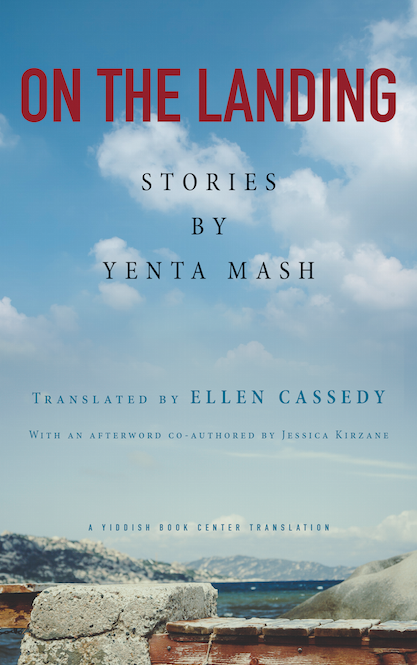
Yenta Mash and her stories will be remembered because they have rare and masterful elegance, uncanny insight into vast prairie-like swaths human nature, and unusual heart. They also tell stories entirely new for many English-speaking people, that of the Jewish exiles to Siberia under Stalin during World War II, and their later migration to Israel. Translator Ellen Cassedy’s is a transcendent achievement; with Mash’s On the Landing she has brought a landmark book into English.
Translator Ellen Cassedy’s is a transcendent achievement; with Mash’s On the Landing she has brought a landmark book into English.
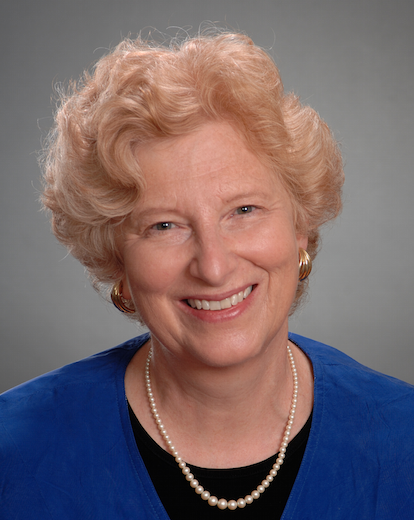
Ellen Cassedy is the author of We Are Here: Memories of the Lithuanian Holocaust and co-translator (with Yermiyahu Ahron Taub) of Oedipus in Brooklyn and Other Stories by Blume Lempel. She was a 2015 Yiddish Book Center Translation Fellow, and On the Landing is a result of her fellowship. Her website is www.ellencassedy.com.
C.M. MAYO: How might you describe the ideal reader for these stories?
ELLEN CASSEDY: Anyone interested in fine literature! Mash is a great read – clear, sometimes funny, and full of ground-level truths about what it was like to live through great cataclysms of the 20th Century.
C.M. MAYO: When and why were you inspired to translate Yenta Mash?
ELLEN CASSEDY: I learned of Mash’s work through the Yiddish Book Center’s translation fellowship program. Having died in 2013, she’s basically a contemporary writer. She was a down-to-earth and often witty observer of a changing world, who drew on her own life of multiple uprootings in telling the stories of people who are forever on the move.
Even in the most harrowing settings, Mash is somehow inspiring. Young and old, her characters are solid, sturdy people with a sense of humor. They’re survivors, people who land on their feet.
The
collection begins in a vibrant Jewish town reminiscent of the one in “Fiddler
on the Roof.”
We then join women prisoners being transported into the Siberian gulag, with its frozen steppes, snowy forests, and surging rivers. After the exile, we see the Jewish community rebuilding itself behind the postwar Iron Curtain. Finally, we join refugees in Israel in the 1970’s, struggling with the challenges of assimilation and the awkwardness of a land where young people instruct their elders, instead of the other way around.
C.M. MAYO: You are also a translator of the Yiddish writer Blume Lempel. Both Lempel and Mash write of suffering, exile, and grief, and yet they are very different writers, with very different experiences during and after the war. In a writerly sense, what are some of the differences that especially strike you?
ELLEN CASSEDY: Mash (1922-2013) and Blume Lempel (1907-1999) grew up in tiny towns in Eastern Europe, not far apart from each other. Both suffered persecution, displacement, and appalling losses.
Lempel left home for Paris as a young woman, fled to America in 1939, and spent the remainder of her life in New York. Her work feels shattered, fractured, unhinged. Her gemlike, poetic style and decidedly unconventional narrative strategies take readers into a realm of trauma and madness. The title story, “Oedipus in Brooklyn,” is Exhibit #1 of her taboo-defying oeuvre.
As a young woman, Mash was deported to Siberia by the Soviets in 1941. She did seven years of hard labor there, then spent three decades in Soviet Moldova before immigrating to Israel in the 1970’s. Her work bears witness in an urgent, orderly, and exacting fashion to a life full of tumult. Her language is alive with regionalisms carried to new places, bits of multiple languages picked up along the way, and neologisms invented to describe new circumstances.
ELLEN CASSEDY: The world of Yiddish writers after World War II was like a virtual café on a global scale. Yiddish newspapers, literary journals, and literary prizes flourished, as did intense epistolary friendships. I don’t have any evidence that Mash and Lempel corresponded, but they must have read each other’s work in Di goldene keyt, the flagship literary journal published in Tel Aviv. And they knew some of the same Yiddish literary figures, including the eminent poet and journal editor Abraham Sutzkever.
“The world of Yiddish writers after World War II was like a virtual café on a global scale. “
C.M. MAYO: How did working on On the Landing compare to working on Lempel’s Oedipus in Brooklyn and to your other translation projects?
ELLEN CASSEDY: I was fortunate to have Yermiyahu Ahron Taub as a co-translator for the Lempel project. We had a rich collaboration, full of constant back and forth. For the Mash project, I drew on the resources of the Yiddish Book Center in Amherst, MA – a wonderful organization that provided me with mentors and a vibrant and an engaged community.
I did the English translation for Yiddish Zoo, a collection of Yiddish poetry for children in three languages. That was a joyful romp with lions and tigers and bears – great fun.
Now I’m working with a gifted cartoonist who’s embarked on a graphic project involving handwritten Yiddish archives. Quite a decoding challenge!
C.M. MAYO: Can you talk about Yenta Mash’s literary influences? (And in which languages did she read?)
ELLEN CASSEDY: Mash knew Russian, Rumanian, Hebrew, and Yiddish. She was drawn to Yiddish literature from early childhood. As a small child, she knew poems by Y.L. Peretz by heart and was familiar with the classical Yiddish writers Sholem Aleichem and Mendele Moykher Sforim. After her years in Siberia, she joined the vibrant Jewish literary circle in the Moldovan capital of Chisinau. But it wasn’t until she was in her fifties, when she immigrated to Israel, that she began to write. She joined the Yiddish literary scene in Israel and was a member of Leivick House, a Yiddish cultural center.
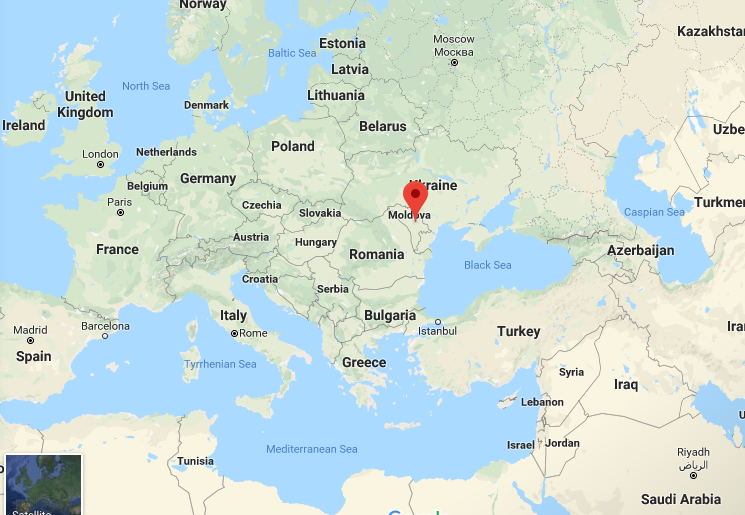
The red marker in this screenshot from Google Maps shows Chisinau, in Moldova, where Yenta Mash lived after her exile to Siberia.
C.M. MAYO: Which writers, in any language, could you compare her to?
ELLEN CASSEDY: Yenta Mash is a master chronicler of exile. Her characters are always on their way to somewhere or from somewhere. That’s why I chose the name “On the Landing,” the name of one of her stories, for the title of my translated collection.
“Yenta Mash is a master chronicler of exile.”
I compare her to other voices of assimilation and resilience – Jhumpa Lahiri (The Namesake), André Aciman (Out of Egypt), and Viet Thanh Nguyen (The Refugees). Her work is keenly relevant today as displaced people seek refuge across the globe.
C.M. MAYO: I am astonished that writing of such quality is only appearing in English for the first time in 2018. Is there more?
ELLEN CASSEDY: Absolutely! Only a fraction of Yiddish literature from the past 150 years has ever been translated into English. As we gain access to more and more of these buried treasures, I believe Yiddish literature will take its rightful place in the world, as what has been called “a major literature in a minor language.”
“As we gain access to more and more of these buried treasures, I believe Yiddish literature will take its rightful place in the world, as what has been called ‘a major literature in a minor language.'”
There’s an expression in Yiddish, “di goldene keyt,” the golden chain, which refers to how Yiddish literature has been passed down through the ages, with one writer after another adding links to the chain. Yiddish was the language that my Jewish forebears spoke in kitchens, marketplaces, and meeting halls on both sides of the Atlantic. I’m thrilled to be able to add my own link to the chain.
Apropos of typing, I am honored to also announce that my short story “What Happened to the Dog?” has been accepted for Cold Hard Type: Typewriter Tales from Post-Digital Worlds, edited by novelist Frederic S. Durbin, writer and Professor of English Andrew McFeeters, and philosopher Richard Polt, the Dean of the Typoshere, and author of The Typewriter Revolution. My own vision of the post-digital world? A mashup of a Fortean echo of Aeschylus’ death, the Galapagos Islands, an Ivy League university quadrangle, and round-a-campfire singin’ with the Girl Scouts. (Like they say about the future, the imaginal can be a beyond-strange land.) What post-digital worlds did the other contributors come up with? I for one look forward to reading…
“There’s a small, international army of typewriter users and collectors on this planet called Earth. Many share some core beliefs: 1) The typewriter inspires creative, deliberate, and thoughtful writing through its singular purpose; 2) Typewriters have no distracting social media apps. Writing, after all, is a solitary act; 3) Typewriters do not require batteries; 4) New technology is not bad, but it is inferior to the mighty typewriter; 5) If you do not think typewriters are cool, then that leaves more typewriters for the rest of us. Still, don’t knock it until you try it; and 6) If you feel the clacking call of the typewriter beneath the full moon on a windy night, check out Richard Polt’s website”
P.S. Visit again next Monday for a fascinating Q & A with Ellen Cassedy, who has translated a brilliant, moving, and genuinely landmark book of short fiction.
The study of English Literature has its pleasures and virtues, and much to do with learning the craft of creative writing; nonetheless, these are not one and the same endeavor. You can earn a PhD in race, class, gender, fill-in-the-blank in the novel, yet still not have the wherewithal to actually write one. That said, a novelist who has never read anything by Shakespeare or, say, Jane Austen, and learned to appreciate why such works are so celebrated, is working at a calamitous disadvantage.
Analogy: an art historian specializing in baroque cabinets is not the cabinet-maker who crafts them. While the art historian focuses on fact and figures and on what the baroque cabinet represents in all its broader context; the latter actually makes one. The former might yammer on for a book or two about the Hanseatic League or the Counter Reformation or the rise of the urban bourgeoisie, and so and and so forth; the latter, she’ll worry about the specifics of the grain of the wood; the type of joint; the choice of tool; a carved rose or a daisy for the keyhole?
Further analogy: any furniture maker who would manufacture a baroque-style cabinet would undoubtedly benefit from some familiarity with the finer examples that have survived.
DEFINITIONS
As a writer, I don’t noodle much about literary definitions of the sort a highschool English teacher would lay on a multiple choice exam, e.g., whether thus-and-such is a simile or a personificaction, metaphor, or allusion. I just think of “imagery” as my palette of “metaphor stuff.” I, the artist, can ignore it. Or I can make tiny dabs of this; squirts of that; wild oceanic splashes! In other words, as I write a novel or a story or a poem or an essay, I use imagery– I apply “metaphor stuff”–when and as I judge it apt.
(Of course, if we aim to find readers, then comes revision and editing, and further revision… More about that big bramble of a subject anon.)
For using imagery, there is no formula. Some marvelous writers relish using loads of it, others, equally marvelous, apply it sparingly.
In general, it serves to slow down, focus and brighten an idea, a character, act, place, thing– whatever it is you want the reader to more sharply “see.”
Yeah, but what about clutter?
In my experience, most people who come to a writing workshop for the first time do not have the easily fixable problem of cluttering up their writing with “metaphor stuff”; rather, for lack of it their writing is dull. And when they do use metaphor stuff, alas, it’s more often than not cliché– that is, somebody else’s metaphor stuff, warmed over 279 times. (More about cliché here.)
How to come up with your own original “metaphor stuff”?
1. Practice. The more often you practice, the easier it gets. Like riding a bike, it doesn’t require some otherwordly talent; most people find it challenging at first and then, quickly, something they can “just do.” For a trove of exercises, have a look at my workshop page’s “Giant Golden Buddha” & 364 More Five Minute Writing Exercises.
2. Learn to notice it as you read. You already have an immense treasure of metaphor stuff at-hand, right there in the books you have already read and loved. Go pluck one off your bookshelf, open it at random and chances are, you’ll find metaphor stuff aplenty. As you reread– and as you read any new book– keep your eyes sharp for the way the author uses it. (See my post on Reading as a Writer.) How well do they use it? If you love the book, chances are, the author uses it very well indeed.
For those feeling a little creaky with the creativity mojo, I’ve posted previously about emulation or permutation exercises. Basically, you jot down another writer’s line or two– anything you especially admire– and then vary the nouns and/or verbs, adjectives and/or adverbs (or however you want to do it). In short, in these exercises the idea is not to plagarize another writer; rather, you emulate; by means of play, you create your own lines.
Yes, sometimes, like a big fat cheesy enchilada, too much metaphor stuff in a manuscript can be too too… uhhff, pass the Alkaseltzer.
But again, there is no formula. Switching back to the furniture analogy, I mean, “metaphor stuff,” not everyone wants all the swirls and twirls and dainty dimpled cherubs and roses and whatnotty-whatnots of baroque furniture. But some people think baroque is the Dickens’ chickens.
For your reference, and the satisfaction of all English teachers, herewith some definitions:
ALLUSION An expression designed to call something to mind without mentioning it explicity; in indirect or passing reference.
“Where’s the Plantation?” John Wesley asked. “Gone With the Wind,” said the Grandmother. “Ha ha.” —Flannery O’Connor “A Good Man is Hard to Find”
ANALOGY A comparison between two things, typically on the basis of their structure and for the purpose of explanation or clarification; a correspondence or partial similarity.
A mind is like a parachute. It doesn’t work if it’s not open. —Frank Zappa
Minds are like ovens— if you leave them open all the time, everything comes out half-baked. —John Michael Greer
METAPHOR A figure of speech in which a word or phrase is applied to an object or action to which it is not literally applicable; alternatvely, a thing representive or symbolic of something else, especially something abstract.
She had heard any number of women talk of pregnancy as a slow ordeal to be endured, but now from month to month she felt only a peaceful ripening. —Richard Yates, “A Natural Girl”
PERSONIFICATION The attribution of a personal nature or personal characteristics to something nonhuman, or the representation of an abstract quality in human form. (Throw animal forms in there, too, whydoncha.)
He watched the clouds: dark swift horses surging up the sky —Malcolm Lowry, Under the Volcano
SIMILE A figure of speech involving the comparison of one thing with another thing of a different kind, used to make a description more emphatic or vivid.
…a young woman in slacks, whose face was as broad and innocent as a cabbage —Flannery O’Connor, “A Good Man is Hard to Find”
When I teach this workshop I ask my students to each take a turn reading an example aloud. I would suggest that you do the same: Slow down, waaaaay down. Take a long, cool moment to read these examples aloud carefully, crisply, as if you were at the podium before a rapt audience.
We drove on, the morning
growing in the sky to our left.
—Rupert Isaacson, The Healing Land: The Bushmen and the Kalahari Desert
I wandered the village of rounded earthen houses, golden and white, decorated with stark geometric designs. They had a peculiar organic quality, as if they had bubbled up from the earth and dried there. Flattened dung cakes stuck on walls to dry looked like giant polka dots. —Naomi Shihab Nye, “Camel Like Only Camel,” in Never in a Hurry: Essays on People and Places
Inquisitiveness flutters this way and that, like a bird in a glass house. —Aldous Huxley, “The Traveller’s-Eye View”
Given the single fossil bone, one fancifully builds up the whole diplodocus. —Aldous Huxley, “The Traveller’s-Eye View”
A Hollywood millionaire is a strong, silent man, clean-shaven, with a face, either like a hatchet or an uncooked muffin. These, on the contrary, had tremendous beards, talked a great deal, were over-dressed and wore white gloves. They looked like a little party of Bluebeards. —Aldous Huxley, “The Traveller’s-Eye View”
Most of the above examples are from a handout I’ve used over the years in my “Techniques of Fiction” and “Literary Travel Writing” workshops at the San Miguel Writers Conference and the Writer’s Center. In case you’ve already seen those, herewith, from recent reading, some fresh examples:
But his smile stung me like a nettle. So I barked, “Have you been to the post?” —Arthur Japin, The Two Hearts of Kwasi Boachi
My playing is no more like hers, than a lamp is like sunshine. —Jane Austen, Emma
I have come out to lie on the rocks where I have the black edge of the north island in front of me, Galway Bay, too blue almost to look at, on my right, the Atlantic on my left, a perpendicular cliff under my ankles, and over me innumerable gulls that chase each other in a white cirrus of wings. —J.M. Synge, The Aran Islands
Again, a curagh with two light people in it floats on the water like a nutshell —J.M. Synge, The Aran Islands
He stuck with the tried and true—adding figures in his head. You could hear his lips whispering quick-quick-quick, like nuts rolling down a hill, and before you knew it he had the balance. —Yenta Mash, “The Irony of Fate,” in On the Landing (translated from the Yiddish by Ellen Cassedy)
#
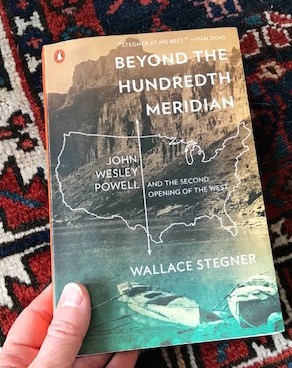
WALLACE STEGNER’S BEYOND THE HUNDREDTH MERIDIAN
In the past couple of weeks, apropos of my book in-progress on Far West Texas (trying to get my mind around the history of the American West in general and Reclamation in particular) I’ve had the rich pleasure of reading Wallace Stegner’sBeyond the Hundredth Meridan: John Wesley Powell and the Second Opening of the West. Stegner is a master of many things, including “the metaphor stuff.”
Some examples:
It is easy to skirt the region, hard to cross it, for from Bear Lake at its northern border to the Vermillion Cliffs along the south, Utah has a spine like a Stegasuarus. —Stegner, BTHM, p. 161
Powell saw the boat hang for a breath at the head of the rapid and then sweep into it. —Stegner, BTHM, p. 63
Suppose he and his family endured the sun and glare on their treeless prairie, and were not demolished by the cyclones that swept across the plains like great scythes. —Stegner, BTHM, p. 220
The inflexible fact of aridity lay like a fence along the 100th meridian. —Stegner, BTHM, p. 229
Characteristically, he took on more than he could finish. He was a Thor, always getting caught in an attempt to drink the ocean dry or uproot the Midgard serpent. —Stegner, BTHM, p. 279
His handling of the Commission was like a skilled muleskinner’s handling of a twenty-mule team. —Stegner, BTHM, p. 289
Three hundred and sixty degrees of horizon ringed them, the sky fitted the earth like a bell jar. —Stegner, BTHM, p. 297
The great men of Zion are on the map in Brigham City and Heber City and Knightsville, and beween and among these are scattered those dense but hollow names, smooth outside with use, packed with associations like internal crystals, that come from the Bible or the Book of Mormon—names that are like Lehi and Manti and Hebron, Nephi and Moroni and Moab. —Stegner, BTHM, p. 192
But here before him was the opportunity of his life, the massive and complex problem of planning for the West whose parts meshed in an intricate system. And here was he with twenty years of experience and knowledge, every bit of which could be applied to the problem as an engine’s power is applied to the axles. The action of Congress, stumilated by Stewart and Teller, had shifted him into gear, and he was not now going to be content with making a humming noise or moving pistons meaninglessly up and down. He was going to turn wheels. —Stegner, BTHM, p. 305
It was the West itself that beat him, the Big Bill Stewarts and Gideon Moodys, the land and cattle and water barons, the plain homesteaders, the locally patriotic, the ambitious, the venal, the acquisitive, the myth-bound West which insisted on running into the future like a streetcar on a gravel road. —Stegner, BTHM, p. 338
He was not merely an explorer, an opener, and an observer, he was a prophet. And yet by the law of motion (and hence of history) which he himself accepted, his motion as a particle in the jar and collision of American life was bound to be spiral. His reforms have taken effect, his plans have been adopted, but partially, belatedly, sidelong, as a yielding resultant of two nearly equal stresses. —Stegner, BTHM, p. 350
>> Find more workshop posts in the archive here; and many more resources at my workshop page on www.cmmayo.com here.
Finally, after more than a decade, I took my own advice to get Madam Mayo off the free Google blogger platform and onto self-hosted WordPress here at www.madam-mayo.com. It was one part 2019 new year’s resolution and another part yikes-my-book-Meteor-is-about-to-come-out-and-I-should-have-already-taken-care-of-this. For the past few weeks I’ve been huffing and puffing up a steeper learning curve, and one with quite a few more scenic (and not-so-scenic) detours, than I had anticipated.
I do not aim, by the way, to import the entire archive of Madam Mayo posts going back to 2006. Archaeologists of Ur-litblogdom are hereby invited to dig around in the archives right where they always were and shall remain, for as long as Googledom, for whatever reasons known only to itself, deems apt. What I am bringing over here to www.madam-mayo.com, with selected links updated, are those posts that I believe best hold up over time: some transcripts of my talks, and other items related to my books (including the one in-progress) and podcasts; book reviews and the richer notes on recommended reading; articles for my writing workshop; and the now substantial collection of Q & As with other writers.
If you’re new to this blog, a few of last year’s posts that I would consider representative of what you can expect here going into 2019 include:
As of today, February 4, 2019, the top Madam Mayo posts for 2018–some thirty in all– plus a wee batch (mainly workshop posts) from a sprinkling of earlier years, are now live here at www.madam-mayo.com. So I have more to do.
I also need to figure out the signup-by-email thing…
In case you are also thinking of migrating a blog to WordPress, or starting a new blog on WordPress, herewith a few resources that I have found especially helpful:
This blog posts on Mondays. This year the fourth Monday of the month is dedicated to a Q & A with a fellow writer.
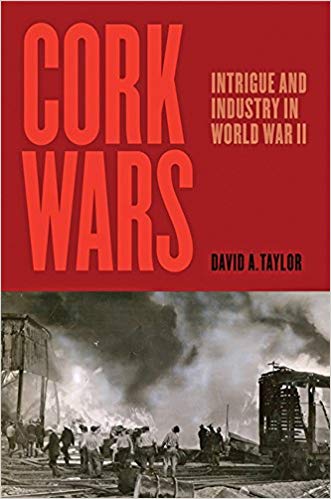
I was excited to see David A. Taylor’s Cork Wars: Intrigue and Industry in World War II, firstly because I know from his previous works that this promises to be a thoroughly researched and superbly written history; and secondly because I have some tangentially related family history with another strategic material during World War II. My grandfather, organic chemist Frank R. Mayo, was then a research chemist at U.S. Rubber Company working on the crucial task of creating a synthetic rubber that could be mass-produced in a dangerously narrowing window of time; sources of natural rubber –essential for making automobile and airplane tires as well as tank caterpillar tracks–had been cut off when the Japanese invaded southeast Asia. Moreover, these days I am not the only one nervously aware that as we become increasingly dependent on our computers, smartphones, and electric vehicles, we are becoming increasingly beholden to a supply of “rare earths,” many found nowhere near the United States, for the batteries (as David mentions in this interview).
Taylor’s Cork Wars has been garnering rich praise. Meredith Hindley, author of Destination Casablanca, calls Cork Wars “fascinating;” Mary Otto, author of Teeth, says: “Cork Wars captures the drama of three families whose lives are bound up with a precious forest product—and the urgency of war;” and noted biographer Douglas Brinkley calls Cork Wars “a landmark achievement!”
C.M. MAYO: How might you describe the ideal reader for Cork Wars?
DAVID A. TAYLOR: The story is narrative nonfiction, so really the ideal reader is anyone who loves a good story. Because it involves espionage and World War II, that tends toward a male reader but the focus on families and how they respond to a crisis will make it interesting to a wider audience. I’ve been pleased that a wide range of readers have responded warmly to the book.
C.M. MAYO: An unsung commodity turns out to be crucial for national defense. It seems to me there are many parallels to this, both in the past and the present. Can you talk about this a bit?
DAVID A. TAYLOR: That’s long been an interest of mine,
especially commodities that come from nature. We’ve come to know that water can
be a flashpoint for conflict and security. And many of us grew up hearing
“Blood for oil!” as a shorthand describing the motivation for wars fought over petroleum
reserves.
But other parallels
today are less well known. One is an obscure ingredient in electronics like our
cellphones: minerals called “rare earths.” Your cellphone contains just a tiny
amount of rare earths, but they’re irreplaceable – and China holds practically a
monopoly on them. That’s why the Pentagon recently issued a report saying rare earths are a matter of
U.S. national security.
That’s a factor in
the current trade conflict. It helps to know these things as world citizens. And
for writers, I think that holds dramatic possibilities as well.
C.M. MAYO: Can you talk about which writers have been the most important influences for your writing in general and for Cork Wars in particular?
DAVID A. TAYLOR: My reading taste has been shaped by
so many wonderful writers of both fiction and nonfiction. It’s hard to keep to
just a few. In fiction I’ve loved the works of Alice Munro, Grace Paley, Amy
Bloom, George Saunders, Kate Wheeler, Chekhov, Tagore (stories), Borges, and
Machado de Assis, the Brazilian master who combines wit and poignancy. In
nonfiction I’ve been influenced by John McPhee, Rebecca Skloot, Isabel
Wilkerson and others.
For Cork Wars, I was very impressed by a novel by Alan Furst called Dark Voyage, set during World War II and in the Mediterranean, in which the crew of a freighter (hauling a cargo of cork for part of the voyage) figures prominently. Furst evoked a world that’s noir and world-wise with vital characters, a combination I wanted for my book.
The other novel that I admired recently – it didn’t influence me because of when it came out – was Jennifer Egan’s Manhattan Beach, which has beautiful writing and characters in that wartime atmosphere of New York harbor.
C.M. MAYO: You have been a consistently productive writer for many years. How has the Digital Revolution affected your writing? Specifically, has it become more challenging to stay focused with the siren calls of email, texting, blogs, online newspapers and magazines, social media, and such? If so, do you have some tips and tricks you might be able to share?
DAVID A. TAYLOR: Thanks, so have you! The digital
revolution has had a huge affect on my process. Yes, the distractions – and
even the requirements – of email and social media have cut a chunk out of my
writing time. I still write in the mornings, right after I get up, and that
helps. And at some point in the day I like to write on paper, for a different
neural connection to work. But I wish I had more tricks for staying focused
(apart from self-imposed deadlines).
C.M. MAYO: Another question apropos of the digital revolution. At what point, if any, were you working on paper? Was working on paper necessary for you, or problematic?
DAVID A. TAYLOR: Yes, I started writing on computers
but printing out to review and revise. I’ve seen research findings that reading
hardcopy can help foster focus on longform reading (and revising). So as much
as I write and revise onscreen, I do also edit on paper. The visceral circling
of passages to move around can be satisfying.
I also read my work
aloud to get my ear involved in hearing points for improvement.
C.M. MAYO: Organization… Keeping the research and working library all in order is a titantic task in writing a book of this nature. What were some of the things you did for this book that worked especially well for you?
DAVID A. TAYLOR: It’s interesting – have you found your own process has changed with each book? Mine has. For my first book, I used index cards to map out scenes, chapter by chapter. Later books relied on folders on the computer.
This one was
challenging in terms of structure – it took a while to find the braided
structure woven in three strands, with three families. As the structure
evolved, the way I sorted my text, interview transcripts and images shifted.
One strength in
this story’s evolution was the rhythm of research and interviews, writing and
revision. The research led me to people to talk with – including Frank DiCara at his home in
Baltimore, and Gloria Marsa, the daughter of a man recruited for spying by the
OSS. I spoke with her often by phone in Mexico City, where she lives.
Those conversations
in turn pointed me forward with search terms for more documentary research,
which often yielded details that would be hard to recall, but that help the
narrative.
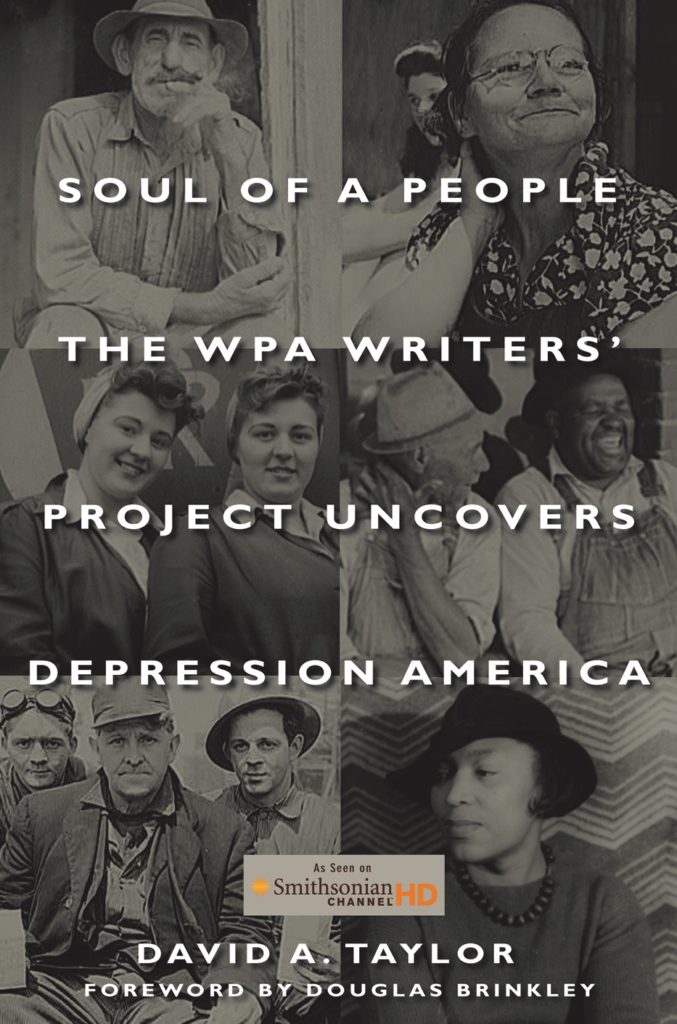
DAVID A. TAYLOR: I’ve been encouraged by the response to Cork Wars and I think there are other formats in which the story and its characters can speak to us. In earlier work, I was fortunate to have partners for adapting my book about the WPA writers of the 1930s, Soul of a People, as a documentary and later as a feature screenplay (not yet produced, but it did get some nice WGA recognition). So I’d like to explore something like that with this story.
I also have several new projects. I’m in awe of the vision of August Wilson, whose Twentieth Century Cycle is so monumental. I love the idea of imagining a vast canvas, and carving it up by decade! On my own much smaller scale, I have my Thirties story with the WPA writers, and now Cork Wars in the 1940s. So I have a few more to go.
>>Visit David A. Taylor here, and check out this excellent trailer for Cork Wars:
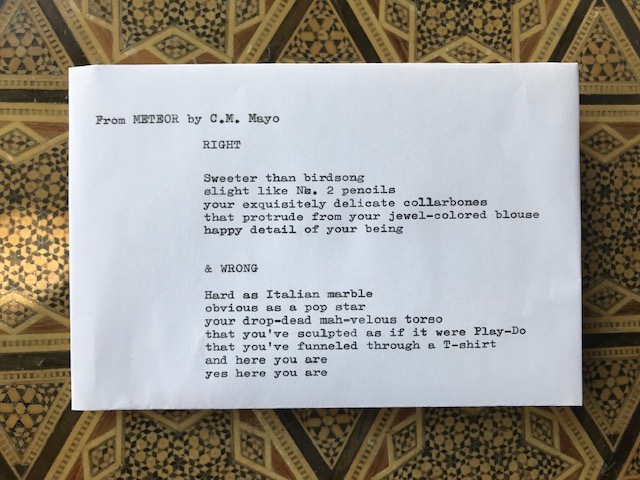
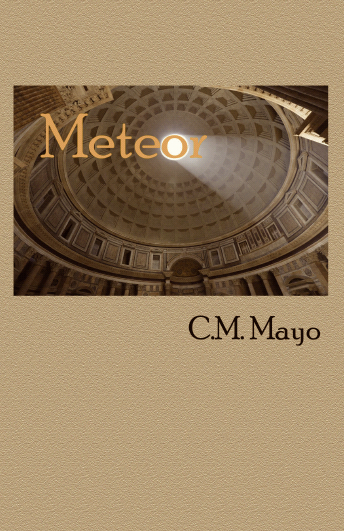
My book Meteor, which won the Gival Press Award for Poetry, and was orginally scheduled to be published in late 2018, has been delayed slightly; it will be out in early 2019. I’m thrilled to see the cover, designed by Kenn Schellenberg, and to announce that Meteor will launch at the Association of Writers and Writing Programs Conference in Portland, Oregon this March. If you’re going to the conference, come on by my reading which will be part of Gival Press’ 20th Anniversary Celebration, and also to my booksigning the following day in the AWP Bookfair (details below).
I’d be the first to say many of these poems could be considered flash fictions, and in fact, a number of them were originally published in literary magazines (e.g., Exquisite Corpse, Gargoyle, Kenyon Review), as fiction. But as I like to say, it’s all poetry– or at least, it should aspire to be.
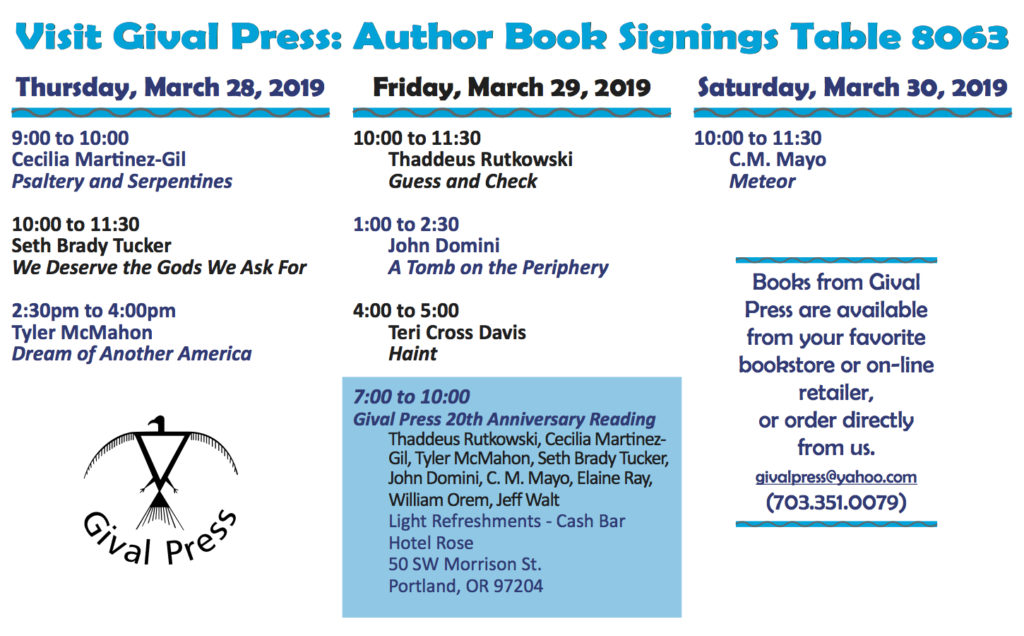
March 29, 2019Portland, Oregon Association of Writers and Writing Programs Conference off-site event Hotel Rose 7 – 10 PM C.M. Mayo, author of Meteor, to participate in Gival Press 20th Anniversray Celebration Reading. More details to be announced.
March 30, 2019 Portland, Oregon Association of Writers and Writing Programs Conference Oregon Convention Center Book Fair, Gival Press, Table # 8063 10-11:30 AM C.M. Mayo will be signing Meteor.
Yep, I am still at work on the book about Far West Texas. I aim to post a podcast apropos of that shortly, however next Monday’s post– the month’s fourth– is dedicated, as ever, to a Q & A with another writer: David A. Taylor, who will be talking about his intriguing Cork Wars.
You could leave it hanging in the tree in the backyard… not what I am recommending, however. Photo courtesy of MorgueFile.
SMOMBIE: It’s a word that popped up in Germany only in 2015. It’s hard to imagine now, but a decade ago, a scene, typical today, of smombies shuffling along city streets would have been but a cliché in a sci fi novel. But here we are.
When we lack the words to precisely describe something, it becomes difficult to recognize it, never mind debate and discuss it. Albeit some decades ago, the Digital Revolution burst upon us all, a series of tsunamis of such dizzying celerity that our vocabulary is still catching up. Only a few years ago a much-needed term was coined by Jake Knapp: “Distraction Free iPhone.” I came across the term when I read Knapp’s recent update on his experience here.
DISTRACTION FREE SMARTPHONE = DFS = defis
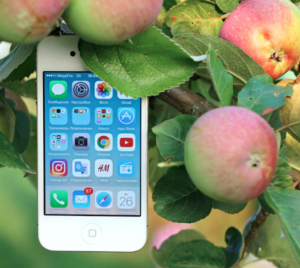
I’ll switch that last word from “iPhone” to “smartphone” to make it Distraction Free Smartphone, DFS for short. I did not think of my smartphone as distraction free until now, but for the past several years, that’s precisely what I have been moving towards, a DFS. Hmm, that sounds a mite snappier!
And I hereby tweak DFS to “defis,” which, I note, is the plural of “defi” which means “challenge” or “defiance.” Indeed, using a distraction-free smartphone is an act of defiance towards smombiedom.
BEYOND PRO OR CON
The magic is, this new word, DFS, or defis, nudges us beyond the rigid ping-pong of pro or anti-smartphone; forward-looking or old fogey. As I wrote in a recent post:
“The reigning paradigm is the same one we’ve had since forever: if it’s digital and new it must be better; those who resist are old fogeys. It’s a crude paradigm, a cultural fiction. And it has lasted so long a time in part because those who resisted either were old fogeys and/or for the most part could not articulate their objections beyond a vaguely whiney, ‘I don’t like it.’
“As an early adopter of digital technologies for decades now (wordprocessing in 1987, email in 1996, website 1998, blog 2006, podcast and Youtube channel 2009, bought a first generation iPad, Twitter 2008, and first generation Kindle, self-pubbed Kindles in 2010, etc.), I have more than earned the cred to say, no, my little grasshoppers, no, if it is digital and it is new it might, actually, maybe, in many instances, be very bad for you.
“In other words, adopting a given digital technology does not necessarily equate with ‘onwards and upwards’; neither does rejecting a given digital technology necessarily equate with backwardness. I so often hear that ‘there is no choice.’ There is in fact a splendiferous array of choices, and each with a cascade of consequences. But we have to have our eyes, ears, and minds open enough to perceive these, and the courage to act accordingly.”
Of course, when it comes to using digital technologies, different people have different needs, different talents, goals, obligations, opportunities, and vulnerabilities. A responsible mother with young children will probably want to use Whatsapp with the babysitter; a real estate agent who wants to stay in business needs to be available to clients, whether by phone, email or text– and so on. Some people slip into the vortex of addiction to social media or gaming far more easily than others…
My aim here is not to judge other people (although I’ll admit to some eye-rolling at smombies slapping themselves into streetlamps), but to examine the nature of digital technology and my own use of it. I am not a mother with young children, nor a real estate agent. Games bore me, always have. I am a writer of books. I blog about digital technology because first, it’s my way of grokking it; and second, I trust that what I’ve learned may be of interest to my readers– for I know that many of you are also writers.
We writers are hardly alone in the need for uninterrupted chunks of time. Brain surgeons, composers, painters, historians, statisticians, sculptors, software engineers… many people, in a wide variety of professions and vocations need, to quote Cal Newport, “the ability to focus without distraction on a cognitively demanding task,” that is to say, engage in what he terms “deep work.”
“Literary travel writing is about first perceiving in wider and sharper focus than normal; then, in the act of composition, shaping and exploring these perceptions so that, as with fiction, it may evoke in a reader’s mind emotions, thoughts, and pictures. It’s not meant to be practical, to serve up, say, the top ten deals on rental cars, or a low-down on the newest ‘hot spas.’ Literary travel writing, at its best, provides the reader the sense of actually traveling with the writer, so that she smells the tortillas heating on the comal, tastes the almond-laced hot chocolate, sees the lights in the distant houses brightening yellow in the twilight, and, after the put-put of a motorcycle, that sudden swirl of dust over the road.”
Writers have always battled distractions, but with the ubiquity of smartphones, and increasingly sophisticated app designs and algorithms to lure us and trap us into “the machine zone,” we’re at a new level of the game– or the war, as Steven Pressfield would have it.
Whatever might or might not be an optimal use of digital technology for you, I know this:
A book that can claim a thoughtful person’s time and attention is not going to be written by someone who is pinged by & poking at their smartphone all the live-long day.
“OUT IN THE WORLD”
Some writers have outright rejected smartphones– but so few, in fact, that only two come to mind: John Michael Greer, a prolific blogger and author whose stance on modern conveniences is, as he titled a collection of essays on his vision of the post-industrial future, Collapse Now and Avoid the Rush; and journalist Sebastian Junger. As Junger said on the Joe Rogan podcast:
“when I’m out, I want to be out in the world. If you’re looking at your phone, you’re not in the world… I just look around at this– and I’m an anthropologist, and I’m interested in human behavior– and I look at the behavior, like literally, the physical behavior of people with smartphones and… it looks anti-social and unhappy and anxious, and I don’t want to look like that, and I don’t want to feel like how I think those people feel.”
While I say a quadruple “AMEN” to Junger’s comment, I decided to keep my smartphone because I value having the emergency information-access and communication backups enough to pay for the smartphone for that alone; plus, I much prefer using the smartphone’s camera and dictation app to having to carry separate appliances, and I use these often in my work.
For me, the question was never whether or not a smartphone is useful. For me, obviously it is. The question is rather:
How can I maximize the benefits of this sleekly convenient multi-tool / communications device, while blocking its djinn-like demands, and so with sharpest powers of observation and consciously directed concentration, stay awake in this world?
I had answered this question by turning my smartphone into a distraction free smartphone, as I realized when I read Jake Knapp’s post.
Knapp’s version of “distraction free” turned out to be different than mine– he deleted his smartphone’s Mail and browser apps, which I kept. And when I Googled around a bit to find other writers who had tried to convert their smartphone to distraction free– and they were astonishingly few– I found that each had a different version of distraction free. Some recommended using grayscale, which I did not find helpful– but you might. Again, no surprise, what works for one writer may not work for another.
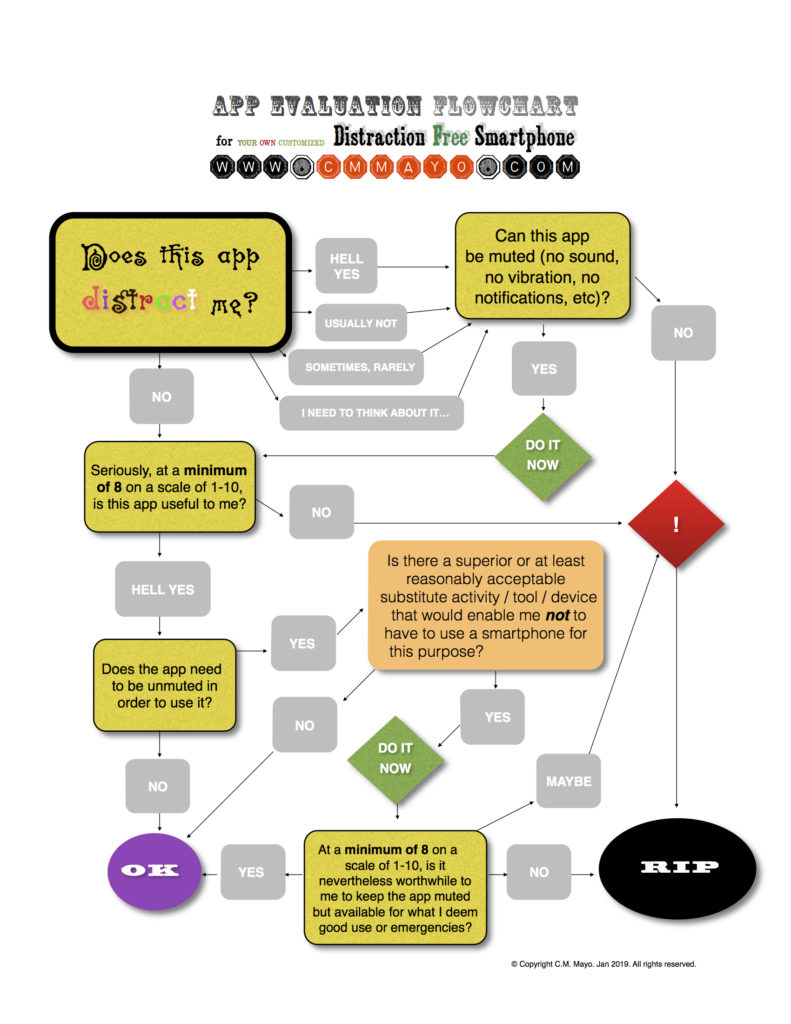
And that got me noodling… over the year-end holidays, instead of going to the movies, I stayed home and made my App Evaluation Flowchart for a Custom Distraction Free Smartphone, which you will find at the end of this post.
THIS WRITER’S DISTRACTION FREE SMARTPHONE (DFS or “defis”)
In early 2019, here’s where I stand, comfortable at last, with my smartphone. My defis, as it were. In order of importance, I use my smartphone as / for a:
Camera (for stills and video)
Audioplayer (various apps for audio books, podcasts, and music, which I usually listen to when flying or driving, never when walking or on public transport)
Emergency Mail
Recorder (dictation app for interviews)
Google translator
Emergency telephone
Emergency Google Maps
Emergency Safari
Calculator
Flashlight
In essence, I use my smartphone only when I decide it will serve me for a specific purpose, e.g., to take a photo, make a call, record an interview. Otherwise, it stays in the charging station at home or zipped into its felt bag in my backpack, wifi off, roaming off. I do not allow it to beep, rill, cheep, chirp, ding, ping or vibrate.
Other than the above-mentioned apps, I have deleted all apps (except the ones Apple will not allow me to delete; those I corralled into a folder I labeled “NOPE.” Do not ask me what they are, I do not remember.)
No social media apps, no Whatsapp, no news, no games.
All– all– notifications are off.
About the smartphone as a phone: I make a call from the smartphone maybe two or three times a month. I never check voicemail. Ever. I don’t know how to check voicemail and don’t tell me its easy because I don’t want to know how.
If you leap to conclude that I’m living the life of a Luddite you’d be wrong. I do make and receive plenty of phone calls– except for emergencies, on a landline. I Skype. I spend hours galore on email– but at my desk, on a laptop. On the laptop I also manage my website and blog. I podcast, too, editing the audio with GarageBand (listen in anytime here). And I film and edit short videos for my YouTube and Vimeo channels.
When I first got an iPhone nearly a decade ago, oh, did I fiddle with apps, apps for this and apps for that and apps that would confect a fairy’s hat! I was becharmed by apps! Ingenious things, apps are.
I was on FB, too, until 2015.
But I am a writer of books, and this smartphone rabbit-hole-orama, it wasn’t working for me.
THE TWO MAIN PULLS
For me, the two main pulls to pick up the smartphone have been:
(1) to see any messages from people and/or about matters I care about; (2) to have something convenient to read / look at when I’m away from my desk and feel bored.
Once I had this clear, I could formulate a more effective strategy than vaguely “finding a healthy balance” or blanging down the anvil of will power.
Over the past several years, trying to figure this out, backsliding, and trying again (and again) to figure this out, what I have found actually works is to remove or minimize temptations to even look at, never mind pick up, the smartphone when it is not in my fully conscious and decided interest to do so; and crucially, I have replaced those “pulls” to look at the smartphone with what are, for me, either superior or at least realistically acceptable alternatives.
B.J. FOGG
B.J. Fogg of Stanford University’s Behavior Design Lab has been an influence in my thinking about the smartphone. His basic equation for inducing a behavior is Motivation + Ability + Prompt (all three simultaneous), or B = MAP.
You can read more about Fogg’s behavior model here.
He’s all very sunny and even uses puppets when talking about his behavior model and how it can help people improve their lives, and I for one sincerely appreciate this. But I suspect that people with darker designs (oh I dunno, like those starry eyed newbies with VC in Silicon Valley who would launch a platform / app that, with maximum speed and efficiency, sucks the life-hours, money, and data out of you) also look to professor Fogg as a guru.
What I’m saying is, more likely than not, you are being very, very cannily manipulated by any one of a number of apps to pick up and remain focused on your smartphone despite what you know perfectly well are your better interests.
And understanding the way in is to understand the way out.
THIS WRITER’S STRATEGIES
I don’t pretend that my strategies will work for other writers. This section is not meant to be a series of recommendations but an example: what works for me, a working writer. (If you want to go direct to the App Evaluation Flowchart for a Custom Distraction Free Smartphone, just scroll on down to the bottom of this post.)
(1) Focus digital communications on email, and always at the desk, on the laptop
This is, to-the-moon-and-back, the most powerful strategy for me. (Read about my game-changing 10-point email protocol here.) I take email very seriously. However, with rare, emergency-level exceptions, I check email only on my laptop, only after 3 PM, and I batch it. I thereby establish the boundaries I need to be able to do my work, and I can truthfully say, “I welcome email,” and “the best way to reach me is by email.” And if not perfect, I am ever better about responding to email in a timely manner– since I have relatively fewer distractions!
Many people have told me that they would prefer to communicate with me on FB or Whatsapp, but… too bad! I am a writer who writes books, which means that I need to funnel communication into specific times, not allowing interruptions to leech my attention willynilly throughout the day. If someone cannot summon the empathy to appreciate that, well, like I said. (Anyway, I love you guys.)
This strategy allows me to keep the smartphone silent and in the closet (its charging station) or zipped in its bag inside my backpack. In B.J. Fogg’s terminology, I have hereby eliminated the motivation, the ability, and the prompts to pick up the smartphone. So I don’t.
(2) When out and about, if there’s a chance of having to wait a spell, carry a paperback
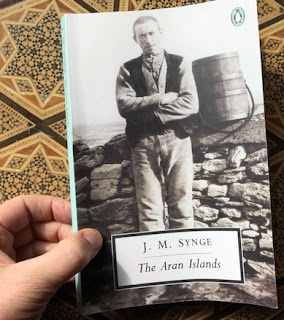
Recent Reading: J.M. Synge’s The Aran Islands Ye, verily, of the time before Instagram and TripAdvisor (A classic of travel writing and the Irish Renaissance, and a reading cure for “the shallows”) weighing in at about the same as a potato
This is the second most powerful strategy for me, and simple and old-fashioned as it is, it took what seems to me now an embarrassingly long time to figure it out.
I’ve always been an avid reader of books and magazines, but when I got an iPhone, suddenly, in spare moments, such as waiting at the dentist, in line at the grocery store, waiting for a friend in a coffee shop, I found myself pecking at it. I was reading, but… it was, in fact, more often skimming, watching, and surfing.
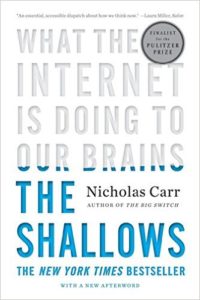
As Nicholas Carr explains in The Shallows: What the Internet is Doing to Our Brains, reading a book and clicking & scrolling on a smartphone (from, say, website to website, to Twitter to FB to Whatsapp to YouTube to Instagram feeds x, then y, then z), do two very different things to one’s brain. The latter literally retrains your brain, resulting in what Carr calls “the shallows,” and once you’re in the shallows, tasks requiring sustained cognitive focus– such as writing a book– become ants-in-the-pants-nigh-impossible.
Don’t tell me I could use a Kindle app to read ebooks on my smartphone; I don’t and I won’t because, again, my goal is to remove as many siren calls to the smartphone as possible, relying on acceptable or superior alternatives. For me, a paperback provides a superior reading experience to an ebook; and if it’s not too heavy, I don’t mind tucking a real book in my bag.
But, by the way, I do read Kindles on occasion, using the Kindle app on my iPad, as a last resort only, when a paper copy is unavailable. I also use my iPad for reading news (which I inevitably regret), a select few favorite blogs, and for listening to audiobooks and podcasts in the kitchen. (If not in its charging station, or with me as I am doing something like say, folding laundry, my iPad remains parked on the kitchen counter.)
In B.J. Fogg’s terminology, with this strategy, I have reduced the motivation to pick up the smartphone. Also in his terminology, I build a tiny habit: when tempted to take out the smartphone to surf, take out the paperback. (You can watch Fogg’s TEDx talk on tiny habits here.)
(3) For a calendar, “to do” lists, and selected contacts, use a Filofax
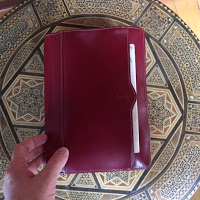
This strategy is an old one for me, tried and true. As Getting Things Done guru David Allen says, “low-tech is oftentimes better because it is in your face.” The Filofax is a century-old British system designed for engineers that is so efficient it still has legions of devotees, among them myself, for over 30 years now. My lovely and ridiculously sturdy cherry-red leather Filofax normally stays next to my laptop on my desk; I can, but I rarely carry it with me.
As for contacts, I keep the addresses and telephone numbers I need at-hand in the Filofax and the rest in a separate system, but not on the smartphone because, again, I aim to focus my communications on email, and always on the laptop. (My smartphone does have emergency contacts.)
In B.J. Foggese: For my to dos and calendar, I have no motivation nor prompts to pick up the smartphone.
(4) For an alarm clock use an alarm clock (and for a watch use a watch)
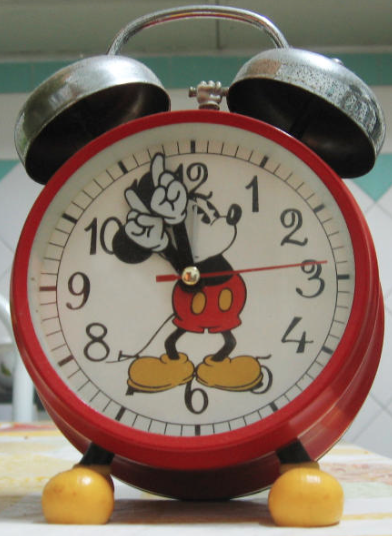
Back in the days of my starry-eyed wonderfest with apps, I downloaded three different alarm clock apps. The cornucopia of “alarms,” from harps to waterfalls to drums to roosters yodeling, that was fun. But I deleted them all and instead use a little plastic alarm clock powered by two AA batteries. It weighs almost nothing, cost less than ten bucks, and works just fine– so I can keep the volume on the smartphone on mute. Don’t tell me I could adjust the volume on the alarm clock app because I don’t want to touch the smartphone if I don’t have to, and certainly not as the last thing at night and first thing in the morning. And I don’t want the smartphone parked anywhere near where I sleep.
This strategy might sound silly. How is the alarm clock app different than say, the calculator or the flashlight or the camera or diction app? The answer is, by definition an alarm clock distracts, it prompts me to pick it up to turn it off– and that is precisely what I do not want my distraction free smartphone to do.
This is not trivial.
In B.J. Foggese: another motivation, ability, and prompt to pick up the smartphone eliminated.
(5) Use paper maps
You read that right. People laugh at me. I laugh back! Sometimes I use a store-bought map but more often, before I go out, I’ve Googled on my laptop and printed out or sketched the directions. I do make use of Google Maps on the laptop and on my smartphone in emergencies– this is one of the reasons for which I keep a smartphone. But by relying primarily on paper, rather than GPS via the smartphone in realtime, I have removed yet another reason to pick up and start poking at the smartphone.
An added benefit, crucial for me as a travel writer, is that my sense of space, direction, and the lay of any given landscape have remained sharper.
(If you love the planet and believe everything paper should be digital, I would invite you to Google a bit to learn about the energy realities of server farms and what precisely goes into smartphone batteries.)
(6) Always carry a pen and small a notebook
Another opportunity to not pick up the smartphone.
(7) Make it a habit to keep the smartphone zipped inside its bag
I don’t make a habit of holding my smartphone in my hand, carrying it in a back pocket, or setting it down on the desk or table next to me. Unless it’s an emergency, or I have an excellent, fully conscious reason to take it out and use it, the smartphone stays dead quiet and out of sight in its bag inside the bag.
In B.J. Foggese, I thereby reduce my motivation, ability, and prompts to touch it.
IN CONCLUSION
My smartphone is now simply (albeit miraculously!!) a lightweight selected multi-tool (camera / recorder / audio player / caculator / flashlight) and emergency information-access and communications device which I carry when I go out of the house, unless it is to walk the dogs. (I never take it when I walk the dogs because when I walk the dogs, I walk the dogs.)
My smartphone does have Mail, Safari, and Googlemaps buttons, but because I rely on my laptop for email and other Internet access, and paper for out-and-about navigation, I no longer feel that pesky tug to pick up and peck at the smartphone– but I do have these apps available to me should I need them. And sometimes I do need them.
Ditto the telephone.
Again, and of course, what works for me may not necessarily work for you. But may this new term, Distraction Free Smartphone, or as I would suggest, DFS, or defis, serve you in thinking through your own concerns and strategies for your own smartphone and your own writing.
DFS MODE
I’ll add one more term: “DFS mode.” A smartphone need not be distraction free almost all the time, as mine is. Let’s say one needs to be available on Whatsapp, voicemail, email or to use some other app for family or work that may ping, ring or ding-ding you at random intervals, and so be it; then, for the time alloted for writing (or other deep work), one’s smartphone could be put into DFS mode. As I hope I have made abundantly clear, this would not necessarily be the same as “airplane mode.”
P.S. Cal Newport’sDigital Minimalism: Choosing a Focused Life in a Noisy World will be out next month. From what I’ve read of his other books and blog, this promises to be a pathbreaking book. If nothing else, the term “digital minimalism” adds depth and nuance to our thinking about digital technology and our use of it.
Warmest wishes to you, dear writerly readers, for a fabulously felicitous and swirlingly creative 2019.
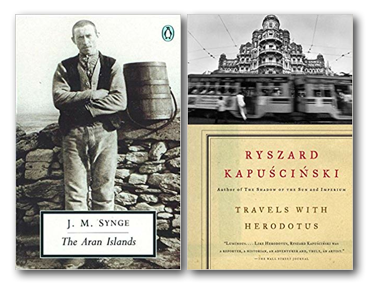
With the new year two brilliant titles have just been added to my list of recommended literary travel memoirs: J. M. Synge’s The Aran Islands and Ryszard Kapuscinski’s Travels with Herodotus. The former is a classic of the Irish Renaissance published in 1907; the latter, the memoir / meditation of an extraordinary Polish international journalist of covering India, China, Africa and more in the 1950s and ’60s. Both of these memoirs were written well before the advent of smartphones and social media and in many ways reading them–and on paper– felt like… profound relief. I’ll have more to say about smartphones, social media, and literary travel writing in next Monday’s post.
Speaking of writing, I can scarcely believe it but in 2019 “Madam Mayo,” this veritable Methusela of blogdom, will celebrate its 13th year. And it has been blinking & beeping on my “to do” list for nearly all of these many years to take my own advice and get off of the Google platform onto self-hosted WordPress.
In the last days of 2018, I finally did it– but not exactly. Various research surfaris yielded the intelligence that blogger-to-Wordpress migrations oftentimes work smoothly but, perchance generate headache-inducing snafus. Moreover, there is a huff-and-puff of a learning curve for any new digital endeavor. Hence I plan to keep that ginormous olde blog parked right where it’s always been at https://madammayo.blogspot.com, while offering new posts (and reposting selected posts of yore, bit by bit as I see fit) at this WordPress self-hosted site, www.madam-mayo.com.
If you subscribe by email, I hope you’ll consider resubscribing from the new WordPress blog instead. (I think that button works over there on the sidebar; if not, it will soon.)
What can you expect from “Madam Mayo” in 2019?
Front and center, I’ll be bringing back the Marfa Mondays Podcasting Project, finishing up podcasts 21-24, as I continue to work on my book on Far West Texas.
My book Meteor, which won the Gival Poetry Prize for publication in 2018, will, after all, be published early this year, so look for some posts on poetry as well.
In addition, as in 2018, the second Monday of each month will be dedicated to topics for my writing workshop, and the fourth to a Q & A with a fellow writer. Next up is the intrepid David A. Taylor, author of Cork Wars.
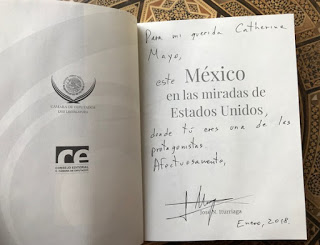
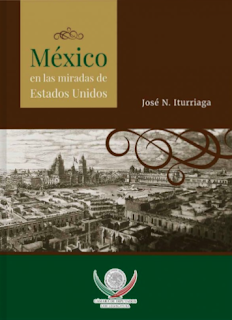
With México en las miradas de Estados Unidos (Editorial Las Animas, 2017), Mexican writer and historian José N. Iturriaga has edited an anthology that is at once a vital scholarly contribution towards the history of Mexican and of US-Mexico relations, and an “armchair read,” as I like to think of those box-of-chocolate tomes one can dip into here and there, on some quiet afternoon (perhaps with a bit of a birdsong and by a burbling fountain…) In short, this is a book I will keep on an eye-level shelf of my working library, but also return to time and again just for the fun of it. (For this reason furnishings for a proper working library include an upholstered armchair and ottoman!)
For those who can read Spanish and have even an
iota of interest in Mexico, México en las miradas de Estados Unidos is
a must-have. Over 130 American voices are represented here, and of an
astonishing variety, from the early 19th century to recent years, and of all
sensibilities. To quote [my translation] from Iturriaga’s introduction, they
are:
“traders and engineers, adventurers and sailors, explorers and historians, photographers and archaeologists, diplomats and journalists, novelists and miners, geographers and artists, poets and filmmakers, priests and planters, scientists, various soldiers, a comic and a president.”
That comic would be Groucho Marx, and the
president, James K. Polk.
Many of these authors will be familiar to those
who who have already read widely on Mexico in English: Fanny Chambers
Gooch, John Kenneth Turner, John Reed, Katherine Anne Porter, Alma Reed,
William Spratling, John Steinbeck, William Burroughs, John Womak.
And I was delighted to see so many of my personal
favorites, among them, pioneer trader and explorer Josiah Gregg, Princess Salm
Salm (suffice to say, had Andy Warhol been alive in 1866 they would have been amiguísimos),
Charles Macomb Flandrau, and my own dear amigo, the accomplished biographer and
historian Michael K.
Schuessler.
I am immensely honored to find my own work in
such company, with an excerpt from my novel based on the true story of Mexico’s
half-American prince, The Last Prince
of the Mexican Empire.
Although I have been reading on Mexican history
for decades now, and in fact collect memoirs of Mexico in English, many of
Iturriaga’s selections were new to me, for example, General John E. Wool,
soldier Thomas Yates Lundie, traveler Maude Mason Austin, and more.
Read about José N. Iturriaga’s many works,
including the recent Saberes y delirios, his fine novel about the
incomparable 19th century naturalist Alexander von Humboldt, here.
Another year of unusually intensive reading, mainly for my book in-progress on Far West Texas, hence this list is extra crunchy with geology, dinosaurs, Westerns, guns, and technology (yet somehow, like a pair of strawberry puddings amongst the platters of BBQ, Emma and The Prime of Miss Jean Brodie slipped in there…)
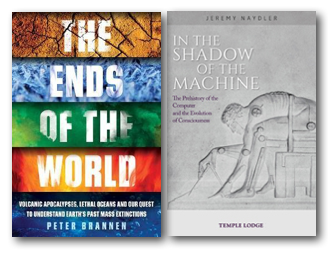
In the Shadow of the Machine: The Prehistory of the Computer and the Evolution of Consciousness by Jeremy Naydler The maintream mediasphere seems to be overlooking this book, and not surprisingly, for it has been published by a small press that specializes in esoteric subjects. If “esoteric” gives you the readerly “cooties,” well, chill, if you possibly can because Naydler’s In the Shadow of the Machine stands as major contribution to the history of both technology and consciousness. If you’re wading through any of the current best-sellers on the perils of too much screentime and AI and all that, fine and important as some of those works may be (more about Carr below), I would suggest that instead, for a more panoramic and penetrating view of the challenge, start with Naydler.
2. Tie:
Death Comes for the Archbishop by Willa Cather Historical fiction closely based on New Mexico and Church history but in all a soaringly lyrical work of empathic imagination. Deservedly one of the grand classics of 20th century American literature.
Emma by Jane Austen Ye olde read-it-by-the-fireside-with-a-cup-of-tea romance. But it’s a more serious work of literary art than it might appear; as a writer of fiction myself I found much to admire in Austen’s Emma. On that note, dear writerly readers, you might find of interest this piece in the Guardian.
The Rise and Fall of the Dinosaurs: The Untold Story of a Lost World by Steve Brusatte Dino-out! Finally, the whole millions-upon-millions-upon-millions of years of dinosaurs falls into parade-like Ordnung! More fascinating stuff about T-Rex & Co. than I ever thought I would find fascinating! Super nerdy in the friendliest, most readable, and authoritative way. If you read one book on dinos, let it be this one.
Ten Arguments For Deleting Your Social Media Accounts Right Now by Jaron Lanier If you know who Jaron Lanier is, you can understand why he, and probably only he can get away with such a title for a commercially published book, one that most people today, and that would include writers with books to promote, would consider hoot-out-loud humbug. But perhaps they would not if [continue reading]
Dense yet elegantly lucid, Stephen L. Talbott’s The Future Does Not Compute: Transcending the Machines in Our Midst was published by O’Reilly Associates in 1995, on the eve of the explosion of email, well before that of social media. Astonishingly, it delineates the nature of our now King Kong-sized challenges with technology, when those challenges were, so it now seems, but embryonic. And Talbott writes with unusual authority, grounded in both philosophy and his many years of writing and editing for O’Reilly Media, a prime mover in the economic / cultural juggernaut of a complex, increasingly dispersed from its origin in California’s Santa Clara Valley, that has become known as “Silicon Valley.” CONTINUE READING
I’m not where I want to be with my writing here at the end of 2018 and Carr’s works detail many of the reasons why. But I’m moving forward by having deactivated my FB, reduced Twitter to once-a-month-ish courtesy tweet for my Q & A with another writer; generally ignoring LinkedIn, and still– still! thumb cemented in the dike!– refusing to use Whatsapp.
But please know, dear writerly reader, that even
as I wend my way, I would not pretend to know what would be best for you. And
this the Matterhorn of the challenge of our time: digital technologies that
might be zest for one person can prove hazardous for another. One needs both the
fortitude and courage to evaluate one’s own path– taking into account one’s
own circumstances, talents, weaknesses, predilections, obligations, and goals–
then strategize, and restrategize as needed.
My sense is that, primed by Carr’s and others’ works
in this vein, our cultural paradigm will definitively shift this winter with
the publication of Cal Newport’s Digital
Minimalism. Never mind what Newport actually has to
say (though as a big fan of his Deep Work, I expect it will be
juicy); in simply coining the term
“digital minimalism” Newport helps us move towards richer
and more effective ways of thinking about how, given our personal and
professional goals and well-being, we can optimize our use (or nonuse) of
digital technologies.
As I write now in December 2018 the reigning
paradigm is the same one we’ve had since forever: if it’s digital and new it
must be better; those who resist are old fogeys. It’s a crude
paradigm, a cultural fiction. And it has lasted so long time in part because
those who resisted either were old fogeys and/or for the most part could not
articulate their objections beyond a vaguely whiney, “I don’t like
it.”
As an early adopter of digital technologies for
decades now (wordprocessing in 1987, email in 1996, website in 1998, blog in
2006, podcast and Youtube channel 2009, bought a first generation iPad and
first generation Kindle, self-pubbed Kindles in 2010, etc.), I have more than
earned the cred to say, no, my little grasshoppers, no, if it is digital and it
is new it might, actually, maybe, in many instances, be very bad for you.
In other words, adopting a given digital
technology does not necessarily equate with “progress”; neither does
not adopting a given digital technology necessarily equate with backwardness. I
so often hear that “there is no choice.” There is in fact is a
splendiferous array of choices, and each with a cascade of consequences. But we
have to have our eyes, ears, and minds open enough to perceive them, and the
courage to act accordingly.
I wish my wiser self could have time traveled to
tell my younger self, Be more alert to the ways you invest your time and
attention. Be aware that the digital can be, in some ways and sometimes, more
ephemeral than paper (and not necessarily ecologically so friendly, either).
Social media mavens are not reading the kinds of books you want to write
anyway, for they lack the time and the attention span. Social media
“friends” may be but are not necessarily your friends; and until you
try to communicate with and encounter them outside these networked public
spaces, e.g., in the real world, and via one-on-one private communication such
as snail mail, telephone, and email, you’re in a hall of mirrors. With almost
every app, every platform, some corporation is harvesting your attention and
data for shareholder value– and all the while conjuring up new ways to grab
even more. Life goes by, zip.