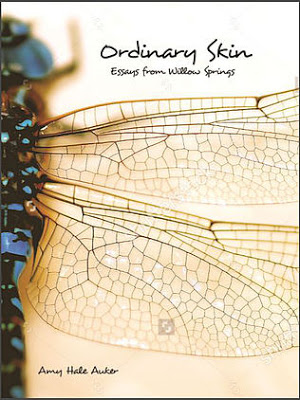
Q & A: Amy Hale Auker, Author of “Ordinary Skin: Essays from Willow Springs”

This year, with some exceptions, the post for the fourth Monday of the month is dedicated to a Q & A with a fellow writer. This is the last Q & A for 2018; look for the series to resume on the fourth Monday in January 2019.

I had the pleasure of meeting Amy Hale Auker and of hearing her read from her work back in 2016 at the Women Writing the West conference in Santa Fe. She’s the author of several works of poetry, fiction and essay, including Rightful Place, the 2012 WILLA winner for creative nonfiction and Foreword Reviews Book of the Year for essays. Her latest collection, Ordinary Skin: Essays from Willow Springs, is a treat for anyone who relishes fine creative nonfiction– and it’s a vivid and moving look at a life lived close to the land, on a working ranch in Arizona.

As those of you who follow my blog well know, my work to date has focused on Mexico, but for a while now I’ve been at work on a book about Far West Texas, and this had led me to read widely and closely about the West. It has a grand if sometimes underappreciated literary tradition, so if you’re not familiar with it, take special note of Amy Hale Auker, and of her reading recommendations here. You will be richly rewarded.

From the catalog copy for Ordinary Skin:

“Touching on faith and body image and belonging, these essays explore our role in deciding what is favorable or unfavorable, as well as where we someday want to dwell, and who came before us. In that touching, they feel their way with observations about current affairs, drought, mystery, and the hard decisions that face us all as we continue to move toward more questions with fewer answers. This exploration is informed and softened by hummingbirds, Gila monsters, bats, foxes, bears, wildflowers, and hidden seep springs where life goes on whether we are there to see it or not. It is about work in a wild and wilderness environment. In the end, even as life changes drastically around us, we are better off for knowing that the ugly mud bug turns into a jewel-toned dragonfly.”

Visit Amy Hale Auker’s website www.amyhaleauker.com 

C.M. MAYO: How might you describe the ideal reader for the essays in Ordinary Skin?

AMY HALE AUKER: Ordinary Skin is a book for anyone who loves language and story and first person narrative, who craves an intimate look at the natural world and the land, who recognizes the value of hard work and sweat with a pause, or many pauses, for falling in love with life, over and over again. While I think that women will find the deeper messages of the instinctual feminine, it is also a refresher course for men on why they love our Mother Earth.

C.M. MAYO: If a reader were to read only one essay in your collection, which would you recommend and why?

AMY HALE AUKER:“Using Tools Backward.” That essay reflects our sense of place and those who came before, paving the way, and who we are as we stand in these places.

C. M. MAYO: You have been a longtime participant in cowboy poetry festivals, including the Cowboy Poetry Gathering in Alpine, Texas. My impression is that while cowboy poetry, fiction and song are beloved to many in the western US and Canada and elesewhere, they are also considered exotic, and alas, something to even disdain, by many in the literary communities in urban areas of the Pacific and Atlantic coasts. Your writing seems to me to fall squarely in both camps– cowboy and what I would call (for lack of a better term) literary. Can you offer your thoughts about this? And perhaps comment on what people who read literary prose but who are unfamiliar with cowboy poetry (and cowboy culture generally) might look for and reconsider?

AMY HALE  AUKER: I have to admit to having run with this question directly to my editor and dear friend, Andy Wilkinson, who is often a clearer thinker and better communicator about labels and definitions than I am. I tend to simply write what I write and bang my head against category later. Wilkinson responded to my query in this way:

“The only way out is to question … artificial categorization. Stevens didn’t write ‘insurance executive’ poetry, Williams didn’t write ‘pediatrics’ poetry, Frost didn’t write ‘farmer’ poetry, etc. Poets write poetry, and though their poems may be about a kind of life, the poets are neither the subjects nor the classifications.”

I agree with Editor Dearest, but would also add that it is not my job to ask any reader to look more closely at any culture. It is my responsibility to simply do my job and step back (my clumsy paraphrase of Lao Tzu). This question looks too closely, in my opinion, at genre, marries me, as a writer/poet, too closely to a day job, a skill set, a means to earn a paycheck. Of course, my work in the natural world, with animals, growing food, informs my writing, my creative process, as did Frost’s… as does Wendell Berry’s. And yes, there are stereotypes out there, always, surrounding any profession or region that has been grossly, and often erroneously, romanticized to the point of becoming myth rather than reality. But an astute reader and listener will be quick to see where the stereotype breaks down and were reality shines through.

I would like to add that the elitist view of literature and life is what furthers the divide in this nation. That the only writing worthy of consideration can’t come from the pen of someone who grows food, who works as a peasant, who has shit on their boots, who works with their hands. This us vs them view of art, literature, and philosophy is dangerous and furthers our separateness.

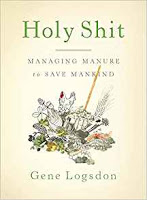
C.M. MAYO: Speaking of shit, my own favorite writer on that topic is Gene Logsdon, who called himself “The Contrary Farmer,” and who wrote a book I highly recommend– it’s informative, beautifully written, and hilarious– with the title, Holy Shit.

For someone who appreciates good writing but is unfamiliar with writing about rural life / farming / ranching, apart from your works, what might be a few reading suggestions?

AMY HALE AUKER: I just added Logsdon to my list of things to read! Thank you.

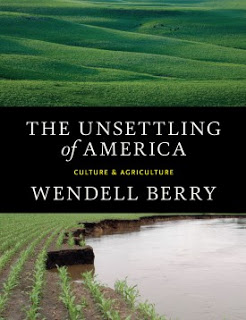
I hope you will consider all of Wendell Berry’s work… poetry, prose, essay…. all of it. I highly recommend The Unsettling of America, essays surrounding the “green revolution” and the industrialization of agriculture.

Some other authors include James Galvin (Fencing the Sky), Verlyn Klinkenborg (The Rural Life), and Merrill Gilfillan (Magpie Rising).

McMurtry addresses this question you and I are tossing around in his excellent foreword to Still Wild: Short Fiction of the American West.

Teresa Jordan wrote a gorgeous memoir, “Ride the White Horse Home.”

These are just a few, but if you really want to the peak of the pile, read The Unsettling of America. Berry is brilliant. 

C.M. MAYO: Can you talk about which writers have been the most important influences for your writing– and which ones you are reading now?

AMY HALE AUKER: My influences are eclectic and many… but I tribute the poetry and songwriting of Andy Wilkinson as an influence to write any and everything that burns brightly in me. I tribute Merrill Gilfillan, Jeanette Winterson, E. B. White, Verylyn Klinkenborg, Barbara Kingsolver, and Edward Abbey with influencing my first person narrative. Clarissa Pinkola Estes, Natalie Goldbberg, Ann Lamott, and Julia Cameron are on my “forever shelf.” Recently I started reading Pema Chodron. I read a lot of fiction when I am writing nonfiction. So, right now I am reading novels. By my elbow is News of the World by Paulette Jiles. I love how she writes literary fiction in a western setting, breaking out of genre.

C.M. MAYO: You have been a consistently productive writer for many years. How has the digital revolution affected your writing? Specifically, has it become more challenging to stay focused with the siren calls of email, texting, blogs, online newspapers and magazines, social media, and such? If so, do you have some tips and tricks you might be able to share?

AMY HALE AUKER:  I view my time as a pie chart. It is important to give of my creative energy consciously. However, my journey has also led me to consider all of the roles in my life as part of who I am as a creative being… author, cowboy, grandmother, gardner, cook, poet, performer, speaker. So, it has been fun to see how very creative I can be on my social media platforms, in particular Instagram. People point their cameras at things they love, so it is a glimpse at their hearts. That said, the most important thing I can do is to go to cow camp where I am unplugged and write in longhand on the unlined page. Or put a 38 pound pack on my back and walk off in the wilderness, solo except for the dog. And I do. When I am home, it takes discipline to turn it all off. But that is what we all should do, for more of the day rather than less.

C.M. MAYO: Another question apropos of the digital revolution. At what point, if any, were you working on paper? Was working on paper necessary for you, or problematic? 

AMY HALE AUKER:  I write three pages of longhand every single morning a la Julia Cameron. It is my discipline and my practice and it serves me well. Even if I don’t get to write the rest of the day, I know I showed up at the page Even if it reads like a “to do” list, I know I was present to my creative fire. I wrote most of “The Story Is the Thing” in longhand on yellow legal pad because a character in the book wrote in the same manner. What startled me was the dramatic and interesting process of transfering my handwriting to the screen. There was a magic there that I have not forgotten and crave to duplicate. So I am grateful that there are so many tools available to us… from uniball pens on blank journal pages to speaking into our phones while we drive to Schrivener (which baffles me) to Word where I can hurry up and get it all down. There is a freedom in having multiple ways to approach art in any medium.

C. M. MAYO: Can you talk about how and why you joined Women Writing the West?

AMY HALE AUKER: I joined Women Writing the West because my publisher, Texas Tech University Press, told me to. It has been an honor to be part of that group of highly talented people.

[C.M.M. post-interview note: Women Writing the West is open to writers (both women and men) living in and/or writing about the West, in any genre. I’ve been a member for several years now, and highly recommend it.]

C. M. MAYO: What’s next for you as a writer?

AMY HALE AUKER: So many things…. I am working on both a very weird collection of short short pieces that are a mixed bag of fiction and nonfiction and meditations as well as what may very well end up being a new collection of essays. However, I don’t believe artists should discuss what they are working on at the time in much detail. It is too easy to talk about our process rather than dig deep and stay in it…. all the way to completion… if there is such a thing.

COMMENTS:
Ms. Mayo: Fascinating interview with Amy Hale Auker. I have two of her essay collections: Ordinary Skin and Rightful Place. Her word choices are poetic; her thoughts on ranch life are inspiring. Thank you for asking inciteful questions—they are challenging but she is up to the task.
–Judith Grout www.judithgrout.com

Thanks for your interview of Amy Hale Auker. I have read both her essays and her fiction and admire both, and heard her poetry at one of the WWW conferences (perhaps Tucson?). Your questions and her answers were thoughtful and interesting. I appreciated your delving into her thought processes and comments on poetry and essays. I loved both of your recommendations for books!
–Julie Weston

Q & A: Lynn Downey “Research Must Serve the Writer,
Not the Other Way Around”

Q & A: Nancy Peacock on The Life and Times of Persimmon Wilson
and Writing in the Swirl of the Digital Revolution

Find out more about C.M. Mayo’s books, shorter works, podcasts, and more at www.cmmayo.com.

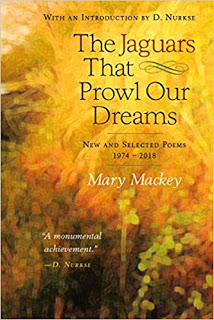
Q & A: Mary Mackey on “The Jaguars That Prowl Our Dreams,” Bearing Witness, and Women Writers’ Archives

This year, 2018, I have been aiming to post a Q & A with a fellow writer, poet and/or translator on the fourth Monday of the month. This usually happens! This month however I am posting two Q & As– this third Monday, and another for the fourth.

The Internet invites us be everywhere allwhen, so it seems, but in ye olde 3D meatspace, I have a habit of attempting to be in three places at the same time. (I leave all other impossible things for before breakfast!) One of those places is California, because that’s where my mother was living, and in recent years I flew out there from Mexico City to see her more times than I can count. Initially, when I realized I needed to go more often, I imagined that I could attend literary gatherings while in California, so I joined the San Francisco chapter of the Women’s National Book Association, an organization I warmly supported in the years I was living in Washington DC.  Alas –(those with elderly parents will smile sadly with understanding)– I never could make it to a meeting. But I did read the SF WNBA newsletters and announcements, including news of Mary Mackey’s books. Her latest, The Jaguars That Prowl Our Dreams, a collection of her poetry from 1974 – 2018, promises to be an especially rich read.

Mary Mackey is the author of a multitude of award-winning poetry collections, novels and more. Read about her distinguished career, and the unusual and highly original nature of her works, here. Though we have yet to meet in California, here we are, at least, on the same page in cyberspace: via email, Mary Mackey graciously answered several of my questions about her work. May you, dear extra curious and adventurous writerly reader, find her answers as fascinating and inspiring as I did.

Here’s the catalogue copy for her latest, The Jaguars That Prowl Our Dreams:

“Mary Mackey writes of life, death, love, and passion with intensity and grace. Her poems are hugely imaginative and multi-layered. Part One contains forty-eight new poems including twenty-one set in Western Kentucky from 1742 to 1975; and twenty-six unified by an exploration of the tropical jungle outside and within us, plus a surreal and sometimes hallucinatory appreciation of the visionary power of fever. Part Two offers the reader seventy-eight poems drawn from Mackey’s seven previous collections including Sugar Zone, winner of the 2012 Oakland PEN Josephine Miles Award for Literary Excellence. “

“Mary Mackey’s poems are powerful, beautiful, and have extraordinary range. This is the poetry of a woman who has lived richly, and felt deeply. May her concern for the planet help save it.”—Maxine Hong Kingston 

“Always Mackey’s eye is drawn to the marginalized, the poor, the outcast, the trivialized. [In] The Jaguars That Prowl Our Dreams, she has created an oeuvre, wilder, more open to change with each passing year. Hers is a monumental achievement.”—D. Nurkse

Read a selection of her poems, including “The Jaguars That Prowl Our Dreams,” on her website.

C.M. MAYO: How might you describe the ideal reader for The Jaguars That Prowl Our Dreams?

MARY MACKEY: As Maxine Hong Kingston observed, my poetry has “extraordinary range.” I write for readers who love the mystical, visionary poetry of  Mirabai, Blake, Pablo Neruda, and Saint John of the the Cross; for readers who want to step into the heart of our disappearing tropical jungles; for women struggling against sexual harassment. My ideal reader hates to be preached to and doesn’t like poems that are obscure—academic poems that read like puzzles. Instead, my ideal reader loves beautiful, well-crafted, complex, profound poetry that can be understood on many levels. My ideal reader also likes to laugh because some of my poems are very funny.

C.M.MAYO: What was the most important challenge for you in selecting poems from your now very substantial ouevre?

MARY MACKEY: When I started selecting, I came up with 280 poems which, when combined with the 48 new poems in Jaguars, would have resulted in a book the size of a cinder block. No poet writes 280 great poems, so I started culling. I ended up with 78 of my very best poems. Not one has a line I don’t like; not one is a second choice. Another challenge was to make sure the poems I picked had stood the test of time, since some were written as early as 1974. Some didn’t, but to my amazement several I wrote in the early seventies as part of the Second Wave women’s movement read as if they had been written today.

C.M. MAYO: In the process of selecting the poems, did you see your development as a poet in a new light? Are your poems very different now, and if so, how?

MARY MACKEY: I didn’t see my poetry in a new light as I went over my previous collections, and although my poems are different in content, they are not different in essence. My poetry has always had an inward and an outward stroke. That is to say, it has always been both highly personal and highly engaged with what is happening in the world. I don’t preach. I don’t tell people what to do. I think it’s the duty of a poet to bear witness to her times, and that’s what I have done for over 40 years: bear witness. Right now I am not writing for those of us who are alive in 2018. I am writing for future generations who will never see a live elephant, a tropical jungle, or a healthy coral reef. I am writing poems to tell them how beautiful our Earth was and what parts of it we are losing due to climate change.

That said, I did discover some changes in my poetry over the years. My lines grew longer, as if I were not as rushed. I married happily and so wrote fewer sad love poems. I fell in love with Portuguese and incorporated some Portuguese words in my last four collections. In 2011, I began to speak openly about the fact that I have run a number of life-threatening fevers (often near 107 degrees) and began to write poems about the visions and fever-induced hallucinations I had during these near-death experiences.

C.M. MAYO: You have been a consistently productive poet and writer for many years. How has the digital revolution affected your writing? Specifically, has it become more challenging to stay focused with the siren calls of email, texting, blogs, online newspapers and magazines, social media, and such? If so, do you have some tips and tricks you might be able to share? 

MARY MACKEY: I’ve been using computers since the early 80’s, so the Digital Revolution did not come as a surprise. It hasn’t affected my writing, but, like all writers these days, I have to spend time on social media that I would have otherwise spent writing, so I ration my online time carefully. To write poetry, to create anything, you need long periods of silence and intense concentration. You need to be able to hear your inner voice. You can’t do this if you are always checking your phone. My solution is rigorous compartmentalization. I set aside times to write and times to do social media.

When I am writing, my phone is off, my browser is closed, and I am completely and absolutely focused on my writing or on the essential daydreaming that precedes writing. When I am doing social media, I am absolutely focused on social media. The two don’t bleed over into one another. I also add a third element: time in the real world with physically present people. I write or do social media for about 5 hours a day beginning in the morning. Then I stop, turn off my computer, and see friends and family, take long walks, talk to strangers, look at the stars or watch an ant or a sparrow. In the evenings, I usually read instead of watching Netflix or something on cable, because I’ve had enough screen time for the day.

C.M. MAYO: Another question apropos of the Digital Revolution. At what point, if any, were you working on paper? Was working on paper necessary for you, or problematic? 

MARY MACKEY: When I started writing, paper was the only option. I still write out the first drafts of my poems in cursive in a special journal because I don’t like to have any technical interface between me and my imagination, nor any temptation to look something up in the initial moments of inspiration. I write freely without thinking about quality or organization. I let my hand and my mind wander. Then I transfer the result to my laptop and begin a rigorous process of cutting, improving, altering, editing, and crafting the final poem. I have taken a 4 page poem, written out in almost unreadable script, and transformed it into a polished, poem of three lines.

I should mention here that I am also the author of fourteen novels. Paper figures big in this part of my writing life. I wrote my first novel out in cursive in a notebook in the Scandinavian statistics section of the University of Chicago Library (a place where you could be sure no one would appear to interrupt you). I wrote the second on a manual typewriter; the third on an IBM Correcting Selectric typewriter, and the fourth on a computer so primitive it didn’t have a hard drive. I’ve used computers ever since for my subsequent ten novels, but at the end of each day, I print out all additions and changes, because I like to have hard copies of my work. I find it easier to edit hard copy, because you can see an entire page and move back and forth more easily. Also you can actually see what you’ve crossed out in case you want to change your mind. You can’t do this with deleted text. Then too, if the Internet goes down, my backups get stolen, my hard drive goes up in smoke, my passwords are compromised, the cloud is hacked, or my computer gets invaded with ransom ware, I have hard copy.

C.M. MAYO: Your papers are archived in the Sophia Smith Special Collections Library, Smith College, Northampton, MA and your website offers a “Guide to Women Writers Archives.”  https://marymackey.com/educators/guide-to-women-writers-archives/ . As a writer with an archive myself and as one who has made grateful use of many archives over the years  –and one also keenly aware of how many valuable collections of papers, alas, end up lost— I am especially interested to know: How did this come about?

MARY MACKEY: It took me fifteen years to get up the courage to try to place my literary papers, because like so many women, I thought no one would want them. Imagine my surprise when I finally sent out emails and got almost immediate replies from nine universities who not only wanted my work, but offered to pay me substantial sums for my archives. I ended turning down monetary offers and donating my archives to Smith College, because they are dedicated to preserving the archives of women writers and the history of women. I’m not an alumna of Smith. I went to Harvard, but I didn’t donate my papers to Harvard because the university wouldn’t let me use Lamont, the Harvard undergraduate library, when I was a student there. In fact, until 1967, no women could enter Lamont. The guards at the door even turned away Ruth Bader Ginsburg.

After my experience with archiving, I decided to help women writers and artists archive their work. I have also helped men, but my focus has been on women, because if you tell a women about archiving, she will invariably say: “No one will want my papers. There’s no use trying.” In contrast, a man will say: “No one will want my papers, but I might as well give it a try.” I tell women that I want our history to be written on stone, not on water. I don’t archive their work for them, but I give them a packet of instructions on how to do it, encourage them to give it a try, tell them my own story of being timid and uncertain, and remind them that they can only control what goes into their archives while they are still alive. When they have successfully placed their papers, I list them on my website in my Guide To Women Writers’ Archives, congratulate them on my Facebook Page, and congratulate them again in my quarterly newsletter.

C.M. MAYO: What’s next for you as a poet and as a writer?

MARY MACKEY: Right now I’m working on a plot outline for the final book in a series of novels about the Goddess-worshiping peoples of Neolithic Europe and their struggle to fight off Sky-worshiping, patriarchal invaders from the steppes. These novels are based on the research of archaeologist and UCLA Professor Marija Gimbutas who helped me with the first two novels in the series.

I’m also working on a series of visionary poems with the working title “Cassandra.” I think Cassandra is the perfect spokeswoman for our era. She saw the future, but when she tried to warn people that disaster was coming, no one believed her.

Poetic Alliteration

As of this year the second Monday of the month is dedicated to my writing workshop students and anyone else interested in creative writing.

Poetic alliteration is one of the many techniques you can use to make your writing more vivid and powerful. The definiton of alliteration: “The occurrence of the same letter or sound at the beginning of adjacent or closely connected words.”

From (of all things) a movie review by Desson Howe in the Washington Post:

“There he is, in all his glory, Brad Pitt, that beautiful, chiseled chunk of celebrity manhood. You want him? Go see Fight Club. You want action, muscle, and atmosphere? You want boys bashing boys in bloody, living color? Fight Club is your flick, dude.” 

To start with, we have “chiseled chunk” — ch and then ch

In the fourth sentence we have “action, muscle, and atmosphere”– ah and ah

Then “boys bashing boys in bloody, living color”– b, b, b, and b

Then “Fight Club is your flick, dude” — f and f

The point: the sound of the words– alliteration– reinforces the meaning.

#

More examples:

“…hold on with a bull-dog grip and chew and choke as much as possible”
— Letter, President Lincoln to General Grant

“When somebody threatens me, he says, I usually tell them to pack a picnic and stand in line.”
— Mikey Weinstein quoted in Marching As to War by Alan Cooperman

“A competitor once described [mining engineer Frank Holmes] as ‘a man of considerable personal charm, with a bluff, breezy, blustering, buccaneering way about him’ “
— Daniel Yergin,  The Prize

“Small heart had Harriet for visiting”
— Jane Austen, Emma

#

As I cannot repeat often enough, as a writer, your best teachers are the books you have already read and truly loved– the books that made you want to write your own. (These books or may not get the Seal of Approval from your English professor– but never mind. Some academics may be artists, and some artists academics, but in general they are creatures as different from one another as a coyote and a horse.)

To repeat: As a writer, your best teachers are the books you have already read and truly loved. Pull one of those beloved books off your bookshelf, have a read-through, see where and how the author uses alliteration. Or not?

Once you recognize a technique you can often spot it in, say, a newspaper article, a biography, or an advertisement. More about reading as a writer here.

Help yourself to more resources for writers on my Resources for Writers page.

Blast Past Easy: A Permutation Exercise with Clichés

Working with a Working Library: Kuddelmuddel

C.M. Mayo’s Workshop Page

Find out more about C.M. Mayo’s books, shorter works, podcasts, and more at www.cmmayo.com.


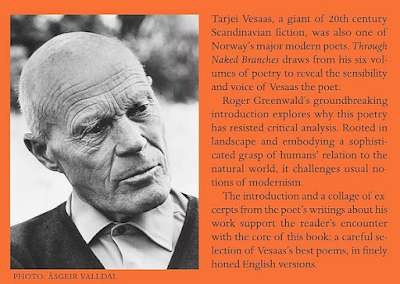
Q & A: Roger Greenwald on Translating Tarjei Vesaas’s “Through Naked Branches” and On Writing and Publishing in the Digital Revolution

This blog posts on Mondays. Fourth Mondays of the month I devote to a Q & A with a fellow writer.

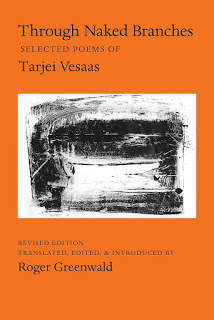
Through Naked Branches: Selected Poems of Tarjei Vesaas, Revised Bilingual Edition, Translated, Edited and Introduced by Roger Greenwald (Boston: Black Widow Press, 2018)

Reading poetry in translation can be like wafting through a door into an eerily beautiful palace. The tiles glow in new colors, shapes are peaked or oval when you expect square, juxtapositions startle, and the cats don’t meow but miau or nya or, as in Norwegian, mjau…  

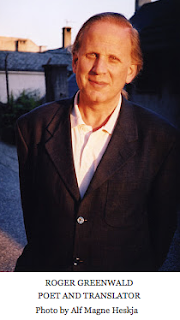
Apropos of the just-published translation from the Norwegian, Through Naked Branches: Selected Poems of Tarjei Vesaas, it is a delight and an honor to post this interview with one of the most accomplished poets and translators working in English today: Roger Greenwald.

C.M. MAYO: How might you describe, in just a sentence or two, the ideal reader for this book?

ROGER GREENWALD: These poems are accessible but deep, and they reflect an unusual sensibility, so anyone who is open to a new experience in poetry is an ideal reader. My introduction explores why this poetry that is easy to “get” is so hard to discuss critically; the essay will be of special interest to people concerned with our relation to the natural world and with ecocriticism.

CMM: What inspired you to translate this work?

RG: Tarjei Vesaas was and is a famous novelist, but his poetry was like a secret shared among other writers and a small number of readers. When I first read his poems, I realized that the best of them were unlike any I had ever read. In addition to his special sensibility, he has a distinctive voice, pace, and turn of phrase, as well as a very fine ear for the music of language. And by the time of his death in 1970, almost none of his poetry was available in English, never mind in versions that did it justice. In some ways it is very difficult to translate. Twenty years passed before I had translated a selection to my satisfaction, and then it took me another eight years (eight drafts) to write my introduction.

CMM: How did you learn the language?

RG: This apparently simple question poses a problem at once: Which language is “the language”?! I first learned Norwegian on my own from a textbook. But Norwegian has two official written norms, and the textbook was about Bokmål, which ultimately derives from Danish and reflects Norway’s urban dialects. Tarjei Vesaas wrote in Nynorsk, which ultimately derives from Old Norse via Norway’s rural dialects. I advanced my knowledge of Bokmål by living in Norway at various times, by doing more reading, and by bothering my friends with a million questions. Dealing with Nynorsk required further study, and I cannot claim to have mastered it even as a reader, so I need more advice and feedback when translating from it than when translating from Bokmål.

CMM: What was the most important challenge for you in this translation?

RG: Vesaas has certain characteristically odd turns of phrase that are difficult or impossible to render in English. They stretch Norwegian but are not un-Norwegian, so they require creative equivalents that stretch English but are not un-English. And of course English cannot be stretched in exactly the same was as Norwegian can be. But the greatest challenge lay in the responsibility I felt to introduce English-speaking readers to this poetry in a way that would help them to see that it was modern even though it was not urban, and that its relation to the natural world was profound and not a throwback to the English Romantic poets.

CMM: Has his work been an influence for your work as a poet?

RG: I think Vesaas’s poetry hasn’t exerted as great an influence on my own poetry as has the work of some other Scandinavian poets, but in one of my poems (“The Milky Way. Big and Beautiful”) I refer to him and quote three lines; and I’d say that in another (“The Voice”), the deliberate pace and the way silence creeps into the stanza breaks probably owe something to Vesaas.

CMM: You have been a consistently productive poet and writer for many years. How has the digital revolution affected your writing? Specifically, has it become more challenging to stay focused with the siren calls of email, texting, blogs, online newspapers and magazines, social media, and such? If so, do you have some tips and tricks you might be able to share? 

RG: I started using computers in the early 1970s to produce files for the literary annual I edited, WRIT Magazine. Coach House Press, where the journal was printed, was a test bed for cutting-edge digital typesetting and layout. I learned enough about computerized editing and typesetting on a UNIX system so that I could take advantage of it for my own work for about twenty years before I acquired my first Windows machine. This was an enormous benefit when it came to revision, especially for translations, and it enabled me to get book manuscripts several stages closer to publication than had been possible earlier. I felt that computers trebled my productivity, not in the sense that I wrote more or translated more, but insofar as they saved large amounts of time and encouraged me to produce finished manuscripts and files that I knew could be used for printing.

That was, you might say, the first digital revolution, the second being that of the Internet and later the World Wide Web. Online resources have made it much easier and faster to answer certain questions that arise in writing and translating, whether these be about language as such, about allusions in texts, or about what a certain landscape, building, or object looks like. Email has greatly facilitated getting advice and feedback from friends and colleagues in distant locations, consulting with authors I’ve translated, and getting proofs from publishers. And the web has made it possible for me to post descriptions of my books, sample poems, and ordering links.

Resisting distraction is really a question of psychology, work habits, and time management. We tend to forget that it was almost as easy to be distracted and to waste time before the Internet existed as it is now. One could read magazines and watch TV for hours a day. Those were, though, less fragmented activities than online distractions can be now, and were less likely to interrupt constantly. I made an early decision to stay off all social media, mainly because of concerns about privacy and distrust of the motives and methods of people like Mr. Green T-shirt. That decision has meant being uninformed about a few events now and then, and it has perhaps reduced my ability to promote my work (how many people would really have followed a Facebook page that posted new material only a few times a year?). But it has prevented most of the woes we all associate with social media, including invasion of privacy, online harassment, and the expense of countless hours on reading and posting.

CMM: Another question apropos of the Digital Revolution. At what point, if any, were you working on paper? Was working on paper necessary for you, or problematic? 

RG: In my formative years, my choice was between handwriting on paper and writing on an electric typewriter. I always used paper then for any work that required real thought and much revision during the writing process. Later I got to the point where I could write letters and reports on the typewriter, and sometimes even fiction when it was driven by a type of nervous energy that was in tune with the hum of the typewriter. Even after decades of using computers, I still write poetry by hand, and I tend to translate poetry by hand also. I can write a first draft of fiction or translated fiction on a computer. Handwritten drafts make it easier to see all the choices one has tried and then crossed out.

CMM: What’s next for you as a poet and as a translator?

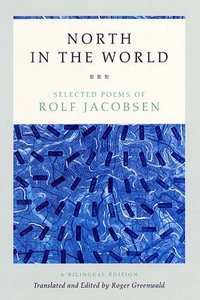
RG: I have more or less withdrawn from translation to focus on my own work (there is one more large translation project that I may or may not get to someday). But I do what I can for my previously published translations, like the Tarjei Vesaas book, which was first published in 2000 and was out of print for many years. Finding a publisher for a new edition enabled me to make revisions – the second time I have been able to revise and/or expand a major selection (on the other occasion the gap was from 1985 to 2002, when the University of Chicago Press issued North in the World: Selected Poems of Rolf Jacobsen). Don’t ask me whether such opportunities are translators’ dreams or nightmares!

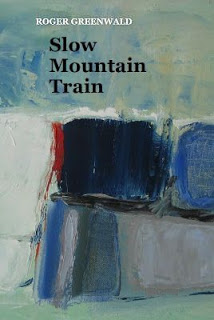
My first book of poems was published in 1993, my second (Slow Mountain Train) in 2015. Now I am hoping to get out my third and fourth books in the next two years. I have manuscripts beyond those and will be working on getting them into near-final form. So get off Facebook and watch my website: www.rogergreenwald.org !

P.S. Click here to read Greenwald’s Q & A for Madam Mayo blog about his translation of Swedish poet Gunnar Harding’s Guarding the Air, from July 2015. See also Greenwald’s lecture for the University of Chicago in its series History and Forms of Lyric.

Q & A: Ellen Cassedy and Yermiyahu Ahron Taub on Translating Blume Lempel’s Oedipus in Brooklyn from the Yiddish

Blast Past Easy: A Permutation Exercise with Clichés

Catamaran Literary Reader and My Translation of 
Mexican Writer Rose Mary Salum’s “The Aunt”

Find out more about C.M. Mayo’s books, shorter works, podcasts, and more at www.cmmayo.com.

Poetic Listing

A much-celebrated poem that amounts to a list– a luminous list– is Robert Pinsky’s “The Shirt.”

How to make a list into something poetic? It helps to be attentive to and creative with diction drops and spikes, repetition, scansion, and alliteration. I’ve already posted on diction and on repetition; in future months look for posts on scansion and alliteration.

Herewith, taken from a few favorite works, are some examples of poetic listing– and to get the most of this, to really hear the poetry, I would suggest that you read these aloud:

#

“During the first days she kept busy thinking about changes in the house. She took the shades off the candlesticks, had new wall-paper put up, the staircase repainted, and seats made in the garden round the sundial; she even inquired how she could get a basin with a jet fountain and fishes.” 
Gustave Flaubert, Madame Bovary

“We eat our supper (cold biscuits, bacon, blackberry jam) and discuss tomorrow. Tomorrow the kind of work I like best begins: buying. Cherries and citron, ginger and vanilla and canned Hawaiian pineapple, rinds and raisins and walnuts and whiskey and oh, so much flour, butter so many eggs, spices, flavorings: why, we’ll need a pony to pull the buggy home.” 
Truman Capote, A Christmas Memory

“Tonight he wished for little things, the chance to take a hot bath, a reasonable suit of clothing, a gift to bring, at the very least some flowers, but then the room tilted slightly in the other direction and he opened up his hands and all of that fell away from him and he wanted nothing.” 
Ann Patchett, Bel Canto

“The carriage was crammed: waves of silk, ribs of three crinolines, billowed, clashed, entwined almost to the heights of their heads; beneath was a tight press of stockings, girls silken slippers, the Princess’s bronze-colored shoes, the Prince’s patent-leather pumps; each suffered from the others feet and could find nowhere to put his own.” 
Guiseppe di Lampedusa, The Leopard

And an example I also used in the post on repetition (money, money, money):

“Tancredi, he considered, had a great future; he would be the standard-bearer of a counter-attack which the nobility, under new trappings, could launch against the social State. To do this he lacked only one thing: money; this Tancredi did not have; none at all. And to get on in politics, now that a name counted less, would require a lot of money: money to buy votes, money to do the electors favors, money for a dazzling style of living…”  
Guiseppe di Lampedusa, The Leopard

#

To take this further, as you are reading whatever you happen to be reading, note in your notebook whenever you find, in your view, any especially apt use of poetic listing. (>>More on reading as a writer here.)

P.S. Help yourself to many more resources for writers on my workshop page.

Poetic Repetition

Grokking Plot: The Elegant Example of Bread and Jam for Frances

Q & A: Amy Hale Auker, Author of Ordinary Skin: Essays from Willow Springs

Find out more about C.M. Mayo’s books, shorter works, podcasts, and more at www.cmmayo.com.


Working with a Working Library: Kuddelmuddel

This blog posts every Monday. Starting this year, every fourth Monday, except when not, is a Q & A with another writer. This week not.

As you dear, faithful, writerly readers know, I have been at work on the Far West Texas book. One of the individuals who appears and reappears throughout the narrative is Lt. John Bigelow, Jr. An officer in the Tenth U.S. Cavalry in the late 19th century, Bigelow had an illustrious father and his own impressive body of work in military strategy and tactics, in many ways anticipating the industrial-level wars of the twentieth century. So, having done a small Himalaya of reading on those Bigelows and the Tenth Cavalry, last fall at the conference at the Center for Big Bend Studies, I presented a paper on Lt. Bigelow, expecting to polish it up into publishable form lickety-split. Ha! It’s still not finished, but at least the draft is, and I submitted it. Wish me luck.

In the meantime, herewith, a few lessons learned about working with a working library.

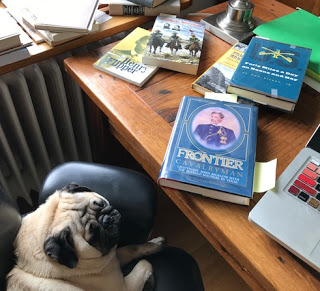
I’m several decades and several published books down the pike now that I pause here, en blog, to confess that I never fully appreciated what was involved with writing a book that necessitated a working library. I just sort of accumulated whatever books I needed, or thought I might need, willynilly, clearing bookshelf space, catch as catch can. Things got rather pile-y, shall we say, and sometimes I wasted good working mornings just hunting for things. I never fully appreciated how unwieldly  some of these working libraries can grow– and grow as, in many cases, they rightfully must.

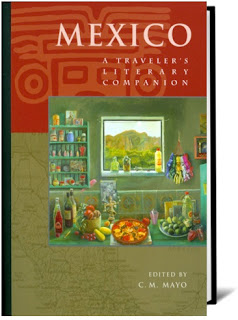
Some of my working libraries took up only a few shelves, for example, the reading for my anthology Mexico: A Traveler’s Literary Companion. The one for my Baja California book, Miraculous Air, took up an entire wall, floor to ceiling, and the working library for my novel on Mexico’s Second Empire almost twice as much space. Ditto my recent book on Madero and metaphysical religion. And… drumroll… most especially the one I am using now on Far West Texas. The Texasbibliothek, as I call it, now hogs and camels and elephants and Macktrucks an entire room.

You may wonder, why can’t I just borrow books from my local library? Answer, Part I: I don’t have a relevant library nearby. Part II: When I am writing I often need to have several different books at-hand; many libraries will not lend out so many books at once, nor bring out so many volumes to a reading room. (But yes, I have consulted books in libraries, and in archival collections.) As I worked on that Baja California book, the Second Empire novel, and the one on the Mexican Revolution, I often had five or ten or even as many as, say, fifteen books open on my desk… such is the Kuddelmuddel of my process.

So… for the types of books I was and am writing, this means having a budget– a realistic budget– for buying books. University press hardcovers can be, ouch. To save money, many a time I bought an ex-library edition off of www.abebooks.com— which for used books is, in my experience, more reliable than amazon or ebay.  And for collectible editions, I would advise steering way clear of amazon and ebay because all sorts of sellers on there have no clue what a first edition is or how to accurately describe a book’s condition. Again, abebooks.com is good and better yet sellers who are members in good standing of the Antiquarian Booksellers Association of America. An occupational danger is that you can get a jones for collecting, and start buying first editions. But that’s another blog post. I used to buy Italian shoes, let me put it that way.

As for organizing these working libraries, I posted previously about that here.  Indeed, I got this current working library, my Texasbibliothek, into such superb shape that, as I was pulling out various titles for this paper on Lt. Bigelow, I had a little fiesta of self-congratulation every single time. 

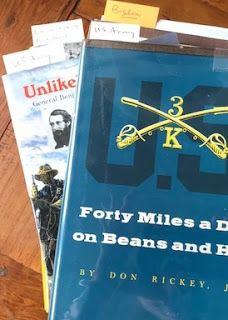
And reshelving the books? Something I do now with this Texasbibliothek that I have never done before– and I am shaking my head that it had not occurred to me sooner– is to tuck into each book a bookmark with its category.

UPDATE: See my November 11, 2019 post “A Working Library” for more about using bookmarks. My technique has advanced!

Making individual bookmarks with the categories noted might seem more trouble than it’s worth, but the challenge is, many books could go into more than one category, and if I have to remember or decide anew which one it is each time I reshelve it, well…. then… unshelved books tend to start piling up and sprawling into big, giant, King-Kong-scale Kuddelmuddel! 

Decluttering? Indeed I do declutter. However, for some subjects, as in these working libraries, the collections in themselves have significant cultural / scholarly value; they should not be broken up. One day I will find them a good home.

What is Kuddelmuddel? 

Not to be confused with Kugel Mugel.

Q & A: Lynn Downey “Research Must Serve the Writer, Not the Other Way Around”

On Writing About Mexico: Secrets and Surprises

This Writer’s Distraction Free Smartphone (Plus an App Evaluation Flowchart to Tailor-Make Your Own)

Find out more about C.M. Mayo’s books, shorter works, podcasts, and more at www.cmmayo.com.


Poetic Repetition

As of this year, 2018, the second Monday of the month is dedicated to my writing workshop students and anyone else interested in creative writing.

Unintentional repetition of a word or phrase in your writing is rather like going out the door with another sweater clinging to the back of your sweater — uh, dorky. Or smiling wide– with a piece of spinach stuck between your front teeth. It’s the sort of thing we all do on occasion, and that is why we need to revise, revise, revise.

Intentional repetition on the other hand, can bring in the bongo-drums of musicality! Here are some examples of this powerful poetic technique:

#

“Man lives in the flicker, Man lives in the flicker.”
— Mark Slade, “The New Metamorphosis” Mosaic 8 (1975), quoted in Marshal McLuhan, “Man and Media,” transcript of a talk delivered in 1979, in Understanding Me: Lectures and Interviews (MIT Press, 2005).

“Wanting to be read, wanting the recognition, whether its Jacqueline Susan-style, all glitz and limos, or sweeping the gland slam of literary events, is not a crime.”
— Betsy Lerner, The Forest for the Trees

“You have also never said one word about my poor little Highland book my only book. I had hoped that you and Fritz would have liked it.”
— Queen Victoria (letter to her daughter, 23/12/1865)

“Tancredi, he considered, had a great future; he would be the standard-bearer of a counter-attack which the nobility, under new trappings, could launch against the social State. To do this he lacked only one thing: money; this Tancredi did not have; none at all. And to get on in politics, now that a name counted less, would require a lot of money: money to buy votes, money to do the electors favors, money for a dazzling style of living…”
— Guiseppe di Lampedusa, The Leopard

“I saw Master Kelley put of the base metal into the crucible, and after it was set a little upon the fire, and a very small quantity of the medicine put in, and stirred with a stick of wood, it came forth in great proportion perfect gold, to the touch, to the hammer, to the test.”
—Edward Dyer, quoted in Patrick Harpur, The Philosopher’s Secret Fire

#

In a previous post I talked about reading as a writer. One thing to notice as you read is where the author repeats a word or phrase– if you judge it effective.

P.S. Oodles of free resources for creative writers on my workshop page, including “Giant Golden Buddha” & 364 more free 5 minute writing exercises.

Diction Drops and Spikes

This Writer’s Distraction Free Smartphone (Plus an App Evaluation Flowchart to Tailor-Make Your Own)

Q & A: Ellen Cassedy and Yermiyahu Ahron Taub on Translating Blume Lempel’s Oedipus in Brooklyn from the Yiddish

Find out more about C.M. Mayo’s books, shorter works, podcasts, and more at www.cmmayo.com.


Diction Drops and Spikes

This blog posts on Mondays. Second Mondays of the month I devote to my writing workshop students and anyone else interested in creative writing. Welcome!

> For the archive of workshop posts click here.

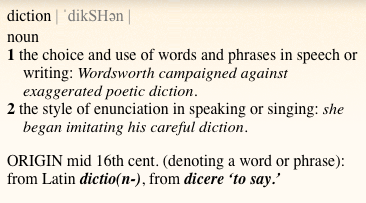
Thanks to the Battle of Hastings of 1066! Because it is a blend of languages, mainly Anglo-Saxon and Norman French, English offers unusual facility for diction drops and spikes, and you, dear writerly reader, if you care to dare, can employ these for a richly dazzling array of effects. Irony, comedy, sarcasm, intimacy, poignancy, revelation, poetry, punch, sass, shock… it’s a long list and I’m sure that you can make it longer.

Here, taken from a few favorite books and blogs, are some examples of diction spikes– that is, a sudden rise in the level of formality of vocabulary and syntax (wherein it all gets very elliptically Latinate)– and drops– gettin’ funky with the grammar and using short, sharp words.

See if you can spot the spikes and drops. I separate them out for you below the quotes.

#

“What then, does one do with one’s justified anger? Miss Manners’ meager arsenal consists only of the withering look, the insistent and repeated request, the cold voice, the report up the chain of command and the tilted nose. They generally work. When they fail, she has the ability to dismiss inferior behavior from her mind as coming from inferior people. You will perhaps point out that she will never know the joy of delivering a well-deserved sock in the chops. True– but she will never inspire one, either.”

— Judith Martin, Miss Manners’ Guide to Excruciatingly Correct Behavior

SPIKE: “What then, does one do with one’s justified anger? Miss Manners’ meager arsenal consists only of the withering look, the insistent and repeated request, the cold voice, the report up the chain of command and the tilted nose.”

DROP : “sock in the chops”

#

“Department of Transportation engineers explained that aluminum highway signs bore a chemical film which kept them from oxidizing. And that the film over time formed a halo effect, a light-purple tinge which migrated to stress points on the metals’ surface. The regional maintentance engineer didn’t think the sign looked a bit like the Virgin, by the way. You must of had to use your imagination. Though maybe, he admitted, he was unenlightened. The manager of the plant that supplied the aluminum sheets assured everyone that they weren’t treated by monks or anything. It was done by a bunch of folks in Alabama.”

— Philip Garrison, “La Reconquisita of the Inland Empire”

SPIKE: “Department of Transportation engineers explained that aluminum highway signs bore a chemical film which kept them from oxidizing. And that the film over time formed a halo effect, a light-purple tinge which migrated to stress points on the metals’ surface.”

DROP:  “…didn’t think the sign looked a bit like the Virgin, by the way. You must of had to use your imagination…”

SPIKE:  “The manager of the plant that supplied the aluminum sheets assured everyone…”

DROP: “…they weren’t treated by monks or anything. It was done by a bunch of folks in Alabama.”

#

“As I thought about composing a new blog post over the past couple of weeks, I resisted the idea of writing about wildfire, even as the topic claimed a growing share of mind day after day. For one thing, I’ve touched the subject before. For another, yet another blog bemoaning the lack of precipitation seemed tiresome. Plus, well, geez: fires are such a downer.”

— Andrea Jones, “Out of the Background” in “Between Urban and Wild” blog, July 4, 2018

SPIKE:  “…bemoaning the lack of precipitation seemed tiresome.”

DROP: “Plus, well, geez: fires are such a downer.”

#

“When I was a young man in the 1970s, New York was on its ass. Bankrupt. President Gerald Ford told panhandling Mayor Abe Beame to ‘drop dead.’ Nothing was being cared for. The subway cars were so grafitti-splattered you could hardly find the doors or see out the windows. Times Square was like the place Pinocchio grew donkey ears. Muggers lurked in the shadows of Bonwit Teller on 57th and Fifth. These were the climax years of the post-war (WWII) diaspora to the suburbs. The middle class had been moving out of the city for three decades leaving behind the lame, the halt, the feckless, the clueless, and the obdurate ‘risk oblivious’ cohort of artsy bohemians for whom the blandishments of suburbia were a no-go state of mind. New York seemed done for.”

— James Howard Kunstler, “The Future of the City”

DROP: “…New York was on its ass.”

DROP: “drop dead.”

SPIKE: “These were the climax years of the post-war (WWII) diaspora to the suburbs. The middle class had been moving out of the city for three decades leaving behind the lame, the halt, the feckless, the clueless, and the obdurate ‘risk oblivious’ cohort of artsy bohemians for whom the blandishments of suburbia were a no-go state of mind.”

DROP: “New York seemed done for.”

#

P.S. More resources for writers on my workshop page, including “Giant Golden Buddha” and 364 More Five Minute Writing Exercises.

Virginia Tufte’s Artful Sentences: Syntax As Style

Grokking Plot: The Elegant Example of Bread and Jam for Frances

Email Ninjerie in the Theater of Space-Time

Find out more about C.M. Mayo’s books, shorter works, podcasts, and more at www.cmmayo.com.


Q & A: Lynn Downey, “Research Must Serve the Writer, Not the Other Way Around”

Starting this year, every fourth Monday I post a Q & A with a fellow writer. This month’s Q & A is with Lynn Downey, my fellow Women Writing the West member, apropos of the news that her book Life in a Lung Resort will be published next year by University of Oklahoma Press.

Lynn Downey is a widely-published historian of the West, with degrees in history and library science from San Francisco State University and the University of California, Berkeley. She has published books and articles on the history of jeans, the treatment of tuberculosis in California, American art pottery, and the history of Arizona. She was the Historian for Levi Strauss & Co. in San Francisco for twenty-five years. Her biography of the company’s founder, Levi Strauss: The Man Who Gave Blue Jeans to the World,was published by the University of Massachusetts Press in 2016, and won the 2017 Foreword Reviews silver INDIE award for Biography. Her next book, Life in a Lung Resort, is the history of an early 20th century women’s tuberculosis sanatorium in California where her grandmother received treatment in the 1920s.  In 2012 Lynn received a Charles Donald O’Malley Short-Term Research Fellowship from the Special Collections Division of the David Geffen School of Medicine at the University of California, Los Angeles, where she studied the history of tuberculosis treatment. Lynn now works as a historical/archival consultant and exhibition writer, and is also a board member of the Frank Lloyd Wright Marin County Civic Center Conservancy. She lives in Sonoma County, California. 

C.M. MAYO: On organizing research: Any lessons learned from your previous book? And lessons learned from this one? Also, are there basic mistakes first time writers oftentimes make in organizing their research? 

LYNN DOWNEY: Organizing research materials — whether for fiction or non-fiction — is a very personal thing. And I think it depends on your life and educational experience. I’m 63 years old, and I loved researching and writing history from my very first term paper in the 5th grade. I’m also an archivist, so I like to keep paper files for the most part, and that has worked for me on all the books I’ve written. 

My last book, Levi Strauss: The Man Who Gave Blue Jeans to the World, posed the greatest challenge because it was the longest and most detailed book I’ve ever written. I used to organize my research materials by chapter– just throw all notes, copies of articles, etc. into files by chapter. But that ended up being cumbersome. So I started keeping files by subject or topic, and also kept a running list of what topics would go into each chapter. I could then put my hands on a subject easily. 

But again, when it comes to research, I don’t know of anything first time writers could do that would be called a “mistake.” The best way to organize research is to find what works for you. That might mean doing down a few paths that lead nowhere — like I did — but as long as you find a method that helps you write, that’s the important thing. Research must serve the writer, not the other way around. 

C.M. MAYO: On research files: What happens to them when you are finished with the book? How do you store them? Do you give them to an archive? (Do you have any related advice for other writers with books that required significant original research?) 

LYNN DOWNEY: I keep my research materials for quite awhile after a book is published, because I sometimes need them again: for interviews, for follow-up articles, etc. All of my files for the Levi Strauss biography will go back to the company eventually. I was the Levi Strauss & Co. Historian for 25 years and did all of my research while I was on the job. I wrote the book after I retired but the materials actually belong to the company and they will go back there once I have a moment to throw them in my car and take them to San Francisco. Once I no longer need the research files I used for my book A Short History of Sonoma I will give them to the Sonoma Valley Historical Society. My advice is to not jettison your files too quickly after you finish a book. They can still come in handy.  

C.M. MAYO: What were some of the more interesting books you read in the process of writing your book? (And would you recommend them?) 

LYNN DOWNEY: My book is a history of the Arequipa tuberculosis sanatorium for women in northern California, where my grandmother was treated in the 1920s. It was in business from 1911-1957. In addition to doing a number of oral history interviews with former patients, I read a lot of books about the history of TB treatment, how a cure was finally found, and about San Francisco history. The sanatorium’s founder was a male doctor named Philip King Brown but his mother was Dr. Charlotte Brown, one of San Francisco’s first female surgeons. She taught him to value women’s health, and most of the doctors who treated the patients at Arequipa were women. I did read some extraordinary books to prepare to write. 

A Rare Romance in Medicine: The Life and Legacy of Edward Livingston Trudeau, by Mary Hotaling, is a great biography of the man who pioneered sanatorium treatment for tuberculosis. Sympathy and Science: Women Physicians in American Medicine by Regina Morantz-Sanchez is a fascinating look at how hard it was for women to break into medicine. Sheila M. Rothman’s Living in the Shadow of Death: Tuberculosis and the Social Experience of Illness in American History was a true grounding in the topic. I recommend all of these books to anyone interested in the history of medicine.  

C.M. MAYO: Can you talk about your working library? 

LYNN DOWNEY: I have a bookcase in my office where I keep all the books needed for my current project. Sometimes I have to pile them on the floor too, but at least they are all in one place! When I finish a project they get moved to one of the five other bookcases I have in my house, and the books for the next project go into my office. I also have filing cabinets in my office for my working files: the subject files I mentioned earlier. Sometimes I have more than will fit in the cabinet and that means I have banker’s boxes on the floor, too.  

C.M. MAYO: You have been a consistently productive writer for many years. How has the digital revolution affected your writing? Specifically, has it become more challenging to stay focused with the siren calls of email, texting, blogs, online newspapers and magazines, Facebook, Twitter, and such? If so, do you have some tips and tricks you might be able to share? 

LYNN DOWNEY: The best thing about the digital revolution for a historian like me is the availability of historic newspapers online. Sites like Newspapers.com, Genealogybank.com, and the Library of Congress Chronicling America site have fully searchable databases. These are the only places that have a “siren call” for me. I have spent many hours in my pajamas in front of my computer following a research rabbit hole on these sites! 

The other digital distractions really don’t get to me. Maybe it’s because I’m older and did not grow up with the instant availability of communication and information that we have now. After years of doing research and writing I am able to focus easily and not get distracted. I really don’t know how to advise someone how to do that, though. Like research, finding a method to stay on track is very personal. Some people I know keep a timer by their computer, and they can’t check email or social media until they hear the bell after an hour is up. 

There’s no single fix for what society throws at us, and what society expects us to do. Which I think is part of the problem. We’re supposed to be constantly checking up on everyone who wants to communicate with us. But my work and my time are important. I’ll check email now and then while I’m working, and if there are no emergencies I go back to what I’ve been working on. 

The joy of research, of writing, of getting the best words on the page far outweighs the need to have a constant connection in cyberspace.  

C.M. MAYO: Did you experience any blocks while writing this book, and if so, how did you break through them? 

LYNN DOWNEY: Honestly, I don’t really get blocks. That was especially true with Life in a Lung Resort because it’s a personal and family story as well as a work of history. I spent decades working full-time and commuting and only had weekends to do my writing. Blocks were not an option, and they also just didn’t arise. I was so happy to be at my desk working on projects I loved.

C.M. MAYO: Back to a digital question. At what point, if any, were you working on paper? Was working on paper necessary for you, or problematic? 

LYNN DOWNEY: Do you mean writing longhand instead of on the computer? I did both with this book as well as all my others. Sometimes when I couldn’t get a topic to gel while writing on my laptop, I would switch to a pen and paper. This uses a completely different part of the brain and it always works. Once I was really stuck trying to get a difficult chapter started. I live 20 minutes from the ranch where writer Jack London lived (it’s now a State Park). So I went to the ranch, sat on a picnic table near London’s house, took out a pad of paper and a pen and started to write. Forty-five minutes later I had my chapter opening and a good start on the rest of it. 

I also collect vintage typewriters and I have one that I use now and then; again, to work another part of my brain to keep my writing from going stale.  

C.M. MAYO: Do you keep in active touch with your readers? If so, do you prefer hearing from them by email, sending a newsletter, a conversation via social media, some combination, or snail mail? 

LYNN DOWNEY: I haven’t yet found a good way to keep in touch with readers, but I give a lot of lectures about my books and often keep in touch with people who have come to hear me speak. I am working with my website designer to make it easier for people to communicate with me, and I hope to do more when Life in a Lung Resort comes out. I am happy to hear from readers any way they like: email, social media, whatever.

C.M. MAYO: What enticed you to join Women Writing the West?

LYNN DOWNEY: Women are often seen as the second-class-citizens of western writing, whether fiction or non-fiction. The West is so often portrayed as a male domain but women have so much to say about this region! When I heard about Women Writing the West I joined up right away. We have to stake our claim here, girls.  

Q & A: Sara Mansfield Taber on Chance Particulars: A Writer’s Field Notebook

Find out more about C.M. Mayo’s books, shorter works, podcasts, and more at www.cmmayo.com.

Jaron Lanier’s “Ten Arguments for Deleting Your Social Media Accounts Right Now”

As of this year, the second Monday of the month is dedicated to my workshop students and anyone else interested in creative writing.

If you know who Jaron Lanier is you will understand why he, and probably only he, can get away with such a title for a commercially published book, a title that most people today, and that would include writers with books to promote, would consider hoot-out-loud humbug.

But perhaps they would not if they more fully understood the perverse and toxic nature of the machine Lanier terms BUMMER.

BUMMER = Behaviors of Users Modified, and Made Into an Empire for Rent

Writes Lanier:

“BUMMER is a machine, a statistical machine that lives in the computing clouds. To review, phenomena that are statistical and fuzzy are nevertheless real.”

And more:

“The more specifically we can draw a line around a problem, the more solvable that problem becomes. Here I have put forward a hypothesis that our problem is not the Internet, smartphones, smart speakers, or the art of algorithms. Instead, the problem that has made the world so dark and crazy lately is the BUMMER machine, and the core of the BUMMER machine is not a technology, exactly, but a style of business plan that spews out perverse incentives and corrupts people.”

BUMMER sounds like science fiction. But alas, as Lanier explains, the business plan behind social media, and the use of proprietary algorithms to hook users into addiction and subtly distort and shape interactions among users, is both real and seriously icky. You’ve probably read or heard something about FaceBook’s shenanigans, but in Lanier’s Ten Arguments you’re getting a far broader, more detailed analysis and argument, in a wierdly charming package, and not from some random TED pundit, but from one of the fathers of the industrial-cultural complex now known as Silicon Valley.

As Jaron Lanier states in his acknowledgements, the title Ten Arguments For Deleting Your Social Media Accounts Right Now is inspired by Jerry Mander’s Four Arguments for the Elimination of Television. I, too, consider Mander’s Four Arguments for the Elimination of Television a personal inspiration and a masterpiece. 

Call me a pessimist: I doubt that Lanier’s book will have any more influence on the general public’s social media habits than did Mander’s on television watching, which came out in the late 1970s. But perhaps such works may assist you in marshaling your attentional power for your creative endeavors, as they did for me, and for this reason I enthusiastically recommend them to you, dear writerly readers.

Carpe diem.

BUT BY THE WAY…

I have not deleted my social media accounts. What I have done is deactivate FaceBook (back in 2015), abandon Twitter (totally, 2021) and now only very rarely participate on LinkedIn and academia.edu, mainly to announce a publication. While I agree with Lanier’s argument that social media is perverse and and toxic, and I sincerely wish that I had never signed up for FB and Twitter in the first place, the fact is, I did, and because of that existing online record and username, I am not ready to hit the delete button. Moreover, I am still digesting some parts of his argument (in particular, I do not accept his hypothesis that the problem is merely what he terms BUMMER).

And, yes, I know, this blog, on the Google platform, blogger, belongs to BUMMER. A better and paid platform is on my to-do list. [UPDATE January 2019: Here at last this blog is on self-hosted WordPress at www.madam-mayo.com]

As for using Google search– definitively BUMMER– I switched to Duckduckgo as my go-to search engine a good while ago.

What’s the specific strategy that would be right for you? I would not presume to say.

But what is clear— and we don’t need Mr Lanier to inform us on this simple point— is that if you want to write anything substantive, and you don’t have the abracadabradocity to summon up more than 24 hours in each day, social media can be a lethal time-suck. The years will scroll by, as it were… and funny how that is, though you Tweet #amwriting often enough, you never wrote what you planned to write…

What’s more, the visibility you can achieve with social media, and the sense of “community,” albeit intermediated by proprietary algorithms of a corportation, are Faustian bargains: you will pay in the end, and on many levels.

P.S. For those who have the inclination and/or sufficient cootie-proofing to handle esoterica, I can also recommend philosopher Jeremy Naydler’s splendidly researched and elegantly argued In the Shadow of the Machine: The Prehistory of the Computer and the Evolution of Consciousness— also just published. You might find it worthwhile to keep in mind, if you read In the Shadow of the Machine, that in his Ten Arguments Jaron Lanier mentions (oh so briefly, blink and you’ll miss it) Waldorf schools. (More about that connection here.)

It Can Be Done! This Writer’s Distraction Free Smartphone
(Plus an App Evaluation App to Tailor Make Your Own)

Notes on Stephen L. Talbott’s The Future Does Not Compute

Great Power in One: Miss Charles Emily Wilson

Find out more about C.M. Mayo’s books, shorter works, podcasts, and more at www.cmmayo.com.