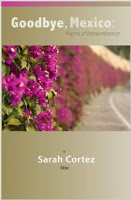
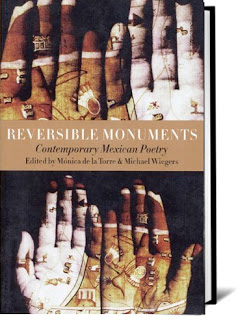
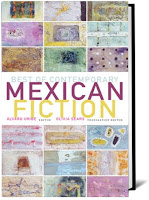
Sparkling sky and only a jeans jacket on the night before Halloween, University of Arizona students everywhere, in witches’ hats and zombie makeup: that’s how it was in Tucson when, as part of the American Literary Translators Conference “Café Latino” bilingual reading fiesta at Café Passé in Tucson, I read my translation, together with the Spanish original, of Mexican poet Agustín Cadena’s poem “Café San Martín.” That translation appears in poet Sarah Cortez’s recent anthology, Goodbye Mexico (Texas Tech Press).
Alas, Cadena could not be in Tucson because he lives in Hungary, where he teaches Latin American Literary in Debrecen. Follow his blog, El vino y la hiel.
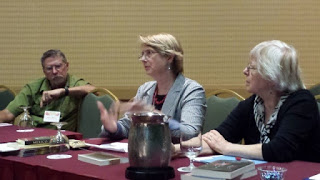
Cadena’s name and many works — he is incredibly prolific and writes in almost every genre–were mentioned many times over the course of this year’s ALTA conference. My dear amiga Patricia Dubrava, who also translates Cadena’s poems and short fiction, shared a panel with me on the following day.
And a very special thank you to Alexis Levitin, my favorite Portuguese translator (and, by the way, editor of Brazil: A Traveler’s Literary Companion), who organized and MC’ed the reading.
In the audience: several very distinguished literary translators (lotus petals upon y’all). The Q & A was extra crunchy, and in true ALTA fashion, in the sweetest way.
(Seriously, literary translators, and especially the crowd that regularly attends ALTA conferences, are angelically generous and encouraging. If any of you reading this have ever thought of trying literary translation and/or attending a literary translator’s conference, my recommendation is, YES!)
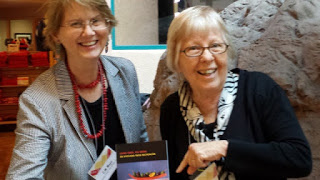
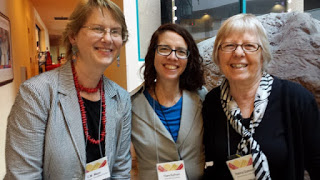
LAS TRES AMIGAS: Yours Truly, Clare Sullivan, and Patricia Dubrava.
Jeffrey C. Barnett, C.M. Mayo, Patricia Dubrava
Transcript of C.M. Mayo’s Remarks for the panel on
Translating Contemporary Latin American Poets and Writers: Embracing, Resisting, Escaping the Magnetic Pull of the Capital
ALTA, Tucson, Arizona, October 31, 2015
I started translating in Mexico City in the early 1990s. Mexico City is Mexico’s capital, but it’s not analogous to Washington DC or, say, Ottowa, Canada. The megalopolis, “the endless city,” as Carlos Monsivaís calls Mexico City, is like Washington DC, New York, Boston, Chicago, Miami and Los Angeles, all piled into one. In other words, its the political capital, financial capital, publishing capital, cultural capital, and television and movie capital. Oh, and business capital, too. Yes, there are other important cities in Mexico, and they have become more important in many ways, and some of them have some excellent writers and poets. But Mexico City is MEXICO CITY.
Back in the early 1990s, the ruling party, the PRI or Partido Revolucionario Institucional or Institutional Revolutionary Party was in power, about to enter the last decade of its more than 70— yes, 70—years in power. How did it last so long? There are many answers to that question but the main one relevant for our topic at hand is that the PRI attempted to bring everyone, whether farmers, campesinos, industrialists or intellectuals, and that would include poets and writers, under its own big tent. It had its ways. Stick and carrot— or bone, as Mexicans like to say.
You may be aware that after two consecutive presidential administrations under the PAN or the Partido Acción Nacional, over the past decade, Mexico’s Presidency has since returned to the PRI. But it’s not exactly a return to the past. Not exactly.
I’m not going to get all political on you, I simply want to underline the fact that back in early 1990s, the Mexican literary establishment, concentrated in Mexico City, was heavily influenced by and subsidized by the PRI government. Just to give you a notion of this: If you were to go into a library and look at some back issues of the leading Mexican literary and intellectual magazine of the time— of course that would be Octavio’s Paz’s Vuelta— you would see a large number of advertisements from government-owned entities and Televisa, the party-allied television conglomerate. There were literary gatekeepers, as there are everywhere in this world, but in Mexico City at that time, they were very few and ginormously powerful. Octavio Paz was king.
Though Octavio Paz met his maker some years ago, in some ways things remain the same. Mexico City is where it’s at. The government still plays an important, although lesser role. Letras Libres, successor to Vuelta, remains a leading magazine of influence, and in fact it does publish some of the best writing you’ll find anywhere.
But since the early 1990s there have been political and economic sea-changes in Mexico. Power is more dispersed. Other political parties have become far more powerful. On the right and the left they rival the PRI and on many an occasion, beat the PRI at the ballot box.
And even more than the political and economic changes, the technological changes have been sea-changes. I’m talking about the rise of digital media, from blogging to YouTube, podcasting, Tweeting, FaceBooking, and publishing— and by the way, amazon is now in Mexico with www.amazon.com.mx.
To find a Mexican writer to translate, you no longer have to travel to Mexico City and get chummy with the powers that be who can make recommendations and, perhaps, invite the anointed to tea. Now, say, from Boston or Hong Kong or Cleveland, you can follow any given Mexican writer’s blog, and comment thereupon. Or, say, send her a Tweet!
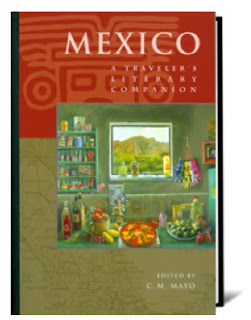
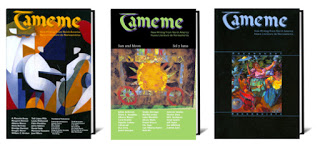
I would love to tell you the story of how, in the late 1990s, I started my bilingual magazine, Tameme, which published many Mexican writers, and my experiences with putting together the anthology, Mexico: A Traveler’s Literary Companion— no easy task, since the idea of the TLC series is to provide writing about the whole country— and that would include writing from and about Baja California, Yucatan, Chiapas, Chihuahua…
At present I am translating short stories by four Mexican writers: Ignacio Solares, a novelist born in Ciudad Juárez, long based in Mexico City; Agustín Cadena, who was born in the state of Hidalgo and is living in Hungary; Araceli Ardón, who was born in San Miguel de Allende and lives in Querétaro; and yet another, Rose Mary Salum, who is from Mexico City and is now based in Houston, Texas.
But I don’t want to take time from my fellow panelists and what I hope will be a rich question and answer session. The main thing I want to emphasize is that, as literary translators, we can play a powerful role in influencing who is and who is not read in English.
Whom to translate? It’s good to ask for advice from the powers that be of the literary establishment in, say, Mexico or Cuba or Chile, and maybe even choose to translate one of them. They might be blast-your-wig-to-the-asteroid-belt fabulous! But we also have to recognize that there are power structures in literary communities, some of them entangled with political structures, and we need to acknowledge and examine, in our own minds, and our own hearts, what part we play in that or choose not to play. And why.
Remote as they are, the Lower Pecos Canyonlands of the US-Mexico border have a strangely magnetic pull. That may sound like a wild assertion, but the evidence comprises over 200 shamanistic rock art sites, many of them thousands of years old, and the fact that dozens of rock art enthusiasts, including myself, find themselves returning again and again.
It was on a meltingly hot August day in 2014 that I made my first foray into the canyonlands for the Rock Art Foundation’s visit to Meyers Spring. A speck of an oasis tucked into the vast desert just west of the Pecos, Meyers Spring’s limestone overhang is vibrant with petrographs, both ancient, but very faded, and of Plains Indians works including a brave on a galloping horse, an eagle, a sun, and what appears to be a missionary and his church.
I took home the realization that with Meyers Spring I had taken one nibble of the richest of banquets. In addition the rock art of the Plains Indians—Apaches and Comanches— of historic times, the Lower Pecos Canyonlands are filled with prehistoric art, principally Pecos River, Red Linear, and Red Monochrome. Of the three, Pecos River is comparable to the best known Paleolithic rock in the world, the caves of Lascaux in France.
I would have to return to the canyonlands— alas for my book’s time and travel budget! Not that the Rock Art Foundation charges more than a nominal sum for its tours. The individual tour to Meyers Spring, which lasted four hours, cost a mere 30 dollars. Everyone involved, including the guides, works for the foundation for free.
By December of 2014 I was back for another Rock Art Foundation tour, this one down into Eagle Nest Canyon in Langtry. Apart from rock shelters with their ancient and badly faded petrographs, cooking debris, tools, and even a mummy of a woman who—scientists have determined— died of chagas, Eagle Nest Canyon is the site of Bonfire Shelter, the earliest and the second biggest bison jump, after Canada’s Head Bashed-In, in North America. Some 10,000 years ago hunters drove hundreds of prehistoric bison—larger than today’s bison—over the cliff. And in 800 BC, hunters drove a herd of modern bison over the same cliff, so many animals that the decaying mass of unbutchered and partially butchered carcasses spontaneously combusted. In deeper layers dated to 14,000 years, archaeologists have found bones of camel, horse, and mammoth, among other megafauna of the Pleistocene.
DESCENT INTO EAGLE NEST CANYON, DECEMBER 2014
Then in the spring of this year I visited the Lewis Canyon site on the shore of the Pecos, with its mesmerizing petroglyphs of bear claws, atlatls, and stars, and, behind a morass of boulders, an agate mirror of a tinaja encircled by petrographs.
LEWIS CANYON PETROGLYPHS, MAY 2015
LEWIS CANYON TINAJA SITE WITH PETROGRAPHS, BY THE PECOS RIVER, MAY 2015
Not all but most of the Lower Pecos Canyonland rock art sites— and this includes Meyers Spring, Eagle Nest Canyon and Lewis Canyon— are on private property. Furthermore, visits to Meyers Spring, Lewis Canyon, and many other sites require a high clearance vehicle for a tire-whumping, paint-scraping, bone-jarring drive in. So I was beginning to appreciate the magnitude of the privilege it is to visit these sites. At Lewis Canyon, as I stood on the limestone shore of the sparkling Pecos in utter silence but for the crunch of the boots of my fellow tour members, I learned that less than 50 people a year venture to float down its length.
This October I once again traveled to the Lower Pecos, this time for the Rock Art Foundation’s annual three day Rock Art Rendezvous. Offered this year were the three sites I had already visited, plus a delectable menu that included White Shaman, Fate Bell, and—not for those prone to vertigo— Curly Tail Panther.
WHITE SHAMAN, OCTOBER 2015
Just off Highway 90 near its Pecos River crossing, the White Shaman Preserve serves as the headquarters for Rock Art Rendezvous. After a winding drive on dirt road, I parked near the shade structure. From there, the White Shaman rock art site was a brief but rugged hike down one side of cactus-studded canyon, then up the other. I was glad to have brought a hiking pole and leather gloves. No knee surgery on the horizon, either. When I arrived at White Shaman, named after the central luminous figure, the sun was low in the sky, bathing the shelter’s wall and its reddish drawings in gold and turning the Pecos, far below, where an occasional truck droned by, deep silver.
The next morning, at the Rock Art Foundation’s tour of the Shumla Archaeological and Research Center in nearby Comstock, I heard Dr. Carolyn Boyd’s stunning talk about her book, The White Shaman Mural: An Enduring Creation Narrative in the Rock Art of the Lower Pecos, which is forthcoming in 2016 from University of Texas Press. Dr. Boyd, whose work is based on 25 years of archaeological research in the Lower Pecos and a meticulous study of Mexican anthropology, argues that White Shaman, which is many thousands of years old, may represent the oldest known creation story in North America.
FATE BELL, OCTOBER 2015
From the White Shaman Preserve, Fate Bell is a few minutes down highway 90 in Seminole Canyon State Park. More than any other site, this shelter in the cake-like layers of the limestone walls of a canyon, reminded me of the cave art I had seen in Baja California’s Sierra de San Francisco. Inhabited on and off for some 9,000 years, Fate Bell is the largest site in the Lower Pecos Canyonlands. It has various styles of petrograph, including a spectacular group of anthropomorphs with what appear to be antlers and wings.
CURLY TAIL PANTHER, OCTOBER 2015
Curly Tail Panther is a scoop of a cave about the size of a walk-in closet, but as if for Superman to whoosh in, set dizzyingly high on a cliff-side overlooking the Devils River. The back wall has an array of petrographs: red mountain lion, anthropomorphic figures, and geometric designs. The only access to Curly Tail Panther is by way of a narrow ledge. Drop your hiking pole or your sunglasses from here, and you won’t see them again. You might lose a character, too—in the opening of Mary Black’s novel, Peyote Fire, a shaman stumbles to his death from this very ledge. The Rock Art Foundation’s website made it clear, Curly Tail Panther is not for anyone who has a fear of heights. But who doesn’t? My strategy was to take a deep breath and, like the running shoes ad says, Just do it.
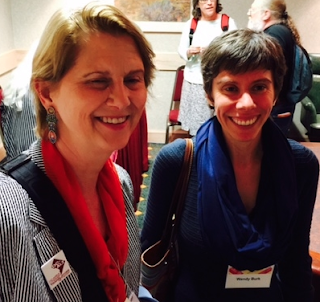
C.M. Mayo and Wendy Burk at the “Translating the ther Side” panel American Literary Translators Association (ALTA) conference, Tucson, 2015. Mark Weiss, chair of the panel, is in the back on the right.
American Literary Translators Association (ALTA) Conference 38, Tucson, October 29, 2015 Panel: “Translating the Other Side” Moderator, Mark Weiss Panelists: Wendy Burk, Catherine Hammond, C.M. Mayo
Edited Transcript of Talk by C.M. Mayo
Muchísimas gracias, Mark Weiss, and thank you also to my fellow panelists, it is an honor to sit on this dias with you. Thank you all for coming. It is especially apt to be talking about translating Mexican writing here, a jog from the Mexican border, in Tucson—or Tuk-son as the Mexicans pronounce it.
I grew up in Northern California and was educated in various places but mainly the University of Chicago. As far as Mexico went, until I was in my mid-twenties, I had absorbed, to use historian John Tutino’s term, the “enduring presumptions.” Translation: I had zero interest in Mexico.
You know that old saying, if you want to make God laugh, tell her your plans?
What brought me to translating Mexican poetry and literary prose was that I married a Mexican—my fellow graduate student at University of Chicago— and we moved to his hometown, Mexico City, in 1986. I am happy to say that we are about to celebrate our 30th anniversary.
For me, as a writer, and as a translator, these decades, mainly spent in Mexico City, have been a grand adventure in learning and exploring the cultures, histories, and geography of Mexico and of course, learning Spanish. I cannot claim that I speak and write Spanish like a native—I started learning Spanish when I was 24 years old. But after three decades in Mexico… well, after three decades of living in any country, if you haven’t learned the language, at least to level of conversation and daily business… I was about to say something unkind.
My husband has his own and very distinguished career as an economist but I call him my Translation Assistant. Although I would say I am fluent in Mexican Spanish, as all of you well know, literary translation can be fluky-tricky. Many a time he has rescued me from what would have been toe-curling embarrassment. May we all have our translation assistants.
Includes my translations of work by T. López Mills
It was back in the early 1990s, when I started writing my own poetry and short fiction, that I had two epiphanies. First epiphany: I could do this! I mean, I knew some Spanish and at the same time, I could write literary fiction and poetry myself. I was beginning to get my own stories and poems published in well-regarded literary journals, such as the Paris Review, The Quarterly, Southwest Review. That gave me a shot of confidence. To this day, I really believe that the best literary translators are not necessarily the most fluent, the most perfectly bilingual, but rather, those who can render the work into the same literary level in the target language.
And the second epiphany was that appallingly little Mexican work was being translated into English.There were some books, mainly from university presses, the occasional anthology, and here and there, a poem in a literary magazine, but I was in Mexico City, in Coyoacán, I could see what was going on, the rich, flourishing literary culture. It was obvious to me that this was not registering in the literary communities north of the border, not the way it should.
Includes my translation of a story by Alvaro Enrigue
For me, getting to know Mexican poets and writers was not difficult. Back in those days of yore, before the Internet … well, one important poet, Manuel Ulacia, was my neighbor. We would often see each other out walking our dogs.
But let me back up for a broader perspective.
Mexico shares a 2,000 mile border with the United States, spanning the southern borders of California, Arizona, New Mexico, and the greater part of Texas. And Mexico has some of the richest literary traditions in the world.
It starts with the codexes of the Maya and the Aztecs, and others—and as a quick side note, there is a book forthcoming in 2016 from University of Texas Press by archaeologist Dr. Carolyn Boyd, in which she argues that the White Shaman rock site near the U.S.-Mexico border in the Lower Pecos Canyonlands, which is thousands of years old, is actually a codex— and basing some of her arguments on the work of Mexican anthropologists, Dr. Boyd has decoded it. It tells the story of creation. And so we can think about “White Shaman” as the first known book in North America. North America, of course, includes Mexico. And the Texan side of the Lower Pecos Canyonlands was once part of Mexico.
And speaking of books, you may recall the hullabaloo about the 14.2 million dollar sale of a copy of the first English language book printed in the New World, The Whole Booke of Psalmes of 1640. Well, that was more than one hundred years after the first Spanish language book was printed in Mexico City. That was Breve y más compendiosa doctrina Christiana en lengua Mexicana y Castellana, printed in 1539. And there may have been an even earlier book printed in 1537, Escala Espiritual par llegar al cielo, but no known copies survive.
My anthology of 24 Mexican writers on Mexico. Read more about this book, including excerpts, here.
In the prologue to my anthology of 24 Mexican writers, Mexico: A Traveler’s Literary Companion, I write, “Mexican literature—a vast banquet—is one of the greatest achievements if the Americas. And yet we who read in English have gone hungry, for so astonishingly little of it has been published.”
Mexico: A Literary Traveler’s Companion was published in 2006 and although I know many of you and other members of ALTA, and other translators, have since then published many Mexican works in translation, and anthologies, this scarcity, this appalling scarcity of translations of works from our neighboring country, continues.
I could go on with names, book titles, and numbers from the publishing industry, but it would be too sad. To give you the simplest and most concrete sense of how sad this situation is, when the sales team asked for blurbs for Mexico: A Traveler’s Literary Companion, I really had a problem. Of course there are many anthologies of English language writing about Mexico. But Mexicans writing about Mexico? I would have to ask a Mexican for a blurb. But what Mexican?
Octavio Paz? Yes, he won the Nobel Prize. But he was dead.
Carlos Fuentes? He was in the anthology himself, so asking him for a blurb would have been awkward. Anyway, he wasn’t answering his email.
Sales reps and bookstore buyers, for the most part, did not recognize the name of any Mexican writer.
Salma Hayek? I suggested.
The sales rep answered, “WOW! That would be AWESOME!”
(No offense intended to Ms Hayek, an accomplished Mexican actress and producer. But methinks a blurb from her, had I been able to wrangle one, would have carried about as much clout as that of, say– to scramble it into Texanese, porquois pas– a rodeo barrel racing champion opining on the national polo team.)
We ended up using a blurb that Isabelle Allende had provided for the Traveler’s Literary Companion series itself—a series from Whereabouts Press that includes many countries, among them, Chile, Costa Rica, Cuba, and as far afield as Australia and Viet Nam.
And I managed to wrangle a blurb from Isabelle Allende’s translator, a translator who is a queen among us—I know many of you will recognize her name—Margaret Sayers Peden. She wrote:
“This delicious volume has lovingly gathered a banquet of pieces that reveal Mexico in all its infinite variety, its spendid geography, its luminous peoples. What a treat!”
Apart from the anthology and various
contributions to other anthologies and literary magazines, for a few years I
founded and edited Tameme, a bilingual
literary journal of new writing from Canada, the US and Mexico. That was a
project I did with my dad, Roger Mansell,
who had 25 years of experience in the graphic arts and printing business in San
Francisco. So if I do say so myself, the three issues of Tameme and two
chapbooks were quite beautiful and they should be collector’s items.
Unfortunately my dad passed away, and with my own books to write, Tameme
was more than I could handle.
Apart from Tameme, the largest translation
project I have undertaken to date is a strange one, and I bring it up because I
know that for many of you the question of rights is a concern. A book that is
out of copyright, you can grab that, you can translate that. Go to it!
Francisco Madero was the leader of Mexico’s 1910
Revolution and President of Mexico from 1911 to 1913, when he was overthrown in
a coup d’etat and murdered. Madero was a Spiritist medium, that is, he believed
he could communicate with the dead—and so can you! His secret book, Spiritist
Manual, written in 1910—the year he launched the Revolution—and published
under a pseudonym when was president elect in 1911, is… all about that. And I
translated it because nobody else had.
As I said in my panel talk last year,
I cannot deny other motives and the millions of other participants in that Revolution of 1910. But its spark, and the way it played out, and, I believe, Madero’s murder, become a radically different story once we take into account his Spiritism.
My aim with my book and my translation of Madero’s book is to deepen our understanding of Madero, both as an individual and as a political figure; and at the same time, deepen our understanding of the rich esoteric matrix from which his ideas sprang, in other words, not to promote his ideas nor disparage them, but explain them and give them context.
It is also then my aim to deepen our understanding of the 1910 Revolution and therefore of Mexico itself, and because the histories are intertwined, therefore also deepen our understanding of North America, Latin America, the Pacific Rim, and more— for as long as a book exists, should someone happen to read it, it can catalyze change in understanding (and other changes) that ripple out, endlessly.
Such is the wonder, the magical embryonic power of a book, any book, whether original or in translation: that, even as it rests on a dusty shelf for a hundred years, or for that matter, an unvisited digital “shelf,” if it can be found, if it can be read, it holds such potential.
To conclude: I mainly translate contemporary Mexican
short fiction and poetry. It is a labor of love and, as an English language
writer who lives in Mexico City, a way for me to engage with Mexico and with my
Mexican colleagues. And finally, translating is a way to bring what I can,
whether it be a monster on a platter or algún taquito sabroso, to the
literary banquet.
To quote myself again from the prologue of Mexico:
A Traveler’s Literary Companion, “Throughout Mexico there are so very many
writers whose work has yet to be translated, or, though translated, deserves a
far wider readership in English.”
Any and all of you who have an interest in
translating Mexican literature— know that you have my heartfelt good wishes.
C.M. MAYO: What inspired you to write this biography?
SONJA D. WILLIAMS: In fall 1994 I had just started working as a writer/producer for the Smithsonian Institution’s Black Radio: Telling It Like It Was project—a 13-part series exploring the legacy of African Americans in radio. (The Smithsonian’s National Museum of American History in Washington, D.C., housed a unit that produced award-winning radio and television documentaries about the American experience). So starting in January 1996, our weekly half-hour Black Radio programs aired on more than two hundred noncommercial radio stations nationwide.
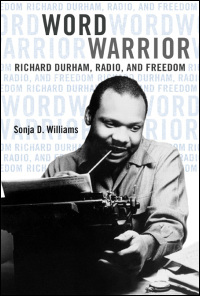
Of the five shows on my producing plate, I felt the most trepidation about the one exploring African American contributions during radio’s “theater of the mind” heyday of the 1930s and 1940s. Blacks were rarely featured in local or national dramatic broadcasts then. When I found out about Destination Freedom, I was struck by this radio series’ lyricism, dramatic flair, and fiery rhetoric. African American writer Richard Durham created this series in 1948 and for two years he served as its sole scriptwriter. A master storyteller, Durham seductively conjured aural magic, inventively dramatizing the lives of black history makers.
And Durham used his desire for universal freedom, justice, and equality to inform his storytelling choices.
Richard Durham had died in 1984, so my interviews with his wife, Clarice, actor/singer Oscar Brown Jr., and writer Louis “Studs” Terkel provided salient insights. Durham was an astute, Chicago-based writer who employed poetic, hard-hitting prose to entertain, educate, and promote positive social change. He stood behind his convictions, even when the consequences of his actions caused him emotional pain, financial hardship—or both.
Durham’s accomplishments reinforced my own belief that the media, in all its incarnations, should serve a higher purpose than just mindless diversion. His life was drama itself, full of unexpected twists and turns, of creative invention and reinvention. His story certainly fascinated me. So after the Black Radio series ended, I planned to work on Durham’s biography.
Unfortunately, other documentary projects monopolized my time. I also continued teaching in my academic home, the Howard University Department of Radio, Television, and Film. Appointment to an administrative position in my department eventually forced me to sandwich research for this book into spring or summer breaks and other far-too-fleeting time frames.
Still, a Howard University–sponsored research grant in 2002 enabled me to begin immersing myself in Durham’s world. Later, a 2009 Timuel D. Black Jr. Short-Term Fellowship in African American Studies sponsored by the Vivian G. Harsh Society enabled me to spend a summer in Chicago. I practically moved into the Woodson Regional Library, home base of the Harsh Research Collection of Afro-American History and Literature, where Richard Durham’s papers reside. Finally, a sabbatical from my university during the 2010–11 academic year allowed me to make significant progress toward the completion of this book.
C.M. MAYO: Did Durham’s family help and/or cooperate with you?
SONJA D. WILLIAMS: Durham’s family members were extremely cooperative and supportive. Durham’s wife, Clarice Davis Durham (now 95), generously allowed me to interview her on numerous occasions, and she provided contact information for several of her husband’s longtime friends and colleagues. She also shared documents she had not donated to the Chicago Public Library’s Harsh Research Collection.
Mrs. Durham’s brother, Charles A. Davis and sister Marguerite Davis offered touching stories and historical perspectives about their brother-in-law, as did Richard Durham’s older sister Clotilde and younger brothers Caldwell and Earl. And Mark Durham, Clarice and Richard’s only son, provided a wealth of additional information and contacts.
C.M. MAYO: What were the most unexpected and biggest challenges for you in writing this book?
SONJA D. WILLIAMS: If someone had told me in the early 2000s that it would take between 10 and 15 years to complete Word Warrior, I would have been convinced that this person had abused some crazy, judgment-clouding substance. The longest documentary project on which I had worked, NPR’s and the Smithsonian’s 26-part series Wade in the Water: African American Sacred Music Traditions, was about five years in the making, from its conception by artist/historian Bernice Johnson Reagon to airdate.
But additional documentary, teaching and administration responsibilities, along with other life demands, soon proved that Word Warrior would take a lot longer to become a reality. And at times I had to overcome serious personal roadblocks. Was I really up to this challenge? Who told me I could write a book? Was I fooling myself?
I got past those doubts, but not without struggle – and time.
C.M. MAYO: I believe every book has many angels. Who were the angels for this book?
SONJA D. WILLIAMS: So many angels hovered over this project. Durham’s longtime friends, artist Oscar Brown Jr., journalist Vernon Jarrett and writer/radio personality Studs Terkel were generous with their time, recollections and insights. Historian J. Fred MacDonald, who died earlier this year, was an angel from the start, providing all types of audio and visual materials and regular encouragement.
Vivian Gordon Harsh, an African American woman I never met, served as an earthbound angel during Durham’s lifetime and a heavenly one in mine. During the 1940s, this pioneering head librarian created and curated a special collection of Negro books and historical documents in Chicago’s George Cleveland Hall Public Library. Durham spent hours there, combing through the research materials Harsh provided for his Destination Freedom and other projects. Today, the Harsh Collection is the largest African American archive in the Midwest. It also houses Richard Durham’s Papers.
And of course, my family members and close friends – angels all – divvied up places to stay, reality checks and butt-kicking critiques.
C.M. MAYO: Were you able to listen to all of Durham’s “Destination Freedom” radio shows? (Where are they archived?) Did you have some favorites– and why?
SONJA D. WILLIAMS: Of the 92 shows in the Destination Freedom series, I listened to all of the tapes that have survived. Northeastern Illinois University historian and author J. Fred MacDonald discovered and rescued those tapes and scripts from Northwestern University years ago and housed them in his own media archives (now located in the Library of Congress). From his archives, Dr. MacDonald sent me a huge box containing copies of every Destination Freedom script. I read every word. I also listened to Destination Freedom tapes in the archives of the New York Public Library’s Schomburg Research Center of Black Culture, and in the Richard Durham Papers archived in the Chicago Public Library’s Harsh Research Collection.
It’s rather hard to pick favorites from such a rich cache of dramatic programs. Of course, a few stand out for their storytelling strengths and messages:
The Rime of Ancient Dodger examined Jackie Robinson’s integration of baseball, starring Oscar Brown Jr. as Robinson and Studs Terkel as a Brooklyn-accented, rhyming narrator. Denmark Vesey recounted Vesey’s revolutionary militancy and his 1822 slave revolt in South Carolina; Negro Cinderella portrayed artist Lena Horne’s young life and social awakening; Premonition of a Panther demonstrated how his sport’s brutality affected boxing great Sugar Ray Robinson; The Death of Aesop displayed the biting humor and wisdom of an Ethiopian slave famous for his fables; The Long Road explored the contributions of women’s suffrage activist and educator Mary Church Terrell.
C.M. MAYO: Durham was Muhammed Ali’s biographer (The Greatest, 1975). Did you find it challenging to write the biography of a biographer?
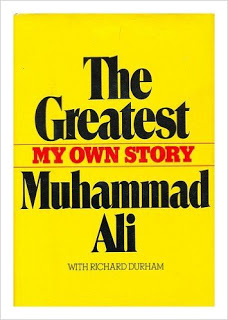
SONJA D. WILLIAMS: In part because Muhammad Ali is such a huge personality and significant cultural figure – and because I was fascinated by his story and his fights during my younger years – Ali threatened to take over the chapter about Durham’s work with him on The Greatest. I had to fight with myself to make sure that Durham remained in focus by using Durham’s interviews with historian J. Fred MacDonald, magazine and newspaper articles where Durham talked about Ali, the tapes Durham personally recorded while following Ali during the writing of The Greatest, and relevant interviews with Durham’s friends, colleagues (including his Random House editor Toni Morrison) and family members.
C.M. MAYO: You’ve written for radio. Did you find writing a book to be similar or a very different process?
SONJA D. WILLIAMS: While I never thought that writing a book would be a breeze, the research process felt very familiar. It required the same primary and secondary research muscles needed for documentary production. I loved digging for information and finding unexpected gems – like Durham’s letters to and from acclaimed writer Langston Hughes, or learning about Durham’s interaction (along with other labor union leaders) with a young Rev. Martin Luther King Jr. Dr. King had journeyed to Chicago to seek financial support for the Montgomery, Alabama bus boycott he was leading. At that point, February 1956, the boycott was in its infancy and struggling to survive.
But writing for the page (or computer screen) is different that writing for the ear, and my early chapter drafts contained clunky chunks of interview segments or script samples. It was as if an unseen narrator (me) briefly set up an audio clip and then let the clip run uninterrupted, taking up a bulk of the page. While I could let audio segments, sound effects, ambient sound and/or music guide listeners in radio storytelling, it was clear that I had to take a more active role as narrator/guide for a book.
I had to reorient my mind and my writing. A struggle.
But if I learned anything from past projects, my work on Word Warrior cemented the fact that hard work, persistence, and faith are essential elements for any creative endeavor.
C.M. MAYO: What’s next for you?
SONJA D. WILLIAMS: I plan to return to my first love, music, and explore the lives, musical triumphs and personal struggles of some contemporary musicians. Wish me luck, faith and persistence!
The now deactivated Facebook page (If you find another C.M. Mayo on FB that would not be me)
Plus, FB has been an unexpected
pleasure: I could keep up with family, both close and distant, and friends,
new, old and previously long-lost. I smiled wide to see photos of a relative’s
80th, jokes and memes posted by cousins and neighbors, videos of the antics of
one of my old book editor’s puppies, and so on.
In that torrent of FB feed arrived many treasures
too, such as artist Hope Swann’s daily door picture; gorgeous paintings by
other artist friends including Mariló Carral, Kelley Vandiver and Edgar
Soberon; a video— I forget who “shared it”— of
a 90 year old yoga teacher; links to read about fascinating books; political
news in Mexico and abroad which I might have missed otherwise; news of a dear
friend’s book prize (yay, Leslie Pietrzyk!!);
and oodles more.
I am grateful to FB for providing this platform,
and grateful to my FB friends (and friends of friends) who have helped make it
such a richly interesting experience. (And muchas gracias, Mikel Miller,
for recently forming the Mexico writers group on FB and so energetically
championing my writing there—and including a chapter from my book
on Baja California in your Kindle anthology, Mexico: Sunlight
& Shadows.)
In sum, as many of you well know, there are
excellent reasons to participate on FB. Nonetheless, after months of dithering,
I deactivated my
account.
Here’s why:
1. I
find it increasingly unsettling that a corporation not only mediates my
interactions with my friends and family but also shapes them by its algorithms,
then harvests and sells the data on those interactions to third
parties. (Translation: it’s looking a mite too 1984.)
2. Not
all, certainly, but much of the FB feed is trivia—(I love you,
N., but I don’t need to see the sandwich you ate yesterday in Barcelona)— or upsetting (I agree with you, J.,
that animal abusers should be punished, but I’d rather not have been slammed
with the photos). Some of the FB feed is assuredly not trivia— the
passing of a beloved grandfather, the birth of a baby, a child’s graduation,
the adventure of a lifetime— but because of FB’s algorithms, posts are
broadcast to “friends” its bots deem relevant, and it can become so.
I mean, if S. didn’t invite me to her birthday party, why did she imagine I
would want to see a photo of her blowing out her birthday candles?
(I’ll admit, maybe I never “got” FB in
this regard; I rarely posted anything from my personal life. In the real,
meatspace world, social networks are intricately nuanced; FB, for all its
“groups” and feed settings and ever-morphing privacy options, turns
it into a one-size-fits-all spew. Adding nuance: I guess that’s what the
algorithm engineers will be working on from the dawn of FB ’til Kingdom Come.)
3. FB
is annoyingly addictive, albeit for some people more than others. For me,
staying off FB like trying to diet with an open box of chocolates at arm’s
reach.
UPDATE: And it’s addictive by design, of course. It’s all about hooking your brain into the machine zone.
4. If
I’m going to get this out the door before I’m 94, I need more time and mental
energy to finish writing my book about
Far West Texas.
5. As far as book promotion goes, FB isn’t the “wow” it first seemed (especially after, for reasons known only to itself, FB changed its algorithms). Furthermore, although many of my readers are on FB, many are not, or don’t follow me there. Yes, one can create author and book “fan pages,” but that is a form of “sharecropping”— after all, FB owns the digital platform— with all the attendant disadvantages for the sharecropper. (My current philosophy: “Likes” on FB are given so promiscuously, they don’t mean much, if anything. From my own platform, that is, my website, true fans of my work, legion or scant may they be, are always welcome to subscribe to my newsletter.) Moreover! As noted above, FB sucks up time and energy that I could apply elsewhere to better effect. (In case you were wondering, for book promotion, apart from writing the next book, that would include blogging, sending out that newsletter, freelancing for magazines, podcasting, an occasional postcard campaign, and… drumroll… answering ye olde email.)
UPDATE: Speaking of “sharecropping, yes indeed, this blog is sharecropping on Google’s platform. It has been on my to do list for an age to move the whole enchilada over to WordPress. Stay tuned.
UPDATE, January 2019: Dear writerly reader, you are now reading this blog on self-hosted WordPress. Viva!
6. Though
I will miss the casual interactions of “liking” and
“sharing” on FB, I prefer to meet friends, family and colleagues in
person, that is, on our terms, not FB’s, and also to talk on the phone
or by Skype, and… more drums… answer my email.
Speaking of email: friends,
family, students, readers: I am sincerely happy to hear from you! As always,
you can write to me at cmmayo (at)
cmmayo (dot) com. And now that I’m free of Facebook, I shall be able
to answer you in a more thoughtful and timely manner.
P.S. To deactivate a FB account, log in, then go
to “settings,” then “security,” then click on
“deactivate your account.” Oh, but FB doesn’t let you go that easily!
The whole ooey-gooey-extra-velcroey process made me shake my head and laugh out
loud several times. By the way, this is not the same action as deleting
the account. I can imagine that I might need to log on again in order to
contact someone whom I couldn’t contact otherwise, or possibly, for some other
very good reason. But to participate as I did before? Definitely not.
FURTHER UPDATE:
November 2017. Still massively relieved to have deactivated FB. In case
you were wondering. But still have not yet moved this blog over to WordPress…
It will happen.
They say that books are magical objects. Certainly some take a long and mysterious while to reach this reader. I had heard about Diana Anhalt’s A Gathering of Fugitives: American Political Expatriates in Mexico 1947-1965 when it first came out in 2002, but it wasn’t until a dozen years later that, after finding it by happenstance at Tepoztlan’s La Sombra del Sabino bookstore, and— more happenstance, a deliciously free afternoon— I delved in, and with increasing admiration and fascination, devoured it.
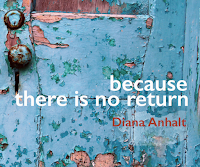
The author of three chapbooks —Shiny Objects, Second Skin, and Lives of Straw— Diana Anhalt is also a superb poet. Her work has been nominated for this year’s Pushcart Prize and her book, Because There is No Return, is forthcoming from Passager Press (University of Baltimore).
FAVORITE BOOKS THAT INSPIRE POETRY A GUEST-BLOG POST BY DIANA ANHALT
1. Sometimes I am convinced I write poetry because I hated Math. Throughout high school I spent my math classes memorizing poems from my literature textbook: Edgar Allen Poe, Robert Frost, Carl Sandburg, Amy Lowell, William Rose Benet, Joyce Kilmer… So, certainly, the books that influenced me, although I no longer remember their titles, and drove me to write poetry, were the high school literature textbooks commonly used during the 1950s.
2. Then, once I started writing in the ‘60s, an inspiration and a frame of reference became John Ciardi’s How Does a Poem Mean (Houghton Mifflin, 1959)
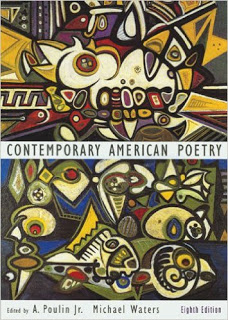
3. One collection I refer to time and time again because so many of its writers spur me to write is A. Poulin’s Contemporary American Poetry (Houghton Mifflin, 1985)
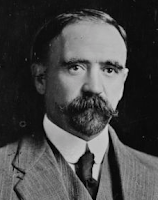
Francisco I. Madero, leader of the 1910 Revolution, President of Mexico (1911-1913) and author of Manual espírita (Spiritist Manual), 1911
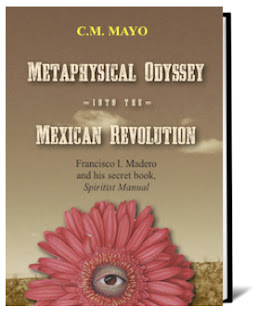
The astonishing thing about Francisco I. Madero’sManual espírita of 1911 is that it lays out his philosophy so passionately and precisely, and yet, with counted exceptions (among them, Mexican historians Tortolero, Guerra de Luna, and Rosas), apart from cursory mentions, historians have told us nearly nothing about this text, its origins, broader esoteric cultural context, and profound implications for understanding Madero’s actions as leader of the 1910 Revolution and as President of Mexico. My translation of Madero’s Manual espírita— the first into English and, as far as I have been able to ascertain, into any language— is included in my book, Metaphysical Odyssey into the Mexican Revolution: Francisco I. Madero and His Secret Book, Spiritist Manual.
>>Click here to view a one minute-long Mexican government video which gives a very basic idea of the official version of Madero’s importance in Mexico.<<
Madero was a medium in the Spiritist tradition of the late 19th and early 20th centuries of France and Mexico. While Metaphysical Odyssey into the Mexican Revolution is a scholarly contribution, I write about Madero and his Spiritist Manual not as an academic historian, but as his translator and as a creative writer who has lived in and written about Mexico for many years. I presumed that most of my readers would encounter Madero’s ideas about communicating with the dead extremely peculiar, even disturbing. For the most part this has been the case. To give one of several (to me, amusing) examples, one prominent Mexico expert who shall remain unnamed felt moved to inform me that, though he very much enjoyed my book, he would not be reading Spiritist Manual.
That said, I am grateful to have been invited to speak about it at the Centro de Estudios de la Historia de México CARSO, Mexico City’s National Palace, Rice University, Stanford University, UCSD Center for US-Mexican Studies, and elsewhere, and to date, historians of Mexico and other scholars in these audiences have been both thoughtful and generous in their comments.
To my surprise, however, the Internet has brought my and Madero’s books another, very different audience, one that encounters the Spiritist Manual as, shall we say, a vintage text out of a well-known and warmly embraced tradition.
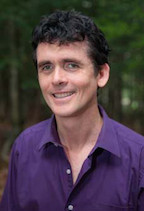
Rev. Stephen A. Hermann www.stevehermannmedium.com
In his review for the National Spiritualist, Rev. Stephen A. Hermann writes, “Anyone interested in the history of international Spiritualism as well as as mediumnistic unfoldment will find this manual invaluable.”
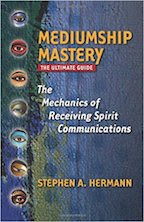
With the aim of providing further historical and philosophical context for Francisco I. Madero and his Spiritist Manual, I asked Rev. Hermann if, from the perspective of a practicing medium and teacher of mediumship— and author of the just-published Mediumship Mastery: The Mechanics of Receiving Spirit Communications— he would be so kind as to answer some of my questions about Madero as a medium and about his philosophy.
ON MADERO AS MEDIUM
C.M. MAYO: In your book, Mediumship Mastery, you distinguish between two broad types of mediumship, mental and physical. “Automatic writing” you categorize as both. Francisco I. Madero was a writing medium, that is, a medium who channeled messages from the spirit world through his hand and pen onto paper. Can you explain this? And, is this type of mediumship still common today?
STEPHEN A. HERMANN: Madero practiced automatic writing in which spirit personalities would control the movements of his arm and hand to write messages. It is common for many people, not knowing the difference, to confuse automatic writing with the phase of mediumship known as inspirational writing. With inspirational writing the medium’s conscious and unconscious mind are very much involved with the process. Genuine automatic writing occurs typically quite rapidly with the medium unable to control the movements taking place. The conscious mind of the medium is not involved in the process and the medium could even be engaged in a conversation with others while the writing is produced.
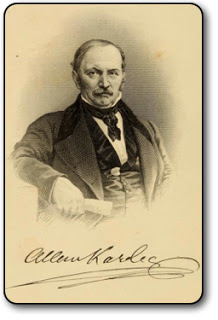
In the period that Madero developed his mediumship the practice of automatic writing, the use of planchette and table for spirit communication was quite common for many mediums. Madero was heavily influenced by the writings of the French Spiritualist Kardec, whose classic Medium’s Book was widely used by students of spirit communication as a standard for mediumistic unfoldment.
As a phase of mediumship automatic writing is not commonly practiced the way it would have been a century ago. In most countries around the world most mediums practice mental phases of mediumship such as clairvoyance, clairaudience and clairsentience (psychic seeing, hearing and sensing). There are also many mediums who practice controlled speaking or trance channeling.
C.M. MAYO: How how would you, as a medium, evaluate Madero’s mediumnistic notebooks? (These are preserved in his archive in Mexico’s Ministry of Finance; in my book, I quoted from some of them, communications in Madero’s handwriting signed by “Raúl,” “José” and “B.J.”).
STEPHEN A. HERMANN: I was impressed by Madero’s dedication to God, the spirit world and his mission to help Mexico. He certainly appears to have lived by higher spiritual principles. The communications that he received I feel were genuine and indicate the great effort of teachers in the spirit world to use him as a positive influence in the material world. I would love to see all his notebooks published and your book distributed even more as Madero’s work is an excellent example of a politician motivated selflessly out of love and duty.
[C.M. MAYO: The mediumnistic notebooks have been transcribed and published in volume VI. of Obras completas de Francisco Ignacio Madero, edited by Alejandro Rosas Robles, Editorial Clío, Mexico, 2000. For more about the work of Alejandro Rosas Robles and other Mexican historians on Madero and esoteric philosophy, see my post Lifting the (Very Heavy) Curtain on the Leader of Mexico’s 1910 Revolution].
C.M. MAYO: It seems that by the time Madero became president he was no longer channeling written messages but instead relied on “inspiration” or telepathic communication from spirits. My understanding is that Madero considered this an advance in his mediumnistic abilities. Would you agree?
STEPHEN A. HERMANN: A student of mediumship is always progressing and as such the manner that his or her mediumship functions will evolve accordingly. I assume that Madero would have put considerable effort into growing as an individual as well as enhancing his own mediumistic skills. It is not that one phase of mediumship is better than another. All spiritual gifts are ways for the spirit personalities to bring love and healing to people in the material world. It is very common for mediums to develop new phases of mediumship as they gain experience and are ready. Madero was very progressive in all aspects of his life.
C.M. MAYO: One of the questions I invariably hear in any presentation or conference about Madero and his Spiritism is that, if he really were hearing from spirits, why did they not warn him about the coup d’etat of 1913, so that he could save himself? (Perhaps because as President coping with the challenges of governing, he no longer had the peace of mind to listen?) In Mediumship Mastery (p. 154-155) you write, “While warnings might be given in order to prevent a mishap, telling the recipient negative information such as he or she is going to die next week or be involved in a serious accident, generally would not come through with controlled regulated mediumship.” Can you explain and/or elaborate?
STEPHEN A. HERMANN: Madero would have been under great stress so it is very possible that his own mind would not have been receptive to warnings given by his guardians in the spirit world. On the other hand, we do not know the full picture in terms of his karma or lessons in this lifetime. Madero performed great works when he was physically present. I am sure that these great works would have continued in other realms after his physical death.
C.M. MAYO: In the introduction to your book, Mediumship Mastery, you mention that you trained as a hypnotherapist. From his personal library we know that Madero was intensely interested in hypnotism. Would this knowledge have enhanced his abilities as a medium and as a political leader? And if so, how?
STEPHEN A. HERMANN: Kardec and many of the pioneers of the Spiritualist movement studied Mesmerism and altered-states-of-consciousness. The awareness of inducing trance states is crucial for the development of mediumistic ability. For example, with clairvoyance the more the medium is able to place his or her mind into a receptive state and get the analytical mind out of the way, the easier it will be to receive as well as accurately interpret spirit messages given in this manner. Mediumship mastery requires considerable discipline on the part of the medium. Hypnosis is an effective tool for helping student mediums train their minds and open up as instruments for the spirit personalities to work through.
ON SPIRITISM, SPIRITUALISM, THE PHILIPPINES, AND PSYCHIC SURGERY
C.M. MAYO: Spiritism developed in France from the root of Anglo-American Spiritualism. As a medium who has practiced and taught in various countries from the U.S. to New Zealand and including in the Philippines, do you see important differences in these traditions, Spiritualism and Spiritism, today?
STEPHEN A. HERMANN: Spiritism and Spiritualism are branches of the same tree. A Spiritist is a Spiritualist who follows primarily the doctrine found within Kardec’s writings. Anglo-American Spiritualists do not limit themselves to Kardec’s writings and as a whole have not officially embraced the concept of reincarnation. The Spiritist approach generally places more emphasis on higher philosophy and less on phenomena or providing evidence of survival as the Spiritualist approach emphasizes. I think as a whole the Spiritist approach tends to be more progressive than what is found in many Spiritualist churches. However, Spiritists can be a bit dogmatic in adhering to Kardec’s writings.
C.M. MAYO: In your chapter “Spiritiual Healing” you discuss psychic surgery in the Philippines. Though Madero does not discuss psychic surgery in the Spiritist Manual, in my book, Metaphysical Odyssey into the Mexican Revolution, I mention the Filipino and Brazilian psychic surgeons as well as some Mexicans including Niño Fidencio and Doña Pachita because they are well-known in Mexico and I felt they represented traditions that could claim at least some tangly bit of roots in the early 20th century Spiritism of Madero. Would you agree? Also, have you practiced and/or witnessed any psychic surgery yourself?
STEPHEN A. HERMANN: There have always been mediums or healers in all cultures. The Philippines were a Spanish colony for almost three hundred years. Many of the leaders of the revolution against Spanish rule were involved in the practice of Spiritualism. Kardec’s writings were again a major influence in this part of the world.
I teach mediumship and healing worldwide and the Philippines is one of the countries I regularly visit. Over the years I have witnessed and experienced many remarkable physical and emotional healings with my own mediumship as well as the mediumship of others. With healing God is the healer and we are only vehicles for God’s unconditional love to work through. Yes, I practice psychic surgery with the help of spirit doctors. However, I do not pull blood and guts out of people and drop it in a tin can as many Filipino healers do.
C.M. MAYO: My understanding is that Spiritism arrived in the Philippines with Spanish translations of Kardec’s works. Presumably many of these came out Barcelona, an important center for esoteric publishing (and indeed, many of the books in Madero’s personal library were from Barcelona). When I discovered that Madero’s 1911 Manual espírita had been reprinted by Casa Editorial Maucci in Barcelona in 1924, I immediately wondered whether any copies had made their way to the Philippines and so played some role in the spread of Spiritism there. Do you know anything about this?
STEPHEN A. HERMANN: I do not know anything about this. Don Juan Alvear in 1901 founded the first Spiritist center in San Fabrian, Pangasinan. I have worked at this center many times and the energy is amazing. Alvear was a great political leader, educator and prominent intellectual. Like Madero, Alvear authored a book on mediumship and was a hero of the revolution. His statue is outside the government building and across the street from the Spiritist center he founded.
[C.M. MAYO: See Hermann’s blog post about some history of Spiritism in the Philippines here. And for more about Spiritism in the Philippines, a subject on which I am admittedly very foggy, one place to start is Harvey Martin’s The Secret Teachings of the Espiritistas.]
ON THE BHAGAVAD-GITA AND REINCARNATION
C.M. MAYO: In many places in your book, Mediumship Mastery, you quote from the Bhagavad-Gita.This was a work that fascinated Madero; he not only mentions it in his Spiritist Manual, but under the pseudonym “Arjuna”— the name of the warrior in the Bhagavad-Gita— he wrote articles about it and was planning a book about its wisdom for the modern world. The Bhagavad-Gita also had an important influence on Gandhi, Emerson, the Theosophists, and many others. One of its many teachings is about reincarnation. In your book’s chapter “Past Life Readings,” you mention that you have recollections of some of your past lives and also have received communications from spirits about others’ past lives. Would you elaborate on reincarnation as explained in the Gita?
STEPHEN A. HERMANN: The Bhagavad Gita is a conversation between the Supreme Personality and Arjuna. I try to read it as much as possible. Life is eternal as the personality continues into the world of spirit. The Bhagavad Gita explains the science of connecting with the Godhead and how to cultivate devotion or love of God. Every seven years pretty much all the molecules in our physical bodies change. So we are always changing physical bodies. Based on our consciousness at the end of this physical life we will end up having to take another physical birth. The Gita explains the process of transmigration and how we can ascend to higher levels.
C.M. MAYO: Like Madero in his Spiritist Manual, in your book, Mediumship Mastery, you advocate a vegetarian diet. Is this an idea that came to Spiritualism / Spiritism from Hindu philosophy?
STEPHEN A. HERMANN: Higher teachers on both the physical and spiritual worlds always advocate vegetarianism as it is very bad to hurt animals and cause suffering to others. A true follower of Jesus would not want to hurt others as would a true follower of Buddha. There is only one God and we are all God’s children. I am sure Madero was influenced by Vedic teachings which is why he loved the Bhagavad Gita.
MORE ABOUT MADERO’S SPIRITIST MANUAL
C.M. MAYO: What surprised you the most about Madero’s Spiritist Manual?
STEPHEN A. HERMANN: I really loved reading the Spiritist Manual. It didn’t really surprise me as I am familiar with everything he wrote already. However, I especially loved reading the extra sections about your research and his notes, etc. I think you did a fantastic job.
C.M. MAYO: In terms of his understanding of mediumnistic unfoldment—or anything else—are there any points where you would disagree with Madero’s Spiritist Manual?
STEPHEN A. HERMANN: Madero approaches mediumship heavily influenced by Kardec’s Medium’s Book. Nothing wrong with that as Kardec’s work was way ahead of it’s time when it was published in 1861. However, the methods and approaches used by the spirit personalities to communicate, train and interact with mediums have greatly improved.
Back in the early years of Spiritualism there were no teachers of mediumship. Mediums learned through trial and error and with the assistance and input of teachers in the spirit world overtime created structured approaches to the unfoldment of the various phases of mediumship.
Madero was brilliant and had he not have been murdered his mediumship would have expanded even more. Love, harmony, enthusiasm, and higher purpose are the qualities needed to create the best conditions for successful mediumistic communications. Madero possessed all these qualities and more.
In the early years of Spiritualism there was much physical phenomena or manifestations of spirit power that could be directly experienced through the five physical senses. Nowadays, people are much more intellectually oriented and as such the mediumship practiced is mainly mental or telepathic in nature. It is not that one method is better but just better suited for the age. The methods for training mediums have greatly improved and expanded in the last 168 years.
C.M. MAYO: As you were reading Madero’s Spiritist Manual, or before or afterwards, did you ever sense that you were in communication with / sensing Madero’s spirit? Is there anything you would like to say about that?
STEPHEN A. HERMANN: I would think that Madero most likely would have been around you a lot when you were researching and writing the book. I do not know if he was around me when I was reading the book, but I do feel that he and I would have a lot in common if we were to meet. I think we would get along pretty well as I can relate to where he was at in terms of his mediumship and his spirituality in general.
C.M. MAYO: In your book, Mediumship Mastery (p. 9) you introduce the subtle bodies that interpenetrate the physical body. As I read it, this is a somewhat different explanation from given by Madero where he, following Kardec, talks about the “perispirit.” Can you explain?
STEPHEN A. HERMANN: The perispirit is the subtle or astral covering. Madero uses Kardec’s terminology. We have a physical body with subtle bodies interpenetrating it. After physical death the soul continues to function through the astral body and travels into the spirit world.
ON MEDIUMSHIP AND ENERGIES
C.M. MAYO: My experience has been that not all but most people either dismiss mediumship as impossible or, believing it possible, are frightened that, in calling on the spirit world, they might encounter negative entities. In particular, the Catholic and many other churches sternly warn against dabbling in conjuring spirits, especially with Ouija boards. In the introduction to your book, Mediumship Mastery, you write, “In all my years of working as a medium, I have never experienced anything negative or that made me feel uncomfortable. My experience of mediumship has always been genuinely positive, loving, and comfortable.” It would seem, from my reading of the Spiritist Manual, that Madero would have agreed. But has this been the case for others you know?
STEPHEN A. HERMANN: Mediumship is all about love and healing. However, training is important as is proper motivation. Someone could have a bad experience with mediumship if they dabble in it or go about doing it in a superficial way. Spiritual mediumship is completely orchestrated by higher spirit personalities. Mediumship is not a board game for drunk teenagers to play at 2 AM. Like attracts like.
C.M. MAYO: In your book’s final chapter, “Dealing with Skeptics,” you write, “People who are closed off and negative for any reason, which would include hardcore skeptics, are exceptionally more difficult to work with as the energies are not as strong, the links to the spirit world weaker, and the connections more incomplete and vague.”
It seems to me that U.S. Ambassador Henry Lane Wilson, who disdained Madero as mentally unbalanced and who, for his support for the coup d’etat that ended with Madero’s murder in 1913, has gone down as one of the archvillians of Mexican history, had much in common with the rigidmindedness of celebrity skeptics such as the Amazing Randi. Would you agree?
STEPHEN A. HERMANN: I don’t know Randi personally nor do I know the US Ambassador of that period. Who knows what motivates people on a deeper level? However, Randi does seem very closed off to higher consciousness and intuitive ability. I suspect that Ambassador Wilson was motivated completely by lower, selfish interests and as a result would have cut himself off from higher spiritual influences.
Skeptics are not necessarily immoral or callous individuals. They just do not often believe in the mystical and are highly suspect of claims that do not fit their rationalist view of the world. I appreciate skepticism as many people are completely gullible and easily misled. It is important to not throw out your intelligence when dealing with mediumship as there is a fine line with genuine psychic impressions and your own imagination.
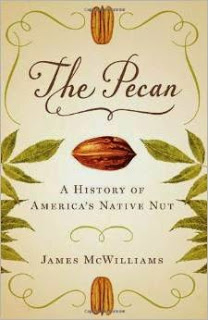
Crisply entertaining and chock-full of crunchy research by a food historian, this apparently delicious little book on America’s native nut— (and isn’t the cover charming?)— is a horror story.
It opens, as the darkest do, with a sunny scene of innocence. Clustered along river bottoms in what would one day become Texas, groves of pecan trees rained down their bounty for wildlife and indigenous peoples. For centuries, pecans were their superfood, dense with calories and nutrition. In the 16th century, Alvar Nuñez Cabeza de Vaca, the conquistador who shipwrecked en route to Florida and wandered west, found the Guadalupe River “a river of nuts”— although he had no word for them but “walnut.” The name “pecan” dates from the late 18th century.
Those are not pecan trees at Monticello.
The pecan did not do well further north. Thomas Jefferson planted some 200 pecan trees in Monticello; none survive. Where nuts were wanted, European walnut varieties proved more popular and versatile, so the pecan was left to do what it had always done, thrive in its wild state along river bottoms, mainly in what is today Texas. Notes McWilliams, “unlike any other fruit-bearing tree in the age of cultivation, the pecan managed to evade the cultivating hand of man for centuries after humans began exploiting it for food.”
Yum!
In the nineteenth century, as ranching and cash crops such as cotton, corn and wheat spread across the South and Midwest, many pecan trees disappeared; nonetheless, a large number of pecan groves survived, especially in Texas, because they clung to riverbanks and bottoms, and proved able to survive a flood other crops could not.
Farmers found wild pecans not only delicious as snacks for themselves, but good pig feed, and bags of them, easily gathered, could be sold in new markets in San Antonio, Galveston, and New Orleans. In the second half of the 19th century, Texas took the lead in pecan production, but not from formal orchards; for the most part, farmers gathered wild pecans.
How to sell more pecans? The market wanted uniformity, thin shells, and dense nut meats. Even the most magnificent pecan tree’s seed, however, would not “come true,” that is, bring forth a tree producing equivalent quality nuts. The solution was grafting. As early as 1822 one Abner Landrum detailed his own successful experiments with pecan grafting in the American Farmer. It seems no farmer bothered to emulate that experiment. The market for pecans was still marginal and, as McWilliams ventures, “it was simply more macho to run a ranch with cattle than to turn that land over to pecans.”
The Big House at Oak Alley Plantation
In the mid-century 19th century, in the Oak Alley Plantation in Louisiana, a slave gardener named Antoine successfully grafted an orchard of more than 100 fabulously productive pecan trees. Decades later, the plantation’s new German owner, Herbert Bonzano, brought the nuts of those grafted pecans to Philadelphia’s 1876 Centennial Exposition. And thus, like so many other fruits before it, the pecan was at last, if slowly, on the road to industrial production— a road, like that to Hell, paved with good intentions.
For a time, farmers relied on wild pecans, resisting experts’ advice to graft pecans, perhaps out of innate conservatism and a reluctance to becoming dependent on nurserymen. Attitudes soon changed. After a series of insect plagues in the last three decades of the 19th century decimated major cash crops, the USDA championed chemical insecticides that, “lo and behold, worked.” Writes McWilliams, “The USDA was no oracle, but as pecan farmers recognized, history showed it could make life much easier for those who tilled the soil for a living. So long as they would listen.” Listen they did.
The 20th century brought increasing industrialization in pecan production. After World War I, writes McWilliams, “pecan trees were becoming carefully managed commodities rather than natural aspects of the southern landscape.” As for shelling, an important source of employment in San Antonio in the 30s, after some labor unrest, this was given over to machines.
In World War II the U.S. government gave the pecan industry a push, promoting the nuts as nutritious replacements for meat; and after imposing price ceilings to help promote consumer demand, buying up millions of pounds of surplus pecans (many fed to schoolchildren). By the late 1940s, pecans were no longer holiday treats or just for pralines, they were in everything from cakes to cookies to pies, even salads. McWilliams: “The aristocrat of nuts had become a commoner.”
McWilliams brings the pecan through the rest of its 20th century history with mail order, frozen foods, processed foods, chain restaurants, granola, and ice cream; its oil extracted for lubricants in clocks and guns, its wood milled for basketball court flooring, its shells collected for mulch, barbecue chips, plywood, pesticides, and more. By 2011, when the author tours a Texan pecan farm, he is stuck with dark wonder:
“First, the entire operation is a streamlined model of mechanization. Vehicles designed to fit snugly between seemingly endless rows of perfectly aligned pecan trees spray pesticides, herbicides, and fungicides; they lay mulch, prune trees, apply fertilizer, and harvest nuts. Other machines disk the soil and smooth the turf between the trees so that fallen nuts do not elude harvest. At times helicopters are even brought in for the purpose of keeping frost from icing the nuts. Propane cannons are on hand to scare off crows. It occurred to me as we drove from orchard to orchard that there was nothing ‘natural’ about a contemporary pecan orchard.I was looking at a factory in the field.”
Oh, but it gets stranger. The money isn’t so much in the pecans as it is in shipping trees from the nursery to China. In 2001, Chinese did not have a word for pecan. Today pecans are a popular health food in China, available everywhere from airports to gas stations. It seems a question of time before the Chinese outstrip the U.S. in pecan production.
The future of the pecan, a “chemically saturated activity,” whether in the U.S. or China or elsewhere, looks grim. Arsenals of insecticides are increasingly necessary to combat aphids, beetles, weevils and more. These chemicals also threaten bees and other pollinators (and without them, our food supply as we know it may collapse). Plant diseases are also becoming increasingly resistant to chemical assault. The soil degrades. At some point— perhaps when China has become the top producer; perhaps when some insect or fungus has wiped out enough orchards; or in the wake of some ecological or economic jolt— it may become unprofitable to continue producing pecans in the U.S., the grafted and chemically attended ones for the mass market, that is.
What then will have become of the now few stands of wild pecans? The good intentions of many decades—ye olde single-minded “economic development”— have brought this once thriving wild nut tree to a state of such fragility that, concludes McWilliams, “we may well lose yet another natural thread to the past.”
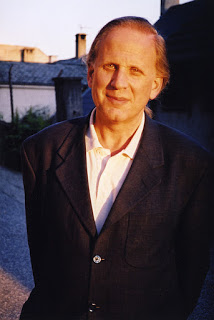
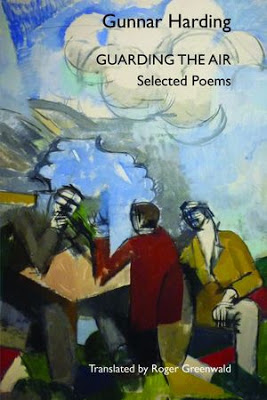
Gunnar Harding, a jazz musician, painter, essayist and a translator himself, is one of Sweden’s leading poets. Surely Harding is one of Sweden’s most prolific as well; Greenwald has selected numerous poems from more than a dozen of his books. Strange, witty and jazzy, Harding’s poems wing from the moon’s Sea of Tranquility to nickels in a jukebox (“Rebel without a Cause”).
GUNNAR HARDING, Swedish literary legend
> Visit Greenwald’s webpage for the book, which includes some of the poems and a video of the launch, here.
> Read the review by Christine Roe for Words Without Borders. “Spanning a lifetime of poetry, Guarding the Air pays homage to tragically under-translated Swedish literary legend”
> Gunnar Harding on Swedish Wikipedia (Note: I’m not a fan of Wikipedia, but alas I could not find much else on Gunnar Harding. Caveat emptor.)
ROGER GREENWALD attended The City College of New York and the Poetry Project workshop at St. Mark’s Church In-the-Bowery, then completed graduate degrees at the University of Toronto. His poetry has appeared in such journals as The World, Pequod, Pleiades, Poetry East, Prism International, The Spirit That Moves Us, The Texas Observer, Great River Review, and Leviathan Quarterly. He has won two Canadian Broadcasting Corp. Literary Awards (poetry and travel literature) and has published two books of poems: Connecting Flightfrom Williams-Wallace in Toronto and in April 2015, Slow Mountain Train, from Tiger Bark Press in Rochester, New York.
C.M. MAYO: In a sentence, why should readers pick up this book?
ROGER GREENWALD: This selection spans the whole career of a major poet whose work is accessible and appealing– and also strong in both idea and feeling.
C.M. MAYO: What were the challenges for you as a translator?
ROGER GREENWALD: First I had to understand each poem in depth, of course, and in this case that meant understanding not only the language and the “argument,” but a broad range of allusions to other literary works, paintings, recorded music, places, people, and so on. (I’ve put pointers to these in endnotes.)
The biggest challenge, as always, was to write in English poems that had something like the voice and the music of the source. People assume that it is easier to translate poems written in a colloquial voice than to translate work full of neologisms, broken syntax, word play, and other notoriously “tough” features. But the fact is that those features give a translator license to be creative and sometimes to sound “strange”; whereas to translate a whole book in a colloquial voice, getting the literal sense and the line units and the music right while never once sounding odd or “translated” is just as hard or harder.
C.M. MAYO: What advice would you offer others who might consider undertaking a poetry translation?
ROGER GREENWALD: Translate into your native language. If you’re not doing that, you need to collaborate with a poet whose native language is the target language. Try to live for at least a year in the country that your poet and his or her language come from. Read not just the major works from that country’s literature, but some of what children read in school years, like fairy tales. Get to know some of the art and music. Watch TV and listen to radio. And ask a lot of questions, especially about the language, its idioms, its peculiarities. When you start understanding friends’ jokes, stand-up comics, and locally made comedy films, you will know your cultural immersion has worked.
ROGER GREENWALD: The greatest benefits have come from sharing knowledge and experiences with other translators. Seeing and hearing their work and discussing how they approached certain texts gave me useful insights into practice. But it was also important to learn about how to navigate relationships with authors and their publishers, how to find suitable potential English-language publishers, how to present work to those, and how to avoid getting burned by unfair contracts. Simply hearing, in the Bilingual Reading series at ALTA conferences, a great range of usually unpublished work, some of it still in progress, has been an ongoing source of delight and inspiration.
And beyond that, it’s worth saying that literary translators have to be some of the most interesting people in the world, with extremely diverse backgrounds, experiences of foreign cultures, and knowledge of wonderful writers who are little known in English, even if their work has been translated and published. So it has been great to get to know my fascinating colleagues!
C.M. MAYO: Are there are other associations you would recommend?
ROGER GREENWALD: None that I belong to. But I have had it in mind for some time to look into the Authors Guild, because it is focused on advocating for fair treatment of authors and translators. And this seems to be an issue of growing concern as digital media undermine publishing revenue, and as companies like Amazon demand deep discounts and exert downward pressure on the sale price of both paper and electronic books.
C.M. MAYO: Where can readers find a copy of this book?
ROGER GREENWALD: I’m happy to say that the publisher of Guarding the Air has excellent worldwide distribution. So readers can buy it directly from the press at www.blackwidowpress.com (choose “Modern Poets” or use Search); they can order it through any independent bookseller they care to support; or they can buy it on line from Amazon or Barnes & Noble.
It’s also worth remembering that readers can ask their public library or their college library to acquire the book.