File this post under Future Reminder to Take My
Own Advice, and if some or all of these ideas also work for you, gentle reader,
verily I say unto you: Wunderbar!
Late last September, having finally rearranged
and set up my working library in my new office in Mexico City– the work in
question being a book on Far
West Texas— I had to pack it all back up again and ship it
across the Atlantic. (Why? Well, that’s a novel I’m not going to write, both
literally and figuratively).
Now that I’ve got my Texas books resettled on
their second set of new shelves in less than six months, I’m ready to take on
2018! But whew, I’ve got biceps after this job for a Hercules. The
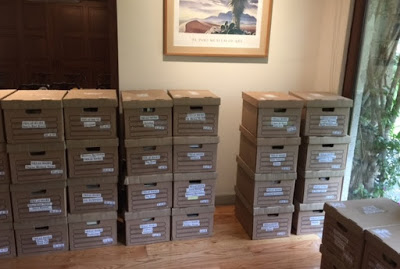
thirty-eight boxes of books comprising what I now call the Texas Bibliothek– I
have landed in German-speaking Switzerland– arrived in mid-January. And a
couple weeks later, every tome and paperback and pamphlet and back-issue of Cenizo Journal
is in place, and I can carry my bike over head! I could scoop up and toss
dessicated Christmas trees, small donkeys and their Schmutzlis
out windows, too, should I take a notion!
ON ORGANIZING (AND TWICE MOVING) A WORKING LIBRARY: Ten Lessons Learned of Late with the Texas Bibliothek
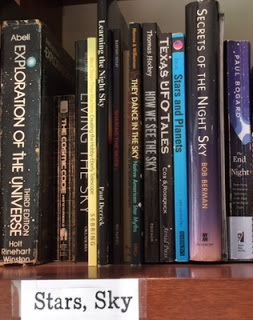
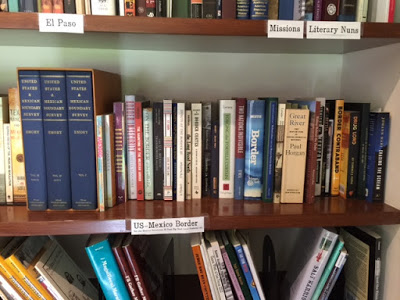
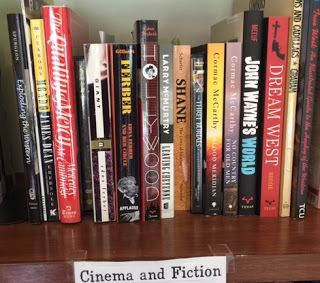
1. Organize the books by topic– not as a
librarian would recommend, but as your working writer’s mind finds most
apt.
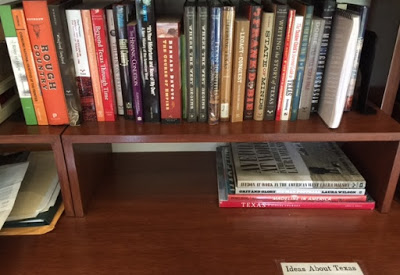
Ideas About Texas (Some, Anyway…)
After all, you’re the one who will be using these
books, not the general public. And even in a fairly substantial working
library, such as this one, there are not enough books to justify the
bothernation of cataloging and labeling each and every title.
If you have more than 50 books and if you do not
organize them in some reasonably reasonable way, why don’t you just open your
front door and let your dogs wander out and then you can go looking for them on
the freeway at four a.m., that might be more fun!
2. If any category has more than 30-40 books,
create a new subcategory.
Because trying to keep books in alphabetic order,
whether by author or by title, makes me feel dehydrated, RRRRRR.
3. Label categories of books with large,
easy-to-read lettering.
Because if you’re a working writer, like me you’re probably near-sighted…
Funny how book designers always have such unique
ideas about colors and font sizes and typefaces…. In other words, I don’t
want to have to look at the visual clutter of those spines to try to figure out
what this bunch is about; I let that BIG FAT LABEL tell me.
If you do not want to make labels, why don’t you
peel the labels off all the jars and cans in your pantry, mix ’em up, and then
try to find which one is the dog food and which one the canned pumpkin? That
would be a mile more hilarious.
4. When moving, before touching anything,
take photos of the whole shebang.
I do not have early onset dementia, but boy
howdy, moving house sometimes makes me feel as if I do. (Did I used to have a
working library? Was I working on a book? What day is it? Is Ikea still open?)
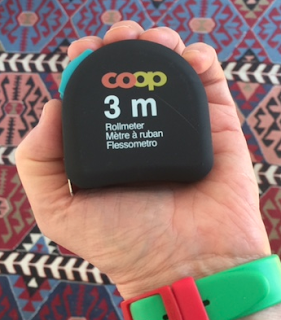
5. Then, before even touching those books, take a tape measure and write down the inches of shelf space required for each and every category.
I suspect that these things are in cahoots with pens and umbrellas.
A tape measure!
I realize this may sound very OCD.
But three moves ago, it did not occur to me to do
this with my working collection on Mexico’s Second Empire / French
Intervention, for my then recently-published book, The Last Prince
of the Mexican Empire. In the rush of moving
I allowed the moving company crew to pack the books,
willynilly-fefifo-rama-chillydilly, and then, on arrival, lacking space, never
mind bookshelf space, and so having to leave that particular library in a
half-unpacked, unsorted chaos, for the next few years more correspondence and
related research was bottlenecked than I want to think about. (That library now
has its home in Mexico City– that would be another blog post.)
The main thing is, you want to be certain you
actually have the bookshelf space you need plus ample wiggle room for
each category before you start packing– and then double
check the available bookshelf space again before you start unpacking.
And never, ever let anyone else pack them.
Sounds obvious. Alas, for me, three moves ago, it
was not.
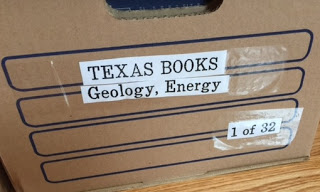
6. Save those neatly made shelf labels to
reattach to the new shelves, and also label– with mammoth, easy-to-read
fonts– each and every box.
Geology, Energy, Box 1 corresponded to category 40, requiring 17 inches of shelf space.
7. Number each box, e.g., 1 of 32; 2 of 32, etc.
These can be cross-referenced with the master
list of categories, which has the measurements.
8. Don’t be stingy with boxes!!
For moving books I prefer the so-called banker’s boxes
with punch-out holes for handles. Banker’s boxes are large enough to take a
heaping helping of books, and the handles make them easy to carry, however the
weight of a book-filled banker’s box remains within the range of what I, a
50-something female whose daily mainly workout consists of walking two pugs,
and, la-de-da, whatever biking and yoga, can easily haul up or down a staircase.
Yes, you could snag a batch of free boxes at the
grocery store, and yes, you probably could, as I certainly could, lift bigger
boxes with double the number of books in them– and most men can haul a stack
of two or even three bigger boxes at a time. However, whatever the upper-body
strength you have and shape you are in, when you are moving house, unless you
for some reason enjoy showering hundreds of dollars on, say, your
chiropractor’s vacation home, lifting huge, ultra-heavy, and unwieldy boxes is
penny wise and dollar dumb. Ox dumb.
Goodie for me, I learned this lesson three moves
ago, and I had an excellent chiropractor.
9. Take photos of the boxes, labels included.
Because you never know! Seems I have good moving
juju. Knock on wood for next time!
On reshelving day, gather together before commencing:
Papertowels
Cleaning spray for the shelves (they will be dusty)
If you are missing any one of these items, you will probably have to interrupt whatever you are doing to go get it, and then in, say, the kitchen, because you have Moving on the Brain, you will be distracted by some zombie command from the dusty ethers such as, I must now go to Ikea to buy garbage bags and whatnotsy whatnots…
#
Meanwhile, dagnabbit, people just won’t stop writing books on Texas!! Two more, post-move, essential additions to the Texas Bibliothek:
Wish me luck, gentle reader. I aim to finish my book on Far West Texas this year. By the way, I host an associated 24 podcast series, “Marfa Mondays,” which is woefully behind schedule because of these moves, but soon to resume. I invite you to listen in anytime to the 20 podcasts posted so far.
P.S. Using the free blogger platform, I also
maintain an online working
library of out-of-copyright (now in the public domain, mainly linked to
archive.org) Texas books— books which I could not or did not want
to attempt to purchase but would like to be able to consult at my
leisure. It includes a number of titles that might appear bizarrely out of
place (one is on Massachusetts, for example)– but after all, this is not for
the general public, but a working library in service of my book in-progress. I
mention this because perhaps you might find it of use to create such an online
library for your own purposes.
P.P.S. For those wondering, what is my take on
ebooks? First of all, I delightedly sell
them! And yes, I have bought some, and as far as the Texas
book research goes, when I need a book urgently and/or the paper edition is
unavailable or expensive, I have been known to download a Kindle or four– or,
as above-mentioned, download out-of-copyright books for free from www.archive.org and similar sites. I
appreciate that convenience, and also the ease with which I can search within a
text for a word or phrase. Nonetheless, on balance, I find ebooks decidedly
inferior to paper. Morever, I doubt that my electronic libraries will outlive me
in any meaningful way, while I expect that my working libraries of hardcovers
and paperbacks, including some rare
editions, may serve other researchers well beyond the horizon of my
lifetime.
As anounced in the last post of 2017, in 2018 I will be posting on Mondays on the following schedule:
First and third Mondays of the month: New writing / news / podcasts; Second Monday: For the writing workshop; Fourth Monday: Cyberflanerie and/or Q & A with another writer, poet, and/or translator; Fifth Monday, when applicable: Whatever strikes my gong.
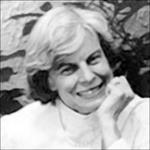
Time snaps by. It is has been two days from a
year since Ann L.
McLaughlin passed away. How I miss my brave, graceful, and very wise
friend. Ann was a decade older than my mother but, curiously, that did not
occur to me until she had passed: There was something ageless about her. She
was a literary scholar and later, when I knew her, a writing teacher and an
artist, a novelist of the most seriously dedicated and generous of our kind.
I met Ann in, I think it was 1999, when, having just moved to the area, I read from my short story collection at the Writer’s Center, in Bethesda MD, just outside Washington DC; as a founding faculty and board member, Ann did me the honor of so welcomingly introducing me to that audience. Shortly thereafter, thanks to a good word from poet and Gargoyle editor and publisher extraordinaire, Richard Peabody, I joined a writing critique group. A crackerjack writing group it was! At various points it included Kate Blackwell, Susan Coll, Kathleen Currie, Katharine Davis, Solveig Eggerz, E.J. Levy, Carolyn Parkhurst, Leslie Pietrzyk, Amy Stolls, Paula Whyman, and Mary Kay Zuravleff, among others– and always, always Ann.
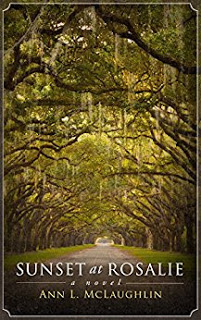
When I joined the writing group, Ann was known for her loosely autobiographical novels Sunset at Rosalie, The Balancing Pole, and Lightning in July. Of the latter, set in Boston polio epidemic of the 1950s, Publisher’s Weekly lauds her “straightforward narration that transforms the events of a prolonged hospital stay into a richly textured tale.”
“So deeply tragic. So tremendously sweet. Ann McLaughlin has captured humanity at its bravest. Artistic, accomplished Hally Blessing is stricken with polio in the prime of her youth, only weeks before the first polio vaccine. Within mere hours, Hally progreses from the elation of her first major venue as a young flautist to the despair of being diagnosed with polio. Ovecoming the deep challenges of fear and disfigurement, Hally struggles to find the inner resources which eventually enable her triumph. The scenes, the characters (even the minor characters) are all vividly portrayed. This work is a victory for the human spirit.”
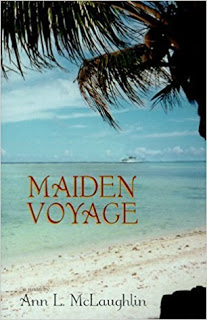
At that time, Ann was out and about promoting Maiden Voyage, a coming-of-age novel set in the 1920s on a newspaper magnate’s yacht. From Mimi Godfrey’s review in the Women’s National Book Association newsletter:
“McLaughlin is a clear-eyed and observant writer, and her evocation of 1920s Washington and the exotic ports of Julia’s trip– Madeira, Alexandria, Sicily, Greece, Zanzibar, Singapore, the South Pacific– is fascinating. But McLaughlin is more interested in charting Julia’s mind and heart, offering a kind of artist-novel of her development as a journalist and fledgling photographer. Julia wrestles with questions that were as vital today as they were in 1924: What is more important for a woman, a satisfying career or marriage and a family? Do the demands of a woman’s work matter as much as a man’s? Julia’s answers to these questions are, even more than the itinerary, what give this engaging novel its lasting satisfaction.”
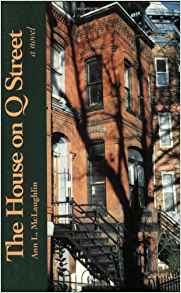
For our writing group, Ann brought in draft after
draft of chapters from The House on Q
Street, her novel set in Washington during World War
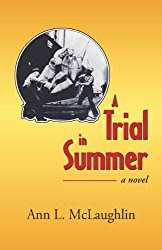
II. After The House on Q Street came A Trial in Summer, set
in Depression-era San Francisco.
And although no longer in the writing group, for
I’d returned to live in Mexico City, I had a chance to read drafts from Leaving Bayberry
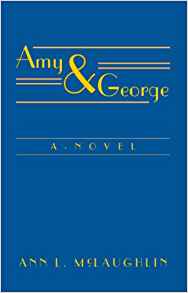
House and the proofs for Amy & George.
I was honored to contribute a blurb for the latter, which takes the reader to
1930s Cambridge, Massachusetts:
“Once again, with charm and heart, McLaughlin brings to life a tumultuous period of U.S. history as she probes and delves into a father-daughter relationship that is sometimes a seesaw, sometimes a dance. This is a wise novel.”
“George is dean of the Harvard Law School and Amy is his young, sensitive daughter. McLaughlin’s skill at portraying the quiet dangers of family life which culminate in an act of violence is tempered by a generosity of spirit and disarming honesty.”
As a member of her writing group I had a direct
window into the effort it took to write these books. I was, and remain, in awe
of Ann’s discipline. No matter what, and there were whats aplenty, Ann could
sit herself down in the chair every day, fire up the laptop, and do the work.
She had a truly rare dedication to craftsmanship, faith in her vision, and, at
the same time, the willingness and sheer grit to rewrite, and rewrite again,
and again, and again and, Lordy! as her characters often said, again.
And then whenever one of her books was
published– this is especially hard for shy creatures such as writers, and no
easy feat for one with health challenges– Ann would get herself out there, she
sent the postcards, kept up with the torrents of emails, and with smiling
aplomb, did the many rounds of readings and signings for her books. Her book
signings at Washington DC’s Politics & Prose– one of the last and most
prestigious of the great independent bookstores– were always packed, every
chair taken, fans standing in the aisles.
Among the many events for her novel A Trial in Summer was a party at my apartment. Somehow, my memory of that conflates with another party, for Mary Kay Zuravleff’s The Bowl is Already Broken, when Ann’s husband Charlie, an esteemed historian, was still alive. He was in a motorized scooter, but he had such joie de vivre, that scooter might have been a whim of a contraption for floating out of Oz. The picture I hold most vividly in my mind is of Charlie parked in the middle of that broad room, beaming, surrounded by so many, many of his and Ann’s adoring friends.
A few years after I had returned to live Mexico
City, it seemed there might be a chance on the horizon to come back to DC and
so, under the wing of Ann’s encouragement and endorsement, I joined the board
of the Writer’s Center. That turned out to be a short-lived commitment on my
part, alas, but what I remember so warmly– what magical moments!– was sitting
at the table in her kitchen in Chevy Chase, petting her cat pretty Booska,
while just the two of us talked writing and teaching writing and what we could
do for that beloved literary oasis.
At the Writer’s Center Ann’s workshops were legendary. Novelist Frank S. Joseph told me, “Ann was the best writing instructor I ever had.”
Year after year Ann gave her students her all plus ten. I knew, from our many conversations, how much they meant to her. In most people’s minds “Washington DC” does not conjure images of literary community, but the fact is, the Writer’s Center is one of the largest literary centers in the United States, and the capital and surrounding area, deep into Maryland, Virginia and even Delaware, is filled with writers who, at some point, took one, two, or several of Ann’s workshops.
Even in her last months, her health failing,
whilst in and out of hospitals, Ann kept on writing. She finished her ninth
novel, The Triangle,
and reviewed the page proofs. Her publisher, John Daniel, describes it thus:
“The Triangle returns to Boston’s 1955 polio epidemic, and combines the theme of coping with disability with that of struggle in the father-daughter friction and frustrated love. The author seems to have written the satisfying resolution to the two overlapping conflicts in her fictive life. This powerful novel is a satisfying finale of a brilliant career.”
Ann McLaughlin died at home on December 20, 2016.
I am but one of a multitude of people who can say
that Ann enriched my life, both as a person and as an artist, immeasurably. Yet
how fleeting the time I had with her, after all. Why did I not take one of her
workshops? Why did I not ask Ann more about her friend and correspondent, John
Updike, or about Janet Lewis, author of The Wife of Martin Guerre, whom
she knew from her years in California? And I regret immensely that we did not
talk more, in the most writerly vein, as we so easily might have, about the
novels of Virginia Woolf, which she surely knew by heart, every one.
I will miss Ann for the rest of my life. Her novels, a treasure of a consolation, will always have a special place here by my desk in my writing room, and in my heart.
Ann L. McLaughlin and C.M. Mayo, Washington DC, 2007 Photo by Alice J Mansell
Washington Post, January 1, 2017
ANN LANDIS McLAUGHLIN
Died at her home in Chevy Chase, MD on Tuesday, December 20, 2016 after a brief respiratory illness.
The daughter of James M. Landis and Stella McGehee Landis, she was born in 1928 and grew up in Cambridge, MA. She graduated from Radcliffe College in 1952 and received a PhD in literature from American University in 1978. Mrs. McLaughlin began teaching several courses every year at the Writers’ Center in Bethesda when it was founded in 1976 and continued teaching until the last year of her life; she also served on the board there. She had fellowships at the Virginia Center for the Creative Arts, Yaddo, and the Studios of Key West.
Ann was the author of eight novels, all published by John Daniel and Co., and recently finished correcting the final proofs on her ninth, to be published in 2017. Her readers were particularly drawn to her portraits of girls and young women coming of age, often in Depression-era America. She wrote with feeling of the intricacy of relationships those between sisters and particularly those between daughters and their difficult, if brilliant fathers. Her long and happy marriage to Charles C. McLaughlin, professor of history and editor of the Frederick Law Olmsted Papers, ended with his death in 2005.
She overcame many challenges, including polio, which she and her husband both contracted during the 1955 epidemic in Boston, which principally affected her speech and swallowing for the rest of her life. But her temperament was remarkably buoyant in the face of adversity and she will be remembered as one of the strongest and kindest of women. She will be missed by generations of students, her family and a wide community of friends and colleagues who were inspired by her gallant, bright spirit, her humor, her gentle wisdom, and her warmth.
She is survived by her sister, Ellen McKee; children, John C. McLaughlin and Ellen M. McLaughlin; and two grandchildren, Rachel and Aaron McLaughlin.
This has been a year of extra-intensive reading, the bulk of it for my book in-progress on Far West Texas. Specifically, I’ve had some catching up to do on the oil industry and New Mexico history (impossible to grok Far West Texas without those subjects). I say this every year but truly, this may have been my richest year of reading yet. I feel so lucky to have encountered these works; each and every one of these authors has my sincere admiration and immense gratitude.
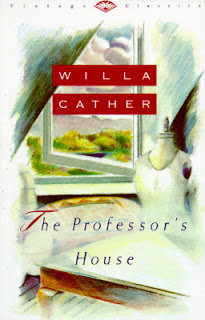
1. The Professor’s House by Willa Cather A deeply weird and profoundly American novel. I had been meaning to read The Professor’s House for years, and I finally did– and by uncannily felicitous happenstance, just after visiting Acoma, Chaco Canyon, and Mesa Verde. (P.S. Whoever calls this book flawed I call a puddinghead.)
2. The Extraordinary Voyage of Pytheas the Greek by Barry Cunliffe A brilliant book that evokes the ghost of a lost book and the world it came out of so unfathomably long ago. This is one I look forward to savoring again.
For the past several years I have been reading intensively about Texas, and that includes its fraught ethnic relations, and with these two books about slavery– both recent and major scholarly contributions– by golly, the whole thang just gelled. For U.S. readers I recommend reading first Torget; then, without delay, Resendiz.
The Daring Flight of My Pen: Cultural Politics and Gaspar Pérez de Villagrá’s Historia de la Nueva Mexico, 1610 by Genaro M. Padilla It astonishes me that so few Americans or Mexicans have ever heard of the epic poem Historia de la Nueva Mexico– and that would include Yours Truly, until I found The Daring Flight of My Pen. Padilla’s book about Pérez de Villagrá’s book rearranged all the furniture in the way I think about the U.S., about the Southwest, and about Mexico– and waxed the floor and put in new curtains, too.
7. Shrinking the Technosphere by Dmitri Orlov This book has an important and urgent message, but it also comes with a gamelan orchestra of super-freaky esoteric undertones. In other words, to appreciate the clanging in there, you have to be ready to appreciate it. Not for the pleasantly numbed of Smombiedom.
8. Resist Much, Obey Little: Remembering Edward Abbey Edited by James R. Hepworth and Gregory McNamee Its impossible to go far into reading about the American West without encountering Edward Abbey and his works, and in particular his iconic Desert Solitaire. Resist Much, Obey Little, an eclectic collection of essays and interviews, is at once a festschrift and an adventure in the funhouse of Abbey’s mind.
9. Big Batch re: The Oil Patch Having crunched through a library’s worth of reading on the oil industry, herewith a selection of some of the more worthy tomes:
The Prize: The Epic Quest for Oil, Money, and Power by Daniel Yergin This one won the Pulitzer Prize when it came out more than two decades ago, and most deservedly. It rewired my thinking about World War II, among many other episodes in the last century.
The Blood of the Earth: As Essay on Magic and Peak Oil John Michael Greer Reading Greer is akin to spooning up Swiss chocolate pudding: page after page of smoothly yumsie schoggi. Yes, even if it’s got crunchy stuff about oil and– keep your crash helmets on!– magic.
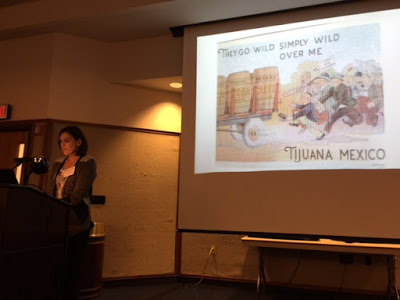
My amiga Cecilia Autrique at the Center for Big Bend Studies Conference, Sul Ross State University, Alpine, Texas, November 2017. Her paper is “American Protestants, Civil Society Organizations, and Temperance on the US-Mexico Border, 1920-1930”
Earlier this month I traveled the loooooooong way out from Mexico City via Houston and then via El Paso to Alpine, TX– (that latter stretch through the Far West Texas desert, spectacular though it be, not for the caffeine-deprived)– to participate in the annual Center for Big Bend Studies (CBBS) conference at Sul Ross State University.
I’ve been working on this book about Far West Texas, which includes the Big Bend, for an age & an eon, so last year, when I was invited to present at the 2016 CBBS conference, I was honored but flummoxed. My book hadn’t– and still hasn’t– been published and, anyway, it’s not a scholarly work but, as I have begun describing it, a lyrical and personal portrait of place. No, no, what they wanted was for me to talk about my book published in 2014, Metaphysical Odyssey into the Mexican Revolution: Francisco I. Madero and His Secret Book, Spiritist Manual. I was flummoxed again, for that book about the book by the leader of Mexico’s 1910 Revolution has zip to do with the Big Bend!
Well, it turned out that anything and everything about the Mexican Revolution is game for the CBBS conference, which is multidisciplinary and covers subjects relevant not only to the Big Bend but the surrounding regions, which include the Texas Panhandle, New Mexico, and northern Mexico’s states of Chihuahua and Coahuila.
So last year at CBBS I presented Metaphysical Odyssey into the Mexican Revolution, andI came away mightily impressed– so much so that I decided to present again this year and I recruited my amiga, Mexican historian Cecilia Autrique, to present her outstanding paper, “American Protestants, Civil Society Organizations, and Temperance on the US-Mexico Border, 1920-1930.” (This paper stems from her PhD thesis at the UNAM in Mexico City, which I hope will be published as a book in both Spanish and English, for it provides vital historical context for any discussion of the current US-Mexico border and narcotrafficking issues.)
Lt. John Bigelow, Jr., U.S. Tenth Cavalry
This year I presented my paper on “John Bigelow, Jr: Officer in the Tenth Cavalry, Military Intellectual, and Nexus Between West and East”– much of which material will appear in my book in-progress, World Waiting for a Dream: A Turn in Far West Texas.
Look for the paper on my website shortly; in the meantime, for those interested, my blog posts about Bigelow are here and here, and the post about his brother, author, world-traveler, life-long friend to Kaiser Wilhelm II, and pioneer magazine publisher Poultney Bigelow, is here. And the selected bibliography on John Bigelow, Jr. and the Bigelow family, and related subjects, which I handed out at the conference, is here.
Bigelow’s relevance to the Big Bend is direct: he was stationed there more than once, scouted all around the region, and indeed, he is an officer already well known to any and all who would study the Indian Wars and the Buffalo Soldiers. I trust I have been able to add new dimensions and insights to his importance for this region, and the West as a whole.
HIGHLIGHTS
One of the downsides of a bustling conference (indeed, a downside to just about everything nifty in the human experience) is that it is impossible to be in two places at the same time! It can also be a challenge to fit fascinating and vital conversations, such as they pop up, into the precise times allotted for coffee breaks and lunch. Alas, there were talks I am tremendously sorry to have missed or to have had to slink into half way through.
Just a few– a very few– of the highlights for me:
Felix Almaraz channeling a Franciscan missionary (and in costume!)
Once again, Al González of Chiricuahua Books busted my shoe budget for the year. I took home a biography of Jack Hays and two very rare books by cowboys about Marfa, Texas.
Steve Black, who gave a super crunchy keynote about Eagle Nest Canyon
A keynote speech by lead archaeologist Steve Black about Eagle Nest Canyon at Langtry, Texas > One of the most jaw-dropping canyons in Texas. Check out my mini-video of the entrance of Eagle Nest Canyon from a visit a couple of years ago here.
(Perchance you wonder, did we see the Marfa Lights? Not this time. But I have indeed seen them and on four different occasions.)
AND A NOTE ON EL PASO’S ELROY BODE
As you might imagine, flying from Mexico City to El Paso via Houston, and back, apart from being a sardine-y experience, was the perfect opportunity to get some reading done.
I have belatedly discovered Elroy Bode! (pronounced Bo-dee). Doubly belatedly, for Bode passed away only months ago. (See his obituary in the El Paso Times.)
I devoured Bode’s El Paso Days and got started on In a Special Light. As the blurbs on his books attest, Bode is much-admired and even beloved by many Texan writers and readers of a literary bent, but he remains obscure, not only outside the region but, as my visit to El Paso’s Barnes & Noble attests, even in his home town. (Nope, the Barnes & Noble did not have in-store even one copy of Elroy Bode’s — “who? Brady?”– several books. But for, like, totally sure, they did have, for the man in front of me in the customer service line, Exploding Kittens.)
Poet Naomi Shihab Nye says: “Elroy Bode is one of the most essential writers the state of Texas has ever been lucky enough to call its own. In a voice that is at once deeply descriptive and eloquently minimalist, he illuminates our corners, dim memories, streets, fields, prairies, hills, hours, and the hardest of days. His no-frills frankness and steady attentiveness have always had a radiant, carifying power.”
As I read I tagged so many of Bode’s lines but perhaps the best, most representative of all is this one, from “Earth-Life” in the collection of his poetic essays, In a Special Light:
“I need the El Paso countryside. I need to hear the call of redwing blackbirds from salt cedars along an Upper Valley canal. I need to stand in a pecan grove and feel the breeze that moves through it– a breeze that reminds me of other breezes in other trees in other, almost forgotten times. I need to see stretched of plowed land where, in the distance, humans are reduced in scale and become of no greater importance to the eye than a rooster in a yard, a tractor in a field.” — Elmer Bode, In a Special Light
After the CBBS conference I spent an afternoon in the El Paso Public Library’s Border Heritage archive where I looked up Elroy Bode and Amado Duro. More about those two caballeros literarios anon.
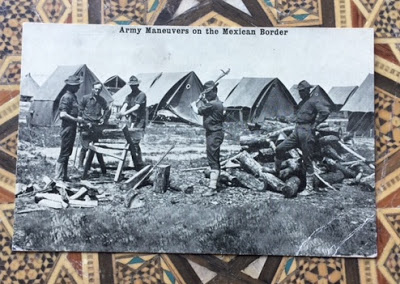
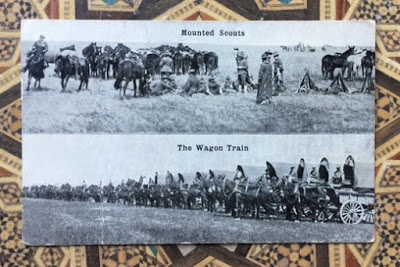
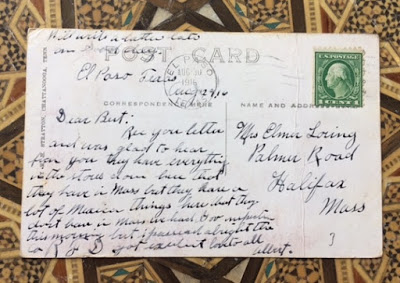
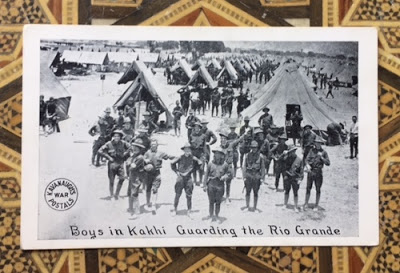
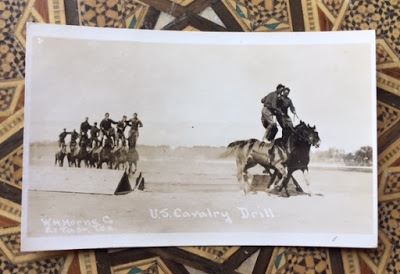
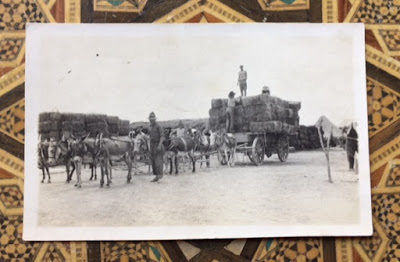
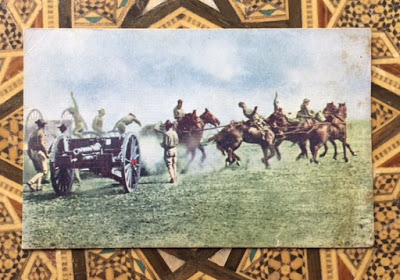
It’s a hazard in rare book nerderie: the ephemera bug bit me! I’m just back from the Center for Big Bend Studies Conference at Sul Ross State University in Alpine (Far West Texas), where I presented on “John Bigelow, Jr.,” about which a longer post is forthcoming, but in the meantime, fresh from that book fair with its bodacious selection of ephemera, herewith, thanks to Galvan Creek Postcards, a few additions to my burgeoning collection of Texas postcards from the era of WWI and the Mexican Revolution:
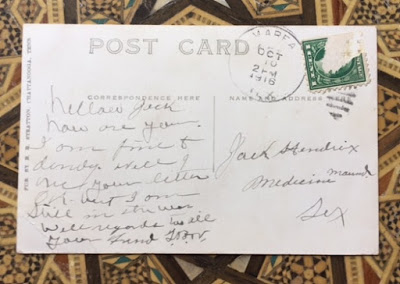
“ARMY MANEUVERS ON THE MEXICAN BORDER”
Postmark:
MARFA, TEX
OCT 10
2PM
1916
TEXT:
hellow Jack
how are you I am fine & dandy.
Well I rec your letter
OK but I am still in the war
Well regards to all Your friend LB [?]
Jack Hendrix
Medicine Mound
Tex
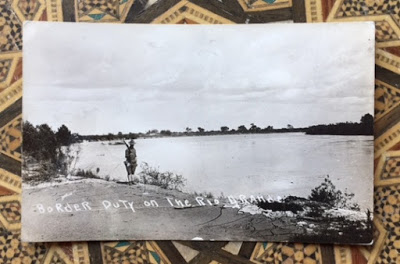
“BORDER DUTY ON THE RIO GRANDE” (REVERSE BLANK)
“MOUNTED SCOUTS; THE WAGON TRAIN”
Postmark:
EL PASO, TEX
AUG 30
1916
TEXT:
Will write a latter lato
[? ? ?]
El Paso Texas
August 29, 1916
Dear Burt:
Rec you letter
and was glad to hear
from you they have everything
in the stores down here that
they have have in Mass but they have a
lot of Mexican things here that they
dont have in Mass we had Gov inspection
this morning but i passed alright the
[?] R F D got excellent love to all
Albert
Mrs Elmer Loving
Palmer Road
Halifax
Mass
“BOYS IN KAKHI GUARDING THE RIO GRANDE”
“W.H. HORNE CO. EL PASO, TEX. U.S. CAVALRY DRILL”
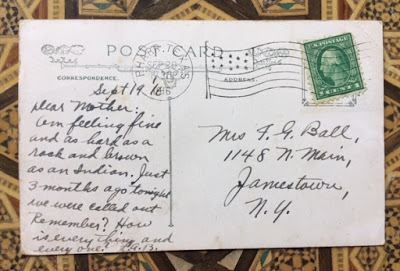
“FORT BLISS, TEXAS”
POSTMARK:
PHARR, TEX
SEPT 20
1916
Sept 19 ’16
Dear Mother:
Am feeling fine
and as hard as a
rock and brown
as an Indian. Just
3 months ago tonight
we were called out
Remember? How
is every thing and
every one? L.A.B.
P.S. My favorite rare book dealer blog is Greg Gibson’s Bookman’s Log. Watch out, these rare book and emphemera guys are dangerous. If he ever scares up a Manhattan clipper ship card…
Last Monday’s post was a batch of notes on John Bigelow, Jr. (1854-1936), an undeservedly obscure personality in late 19th century and early 20th century American history. This Friday at the Center for Big Bend Studies conference I’ll be giving a talk about the diverse periods of his life and achievements. The title: John Bigelow, Jr.: Officer with the Tenth Cavalry, Military Intellectual, and Nexus Between West and East.
I’m not aiming to write Bigelow’s biography, although he certainly merits one,* and I hope my work may encourage and aid some other scholar in that endeavor. Apart from this talk and, fingers crossed, resulting paper for the Journal of Big Bend Studies, my project is a literary travel memoir, World Waiting for Dream: A Turn in Far West Texas, in which Bigelow appears, briefly, or at some length, in various chapters, as he was stationed in or traveled through Fort Stockton, Fort Davis, Peña Blanca (now Peña Colorado, a public park south of Marathon), the Guadalupe Mountains, and other sites in the Trans-Pecos, that is to say, Far West Texas at different times in the late 19th century. Hence, it behooves me to do this research– and wagonloads more about the Apaches and Comanches, et al— and if you find this subject half as fascinating as I do, gentle reader, you’re in for a fiesta with more than a few firecrackers.
*An excellent partial biography by Marcos Kinevan is Frontier Cavalryman: Lieutenant John Bigelow with the Buffalo Soldiers in Texas (Texas Western Press, 1998).
My copy of the 1958 edition of John Bigelow Jr.’s ON THE BLOODY TRAIL OF GERONIMO (The cover shows an illustration by Frederic Remington).
Apropos of researching John Bigelow, Jr., new in my working library is a handsome hardcover, the 1958 Westernlore Press limited edition of Bigelow’s collected articles for Outing, his brother Poultney Bigelow’s magazine: On the Bloody Trail of Geronimo: A Soldier’s Journal-Account of the Apache Campaign of 1886, introduced and annotated by Arthur Woodward.
Bigelow’s articles in Outing, and as reproduced in this tome, are accompanied by illustrations by a number of artists including Poultney Bigelow’s Yale University classmate, the then-unknown Frederic Remington.
As Woodward writes in his foreward, “It was a fortunate combination. Bigelow the young lieutenant who was breaking into print for the first time, and Remington, who was likewise doing his first important commission as an illustrator.”
In fact, this was not Bigelow’s first publication– although it was his first for a general readership. Two years earlier, in 1884, Bigelow had published his study of two major battles in the Franco-Prussian War, Mars-La-Tour and Gravelotte. And, over the years, he would go on to produce an important oeuvre on military strategy.
Bigelow’s Outing essays comprised his diaries as an officer in the Tenth Cavalry, published as a series of 14 articles under the title “After Geronimo,” beginning in March 1886 and concluding in April 1887. As in Texas, Bigelow remained with the 10th, an African American regiment first established in 1866, but in this action they had been sent further west, to Arizona, to mop up the last of Apache resistance. The Comanche had been defeated in Palo Duro Canyon in 1874, and with Geronimo’s surrender in September 1886, the wars in the southwest ended. (On the northern Plains, the Ghost Dance War, Pine Ridge Campaign, and Massacre at Wounded Knee would be over by 1891.)
Despite the title, Bigelow’s diary says little about the Apaches and less about Geronimo, but it provides a rare and colorful felt sense of what is was like to serve in the West in the last days of the Indian Wars. It is also a window onto Bigelow as a military intellectual, one supremely well-versed on the literature of war and, in particular, battles of the U.S. Civil War and the Franco-Prussian War– and one who, even while chasing Apaches on horseback, was thinking about the logistics and professionalism required for the industrialized wars of the future.
THE APACHES
Linguistic evidence suggests that the Apache arrived in the southwest of what is now the United States after having migrated from the northwest centuries ago. The story of the wars against them, first by the Spanish, then the Mexicans, sometimes the Comanches, and then beginning in the 1830s, the Americans, is an ugly one with many chapters. By 1885 the Apache had been decimated, and survivors eked out a meagre life on reservations (another ugly story in itself, with many chapters). On May 17, 1885, a small contingent of Chiricahua Apache led by Geronimo and Nachez bolted the reservation with over 100 other warriors, women and children, heading towards Mexico. Writes Woodward in his introduction of Bigelow and his men:
“[T]heir work guarding the mountain passes leading out of Mexico into Arizona was a most important one. No one knew exactly where Geronimo and his band would strike.”
A graduate of West Point’s class of ’77, Bigelow had no personal animus towards the Apache. He was a patriot from the very core of the Eastern Establishment, a career officer in want of the field experience that could bring him a promotion. Previously, he had served in Texas with the Tenth Cavalry from late 1877 through the end of 1879, participating in the Victorio Campaign, then returning to West Point as an assistant professor of French. He married in Baltimore in 1884, then returned to Texas again, this time with his bride and baby, first stationed at Fort Davis, Texas, then to Fort Grant, Arizona for the Geronimo campaign.
There is much more to say about his varied and outstanding career, but to return to the Geronimo Campaign, Bigelow made no bones about his motives for returning West. As he writes in his diary for May 19, 1885 (Outing, April 1886):
“I had rejoined my regiment with the expectation of gaining in efficiency from experience in the field, and I realized the fact that the opportunities for doing so in our army were becoming fewer and harder to seize every year. I also realized that laurels were scarce along Indian trails, and that they grew in difficult places. It was principally for the practice of looking and reaching for them, with the hope that the skillfulness this acquired might some day serve me under more favorable conditions, that I aspired to getting on the trail of these Chiricahuas.”
But in the same entry, Bigelow also says:
“The American public does not know the meaning of the phrase, Indian atrocity– not its true meaning… There is no public organ to give them utterance. Their revolting indecency often excludes them from every respectable paper…”
MORE ABOUT THE 1958 EDITION
In the past, for this sort of research I would have made do with online materials or purchased an ex-library or otherwise beat-up “reading copy” from whatever used bookseller. But I have become a rare book nerd! And this fine, mylar-covered and autographed (by the editor, Arthur Woodward), was not so expensive after all (say, half the cost of a pair of not-quite-Ferragamos, or less than the cost of 4 pounds of brisket BBQ). It is a finer edition than I expected, and with a crisp, two-color title page. Check this out:
The two color title page, 1958 edition, in pristine condition
The editor of the volume, Arthur Woodward, was Chief Curator of History and Anthropology of the Los Angeles County Museum, and the author of several books on Western history.
The end papers, front and back, show the same map: OUTLINE MAP OF THE FIELD OF OPERATIONS AGAINST HOSTILE CHIRICAHUA INDIANS.
This first illustration, a portrait of Geronimo, is not by Frederic Remington but by J.R. Chapin, dated 1885.
Portrait of Geronimo by J.R. Chapin
And here are several of the Remington sketches:
“Tenth Cavalry Types” by Frederic Remington
“Arrival of the Doctor” by Frederic Remington
“The Dog of Nogales” by Frederic Remington
“A Six-Mule Government Team and Wagon” by Frederic Remington
“Reading the Orders” by Frederic Remington
“The Race” by Frederic Remington
One of the Pack Mules Turned a Somersault” by Frederic Remington
“Surprised by a Party of Mexicans” by Frederic Remington
LT. BIGELOW AND HIS DIARY
Bigelow was an unusually well-educated officer. His father was a renowned New York newspaper editor and eminence of the Republican Party whose friends included such literary lights as Charles Dickens, Joaquin Miller, Mark Twain, and Oscar Wilde. (Bigelow, Sr was also the editor of Josiah Gregg’s iconic best-seller Commerce of the Prairies, and when serving as US ambassador to France during the Civil War, had rescued Benjamin Franklin’s autobiography. More about Bigelow, Sr. anon.) John Jr.’s diary is wonderfully rich with vivid detail, e.g.:
“May 19, 1885… The men and officers have not remained in the fiery furnace in which the command unsaddled. The men are mostly strewn along the railroad track, asleep in the shade of the freight cars; others are in the pump-house, through which water is brought up from an artesian well into the railroad tank; others are lounging on the platform of the station. They officers are in the warehouse. They are an ennuyé-looking set at this hour of 4 P.M.; one of them is sleeping on the hand-truck… About 5 P.M. took place the great excitement of the day– a passenger train came in from the West, and stopped about five minutes. A brisk sale ensured of newspapers and California fruit, in which a crushing railroad monopoly possessed itself of many a last cent. One officer paid 4 bits (50 cents) for four oranges.” (Outing, April 1886)
“September 6, 1885… Like most primitive American towns [Harshaw] consists of one street, lined with box-like frame houses, largel eating and drinking places; in front of these we saw an assortment of Harshaw’s men of leisure, whose facial expressions conveyed a seeming determination not to be the first to say good-day.” (Outing, June 1886)
A LANDSCAPE OF INDUSTRIALIZATION
While Bigelow does describes the saguaro cacti, gila monsters, and other exotica, including Mexican tortillas, pinole, and panocha, he and his men traverse a rapidly industrializing Arizona of railroads and hardscrabble mining towns. When possible, to spare the horses, he would march them along the railroad.
In Clifton:
“October 3, 1885… While coming into the town, I had noticed a peculiar intermittent light… which I thought might come from an electric light; now I saw that it came from a smelting work across the river. It was produced by the fresh slag; the pigs– that is, I believe, what they call them– breaking open as they rolled down the side of the dump, exposing the incandescent mass inside. having seen to the feeding and grooming of my horses, I started out with Lietnenant Reade in search of a dinner. We wandered down the street to near the end of the town, and entered the largest and brightest-lighted of the many resorts that we passed– a typical mining-town amusement hall. From a sort of large box I looked over a breast-high, counter-like partition into the main room upon a crowd of men and women of various ages and nationalities. At the middle of the side opposite the entrance was the bar. At the farthest end, from which came the sounds of lively music on the violin and other instruments, I could see figures bobbing and whirling through square and round dances. About the middle of the room was a mixture of Mexicans and Americans, sprinkled with Germans, English, Irish and other nationalities… Some of these people were playing at the billiard-tables, others were seated on the side of the room opposite the bar, or standing about the floor engaged in more or less excited conversation. The women, coming up in their promenades between the dances for a change of scene and air– sometimes for refreshment at the bar– were fewer here than at the farther end of the room. As seated at one of the restaurant tables, I took in the animated scene, I questioned to myself the propriety of my being where I was, especially of my being seen here in uniform. Before I had answered this questioning to my entire satisfaction, a couple of well-dressed gentlemen came into our little room, and as they sat down at the table next to ours, one of them was designated to me as the Governor of the Territory. I had no further concern as to the propriety of my situation. Having eaten a good supper, I repaired, rather tired, to my saddle and blankets for the night.” (Outing, August 1886)
“January 21, 1886. My authority for a leave having come yesterday, I… boarded a train and settled down with my Spanish grammar and my papers and periodicals to their enjoyment from a spring-cushioned seat. At Benson, the junction with the Southern Pacific Railroad, I lunched at a Chinaman’s, at the small cost of twenty-five cents, and I think I know what I ate. It brought me back to civilization to find myself, as I did at one o’clock, seated in a sleeping car opposite a young man in a close-fitting checked suit, carrying an extreme height of collar and sporting a varnished cane.”(Outing, November 1886)
WHITHER GERONIMO?
Not a scene Lt. Bigelow saw: Geronimo and his warriors in Mexico, prior to their surrender in Skeleton Canyon, Arizona.
Bigelow did not see much action nor even get close to Geronimo; the Apache warrior-shaman seems an almost ghost-like presence in the diary.
“Sept 8, 1885… Geronimo is thought to be making for the San Mateo Mountains, the Indian strongold in New Mexico. I expect soon to hear of a movement of troops from the border towards the interior” (Outing, July 1886)
“October 7, 1885... About an hour after dark I made out a fire among some trees ahead of me. Having proceeded to within a few hundred yards of it, I halted, dismounted the troop, and advanced with my ranking non-commissioned officer to determine what it was. The corporal put his ear to the ground and reported, “They are cowboys, sir; I hear the voices.” So I mounted and pushed on. When about one hundred yards farther, we crossed a railroad and a hard level stretch beyond it, and came upon a stream about twenty feet across, which I took to be the Gila. I worked my way along it toward the fires on the opposite bank, hallooing for some one to come and show me where to cross. I was soon answered by a man standing close to the water’s edge, who told me to do so where I stood, and asked me who I was. Upon telling him, I asked him, with lively curiosity, “Who are you?”
“I am Lieutenant Reade.”
It turned out to be my friend and classmate, Lieutenant Reade, of my regiment, and my corporal’s alleged cowboys were his men.” (Outing, August, 1886)
“October 4, 1885... I went to the telegraph office for news. Learned that… General Crook concludes that the Indians have returned to Sonora.” (Outing, August, 1886)
“February 3, 1886... I apprehend that Geronimo is not yet ready to make an unconditional surrender.” (Outing, December 1886)
“March 4, 1886… Camp-life seems drearier and emptier than ever. I try to reconcile myself to it as a wholesome discipline in preparation for the intervals of inaction in real way, but it is hard to imagine this inanity in real war.” (Outing, January 1887)
“March 18, 1886. It is now three days since General Crook was to have met Geronimo, but we have not yet heard of his doing so.” (Outing, January 1887)
“March 21, 1886… This time last year I was packing to move from Texas to Arizona and I have been pretty constantly in camp or on the march ever since. When I consider what little professional advantage that this roughing it is affording me, I am satified with the prospect of a return, without honor or distinction, to my garrison home.” (Outing, January 1887)
But the violence, and for Bigelow, the chase, heats up in May. Bigelow and his men are in the field, hearing stories of killings and kidnappings, seeing signs of Indians, visiting abandoned and pillaged ranches– but still, no Geronimo. The last article in the series, published in April 1887, in the main diary entries from June 1886, have Bigelow and his men roughing it out in the field.
“June, 1886... we found the body of a man shot through the heart. From papers lying near him and from his appearance, I judged him to be a German. He was evidently camping here, cultivating a small vegetable garden.. I noticed on the top of his head a raw, white circle about the size of a dollar, which showed him to have been scalped.” (Outing, April 1887)
They cross the border into Mexico, passing near American-owned mines:
“San Lazaro, Mexico, June 14, 1886... I am told that the day after I passed through here going east, a party of Indians, numbering thirty-seven, crossed the road some twenty-five miles below, testifyng to their hot pursuit by eating raw meat.” (Outing, April 1887)
Without ceremony, the diary trails off with the last installment in Outing April 1887, when presumably, readers would have known of Geronimo’s surrender in September 1886 in Arizona’s Skeleton Canyon.
In the diary published in Outing Bigelow says little of the Chiricahua Apache. Most of his descriptions of Indians of are of his own scouts, Tontos and Mojave. However brief and light his focus, Bigelow has an eye for novelistic detail:
“December 14, 1885…After issuing them their arms, ammunition, accoutrements and camp equipage, I proceeded to take down the wants of my Indians in the way of clothing. which struck me as rather capricious. Some wanted a hat, and some did not; the same was the case with boots… In order to get at the sizes they needed, I had toi let them try on my own boots and hat and gauntlets…. One Indian amused us very much in his first attempt to utilize a boot-jack.” (Outing, September 1886)
“January 30, 1886… Tonto Jim… did not stay long, as I offered him nothing to smoke. These Indians are greater smokers if cigarettes than the Mexicans. Not smoking myself now, I have discontinued keeping tobacco, and I apprehend that my Indian friends will fall off from me. They used to come in and make long visits on my tobacco-box, and would often ask me for tobacco and cigarette papers, of which I kept an extra supply for them. They never say “thank you,” or anything that seems like it. I do not think there is any such phrase in their language.” (Outing, December, 1886)
GERONIMO THEN, GERONIMO NOW
I cannot help but wonder what Bigelow would have made of the rest of Geronimo’s life, and whether he reflected upon his own influence on Geronimo’s fame. (Perhaps I shall find out, if I can consult his diaries, which are in the Library at West Point.) After a stint as a POW in Florida, then Alabama, Geronimo lived out his life in Fort Sill, Indian Territory. Writes William A. Clements in Imagining Geronimo:
“Geronimo became a celebrity. He attended world’s fairs in Omaha, Nebraska, in 1898; Buffalo, New York, in 1901; and Saint Louis, Missouri, in 1904. He participated in Theodore Roosevelt’s inauguration in 1905 and was courted by Wild West show entrepreneur Gordon Lillie (Pawnie Bill). He was a tourist attraction and provided good copy for journalists who speclated that he had gone mad, that his much heralded conversion to Christianity was only a sham, and that he was plotting an escape. Newspapers sought his opinions on topics such as the Filipino resistance to the American presence following the Spanish-American War and the education of Apache children. Geronimo died in 1909 from pneumonia that he contracted after lying out all night after one of his protracted drinking bouts.” (p. 10)
As those of you who follow this blog well know, I live in Mexico City and have been at work on a book about the Trans-Pecos (that, is Far West Texas) for more than a spell. Books on the Trans-Pecos are sparse on the ground south of the border, so when I travel to Texas I always try to scour a bookshop or three. Thus have I accumulated a working library, including not a few rare and unusual books. For this sort of project, archival research is also important to do– and I have done some– but it can be woefully expensive to travel to and spend time working through archives. So whenever an historian has taken the trouble to transcribe and publish anything relevant from any archive of interest to me, I am triply grateful for such a find.
Why is this excerpt from Lieutenant Bigelow’s diary, from 1884-1885 in Fort Davis, Texas, so interesting and important?
The Tenth refers to the Tenth Cavalry, one of the African American regiments — “Buffalo Soldiers”– established after the U.S. Civil War, famed for its exploits in the West during the Indian Wars of Bigelow’s time (and later, in the Spanish-American War, also of Bigelow’s time, but that would be another blog post).
Fort Davis, tucked among the volcanic Davis Mountains, and surrounded by hard desert for hundreds of miles around, was one of a string of US Army forts set up to protect the El Paso Road.
To give an idea of the remoteness, Bigelow wryly remarks:
Fort Davis, Texas. Thursday Jan. 15, 1885 … One is apt is a country like this to suspect everybody one meets with some discreditable reason for being here, without thinking that one is subject to the same suspicion oneself.
It was highly unusual for anyone to keep such a detailed, articulate, and thoughtful diary as did Lt. Bigelow. No doubt he was encouraged in this endeavor by his father, John Bigelow, a dedicated diarist himself, and newspaper owner and editor, author, ambassador, and publisher. (For one of my previous books, The Last Prince of the Mexican Empire, a novel based on the true story during the French Intervention in Mexico, I consulted Bigelow Sr.’s diary in the New York Public Library’s Manuscripts Division. More about Bigelow, Sr. anon.)
Back to Lt. Bigelow. Writes McChristian of Lt. Bigelow’s Fort Davis diary:
“A keen observer and a skillful writer, Bigelow left a vivid record of events and relationships at the post as he witnessed them. He included no expeditions or battles, no heroics, no glitter– only the realities of life on the frontier.”
Nuggets in Lt. Bigelow’s diary include:
Fort Davis, Tex. February 12, 1885 Have written to Chicago for 1/2 doz. base balls for the troop. The men have bats and bases. I hope my efforts to afford them recreation will counteract the unpleasant impression they receive from the extra drill that I give them and the increased severity of discipline to which I subject them.
The men were not so isolated as they might have seemed:
Fort Davis, Texas. Sat. Feb. 14, 1885… I read the report in the New York Herald today that Khartoum had fallen. From that paper I gather that the British do not comprehend yet the power of their enemy. They think of turning the tables with five or ten thousand additional troops. They will want five or ten times that many troops to conquer the Mahdi.
And Bigelow mentions meeting Quanah Parker:
Fort Davis, Tex. Tuesday Dec. 9, 1884. Have just returned from a call at Lt. Woodward’s where I met the Chief of the Comanches in the Indian Territory [Oklahoma]. His tribe is not regarded as civilized. It is behind the Choctaws, Chickasaws, Seminoles. All communications with his tribe from the Federal Government go to him. He assembled the heads of families with whom he discusses the matter. Ten years ago, says Woodward, this man wore a blanket and breech clout. Today he is dressed like any white man. He has two other Indians with him. All three are going tomorrow about 60 miles south of here to get a certain herb which they prize as a medicine. Clarke is to escort them with about 1/2 dozen men. Quanah has a determined, and intelligent, though not a bright look. His mother was a white woman captured in Texas when quite a child; who subsequently married an Indian.
[Quanah’s mother was Cynthia Ann Parker and his father a chief, Nocona. The “certain herb” they were heading south to harvest was peyote cactus, then abundant in the Big Bend along the Rio Grande.]
Lt. Bigelow and Quanah are among the personalities I will be including in my book on Far West Texas. Apropos of that, this November I will be presenting a paper about Bigelow at the Center for Big Bend Studies conference at Sul Ross State University– in heart of the Trans-Pecos. Indeed, there are continents more to Bigelow’s life than his brief posting to Fort Davis and these few pages of his diary might suggest. The original diary, which spans many more years, including his earlier postings in the Texas in the 1870s, is in the United States Military Academy (West Point).
There is also a substantial archive of John Bigelow Jr. (and Sr. and family) correspondence during the Texas years (and much more) at Union College in Schenectedy, New York.
Bigelow’s father, John Bigelow, Sr. was an ardent reader of Emanuel Swedenborg, having encountered the Swedish mystic’s books on a journey to Haiti in his work as an Abolitionist (whew, yes, that is all packed into in one sentence! Never a dull moment with John Bigelow, Sr.). So I have been wondering to what degree, if any, his son might have been influenced by those ideas. I have little to go on at this point, but one comment in Lt. Bigelow’s diary is suggestive:
Fort Davis, Tex. Dec 4, 1884… I have begun reading to Mary (a chapter every evening) a book that was given to her in Baltimore: Natural Law in the Spiritual World. I find it original, interesting, and edifying.
Natural Law in the Spiritual World was a best-seller of its day; the author was Scottish evangelist Henry Drummond (1851-1897). As far as I can ascertain from a search through the digital edition of this book however, Drummond was not retailing Swedenborgiana.
Also of note is the masters thesis by Howard K. Hansen, Jr., “The Remarkable John Bigelow, Jr: An Examination of Professionalism in the United States Army, 1877-91,” Old Dominion University, 1986, which provides a splendid introduction to Bigelow’s oeuvre as a military intellectual, including Mars-la-Tour and Gravelotte; The Principles of Strategy; and The Campaign of Chancellorsville.
Today Bigelow’s best-known publication is his series of 15 articles, “After Geronimo,” based on the diary he kept as a cavalry officer with the Tenth in Arizona, which he published in his brother Poultney Bigelow’s magazine, Outing in 1886-87. Some of these articles included illustrations by Poultney’s Yale University classmate and friend, the soon-to-be-world-famous artist Frederic Remington. John Bigelow, Jr.’s articles for Outingwere collected and republished in 1958 as On the Bloody Trail of Geronimo, with an introduction and notes by Arthur Woodward.
From his obituary in the New York Times, March 1, 1936:
… Expert strategist and tactician, Spanish War veteran, geographer, author, college professor and descendant of a family distinguished in American history, Colonel Bigelow was well-known in military and social circles both in the United States and abroad.
His father was John Bigelow, United States Ambassador to France under President Lincoln, and his mother, the former Jane Tunis Poultney, a social leader of her day. Poultney Bigelow, the author, is a brother.
The colonel was born in New York on May 12, 1854. After attending private schools in New York, Providence, R.I., and in Europe, he was appointed to West Point, from which he was graduated in 1877. One Jun 15 of that year he was commissioned as a second lieutenant.
Promoted to first lieutenant on Sept. 24, 1883, he was made a captain on April 15, 1893, a major on Dec. 8, 1902, and lieutenant colonel on Sept. 15, 1904, being retired at his own request the same day. From 1887 to 1889 he was adjutant general of the District of Columbia Militia.
Colonel Bigelow particularly distinguished himself during the Spanish-American War. He was wounded four times at the battle of San Juan Hill on July 1, 1898. For his heroic conduct then he was cited in general orders and received the Silver Star…
And I found him and his wife (née Mary Dallam) listed on p. 57 of the 1918 New York Social Register. Bigelow was then at Rutgers College in New Jersey.
Viva, Richard Polt! He says that if you send him your address he will send you this postcard.
One of the themes in my work-in-progress
on Far West Texas is the nature and pervasive influence of
technology, especially digital technology– but also other kinds of industrial
and military technology.
So what’s with the typewriter poem? The poem
pictured above, “The Typewriter Manifesto,” is by philosophy
professor Richard Polt. I’m a big fan of his blog and his book, The Typewriter
Revolution.
My 56 year-old Hermes 3000 works fine, no need to update the OX! (Yes, ribbons are easy to score on eBay).
Nope, I am not a Luddite, but yep, I use a typewriter on occasion. When needed, I also use a Zassenhaus kitchen timer, a 30 year-old finance-nerd calculator (I used to be a finance nerd), and a battery-operated alarm clock. Yes, I know there are apps for all of those, and yes, I actually have downloaded and previously used all those apps on my smartphone but, e-NUFFF with the digital! Too many hours of my day are already in thrall to my laptop, writing on WORD or blogging, emailing, podcasting, maintaining my website, surfing (other blogs, mainly, and newspapers, plus occasional podcasts and videos), and once in a purple moon, making videos. Most days my iPhone stays in its drawer, battery dead, and I like it that way.
But kiddos, this not a writer-from-an-older-generation-resisting-innovation thing. Back when I was avid to adopt new technology. I had a cell phone when they were the size and shape and weight of a brick. I started my website in 1999! I bought the first Kindle model, and the first iPad model. I was one of the first writers to make my own Kindle editions (check out my latest). I started podcasting in 2010. I even spent oodles more time than I should have figuring out the bell-and-whistles of iTunes’ iBook Author app… and so on and so forth.
From Charles Melville Scammon’s “California Grays Among the Ice” Whales! Magnificent outside! Digestive juices inside!
In short, with technology, especially anything
having to do with writing and publishing, I dove right into the deep end… and
I have seen the whale. And it was not, is not, and will not be on my schedule
to get swallowed whole.
(The original pretzel-brain inducing essay by
Heidegger, “The Question Concerning Technology,” with its handful of
profound points coccooned within copious noodathipious deustcher
Philosophieprofessor flooflemoofle, is here.)
And here is the Lilly interview with Jeffrey Mishlove, for “Thinking Allowed” (the one where Dr. Lilly wears his earrings and Davy Crockett hat). Um, you will not eat your popcorn during this one.
#
Delighted to have surfed upon Tadeuz Patzek’s
blog, LifeItself. Patzek is a professor of petroleum engineering,
recently chair of the department at University Texas Austin. He
is co-author with Joseph A. Tainter of Drilling Down. I
read Drilling Down on Kindle this week, then bought the paperback to
read it again.
“Cryptocurrencies are a new
asset classthat enable decentralized
applications.“
In other words, “cryptocurrencies” are
not currencies as we know them. “Crypto” is too sexy a word for what
these actually are. So let’s call these puppies NACTEDAs. Rhymes with
“rutabagas.”
Ludwin’s most interesting quote? Buried deep in
the middle of his explanation of the nature of NACTEDAs is this colorful
explanation of how NACTEDAs are generated or “mined”:
“Now we need an actual contest… On your mark, get set: find a random number generated by the network! The number is really, really hard to find So hard that the only way to find it is to use tons of processing power and burn through electricity. It’s a computing version of what Veruca Salt made her dad and his poor factory workers do in Willy Wonka. A brute force search for a golden ticket (or in this case, a golden number).”
This is not a point Ludwin makes (he sails on,
with utter nonchalance): It is just a question of time– maybe a loooooooong
time, albeit perchance a seemingly out-of-nowhere-pile-on-Harvey-Weinstein
moment– until people recognize the environmental and social justice
implications of such extravagant electricity use for generating NACTEDAs.
Can you say, opportunity cost?
As it stands, most people don’t or don’t want to
grok where the magic invisible elixir that always seems to be there at the flip
of a switch actually comes from…. which is, uh, usually… and
overwhelmingly… coal. And neither do they grok that this flow of power is not
never-ending, but a utility that can be cut off. Ye olde winter storm can do it
for a day or so. More ominously, the grid itself can fail for lack of
maintenance, or any one of one a goodly number of events– it need not
necessarily be some cinematically apocalyptic cyberattack or epic solar flare.
Can you say Puerto Rico. Can you say Mexico City after the earthquake. Can you
say what happens when you don’t pay your bill. Or if the electrical company
makes a mistrake. Lalalalala.
In any event, I wouldn’t recommend a camping
vacation on some random mountaintop in West Virginia any time for… the rest
of your life.
#
And
herewith, hat tip to Root Simple,
Lloyd Kahn demonstrates his low-tech dishwashing method. The duck part at the
end is charmingly weird.
Andy Warhol must be twirling his wig there in some fuggy realm of the astral watching the Instagramming-Tweeting-Facebooking smombiedom of our day. So it seems, everyone and their neighbor’s cousin’s twinkle-eyed cat is a 24/7 celebrity in their own iPhone. A century ago, many a decade before Mr. Warhol’s meteoric flash through the bizarropheres of celebridom (which I daresay have reached their apogee with our Tweeter-in-Chief, DJT), celebrity meant something different, and if not always, at least usually a more curated and dignified elevation to social visibility, and perchance of a literary nature. Well! I’ll leave it for our social historians to parse out the granular detail from that particular conceptual bramble-clogged tarpit. I’m just bloggin’ here about POULTNEY BIGELOW, an obscure figure today, but a dazzler of a literary celebrity in his time.
The author of a raft of books and pioneer publisher of the sports magazine Outing, Poultney Bigelow has popped up on my radar because I am at work on a book about Far West Texas that will include some discussion of his older brother, John Bigelow, Jr.’s articles about the Indian Wars, which Poultney published in Outing, along with illustrations by Poultney’s classmate at Yale, Frederic Remington.
> Next up on my reading list: G. Edward White’s The Eastern Establishment and the Western Experience (Yale University Press, 1968).
JOHN BIGELOW SR.
John Bigelow (Sr)
Poultney (b. 1855) and John Jr. (b. 1854) were the sons of John Bigelow, a skyscraper of a figure in US, New York State, New York City, and Panama Canal history. As President Lincoln’s Minister to France, John Bigelow Sr. also had quite a bit to do with twisting Napoleon III’s arm to remove his army from Mexico… and Abolition… publishing history… and Swedenborgianism….
Poultney Bigelow’s best-known work is his memoir, Seventy Summers, in two volumes, 1925.
When he was a boy, as mentioned, his father was President Abraham Lincoln’s Minister to France. Those familiar with Mexican history will recall that the French Imperial Army had invaded Mexico to support a return to a Catholic monarchy: the regime of Maximilian von Habsburg. By 1866, thanks in part to Bigelow’s persistent pressure in support of the Mexican Republic, Napoleon III’s support for Maximilian was waning, and the Mexican monarchy began to collapse. Poultney Bigelow (vol I p. 33):
The Prince Imperial of France
“The Emperor sent his only child, the Prince Imperial, to mark his warm friendship for Uncle Sam. It was a bitter pill for Eugenie, and still more for her Court, who had invested much money in Mexico. How they must have cursed the heretics, Lincoln and Stewart and Grant, for thus destroying their dreams of easy money!…
“Prince Imperial was not so attractive to me… His hair was perfumed, oiled, and curled; he wore a velvet suit with a wide lace collar; he was pale, thin, and obviously on an official mission. An arm-chair became his baby throne, and behind it stood a forbidding Field-Marshal whose uniform was rich in decorations, and whose grandeur checked any impulse we boys might have cherished as regards a rough romp.
“My brother [John Bigelow, Jr] and myself were formally presented– and amongst the many elders many compliments were exchanged, and much emphasis laid upon the Emperor’s kindness so nobly manifested. But the formality was an empty one– we did not play any games with His Imperial Highness, and he soon retired with his war-like equerry to tell his fond mamma that he had been among the American savages, that he had escaped alive, and was uncommonly glad at not having had to share in our brutal pastimes.”
Playtime in Potsdam with Prince Wilhelm (1859-1941), whom he calls William, who would become Kaiser Wilhem II, was a marked contrast (vol I p. 76):
“At the Neues Palais I was cordially welcomed by Prince William and his brother Henry… From the hour of my first visit until our departure for New York in the fall of 1872, I was an almost constant playmate of the future Kaiser… We romped about the great palace if the weather was bad, played hide-and-seek in the vast attic spaces, and once had the rare treat of working the stage machinery in the theater. Of course, as in the case of most normal boys, we compared notes on likes and dislikes. Prince William knew his Fenimore Cooper by heart, and thirsted for games reminiscent of Uncas and Leatherstocking.”
The future Kaiser Wilhelm
Literary connections were multitudinous in the Bigelow household. Babe Poultney is held by Washington Irving (p.19), as a boy shakes hands with Charles Dickens (p. 54); and later visits with Samuel Clemens, aka Mark (“Dear old Mark!”) Twain in Johannesburg and in London (pp. 165-168). On the poet Joaquin Miller (p.197):
“Joaquin (pronounced Walk-een by the initiate) had rented a cottage on my father’s place near West Point, and acted the part of an interesting savage slowly accomodating himself to the ways of the white man… On his head was a picturesque Mexican sombrero, beneath whose broad brim flowed a massive main after the fashion of Buffalo Bill…”
Jefferson Davis
Giants of politics and captains of industry make their cameo appearances, among the former, Jefferson Davis (breaks up a dog fight with his bare hands p. 225), Theodore Roosevelt (vol I 272, vol II 194, 212 212….) and among the latter, Andrew Carnegie. With Carnegie, as with certain others, Poultney can be cutting– and this apropos of Carnegie’s annual visits on John Bigelow, Sr.’s birthday (p. 198):
“Carnegie awakened my dislike from first meeting him in the early ‘eighties, and this instinctive feeling was further fortified by my father who was profoundly religious.”
The scene in which Bigelow Sr invites his birthday visitor to finance
the translation and publication of the works of Swedenborg would make a
prize-winning playlet.
Poultney’s first taste of Yale University did not suit him. He took a two year leave to travel the world. It would be difficult to overstate his adventures before starting Outing
magazine: China, Japan, Papua New Guiness, Borneo, China… returning
to Yale in 1876… and many more subsequent world travels…
At Yale University he meets Frederic Remington; together they take a drawing class (p. 301):
“The most difficult of all statues for a beginner was given us: the madly dancing Faun generally credited to Praxiteles. At long intervals the melancholy professor of drawing entered our cheerless room, gazed sadly at our clumsy crayoning, made a few strokes by way of emphasizing our clumsiness, and then disappeared.”
OUTING: AN ILLUSTRATED MONTHLY MAGAZINE OF RECREATION
The range of sports covered included bear hunting, moose hunting, salmon fishing in Canada, blowing up an abandoned ship in the waters off Madeiria, camping in Yellowstone , cruising to the Bahamas in winter, chasing Geronimo, tennis… Uf, I am breathless just typing all that.
IN OUTING: “AROUND THE WORLD ON A BICYCLE” BY THOS. STEVENS, ILLUSTRATED BY W.A. ROGERS
I just kind of went acorns & hazelnuts taking screenshots from the series of articles on biking, “Around the World on a Bicycle” by biking pioneer Thomas Stevens (1854 – 1935), illustrated by W. A. Rogers.
A FEW FURTHER NOTES ON “OUTING”
And here are a few of the ads in Outing— which give an idea of the magazine’s readers, or at least as the editor and his advertisers might have envisioned them:
In general the articles in Outing are long, dense (no pull quotes), and sparsely if interestingly illustrated. The contrast with most of our contemporary magazines– a froth of pull quotes, splashy photos and advertising featuring more splashy photos (for the most part of stick-thin people exuding ennui, disdain, or immanent coma) and the whole of it but sprinkled with driplets of prose– is striking. I quail to think of Mr Bigelow’s reaction were he to have seen the likes of Sports Illustrated.
The prose in Outing gives me a yen for crumpets, or something. From the opening of a November 1885 “To the Pole on Sledges” by W.H. Gilder:
“Do I think that any one will ever reach the North Pole? Most assuredly.”
The
poetry is, shall we say, evidence that literary tastes have since
evolved. Herewith a couple of samples (after which point my bemusement
wears thin):
YO, THEODORE ROOSEVELT!!!
Screenshot of an article by Theodore Roosevelt in Poultney Bigelow’s Outing.
A buff-looking portrait of Theodore Roosevelt by J. R. Chapin
A CHAT WITH STANLEY IN THE CONGO
Later in this article there is a gruesome drawing of doing in a hippopotamus, not shown here.
Notes about Poultney’s older brother John Bigelow Jr, his career, and his reporting on the Indian Wars for Outing anon.
Isn’t just too too too tooooo much a-gurgling and churgling and over-arcing and under-the-rugging in this techno-kray-zee world? In the spirit of calming things down, this Monday I offer a wee but wicked poem, typed on ye olde 1961 Hermes 3000: