As I mosey along with my book about borderlands Far West Texas I have become increasingly fascinated by the interweavings of the imaginal realm and the real, that is, how novels, television shows and movies are inspired by and in turn shape our ideas about this place, its people, and its history. (See my previous post, “Thirteen Trailers for Movies with Extra-Astral Texiness.”) I have also been pondering the ways in which the digital revolution has transformed the experience of travel itself, conflating, multilayering, and pretzeling time and space. (See my post on “Literary Travel Writing: Notes on Process and the Digital Revolution.”) And I’ve been noodling on technology (see “Notes on Wolfgang Schivelbusch’s The Railway Journey.”)
So no surprise, I have ended up, willy by nilly,
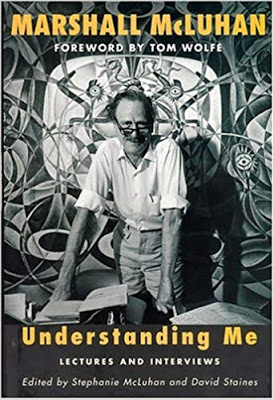
crunching through the ouevre of Marshall McLuhan.
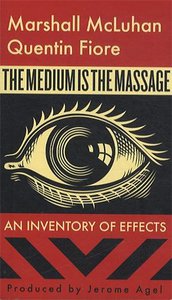
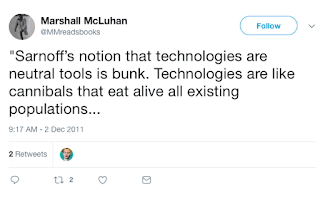
For anything to do with media, Marshall McLuhan is your superstar go-to guy. He’s wild, brilliant, cryptic until you realize just how very brilliantly inside-out brilliant, and spookily prophetic. His famous saying was, “the medium is the message.” His arguably most famous book, however, is titled The Medium is the Massage.
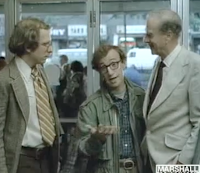
An excellent introduction to his work is this video on the Marshall McLuhan Speaks website. It opens with his cameo in the Woody Allen film, “Annie Hall,” then goes to an approximately 20 minute introduction by Tom Wolf.
This year I’ve been posting a Q & A with a
fellow writer on the fourth Monday of the month, and while I have every
intention of continuing to do so, this Monday instead herewith some notes on
the epic novel by the artist who, back in 2001, passed over to the Great
Beyond: Tom Lea.
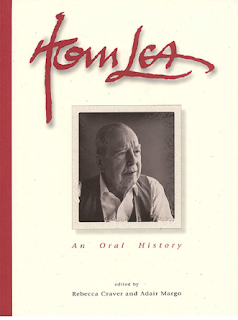
“It is part and parcel of your culture and I
think you should cherish it,” says Italian art historian
Luciano Cheles of the surprisingly little-known works of El Paso, Texas painter
and writer Tom Lea. And encouraging that is precisely what Adair Margo has been
doing with great verve for the past many years with the website and educational
programs of the Tom Lea
Institute. I had the immense privilege of attending Margo’s talk
about Tom Lea at the Bullock Museum in Austin back on October 15, 2015. (And by
felicitous happenstance, I sat next to Luciano Cheles.) More about that anon.
Here is the must-see 5 minute video with what
Cheles has to say about Lea’s artwork:
For more on Lea’s and The
Wonderful Country’s place in the canon, see Marcia Hatfield Daudistel’s
majestic anthology, Literary El Paso
(TCU Press, 2009).
WILDEST WEST EL PASO
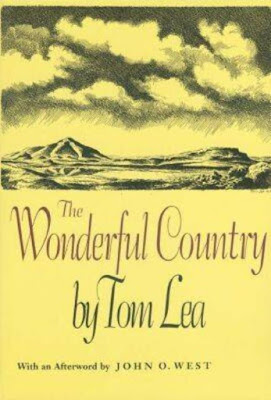
This post is prompted by my work-in-progress about Far West Texas (…stay tuned for more podcasts…) At long, belated last I have tackled Tom Lea’s epic historical novel of El Paso.
I am happy to report that The Wonderful Country is wonderful indeed, a masterpiece not only of works set in El Paso, but in the genre of the Western, and indeed in all of American fiction.
These days most literary readers, and especially those out on the coasts, tend to turn their noses up at Westerns. Dear curious and adventurous reader, if that describes you, be assured that to overlook reading The Wonderful Country is to miss out on something very fine in U.S. literary heritage. The Wonderful Country was popular in its day, back in the 1950s, but it is not a typical commercial novel; it has a high order of literary quality; morever, its treatment of Mexicans and Mexico is unusually knowing and sensitive. (What would I know about that? Start here and here; my books are all here).
Set in post-Civil War El Paso, that is, the
latter part of the nineteenth century, the first days of the railroad and the
last of the free-roaming Apache, and published in the pre-Civil Rights era,
Lea’s The Wonderful Country forthrightly portrays many of the still
painful tensions in the border region. While he writes with an unusually open
heart and mind, Lea is scrupulous in rendering accurate period detail. The
“N” word appears! (In the mouth of a character.) There is no lack of
roastin’ ‘n stabbin’ n’ shootin’ n’ scalpin’ and our hero is the son of a
Confederate from Missouri. Vegetarians and those with flea-trigger hot-buttons,
be forewarned.
From the catalog copy, TCU Press, 2002:
“Tom Lea’s The Wonderful Country opens as mejicano pistolero Martín Bredi is returning to El Puerto [El Paso] after a fourteen-year absence. Bredi carries a gun for the Chihuahuan war lord Cipriano Castro and is on Castro’s business in Texas. Bredi fears he will be arrested for murder once he is back across the Rio Grande. Fourteen years earlier– shortly after the end of the Civil War–when he was the boy Martin Brady, he killed the man who murdered his father and fled to Mexico where he became Martín Bredi.
“Back in Texas, other misfortunes occur to Brady. First he breaks a leg; then he falls in love with a married woman while recuperating; and, finally, to right another wrong, he kills a man.
“When Brady / Bredi returns to Mexico, the Castros distrust him as an American, and Martin is in the intolerable position of being not a man of two countries but a man without a country.
“The Wonderful Country is marvelous in its depiction of life along the Texas/Mexico border of a century-and-a-half ago. Lea brings to life a time that was wild, a time when Texas and Mexico were being settled and tamed. Lea knows the desert region of his birth as well as anyone who has ever written about El Paso and the great nation that borders it to the south.”
NOTES ON THE TCU PRESS EDITION WITH AN AFTERWORD
BY JOHN O. WEST
You should be able to scare up a first edition
over on www.abebooks.com,
and power to you if you want to shell out the clams for a fine first with
intact dustjacket and an autograph. The copy I read is the paperback
reprint of 2002 available from TCU Press (and most online
booksellers) which includes afterword by John O. West, a noted US-Mexico border
scholar. For West’s afterword I would recommend the TCU Press paperback as your
best buy (unless your main goal, buck for buck, is to beat the stock market).
As far as I know, all editions include the
elegant and evocative drawings Lea made to head each chapter.
John O. West argues, and I concur:
“The story of Martin Brady is that of Thomas Wolf’s You Can’t Go Home Again, of Mark Twain’s Huckleberry Finn; the setting in the desert Southwest gives it particular realism, but the theme makes it speak beyond the region where it grew.”
West also provides some illuminating background
on the inspirations for the novel. My additional notes below.
NOTES ON THE PLACE, THE PEOPLE, AND THE EVENTS
THAT INSPIRED THE NOVEL, PLUS SOME RELATED RECENT WORKS & WEBSITES
Tom Lea’s “El Puerto” is based on El Paso; Fort Jefflin, clearly inspired by Fort Bliss.
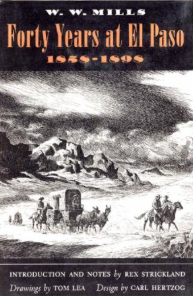
El Paso pioneer W.W. Mill’s memoir Forty Years at El Paso, 1858-1898 was Tom Lea’s major inspiration. A first edition is pricey! But it is out-of-copyright now so you can read a digitalized edition for free online.
W. H. Timmons’ El Paso: A
Borderlands History (Texas Western Press, 1990). Back in the
1960s, Timmons served as Chairman of the History Department at the University
of Texas El Paso.
Fort Bliss actually moved around the El Paso region
quite a bit in the 19th century, but you can visit the current Fort Bliss,
which has an adobe museum and a modern museum– the latter perhaps of most
interest for WWII aficionados. The historic parade grounds, surrounded by
stately houses for senior officers, are well worth a visit.
Some of the characters in The Wonderful
Country are inspired by (or mighty similar to) some real people, among
them:
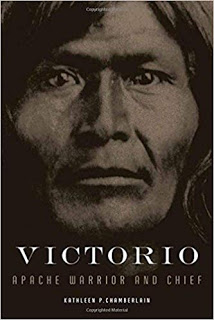
Both the U.S. Army and the Mexican Army went after the Apaches, and in some instances, U.S. forces chased Apaches into Mexico. In general such US Army forays seem to have been welcomed by the Mexicans, but communications in these remote areas were dicey and resentments still very raw after the US-Mexican War. Many historians writing in English about border history have not had the wherewithall to research Spanish language sources, and vice versa, so there is some low-hanging fruit here for those historians with cross-border cultural and language skills. The Apaches also have something to say about it. One recent biography of note is Kathleen P. Chamberlain’s Victorio: Apache Warrior and Chief (University of Oklahoma Press, 2007).
The hero of The Wonderful Country becomes
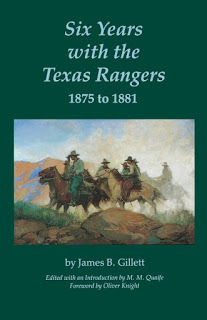
a Texas Ranger. A crucial source for Lea, writing back in the 1950s, was James
B. Gillett’s 1921 memoir, Six Years with
the Texas Rangers: 1875-1881, from which Lea takes the epigraph and
his title:
“Oh, how I wish I had the power to describe
the wonderful country as I saw it then.”
> Check out Gilett’s page at
the Texas Rangers Hall of Fame and Museum in Waco, Texas. Gillett
ranched south of Alpine and upon moving to Marfa helped found the West Texas
Historical Association. He died in 1937 and is buried in Marfa.
(The Texas Rangers made up a more heterogeneous
group than some too easily conclude. See also the 2014 book by historian
Cynthia Leal Massey, Death of a Texas
Ranger. An interview with Massey is here.)
TENTH UNITED STATES CAVALRY
Marcos Kinevan’s superb (of partial) biography of Lt. John Bigelow, Jr. of the Tenth U.S. Cavalry in Texas
The Wonderful Country has
a number of characters who serve in the Tenth U.S.
Cavalry. The Tenth was famed for its African American
“Buffalo” soldiers, and its exploits in fighting Indians, especially in
Texas and then Arizona.
Less famous, but undeservedly so, is Lt. John Bigelow, Jr., who is the subject of a forthcoming paper I presented at last year’s Center for Big Bend Studies Conference. His younger brother, Poultney Bigelow, who published his series of articles on trailing the Apaches, was a great friend of artist Frederic Remington who illustrated many of the articles. Their father, John Bigelow, was an accomplished editor (at one point editing the New York Times), he served as President Lincoln’s ambassador to France, and had much to do with the founding of the Republican Party, the New York Public Library, the Panama Canal, and promoting Swedenborgianism. Bigelow, Sr also entertained literary celebrities including Charles Dickens and Oscar Wilde. My paper explores some of the family’s rich and varied social and political connections, John Bigelow Jr’s reports for Poultney’s magazine, his role as a nexus between the Eastern establishment and the West, and his importance as a military intellectual who anticipated the profound changes to come in 20th century warfare.
NOTES ON THE 1959 MOVIE “THE WONDERFUL
COUNTRY” BASED ON THE NOVEL
… Reminds me of that old
joke about the goats out browsing on a hill in Hollywood. They find the can
with the reel of film, they kick it open, and they start munching… The one
goat says to other, well, whaddya think? The other goat chews some more.
“Eh,” the goat says, “I liked the novel better.”
One of the African American “Buffalo
soldiers” is played by baseball star Satchel Paige. Tom Lea himself has a
cameo as the barber, Peebles.
“Writing is a kind of burden to me, which painting is not. I sweat and stew and fight painting, but I am not overwhelmed… by problems like I was with writing. I taught myself to write and never had any kind of a mentor or formal course… I taught myself to write by reading, reading good stuff.”
On The Wonderful Country:
“…I wanted to do something that ad been on my mind since I was a kid: Write about this borderland and the people on both sides of the river.”
“When traveling down in Mexico I never carried anything more than a little notebook because I was trying to train myself to hear rather than to see. I was trying so hard to be a good writer, you know… The hardest chapter in that book was where Martin goes with Joe Wakefield across the river in the springtime. I was trying to tell how much this fellow felt about both sides of the river. I remember I struggled and struggled for some way to express springtime and I settled it by saying, ‘A mockingbird sang on a budded cottonwood’ or something like that. I had to watch myself about using the big word. I always chose the shortest way if it could say exactly what I wanted.”
“A gust of wind sished sand against the one small windowpane.” (p.16)
“They ate in the light of tallow dips, a dozen men in soggy leather, laughing and chewing, with the rain sounding on the roof, and cold drops leaking through.” (p.250)
“Slowly, under the winking high stars, they came to where they saw beyond the paleness of the sand the darkness of the brush that lined the river, and they rode toward it. They worked across a dry flat of alkali white in the starlight, with the hooves scuffling the crust in the windless silence. ” (p.306)
FURTHER MISC NOTES
From Tom Lea Month 2012, Nick Houser on Lea’s Cabeza de Vaca picture:
In my opinion, Lea’s masterwork is his 1938 mural
“The Pass
of the North” which is in El Paso Historic Federal Courthouse
Building.
NOTES ON HIS FAMILY
Lea’s father was Tom Lea
(1877-1945), who served as mayor of El Paso during the Mexican
Revolution. (Alas, many Mexicans and Mexican Americans do not remember Mayor
Lea fondly; this is
one reason why.)
Of late American readers have been well served by a veritable cottage industry of works about the Roman Republic and Empire, and their respective falls, and various aspects thereof, and what lessons we, with our republic (or empire, as some would have it), purportedly at the precipice of analogous fiscal, ecological, military, social and/or political Seneca Cliffs, might learn from them. History may not repeat itself any more than we can wade into the same river twice, but, of course, we can step into rivers that look more than a sight familiar. Sometimes a nicely behaved river—let’s dub it the Goth Swan—turns of a sudden into a drowning horror. Indeed, a close reading of Roman history does suggest, in blurriest outlines, some analogies with contemporary trends and conundrums. But there are perhaps more valuable insights to be parsed from our own little-known and, relatively speaking, recent history.
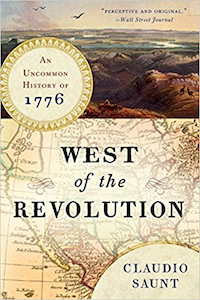
In West of the Revolution, Claudio Saunt, a noted scholar of early American and Native American history, spotlights nine places and formative events of 1776 that rarely raise a blip on the radar of even the most well-educated Americans. As Saunt writes in his introduction, “The American Revolution so dominates our understanding of the continent’s early history that only four digits—1776—are enough to evoke images of periwigs, quill pens, and yellowing copies of the Declaration of Independence.”
As of this year, the second Monday of the month is dedicated to my workshop students and anyone else interested in creative writing.
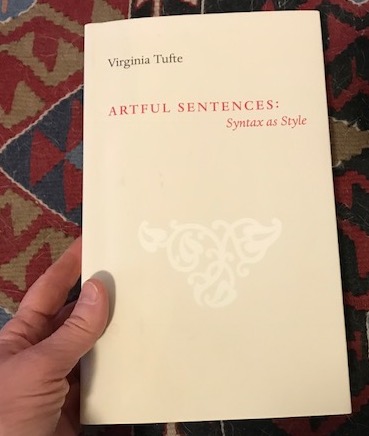
While I increasingly rely on the Internet for reference—I’ll more likely type a word into my on-line dictionary or thesaurus than pull a wrist-breaker of an old tome off its shelf—there is still no substitute for a writer’s reference library: real books on a real shelf, at-hand. And among the most useful works in my own reference library is Virginia Tufte’s Artful Sentences: Syntax as Style.
From the catalog copy:
“… Tufte presents—and comments on—more than a thousand excellent sentences chosen from the works of authors in the twentieth and twenty-first centuries. The sentences come from an extensive search to identify some of the ways professional writers use the generous resources of the English language. “The book displays the sentences in fourteen chapters, each one organized around a syntactic concept—short sentences, noun phrases, verb phrases, appositives, parallelism, for example. It thus provides a systematic, comprehensive range of models for aspiring writers.”
But Artful Sentences is not only for aspiring writers. Having written more books than I’ll bother to count, I still find that an occasional review consistently yields inspirations.
Where, and for what effect, can I limber up my writing? Perhaps I need to work in shorter sentences. (p. 9) Bright little ones!
Or perhaps, I could play a bit with what Tufte terms “Catalogs of modifiers” (p.100)– basically, a bunch, a spew, an avalanche of adjectives.
Or perhaps, I might try “an adjective as an opener.” (p.160) Open doors, don’t they seem more inviting?
Artful Sentences elucidiates the immense range of possibilities we have in the English language to arrange our sentences, and within them, the sounds and rhythms of words, the better to sharpen and strengthen what we mean to say. And that, my dear writerly reader, is power.
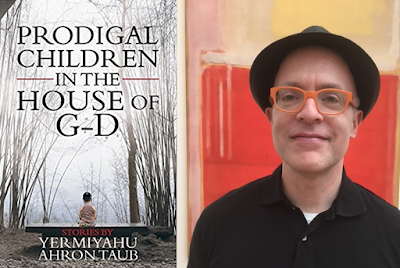
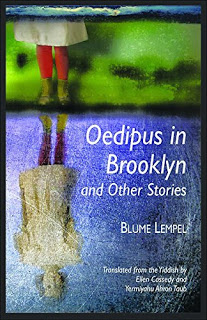
Starting this year, every fourth Monday I run a Q & A with a fellow writer. This fourth Monday features Yermiyahu Ahron Taub, the author of Prodigal Children in the House of G-d: Stories (2018) and six books of poetry, including A Mouse Among Tottering Skyscrapers: Selected Yiddish Poems (2017). Preparing to Dance: New Yiddish Songs, a CD of nine of his Yiddish poems set to music by Michał Gorczyński, was released in 2014. Taub was honored by the Museum of Jewish Heritage as one of New York’s best emerging Jewish artists and has been nominated four times for a Pushcart Prize and twice for a Best of the Net award. With Ellen Cassedy, he is the recipient of the 2012 Yiddish Book Center Translation Prize for Oedipus in Brooklyn and Other Stories by Blume Lempel (2016). His short stories have appeared in such publications as Hamilton Stone Review, Jewish Fiction .net, The Jewish Literary Journal, Jewrotica, Penshaft: New Yiddish Writing, and Second Hand Stories Podcast.
C.M. MAYO: You are co-translator (with Ellen Cassedy) from the Yiddish of Blume Lempel’s extraordinary short stories, Oedipus in Brooklyn. Would you say that Lempel’s work has been an influence on your own fiction? Can you talk a bit about some of your influences, and your favorite writers?
YERMIYAHU AHRON TAUB: Blume Lempel is certainly a source of personal inspiration, and working with Ellen Cassedy on that project was and continues to be a great joy. Despite suffering enormous familial loss in the Holocaust and years of creative block, Lempel built a career as a Yiddish writer with single-minded focus and commitment. She created an authorial voice that was uniquely her own and a prose rich in poetry, experimentation in time and voice, and empathy. She looked at characters at the margins of society and at themes still considered taboo, including abortion, prostitution, and incest. I was drawn to Lempel’s work for all of these reasons and in researching her autobiography, came to be inspired also by the example of her courage in life and art. Our work overlaps somewhat in our interest in life at the margins and blurring the line between poetry and prose, although I think much of Lempel’s work is more firmly anchored than mine in the realm of the experimental and avant-garde. I do see Lempel as a kindred literary spirit.
I have been reading voraciously and widely since childhood. It’s difficult to pinpoint specific literary influences. I prefer to think of texts whose effects remain with me. Even if I don’t recall particular plots, the authors’ themes and concerns, and overall sensibilities remain. I am interested in writers who take risks, who go against the grain, who can create a marriage of emotional impact and beauty of language, who write with psychological acuity and care.
A partial list of favorite English-language fictional texts, in alphabetical order of author’s last name, include:
Julia Alvarez, How the Garcia Girls Lost Their Accents Michelle Cliff, Abeng Marian Engel, Bear Janet Hobhouse, The Furies F.M. Mayor, The Rector’s Daughter Elizabeth McCracken, The Giant’s House: a Romance Gloria Naylor, The Women of Brewster Place Joyce Carol Oates, Where is Here? James Purdy, 69: Dream Palace and Other Stories Jean Rhys, Wide Sargasso Sea Marilynne Robinson, Gilead, Home, and Lila Sinclair Ross, As For Me and My House Elizabeth Taylor, Angel and Mrs. Palfrey at the Claremont Edith Wharton, The House of Mirth
If we include non-fiction, poetry, and Yiddish literature and world literature in translation, there would be many more titles to add.
C.M. MAYO: You have been a consistently productive writer and poet for many years. How has the digital revolution affected your writing? Specifically, has it become more challenging to stay focused with the siren calls of email, texting, blogs, online newspapers and magazines, Facebook, Twitter, and such? If so, do you have some tips and tricks you might be able to share?
YERMIYAHU AHRON TAUB: The digital revolution has helped bring about a dynamic international literary culture. Poems and stories can now be read by anyone with computer access. Blogs such as yours also support the work of writers and connect writers and readers. Before appearing in book form, much of my work has appeared in online publications. In the digital age, it is more affordable to publish literary ‘zines, although maintaining the availability of defunct journals remains an issue of concern for literary publishers, writers, and readers. Facebook is useful for sending out announcements of new work and seeing what colleagues and friends have been doing. I also enjoy the travel, food, and family photos that people post! I started on Facebook fairly recently. I thought it would take more of my time that it actually has. I am not on Twitter or other social media.
There’s only a limited amount of time in the day. I like to set aside time for daily translation, reading, and/or writing or writing-related business, as well. The proliferation of media in the digital age offers tempting distractions from writing. There are now so many offerings in television and film, many of them quite literary and demanding extensive viewing time.
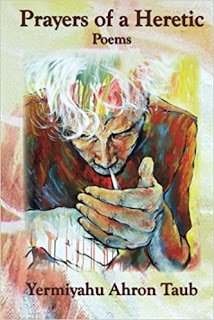
Still, I always return to the written word. And I prefer to read in hard copy. Nothing has replaced words on a paper—the joy that comes from concentration on those words, turning the page, the touch of paper, the heft of a book in one’s hand or one’s lap. The poems “Eavesdropping” and “Luddite’s Exhortation” in my fourth collection Prayers of a Heretic explore the pleasures—cerebral, sensual, and otherwise—of books and reading from books. The key to productivity is tuning out all of the distractions to draw on the creativity that emerges from focus and quiet, or perhaps more aptly put, quietude. One can be sitting in a noisy cafe and still be in a place of internal quiet.
But, of course, there are many ways to live and work as a writer. Find what works for you and honor that process.
C.M. MAYO: Are you in a writing group? If so, can you talk about the members, the process, and the value for you?
YERMIYAHU AHRON TAUB: When I lived in New York, I was in the Yugntruf Yiddish writers’ circle for many years. Attendees brought in a poem or a story and shared it with the group. It was a great way for me to get feedback on my Yiddish writing and to encounter new Yiddish creativity. That group continues to meet. I have attended two sessions of a poetry group here in Washington, D.C. I’m not sure if that qualifies as being “in a writing group.” Here too, folks distribute the poems, read it aloud, and then provide comments. The feedback was quite rigorous and helpful, and I enjoyed the gatherings. However, I’ve only attended two sessions since my recent focus has been on writing prose and on translating from the Yiddish.
C.M. MAYO: Did you experience any blocks while writing these stories, and if so, how did you break through them?
YERMIYAHU AHRON TAUB: Fortunately, I did not experience writer’s block while writing these stories. As I note in the book, I wrote Prodigal Children in the House of G-d while on an artist’s residency at The Writers’ Colony at Dairy Hollow (Eureka Springs, Arkansas). Having three weeks to concentrate solely on writing enabled my turn from poetry to fiction. TWCDH was a magical experience — a great studio, friendly staff and writers in residence, and the ideal setting that combined natural beauty and a charming, historical small town. During the afternoons, I took walks and worked through ideas for the writing I was doing in the studio. Sometimes, I took walks with other writers in residence.
C.M. MAYO: Back to a digital question At what point, if any, were you working on paper for these stories? Was working on paper necessary for you, or problematic?
YERMIYAHU AHRON TAUB: My writing life as an adult has largely been conducted on the computer. Of course, the digital revolution has made it easier to submit work to literary magazines. Instead of having to print out hard copies, write and include a self-addressed stamped envelope, and go to the mailbox or post office, one can now submit work electronically. Writing on the computer also allows for extensive revision. In my childhood and youth, I wrote by hand. In college, I sometimes submitted papers typed on a typewriter. So I remember well the challenges in the revision process back then.
C.M. MAYO: Do you keep in active touch with your readers? If so, do you prefer hearing from them by email, sending a newsletter, a conversation via social media, some combination, or snail mail?
YERMIYAHU AHRON TAUB: I welcome feedback from readers. I prefer e-mail over other forms of communication. I sometimes go for long periods of time without checking Facebook. I rarely use snail mail. I try to answer all letters. Giving readings, particularly ones that include a Q & A, is another great way to connect with readers.
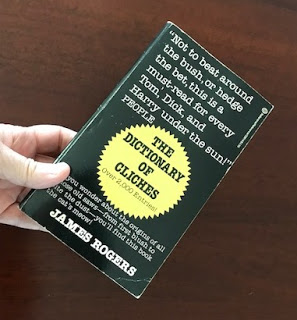
YE ARCHAEOLOGICAL FIND Yes, this was on my bookshelf and yes, I actually used to consult it.
I have previously posted on my favorite exercises for a fast-acting manuscript Rx, what I call “emulation” or “permutation” exercises, here. (Which one is it, emulation or permutation? Depends. That would be another post.)
The basic idea is to take a phrase or perhaps as many as a few sentences from another writer’s work or from your own manuscript, and play with it in some predetermined way. Sometimes the exercise might prompt a new piece; othertimes it might give you just what you need to brighten up the blah or smooth a rough patch in a draft. Moreover, for my wampum, permutation exercises beat crossword puzzles by a Texas section. (Yowie, that was an orangutang’s tea party of imagery!)
Yes, I am being silly. To play, you have to be
willing to be silly! Tell your ego to just take a long cool breath. You, dear
writerly reader, do not have to use the results of your writing exercises in
your manuscript, never mind show them to anyone else.
Simply, for any given permutation exercise, come
up with a bunch of things! Maybe elegant, maybe dorky. Maybe even dorksterly
dorkikins dorky. Then circle the one or two results that, for whatever reason,
strike your fancy and/or seem apt for your purposes.
In my experience, and that of many of my writing
students, doing these exercises is a tiny investment for a mega-payoff. The
more often you do these little exercises, the easier they get, and this ease
will greatly serve you in your endeavors to write, and in particular, to write
more vividly. You will also get practice in generating material you are able
to, la de da, discard. And discarding unworthy bits and pieces of a
draft, and even whole novels, without attachment, that’s a vital skill for a
writer, too.
“IT’S LIKE DEJA VU ALL OVER AGAIN”
There are as many permutation exercises as you
can dream up. This one, what I call “Blast Past Easy,” plays with
cliché.
How can you spot a cliché? If a phrase sounds
familiar and/ or it came to you too easily, it’s probably a cliché.
What’s wrong with cliché? For more discerning readers, whom presumably you would want to have, cliché signals a lack of originality and/or naiveté and/or sloppiness. In sum: mediocrity. There are exceptions– for example, a fictional character or the subject of biography might use cliché (and if they do, that tells us something about them, does it not?) And some essayists use cliché for comic effect. (I’ll be posting about intentional diction drops anon.)
“Like deja vu all over again”– well,
you can debate me, but I’m going to call that a cliché, except as used by
Yogi Berra, because he’s the one who came up with it.
Here are a few clichés I happened upon in recent
weeks’ reading, and my permutations– four each. If you feel so moved, a good
exercise could be to add more permutations of your own.
“Talk does not boil the rice” Talk does not shampoo the pooch Talk does not slice the pepperoni Talk does not iron the shirts Talk does not roast the turkey
(You might try a permutation of the noun,
“talk,” e.g., art; violin playing; texting
“Bet you dollars for donuts” Bet you deutschmarks for Dingdongs Bet you dinars for dinos Bet you dollars for diddlysquat Bet you pounds for peanuts
(Part of what makes “dollars for
donuts” such an appealing cliché is the alliteration, that is, the
repeating “d”s of “dollars” and “donuts.” You
might try varying the sound, e.g., silver for Skittles, or, pesos for pips,
etc.)
“Let the cat out of the bag” Let the cockroach out of the bag Let the bedbug out of the backpack Let the tarantula out of the pickle jar Let the worm out of the compost pile
(Another permutation could be to switch the verb,
e.g, Put the cat in the bag; stuff the cat in the bag; drown the cat in the
bag; swing the cat in the bag, etc.)
“The bee’s knees” The snail’s tail The donkey’s ankle The sloth’s toenail (doesn’t rhyme but, oh well, I like it) The kitten’s mittens (is that a cliché?)
“A fish out of water” A mole out of its hole A horse out of its pasture A sheep out of its herd A troll out of his cave A credit card nowhere near a department store
“Barrel, Mirror, Telephone” In three sentences or less describe the barrel. In three sentences or less describe the mirror. Where is the telephone? Describe what happens.
“Systems analysis must become cultural
analysis, and in this historians may be helpful.”– Lynn White, Jr.
Drive into Far West Texas and before you can say
“pass the Snickers” you’ll spy the railroad tracks, which more often
than not run, seemingly infinite sinuous ribbons, parallel to the highway.
Travel for a spell and you’ll pass or, if at a crossing, be passed by a freight
train, always an impressive experience. All of which is to say, railroads are
an inescapable part of Far West Texas scenery and history, and so, for my book
in-progress on that region, I have been doing my homework.
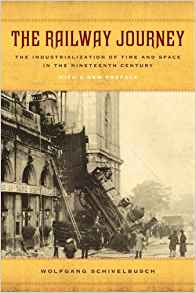
Of late: The Railway Journey: The Industrialization of Time and Space in the Nineteenth Century by Wolfgang Schivelbusch, a German historian and scholar of cultural studies. Originally published as Geschichte der Eisenbahnreise, the English translation came out in 1979; I read the 2014 edition with a new preface, “World Machines: The Steam Engine, the Railway, and the Computer,” in which Schivelbusch asks,
“Could it be that the railway, the
accelerator of the Industrial Revolution, and the computer occupy different
points along / on the same trajectory of machine evolution?”
In recent weeks, this question of machine
evolution, to my surprise, has begun to interest me intensely.
At first I had thought of this book I am writing about Far West Texas as a doppelgänger to my 2002 memoir of Mexico’s Baja California peninsula, Miraculous Air, for the ecosystems and early exploration and mission histories of these two regions have many parallels. There are indeed many parallels, however, to start with, the literature on Far West Texas is exponentially greater and– more to the point– since the time I was traveling in Baja California, the experience of traveling itself has been radically transformed by the Digital Revolution. My sense of this is a compression of time and a curious elasticity of space; of oftentimes disquieting and othertimes most welcome transparency; and that constant pull to the little screens that, so it would seem, we all feel these days, whenever, wherever.
In The Railway Journey, Schivelbusch opens
with a detailed discussion of the history of the steam engine.
“Next to wood, water and wind power were the main energy sources of pre-industrial economic life. The Industrial Revolution, generally seem as having begun in the the last third of the eighteenth century, was a complex process of denaturalization… Iron became the new industrial building material, coal the new combustible. In the steam engine, the prime mover of industry, these two combined to produce energy in theoretically unlimited amounts.”
The “decisive step” for the development
of the steam engine– and ultimately the railroads– was the introduction of
rotary motion, “a kind of mechanization of the mill race.” In other
words, transforming the up-and-down movement of the steam-driven piston
to the driving wheel.
In his new 2014 preface, however, Schivelbusch
writes: “It took me forty years and the Digital Revolution to realize that
I had missed the more important point of the invention preceding it.” In
other words, the technological Crossing of the Rubicon, as it were, was
“placing a piston in a cylinder and applying the pressure of steam… [I]t
did not transfer an existing form but forced a new form of power out of
combustible matter.” Moreover, “the piston’s up-and-down movement
was no longer the analogue of any form of movement found in nature but
possessed a binary-digital logic all its own.”
Watch a demonstration of a piston (in this
example, powered by an electric motor):
Most histories of the computer’s binary-digital
logic that I am familiar with focus on English mathematician George Boole’s An
Investigation into the Laws of Thought (1854)– the concept of binary
logic. Schivelbusch’s is a wondrously powerful insight.
THE MACHINE ENSEMBLE
In his second chapter, “The Machine
Ensemble,” Schivelbusch explores the ways the development of the railways
was experienced as “denaturalization and densensualization.” With
cuttings, embankments, and tunnels”the railroad was constructed straight
across the terrain, as if drawn with a ruler.” Now “the traveler
perceived the landscape as it was filtered through the machine ensemble.”
And what is the machine ensemble? “[W]heel
and rail, railroad and carriage, expanded into a unified railway system… one
great machine covering the land.”
RAILROAD SPACE
With the railroad, argues Schivelbusch,
“space was both diminished and expanded.” Things moved across space
faster, and simultaneously, more space could be accessed. “What was
experienced as being annihilated was the traditional space-time coninuum which
characterized the old transport technology.”
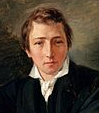
Schivelbusch quotes the German poet Heinrich
Heine, writing in 1843:
Heinrich Heine, protosurrealist
“What changes must now occur, in our way of looking at things, in our notions! Even the elementary concepts of time and space have begun to vacillate. Space is killed by the railways, and we are left with time lone… Now you can travel to Orléans in four and a half hours, and it takes no longer to get to Rouen. Just imagine what will happen when the lines to Belgium and Germany are completed and connected up with their railways! I feel as if the mountains and forests of all countries were advancing on Paris. Even now, I can smell the linden trees; the North Sea’s breakers are rolling against my door.”
Sniffed Victorian-era English art critic John
Ruskin:
“Modern traveling is not traveling at all; it is merely being sent to a place, and very little different from being a parcel.”
(I quail to imagine what might have been Ruskin’s
reaction to a TSA line. We airline travelers have been demoted from parcel to
cattle…)
PANORAMIC TRAVEL
For me, having spent so many hours driving
through the vast spaces of Far West Texas, the fourth chapter, “Panoramic
Travel,” was the most engaging. The opening epigraph is from Emerson’s Journals:
“Dreamlike traveling on the railroad.” In a car, as in a railway
compartment, we are enclosed from the weather behind windows, and by a roof and
a floor. We rest our bodies in an upholstered seat. Beyond the window, things
sail by silently, inexorably, scentlessly: hills, fences, a gas station– it
becomes a blur.
Travel by railroad induced “panoramic
perception.” Schivelbusch:
“Panoramic perception, in contrast to traditional perception, no longer belonged to the same space as the perceived objects: the traveler saw the objects, landscapes, etc. through the apparatus which moved him through the world. That machine and the motion it created became integrated into his viual perception: thus he could only see things in motion. That mobility of vision– for a traditionally oriented sensorium, such as Ruskin’s– became a prerequisite for the ‘normality’ of panoramic vision. This vision no longe experiences evanescence: evanescent reality had become the new reality.” (p.64)
Because this can be deadly boring, and
necesitated being in close quarters with fellow travelers of, shall we say,
possibly inconvenient social connections, bougeois train travelers took up
reading. Schivelbusch:
“Reading while traveling became almost obligatory.The dissolution of reality and its resurrection as panorama thus became agents for the total emancipation from the traversed landscape: the traveler’s gaze could then move into an imaginary surrogate landscape, that of his book.” (p. 64)*
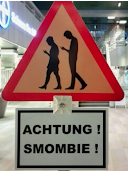
But back to computers. I am beginning, with
fraying patience, to think of ours as the Age of Phubbing Smombies. To walk the
aisle of a railway passenger car or an airplane is to catch the soundless
glow of dozens of little screens… the overwhelming majority not of text but
of flashing images of murders, faces, scantily clad women, roaring dinosaurs,
cars and other objects hurling off cliffs (what is it with all the cliffs?)..
and cartoons of the same… In sum, a mesmerizing mishmash of imagery.
AMERICAN VS EUROPEAN RAILROADS
In the 19th century the “great machine”
of the railway ensemble spread across the land in both Europe and the
North American continent, but, as Schivelbusch details, there were fundamental
differences in the pattern and nature of that machine. Europe was already
densely populated and richly networked by highways and roads; “in America,
the railroad served to open up, for the first time, vast regions of previously
unsettled winderness.”* In other words, to quote Schivelbusch quoting von
Weber, “In Europe, the railroad facilitates traffic; in
America, it creates it.”
*Quibble: Important regions of America’s interior were not in fact a wholly “unsettled wilderness” until after the cascading demographic collapses, and later Indian removals, and the Indian Wars. There were well-established trails and trade routes throughout the continent, many going back many hundreds of years. But yes, compared to Europe, the road networks in Amreica were thin and poor and the vast desert expanses and the Great Plains were terrible to traverse by horse-drawn vehicles, as many memoirs attest.
And while Europe’s industrial revolution focused
on manufacturing, primarily textiles, in America it was about agriculture
(cotton, tobacco) and transport. In the early 19th century, what American
industry had in the way of machines was, writes Schivelbusch, “river
steamboats, railroad trains, sawmills, harvesting combines.”
By the 19th century the string of older cities of
the North Atlantic coast– Boston down to Washington DC– were linked by
well-established highways, however, the rest of the continent had more
primitive roads, oftentimes what amounted to footpaths and, above all,
waterways: The Mississippi, the Missouri, the Ohio, the Hudson, various canals,
and the Great Lakes. “Thus passenger travel used these waterways in the
absence of highways… One traveled by water whenever possible.”
Unsurprisingly, the American railway compartment
took on the distinctive character of the American riverboat cabin. These tended
to be broad open rooms, more comfortable for traveling long distances. European
railroad compartments took their template from the stagecoach, a cozier space.
Schivelbuch argues that in American culture the
railroad was closely linked with the steamer both because it was these were the
first and second mechanized means of transportation and because so much of the
interior landcape– the Great Plains–was described by travelers as kind of
vast ocean. (Indeed it was, in an eon past, the bottom of an ocean.)
The path of the railroad tracks differed as well:
American tracks tended to curve where European tracks would be straight. As
Schivelbusch points out, this reflected differences in labor and land costs. In
America, land was cheap and labor expensive. In Europe then “it paid to
construct tunnels, embankments and cuttings in order to make the rails proceed
in a straight line, at a minimum of land cost.”
Ah, so that explains the sinuosity of those Far
West Texas rails.
INDUSTRIALIZED CONSCIOUSNESS
“new consciousness of time and space based on train schedules and the novel activity of reading while traveling” (p.160)
Re: The reconsideration of the concept of shock
in the 19th century. Schivelbusch:
“The railroad related to the coach and horses as the modern mass army relates to the medieval army of knights (and as manufacture and industry do to craftmanship.)” (p.159)
Re: A “sinister aspect”.
Schivelbusch:
“…it had become possible to travel in something that seemed like an enormous grenade.” (p.160)
“The train passenger of the later nineteenth century who sat reading his book thus had a thicker layer of that skin than the earlier traveler, who coud not even think about reading because the journey still was, for him, a space-time adventure that engaged his entire sensorium.” (p.165)
(Thicker layer of skin!! Just turn on TV news!!
The commercials!! In our day, we’ve all grown callouses on top of rhino hide.)
HAUSSMANN’S REDO OF PARIS AND A NEW CONSCIOUSNESS FOR A NEW CITYSCAPE
Schivelbusch covers Haussmann’s remodeling of
Paris in detail in chapter 12, “Tracks in the City.”
“The streets Haussmann created served only traffic, a fact that distinguished them from the medieval streets an lanes that they destroyed, whose function was not so much to serve traffic as to be a forum for neighborhood life; it also distinguihsed them from the boulevards and avenues of the Baroque, who linearity and width was designed more for pomp and ceremony han for mere traffic.” (p. 183)
“The broad, tree-lined streets were seen as providers of light and air, creating sanitary conditions in both a physiological and a political sense– the latter favorable to the rule of Napoleon III.” (p. 186)
MORE ABOUT PANORAMIC PERCEPTION
The final chapter, “Circulation,” looks
at the consequences of the changes in transportation for retail, specifically,
the development of department stores.
“As Haussmann’s traffic arteries were connected to the rail network by means of the railway stations,and thus to all traffic in its entirety, the new department stores, in turn, were connected to the new intra-urban arteries and their traffic. The Grands Magasins that arose during the second half of the nineteenth century were concentrated on the boulevards that supplied them with goods and customers.” (p.188)
While traveling on the train put an end to
conversation, so the department store put an end to haggling, for now there
were price tags.
Department stores encouraged panoramic
perception.
“There had to be noise, commotion, life everywhere… The customer was kept in motion; he traveled through the department store as a train passenger traveled through the landscape. In their totality, the goods impressed him as an ensemble of objects and price tags fused into a pointillistic overall view…”(p. 191)
The sources of parnoramic perception were at once
speed and “the commodity character of objects.”(p. 193)
THE CIRCULATION CONCEPT IN THE 19th CENTURY
“… whatever was part of circulation was regarded as healthy, progressive, constructive; all that was detached from circulation, on the other hand, appeared diseased, medieval, subversive, threatening.” (p. 195)
CIAO, GRAND TOUR
Re: The Grand Tour, “an essential part of
… education before the industrialization of travel.” The world was
experienced in its original spatio-temporality… His education consisted of
his assimilation of the spatial individuality of the places visited, by means
of an effort that was both physical and intellectual” (p. 197)
(At this thought, of the industrialization of
travel, I had an evil little chuckle recalling Mrs Pofrock in Henry James’ The
Ambassadors.)
So:
“The railroad, the destroyer of experiential space and time, thus also destroyed the educational experience of the Grand Tour… the places visited by the traveler became increasingly similar to the commodities that were part of the same circulation system. For the twentieth-century tourist, the world has become one huge department store of countrysides and cities” (p. 197)
I would venture that a more apt analogy would now
be “menu of venues for digitally realized self-presentation” —
translation from the Noodathipious Flooflemoofle: “selfies.” I hear
most everyone shops online these days.
#
FURTHER TIDBITTY THOUGHTOID
A curious analogy occured to me, that just as the
automobile allowed for more agency for a traveler vis-a-vis the railroad, so
the tablets and smartphones allow more agency than the television for the
consumer of entertainment.
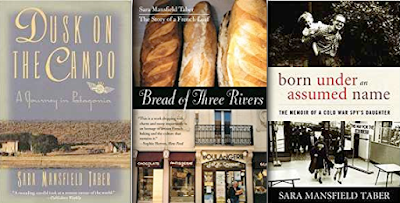
Without exception Taber’s works are superb, wondrous, must-reads for anyone who would explore the world from an armchair– and for anyone who would write their own. There is so much to relish and to learn from Taber’s daring, her mastery of the craft, her ability to see the most telling particulars, and the exquisite, sensuous beauty of her prose.
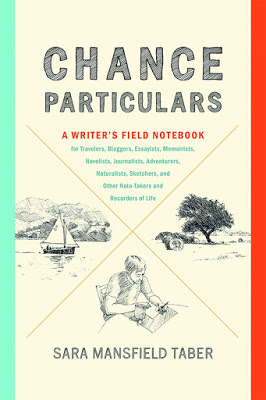
Based just outside Washington DC, Taber is also a long-time writing teacher, currently leading workshops both privately and at the Writer’s Center (Bethesda MD) and elsewhere. And now, for both her workshop students and for those at a distance, who cannot take her workshop, just out from Johns Hopkins University Press, and with lovely illustrations by Maud Taber-Thomas, we have Sara Mansfield Taber’s Chance Particulars: A Writer’s Field Notebook.
I was honored to have been asked to contribute a blurb:
“Sara Mansfield Taber’s Chance Particulars is at once a delicious read and the distilled wisdom of a long-time teacher and virtuoso of the literary memoir. Her powerful lessons will give you rare and vital skills: to be able to read the world around you, and to read other writers, as a writer, that is, with your beadiest conjurer’s eye and mammoth heart. This is a book to savor, to engage with, and to reread, again and again.” – C.M. Mayo
The following Q & A is reprinted from her publisher’s website (Johns Hopkins University Press):
Q: Why did you decide to write this book?
SARA MANSFIELD TABER: So that writers of any stripe—from travelers, to bloggers, to journal-keepers, to memoirists, essayists, and journalists—will know just what to note down so as to paint rich and vivid pictures of people and places, and create a lively record of their experiences in and responses to the world.
Q: What were some of the most surprising things you learned while writing/researching the book?
SARA MANSFIELD TABER: The writing of the book allowed me to put on all my hats—literary journalist, anthropologist, memoirist, essayist, journal-keeper, and traveler—and draw together in one place all that I have learned, from those various fields, about keeping a lively field notebook. Writing the book let me re-live the pleasure of field-notebook keeping and also offer the prodigious pleasure of the habit to others. It is a way to get to live your life twice.
Q: What do you hope people will take away from reading your book?
SARA MANSFIELD TABER: A sense of exhilaration—to stride out into the world, to experience it fully and observe it closely, and then to write about that world with all the richness and color they can muster.
Check out the trailer for Sara Mansfield Taber’s Chance Particulars:
As of this year, my posts for the second Monday of the month are dedicated to my workshop students and anyone else interested in creative writing.
As those of you who follow this blog well know, I am work on a book of creative nonfiction about Far West Texas, a subject distant indeed from children’s literature. But Russell Hoban’s 1964 classic, Bread and Jam for Frances, is bright in my mind because in the recent days of my mother’s final illness, I read it to her several times.
Bread and Jam for Frances was a great favorite of ours, a book my mother read to me when I was learning to read in the early 1960s. She always appreciated children’s books, and often gave copies of her favorites as gifts. Other favorites of hers included DuBose Heyward’s The Country Bunny and the Little Golden Shoes; Margaret Wise’s The Little Fur Family; anything and everything by Beatrix Potter; and many other titles about in Hoban’s series about Frances the badger and her little sister Gloria.
From 1939… still selling faster than little bunnies can hop…
In her last days my mother was unable to do more
than listen to TV news– and it pained me to sit in that room awash with
reports of shootings, bombings, crashes, the latest tweets from POTUS,
commercials for drugs and those breathlessly chirpy recitations of ghastly side
effects, and even such absurd “news” stories as– this one still
makes me chuckle– “Robotic Dinosaur on Fire!”* So I asked my mom if,
instead, I could read to her from some of her favorite children’s books and she
said, delightedly, yes.
*(Robotic Dinosaur on Fire!-– That’s the
title of my next book of poetry.)
What brings me to mention Bread and Jam for
Frances here is that, as I appreciated for the first time, the plot is at
once simple and unusually elegant.
GROKKING PLOT
No matter whether one is writing an adult
thriller, a romance novel, or a literary tour-de-force of an historical epic,
plot is something a writer needs to grok, before writing, during drafting, and
in the editing process. Where to go, what to cut? For many writers, particularly
those working on a first novel, plot can seem more difficult to wrestle down
than a wigged-out octupus.
The best and most complete craftmans’ treatment
of plot that I have found to date is in Robert McKee’s Story,
a book aimed at screenwriters, but almost every one of his yummy
nuggets applies to novels as well. That said, it’s a big, fat, doorstopper of a
crunchily crunchwich-with-garlic- sweetpotatoes-on-the-side kind of book, not
the most appropriate for a one day workshop, as I prefer to teach them.
These three and many more recommended books on craft are listed on my workshop page.
Gardner’s On the Art of Fiction is the
best introductory book on craft I know– over the past 30-odd years I have read
it and reread it more times than I can count (and bought new copies when the
old ones fell to pieces). However, on many an occasion, before I learned to
first give ’em ye olde cold fish of a caveat, the more sensitive among my
students would complain bitterly about Gardner’s arrogant tone. And to those of
you not in my workshop but who who have read and loathed Gardner, I say unto
you: Buck up, kiddos, or consider that Gardner did you a favor so you can quit
now because the literary world, like the whole big wide rest of it, makes
snowflakes sweat blood! Then flash-fries ’em to a crisp! Anyway, Gardner died
in a motorcycle accident years ago so you’re unlikely to ruffle his feathers
with your cranky review on Goodreads– which only makes you sound like a
flaming snowflake. SSSSsssss.
Seriously, have a laugh, shake off Gardner’s tone
like the peacocking silliness that it is; if you want to understand the art of
fiction, I urge you to read what he has to say. (Also, by the way, you can
ignore the subtitle, Notes on Craft for Young Writers. It’s for anyone
writing fiction, at any age.)
Of course, in a workshop it is necessary to talk about plot in reference to one or more specific novels. But one of the gnarliest challenges for a workshop is that reading a novel requires many hours– no time for that in a one day format– and even the most well-read writers may not have read the same books, nor share the same taste. Perhaps we have all read Edith Wharton, but for you it was Ethan Fromm, for me, The Custom of the Country. Willa Cather? Perhaps you read My Antonia and I read Death Comes for the Archbishop. And, Lord knows, there are perfectly intelligent and talented workshop students who have not heard of either Cather or Wharton. Lord also knows that, much as we may recommend our favorite novels to each other, even we roaringly avid readers may work but a fraction of the way down our towering to-read piles.
Edith Wharton and Willa Cather, masters of American literature– and plot. My uberly-uber faves. In an ideal workshop I would dissect the plot in any one or or more of their novels (I should like to think that these ladies would have been charmed by Bread and Jam.)
What a fine thing then to have found a little
book, so short and sweet, with such an expertly wrought plot as Bread and
Jam for Frances.
But I cannot bring myself to do taxidermy, that is to say, a synopsis. For those of you looking to learn about plot (and/or find a worthy children’s book as a gift for your favorite young reader), may I suggest that you buy a copy of Bread and Jam for Frances, then read it, which won’t take you more than about 10 to fifteen minutes. Then return here, just below the ampersand.
~ & ~
Bread and Jam through the FICHTEAN CURVE
Think of this as a triangle (curvy if you wish)
where your story travels, episode-of-conflict by episode -of-conflict, up the
hypotenuse to the big pointy CLIMAX. Then, with your denouement– pronounced,
raising your nose oh so slightly, day-noo-mahn— slidey-slide down
to…The End!
Episode o’ conflict: At breakfast Frances does
not want an egg; she only wants bread and jam.
E o’ c: She admits she traded yesterday’s chicken
salad sandwich for bread and jam
E o’ c: At lunch she offers to trade her bread and
jam for a sandwich, is refused
E o’ c: At snack time her mother gives her not a
special snack but bread and jam
E o’ c: For dinner there are veal cutlets but
Frances gets… bread and jam
Climax: At the next dinner Frances cries and asks
for spaghetti and meatballs!
Denouement: For lunch the next day Frances enjoys
a lunch of a lobster salad sandwich and much more. She agrees with her friend
Albert that it is good to eat many different things.
Bread and Jam
through Syd Field’s THREE ACT PARADIGM
I SET UP Breakfast at home: Frances does not want her egg, only bread and jam. She admits she traded yesterday’s lunch of a chicken salad sandwich for bread and jam
Plot point (what takes us to Act II): It’s time
for Frances to go to school
II CONFRONTATION Lunch with Albert, Albert has a nice lunch while Frances has only bread and jam.
Snack time, it’s still bread and jam.
Dinner, still bread and jam.
Dinner again, bread and jam
Plot point (what takes us to Act III): Frances cries
and asks for meatballs and spaghetti
III RESOLUTION Frances enjoys her meatballs and spaghetti
The next day, Frances opens her lunch box to find
a very nice lunch with a lobster salad sandwich and, with her friend Albert,
discusses how nice it is to eat many things
#
Perchance this sounds silly. Am I saying that we
can compare the simple little plot in Bread and Jam for Frances with
that of such literary heavyweights as say, The Custom of the Country? Death
Comes for the Archbishop? Or, for that matter, The Great Gatsby? Yes,
dear writerly readers, that is what I am saying– and moreover, that because
the plot of Bread and Jam for Frances is so compact and simple, it is
easier to see. And having seen it so clearly, you should then be better able to
see plot in your own work.
What does your plot look like through the
paradigm of the Fichtean curve? And of the three-acts?
Now your wigged-out octopus just might shed a few limbs, or at least, braid them together and sit up nicely and accept a cup of tea– and in between sips, calmly inform you, in his bubbly French accent, what’s to happen next. (Never a dull moment writing fiction.)
“What’s in the Kitchen Drawer?” This is a vocabulary expanding exercise— not about using new words, but rather words you already know but seldom use. List the objects in your kitchen drawer(s)— from the spatula to the grapefruit knife to the soup ladle.
Ellen Prentiss Campbell writes: “Love those books, and your essay! Hoban was featured in a display at Beinecke at Yale. I often think of Frances’s difficult experience with Thelma, the bad friend, who trades for her tea set.”
I happened upon the website of novelist Nancy Peacock in, of all places, the comments section of computer science professor Cal Newport’s blog. Newport is the author of Deep Work: Rules for Focused Success in a Distracted World. Novelist Nancy Peacock’s comments there echoed my own on the topic of social media; moreover, as I am writing about the Seminole Scouts and the Indian Wars in Far West Texas, an undeservedly obscure subject, I was intrigued to learn about her latest novel, The Life and Times of Persimmon Wilson.
From the catalog copy:
“For fans of Cold Mountain and The Invention of Wings comes a tour de force of historical fiction (Henry Wiencek, author of Master of the Mountain) that follows the epic journey of a slave-turned-Comanche warrior who travels from the brutality of a New Orleans sugar cane plantation to the indomitable frontier of an untamed Texas, searching not only for the woman he loves but so too for his own identity.
I have been to hangings before, but never my own.
Sitting in a jail cell on the eve of his hanging, April 1, 1875, freedman Persimmon Persy Wilson wants nothing more than to leave some record of the truth his truth. He may be guilty, but not of what he stands accused: the kidnapping and rape of his former master’s wife.
In 1860, Persy had been sold to Sweetmore, a Louisiana sugar plantation, alongside a striking, light-skinned house slave named Chloe. Their deep and instant connection fueled a love affair and inspired plans to escape their owner, Master Wilson, who claimed Chloe as his concubine. But on the eve of the Union Army s attack on New Orleans, Wilson shot Persy, leaving him for dead, and fled with Chloe and his other slaves to Texas. So began Persy’s journey across the frontier, determined to reunite with his lost love. Along the way, he would be captured by the Comanche, his only chance of survival to prove himself fierce and unbreakable enough to become a warrior. His odyssey of warfare, heartbreak, unlikely friendships, and newfound family would change the very core of his identity and teach him the meaning and the price of freedom.

From the author of the New York Times Notable Book Life Without Water, The Life and Times of Persimmon Wilson is a sweeping love story that is as deeply moving and exciting an American saga as has ever been penned –Lee Smith, author of Dimestore.”
C.M. MAYO: You have been a consistently productive literary writer for many years. How has the digital revolution affected your writing? Specifically, has it become more challenging to stay focused with the siren calls of email, texting, blogs, online newspapers and magazines, Facebook, Twitter, and such? If so, do you have some tips and tricks you might be able to share?
NANCY PEACOCK: My biggest experience with the digital revolution has been with Facebook. After much cajoling from an agent and the culture, I finally opened a Facebook account. That’s what we’re supposed to do, as writers, right? We’re supposed to promote our work every possible way. I was surprised to find things that mattered to me on Facebook, and then, as those things dwindled, I became addicted to searching for them. In the end, my mind became fractured, and I was unable to focus on what I needed to focus on: the writing. I deleted my FB account. I did not disable it. I deleted it, and I feel my mind healing. It was like coming off a drug.
I’m a very private person, and my writing grows from that. I need spaciousness to pull it all together, and spaciousness is coming to be seen a bit like the horse and buggy. Quaint and picturesque, but impractical. But I needed it. Not having it is a deal breaker to me.
I also spend a lot of time on research. Writing any novel requires keeping a lot of plates in the air. Writing a historical novel requires keeping those plates from colliding and breaking against facts and dates. It takes focus. I couldn’t focus because social media had splintered my ability to do so.
I think writers, and publishers (maybe especially publishers) need to start taking a bigger picture of what literature means, and what it has to offer that other forms of storytelling, namely movies and television, do not. Writing and reading are ways to slow down. I wish the industry would embrace that, and stop whipping the more, more, more horse.
For me it really came down to either being a writer or presenting as a writer. I chose the former.
C.M. MAYO: Are you in a writing group? If so, can you talk about the members, the process, and the value for you?
NANCY PEACOCK: I am in a writer’s group. The group grew from a women’s writers group which I led for years, and for income. Over time the members became very solid with each other, and I kept looking in from the position of leader thinking I want to join. I thought that for years. Finally I asked if they would accept me as a member, and they said yes. So I lost some income because I no longer lead the group, but I gained an incredible group. These women are sharp, funny, great listeners and exceptional responders to the written word. We have three novelists (one needs to finish her novel – she knows who she is!), a poet, and an essayist, short story writer, and poet combined into one amazing person, who also bakes great cakes! We’ve seen each other through life events, sickness, raising children, publication, struggling with the work (although it is mostly me who struggles and crashes with the work) and much more.
I think the format of a writing group is very important, and that not enough people pay attention to that. I don’t think just any comment goes. You need an agreement among the members on how to respond. For instance, I once brought in a piece to a different writing group. The piece mentioned being in therapy, and one of the members response was to say she was glad I was still in therapy. She said it again and again, and it was personal, a judgement on my sanity, and had nothing to do with the writing or the story I was telling. This was not OK at all and I tried to discuss it with them and got shot down for it. One of the reasons my current group works so well and has lasted so long is because we follow guidelines that were established at the very beginning.
C.M. MAYO: Did you experience any blocks while writing this novel, and if so, how did you break through them?
NANCY PEACOCK:The Life and Times of Persimmon Wilson was the least blocked novel I have ever written. The opening line, “I have been to hangings before, but never my own,” arrived to me on a walk I took one morning to watch the sunrise. It literally was suddenly in my head. Out of nowhere. I went home and wrote it down, even though at the time I was very discouraged about writing and publishing and was thinking I might never write again. That evening I watched the documentary about The West by Ken Burns, and I idly wondered if there were any black Indians. I knew there were white Indians from having read The Captured by Scott Zesch years earlier. From these two things, the line in my head and the idea of a black Indian, the first chapter poured out of me.
With some books you labor hard to get to know the characters, and to gain their trust. With others you are possessed. This was a possession. I had to do a lot of research and shape the narrative around historical events, but Persy (Persimmon Wilson) was very willing to talk to me. I had a sense of urgency from him, just as if he was about to hang in a few days time, which at the opening of the novel, he is.
C.M. MAYO: Back to a digital question. At what point, if any, were you working on paper for this novel? Was working on paper necessary for you, or problematic?
NANCY PEACOCK: I mostly compose on the computer. I don’t have trouble with it. I trained myself to do it with my first book. When it comes to anything but writing, I don’t like being on the screen. It’s the interaction between story and me that makes composing on the computer different from all other screen activity. If I get stuck on something, if a scene is not working, I turn to writing by hand. That usually makes something break through that wouldn’t come before. I also teach two prompt writing classes each week, during which I write with the students, and I sometimes use that time to work on a novel. I remember vividly writing the scene in which Persy is captured by the Comanche in my class, and reading it to them. It went almost verbatim into the book.
C.M. MAYO: Do you keep in active touch with your readers? If so, do you prefer hearing from them by email, sending a newsletter, a conversation via social media, some combination, or snail mail?
NANCY PEACOCK: I am in active touch with a large group of local writers and readers because I’ve built a community around a free class that I teach once a month I’ve been doing this for fifteen years now, and hundreds of people have come through my workshop. Because of this community building, I’ve built a local fan base. National has proven more difficult, and I don’t really think social media helps. I think it’s spitting in the wind.
I have a website and occasionally hear from someone via the contact form. I always love hearing from anyone who’s read my book. I’ve found that if someone takes the time to contact me, it’s because they liked something in the book, so it’s (mostly) been a positive experience.
I’d like to encourage readers to contact writers whose work has impressed them. There’s so much competition to the printed page these days. I don’t even think publishing houses understand the unique value of the novel.
Another community building activity I hope to organize is a regular letter writing campaign to favorite authors. Real letters. Not email. Real letters (or postcards!) with stamps and handwritten words on them. I am extremely touched when I receive one of these, and I’d like to make a space for readers to reach out to writers. I’d like this to be a regular part of the reading experience. Another nod to the slowing down reading gives you. Nothing says love like snail mail!