Say “Texas” and the images that pop into most people’s minds do not include literary figures and their oeuvres. But trust me, as one who has been working on a book about Far West for more years than I care to count, Texas has one helluva literary culture, a long-standing and prodigious production, yea verily flowing out as if by pumpjacks, and if not all, a head-swirling amount of it is finer than fine, and there are legions of readers who sincerely appreciate and celebrate it, as do I. Know this: Lonn Taylor and Don Graham, both of whom just passed away, were giants among Texas literati.
LONN TAYLOR(1940-2019)
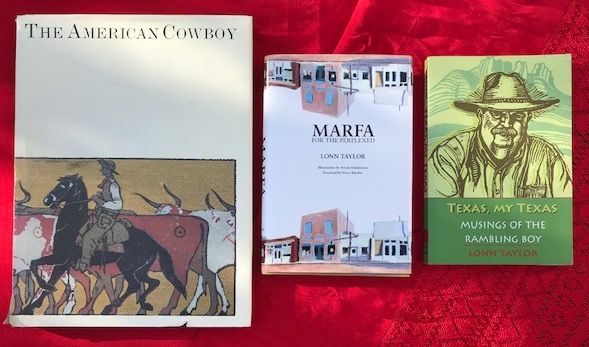
From my Texas Bibliothek: A selection of many treasured works by Lonn Taylor.
Lonn Taylor was an historian who wrote about many things including cowboys and the American flag and every nook and cranny and corner of Texas, so it seemed, always with erudition, elegance, and heart. I had some correspondence with Taylor before I met him in Fort Davis– to which town in Far West Texas he had retired with his wife Dedie after a career as an historian at the Smithsonian Institution in Washington DC. In his book-cave of an office below the copper-red shadow Sleeping Lion Mountain, I interviewed him for the Marfa Mondays Podcasting Project (listen in any time). I was at once charmed, grateful, and mightily enlightened about multitudinous things Texan. Later I saw him and Dedie at the annual Center for Big Bend Studies conference, and over the next few years, many an email zinged back and forth. I am but one of many people who counted Lonn as a personal friend and a mentor, and I am saddened by his loss more than I can say.
Taylor’s works are a cultural treasure, a monument. And he was wondrously productive. However did he manage to write all these books and his Rambling Boy column for the Big Bend Sentinel, and keep up with what surely must have been a daily hurricane of email? I was just about to email him a congratulations on his latest book, Turning the Pages of Texas, when I got the news from Carmen Tafolla, President of the Texas Institute of Letters, that in an instant– a stroke on June 26– he was gone from this world.
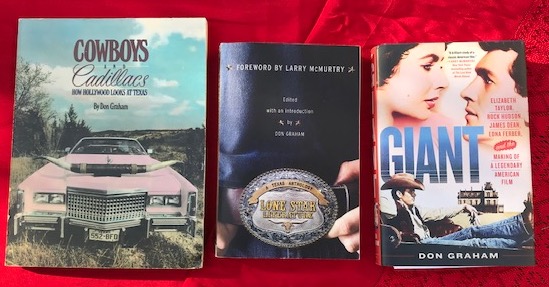
Also from my Texas Bibliothek: Some essential works by film historian and literary critic Don Graham.
Just days before Lonn’s passing, on June 22, Don Graham also died of a stroke. I never met Graham, the renowned J. Frank Dobie Regents Professor of English at the University of Texas Austin, but I thought I would very soon, for I had been emailing with him about arranging a podcast interview on the latest of his many splendid books about Texas: Giant: Elizabeth Taylor, Rock Hudson, James Dean, Edna Ferber and the Making of a Legendary American Film.
I do not think it is possible to comprehend Texas as a cultural and political entity without taking into account the imaginal influences (and sometimes very weird echos) of fiction and films– and, in particular, the film based on Edna Ferber’s best-selling novel, Giant. And no one wrote about all of that, and Giant, more lucidly than Don Graham.
We have never met, but I feel as if we have. I think this is always true when one has read another’s such wonderful writing. But I did “meet” Diana Anhalt, in a matter of speaking, when years ago, she sent me a selection from her powerful and fascinating history / memoir of growing up in Mexico City, A Gathering of Fugitives: American Political Expatriates in Mexico 1948-1965. When, sometime later, I read the entirety of that beautifully written book itself–which I admiringly recommend to anyone with an interest in Mexico–I wrote to her, and we have kept in touch ever since. Apart from writing poetry and essay, we have this common: a lifetime, it seems, of living in Mexico City, and married to a Mexican. By the time we found each other’s work, however, Diana and her husband Mauricio had left “the endless city” for Atlanta, Georgia. (But ojalá, we will meet one day outside of cyberspace soon!)
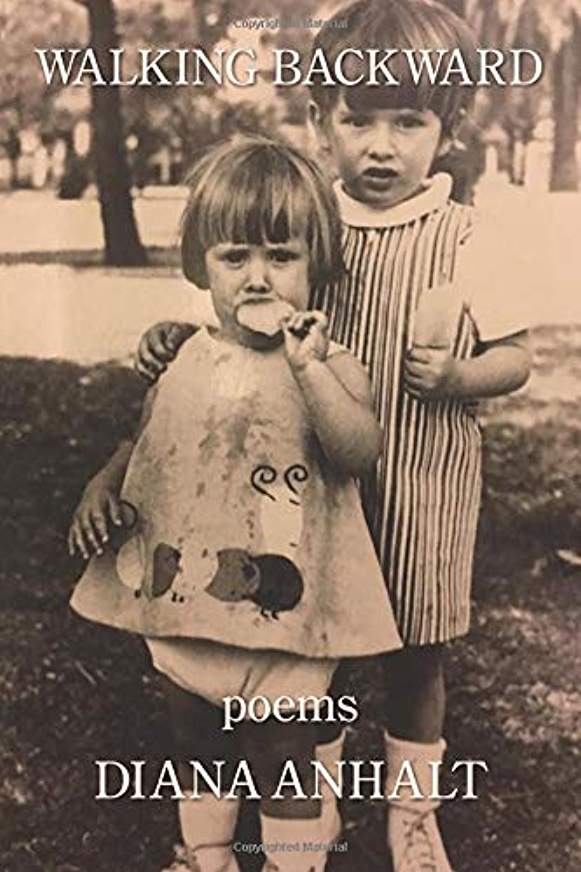
Her latest, just out from Kelsay Books, is Walking Backward. From her publisher’s website, her author bio:
“Diana Anhalt left Mexico over nine years ago following close to a lifetime in that country but claims her writing sometimes digs in its heels and refuses to budge. She continues to write about Mexico. Many of her essays, short stories, and book reviews have appeared in both English and Spanish along with her book, A Gathering of Fugitives:American Political Expatriates in Mexico 1948-1965. Since she first arrived in Atlanta, two of her chapbooks, Second Skin, (Future Cycle Press), Lives of Straw, (Finishing Line Press), and one short collection, Because There Is No Return, (Passager Books), have been published. Her work has been nominated for a Pushcart Prize and has appeared in “Nimrod,” “Concho River Review,” “The Connecticut River Review,” “The Atlanta Review,” and “Spillway,” among many others. She believes this is the first time her work has started to lose its Mexican accent.” Source: Kelsay Books
Writes Dan Veach, founding editor of Atlanta Review, author of Elephant Water and Lunchboxes:
“The best way to visit any country is with someone who knows and loves it intimately. In Walking Backward, Diana Anhalt welcomes us graciously into the very heart of her family and her Mexico. With deep empathy and quiet courage, and always with a saving grace of humor, she shows us how to deal with love and loss, both on a personal and an artistic level.”
#
C.M. MAYO:What inspired you to write Walking Backward?
DIANA ANHALT: I wanted to put together a collection—this is my fifth—which would include, for the first time, some of what I’d written following my husband’s death three years ago, but it couldn’t just be a book about death so I settled on including, as well, work focused on the family, on the past.
MISSING by Diana Anhalt
I walk my unwritten poems down La Reforma, stop to buy La Prensa, scan the Want Ads. Missing bilingual parrot Inglés/Español, answers to the name of Palomitas.
Se Busca María Felix look-alike for chachacha-ing on Saturday nights. Extraviado/Lost guitar case filled with woman’s shoes and toothpaste samples.
In Search Of instructions on how to read divining bones. Reward Offered for information leading to whereabouts of Gabi Escobedo, missing since September.
Attención Mauricio—You’ve been dead long enough. It’s time to come home.
C.M. MAYO:If a reader were to read one poem in this collection, which one would you suggest, and why?
DIANA ANHALT: The logical choice would be Walking Backward, the title poem and the first in the book. After Mauricio and I left Mexico and the home where we had lived for many years, I’d wake up in the middle of the night to go to the kitchen or the bathroom only to discover my feet walking in the direction they would have taken in my Mexican home, not here in Atlanta. The title’s suggestion of walking and residing in the past was what I was aiming for.
[SCROLL DOWN TO THE END OF THIS POST READ THE POEM, “WALKING BACKWARD”]
C.M. MAYO:Can you talk about which poets and writers have been the most important influences for you?
DIANA ANHALT: It’s changed, of course, over the years, but more recently I was very fortunate to belong to a group which worked closely with the head of the Georgia Tech poetry program, the late Tom Lux, who became a mentor and friend. Tom facilitated our interaction with the poets Ginger Murchinson and Laure Ann Bosselar. Richard Blanco and a number of wonderful poets in our Poetry Workshop and others writing here in Atlanta have also influenced my poetry. C.M. MAYO:Which poets / writers are you reading now?
DIANA ANHALT:Here: Poems for the Planet, a recent anthology, edited by poet Elizabeth Coleman, Jo Harjo, our new U.S. poet laureate, and Land of Fire by Mario Chard.I’ve also been reading Jennifer Clement’s Gun Love and Fatima Farheen Mirza’s A Place for Us.
C.M. MAYO:You have been a productive poet and writer for many years. How has the Digital Revolution affected your writing? Specifically, has it become more challenging to stay focused with the siren calls of email, texting, blogs, online newspapers and magazines, social media, and such? If so, do you have some tips and tricks you might be able to share?
DIANA ANHALT: You’ve expressed it well. It has been challenging to stay focused and I’m afraid that, as of now, I’m still incapable of using it fully to my advantage—I don’t use social media— but I do find the Internet extraordinarily helpful at times in establishing contacts, finding venues and staying in touch.
C.M. MAYO:Another question apropos of the Digital Revolution. At what point, if any, were you working on paper? Was working on paper necessary for you, or problematic?
DIANA ANHALT: I had always worked on paper but once I began to write on the computer I found the ability to make changes and save the many versions necessary in producing a poem very helpful. I still keep a notebook, transfer the notes to the computer, and do the actual writing on the computer. C.M. MAYO:What’s next for you as a writer / poet?
DIANA ANHALT: Now that Walking Backward is out I will continue to produce for our monthly poetry workshop meetings, send my work out, enter a contest or two but I do hope to get back and revise my now outdated computer files for A Gathering of Fugitives: American Political Expatriates in Mexico 1948-1965. (Although I must admit that I’ve been promising myself to do that for years. Still haven’t.)
Use ‘heel’ and ‘toe’ as verbs
WALKING BACKWARD By Diana Anhalt
Late each night I rose, woozy with sleep and my bare feet traveled blind—knew one room from the next through cracks in the wood, space between floorboards,
sensed their width, breadth, girth… For forty years I called that same place home— Left it, yet it resides in me. The feet are last to follow. They fumble the unfamiliar,
reject the waxed surface of a new life, are the last to forgive my leaving, long to return me to the old home—wet wash pinned to a line in the courtyard, scent of chili
and cilantro wafting from the kitchen. At night they lurch backwards into the past, tread the dream halls where faces linger in mirrors, Spanish echoes down corridors
into a past I thought I’d left behind— And there you are. You wait in the doorway, lean against the door frame and ask: Como te fue? How did it go? Red wine or white?
Walking Backward
Late each night you rose, woozy with sleep, the space your familiar, and your bare feet traveled it blind—knew one room from the next through cracks in the wood, space between floorboards, splinters, sensed their width, breadth girth.
For forty years you called the same place home— Leave it, yet it resides in you. The feet are last to follow. They fumble the unfamiliar, reject the waxed surface of a new life, are the last to forgive your leaving, long to return you to the old home—wet wash pinned to a line in the courtyard, scent of chili and cilantro wafting from the kitchen.
At night they lurch backwards into the past, tread dream halls where faces linger in mirrors, Spanish echoes down corridors into a past you thought you’d left behind—
And there you are. You wait in the doorway, lean against the door frame and ask: “Como te fue?” How did it go? Red wine or white?
They cleave to familiar roadways. The late night path between bed and bathroom. Your feet are the last to forgive you. The feet are the last to forgive your leaving murky Leading you down a hall you left behind. (no longer there) You alongside
(forgive)
(home) in the cracks between boards. (where your Spanish song)
(And when you leave) The feet are the last to forgive your leaving home
Footsteps lurk in the past. My feet tread the past. Your feet are the last to forgive you. (to forgive your wandering.) You abandon your past
My feet still know a past when…. Tide erases footsteps on the sand.
Bare feet, it’s time to get used to this, this unknown space, a floor less friendly, rougher on your soles, less familiar with your tread, colder, tile not wood
The tug of familiar surfaces
Today after a deep sleep my feet walk me Toward the door I left behind down a hallway I left behind. No longer there.
Xxxxxxxxxxxx Late each night you rise, woozy with sleep,the space your familiar, and your bare feet travel it blind—tread those same midnight floorboards sense their width, breadth girth, know one room from another through cracks in the wood, They tread the past.
Lingered behind in the familiar Who thought to warn them? I forgot to warn them.(you)
Late at night, woozy with (from) sleep I forget to tread the slippery smoothness of new floors (I forget and tread the old floors) through hallways silenced by sleep, dizzy with sleep
Foothold, heel and toe My body owns (keeps, retains) the compass, (encompasses) Maps (traces) the floors I left behind. My footsteps tread past.
retrace ones steps (If you) live in the same place for 40 years. (Call one place home) tread the same midnight floorboards That place resides in you. (When) You rise at night, the floor is your familiar and your bare feet travel it—feel it’s width, breadth girth, Know one space from another by the cracks in the wood, a shaky floorboard,
(After years treading the same midnight floorboards)
Today, late at night, woozy with (from) sleep
After years of treading darkened halls feet knewthose floors and follow them. They seek the familiar groundwork of the past, late to discover it’s disappeared. (no longer there.)
I argue with my feet (An argument with my feet) Earlier notes
I walk away from forty years of my life
Awakened to darkness, late at night my feet refuse to travel, walk the dark, down the hall you left behind Remind me that I never thought to tell them:
For forty years you call the same place home and each night, woozy with sleep, your feet tread those same midnight floorboards until
My feet still remember a past when
your feet tread those same midnight floorboards until that place resides in you
Awakened from a deep Nudged into the past Nudge words into meaning
When I left I forgot to tell (warn) my feet. They stayed Behind entrenched in the familiar streets of home
Go through the process of leaving
I forgot to tell you. (them) (warn them) When I left I forgot to tell (warn) my feet. they linger behind
Behind
Highways, biways. At home on bicycle pedals. My feet, unlike the rest of me, refuse to take the lead (to follow my lead) Highways, biways. At home on bicycle pedals. My feet, unlike the rest of me, refuse to take the lead (to follow my lead) When I rise from bed late at night in this new place fuzzy (heavy) with sleep Feet speak a language of their own
The scurry, scrape against the floor New territory (territorial)
I try to reason with my feet.
Abandon home after forty years, last to follow are the feet. They fumble the unfamiliar, reject the waxed surface of new floors. (newness)
They reject the slippery smoothness of new floors They forget to tread the slippery smoothness of new floors And fumble in the unfamiliar (I forget and tread the old floors) through hallways silenced by sleep, dizzy with sleep When you abandon (leave) home after 60 years. the feet are the last to follow. Mine, at home in the past, learned (memorized) the floors—width, breadth, girth Today, in this new place, they move (walk) (grope) backwards into (retrieving) the past late at night, woozy with sleep, reject the slippery smoothness of new floors forget to tread the slippery smoothness of new floors fumble with the unfamiliar The late night path (track another word-meaning destination?) between bed and bathroom. You abandon your past
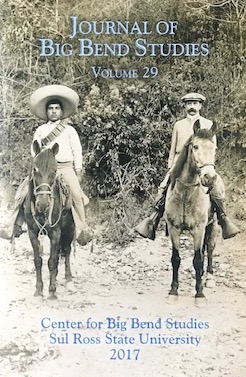
Nope, that is not Francisco I. Madero, pictured right, but J.J. Kilpatrick, subject of Lonn Taylor’s fascinating article in this same issue of the Journal of Big Bend Studies, vol. 29, 2017.
For those rusty on their borderlands and Mexican history, Francisco I. Madero was the leader of Mexico’s 1910 revolution– the first major revolution of the 20th century– and President of Mexico from 1911-1913. This was not only a transformative episode for Mexico, but also for Texas.
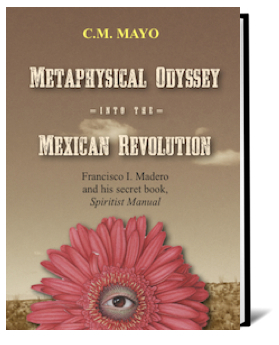
My book, Metaphysical Odyssey into the Mexican Revolution: Francisco I. Madero and His Secret Book, Spiritist Manual, came out in 2014 (also in Spanish, translated by Agustín Cadena as Odisea metafísica hacia la Revolución Mexicana, Francisco I. Madero y su libro secreto, Manual espírita, from Literal Publishing.) So far so good: it has been cited already in a number of scholarly works about Madero and the Revolution.
Yes indeed, Metaphysical Odyssey is a peculiar title. In the article, I explain why I chose it and why, much as readers groan about it, I would not change it.
> Read the paper here. (I had posted an earlier only partially edited PDF at this link; in case you’ve already seen it, as of today, June 17, 2019, it has been updated.) And you can order a copy of the actual printed article with all photos, and of the complete issue from the Center for Big Bend Studies here.
A few of the photos, not in the PDF:
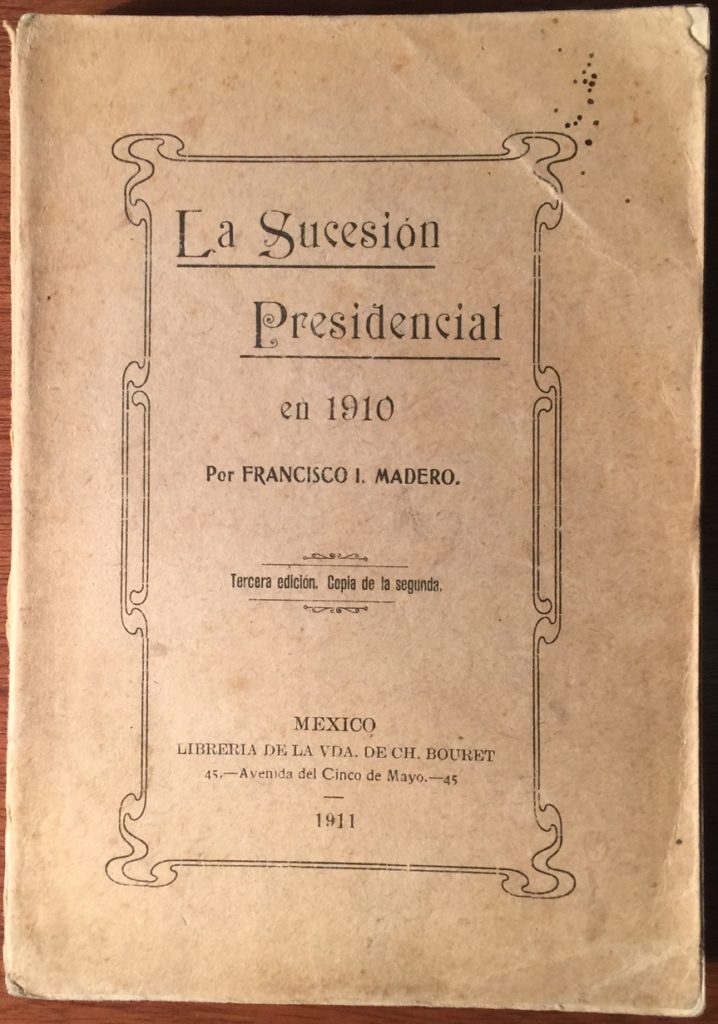
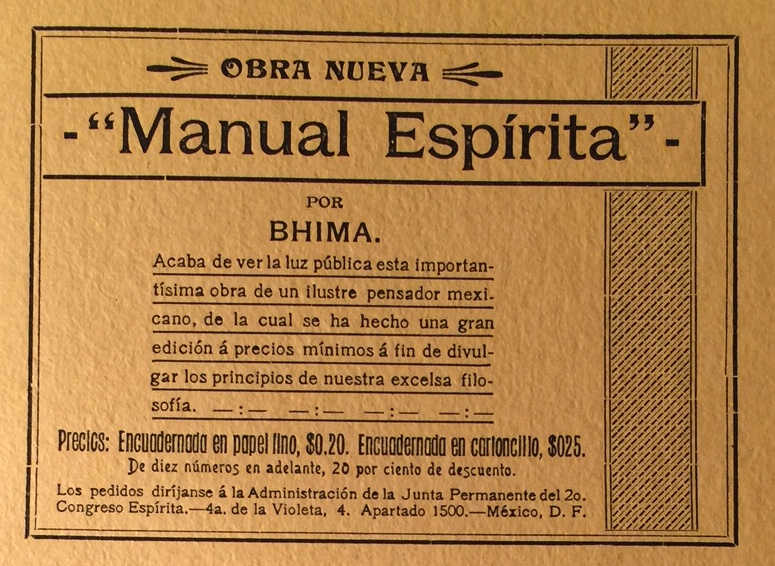
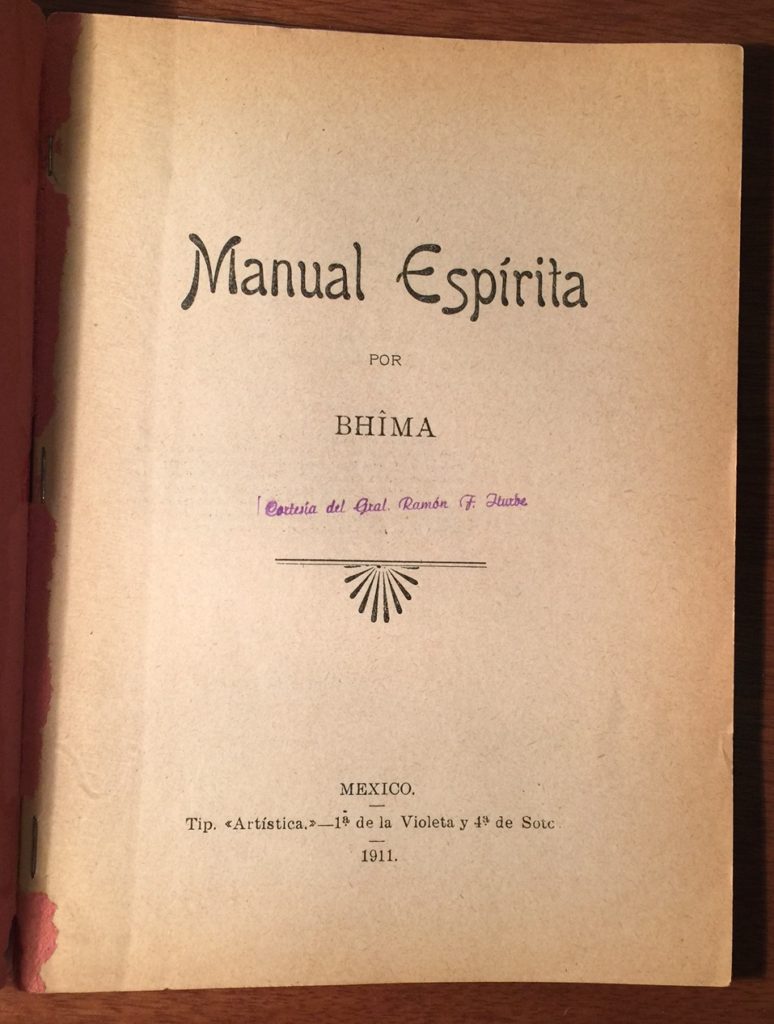
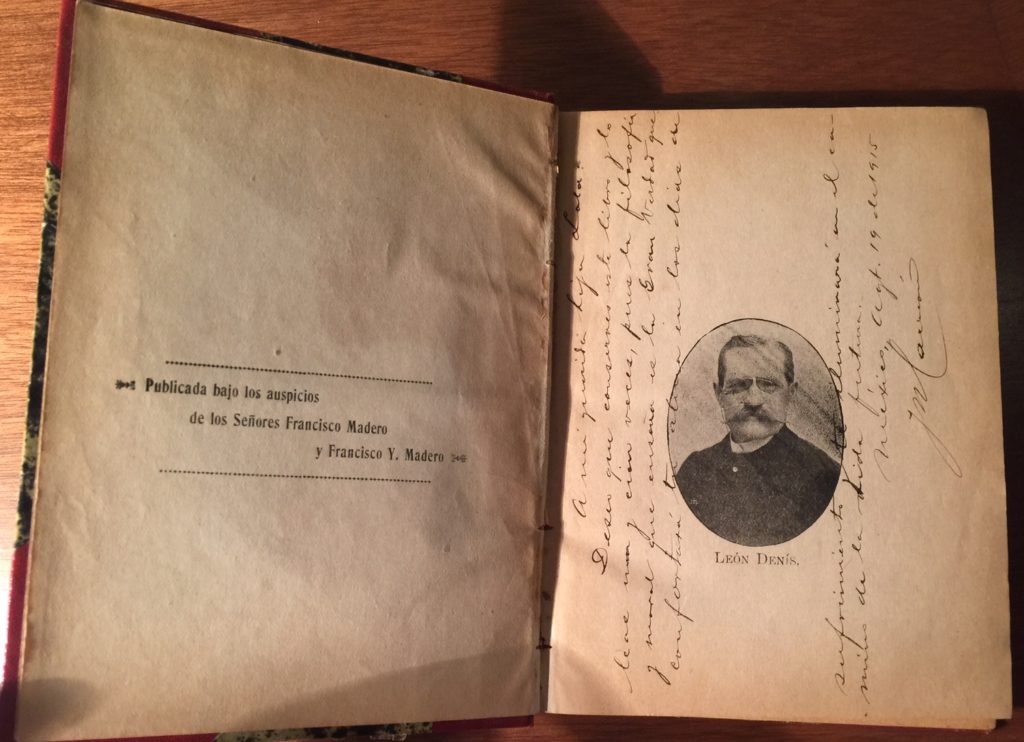
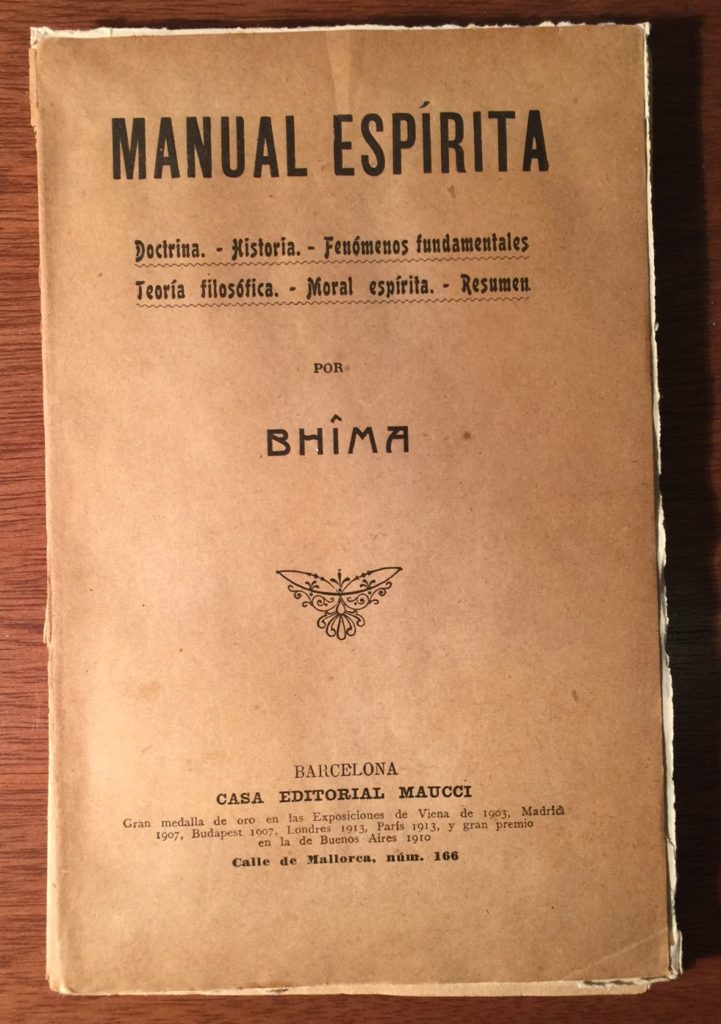
The first and definitively not secret book. This shows my copy of a third edition of the book that launched the Mexican Revolution: Francisco I. Madero’s La sucesión presidencial en 1910 [The Presidential Succession in 1910]. This third edition is from 1911. The first edition is dated 1908 and went into circulation in early 1909. Photo: C.M. Mayo.Advertisement in Helios, October 1911, for the just-published Manual espírita by Bhîma, that is, Francisco I. Madero. Photo: C.M. Mayo.The title page of my copy of a first edition of Madero’s Manual espírita of 1911. Note that it is stamped “Cortesia del Gral. Ramón F. Iturbe [Courtesy of General Ramón F. Iturbe]. Photo: C.M. Mayo.Frontispiece and title page of my copy of the 1906 Spanish translation of Léon Denis’ Aprés le mort, translated from the French by Ignacio Mariscal and sponsored by Francisco Madero and his son, Francisco I. Madero. Photograph by C.M. Mayo.My copy of the cover of the rare circa 1924 Barcelona edition of Manual espírita. Photo by C.M. Mayo.
#
SPECIAL NOTE
Undoubtedly scholars, novelists and screenwriters will be producing works about Francisco I. Madero and the Mexican Revolution until Kingdom Come (or, perhaps I should say, the Reemergence of Atlantis); because I am a literary writer who roams over a wide variety of subjects, I do not intend to keep up with them all. That said, I regret that I could not cite in my article the book by Mexican historian Beatriz Gutiérrez Müller, Dos Revolucionarios a la sombra de Madero: A historia de Solón Argüello Escobar y Rogelio Fernández Güell(Mexico: Ariel, 2016), which I recommend as crucial for any bibliography on Madero, his Spiritism, the history of metaphysical religion in Mexico, and the Mexican Revolution itself. Gutíerrez Müller’s work should also be of special interest for anyone interested in current Mexican politics, for the prologue is by the author’s husband, now president of Mexico, Andrés López Obrador. This video on his YouTube channel shows the president and first lady discussing her book.
My writing assistant presents the lap desk. He likes the lap desk. It means we all sit together on the sofa.
As far as the need for equipment goes, writing is not like casting bronze sculpture. All you need is a pencil and paper–any scrap will do. The formidable challenge most writers face is managing their attentional focus, that is to say, their ability to actually sit down and, ahem, actually write.
Sheer willpower isn’t the only thing needed, however. Habits, even tiny habits, can help enormously. Here’s where some writerly material tools can be useful… perhaps. I say “perhaps” because what works for one writer may not necessarily work for another.
What do I mean by “writerly material tools”? Well, you could have a special pencil and make a ritual of sharpening your special pencil– so there you have a pencil, and you have a pencil sharpener. Not a budget buster. If you don’t know what to do with your money, why, you could go gung-ho for such writerly material tools as a gold-plated typewriter with your name engraved in curlicues or, say, some rococo-rama iteration of George Bernard Shaw’s rotating writing shed.
What works for me? Sometimes I write with a pencil and paper but generally I am at my desk with my laptop or, perchance, my typewriter. But for a spell each and every morning I also use a lap desk, which enables me to turn my office sofa– a big sloppy boat of a sofa with two pugs inevitably snoring through their post-breakfast siestas– into another workspace.
A lap desk has its limits, obviously: It holds the laptop, or a pencil and paper, that’s it. But for certain writing endeavors, it enables me to remove myself to a different working space, as needed, and so clear my mind, the better to focus on the task at-hand.
If you want to try using a lap desk you don’t necessarily need to buy one. A cookie pan balanced over a pillow would work just as well.
Where in your house is there a comfortable spot to sit where you don’t normally? Maybe that could be the place you take your lap desk every morning, or every evening, instead of, say, scrolling through the news or social media feeds on the smartphone, or plunking yourself in front that bigger screen.
What for? Well, do you feel stuck with your novel? Or memoir? Might you try flexing your creative mojo with 10 minutes of writing exercises? Or 15 minutes of journaling?
Some writers claim that it helps to do their financial paperwork in a different place than their creative work– so you could try doing one at your lap desk, the other at your regular desk, or kitchen table, or library carrel– or wherever it is for you.
There are of course infinite ways to slice & dice & spice one’s writing time and routines. Again, what works for one writer may or may not for another.
My point is, my experience has been that it helps to corral a convenient alternative writing place for a specific time and specific writerly purpose, and a lap desk, bingo, turns any number of places into possibilities, from the bed to the sofa to the floor to the balcony, the garden….
Of late I have become an enthusiast of typewriting— the machine I am working on these days is a refurbished Swiss-made 1967 Hermes 3000, and quite the workhorse it is! (Ribbons? Kein Problem.) Of course I do most of my writing on my computer using Microsoft Word; WordPress for this blog; not to mention multitudinous hours spent with ye olde email program. But for laser-level attentional focus–and percussive energy!– the typewriter is something special, and as time goes by, the more I use it, the more I appreciate it. In fact, I now use my typewriter for one thing or another (drafts, notes, letters, recipe cards) almost every day.
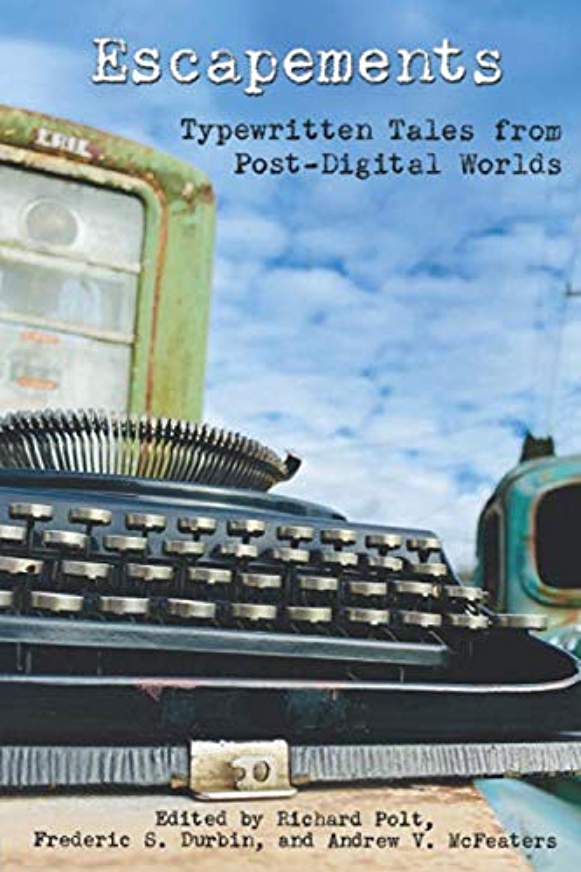
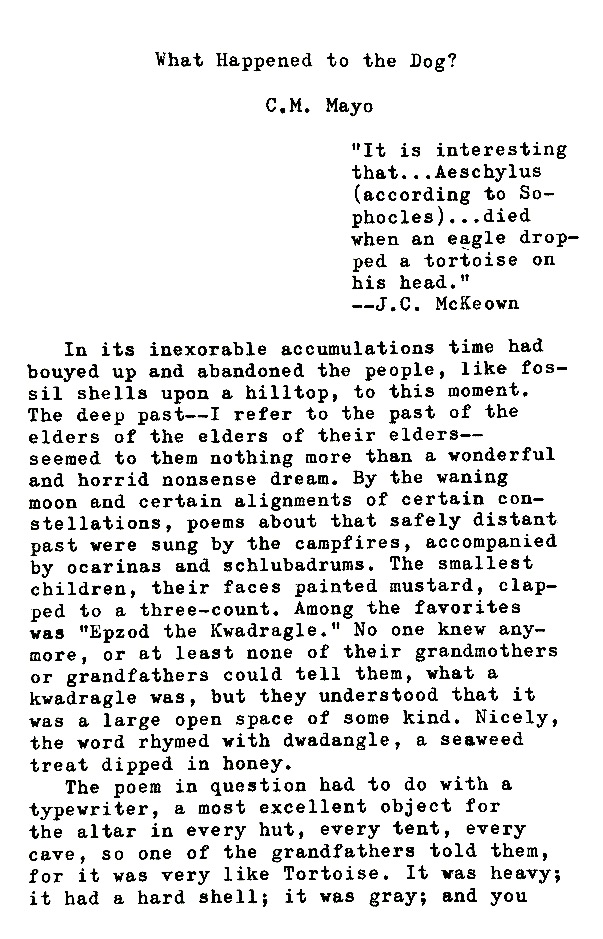
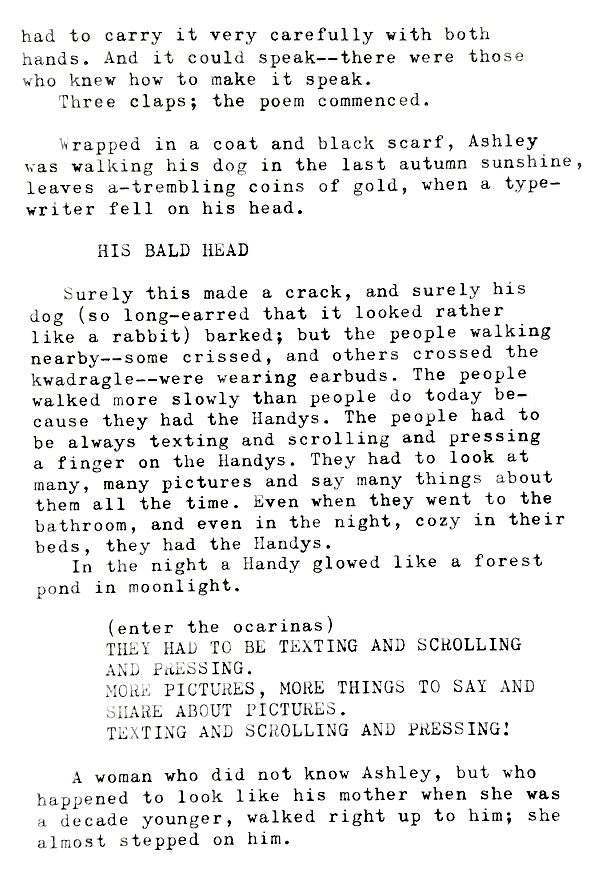
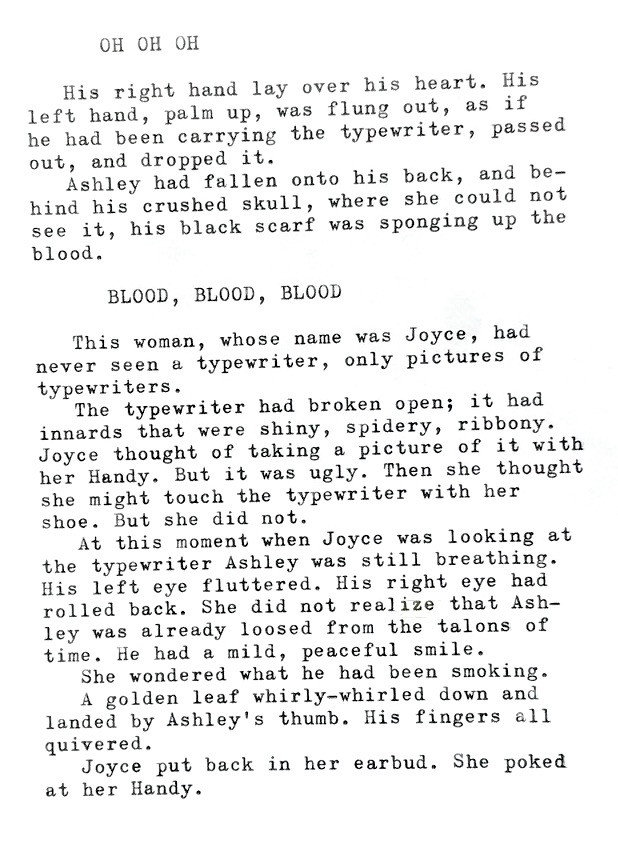
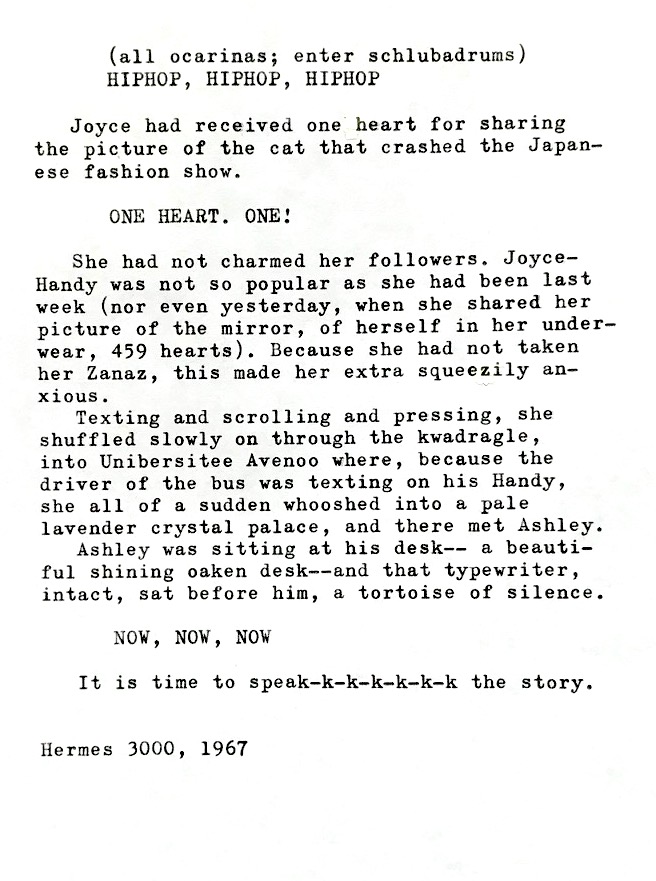
Though I have yet to meet him in person, my mentor in the Typosphere is none other than Richard Polt, professor of philosophy at Xavier University and the author of some heavy-weight tomes on Heidegger, and, to the point, a practical manual I often consult, and warmly recommend to anyone thinking of buying a typewriter, or, say, hauling Grandpa’s out of some cobwebbed corner of the garage: The Typewriter Revolution. As “Richard P.” Professor Polt also maintains a blog of the same name. And now he, Frederic S. Durbin, and Andrew V. McFeaters, have put together a pair of anthologies, both just published, the second of which, Escapements: Typewritten Tales from Post-Digital Worlds (Loose Dog Press, 2019), includes a story of mine: “What Happened to the Dog?”
Herewith, “What Happened to the Dog?” (Caveat: undoubtedly the photographs in the book itself are of better quality; these I just snapped with my smartphone, too quickly, I daresay, in a rush to make the PO with the originals.) May this entice you to buy the ridiculously low-priced anthology of a cornucopia of wildy-imagined stories by many other writers, now available at amazon.com— and better yet, have a go at typing your own pre-/post-digital fiction.
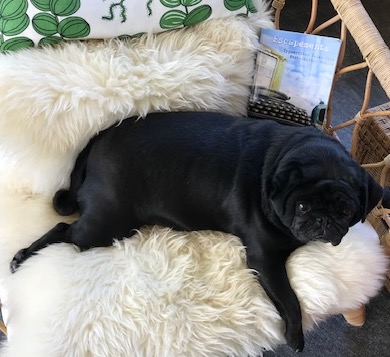
My writing assistant answers the title question: She was having a perfectly reasonable morning siesta when, suddenly, this book appeared on her back. She reports that this reminded her, mistily, of a previous life as a dimetrodon.
Those of you who follow this blog may be wondering, what perchance, and by jumpingjacks, does this short story about a typewriter have to do, and by the way what has happened with, the book in-progress on Far West Texas? The question of technology has turned out to be central to what I am writing about Far West Texas. (Darkly: there will be Heidegger quotes.)
Fingers crossed that I can finally get the next Marfa Mondays podcast up Monday after next.
Next Monday, the second of the month, I post here for the writing workshop. More anon.
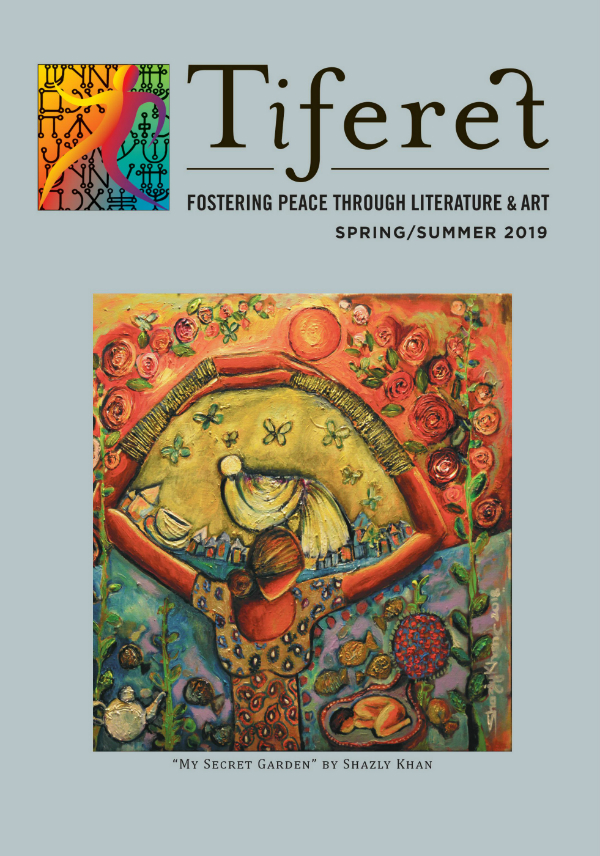
It has been more than a couple of years now since I participated as faculty at the San Miguel Writers Conference, but shining bright in my memory is a chat in the emerald cool shade of some palm trees there with Donna Baier Stein. And then we crossed paths again at the Women Writing the West Conference. Pequeño mundo! And at some point in between, to my great honor, she published an excerpt from my book, Metaphysical Odyssey into the Mexican Revolution, in her journal, Tiferet. Donna Baier Stein’s latest book is a collection of short stories inspired by artworks by Thomas Hart Benton– one of the greatest of the greats among American artists, and a personal favorite of mine.
“When a contemporary writer turns her imagination loose inside the images of an iconic artist of the past, the result is storytelling magic at its best. Here are nine tales that bring to vivid life the early decades of the 20th century as witnessed by one of America’s most well-known painters. Thomas Hart Benton sketched fiddlers and farm wives, preachers and soldiers, folks gathering in dance halls and tent meetings. Though his lithographs depict the past, the real-life people he portrayed face issues that are front and center today: corruption, women’s rights, racial inequality.
“In these stories we enter the imagined lives of Midwesterners in the late 1930s and early 1940s. A mysterious woman dancing to fiddle music makes one small gesture of kindness that helps heal the rift of racial tensions in her small town. A man leaves his childhood home after a tragic accident and becomes involved with the big-time gamblers who have made Hot Springs, Arkansas, their summer playground. After watching her mother being sent to an insane asylum simply for grieving over a miscarriage, a girl determines to never let any man have any say over her body.
“Then as now, Americans have struggled with poverty, illness, and betrayal. These fictions reveal our fellow countrymen and women living with grace and strong leanings toward virtue, despite the troubles that face them.”
C.M. MAYO: When and where did you first encounter Thomas Hart Benton’s work, and what inspired you do write this whole collection of stories?
DONNA BAIER STEIN: My father, a nearly lifelong Kansas Citian, was given an early edition lithograph by Benton in the 1950s. This was passed on to me, and I had it hanging on my office wall for many years. One day, moved by a desire that my next writing project be based on something something outside of my own life experiences, I started writing down what I saw in the picture, which showed a horse galloping across a field and two boys riding bareback, one of whom has just fallen off the animal. This led to the creation of fictional characters and a plot. After that first story was published in Virginia Quarterly Review, I wrote eight more. I owned a book of Benton’s black and white lithographs compiled and edited by Creekmore Fath and picked out images from that book that resonated with me.
C.M. MAYO: If a reader were to read one story in this collection, which one would you suggest, and why?
DONNA BAIER STEIN: Probably “Morning Train.” It’s one of my favorites because I am most intrigued by its main character, Ruth, and how she deals with the masculine.
C.M. MAYO: Can you talk about which writers have been the most important influences for you?
DONNA BAIER STEIN: Writers I grew up admiring were John Updike, Kurt Vonnegut, Saul Bellow, Ray Bradbury. Unfortunately when I was in high school we weren’t reading a lot of women writers! I also loved Faulkner, Melville, Woolf.
C.M. MAYO: Which writers are you reading now?
DONNA BAIER STEIN: I just finished Great American Desert by Terese Svoboda, which is absolutely stunning. I look forward to reading more of her books. After finishing Plainsong by Kent Haruf I immediately dove into its follow-up, Eventide.
C.M. MAYO: Before earning your MFA in writing, you had had a career as a copywriter. How do you think doing this kind of writing affected your literary writing?
DONNA BAIER STEIN: Well, it had good and bad effects! Good in the sense that it taught me to write even when I didn’t feel like it, made me comfortable with writing imperfect first drafts, and helped build the muscle memory of writing. It was bad in that I spent many years avoiding my own creative writing, or doing it only in bits and pieces on the side.
C.M. MAYO: You are founding editor and publisher of Tiferet Journal. Can you talk about what inspired you to do that? And how do you see Tiferet now and in the future?
DONNA BAIER STEIN: I had been fortunate enough to be asked to help found the Bellevue Literary Review. Their niche was “at the nexus of medicine and literature.” I started thinking that in addition to the body and literature, we should look at what happens at the nexus of spirit and literature. At the time I was studying something called integrated kabbalistic healing and was very interested in the spiritual matters and the ways the Word appears in all religions. My teacher in that school called language the first particularization of nothingness, and that definition appealed to me. I also learned the meaning of the word tiferet (heart, compassion, reconciliation of opposites) and fell in love with it. I am the only child of a Christian mother and Jewish father, and I grew up thinking we all need to get along. I founded Tiferet as a way to help foster interfaith dialogue. It’s a labor of love, really, and I often think about closing it down. But we have a terrific group of volunteer editors and an enthusiastic and supportive community of writers and readers. And considering how divisive our country is these days, it doesn’t seem to be the time to close up shop.
C.M. MAYO: As both an author and an editor, what is the best, most important piece of advice you would give to a writer who is just starting out to look to publish in magazines and perhaps publish a first book?
DONNA BAIER STEIN: My advice is to polish and persist. Don’t be sloppy. If your manuscript has egregious errors on the first page, it may well be ignored. If you receive rejections, consider revising and resubmit to other publications. Editors are inundated these days so your work may be rejected for reasons beyond your control.
C.M. MAYO: You have been a productive writer for many years. How has the Digital Revolution affected your writing? Specifically, has it become more challenging to stay focused with the siren calls of email, texting, blogs, online newspapers and magazines, social media, and such? If so, do you have some tips and tricks you might be able to share?
DONNA BAIER STEIN: I spend way too much time on social media, especially now as I promote Scenes from the Heartland. And I sometimes consider email the bane of my existence. That said, both social media and email are essential vehicles of communication these days. In my imagination, I envy those writers I mentioned earlier (Updike, Vonnegut, et al.) who could concentrate on writing, not on self-promotion. The self-promotion side of our brain is very different from the writer’s side, and I definitely prefer the latter. One trick that helps me is removing Facebook, Instagram, and Twitter from my cell phone and only visiting those sites when I’m at my desk on my computer. It’s very, very addictive, uncomfortably so. The plus side of the internet though is the wealth of material it puts at our fingertips. I absolutely love doing historical research for my stories and novels online.
C.M. MAYO: Another question apropos of the Digital Revolution. At what point, if any, were you working on paper? Was working on paper necessary for you, or problematic?
DONNA BAIER STEIN: I remember my former husband gave me an IBM self-correcting Selectric typewriter in, I believe, 1982. And I remember buying a lifetime supply of WhiteOut at my first trip to Price Club many years ago! I worked on a typewriter in my first job as a copywriter at Times Mirror Magazines and for many years as a freelance copywriter. I think I got my first computer, a Televideo, in the mid 1980s. Amber letters on a black screen. I LOVE the ability to correct without retyping an entire page and am pretty addicted to my laptop. I have terrible handwriting and as much as I’d like to write first drafts by hand, it’s not efficient for me. Thoughts seem to come too fast to write well with pen on paper. That said, I write drafts on the computer then print out the pages, edit by hand, input those corrections on computer, and repeat.
C.M. MAYO: What’s next for you as a writer?
DONNA BAIER STEIN: I’m working on another historical novel that features Sarah Bernhardt, Nikola Tesla, and Swami Vivekananda and takes place in Paris and New York in the 1890s. I’m fascinated by the fact that these three knew each other and were friends.
A most wonderful rare book about a 17th century American poet, whom I aim to write about, has arrived in my library. But phew, it STINKS. It stinks so nasty, I cannot even bear to read half a page of it.
Here’s what a used books expert says about smelly books:
But ayy, this book I have is another level of stinky. Think musty, as in New Orleans graveyard. Googling around, I find that baking soda, strong sunlight, and kitty litter are some possible remedies. I will try the kitty litter, and report. Meanwhile, any suggestions would be most welcome.
#
Migrating this blog, or rather, migrating selected link-updated posts from its old blogger platform to self-hosted WordPress here at www.madam-mayo.com has been a bit of a job, ongoing since January of this year 2019. So this Monday I’m taking a break, reposting a recently migrated piece, a readers’ favorite of this blog’s many Mexico-related posts.
What the Muse Sent Me about the Tenth Muse, Sor Juana Inés de la Cruz by C.M. Mayo First published at Madam Mayo blog March 20, 2017
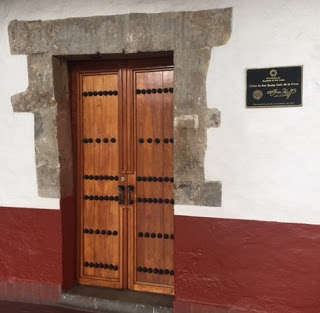
Door to the quarters of Sor Juana Inés de la Cruz, “the Tenth Muse.” Photo by C.M. Mayo, 2017.
Late last year my amiga the brilliant short story writer Paula Whyman invited me to send a “Dispatch from Mexico City” for her new magazine, Scoundrel Time. So I dialed in to Muse HQ…
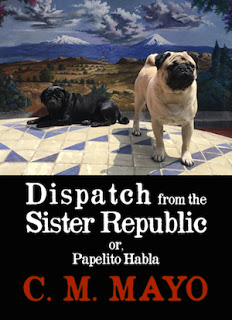
As I told Paula, woefully past the deadline, I had asked the Muse for a slider, a yummy little note about books in Mexico, but she delivered the whole ox. In other words, my “Dispatch from the Sister Republic or, Papelito Habla”is a novela-length essay about the Mexican literary landscape, from prehispanic codices to contemporary writers. It is what it is, I don’t want start chopping (there would be blood!!), but of course, a 30 page essay is too long for a magazine.
Scoundrel Time will be publishing an excerpt about Alvar Nuñez Cabeza de Vaca’s Relación-– a nearly 500 year-old memoir little known outside of Mexico and Texas, yet that stands as one of the most astonishing and important books ever written. (As soon that goes on-line, I will be sure to link to it from here. Read the piece about Cabeza de Vaca in Scoundrel Time here.)
For rare book collectors, Mecca is Mexico City’s Colonia Centro, and for such aficionados of mexicana as myself, its sanctum sanctorum, the Librería Madero—by the way, recently relocated from the Avenida Madero to the Avenida Isabela La Católica, facing the the formidable wedding cake-white corner of the 16th century ex-convent of San Jerónimo, known today as the Claustro de Sor Juana, that is, the Convent of Sister Juana.
And if you would not know Sor Juana from a poinsettia, gentle reader, with all respect, you must crowbar out that boulder of ignorance, for which you will be rewarded by a glimpse of the diamond of the Mexico’s Baroque period, the first great Latin American poet and playwright, “the Tenth Muse,” a cloistered nun.
Texan poet John Campion was the first to translate Sor Juana’s magnum opus, “Primero sueño,” as “The Dream,” in 1983. (Alas, that date is not a typo.) Campion’s translation is out of print, but he offers a free PDF download of the text on his website, worldatuningfork.com. The first lines of Campion’s translation beautifully capture Sor Juana’s uncanny power:
Pyramidal death-born shadow of earth aimed at heaven a proud point of vain obelisks pretending to scale the Stars
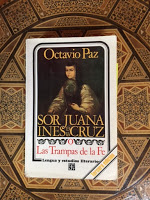
In her time Sor Juana was one of the most learned individuals, man or woman, in the New World, and her prodigious oeuvre, from love poems to polemics, comedies to enigmas to plays to villancicos, was exceptionally sophisticated, so much so that its interpretation is today the province of a small army of sorjuanistas. As Mexico’s Nobel laureate poet Octavio Paz writes in Sor Juana: Or, the Traps of Faith (translated by Margaret Sayers Peden), “A work survives its readers; after a hundred or two hundred years it is read by new readers who impose on it new modes of reading and interpretation. The work survives because of these interpretations, which are in fact resurrections.”
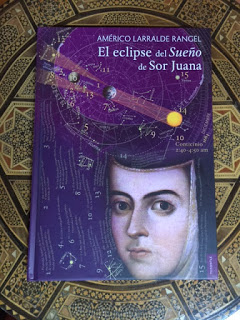
And perchance startling discoveries. In his 2011 El eclipse del Sueño de Sor Juana, Américo Larralde Rangel makes a radiant case that her “Primero Sueño” describes the dawn over Mexico City after a lunar eclipse on the solstice of the winter of 1684.
In the Librería Madero I find on the first shelf, facing out, two new books by sorjuanistas: one about Sor Juana’s family, another, just published by a Legionario de Cristo, that purports to decipher her twenty enigmas. The latter work incorporates a series of contemporary paintings of Sor Juana in the baroque style—dim backgrounds, crowns and scepters of flowers, and afloat above her head, fat-tummied cherubs, flounces, unspooling bundles of draperies. But these Sor Juanas look too pert, make too coy a tilt of the head. It seems to me as if, session over, the model might have just tossed off that habit to wriggle into some yoga wear.
Yes, just as in the United States, in Mexican cities yoga studios have been popping up like honguitos.
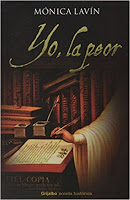
But if a vision of modern Mexico would have been obscure to Sor Juana, by no means is Sor Juana obscure in modern Mexico. She has inspired scores of poets and musicians; there have been movies, documentaries, and novels, most recently, Mónica Lavin’s 2009 best-seller Yo, la peor (I, the Worst—yet to be translated into English—fingers crossed that Patricia Dubrava will do it).
As I write this in 2017, Sor Juana graces the celadon-green 200 peso bill. From the portrait by Miguel Cabrera in the Museo Nacional de Historia: a serenely intelligent young woman’s face framed in a wimple, and behind her, her quills and inkpot and an open book of her poetry—and a few lines:
Hombres necios que acusáis a la mujer sin razón, sin ver que sois la ocasión de lo mismo que culpáis.
I cannot pretend to render the music of Sor Juana’s lines into English. But here’s a rough go at their literal meaning: You pig-headed men who accuse women unjustly, blind to the fact that you are the cause for that which you cast blame.
UPDATE: “Dispatch from the Sister Republic or, Papelito Habla,” my long essay on the Mexican literary landscape and the power of the book, is now available in Kindle.
#
P.S. You will find more Mexico-related posts on this blog’s Mexico page. As you will see, there are a few posts that have been migrated, and many more to go– and more as yet unlisted. Plus, ayyy, there is the whole Maximilian – Carlota blog (History of Mexico’s Second Empire / French Intervention) to do…. It will happen.
Now that anyone and everyone and their dog, cat, budgie, llama, and chartreuse polkadot giraffe can start a blog, or for that matter an online magazine (dub your blog an online magazine, pourquoi pas?), I am rarely asked, with that gaze of yearning, as I so often was twenty years ago, how can I get published? These days, um, lift a finger and click “publish.”
Nonetheless it remains a fact that for most poetry, short stories, and literary essays, discerning readers will be easier to come by when said work is brought out not by its author, but by a print magazine or imprint of repute. (There are exceptions, but that would be another blog post.)
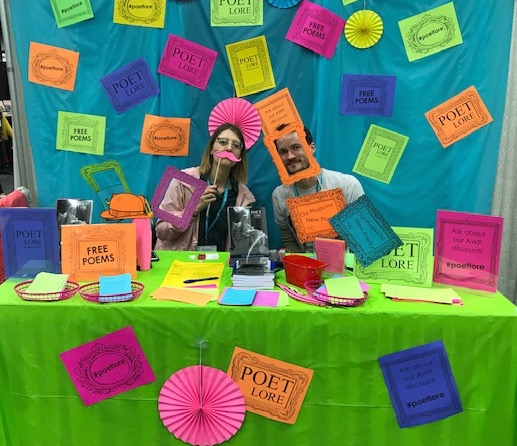
Back at the end of March I attended the annual AWP bookfair— this is the biggest litmag scene in the US– and what struck me about it was how little things had changed in the past 20 years. There were Poet Lore, the Paris Review, Fourth Genre, Creative Nonfiction— a whole host of venerable litmags that have been around since forever. (In the case of Poet Lore, that would be 1889.)
Poet Lore at AWP 2019, Emily Holland and Zack Powers. Photo: C.M. Mayo
Certainly, there have been some changes. Back when, in pre-website times, most editors disdained emailed submissions; now most solicit electronic submissions, and oftentimes via submittable.com. (Does anyone under the age of 25 even know what an SASE* is?) It is no longer considered beyond the pale for a reputable litmag to charge for submissions. (Two dollars there, three dollars here… it adds up for writers…. and so a litmag can cover at least some fraction of their costs. Such are the economics…)
*Self-Addressed Stamped Envelope.
More changes I noted at the AWP bookfair: a good number of writers, and not necessarily the younger ones, now sport green hair and tattoos. Smombies hither & yon.
And of course, all the litmags now have their websites, Twitter, FaceBook page, YouTube, mailing list, etc.
But on the whole the bookfair’s tables and booths looked much as they would have in 1999. The better litmags still bring out print editions, their editors having selected the contents from titanic “slush piles” of unsolicited submissions– albeit these slush piles are largely electronic now.
The USA in its every corner and cranny suffers no shortage of poets or literary writers! So getting your piece published by a reputable literary magazine is still, more often than not, a head-banger of a challenge. It takes discernment; and, barring lucky stars (and I don’t mean the cereal with those crappy marshmallows), a champion athlete’s ability to not take rejection personally and, like a certain senator, to nevertheless persist; and, less glamorously, but vitally, following editors’ submissions requirements and keeping an eye out for their calls for submissions.
I have plenty more to say about publishing in literary magazines, however, I have already said it! This second Monday I am hereby point to an old (but updated) article I wrote for the John Hopkins University Part-Time Writing Program newsletter, “Out of the Forest of Noise: On Publishing the Literary Short Story” –all of which advice also applies to poetry and literary short essay, and translations into English of same.
BATCAT PRESS’ CALL FOR SUBMISSIONS
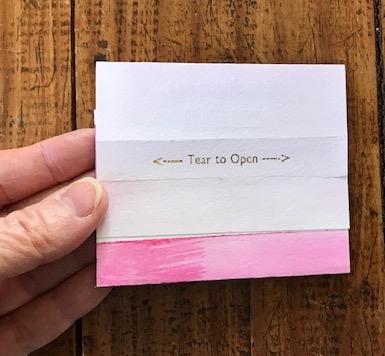
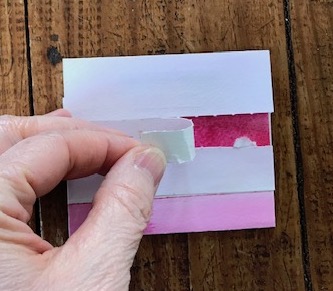
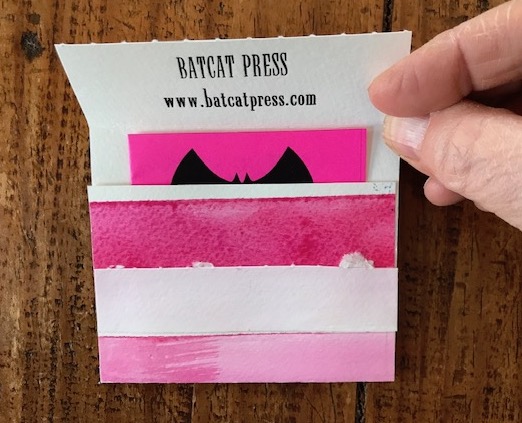
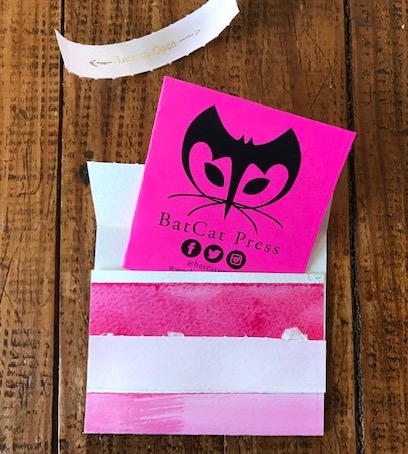
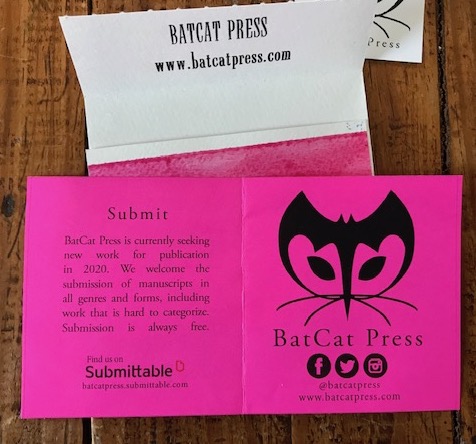
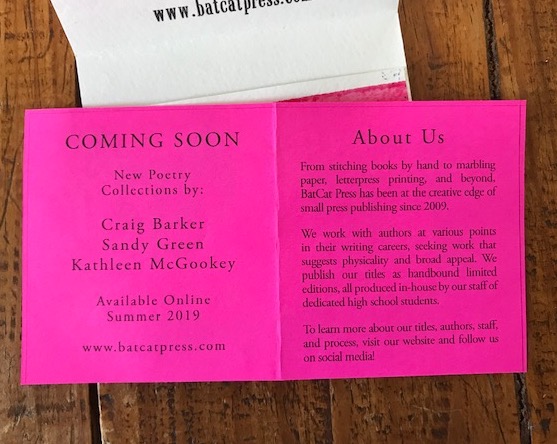
Before getting to that dusted-off article, however, I must mention something I saw at AWP such as I had never seen before: BatCat Press’ coyly playful call for submissions, not the usual boring old flyer, but a little gift of “book art” in itself.
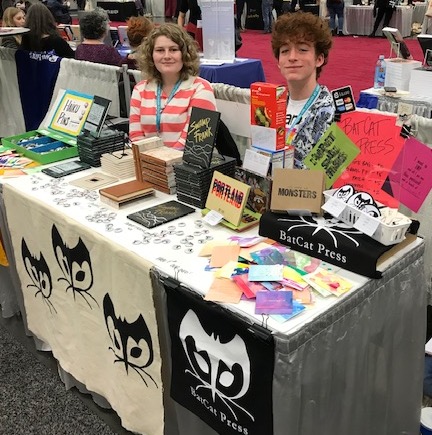
BatCat Press at AWP 2019. Photo: C.M. Mayo.
As I mentioned in last month’s post on AWP, BatCat Press is a book arts press run by highschool students– something very unusual to see at AWP. And the quality of their publications is impressive. Viva!
Here’s how they describe themselves:
“From stitching books by hand to marbling paper, letterpress printing, and beyond, BatCat Press has been at the creative edge of small press publishing since 2009. We work with authors at various points in their writing careers, seeking work that suggests physicality and broad appeal. We publish our titles as hardbound limited editions, all produced in-house by our staff of dedicated high school students.”
This is their “call for submissions”:
OK… Now, from my archives:
OUT OF THE FOREST OF NOISE: ON PUBLISHING THE LITERARY SHORT STORY
From The Part Times, a newsletter of the M.A. in Writing Program, Zanvyl Krieger School of Arts and Sciences, Johns Hopkins University, Fall 2001 (with some minor edits and updates). Last updated: February 2018
So you want to get your short story published. Take heart: you can do it. And, if your work is worthy— a question only you can answer— it merits the effort. Like a boat, send it out where it belongs, over the great wide sea. Let it find readers, whoever they may be, on whatever strange shores. Some of your readers may not be born yet. It helps to keep that in mind.
Beginning writers often imagine publishing their short story to be a glamorous event, Hemingwayesque in a wear-your-sunglasses-and-knock-back-the-grappa-as-agents-ring-your-phone-off kind of way. But for most writers it’s an experience on par with, say, folding laundry. Unless you make one of the slicks— The New Yorker, Esquire, Atlantic Monthly, Harper’s— most likely your payment will be two copies of the magazine. These will arrive in your mailbox in a plain brown envelope. Some editors jot a thankyou note, but most don’t bother. Chances are, your friends and family will not have heard of the magazine. Even the best literary journals often manage only a modest circulation— 500 to 5,000— and may not be available for sale except in a very few widely scattered off-beat independents. In short, if you want money, you’d do better to flip burgers, and if you want attention, go fight bulls. Knock back that grappa, heck, wear a spangled pink tutu and splash in the Dupont Circle fountain during lunch hour. Scream obscenities in Swahili. Whatever.
So why try? Because when your story is published it is no longer one copy printed out from your printer, but 1,000 or more. Perhaps one is lying on someone’s coffee table in Peterborough, New Hampshire, or on a poet’s broad oak desk overlooking the beach at La Jolla, California. Maybe one sits on the shelves at the University of Chicago’s Regenstein Library, or on a side table in the lobby at Yaddo. Perhaps a dentist will read your story, or a retired school teacher from Winnetka. Perhaps one day, a hundred years from now, a bizarrely tattooed highschool student will find it on a shelf in the basement of the Reno, Nevada public library, and she will sit down Indian-style on the cold linoleum floor and read it, her eyes wide with wonder. Your story, once published, lives its own life, sinking some deep, strange roots. Potentially forever. [>> CONTINUE READING THIS ARTICLE ON WWW.CMMAYO.COM]
B. Traven, the naturalized Mexican who wrote in German and English, was an internationally best-selling novelist many of whose works were made into into movies, most famously The Treasure of the Sierra Madre, starring Humphrey Bogart. In Mexico he remains immensely respected: recently, decades after his death, his life and works were celebrated with a splashy, crowd-pleasing show at Mexico City’s Museo de Arte Moderno. But who was B. Traven? Where did he come from? Why, really, did he come to Mexico? And why was he so reclusive, and so fond of pseudonyms?
Many a member of the literary cognoscenti will tell you that the B. stood for Bruno. Not so. Ret Marut? Not so. Was he Prussian, Bavarian, Norwegian, American? Any number of claims and theories have been put forth over the years, one or more of which you can ever and always find, depending on who last logged in to edit that Maoist mashup otherwise known as Wikipedia.
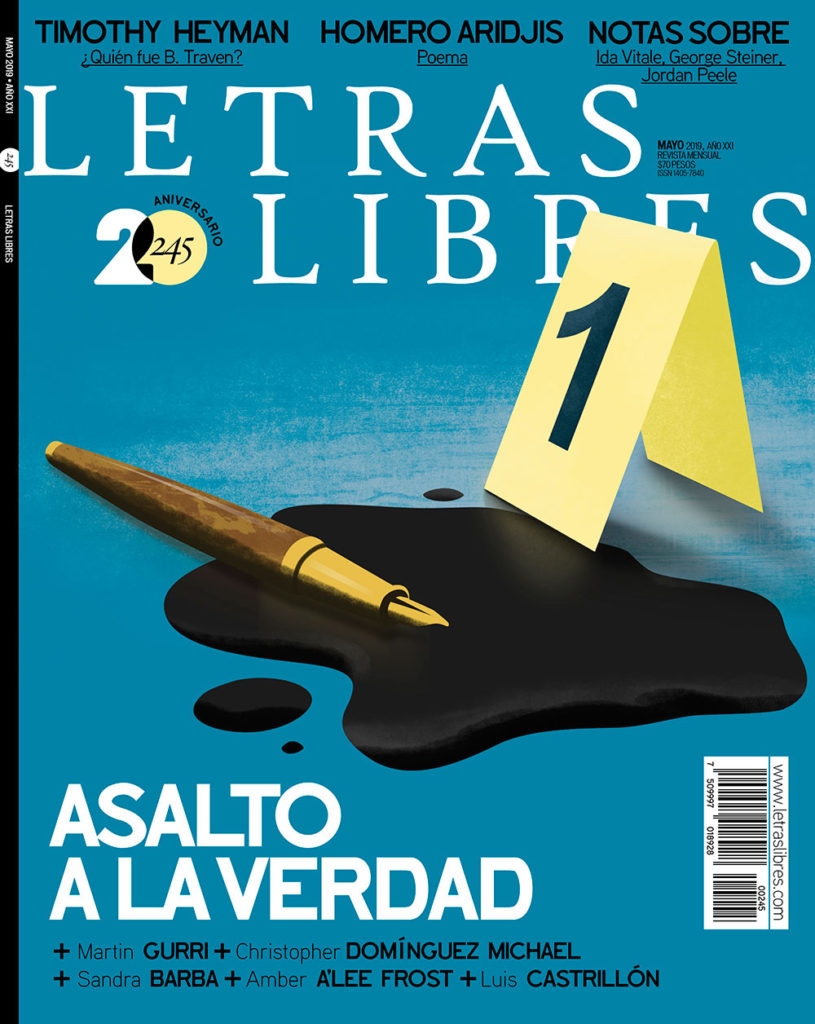
In this month’s Letras Libres, 50 years after his death in Mexico City, B. Traven’s true identity has been revealed, and this time by someone whose closeness to the subject and research are flat-out impossible to beat: Timothy Heyman, who together with his wife, B. Traven’s stepdaughter Malú Montes de Oca de Heyman, administers Traven’s literary estate.
Because Traven had wanted it this way, after he died in Mexico City in 1969, his widow claimed that he was the German actor and journalist Ret Marut. But in fact Ret Marut was only another disguise.
Traven’s close friend the cinematographer Gabriel Figuera once claimed Traven was Moritz Rathenau, but for Traven’s biographers, that bit of intelligence seems to have been either overlooked or treated as nothing more than a wisp of a rumor among others. However, Timothy Heyman reveals, B. Traven / Ret Marut was Moritz Rathenau. And more: Moritz Rathenau was the illegitimate son of none other than Emil Rathenau (1838-1915), one of Germany’s richest Jewish industrialists, founder of AEG. His mother was Irish actress Helen Mareck. For his political activities in the violent tumult of post World War I Germany, as Ret Marut, he was condemned to death in 1919, and escaped to remain undercover in Germany. In 1922 his half-brother Walther Rathenau, then Minister of Foreign Relations, was assassinated by an extreme rightwing antisemitic group– an event some historians identify as the beginning of the Holocaust. The following year, as “B. Traven,”– B. for “Plan B”–Moritz Rathenau escaped what would in another decade become Nazi Germany, and– long story short– he lived a long life as an international literary star in wildly productive seclusion in Mexico.
Timothy Heyman’s article with all the details appears in the current issue of Mexico’s most prestigious magazine, Letras Libres.
My favorite rare book historian Michael F. Suarez, SJ gives this excellent talk for TEDxCharlotteville:
#
AND FROM THE MADAM MAYO ARCHIVES…
Poco a poco (bit by bit), since January of this year I have been migrating selected and updated posts from Madam Mayo’s original Google Blogger platform to self-hosted WordPress here at www.madam-mayo.com. Madam Mayo goes all the way back to the Cambrianesquely Blogasonic Explosion, I mean, um, 2006… This past week I’ve worked a bit on the translation posts, among them:
TRANSLATING ACROSS THE BORDER Originally posted October 29, 2015 Edited Transcript of a Talk by C.M. Mayo at the annual conference of the American Literary Translators Association (ALTA)
Muchísimas gracias, Mark Weiss, and thank you also to my fellow panelists, it is an honor to sit on this dias with you. Thank you all for coming. It is especially apt to be talking about translating Mexican writing here, a jog from the Mexican border, in Tucson—or Tuk-son as the Mexicans pronounce it.
I grew up in Northern California and was educated in various places but mainly the University of Chicago. As far as Mexico went, until I was in my mid-twenties, I had absorbed, to use historian John Tutino’s term, the “enduring presumptions.” Translation: I had zero interest in Mexico.
You know that old saying, if you want to make God laugh, tell her your plans?