After a battle with brain cancer, my dear amigo Bill Gruben has passed onto new and surely most wondrous adventures. He had such a good heart and a brilliant, wildly whimsical sense of humor. I will miss him more than I can say.
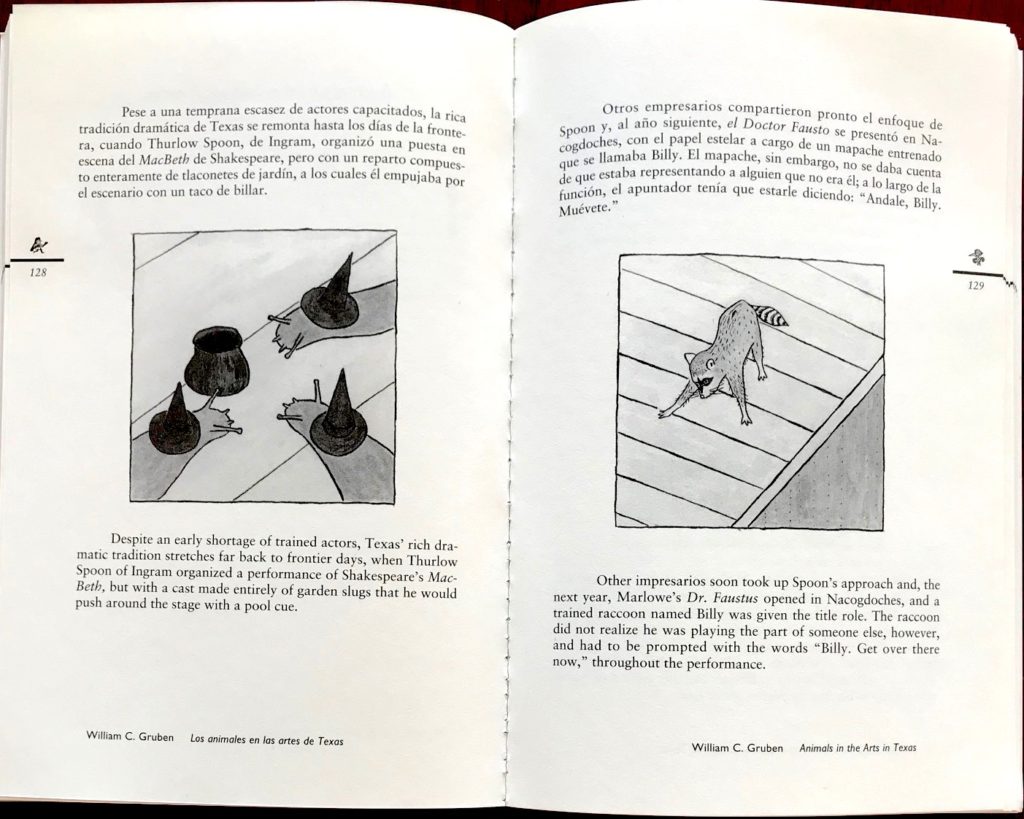
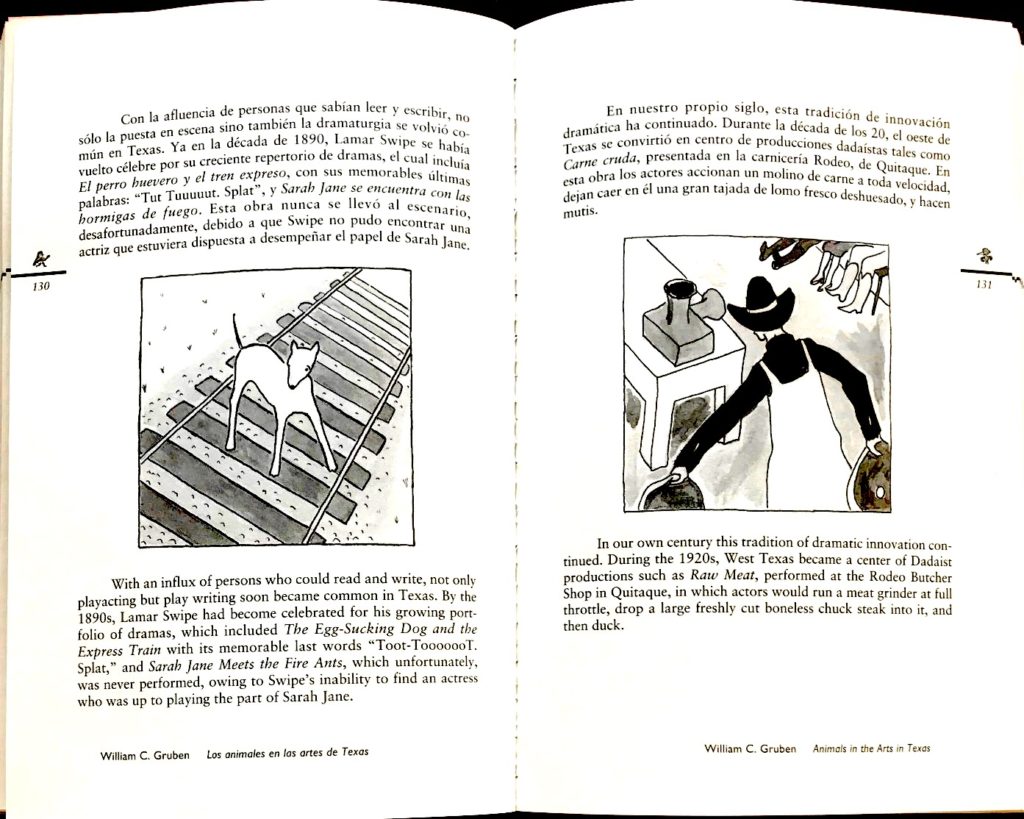
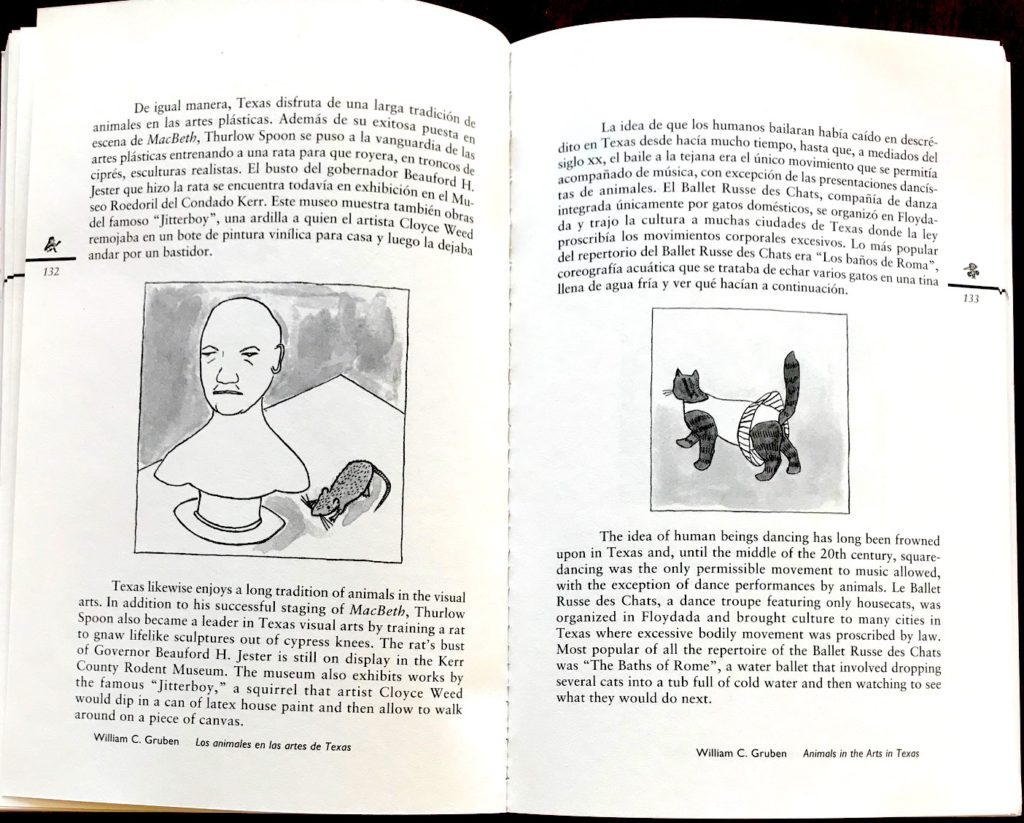
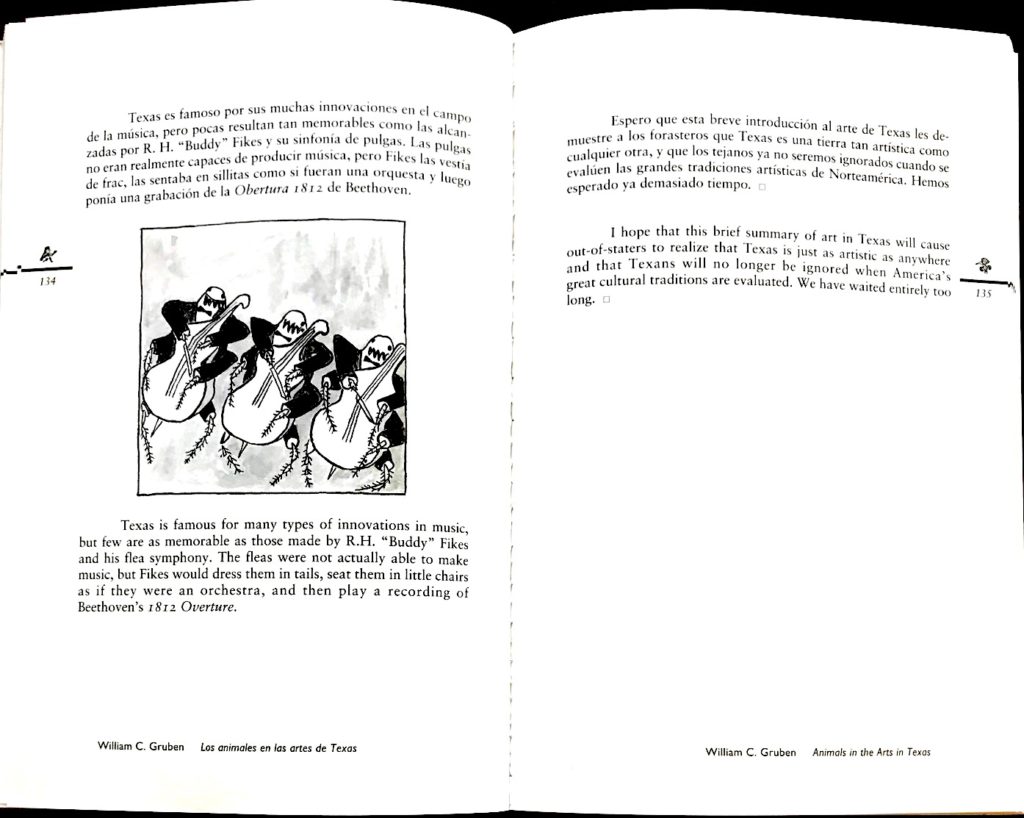
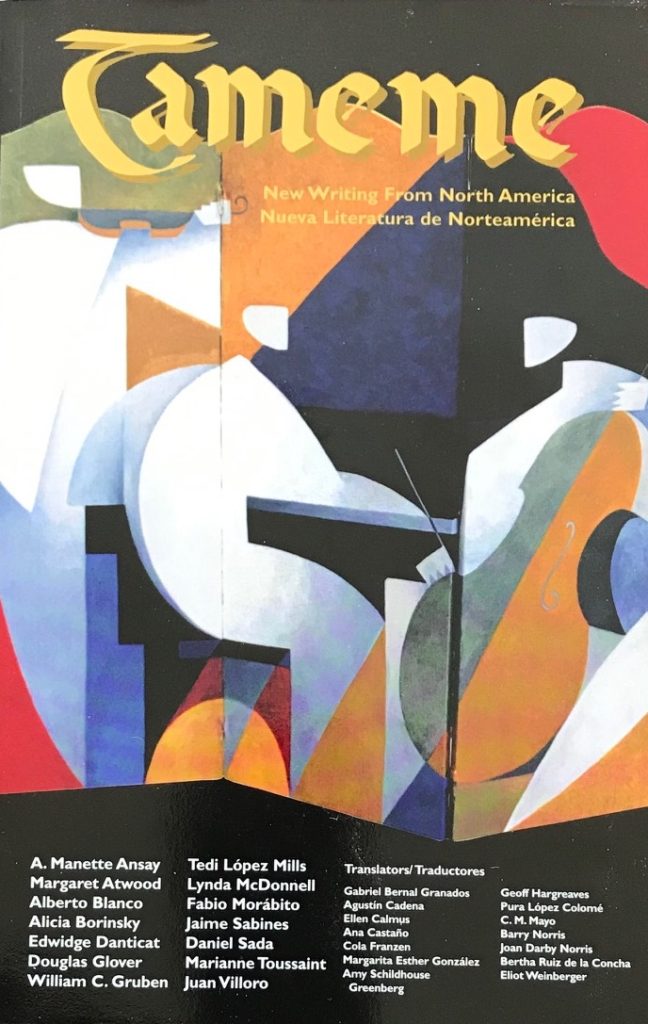
I met Bill some 30 years ago when I was working as an economist in Mexico City and he as an economist with the Dallas Fed. New flash: Not all economists are just economists! Bill, who spoke fluent Spanish and knew more about Mexico than most Mexicans, had written jokes for Joan Rivers and Phyllis Diller and published some of his brilliant comedic essays about Texas in no less a venue than The Atlantic Monthly. I was then already writing poems and short stories, and translating Mexican poetry. Later, when I got the notion to publish Tameme, a bilingual literary journal that brought together writers and poets from Canada, the US, and Mexico in bilingual English/ Spanish format, I asked Bill if he would contribute something to the first issue. I was immensely honored and quite tickled when he sent me “Animals in the Arts in Texas.” It was translated into Spanish by the splendid Mexican poet and novelist Agustín Cadena. In Bill’s memory, herewith that piece from Tameme, originally published in 1999:
#
From the Dallas Morning News, March 29, 2020: William Charles Gruben III died peacefully at his Dallas home on Tuesday, March 17th, 2020, at the age of 76, due to complications from an inoperable glioblastoma. Husband, father, economist, polymath, polyglot, musician, humorist, prankster, Bill was a classical thinker, a Medieval scholastic, a Renaissance man, a modern theorist, a postmodern ironist, and, above all else, a true soul of The Enlightenment, in that his whole life was a determined, joyous pursuit of knowledge fueled by the power of human reason and an endless supply of jokes.
Born on September 29th, 1943 in Sacramento, California, Bill was a conscientious and devoted older brother (one not above launching a younger sibling down the occasional laundry chute) during a childhood of multiple family moves: from Illinois to rural Texas, San Antonio, Houston (where he swam the bayous, alligators included) and suburban Dallas. He was an enthusiastic cadet in the Junior Yanks in the mid-50’s, and spent a few weeks every summer at his grandparents’ cotton farm in West Texas. As a high school student he mastered the guitar and the trombone, earning spending money gigging with a Dixieland band. Later in life, he learned to play a mean and somewhat soulful didgeridoo.
A graduate of Richardson High School, SMU, and The University of Texas, where he earned a doctorate in economics, Bill’s working life was a paradox. He spent the better part of his career at The Federal Reserve Bank of Dallas, where he specialized in practical applications of economic theory and the then emerging Mexican and Latin American markets, and where he co-created The Center for Latin American Economics. But Bill’s relationship to “The Dismal Science” was anything but. He understood that at the root of economic study was both the human and the quite-possibly marvelous: that economies were more than diminishing marginal return curves and income elasticity, but places where our desires and dreams collide with reality in all kinds of fascinating and exhilarating ways. An inspiration to colleagues and mentees alike, Bill’s favorite rejoinder while crunching data or preparing a paper or presentation was always, “Do you believe we get paid to do this?!” followed by another one of his brilliant one-liners. For, much as he found joy in Peso stabilization forecasts and comparative GDP analyses, Bill Gruben found hilarity in everything else.
In the 1970s, he, along with his brother, wrote, produced, and hosted a 30 minute comedy show on KCHU called “Dallas Arcade.” In the 80s, he published pieces in The Atlantic that satirized the excesses of oil-boom Texas. He wrote jokes for Joan Rivers, who used some on The Tonight Show, and for Phyllis Diller, who tried to persuade him to dump economics, move to Hollywood, and write comedy full time. Bill Gruben was too good an economist to take her suggestion. But he was terribly flattered.
Upon his retirement from The Dallas Fed, Bill spent his time among homes in Dallas, Laredo, and Monterrey, Mexico. From 2008-2014, at Texas A&M International University, he was Director of the Ph.D. Program in International Business at the University’s A.R. Sanchez, Jr. School of Business, and a Radcliffe Killam Distinguished Professor of Economics; from 2013-14, he directed The Center for Western Hemispheric Trade.
Upon his second retirement, Bill transferred his creative energies from the literary to the visual arts. His last series of canvasses depict the suffering of narcos tormented by comically enraged demons. And even this past January, when he struggled to walk and eat, he insisted on going to Fort Worth to see the Renoir show. He spent two hours on his feet looking at every painting.
Bill is preceded in death by father WIlliam Charles Gruben II, mother Virginia Dorothy Anderson Gruben, and wife, the artist Marilu Flores Gruben. Bill is survived by beloved spouse Nieves Mogas, daughters Adrienne Gruben, a film executive and documentarian, and Anna Gruben Olivier de Vezin, a non-profit director, sons-in-law David Goldstein, a technical director for live broadcast events, and Charles Olivier de Vezin, a screenwriter and film editor, grandchildren Maria Francisca Goldstein and Manel Olivier de Vezin, sister Patricia Gruben, brother Roger Gruben, and a host of adoring nieces, nephews, and cousins. The family expresses its deep gratitude to caregivers Penelope Clayton-Smith, Dario Delgado, and Frank Aven. Due to the coronavirus pandemic, services are on hold, but there will be a virtual service in mid April.
In lieu of flowers, the family welcomes contributions in Bill’s name to The Latin American and Caribbean Economic Association or to El Instituto de Atención Integral Discapacitado Retos, A.B.P.
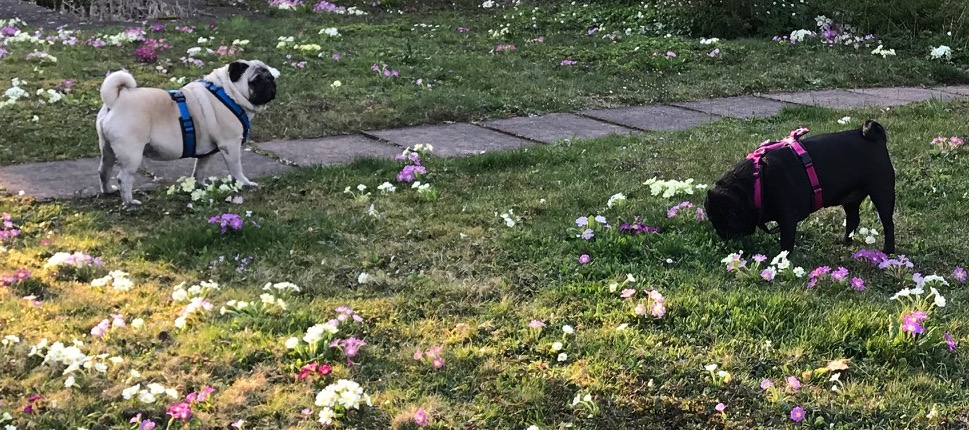
My writing assistants Uliberto Quetzalpugtl and Washingtoniana Quetzalpugalotl snoofling at the mysteries.
For those interested in my publications, podcasts, and writing workshops, after a loooooong hiatus, I am resuming the newsletter, herewith commencing a new schedule of posting it on Madam Mayo blog every fifth Monday of the month (when there is a fifth Monday, that is to say, a few times a year).
I will also be sending out the newsletter to subscribers via email. If you would like to receive only the emailed newsletter, just zap me an email, I’ll be delighted to add you to my list. (If you’ve already signed up, stay tuned. I’ve had to switch my emailing service from Mailchimp to Mad Mimi, a bit of a process. Long story short, I give Mailchimp a black banana. Mashed in the noggin!)
If in addition or instead you’d like to sign up for the Madam Mayo blog post alerts every Monday via email, just hie on over to the sidebar (or, if you’re on an iphone, scroll down to the end of this post) for the signup. Welcome!
PODCASTS
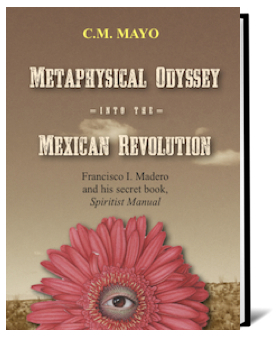
“WORDS ON A WIRE”: Award-winning writer and Chair of the UTEP Creative Writing Department Daniel Chacón interviews me about my book Metaphysical Odyssey into the Mexican Revolution: Francisco I. Madero and His Secret Book, Spiritist Manual (which includes my translation of Madero’s 1911 book). This interview with Daniel Chacón was a special honor and delight for me because while my book is a work of scholarship, it is at the same time a work of creative nonfiction. It turned out to be a very fun interview, if I do say myself. >> Listen in anytime here.
Still in production, but allllllllmost ready: The MARFA MONDAYS Podcasting Project resumes with #21: a reading of my longform essay “Miss Charles Emily Wilson: Great Power in One.” Researching and writing this rearranged all the furniture in my mind about Texas, the US-Mexico border, Florida, the Indian Wars, and much more… Miss Charles is someone everyone should know about.
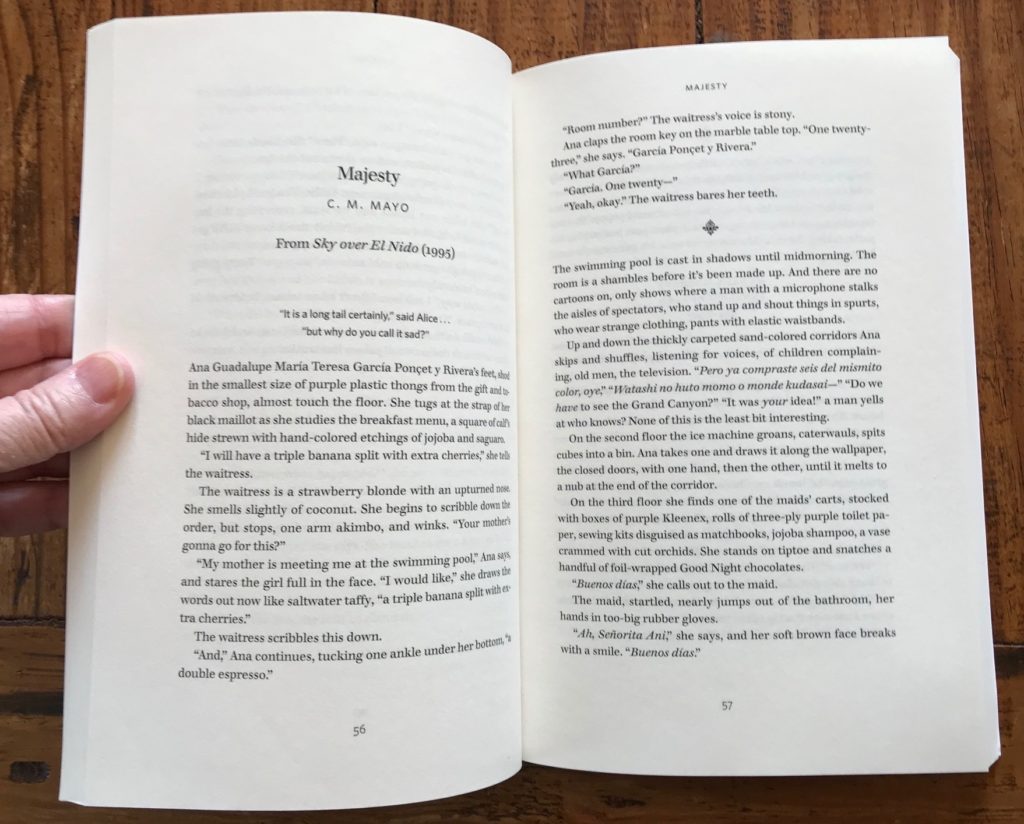
My gosh, it’s unsettling to read a story I wrote so long ago (maybe 1993 or 1994?). And “Majesty” is a strange story, and stranger still to be rereading in this age of the iPhone. It’s set in an Arizona luxury golf resort / spa in the late 1980s / early 1990s–another world, so to say, and on multiple levels. I recall the fun I had playing with the Alice in Wonderland imagery– I had recently been introduced by Douglas Glover to the German novel The Quest for Christa T. and the idea of the story as a net, an important influence on my fiction writing ever since.
Get your copy from all the usual suspects, including amazon.com
GIVAL PRESS POETRY AWARD CONTEST JUDGEDBY YOURS TRULY
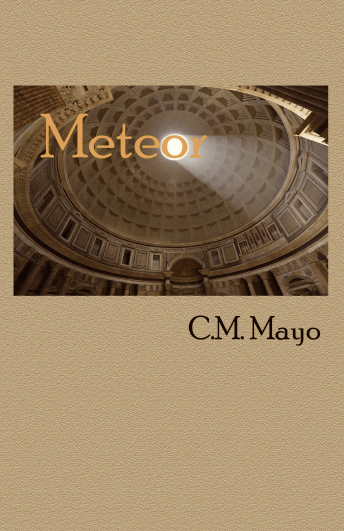
Back in January, as the winner of the most recent Gival Press Poetry Award (for Meteor), I selected the winner for this year from an excellent batch of anonymous manuscripts. Here’s the press release from Gival Press:
February 6, 2020 For Immediate Release Contact: Robert L. Giron
(Arlington, VA) Gival Press is pleased to announce that Matthew Pennock has won the Gival Press Poetry Award for his collected titled The Miracle Machine. The collection was chosen by judge C.M. Mayo. The award has a cash prize of $1,000.00 and the collection will be published this fall.
“With a craftsman’s deftest precision and a thunder-powered imagination on DaVinci wings, the author recreates a lost world within a lost world that yet—when we look—shimmers with life within our world. Elegant, wondrously strange, The Miracle Machineis at once an elegy and a celebration, tick-tock of the tao.” —C.M. Mayo, author of Meteor
About the Author
Matthew Pennock is the author of Sudden Dog (Alice James Books, 2012), which won the Kinereth-Gensler Award. As per the terms of that award, he joined the board of Alice James Books in 2011, In 2014, he co-created AJB’s editorial board with executive editor Carey Salerno, and then became the board’s first chairperson, a position he held until 2020. He received his MFA from Columbia University and his PhD from the University of Cincinnati. His poems have been widely published in such journals as Gulf Coast, Denver Quarterly, Western Humanities Review, Guernica: A Magazine of Art and Politics, New York Quarterly, LIT, and elsewhere. He currently owns and operates a learning center outside of Washington, D.C.
I am working on a book so I have no workshops yet scheduled for 2020. For my students, and anyone else interested in creative writing, I will continue to post on some aspect of craft and/or creative process here at Madam Mayo blog on the second Monday of the month.
> View the archive of Madam Mayo workshop posts here.
Meanwhile, I’m putting together a new workshop on applying poetic techniques to fiction and creative nonfiction… More news about that in the next newsletter.
Clifford Garstang, who did a Q & A for this blog in 2019, has posted his annual Literary Magazine rankings. Dear writerly readers looking to publish, while of course his, mine, yours, or anyone’s rankings of literary magazines are subject to debate, take this as a valuable and free resource!
Speaking of publishing, that usually involves a heaping helping of rejections. Well, I say, micro freaking deal! Rev that sense of humor! Need some assistance in that department? Here’s what Jia Jiang learned from 100 days of rejection:
#
There’s more to Mexico than beaches & pyramids & Frida chunches… (Chunches: That’s Mexican for tchotchkes. Not to be confused with Ughyur raisin-drying facilities.) For anyone interested in the rich cultural heritage of Mexico, check out Richard Perry’s long-ongoing blog, Arts of Colonial Mexico. Richard writes: “For the New Year, we plan to highlight monuments and art works in Oaxaca and Yucatan as well as in Guanajuato, Puebla and Tlaxcala.”
#
An email from Danuta E. Kosk-Kosicka, editor of Loch Raven Review:
Dear Fellow Translators,
I want to spread the word about Loch Raven Review’s role in showcasing poetry translated from a variety of languages, featuring as a rule one language per each issue’s bilingual section. Since 2011, when I accepted the responsibility of the Poetry Translations Editor, Loch Raven Review has featured 21 sections of poetry in translation. I’ve compiled a list of all the sections, starting with the Spanish language, followed by the expected and unexpected languages, such as Catalan, Mayan or Kurdish, at http://danutakk.wordpress.com/loch-raven-review/
I’ve made it a point to engage local area translators, starting with Yvette Neisser and Patricia Bejarano Fisher, then Nancy Naomi Carlson, Barbara Goldberg, Katherine E. Young, Nancy Arbuthnot, Zeina Azzam, and then Zackary Sholem Berger, Xuhua Lucia Liang, and Maritza Rivera in the most recent LRR Volume 15, No. 2, 2019.
Starting in 2018 we have nominated four translations for the Pushcart Award.
I feel proud and happy to be able to bring together poets who write in such a variety of languages, and the translators who make the poems available to the English language readers.
Wishing you all a peaceful, creative, and joyful 2020,
Danka
Danuta E. Kosk-Kosicka
#
Emma Lawton on “What Parkinson’s Taught Me”:
#
There is nothing you cannot do! Says Tao Porchon-Lynch, the world’s oldest yoga teacher– who recently passed away at 101. She made 98 look like 18. Bless you, Tao.
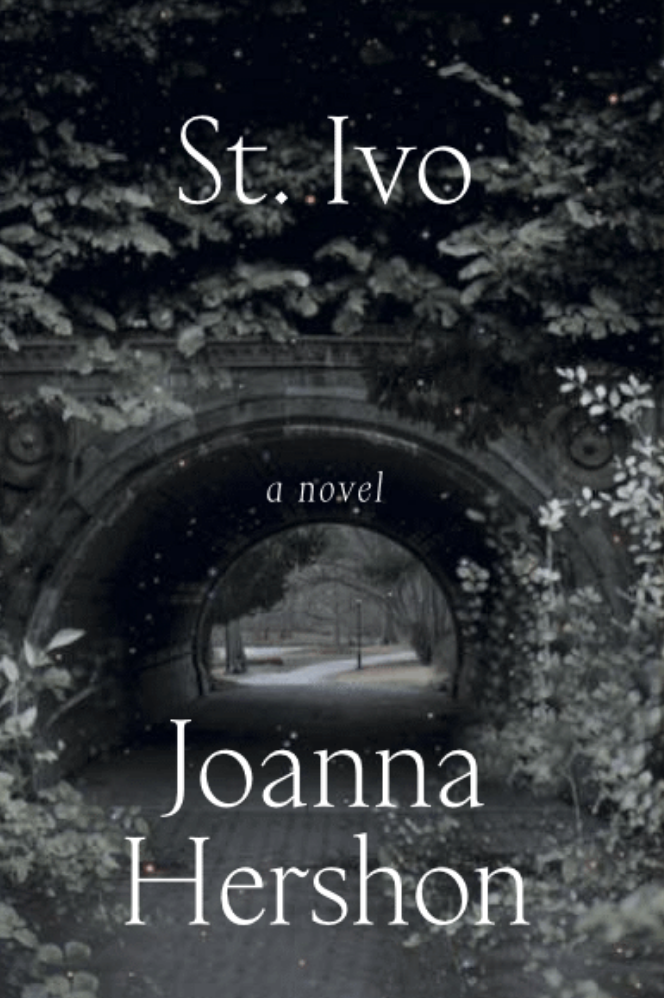
Widely-lauded novelist Joanna Hershon’s latest, which is scheduled to launch this April from Farrar, Straus & Giroux– just when the brick-and-mortar bookstores will be reopening, one hopes!–promises to be an all-star book club pick. Here’s the catalog copy:
Over the course of a weekend, two couples reckon with the long-hidden secrets that have shaped their families, in a charged, poignant novel of motherhood and friendship.
It’s the end of summer when we meet Sarah, the end of summer and the middle of her life, the middle of her career (she hopes it’s not the end), the middle of her marriage (recently repaired). And despite the years that have passed since she last saw her daughter, she is still very much in the middle of figuring out what happened to Leda, what role she played, and how she will let that loss affect the rest of her life.
Enter a mysterious stranger on a train, an older man taking the subway to Brooklyn who sees right into her. Then a mugging, her phone stolen, and with it any last connection to Leda. And then an invitation, friends from the past and a weekend in the country with their new, unexpected baby.
Over the course of three hot September days, the two couples try to reconnect. Events that have been set in motion, circumstances and feelings kept hidden, rise to the surface, forcing each to ask not just how they ended up where they are, but how they ended up who they are.
Unwinding like a suspense novel, Joanna Hershon’s St. Ivo is a powerful investigation into the meaning of choice and family, whether we ever know the people closest to us, and how, when someone goes missing from our lives, we can ever let them go.
Buy the book from all the usual online booksellers, including amazon and your local independent bookstore via indiebound.org
JOANNA HERSHON: The original inspiration was something I experienced on the subway in NYC, where I live. A man began talking to me and something about the conversation was strange and felt almost other-worldly. Another inspiration was a conversation with my husband, who observed that what I was actually interested in was not a more straightforward thriller (which I had originally thought I’d wanted to write) and more along the lines of what he observed I was good at, which is creating suspense and human drama out of tense but ordinary situations.
C.M. MAYO:As you were writing St. Ivo did you have in mind an ideal reader?
JOANNA HERSHON: I have to admit that I never think that way, though I do feel in conversation with forces outside of myself. I think the ideal reader is someone who really engages with a book. Reading is such a private experience, and one can never predict what a reader’s experience will be. I love the mystery of this notion.
C.M. MAYO:And can you describe the ideal reader for St. Ivo as you see him or her now?
JOANNA HERSHON: I think my ideal reader is anyone—male or female—who is interested in relationships, who has loved deeply, who has an interest in platonic, parental and/or romantic love.
C.M. MAYO:Can you talk about which writers have been the most important influences for you?
JOANNA HERSHON: Different writers have come into my life and different moments. Off the top of my head and in no particular order: Leo Tolstoy, Phillip Roth, Michael Cunningham, Grace Paley, Helen Schulman, Jennifer Egan, Susanna Moore, Mona Simpson, Evan S. Connell, Scott Spencer, Wallace Stegner.
C.M. MAYO:Which writers are you reading now?
JOANNA HERSHON: I’m responding to this in the midst of the Corona virus, when I am especially atuned to books which—like mine—are being affected by this awful time. Phyllis Grant’s unique and gorgeous memoir Everything is Under Control is a gem of a book with excellent recipes. Cathy Park Hong’s Minor Feelings is a book of sharp and powerful essays reflecting on the Asian American experience.
C.M. MAYO:How has the Digital Revolution affected your writing? Specifically, has it become more challenging to stay focused with the siren calls of email, texting, blogs, online newspapers and magazines, social media, and such? If so, do you have some tips and tricks you might be able to share?
JOANNA HERSHON: I imagine that, like most people, I’m more distracted with social media, texting and email but I still do feel like when I’m writing… I’m writing, just like I always did before the internet existed. Part of what I love and crave about writing fiction is that it’s a process that feels timeless and part of my essential self.
C.M. MAYO:Another question apropos of the Digital Revolution. At what point, if any, were you working on paper? Was working on paper necessary for you, or problematic?
JOANNA HERSHON: I certainly wrote on paper for many years until the Microsoft Word option of cutting and pasting became such an integral part of my writing. I still prefer to read manuscripts on paper and to use a pencil to mark them up. More and more though, I use Track Changes in Word and write notes and edit with that program in order to save paper for environmental reasons and also because it’s easy and can be very helpful.
C.M. MAYO:What is the most important piece of advice you would offer to another writer who is just starting out? And, if you could travel back in time, to your own thirty year-old self?
JOANNA HERSHON: Read as much as possible. Carve out time to read and to be silent. Also, move through the world open to mystery and strangeness and meaning. When you walk, when you observe, take in the details and pay attention to what you recall, even if it seems meaningless. There’s usually something worth noting if it stays. As for my thirty year old self: I was writing a LOT when I was thirty, so I think I’d probably say to keep going, but maybe to also travel more before having children.
“Read as much as possible. Carve out time to read and to be silent. Also, move through the world open to mystery and strangeness and meaning.”
C.M. MAYO:What’s next for you?
JOANNA HERSHON: I am really not sure. Due to the Corona Virus, I am currently in social isolation in Brooklyn with my family. My kids will begin remote learning in about two weeks. My novel is about to be published. I’d thought I’d be touring and going to book groups and book stores all spring and now I am mostly cooking and cleaning and entertaining my five-year-old. I hope to connect with readers more and more online. It’s hard to imagine that I won’t start another novel and hopefully soon. I have written novels for my entire adult life and it feels like an inextricable part of me.
In this age of Instagram and Tripadvisor & etc. etc. etc. it would seem that increasingly fewer people have the interest, never mind the attentional focus, for literary travel memoir. But readers of this genre were always a tiny minority of the general population. I say, on this planet of billions of people, there will always be a good number of people who read, and read insatiably, seriously, broadly, and deeply. Ergo, we can be sure that someone somewhere will be writing something about someplace, and some number of these works, however small, will undoubtedly be read by some intelligent and thoughtful someone.
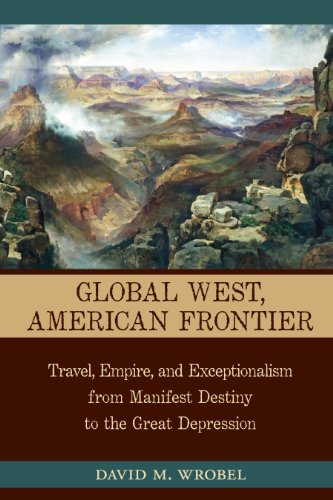
I write literary travel memoir and, on occasion, I teach a workshop on that genre, so when, as part of my reading for my book in-progress on Far West Texas, I came across cultural historian David M. Wrobel’s superb Global West, American Frontier, apart from its helping me get my mind around “Texas,” I felt moved to make a few notes on what he has to say about this oft-undervalued literary genre. Dear writerly reader, may you may find these quotes as heartening as I did.
“The travel book remained a key genre throughout the twentieth century, and still is today. In the early twenty-first century, when it is possible to fly to nearly anywhere in the world within a day and to travel virtually anywhere via the Internet, a quaint, old-fashioned printed companion remains surprisingly popular. A distinctive hybrid of the fiction and nonfiction forms, of reflection and reportage, of anthropology, history, and literature, still serves as an essential accompaniment for actual travel or provides core background reading for a journey.” (pp. 5-6)
“The truly gifted and valuable travel writers are, I would venture, the ones who come to realize that they are not just traveling through other landscapes but through the landscapes of other people’s lives; they are visitors who care to learn what a place means to the people who live there.” (p.13)
“[T]he travel narrative form has remained an important guide to western America even as new technological developments have compressed space and rendered the most faraway places more readily accessible. For this reason, the travel book can be deemed an unlikely survivor in the digital age.” (p.17)
“The travel book lives on, oblivious to the assumption that its time should long since have passed.” (p.187)
“The real authenticity or value of the genre surely lies in the expansiveness of the vision of its practitioners. This is why the travel book has persisted for nearly two centuries since its death was first announced and for more than three-quarters of a century since its demise was dramatically reproclaimed, and why today it seems as vital as ever, even though getting to almost anywhere in the world in next to no time at all is now more a chore than a challenge. The ease of travel does not restrict the vision of the obervant travel writer in the postmodern age any more than the difficulty of travel guaranteed smart observation in the premodern or modern periods.” (p.187)
“It is the ability of the traveler to experience and reflect on what is encountered along the way that is most important.” (p.187)
-David M. Wrobel, Global West, American Frontier
#
PS I would consider these among the best of the genre:
See also the Q & A’s here on Madam Mayo blog with the brilliant Shelley Armitage (Walking the Llano); Bruce Berger (A Desert Harvest, etc.); and Sara Mansfield Taber (Bread of Three Rivers, etc).
Do you write with a pen or a pencil? That’s the biggest, fattest cliché of a question for a writer. Caramba! I never thought I’d write a post about a pencil.
Backstory: An age ago I read about Palomino Blackwing pencils on Kevin Kelly’s Cool Tools blog, and because I’d found a number of surprisingly excellent recommendations there, I thought hmmm, I just might maybe look for those pencils one of these days…
I wasn’t even writing with a pencil at that point. I had used mechanical pencils on and off in high school and college, but I hated running out of the leads, or as often happened, finding that I had the wrong size. I was all for writing with ballpoint pens, and (long, boring story) I came into a supply of some 250 swag pens, so that lasted me for the past decade…
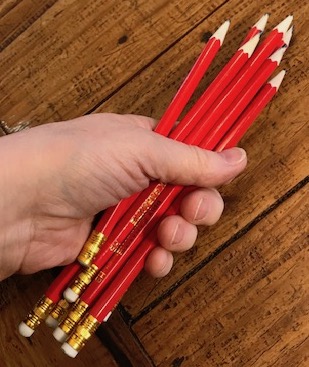
Two years ago I started writing with a pencil again. I had just happened to be in the stationary supply aisle in my local grocery store when, for no particular reason, except that I fancied their fire-engine red color, I tossed a packet of pencils into the cart. These were nothing special, regular old No. 2 lead pencils. But I soon found that I quite liked writing with a pencil, mainly because I could erase! I erase a lot.
Ye olde grocery store pencils. Nothing special.
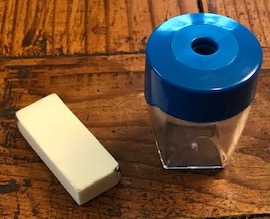
Voilà, also from my local grocery store, my eraser and pencil sharpener!
Ye olde eraser and ye olde pencil sharpener.
Thundernation, I think I spent, like, maybe five bucks on all this low-tech equipment. (Casting bronze sculpture, this ain’t…)
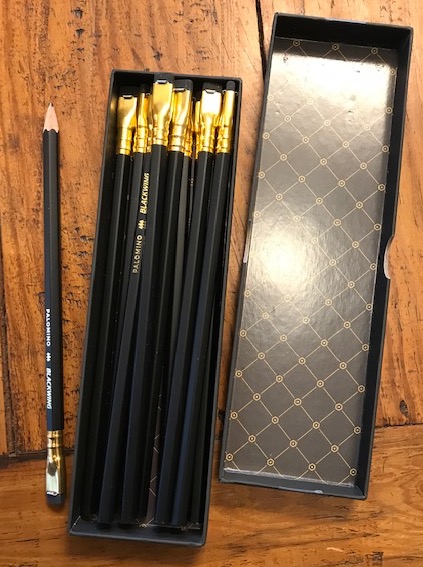
So the mammoth news is, last month I finally ordered a dozen Palomino Blackwings, which cost a ridiculous (==put on your seatbelt==) 25 dollars. (That comes to about 2 bucks per pencil.) They arrived in a sleek black box suitable for Swiss truffles.
WAHH!!! No Swiss truffles!! My Palomino Blackwing pencils.
The Palomino Blackwing pencil is fabulicious! It glides across the page in a way I can only describe as yummy. It seems the secret is the Japanese graphite, “crafted with clay for strength and wax for smoothness.”
Trivial as they may seem, these material matters of writerly routine and comfort– using a special pencil, or, say, a lap desk for a certain task on a certain sofa at a certain time– can make a nifty difference for a writer’s productivity.
So, actually, there just might be something for you to the question, do you write with a pen or a pencil?
Or, on a computer or a typewriter? Or, all of the above?
Coffee or tea?
Classical music or rock music?
Desk facing the window or the wall?
If you are feeling in any way blocked or slow with your process, what might make a refreshing tweak for you?
A nutty month it’s been, dear writerly readers. Herewith another old but extra-crunchy interview– one of my favorites. Why so? Among many reasons, in my book-in-progress on Far West Texas I am writing about Xavier González, an artist who worked in the Big Bend (among many other places in his long life, which began in Spain in 1898 and concluded in New York City in 1993), and it’s fun to realize, via his teacher Diego Rivera, he has a link to Santiago Rebull…
An Interview with Alan Rojas Orzechowski about Maximilian’s Court Painter, Santiago Rebull
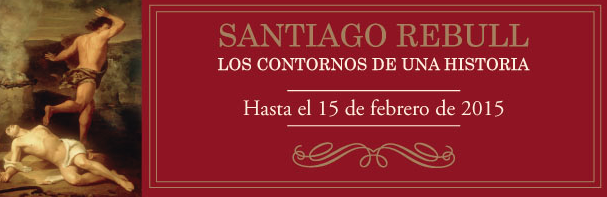
Santiago Rebull: The Outlines of a Story, at the Museum of the Diego Rivera Mural in Mexico City. Through February 15, 2015
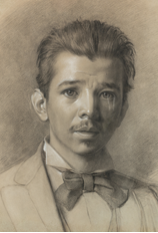
He was Maximilian’s Court Painter, a leading figure in 19th century Mexican painting, and one of the important influences on Diego Rivera, yet few people have heard of Santiago Rebull— until now.
If you’re anywhere near Mexico City, come in and visit the Santiago Rebull show at the Museo Mural Diego Rivera. >> More information here. << For those aficionados of the history of the French Intervention, and in particular the brief reign of Maximilian von Habsburg as Emperor of Mexico, this is an especially important show not to miss, for Rebull was Maximilian’s Court Painter and, interestingly, one of the few individuals close to the monarchy who managed to remain in Mexico and even thrive in subsequent decades under the Republic. Herewith, my interview with the show’s curator, Mexican historian Alan Rojas Orzechowski.
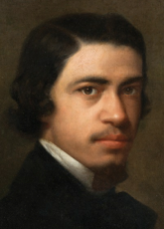
Santiago Rebull, Self-portrait, 1852
C.M. MAYO: What gave you the idea for the show?
ALAN ROJAS ORZECHOWSKI: The exhibition Santiago Rebull: Los contornos de una historia (Santiago Rebull: The Outlines of a Story) presented in the Museo Mural Diego Rivera is our own way to pay homage to one of the most creative minds of the Academic Movement in Mexico, an illustrious painter and educator who molded the minds of pupils such as Roberto Montenegro, Ángel Zárraga and Diego Rivera.
As an outstanding teacher, he taught Diego Rivera as a young student in the San Carlos Academy of Arts. Rivera in return, always considered him as a mentor and guide, respecting him as both, as an instructor and fellow artist. Exploiting this connection, the Museo Mural Diego Rivera and external curator Magaly Hernández, thought suitable to present an exhibition which honored Rebull’s artwork, underlining his influence on Rivera and his generation.
C.M. MAYO: How did Santiago Rebull, so close to Maximilian, manage to remain in Mexico and continue working as a successful artist for decades afterwards?
ALAN ROJAS ORZECHOWSKI: I personally think that it was his undeniable talent as an artist which enabled him to continue teaching in San Carlos Academy during three more decades.
In the immediate years after Maximilian’s fall he did receive severe reproaches from fellow artists and local newspapers as a monarchist and “afrancesado” (pro-French), but he carried on painting members of the political, economic and cultural elite. As a testament of this, the portraits of Presidents Benito Juárez and Porfirio Díaz are shown in the exhibition. Both pieces are dated in the 1870s, less than a decade after the monarch´s disgrace.
He retained his position as a teacher in San Carlos and also imparted drawing lessons to female pupils in the Colegio de Vizcaínas which was the only female and secular school in Mexico throughout the XVIII and XIX centuries. Along with his academic career, he remained a prolific painter, authoring remarkable pieces such as La muerte de Marat (Marat’s Death) and several portraits.
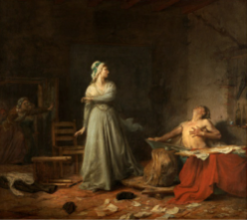
Santiago Rebull, La muerte de Marat, 1875
C.M. MAYO: What has been the reaction from art historians and historians of the Second Empire?
ALAN ROJAS ORZECHOWSKI: The Academic reaction towards the Second Empire, from both, historians and art historians, has changed through time. During the first half of the XX Century, the posture was very much aligned to the official history, characterized by a nationalist stance in which Maximilian was portrayed as an invader and many of his actions as an imposition to Mexicans.
Nevertheless, this has shifted to a fascination for both, Maximilian and Charlotte, partly thanks to literature. En example of this, the book Noticias del Imperio (News from the Empire) by Fernando del Paso or The Last Prince of the Mexican Empire by C.M. Mayo.
Historians have now a much more benevolent gaze to the Second Empire, emphasizing on Maximilian’s liberal measures that assisted the indigenous groups and regulated Ecclesiastic influence on civilians—which certainly made him unpopular with his original supporters. Art historians tend to be cautious with their judgments, stressing the continuity on San Carlos Academy trough its curriculum, academic cluster and board, all of them dramatically modified with the Republic’s restoration.
For instance, Eduardo Báez Macías, in his volume History of the National School of Fine Arts (Old San Carlos Academy), mentions Maximilian’s patronizing attitude towards Mexican art, believing it to be provincial to what he was used to in Europe.
My personal view is the opposite. Maximilian was a very intelligent ruler, he was aware of the necessity of his government’s legitimacy, and knew that the main way to achieved it was through art and Court protocol. In the first case, he arose from the liberal vs. conservative´s discussion over national heroes and entrusted several talented young artists to create a portrait gallery of the libertadores, including characters such as Hidalgo and Iturbide along. Also, in several Imperial projects he preferred to employ talented Mexican students over well-known established European teachers as Eugenio Landesio or Pelegrín Clavé.
C.M. MAYO: Which of all the 68 pieces do you consider the most essential for understanding Rebull and his place in Mexican art?
ALAN ROJAS ORZECHOWSKI: Santiago Rebull is one of the most relevant XIX century painters in Mexico’s history. He is a fundamental artist of the Academicism generation, and keystone to understanding the shift in the Art Scene towards the Vanguards and the Mexican Painting School of XX century, since he was an inexhaustible teacher to many of its participants.
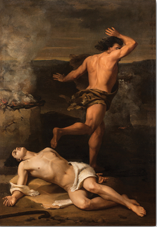
One of Santiago Rebull’s anchor pieces is La muerte de Abel (Abel’s Death). It was painted in 1851 and earned him a scholarship to travel to Rome.
Santiago Rebull, La muerte de Abel, 1851
He there attended the San Lucas Academy, a conservative catholic art school that followed the principles of the Nazarene Movement, specially influenced by the German painter Johann Friedrich Overbeck. Rebull studied under the guidance of Academic artist Thomaso Consoni, who molded and perfected his technique through a careful series of exercises consisting on copying masterpieces from Renaissance maestros. Therefore, La muerte de Abel best represents the Academic ideals of trace, color use and proportions so faithfully followed by Rebull.
C.M. MAYO: Was it difficult to find these 68 pieces, and were there any you couldn’t get for the show that you wish you had?
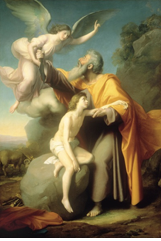
ALAN ROJAS ORZECHOWSKI: Unfortunately there was a piece we were unable to obtain, El sacrificio de Isaac (Isaac’s Sacrifice) painted in 1858 during his sojourn in Italy and displayed in the Centennial Exposition of Philadelphia and later shown in New Orleans. The image is almost 118 inches tall and it’s a flawless sample of Rebull´s work during this formative voyage under Consoni’s guidance. Alas, it was a crucial piece in the National Museum of Art (MUNAL), therefore, they were unable to lend it.
Santiago Rebull, El sacrificio de Isaac, 1859
It was relatively unproblematic to secure the greater part of the assortment since it belongs to the painter’s descendants, most of them eager to promote their ancestor’s work. The rest of the pieces were graciously provided by significant institutions such as the San Carlos Academy, the National Museum of Art and the Colegio de Vizcaínas.
C.M. MAYO: Was the museum at Il Castillo di Miramar involved in any way? The original of Rebull’s portrait of the Emperor Maximilian was sent there, is that right?
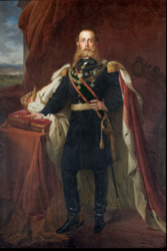
ALAN ROJAS ORZECHOWSKI: The original full length portrait of Maximilian was painted by Santiago Rebull in 1865. The Emperor took such pleasure on it that resulted on the appointment of Rebull as court painter; he was also awarded the Order of Guadalupe, the Empire’s uppermost honor. The monarch relocated the painting in Miramar Castle in Trieste, Italy that same year. Nonetheless he commissioned Joaquín Ramírez, another Academic painter to produce an exact copy of his portrait. Currently, the latter is part of the National Institute of Fine Arts collection and it’s shown at Chapultepec Castle. We exhibit a contemporary reproduction of Ramírez painting.
Joaquín Ramírez, Portrait of Emperor Maximilian I, ca. 1866.
C.M. MAYO: The decorative bacchantes that Rebull painted for Chapultepec Castle– were these Maximilian’s idea or the artist’s? What do you think was the message of such decorative paintings?
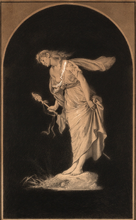
ALAN ROJAS ORZECHOWSKI: The decorative bacchantes of Miravalle (Chapultepec) Castle were the Emperor’s idea but Rebull only painted four of them during Maximilian’s reign since the remaining two were created later, during President Porfirio Díaz administration when he occupied the castle as his summer residence.
The message behind the bacchantes is clear: the ideal of graciousness that courtesan life implied. Maximilian was convinced that through art and elaborate court rituals his regime would gain the legitimacy and acceptance of Mexican elites. The creation of new titles, honors and reinstated old colonial titles were strategies followed by the sovereign. Thus, art and protocol were undeniably intertwined in the imperial residences.
Santiago Rebull, Bacante para la terraza del Alcázar de Chapultepec, 1894
In the words of art historian Justino Fernández “Rebull planned six bacchantes figures […] the romanticism of the epoch finds here one of its classical expressions, these women, or better said, demigoddesses, highly idealized, wear the magnificence of their figure, in a movement attitude.” * *Justino Fernández. El arte del siglo XIX en México, Mexico, Imprenta Universitaria, 1967, p. 77.
C.M. MAYO: What do you consider Rebull’s most essential achievements as an artist?
ALAN ROJAS ORZECHOWSKI: His personal career is bound to the history of San Carlos Academy; we may consider him as a founding painter of Mexican art of the first decades of independence, when the elite and middle classes were shaping an identity of their own, which they found in the expressions of Academicism and Neoclassic Art.
He perfected his education with the European sojourn—not remaining solely in Rome, but traveling extensively through Spain—and returned with a refined paintbrush imbibed by Purism and Nazarene precepts.
The preparative drawings are a testament of Rebull’s expertise of trace and copying, the two cornerstone of a XIX century Academic education. Upon his return he grew as a prolific portraitist, the most important being that of Emperor Maximilian.
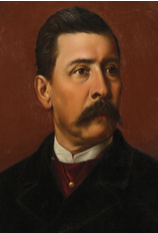
But his talent was enjoyed not only by royals; both Presidents Benito Juárez and Porfirio Díaz were also depicted by the artist. The latter, is embodied as a young aspiring president, unlike later representations where an elderly and heavily ornamented military men is shown. Furthermore, common and quotidian characters were also portrayed by him.
Santiago Rebull, Portrait of Porfirio Díaz, 1872
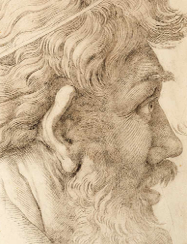
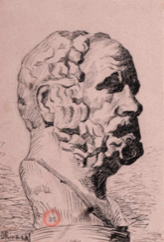
Santiago Rebull, Portrait of an unknown man, undated
C.M. MAYO: Why is the show in the Museo de Diego Rivera? Can you talk a little about Rebull’s influence on Diego Rivera?
ALAN ROJAS ORZECHOWSKI: Since the Museo Mural Diego Rivera has the commitment of preserving Diego Rivera’s legacy, promoting the artistic expressions created during the XX century and especially those influenced by Rivera himself, we thought there was a great breach with his predecessors. Who were they? Who particularly influenced him?
Rivera was educated at the San Carlos Academy of Arts in Mexico City where he was an accomplished student, tutored by the great artists of the XIX century Academic movement. He received a refined instruction from painters such as José Salomé Pina, José María Velasco and Santiago Rebull. Diego always felt in debt towards the latter, recognizing him as his mentor.
I am off again this week, dear writerly readers, but I offer you this post from the archives about one of my very favorite and most secretly wondrous places on the planet.
THE SOLITARIO DOME
Originally posted on Madam Mayo blog March 13, 2015
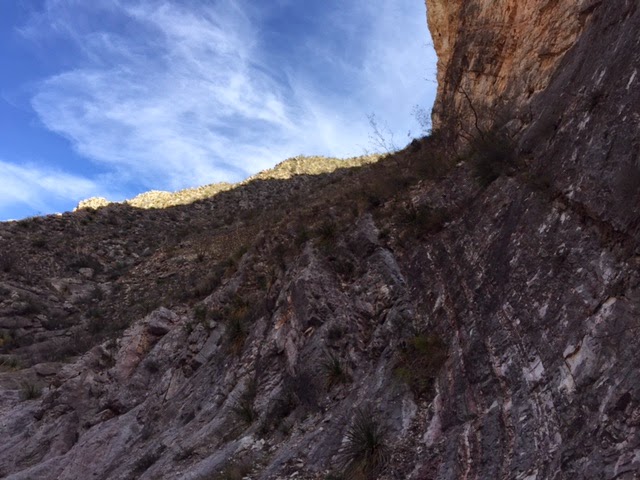
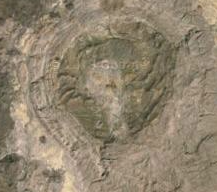
Inside The Solitario. Photo: C.M. Mayo, March 2015
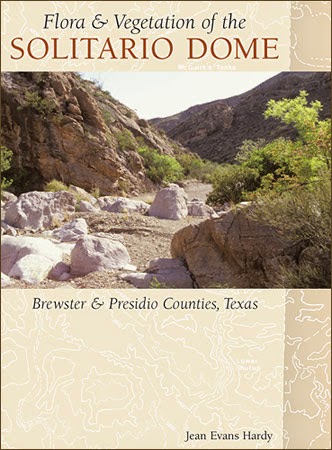
Flora and Vegetation of the Solitario Dome by Jean Evans Hardy, Iron Mountain Press, 2009 (Whoa, call the chiropracter, I brought this one home in my carry-on!)
Geology of the Solitario by Charles E. Corry, et al. Geological Society of America Special Paper 250, 1990.
“Igneous Evolution of a Complex Laccolith-Caldera, the Solitario, Trans-Pecos, Texas: Implications for Calderas and Subjacent Plutons” by Christopher D. Henry, et al.Geological Society of America Bulletin, August 1997 (Super-crunchy PDF)
The Solitario: Sentinel of the Big Bend Ranch State Park” Megan Hicks, The Big Bend Paisano, Winter 2004/2005 (PDF)
“Geology at the Crossroads” By Blaine R. Hall, Big Bend Ranch State Park (PDF)
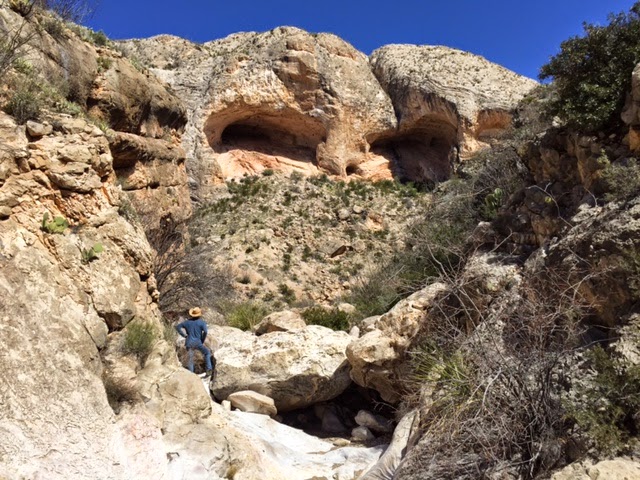
Entering the labyrinth of the Solitario via Los Portales (That’s my guide, Charlie Angell, he’s the best, check him out on Tripadvisor.com). Photo: C.M. Mayo, March 2015
Like many writers I nurture an oft-adjusted list of possible future writing projects (PFWP). I’ve been at this game for more years than I want to confess, so trust me when I say it’s surprisingly easy to get a sizzling-hot-slam-a-roni of an idea and then… have completely forgotten all about it anywhere from five minutes to five weeks later. But there they all are, captured in ink on my PFPW! (I keep mine in my Filofax. Other writers might prefer to keep theirs in a file on their computer or, perhaps, in a special notebook.)
Right now, February 2020, my PFWP list has four nonfiction books, three novels, a batch of stories, a couple of poems, a couple of translation projects, and an essay of creative nonfiction. Two of these possible future writing projects have been sitting on the list for over a decade. Oh, and just yesterday, I came up with a solidly good idea, if I do say so myself, for a scholarly paper about a cavalry officer’s adventures in the Guadalupe Mountains.
Will I ever get to them all? That is not the question.
My PFWP list is not so much a “to do” list as it is my very own rich and appealing menu. Whenever the time comes that I am ready to commit to a new writing project, I’m never left sitting there, spinning my wheels, wondering, ohmygosh, what can I write now? I simply whip out the PFWP and see which of those many projects feels right for me for a next-action.
All of them are appealing enough to me that were any one the only option I would gladly do it– or else I don’t add it to the list.
Meanwhile, one thing that helps keeps me going with my current writing project– the memoir of Far West Texas— is my NTDN list, that is, my list of the things Not To Do Now. These are things I feel pressured by others to do; or tempted against my better judgement to do; or expect / want to do at some point, but not now– “now” being the horizon for my current writing project.
TOP 5 ON MY NTDN LIST
(1) Download Whatsapp Nope, I have never downloaded Whatsapp. Bless you, my many friends and relatives who have asked me for my Whatsapp, because I love you! I do want to be in touch, I do want to see your photos! But it’s either my book gets written + I answer email or I do Whatsapp + I answer email. I have only 24 hours in the day. May I be blunt? Would you really wish for me to not write my book?
(2) Get a TV I gave away my TV an eon ago. I had a Netflix subscription once, but it so long ago I have forgotten when it was that I canceled it. Bless you all who can spend hours watching TV! But I don’t, I can’t, and that’s that!
(3) Participate on Social Media FaceBook deactivated in 2015. LinkedIn minimal. Instagram zip. Twitter I’ve been on since the get-go, but for a long while now I only tweet the link to the once-a-month Q & A on this blog, and on very rare occasion something similar, as a courtesy to that writer and anyone else mentioned on my blog. I consider Twitter so toxic that when I log on I use a timer to keep the whole interaction under 3 minutes. Why so toxic? Let me count the ways… but that would be another blog post. Twitter is just evil.
(4) Pilates class I recently gave up my weekly pilates, a wonderful class. I do think physical activity is important, but right now I don’t want to have to take time to get in my car and drive somewhere else and on a rigid schedule (um, the class doesn’t wait for me…). I’d prefer to take classes with a real person, but again, there are only 24 hours in the day, and to make time for writing I have to let some things go. I do take walks everyday, and weather permitting, I bike, and I also do yoga every day, both on my own, and with online yoga classes which, by their nature, commence, pause, and conclude in my own home at my own convenience.
(5) Teach a writing workshop This is terribly tempting because I love teaching writing workshops. I am always charmed, challenged, and inspired by my students! And I believe my own writing is much better for having taught various workshops over so many years. But right now I need the time and creative energy for my book. Therefore, barring a possible mini-conference workshop next fall, I am not teaching again until (maybe) later this year. In the meantime, I console myself with writing a once-a-month workshop post for this blog.
#
My NTDN list is actually far longer, and it includes everything on my PFWP list, by definition. But you get the idea.
Of course, each writer’s PFWP and NTDN lists are going to be as unique as his or her fingerprints. My point is not that the items on my lists would be good for you or anyone else, but simply that, in my experience, too few writers trouble to make these lists in the first place—and then wonder why they feel at a loss about what to write, and then even when they do know what they want to write, they often find themselves spending their time and mental energies in ways that do not support their writing.
If you haven’t already made your PFWP list, simply muse: What writing projects sing (or whisper) to you as possibilities? Be sure to keep a notebook and pen with you at all times. Your best ideas just might come to you when you’re out and about. Or taking a shower. Or folding laundry.
And as for a NTDN list, what are some activities that might tempt you, or be warmly or even hotly encouraged by the people around you, but that, on reflection, you would consider a fatal drag on your time and mental energies for accomplishing your current writing project(s)? Or what are some things that you would be delighted to do, just not now?
This past Friday I had the honor and delight of being interviewed for the Words on a Wire podcast by Daniel Chacón, an award-winning creative writer and Chair of the University of Texas El Paso Creative Writing Program– and not about my latest book (Meteor, poetry) but about an older book of mine which, over the years since it came in 2014, surprisingly few people have dared to ask me about. Yep, it’s super spooky! Metaphysical Odyssey into the Mexican Revolution: Francisco I. Madero and His Secret Book, Spiritist Manual. I often refer to it as a chimera of a book, for it is not only my book about Madero’s book + my translation of Madero’s book, but my part of it is a work of scholarship that is at the same time intended to be a work of literary art in itself.
Just as soon as that link to the Words on a Wire podcast is live, I will post it here.
In the meantime, because I wish I’d thought to mention it in the interview, herewith a post from 2014 about a very rare but very important Mexican book, Una ventana al mundo invisible:
Una Ventana al Mundo Invisible (A Window onto the Invisible World): Master Amajur and the Smoking Signatures
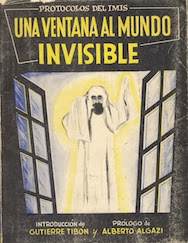
Una ventana al mundo invisible. Protocolos del IMIS Editorial Antorcha, Mexico City, 1960. [A Window to the Invisible world: Protocols of the IMIS]
I was a long ways into into the labyrinth of research and reading for my book, Metaphysical Odyssey into the Mexican Revolution, when I happened into Mexico City’s Librería Madero, expressing a vague interest in Francisco I. Madero and “lo que sea de lo esotérico.” When the owner, Don Enrique Fuentes Castilla, set this book upon the counter, I confess, the cover, which looks like a Halloween cartoon, with such childish fonts, did little to excite my interest. But oh, ho ho (in the voice of the Jolly Green Giant):
A Window to the Invisible World: Protocols of the Mexican Institute for Psychic Research Mexico City, 1960
This book, Una ventana al mundo invisible, is nothing less than the official, meticulously documented records of the dozens and dozens of research-séances of the Instituto Mexicano de Investigaciones Síquicas or IMIS (Mexican Institute of Psychic Research) from April 10, 1940 to April 12, 1952, members of which included– the book lists their names and their signatures— several medical doctors and National University (UNAM) professors; an ex-Rector of the UNAM, the medical doctor and historian Dr. Fernando Ocaranza; several generals; ambassadors; bankers; artists and writers, including José Juan Tablada; a supreme court justice; an ex-Minister of Foreign relations; an ex-director of Banco de México, Carlos Novoa; Ambassador Ramón Beteta, ex Minister of Finance; and… drumroll… both Miguel Alemán and Plutarco Elías Calles. *
Close up of the subtitle. Oy, the font. (Dude, what were you smoking?)
*I hate giving wikipedia links but as of this writing, the official webpage for the Mexican presidency doesn’t go back more than four administrations.
For those a little foggy on their Mexican history, Plutarco Elías Calles served as Mexico’s President from 1924-1928, and Miguel Alemán, 1946-1952. At the time of the séances documented in Una ventana al mundo invisible, Calles was in retirement, having returned from the exile imposed on him by President Cardenás in the 1930s.
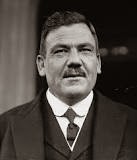
President of Mexico, “El Jefe Máximo” Plutarco Elías Calles. In retirement he joined the IMIS and was a regular participant in the research-séances documented in Una ventana al mundo invisible
When Una ventana al mundo invisible was published in 1960, Alemán was long gone from power, and Calles had passed away.
I had heard, as has anyone who goes any ways into the subject, that Alemán and Calles and other Mexican “public figures” were secret Spiritists, but here, dear readers, in the Protocolos del IMIS, are the smoking signatures.
Yes, There are Other References to Una ventana al mundo invisible
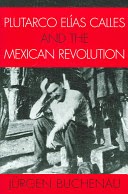
Mexican historian Enrique Krauze was one of the first to cite Una ventana al mundo invisible in his chapter on Calles in Biography of Power, as does Jurgen Burchenau in his biography, Plutarco Elías Calles and the Mexican Revolution. But, as I write these lines, Una ventana al mundo invisible remains surprisingly obscure.
The Revolution as dolor de cabeza
Of course, I googled. A Mexican writer, Héctor de Mauleón, had discovered Una ventana al mundo invisible in a different Mexico City antiquarian bookstore and written up a summary for the October 2012 issue of Nexos. (But he complains of his copy’s missing the picture of the conjured spirit, “Master Amajur.” More about that in a moment.) And also recently, Grupo Espírita de la Palma, a Canary Islands Spiritist blog, which has posted several important bibliographic notes as well as a bibliography of Spanish works on Spiritism, posted this piece about the Jesuit Father Heredia’s involvement with the IMIS–thanks to his friend, none other than Calles–and about this book.
(A research project for whomever wants it: to delve into the Mexican hemerotecas of 1960-61 for any newspaper coverage, and 1979 and 1994 for anything about the Posadas and Planeta editions. My guess is, not much, for the press was largely under the thumb of the ruling party and this sort of information about Mexican Presidents would have been, to say the least, unwelcome. But that’s just my guess.)
So, Now, Delving into the Contents…
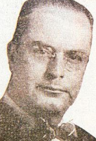
Rafael Alvarez y Alvarez (1857 – 1955), Mexican banker and founder of the Instituto Mexicano de Investigaciones Síquicas (IMIS)
The copy Don Enrique was offering, and for a very reasonable price, still had its dust jacket, small tears in places along the bottom and the top, but intact (the image on this blog post is a scan of my copy). The rest of it was pristine; the pages had not even been cut. Don Enrique slit open a few for me in the bookstore, and once home, I continued with my trusty steak knife (read about my other steak knife adventure here.)
I dove right in and learned that the founder of the IMIS, to whose memory the book is dedicated, was Rafael Alvarez y Alvarez (1887-1955), a distinguished Mexican banker, a president of the Monte de Piedad, and a congressman and senator. (Looking at his portrait with my novelist’s eye– that gaze! the bow tie!– yes, the intrepid maverick.)
The introduction is by Gutierre Tibón, an Italian-Mexican historian and anthropologist, professor in the National University’s prestigious faculty of Philosophy and Literature, and author of numerous noted works, including Iniciación al budismo and El jade de México.
A Brief Bit of Background on 19th Century Parapsychological Research
The goal of the IMIS was to progress in the tradition of pioneer American, English, and European parapsychological researchers. From my book, Metaphysical Odyssey into the Mexican Revolution, the first chapter, which provides 19th century background for Madero’s ideas about Spiritism, which he considered both a religion and a science:
“The exploits of mediums such as the Fox sisters, D.D. Home, the Eddy Brothers, and later in the nineteenth century, prim Leonora Piper (channel for the long-dead ‘Dr Phinuit’ and the mysterious ‘Imperator’), and wild Eusapia Palladino (whose séances featured billowing curtains, floating mandolins and, popping out of the dark, ectoplasmic hands), spurred the studies of investigators, journalists and a small group of elite scientists. Noted German, Italian, and French scientists, such as Nobel prize-winning physiologist Charles Richet undertook the examination of these anomalous phenomena, but the British Society for Psychical Research, founded in 1882, and the American Society for Psychical Research founded three years later, led the fray. Though their ranks included leading scientists such as chemist William Crookes, naturalist Alfred Russel Wallace, physicist Oliver Lodge, and William James (the Harvard University professor considered the father of psychology). Yet their researches almost invariably met not with celebration, nor curiosity on the part of their fellow academics, but ridicule, often to the point of personal slander.”
Medium Luís Martínez and “Spirit Guide” Dr. Enrique del Castillo
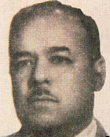
Luis Martínez, Mexican medium
As James et al had Leonora Piper, and Richet and Lombroso, Eusapia Palladino, the IMIS employed the medium Luis Martínez, who was able to evoke a broad spectrum of phenomena, from ringing bells to apports, ectoplasm, breezes, raps and knocks, levitation, and so on.
In séances with Martínez, the IMIS heard from its spirit guide on the “other side,” one Dr. Enrique del Castillo, a Mexican doctor of the 19th century. According to Dr Tibón in his introduction to Una ventana al mundo invisible (p. 20, my translation):
“The way he looked was perfectly well known because once he “aported” his photograph, which was later made into a larger size, framed and displayed the Institute’s workroom. Another aport of Dr. del Castillo were his spectacles, identical to those in the portrait. He brought them on October 24, 1944, at 10:30 pm, in a séance that was documented in Cuernavaca, and he said these words, directing them to Rafael Alvarez y Alvarez: ‘In leaving my spectacles to you, dear son, it is with the wish that you will see clearly the future road we must take. May these spectacles take you on the path where we will always be companions.’”
Enter “Master Amajur”
Of special note was the séance on the evening of September 24, 1941, when Plutarco Elías Calles invited Carlos de Heredia, S.J., author of a book debunking Spiritism– and Father Heredia, sufficiently awed (and according to Calles, converted) affixed his signature as witness to genuine phenomena. That séance is documented in its entirety in Una ventana al mundo invisible. From Dr. Tibón’s introduction (p.21, my translation):
“That memorable night there materialized another spirit guide for the circle: an oriental doctor named Master Amajur; and he did not only show himself completely to Father Heredia, he also spilled a glass of water, saturated it with magnetic fluid, and gave it to him to drink. Then there appeared the phantom of Sister María de Jesús and, before the astonished cleric, illuminated her face in a most unusual manner. Finally, Dr Enrique del Castillo appeared, surrounded by many tiny lights. These levitated the medium, chair and all– the equivalent of raising almost 100 kilos– and silently left him in the other end of the room. This phenomenon was verified for the first time. Later, I had the fortune to attend its repetition and I literally saw the medium fly two meters into the air.”
Master Amajur started showing up from the first documented séance of May 8, 1940 (p. 89, my translation of some of the highlights):
“Master Amajur [appeared] very clearly, he touched all of us and he wrote a message which says: Go forward and I will help you. When we asked him [for a message] he left a message for Colonel Villanueva that says: It would be good for you to attend a séance. [… ]The first materialization produced an electric spark above the lightbulb that was loose in its socket [… ] There was an aport: a small bottle of perfume and its essence sprinkled above us. The music box passed over our heads. The Master gave us his cloak to touch, which seemed to all of us a piece of gauze. One again he produced a fresh breeze: it smelled of ozone.
On June 12, 1940 (p.90, my translation):
[…] the Master came in. This manifestation appeared first as a human hand covered with a veil, imitating a human figure. Then it increased in size and luminosity until it came txo a height of about 1.5 meters. Only the head and bust could only be seen. It was covered in a bluish white veil which I touched with my face. It gave me the impression of being a cotton fabric… It gave me a large glass of water to drink… It put flowers in our hands, it gave us a perfumed air, and when luminous blobs passed near my face I perceived the smell of phosphorous.”
On June 22, 1941 (my translation, p. 92):
“In front of all of us, Amajur left on the wall an inscription that said: Go forward. Upon request, he gave fluid to a magnolia and then he began to cut the petals. One by one these were deposited in the mouths of the participants.”
And so on. Séance after séance after séance–96 in all–with sparks, music, levitations, ectoplasmic this & that, perfumes, flowers, and frequent appearances not only by Master Amajur and sundry others, but also a childlike spirit, “Botitas” (Little Boots), who would tug on the participants’ pant legs.
Photographing Master Amajur
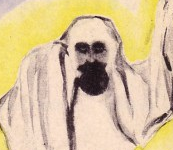
Close up of “Master Amajur” From the cover of Una ventana al mundo invisible
Skipping ahead to the séance of June 17, 1943– which Plutarco Elías Calles attended– Master Amajur has agreed to pose for a photograph. At first this doesn’t work; the photographer only captures a hand and then, suddenly, falls into convulsions. But then, after some further bizarre phenomena and friendly intervention by the spirit Dr. del Castillo, the photograph is achieved (p. 194, my translation):
“According to Mrs. Padilla [wife of Ezequiel Padilla, ex Minister of Foreign Relations, also in attendance on this occasion], and in agreement with all the other participants, at the moment of the explosion or flash from the photographer’s lamp, in the shadow could be seen the complete figure of the master, as if a statue of about 2 meters covered in a cloak, from head to foot. It was also noted that Master Amajur received a powerful shock and on asking him if he would permit another photograph to be taken, he said no.”
According to the dust jacket flap text, this is the very photograph that adorns the cover of the book. But, um, it looks more like a drawing to me. (As, by the way, many purported “spirit photographs” do. Google, dear reader, and ye shall find. Lots on eBay, by the way.)
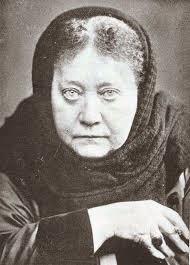
Madame Blavatsky. The monumental figure of modern esotericism. Author of The Secret Doctrine and Isis Unveiled, etc. Founder, Theosophical Society
For historians of the metaphysical, it is interesting to note that Master Amajur claimed to be a member of the Great White Brotherhood, a term which came into use in the West with Madame Blavatsky, co-founder of the Theosophical Society, in the 19th century. She claimed that her teachers, who often met with her on the astral plane, were the Great White Brothers or Mahatamas, the Ascended Masters Koot-hoomi (Kuthumi) and Morya. Later, her follower A. P. Sinnett expanded on this topic in a sensational book of its day, The Mahatma Letters (1923). Over the decades, other psychics claimed to receive channeled messages from various Ascended Masters, most notably “St. Germain” and Alice Bailey’s “Djwahl Khul” or “The Tibetan.” It would seem that “Master Amajur” falls into this rather blurry and ever-morphing category.*
*So are the terms Great White Brother, Mahatma, and Ascended Master one and the same? In this article in Quest, modern-day Theosophist Pablo B. Sender elucidates.
Interesting to note also that a google search brought up the tidbit that “Amajur” was the name of an astronomer of 10th century Baghdad– though I hasten to add, according to the IMIS reports in Una ventana al mundo invisible, “Master Amajur” spoke Mexican Spanish. And of further note: there are Spiritist groups that continue to channel messages from Master Amajur today.
Dear readers, conclude what you will, and whether this finds you embracing a gnosis that “resonates” with you, cackling like a hyena, or just numbly confused, surely we can agree that this is all very remarkable.
So What, Pray Tell, Does All This Have to Do with Don Francisco I. Madero?
Francisco I. Madero, President of Mexico 1911-1913; leader of the 1910 Revolution; and as “Bhima,” author of the 1911 Spiritist Manual
My book, Metaphysical Odyssey into the Mexican Revolution, is about Madero as leader of the 1910 Revolution and President of Mexico, 1911-1913 and how his political career was launched as an integral part of his Spiritist beliefs. (The book includes my translation of his secret book of 1911, Spiritist Manual, which spells it all out– all the way to out-of-body travel and, yes, interplanetary reincarnation.)
Not all– Enrique Krauze, Yolia Tortolero Cervantes, Javier Garciadiego, Alejandro Rosas Robles, Manuel Guerra de Luna, among others, are important exceptions– but most historians of Mexico and its Revolution sidestep, belittle, or even ignore Madero’s Spiritist beliefs. In my book, I have quite a bit to say about why I think that is (key words: cognitive dissonance), but in sum, few have any context for Madero’s ideas which, for most educated people in the western world, fall into the category of absurd nonsense and “superstition.”
My aim in my book– and this blog post– is not to convince the reader of the truth or falsity of any religious beliefs (ha, neither do I poke tigers with sticks for the hell of it), but to provide a sense of the history and richness of the matrix of metaphysical traditions from which Madero’s beliefs emerged. And with this context, I believe, we can arrive at the conclusion that Madero was not mad, nor so naive and weak as many have painted him, but that, in fact, he was a political visionary of immense courage who found himself on a counterrevolutionary battlefield of such rage and chaos that, if it was fatal for him, would have been for almost anyone else as well.
Madero did not, like some mad alchemist, cook up his ideas by himself; they fit into what was then and is now a living tradition. Madero’s Spiritism was French, itself an off-shoot of American Spiritualism, and with roots in occult Masonry and hermeticism and mesmerism; in the early 20th century, Madero also adopted ideas from a wide range of difficult-to-categorize mystics, such as Edouard Schuré, and from the Hindu holy book so beloved of the Theosophists, Thoreau, and Mohandis Gandhi: the Baghavad-Gita.
After Madero, on the one hand, we see Spiritism melding with folkloric and shamanistic traditions, as with the mediumistic healers Niño Fidencio, Doña Pachita, and the “psychic surgeons” of Brazil and the Philippines. On the other hand, a very small and adventurous group of what was primarily members of the educated urban elite– as we see in Una ventana al mundo invisible– continued the international tradition of parapsychological research that, as we know from his Spiritist Manual and his personal library, Madero greatly admired.