From the Archives: On Francisco I. Madero as Medium: Q & A with Rev. Stephen A. Hermann, Author of “Mediumship Mastery”

This blog posts on Mondays. Fourth Mondays of the month I devote to a Q & A with a fellow writer.

Throughout this month of August I am on vacation, nonetheless posting each Monday– herewith, one of my favorites from this blog’s archives:

On Francisco I. Madero as Medium:
Q & A with Rev. Stephen A. Hermann,
Author of Mediumship Mastery

Originally posted on Madam Mayo blog July 15, 2015
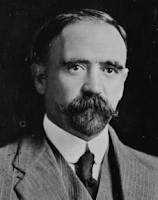
Francisco I. Madero, leader of Mexico’s 1910 Revolution,
President of Mexico 1911-1913, and author of Manual espírita (Spiritist Manual), 1911 — subject of my book, Metaphysical Odyssey into the Mexican Revolution.

The astonishing thing about Francisco I. Madero’s Manual espírita of 1911 is that it lays out his philosophy so passionately and precisely, and yet, with counted exceptions (among them, Mexican historians Enrique Krauze, Yolia Tortolero, Manuel Guerra de Luna, and Alejandro Rosas), apart from cursory mentions, historians of the Mexican revolution have told us nearly nothing about this text, its origins, broader esoteric cultural context, and profound implications for understanding Madero’s actions as leader of the 1910 Revolution and as President of Mexico. My translation of Madero’s Manual espírita— the first into English and, as far as I have been able to ascertain, into any language— is included in my book, Metaphysical Odyssey into the Mexican Revolution: Francisco I. Madero and His Secret Book, Spiritist Manual.

>>Click here to view a one minute-long Mexican government video which gives a very basic idea of the official version of Madero’s importance in Mexico.<<

Madero was a medium in the Spiritist tradition of the late 19th and early 20th centuries of France and Mexico. While Metaphysical Odyssey into the Mexican Revolution is a scholarly contribution, I write about Madero and his Spiritist Manual not as an academic historian, but as his translator and as a creative writer who has lived in and written about Mexico for many years. I presumed that most of my readers would encounter Madero’s ideas about communicating with the dead extremely peculiar, even disturbing. For the most part this has been the case. To give one of several (to me, amusing) examples, one prominent Mexico expert who shall remain unnamed felt moved to inform me that, though he very much enjoyed my book, he would not be reading Spiritist Manual.

That said, I am grateful to have been invited to speak about it at the Centro de Estudios de la Historia de México CARSO, Mexico City’s National Palace, Rice University, Stanford University, UCSD Center for US-Mexican Studies, and elsewhere, and to date, historians of Mexico and other scholars in these audiences have been both thoughtful and generous in their comments.

To my surprise, however, the Internet has brought my and Madero’s books another, very different audience, one that encounters the Spiritist Manual as, shall we say, a vintage text out of a well-known and warmly embraced tradition. 
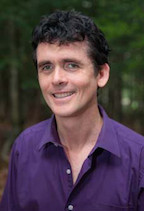
Rev. Stephen A. Hermann, author of Mediumship Mastery
www.stevehermannmedium.com

In his review for the National Spiritualist, Rev. Stephen A. Hermann writes, “Anyone interested in the history of international Spiritualism as well as as mediumnistic unfoldment will find this manual invaluable.”

With the aim of providing further historical and philosophical context for Francisco I. Madero and his Spiritist Manual, I asked Rev. Hermann if, from the perspective of a practicing medium and teacher of mediumship— and author of the just-published Mediumship Mastery: The Mechanics of Receiving Spirit Communications— he would be so kind as to answer some of my questions about Madero as a medium and about his philosophy.
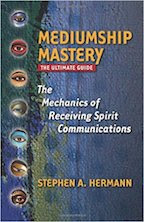
ON MADERO AS MEDIUM

C.M. MAYO: In your book, Mediumship Mastery, you distinguish between two broad types of mediumship, mental and physical. “Automatic writing” you categorize as both. Francisco I. Madero was a writing medium, that is, a medium who channeled messages from the spirit world through his hand and pen onto paper. Can you explain this? And, is this type of mediumship still common today?

STEPHEN A. HERMANN: Madero practiced automatic writing in which spirit personalities would control the movements of his arm and hand to write messages. It is common for many people, not knowing the difference, to confuse automatic writing with the phase of mediumship known as inspirational writing. With inspirational writing the medium’s conscious and unconscious mind are very much involved with the process. Genuine automatic writing occurs typically quite rapidly with the medium unable to control the movements taking place. The conscious mind of the medium is not involved in the process and the medium could even be engaged in a conversation with others while the writing is produced.

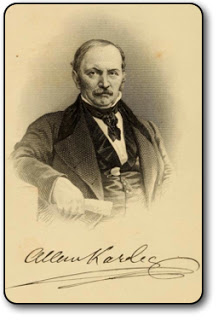
In the period that Madero developed his mediumship the practice of automatic writing, the use of planchette and table for spirit communication was quite common for many mediums. Madero was heavily influenced by the writings of the French Spiritualist Kardec, whose classic Medium’s Book was widely used by students of spirit communication as a standard for mediumistic unfoldment. 

As a phase of mediumship automatic writing is not commonly practiced the way it would have been a century ago. In most countries around the world most mediums practice mental phases of mediumship such as clairvoyance, clairaudience and clairsentience (psychic seeing, hearing and sensing). There are also many mediums who practice controlled speaking or trance channeling.

C.M. MAYO: How how would you, as a medium, evaluate Madero’s mediumnistic notebooks? (These are preserved in his archive in Mexico’s Ministry of Finance; in my book, I quoted from some of them, communications in Madero’s handwriting signed by “Raúl,” “José” and “B.J.”).

STEPHEN A. HERMANN: I was impressed by Madero’s dedication to God, the spirit world and his mission to help Mexico. He certainly appears to have lived by higher spiritual principles. The communications that he received I feel were genuine and indicate the great effort of teachers in the spirit world to use him as a positive influence in the material world. I would love to see all his notebooks published and your book distributed even more as Madero’s work is an excellent example of a politician motivated selflessly out of love and duty.

[C.M. MAYO: The mediumnistic notebooks have been transcribed and published in volume VI. of Obras completas de Francisco Ignacio Madero, edited by Alejandro Rosas Robles, Editorial Clío, Mexico, 2000. For more about the work of Alejandro Rosas Robles and other Mexican historians on Madero and esoteric philosophy, see my post Lifting the (Very Heavy) Curtain on the Leader of Mexico’s 1910 Revolution].

C.M. MAYO: It seems that by the time Madero became president he was no longer channeling written messages but instead relied on “inspiration” or telepathic communication from spirits. My understanding is that Madero considered this an advance in his mediumnistic abilities. Would you agree?

STEPHEN A. HERMANN: A student of mediumship is always progressing and as such the manner that his or her mediumship functions will evolve accordingly. I assume that Madero would have put considerable effort into growing as an individual as well as enhancing his own mediumistic skills. It is not that one phase of mediumship is better than another. All spiritual gifts are ways for the spirit personalities to bring love and healing to people in the material world. It is very common for mediums to develop new phases of mediumship as they gain experience and are ready. Madero was very progressive in all aspects of his life.

C.M. MAYO: One of the questions I invariably hear in any presentation or conference about Madero and his Spiritism is that, if he really were hearing from spirits, why did they not warn him about the coup d’etat of 1913, so that he could save himself? (Perhaps because as President coping with the challenges of governing, he no longer had the peace of mind to listen?) In Mediumship Mastery (p. 154-155) you write, “While warnings might be given in order to prevent a mishap, telling the recipient negative information such as he or she is going to die next week or be involved in a serious accident, generally would not come through with controlled regulated mediumship.” Can you explain and/or elaborate?

STEPHEN A. HERMANN: Madero would have been under great stress so it is very possible that his own mind would not have been receptive to warnings given by his guardians in the spirit world. On the other hand, we do not know the full picture in terms of his karma or lessons in this lifetime. Madero performed great works when he was physically present. I am sure that these great works would have continued in other realms after his physical death.

C.M. MAYO: In the introduction to your book, Mediumship Mastery, you mention that you trained as a hypnotherapist. From his personal library we know that Madero was intensely interested in hypnotism. Would this knowledge have enhanced his abilities as a medium and as a political leader? And if so, how?

STEPHEN A. HERMANN: Kardec and many of the pioneers of the Spiritualist movement studied Mesmerism and altered-states-of-consciousness. The awareness of inducing trance states is crucial for the development of mediumistic ability. For example, with clairvoyance the more the medium is able to place his or her mind into a receptive state and get the analytical mind out of the way, the easier it will be to receive as well as accurately interpret spirit messages given in this manner. Mediumship mastery requires considerable discipline on the part of the medium. Hypnosis is an effective tool for helping student mediums train their minds and open up as instruments for the spirit personalities to work through.

ON SPIRITISM, SPIRITUALISM, 
THE PHILIPPINES, AND PSYCHIC SURGERY

C.M. MAYO: Spiritism developed in France from the root of Anglo-American Spiritualism. As a medium who has practiced and taught in various countries from the U.S. to New Zealand and including in the Philippines, do you see important differences in these traditions, Spiritualism and Spiritism, today?

STEPHEN A. HERMANN: Spiritism and Spiritualism are branches of the same tree. A Spiritist is a Spiritualist who follows primarily the doctrine found within Kardec’s writings. Anglo-American Spiritualists do not limit themselves to Kardec’s writings and as a whole have not officially embraced the concept of reincarnation. The Spiritist approach generally places more emphasis on higher philosophy and less on phenomena or providing evidence of survival as the Spiritualist approach emphasizes. I think as a whole the Spiritist approach tends to be more progressive than what is found in many Spiritualist churches. However, Spiritists can be a bit dogmatic in adhering to Kardec’s writings.
.

C.M. MAYO: In your chapter “Spiritiual Healing” you discuss psychic surgery in the Philippines. Though Madero does not discuss psychic surgery in the Spiritist Manual, in my book, Metaphysical Odyssey into the Mexican Revolution, I mention the Filipino and Brazilian psychic surgeons as well as some Mexicans including Niño Fidencio and Doña Pachita because they are well-known in Mexico and I felt they represented traditions that could claim at least some tangly bit of roots in the early 20th century Spiritism of Madero. Would you agree? Also, have you practiced and/or witnessed any psychic surgery yourself?

STEPHEN A. HERMANN: There have always been mediums or healers in all cultures. The Philippines were a Spanish colony for almost three hundred years. Many of the leaders of the revolution against Spanish rule were involved in the practice of Spiritualism. Kardec’s writings were again a major influence in this part of the world.

I teach mediumship and healing worldwide and the Philippines is one of the countries I regularly visit. Over the years I have witnessed and experienced many remarkable physical and emotional healings with my own mediumship as well as the mediumship of others. With healing God is the healer and we are only vehicles for God’s unconditional love to work through. Yes, I practice psychic surgery with the help of spirit doctors. However, I do not pull blood and guts out of people and drop it in a tin can as many Filipino healers do.

C.M. MAYO: My understanding is that Spiritism arrived in the Philippines with Spanish translations of Kardec’s works. Presumably many of these came out Barcelona, an important center for esoteric publishing (and indeed, many of the books in Madero’s personal library were from Barcelona). When I discovered that Madero’s 1911 Manual espírita had been reprinted by Casa Editorial Maucci in Barcelona in 1924, I immediately wondered whether any copies had made their way to the Philippines and so played some role in the spread of Spiritism there. Do you know anything about this?

STEPHEN A. HERMANN: I do not know anything about this. Don Juan Alvear in 1901 founded the first Spiritist center in San Fabrian, Pangasinan. I have worked at this center many times and the energy is amazing. Alvear was a great political leader, educator and prominent intellectual. Like Madero, Alvear authored a book on mediumship and was a hero of the revolution. His statue is outside the government building and across the street from the Spiritist center he founded.

[C.M. MAYO: See Hermann’s blog post about some history of Spiritism in the Philippines here. And for more about Spiritism in the Philippines, a subject on which I am admittedly very foggy, one place to start is Harvey Martin’s The Secret Teachings of the Espiritistas.]

ON THE BHAGAVAD-GITA AND REINCARNATION

C.M. MAYO: In many places in your book, Mediumship Mastery, you quote from the Bhagavad-Gita.This was a work that fascinated Madero; he not only mentions it in his Spiritist Manual, but under the pseudonym “Arjuna”— the name of the warrior in the Bhagavad-Gita— he wrote articles about it and was planning a book about its wisdom for the modern world. The Bhagavad-Gita also had an important influence on Gandhi, Emerson, the Theosophists, and many others. One of its many teachings is about reincarnation. In your book’s chapter “Past Life Readings,” you mention that you have recollections of some of your past lives and also have received communications from spirits about others’ past lives. Would you elaborate on reincarnation as explained in the Gita?

STEPHEN A. HERMANN: The Bhagavad Gita is a conversation between the Supreme Personality and Arjuna. I try to read it as much as possible. Life is eternal as the personality continues into the world of spirit. The Bhagavad Gita explains the science of connecting with the Godhead and how to cultivate devotion or love of God. Every seven years pretty much all the molecules in our physical bodies change. So we are always changing physical bodies. Based on our consciousness at the end of this physical life we will end up having to take another physical birth. The Gita explains the process of transmigration and how we can ascend to higher levels.

C.M. MAYO: Like Madero in his Spiritist Manual, in your book, Mediumship Mastery, you advocate a vegetarian diet. Is this an idea that came to Spiritualism / Spiritism from Hindu philosophy?

STEPHEN A. HERMANN: Higher teachers on both the physical and spiritual worlds always advocate vegetarianism as it is very bad to hurt animals and cause suffering to others. A true follower of Jesus would not want to hurt others as would a true follower of Buddha. There is only one God and we are all God’s children. I am sure Madero was influenced by Vedic teachings which is why he loved the Bhagavad Gita.

MORE ABOUT MADERO’S SPIRITIST MANUAL

C.M. MAYO: What surprised you the most about Madero’s Spiritist Manual?

STEPHEN A. HERMANN: I really loved reading the Spiritist Manual. It didn’t really surprise me as I am familiar with everything he wrote already. However, I especially loved reading the extra sections about your research and his notes, etc. I think you did a fantastic job.

C.M. MAYO: In terms of his understanding of mediumnistic unfoldment—or anything else—are there any points where you would disagree with Madero’s Spiritist Manual?

STEPHEN A. HERMANN: Madero approaches mediumship heavily influenced by Kardec’s Medium’s Book. Nothing wrong with that as Kardec’s work was way ahead of it’s time when it was published in 1861. However, the methods and approaches used by the spirit personalities to communicate, train and interact with mediums have greatly improved.

Back in the early years of Spiritualism there were no teachers of mediumship. Mediums learned through trial and error and with the assistance and input of teachers in the spirit world overtime created structured approaches to the unfoldment of the various phases of mediumship.

Madero was brilliant and had he not have been murdered his mediumship would have expanded even more. Love, harmony, enthusiasm, and higher purpose are the qualities needed to create the best conditions for successful mediumistic communications. Madero possessed all these qualities and more.

In the early years of Spiritualism there was much physical phenomena or manifestations of spirit power that could be directly experienced through the five physical senses. Nowadays, people are much more intellectually oriented and as such the mediumship practiced is mainly mental or telepathic in nature. It is not that one method is better but just better suited for the age. The methods for training mediums have greatly improved and expanded in the last 168 years.
C.M. MAYO: As you were reading Madero’s Spiritist Manual, or before or afterwards, did you ever sense that you were in communication with / sensing Madero’s spirit? Is there anything you would like to say about that?

STEPHEN A. HERMANN: I would think that Madero most likely would have been around you a lot when you were researching and writing the book. I do not know if he was around me when I was reading the book, but I do feel that he and I would have a lot in common if we were to meet. I think we would get along pretty well as I can relate to where he was at in terms of his mediumship and his spirituality in general.

C.M. MAYO: In your book, Mediumship Mastery (p. 9) you introduce the subtle bodies that interpenetrate the physical body. As I read it, this is a somewhat different explanation from given by Madero where he, following Kardec, talks about the “perispirit.” Can you explain?

STEPHEN A. HERMANN: The perispirit is the subtle or astral covering. Madero uses Kardec’s terminology. We have a physical body with subtle bodies interpenetrating it. After physical death the soul continues to function through the astral body and travels into the spirit world.

ON MEDIUMSHIP AND ENERGIES

C.M. MAYO: My experience has been that not all but most people either dismiss mediumship as impossible or, believing it possible, are frightened that, in calling on the spirit world, they might encounter negative entities. In particular, the Catholic and many other churches sternly warn against dabbling in conjuring spirits, especially with Ouija boards. In the introduction to your book, Mediumship Mastery, you write, “In all my years of working as a medium, I have never experienced anything negative or that made me feel uncomfortable. My experience of mediumship has always been genuinely positive, loving, and comfortable.” It would seem, from my reading of the Spiritist Manual, that Madero would have agreed. But has this been the case for others you know?

STEPHEN A. HERMANN: Mediumship is all about love and healing. However, training is important as is proper motivation. Someone could have a bad experience with mediumship if they dabble in it or go about doing it in a superficial way. Spiritual mediumship is completely orchestrated by higher spirit personalities. Mediumship is not a board game for drunk teenagers to play at 2 AM. Like attracts like.

C.M. MAYO: In your book’s final chapter, “Dealing with Skeptics,” you write, “People who are closed off and negative for any reason, which would include hardcore skeptics, are exceptionally more difficult to work with as the energies are not as strong, the links to the spirit world weaker, and the connections more incomplete and vague.”

It seems to me that U.S. Ambassador Henry Lane Wilson, who disdained Madero as mentally unbalanced and who, for his support for the coup d’etat that ended with Madero’s murder in 1913, has gone down as one of the archvillians of Mexican history, had much in common with the rigidmindedness of celebrity skeptics such as the Amazing Randi. Would you agree?

STEPHEN A. HERMANN: I don’t know Randi personally nor do I know the US Ambassador of that period. Who knows what motivates people on a deeper level? However, Randi does seem very closed off to higher consciousness and intuitive ability. I suspect that Ambassador Wilson was motivated completely by lower, selfish interests and as a result would have cut himself off from higher spiritual influences.

Skeptics are not necessarily immoral or callous individuals. They just do not often believe in the mystical and are highly suspect of claims that do not fit their rationalist view of the world. I appreciate skepticism as many people are completely gullible and easily misled. It is important to not throw out your intelligence when dealing with mediumship as there is a fine line with genuine psychic impressions and your own imagination.

#

> Visit the webpage of Rev. Stephen A. Hermann, author of Mediumship Mastery

> Visit the web page for Metaphysical Odyssey into the Mexican Revolution: Francisco I. Madero and His Secret Book 

> Visit the webpage for my book, together with a transcription of Madero’s Manual espírita, in Spanish, Odisea metafísica hacia la Revolución Mexicana.

> Visit the webpage for Resources for Researchers

> Find more Q & A’s here.

Q & A: W. Nick Hill on Sleight Work and Mucho Más

What Is Writing (Really)? 
Plus A New Video of Yours Truly Talking About 
Four Exceedingly Rare Books Essential 
for Scholars of the Mexican Revolution

Why Translate? The Case of the President of Mexico’s Secret Book
Find out more about C.M. Mayo’s books, shorter works, podcasts, and more at www.cmmayo.com.

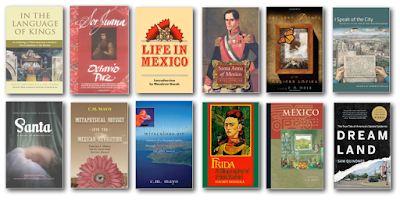
From the Archives: “Reading Mexico: Recommendations for a Book Club of Extra-Curious & Adventurous English-Language Readers”

Hiding out! Chillin’! My writing assistants demonstrate the concepts.

I am hiding out this August Monday from the blog… and reading a most unusual novel, about which word soon. Meanwhile, herewith, an extra-crunchy post from the Madam Mayo blog archives:

Reading Mexico:
Recommendations for a Book Club
of Extra-Curious & Adventurous English-Language Readers


Originally published on Madam Mayo blog November 21, 2016

In recent days, I am delighted to report, more than one American has asked me for a list of recommended reading on Mexico for their book clubs. Before I present my correspondents, and you, dear reader, with my list, herewith a big fat flashing neon-lime caveat: 

This list is unlikely to coincide with most English language writers’ and readers’ ideas of what might be most appropriate. Nope, no Graham Greene. No D.H. Lawrence, no Malcolm Lowry, nor John Steinbeck. Most of the usual suspects have gone missing from my list. I packed the bunch of them off, as it were, to Puerto Vallarta for margaritas (a drink invented by a Texan, by the way) and a purgatory of reading juicy crime-novels. About crime novels, I am not your go-to gal.

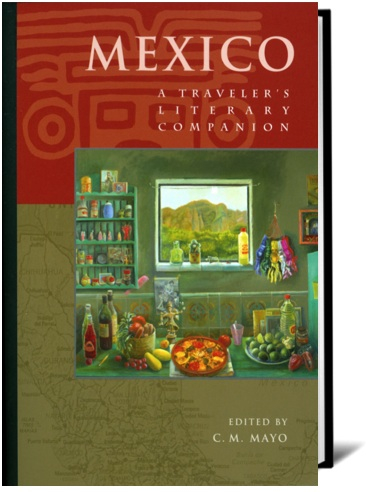
For those of you new to this blog, let me introduce myself. I am a US citizen who has been living in Mexico City on and off for over three decades, and not in an expat community, but as a part of a Mexican family. Over these many years I have written several books about Mexico, most recently, the novel based on the true story of Mexico’s Second Empire, The Last Prince of the Mexican Empire, and Metaphysical Odyssey into the Mexican Revolution: Francisco I. Madero and His Secret Book, Spiritist Manual. I have also translated a long list of Mexican writers and poets, and am the editor of an anthology, Mexico: A Traveler’s Literary Companion, which is not a guidebook but a selection of 24 Mexican writers on Mexico, many in translation for the first time. All of which is to say that although I have not read each and every last thing ever published on Mexico (a feat for a bot!), I am indeed familiar with both the Spanish and the English language literature on Mexico, fiction and nonfiction. 

TWO CHALLENGES: SAD! VERY SAD!

But to make a list of recommendations for an English-language book club there are challenges. First, a number of Mexican works have been translated into English, but this amounts to only a tiny percentage of what has been published in Mexico over the centuries. To quote DJT completely out of context, “Sad!”

Second, also sadly, many of the best-known and easily available originally-in-English works on Mexico strike me as superb examples of a south-of-the-border species of what Edward W. Said termed “orientalism.” Translation: toe-curling. Steinbeck’s The Log from the Sea of Cortez, to take but one example, while a deserved classic for its lyric beauty (count me a fan), will tell you little about Mexico, never mind the Baja California peninsula that stretches for nearly a thousand miles along the Sea of Cortez; much of what Steinbeck says about it is either flat wrong or rendered through a filter of commonplace prejudice and presumption.

Much of the best of contemporary English language literature on Mexico covers the border, mainly focusing on illegal immigration, drug trafficking, and violence. There are several excellent works under that voluminous tent, but I’d like to get to those last. I submit that for a deeper sense of Mexico, one has to dig past the sorts of stories one can easily encounter in the mainstream news, television, and cinema, to go both deeper into the country and deeper into its past.

For a deeper sense of Mexico, one has to dig past the sorts of stories one can easily encounter in the mainstream news, television, and cinema, to go both deeper into the country and deeper into its past. 

Nope, that sad little shelf in the back room of your local big box bookstore is not the place to look. Unfortunately, and head-scratchingly—for the United States shares a nearly 2,000 mile border with Mexico, and all the cultural, economic, ecological, historical, and political intertwinings that would suggest— the selection of such works in English, enticing a “box of chocolates” as it may be, is limited. Moreover, whether because of their scarcity, high prices, length, and/or academic prose-style replete with reams of footnotes, few English language works on Mexico lend themselves to a felicitous selection for a book club.

A NOTE ON (MORE THAN) A FEW TITLES NOT ON MY LIST FOR BOOK CLUBS

Historian John Tutino’s Making a New World, for example, is a scholarly doorstopper of a tome, so I wouldn’t recommend it for a book club; however, I do believe it is one of the most important books yet published about Mexico. Read my review of Tutino’s Making a New World here and listen in anytime to my extra crunchy podcast interview with Tutino here.

Seriously, if you want to start getting an idea of Mexico beyond the clichés, stop reading this right now and listen to what Tutino has to say.

…  RESUME HERE

Also, I would have recommended the magnificent The Mexican Treasury: The Writings of Dr. Francisco Hernández, edited by Simon Varey, but (sigh),Stanford University Press has priced it at USD 72 a copy. You might ask your university or local public library to order a copy, if they do not already have one. 

Another wonder not on my list for book clubs— but do have a look at the digital edition free online— is Franciscan missionary Bernardino de Sahagún’s Historia general de las cosas de Nueva España, or General History of the Things of New Spain. The original 16th century manuscript, which contains 2,468 colorful illustrations and text in both Spanish and Nahuatl (the language spoken by the Aztecs phonetically transcribed using Latin), is also known as the Florentine Codex because it is in the Medicea Laurencziana Library in Florence, Italy. 

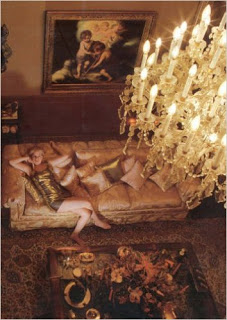
Then there is Daniela Rossell’s hilariously outré take on Mexico City’s, as the title says, Rich and Famous, but at over USD 100 for a used paperback copy, that title did not make it to my list, either. (But if you and your book club have wheelbarrows of cash to spare for no better purpose than to rain down upon amazon.com for some dozen copies of Rich and Famous, well, pourquoi pas? Read it while eating your cake, too!)

Numerous Mexican fabulosities, including Rich & Famous,  which cover is shown here, are not on my list.

My list, therefore, focuses on works in a variety of genres, from biography to history to poetry, that are not only illuminating but could be enjoyable reading for avid and thoughtful readers, and lend themselves to a spirited book club discussion. And, crucially for most book clubs, these are titles currently available at more-or-less-reasonable prices from major online booksellers and/or, as in the few instances when a work has lapsed into the public domain, as free downloads from www.archive.org. 

Toss a tomato if you like, but I also recommend my own works, else I would not have troubled to write them.

> For those looking for more complete and scholarly lists of recommended reading on Mexico, as well as several more fine anthologies, click here.

PREHISPANIC, CONQUEST, COLONY
(IN ALPHABETICAL ORDER BY AUTHOR)

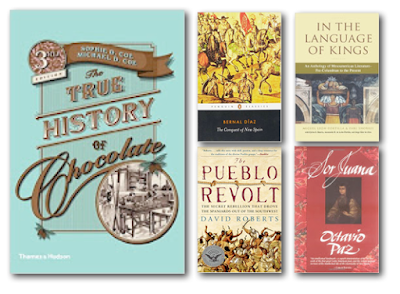
Coe, Sophie D., and Michael D. Coe. The True History of Chocolate
A scrumptuously sweeping history of Mexico’s most delicious bean by a noted food historian and anthropologist. This one should be an especially popular pick for any book club.

Díaz, Bernal. The True History of the Conquest of New Spain
One of the greatest books every written about one of the greatest adventures of all time. And that is no exaggeration.
> Also available on archive.org

León-Portilla, Miguel, and Earl Shorris. In the Language of Kings: An Anthology of Mesoamerican Literature, Pre-Columbian to the Present
León-Portilla is one of Mexico’s leading historians and intellectuals and this collection, the first to offer a comprehensive overview of this literature, is magnificent. 

Paz, Octavio. Sor Juana or, The Traps of Faith
Translated by the exceptional Margaret Sayers Peden. Catalog copy: “Mexico’s leading poet, essayist, and cultural critic writes of a Mexican poet of another time and another world, the world of seventeenth-century New Spain. His subject is Sor Juana Inés de la Cruz, the most striking figure in all of Spanish-American colonial literature and one of the great poets of her age.”

UPDATE: See my blog post of March 20, 2017, “What the Muse Sent Me About the Tenth Muse, Sor Juana Inés de la Cruz”

Roberts, David. The Pueblo Revolt: The Secret Rebellion that Drove the Spanish Out of the Southwest
The Pueblo Revolt of 1680 took place in what was then the Kingdom of New Mexico and is now within the United States; nevertheless, this is an crucial episode for understanding the history of the North American continent, including, of course, Mexico. 

NINETEENTH CENTURY 
(IN ALPHABETICAL ORDER BY AUTHOR)

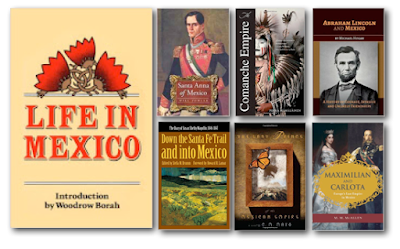
Calderón de la Barca, Madame (Frances Erskine Inglis). Life in Mexico
This delightfully vivid memoir of 1842 by the Scottish-born wife of Spain’s first ambassador to Mexico should go at the top of the list for any Mexicophile. 
> Also available on archive.org
> Read my review for Tin House

Fowler, Will. Santa Anna of Mexico
A new and revisionist history of that tremendous and mercurial personality who dominated the first half of 19th century Mexico, the “Napoleon of the West.”
Hämäläinen, Pekka. The Comanche Empire
A mite heavy-going for a book club, but essential for understanding the historical relationship between the U.S. and Mexico and the US-Mexican War. 
> Read my review of this book.
> For a less rigorous but more entertaining and elegantly-written work on the Comanches, see S.C. Gwynne’s Empire of the Summer Moon.

Hogan, Michael. Abraham Lincoln and Mexico: A History of Courage, Intrigue, and Unlikely Friendships
In this shining contribution to the literature on Abraham Lincoln and that of the US-Mexican War, Michael Hogan illuminates the stance of a young politician against that terrible war, telling a story that is both urgently necessary and well more than a century overdue.

Magoffin, Susan Shelby. Down the Santa Fe Trail and into Mexico
Now considered a classic of mid-19th century Americana, as a work of literature, this book has its limits and faults, for it was written as a private diary by a Missouri trader’s bride who was only 19 years old. I warmly recommend it for US book clubs because it is easy to find an inexpensive copy, and if it has faults, it also has many charms; and moreover, it provides an unforgettable glimpse of historical context for US-Mexico trade. Y’all, US-Mexico trade did not start with NAFTA. 
> See my blog post of notes about this book.

Mayo, C.M. The Last Prince of the Mexican Empire
A novel based on extensive archival research into the strange but true story of the half-American grandson of Agustin de Iturbide, Agustin de Iturbide y Green, in the court of Maximilian von Habsburg. A Library Journal Best Book of 2009.
> Visit this book’s website for excerpts, reviews, photos and more
> Related: From Mexico to Miramar or, Across the Lake of Oblivion
A nonfiction novela about a fairytale: a visit to the Emperor of Mexico’s Italian castle. An award-winning long-form essay now available in Kindle.

McAllen, M.M. Maximilian and Carlota: Europe’s Last Empire in Mexico
A deeply researched book about a period of Mexican history that, while vital for understanding modern Mexico and its relations with the United States and Europe, is of perhaps unparalleled cultural, political, and military complexity for such a short period.
> Listen in anytime to my extra-extra crunchy conversation with M.M.McAllen about her splendid book, the first new major narrative history of this period in English in nearly forty years.

LATE 19th CENTURY, REVOLUTION, EARLY 20th CENTURY
(IN ALPHABETICAL ORDER BY AUTHOR)


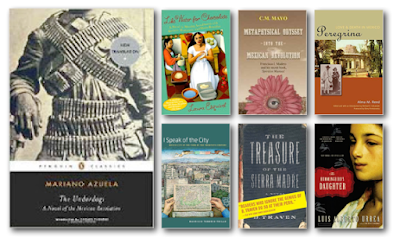
Azuela, Mariano. The Underdogs: A Novel of the Revolution
This is the first and classic Mexican novel of the Revolution, translated by Sergio Waisman and with a foreword by Carlos Fuentes. The original title in Spanish is Los de abajo. Not everyone’s slug of mescal, but a century on, it remains a cult fave, especially around the border.

Cooke, Catherine Nixon. The Thistle and the Rose: Romance, Railroads, and Big Oil in Revolutionary Mexico
This family history of Scotsman John George McNab and Oaxacan Guadalupe Fuentes Nivon McNab not only gives an overview of the transformation of the Mexican economy in the late 19th and early 20th centuries, but some of Mexico’s ethnic, social, and regional diversity, both of which are far greater than U.S. media and Mexican tourist industry narratives would suggest.

Esquivel, Laura.Like Water for Chocolate: A Novel in Monthly Installments with Recipes, Romances, and Home Remedies
The charming novel that was made into a major motion picture. 

Mayo, C.M. Metaphysical Odyssey Into the Mexican Revolution: Francisco I. Madero and His Secret Book, Spiritist Manual
Knocks the huaraches off most people’s understanding of the 1910 Revolution, and its leader, Francisco I. Madero, who was elected President of Mexico in 1911 and served until his assassination in the coup d’etat of 1913. Someone described Metaphysical Odyssey as The Underdogs turned upside down, inside out, and with a cherry orchard on top. Anyway, Metaphysical Odyssey into the Mexican Revolution is nonfiction and it includes the first and complete translation of Madero’s Spiritist Manual of 1911. 
> Visit this book’s website for excerpts, reviews, interviews, podcasts, and more.

Reed, Alma. Peregrina: Love and Death in Mexico
Edited by Michael K. Schuessler with a foreword by Mexican writer Elena Poniatowska, who knew Alma Reed back in the 1960s. Reed was a journalist from San Francisco who came to Yucatan on assignment and ended up engaged to marry the governor, Felipe Carrillo Puerto. Just before the wedding Carrillo Puerto was assassinated.
> Listen in to my podcast interview with Michael K. Schuessler. 

Tenorio-Trillo, Mauricio, I Speak of the City: Mexico City at the Turn of the Twentieth Century
A leading scholar of Mexico takes on Mexico City from 1880 to 1940 in this beautifully written work. If you have ever visited or ever plan to visit Mexico City, this rich-as-a-truffle read is a must.

Traven, B. The Treasure of the Sierra Madre
Although it seems he may have been born in Germany, one must count the mysterious B. Traven, who escaped a death sentence in Germany in the 1920s, as a Mexican writer. Little is known about his early life. According to his Mexican stepdaughter, the “B.” stands not for Bruno as some biographers have asserted, but for “Plan B.” Mexico City’s Museo de Arte Moderno recently closed its B. Traven show which featured clips from the movie “The Treasure of the Sierra Madre” directed by John Huston and starring Humphrey Bogart, as well as clips from several other major movies inspired by Traven’s novels, and displays of his papers, photographs, guns, and typewriters. 

Urrea, Luis Alberto. The Hummingbird’s Daughter
The novel based on the true story of his great aunt, the folk saint and mediumnistic healer Teresita Urrea, la Santa de Cabora (Cabora is in Chihuahua). 

MID TO LATE TWENTIETH CENTURY
(IN ALPHABETICAL ORDER BY AUTHOR)

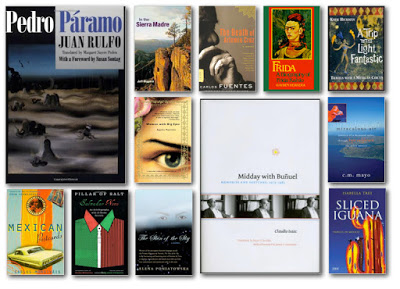
Biggers, Jeff. In the Sierra Madre
Adventure writing at its finest.

Fuentes, Carlos. The Death of Artemio Cruz
New translation by Alfred MacAdam. The famous novel by the famous author. Muy macho. Dark. Bitter. Ayyy a real jaw-cruncher.  

Herrera, Heyden. Frida: A Biography of Frida Kahlo
The best introduction to Mexico’s most famous and uniquely flamboyant artist of the 20th century.

Hickman, Katie. A Trip to the Light Fantastic: Travels with a Mexican Circus
A spellbinding memoir by a noted British writer. 

Isaac, Claudio. Midday with Buñuel: Memories and Sketches, 1973 – 1983
Mexican filmmaker Claudio Isaac’s very personal and poetic recollection of his friendship with his mentor, the Spanish surrealist Luis Buñuel, a major influence on Mexican (and world) cinema, who died in Mexico City in 1983. I do not have the original Spanish for a comparison, but the English is so vivid and smoothly elegant, I am sure that Brian T. Scoular’s must be a superb translation. 
Mastretta, Angeles. Women with Big Eyes
Short stories about “aunts” translated by Amy Schildhouse Greenberg. A best-seller in Mexico and widely read in Spanish in the United States as well. (A story from this book is in my anthology, Mexico: A Traveler’s Literary Companion.)

Mayo, C.M. Miraculous Air: Journey of a Thousand Miles through Baja California, the Other Mexico
LA Times: “A luminous exploration of Baja California, from its southern tip at Los Cabos to its ‘lost city’ of Tijuana…. a work of nonfiction that elides into modern myth.” 
> Visit this book’s website for excerpts, photos, podcasts, and more
> More recommended reading on Baja California, including titles by Bruce Berger, Harry Crosby, and Graham Mackintosh.

Mayo, C.M., ed. Mexico: A Traveler’s Literary Companion
A portrait of Mexico in the work of 24 contemporary Mexican writers, many translated for the first time. Among them: Agustín Cadena, Rosario Castellanos, Fernando Del Paso, Ricardo Elizondo Elizondo, Laura Esquivel, Carlos Fuentes, Mónica Lavín, Angeles Mastretta, Carlos Monsiváis, Juan Villoro.
> Visit this book’s website for excerpts, podcasts, and more.
> NPR interview about this book.

Monsiváis, Carlos. Mexican Postcards
Edited, Introduced and Translated by John Kraniauskas. A collection of essays by Mexico City’s most beloved social commentator. (His essay “Identity Hour or, What Photos Would You Take of the Endless City?” is included in my anthology, Mexico: A Traveler’s Literary Companion.)

Novo, Salvador. Pillar of Salt: An Autobiography, with 19 Erotic Sonnets
Introduced by Carlos Monsiváis; Translated by Marguerite Feitlowitz. The memoir of a major and controversial figure in 20th century Mexican letters. Never a dull moment with Sr. Novo.

Poniatowska, Elena. The Skin of the Sky.
Poniatowska is one of Mexico’s most respected journalists and literary writers. Her better-known works include Massacre in Mexico, and Here’s to You, Jesusa. For a book club seeking a fresh and unexpected look at Mexico, however, I would recommend first reading The Skin of the Sky.

Rulfo, Juan. Pedro Paramo
The surrealist novel of the 1950s now translated by Margaret Sayers Peden. 

Schuessler, Michael K. Elena Poniatowska: An Intimate Biography
> Listen in to my interview with Michael K. Schuessler.

Sullivan, Rosemary, Villa Air-Bel: World War II, Escape, and a House in Marseilles.
You might not guess it from the title, but Villa Air-Bel is essential reading for understanding modern art in post-WW-II Mexico. My article about the author and this book, “A Traveler in Mexico: A Rendezvous with Writer Rosemary Sullivan,” appeared in Inside Mexico, March 2009.

Tree, Isabella. Sliced Iguana: Travels in Mexico
One of my favorites for armchair traveling. Crisp, observant, original.
> Isabella Tree offers this guest-blog post on her five favorite books on Mexico. 

MEXICO POST-2000 & THE BORDER(IN ALPHABETICAL ORDER BY AUTHOR)

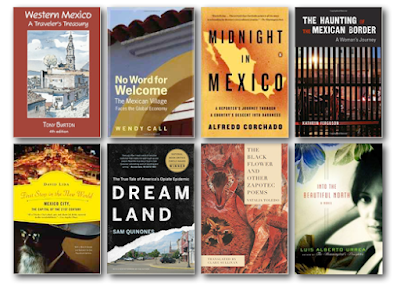
Burton, Tony. Western Mexico: A Traveler’s Treasury
A unique guidebook by an English geographer that is chock full of surprises, plus illustrations and many maps. Yes, I am recommending a guidebook for a book club; it is that special. 

Call, Wendy. No Word for Welcome: The Mexican Village Faces the Global Economy
A passionate look at Mexico’s Isthmus of Tehuantepec, a little known and yet culturally, economically, historically, and politically vital part of Mexico. Winner of the Grub Street National Book Prize for Nonfiction. 

Corchado, Alfredo. Midnight in Mexico: A Reporter’s Journey through a Country’s Descent into Darkness
Like the title says. 

Ferguson, Kathryn. The Haunting of the Mexican Border
Ferociously personal reporting on both sides of the border.

Lida, David. First Stop in the New World: Mexico City, the Capital of the 21st Century
A long-time resident of Mexico City and a prolific writer in both English and Spanish, Lida is one of the most knowledgable Americans writing about Mexico. 
>Visit Lida’s blog

Quinones, Sam. Dreamland: The True Tale of America’s Opiate Epidemic
Dreamland should be read—and more than once— by anyone who would make or attempt to influence policy on the drug trade, whether legal or illegal. Moreover, Dreamland should be read by every citizen who would visit a doctor. > Read my review of this book in Literal Magazine.
> See also his beyond-outstanding collections of essays on Mexico: True Tales from Another Mexico and Antonio’s Gun and Delfino’s Dream.

Toledo, Natalia. The Black Flower and Other Zapotec Poems
Translated from Zapotec, a major indigenous language in Mexico, by Clare Sullivan.

Urrea, Luis Alberto. Into the Beautiful NorthYou can’t go wrong with Luis Alberto Urrea, pick any one or more of his titles.
> Visit his website.

PLUS! PLUS! PLUS! PLUS! PLUS!
FIVE BOOKS ON MEXICO THAT I HAVE NOT YET READ,
BUT IF I WERE IN A BOOK CLUB I WOULD VOTE TO READ THEM

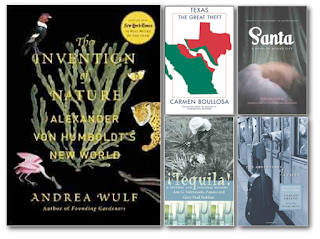
Boullosa, Carmen. Texas: The Great Theft 
Translated by Samantha Schnee. Why I would vote to read this book: Boullosa is one of Mexico’s best-known literary writers; Schnee is a respected literary translator, and the flip-side of the story of Texas is one Americans rarely if ever hear.

Gamboa, Federico. Santa
Translated and edited by John Charles Chasteen. Why I would vote to read this book: It was a racy best-seller of its day in Mexico and its author, Federico Gamboa, was a noted literary figure and politician.

Prieto, Carlos. Adventures of a Cello
It is a Stradivarius and Prieto is one of the best cellists in the world. From the catalog: “To make the story of his cello complete, Mr. Prieto also provides a brief history of violin making and a succinct review of cello music from Stradivari to the present. He highlights the work of composers from Latin America, Spain, and Portugal, for whose music he has long been an advocate and principal performer.”

Valenzuela-Zapata, Ana G. and Gary Paul Nabhan. Tequila: A Natural and Cultural History
From the catalog: “Ana G. Valenzuela-Zapata, the leading agronomist in Mexico’s tequila industry, and Gary Paul Nabhan, one of America’s most respected ethnobotanists, plumb the myth of tequila as they introduce the natural history, economics, and cultural significance of the plants cultivated for its production.”

Wulf, Andrea. The Invention of Nature: Alexander von Humboldt’s New World
German naturalist Alexander von Humboldt wrote about his research and explorations in Mexico; it would be difficult to overestimate his influence on how Mexican scientists saw their own country, and how Europeans saw Mexico in the 19th century. Friends have raved about Wulf’s book, so it would get my vote for a read. 


Q & A with Diana Anhalt on Her Poetry Collection Walking Backward

Journal of Big Bend Studies: “The Secret Book by Francisco I. Madero”

Translating Across the Border

#

Find out more about
C.M. Mayo’s books, articles, podcasts, and more.

From the Archives: Writing Loglines and the Concept of “the Eyespan”

This blog posts on Mondays. Second Mondays of the month I devote to my writing workshop students and anyone else interested in creative writing. Welcome!

> For the archive of workshop posts click here.

This finds me away from the blog this week. Herewith a post from the archives:

Writing Loglines and the Concept of “the Eyespan“

Originally posted on Madam Mayo blog February 22, 2012

I resisted writing loglines for a long time, for I was of the school of Flannery O’Connor’s famous saying (as I recall it), “if you want to know what the story is about, read the story.” In other words, I believed in the mysterious resonance of literary profundity– and, oh yeah, I still do– but I have come to appreciate the focusing power, both for the writer herself and for her sales team (agent, editor, marketing staff, booksellers, et al) of packing the whole enchilada into one super-yummy bite– because, otherwise, you and your readers will be left vaguely wondering, um, what might it be? “A good meal?” Err, that could anything from a chunk of cheese to a 5 star foie gras extravanganza.

Specificity entices.

It also repels. Dear writerly reader, as you know, there are readers you don’t want your book to attract. I don’t mean that in a necessarily snobby way. After all, someone who’s looking for a guidebook wouldn’t want to be served up a lyrical literary experiment in travel memoir– and vice versa.

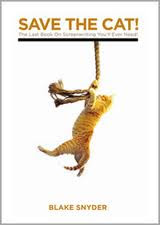
I just wrapped up a few days of giving writing workshops in San Miguel de Allende, and on the last day, I evangelized about loglines which I would have done anyway but it so happened that I had just, the night before, finished reading Blake Snyder’s Save the Cat! a both amusing and practical guide to writing screenplays which, by the way, offers a slew of examples of great loglines. I don’t write screenplays (yet) but the basic principles of storytelling are the same, whether for the screen or the stage, the page, or lo! ye olde campfire. Seriously, if you’re writing any kind of story, read Save the Cat!, have a chuckle or nine, and save yourself a heap of headaches. 

Snyder writes, “If you can’t tell me about it in one quick line, well, buddy, I’m on to something else.”

(Does this guy snazz around Malibu in a little red convertible, or what?)

Yours Truly defines the so-called logline as a one to two sentence description of the book that (a) tells the reader what to expect and (b) entices.

Here are some examples from various books that work for me– not all official, by the way, but plucked from longer descriptions on the book’s jacket; others are simply subtitles; others were cooked up not by the author but by the editor and/or marketing staff:

This ultimate insider’s guide reveals the secrets that none dare admit, told by a show biz veteran who’s proven that you can sell your script if you can save the cat.
Save the Cat! by Blake Snyder

From literary journalist Sara Mansfield Taber comes a deep and wondrous memoir of her exotic childhood as the daughter of a covert CIA operative.
Born Under an Assumed Name by Sara Mansfield Taber

How what we hear transforms our brains and our lives, from music to silence and everything in between
Healing at the Speed of Sound by Don Campbell and Alex Doman

An epic novel about a family torn apart in the struggle-to-the-death over the destiny of Mexico
The Last Prince of the Mexican Empire by Yours Truly 

Alexander von Humboldt and the Latin American journey that changed the way we see the world
Humboldt’s Cosmos by Gerard Helferich

Not long ago the Big Thicket of East Texas was still one of those places singular in its southernness, like the Mississippi Delta or the Carolina Low Country; now its old-timers and their ways are nearly gone. They will not be forgotten, though, for in My Grandfather’s Finger, Edward Swift recalls a Big Thicket populated by family and friends as gloriously vibrant and enigmatic as the land itself. 
My Grandfather’s Finger by Edward Swift

War and Peace broadly focuses on Napoleon’s invasion of Russia in 1812 and follows three of the most well-known characters in literature: Pierre Bezukhov, the illegitimate son of a count who is fighting for his inheritance and yearning for spiritual fulfillment; Prince Andrei Bolkonsky, who leaves his family behind to fight in the war against Napoleon; and Natasha Rostov, the beautiful young daughter of a nobleman who intrigues both men. 
War and Peace by Leo Tolstoy

All of these fall into what I think of an an “eyespan”– an amount of text the reader’s eye can take in in a “gulp.” (I admit, the last example is long– but it is one sentence.) 

If you google around, you will find a multitude of webpages with advice, and schoolmarmy formulas, for writing log lines. Such rigidity might be apt for certain industries (TV pilots?) but for books, we have a scootch more wiggle room. But not past the eyespan.

What you might also notice is that in these examples– just pulled from the books I happened to have at hand– the (very few) adjectives and verbs have verve:

ADJECTIVES

ultimate
singular
gloriously
vibrant
enigmatic
deep 
wondrous
exotic
covert
illegitimate
beautiful

VERBS

reveals
dare
admit
prove
sell
save
hear
transform
to be (forgotten)
follows
fighting
yearning
leaves
fights (again!)
intrigues

So…. if you’re working on a log line, why not make a list of vervy verbs and such from the books you have at hand? Recycling a few of them (covertly fighting! deeply yearning! wondrously transforming!) can be a felicitous endeavor…

P.S. I offer several detailed reading lists for writers here.

For updates on upcoming workshops I invite you to sign up for my newsletter here.

On Seeing as an Artist or, Five Techniques for a Journey to Einfühlung

Q & A: Amy Hale Auker, On Ordinary Skin: Essays from Willow Springs 

Daniel Chacón’s “Words on a Wire” Podcast Interview with Yours Truly About Francisco I. Madero’s Secret Book

Find out more about
C.M. Mayo’s books, articles, podcasts, and more.

From the Archives: “Another One Hundred Foreigners in Morelos: José N. Iturriaga (and Yours Truly) in Cuernavaca’s Historic Jardín Borda”

I’m away from the blog this Monday– my writing assistants illustrate the concept.

Another One Hundred Foreigners in Morelos:
José N. Iturriaga (and Yours Truly) in
Cuernavaca’s Historic Jardín Borda

Originally posted on Madam Mayo blog July 4, 2016

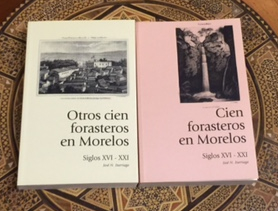
The two volume anthology by José N. Iturriaga, a collection of writings by foreigners in Morelia, from the 16th to the 21st century. 

To see one’s own country through the scribbles of foreigners can be at once discomfiting and illuminating. Out of naiveté and presumption, foreigners get many things dead-wrong;  they also get many things confoundingly right. Like the child who asked why the emperor was wearing no clothes, oftentimes they point to things we have been blind to: beauty and wonders, silliness, perchance a cobwebby corner exuding one skanky stink. And of course, there are things for foreigners to point at in all countries, from Albania to Zambia.

As an American I have to admit it’s rare that we pay a whit of attention to writing on the United States by, say, Mexicans, Canadians, the Germans or the French. True, we have the shining example of Alexis de Tocqueville’s Democracy in America, which every reasonably well-educated American may not have waded through but has at least heard of (and if you haven’t, dear reader, now you have.) But de Tocqueville’s tome is a musty-dusty 181 years old (the first of its four volumes was published in 1835, the last in 1840– get the whole croquembouche in paperback here.)

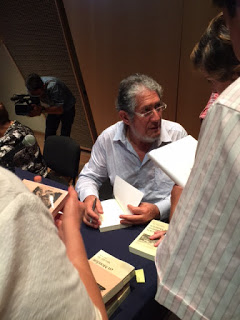
José N. Iturriaga, signing copies of his anthology, July 1, 2016, Centro Cultural Jardin Borda, Cuernavaca, Morelos, Mexico.

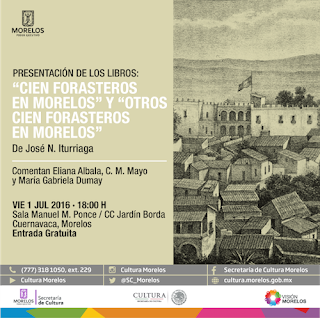
This past Friday, July 1, 2016, I participated in the launch of novelist and historian José N. Iturriaga’s anthology Otros cien forasteros en Morelos [Another One Hundred Foreigners in Morelos], the companion volume to Cien forasteros en Morelos [One Hundred Foreigners in Morelos], from the 16th to the 21st century.

(For those rusty on their Mexican geography, Morelos is a large state in central Mexico that includes Cuernavaca, “the city of eternal springtime,” which it actually is, and Tepoztlán, a farm town surrounded by spectacular reddish bluffs that, despite an influx of tourists from Mexico City and abroad, still has a strong indigenous presence, and has been designated by Mexico’s Secretary of Tourism as a “pueblo mágico.” The most famous resident of the state of Morelos was Revolutionary leader Emiliano Zapata.) 

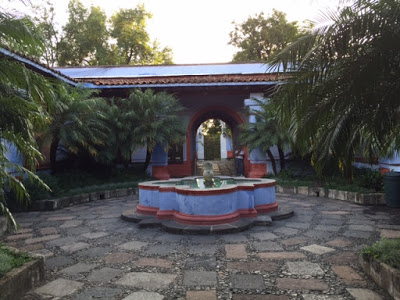
The launch was held in the Centro Cultural Jardín Borda (Borda Gardens Cultural Center), an historic garden open to the public in downtown Cuernavaca– about an hour and a half’s drive from Mexico City. 

Jardín Borda, entrance patio, towards evening on an overcast day.

As Iturriaga said in his talk, for almost forty years he has been studying the writings of foreigners on Mexico, precisely for the fresh, if not always kind nor necessarily accurate, perspective they offer on his own country. 

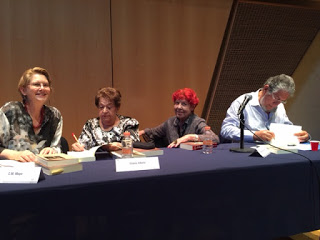
I admire Iturriaga’s work, and his curiosity, open-mindedness, and open-heartedness more than I can say. It was a mammoth honor to have had an excerpt from my novel included in his anthology, and to have been invited to participate on the panel presenting his anthology. The other two panelists, whose work is also in the anthology, were poet, novelist and essayist Eliana Albala and journalist and poet María Gabriela Dumay, both of whom came to live in Cuernavaca in the early 1970s, political exiles from Pinochet’s Chile.

Mexican book presentations tend to be more formal affairs than those in US (the latter usually in a bookstore with, perhaps, a brief and informal introduction by the owner or a staff member. I have war stories.) In Mexico, in contrast, there is usually a felt-draped dais, always a microphone, and two to as many as five panelists who have prepared formal lectures about the book. The author speaks last, and briefly. Another difference is that the Mexican reporters, photographers, and oftentimes television cameras crowd the dais, lending the affair a glamor and gravitas rare for a US book presentation. Afterwards, there is a party with white-gloved waiters pouring “vino de honor”– in this case, for Iturriaga’s  Otro cien forasteros en Morelos, whoa, mezcal.

C.M. Mayo, Eliana Albala, María Gabriela Dumay, José N. Iturriaga, July 1, 2016, Centro Cultural Jardín Borda, Cuernavaca, Morelos, Mexico

>> Where to buy Otros Cien Forasteros en Morelos? I hope to be able to provide a link shortly.

Here is my talk for the panel, translated into English.

Dear José Iturriaga; fellow panelists, Eliana Albala and María Gabriela Dumay; everyone in this beautiful Centro Cultural Jardín Borda who made this event possible; Ladies and Gentlemen:

First of all, heart-felt congratulations to José Iturriaga on this extraordinary anthology in two volumes, a magnificent and opportune cultural contribution that, no doubt, required endless hours of reading, not to mention the tremendous labor of love that went into selecting and then translating so many writers. 

Between the covers of this second volume, Otros cien forasteros en Morelos, I find my fellow Americans Jack London, Katherine Anne Porter, and John Steinbeck– among the most outstanding figures in US literature. There is also the great novelist who arrived, so mysteriously, from Germany: B. Traven; and artists such as Pedro Friedeberg; and distinguished historians such as John Womack, author of Zapata and the Mexican Revolution, Michael K. Schuessler, biographer of the eccentric poetic genius Pita Amor; and the Austrian Konrad Ratz, whose meticulous research on Maximilian von Habsburg was essential, in fact a parting of the seas, in our understanding of the personality, education, and politics of the Archduke of Austria.

In three words, José Iturriaga’s anthology is eclectic, fascinating, and illuminating.

It is a great honor for me to participate in this presentation and an even greater honor that this second volume, Otros cien forasteros en Morelos, includes excerpts from my novel, The Last Prince of the Mexican Empire. [In the anthology, excerpts are taken from the Spanish translation by Mexican novelist and poet Agustín Cadena, El último príncipe del Imperio Mexicano.]

My novel is about the grandson of Agustín de Iturbide,* Agustín de Iturbide y Green (1863-1925) whom Maximilian “adopted” in 1865, making this half-American two-year old, briefly, Heir Presumptive to the Mexican throne.

(*Agustin de Iturbide (1783-1824) led the final stage of Mexico’s war for independence from Spain, and supported by the Catholic Church, was crowned Emperor of Mexico in 1822, deposed in 1823, and executed in 1824. )

In the winter of  1866, Maximilian brought his court here, to the Jardín Borda. And since we are within those very walls and surrounded by those very gardens, in celebration of José Iturriaga’s work, I would like to invoke those foreigners of the past, that is to say, I would like to read the few very brief excerpts from the novel, The Last Prince of the Mexican Empire, as they appear in this anthology. 

This bit from the novel is the imagined point of view of José Luis Blasio, a Mexican who served as Maximilian’s secretary:

Depend on it: Maximilian is shepherding Mexico into the modern world— so José Luis Blasio, His Majesty’s secretary, has told his family and tells himself. And this is no small task when His Majesty must grapple not only with our backwardness and ingratitude, but that thorn in his side, General Bazaine. The rumor is that, abetted by his Mexican wife’s family, Bazaine schemes to push aside Maximilian; they aim to have Louis Napoleon make Mexico a French Protectorate with himself in charge—  not that José Luis would give that a peso of credence. But José Luis does consider it an outrage, the latest of many, that he would wire a complaint that Maximilian has removed his court to Cuernavaca, rather than “attend to business in the capital.”

Yes, they are here in the Casa Borda amongst gardens and fountains, fruit trees, palm trees, parrots of every size and color—  a world away from Mexico City. But does not Louis Napoleon go to Plombières and Biarritz? Queen Victoria, who has sterner blood, travels as far as Balmoral in the Scottish Highlands. Dom Pedro II of Brazil retires to his villa in Petropolis. And did not the empress’s late father, Leopold, absent himself from Brussels in the Château Royal at Laeken? It is natural that for the winter, His Majesty should hold court in a healthier clime. 

But even here where he siestas in a hammock, drinks limeade from a coconut shell, and wears an ecru linen suit with an open-necked blouse, Maximilian’s work never ceases. It is a wide, rushing river that José Luis can only hope will not overspill its banks. In the past year, José Luis has come to appreciate the uncompromising necessity of working long hours; indeed, his eyesight, never strong, has deteriorated from so much reading in the dim of early mornings. Maximilian arises at four; his valet attends him, and though he might linger over breakfast, by no later than six, he is at “the bridge,” as he says, that is, his desk—  or, as here in Casa Borda, a folding table on the veranda. His Majesty’s dispatch box is heavy, and growing ever heavier… 

And now Pepa de Iturbide, daughter of the Emperor Agustín de Iturbide, godmother to Agustin de Iturbide y Green, and member of Maximilian’s court:

It is a holy miracle that she got a wink of sleep at all! So appalled she is by Maximilian’s whim to uproot the court to this hamlet two bone-jarring days travel up and down the sierra— good gracious, this is no time to abandon the capital, and go gallivanting about with butterfly nets and beetle jars! Matamoros is under siege; the whole state of Guerrero, from Acapulco to Iguala, is in thrall to guerrillas. And Pepa got it from Frau von Kuhacsevich, who got it from Lieutenant Weissbrunn, that whilst the empress was in Yucatan, Maximilian fancied a visit to Acapulco, but General Bazaine nixed it because it would have been impossible to maintain security for his person. That is the sum of things!

Oh, but in Mexico City Maximilian felt cramped, “an oyster in a bucket of ice,” he said. Over the past two months, the few times Pepa chanced to see Maximilian, he had spoken of the empress’s dispatches from Yucatan proudly but with— Pepa recognized it when she saw it— a glint of green. If Maximilian could not have his expedition to Yucatan, by Jove, he was going to go some place tropical! And Maximilian could not be outshone by his consort, oh no. A mere visit to Cuernavaca would not do; he had to serve himself  the whole enchilada with the big spoon: an Imperial Residence with landscaping, fountains, an ornamental pond stocked with exotic fish, and furnishings and flub dubs aplenty, comme ça and de rigueur. Whom did he imagine he was impressing with this caprice? Poor Charlotte, exhausted after Yucatan.  And as if the von Kuhacseviches were not already foundering in their attempts to manage the Imperial Household in Mexico City! As if the Mexican Imperial Army could offer its officers anything approaching a living wage! Or keep its depots stocked with gunpowder! It is a monumental waste of time, of effort, of money, and to boot, Casa Borda is a-crawl with cockroaches, beetles, earwigs, and moths—  a bonanza for Professor Bilimek!

And now the Austrian Frau von Kuhacsecvich, Mistress (chief administrador) of the Imperial Household: 

On the steps to the next patio, Frau von Kuhacsevich must pause to fan herself. Cuernavaca is not the Turkish bath of the hot lands, more, as Maximilian put it, an Italian May. Pleasant for the men, and Prince Agustín, perhaps, but a trial for those who must encase themselves in corsets and crinolines. Oh, poor Charlotte that her father has died, but Blessed Jesus, what would Frau von Kuhacsevich have done had she been obliged to wear mourning black! The thought simply wilts her. She is afraid her face has gone red as a beet. Her back feels sticky, and under her bonnet, she can feel her scalp sweating. Taking the bonnet off is out of the question: her roots have grown in nearly an inch— in all the rushing to and fro, there has not been a snatch of time to touch up the color.

An Italian May: in that spirit, for luncheon, Tüdos has concocted an amuse-gueule of olives, basil, and requeson, a cheese too strong to pass for mozzarella, but toothsome. In addition to coffee, he will be making a big pot of canarino: simply, the zest of lemons steeped as tea. Well, here it has to be made of limes, ni modo, no matter, as the Mexicans say.

Finally, Maximilian himself:

Here, this moment in Cuernavaca, one is happy: perfumes in the air, colors from the palette of Heaven, birds, flowering trees and vines and oranges, the music of the orchestra and of the fountains, this bone-warming sunshine…

Thank you.

We Have Seen the Lights: The Marfa Ghost Lights Phenomenon

Book Review: Our Lost Border: Essays on Life Amid the Narco-Violence, edited by Sarah Cortez and Sergio Troncoso

Translating Across the Border

Find out more about
C.M. Mayo’s books, articles, podcasts, and more.

Q & A: Katherine Dunn on “White Dog” and Writing in the Digital Revolution

“Simple tiny steps of work. I find I actually get a lot done in a shorter amount of time than when I was younger.”
–Katherine Dunn

This blog posts on Mondays. Fourth Mondays of the month I devote to a Q & A with a fellow writer.

This month’s Q & A is with visual artist and writer Katherine Dunn, whom I admire more than I can say. I have one of her artworks in the entrance of my house, and another framed in my office, such that I see them both every day–and they always lift my spirits. And I’ve been reading her blog, Apifera Farm, since the dawn of blogging. Her blog can be charming, but dear writerly reader, it’s deeply wise, and it oftentimes features posts about and photos of death (read what she has to say about that here). Her farm, originally in Oregon, is an unusual one. Now relocated to loveliest Maine, Apifera is an incorporated non profit and registered 501[c][3] with a mission to adopt and care for elder/special needs barn animals/creatures and to bring the animals together with elder/special needs people for mutually healing visits.

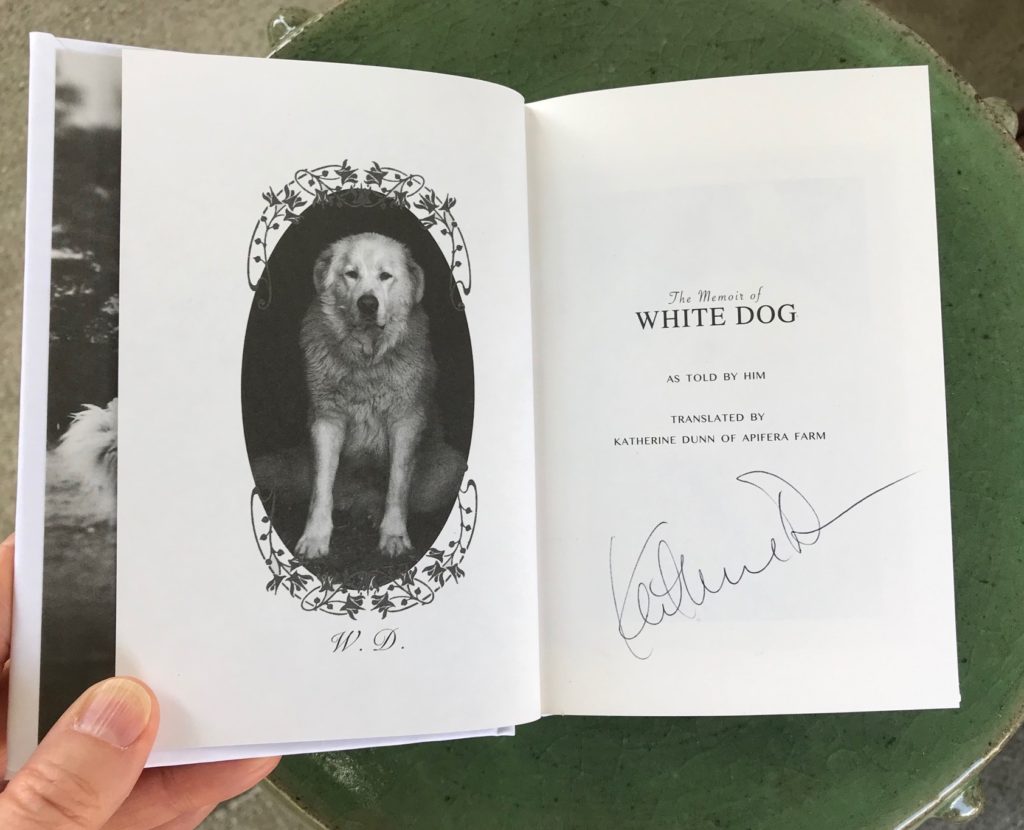
Katherine Dunn’s latest of many books is the exquisite four-color and offset-printed White Dog, and apropos of that, she agreed to answer some questions.

C.M. MAYO: What inspired you to write this book?

Katherine Dunn: White Dog! The mystery of where he really came from was always on my mind. Many opinions were given at the time. But in the end, I stayed with the ‘magic’ of his arrival. All my life I find I am put in situations, that if I had been somewhere else on that day my life would have taken another path. I feel that way with White Dog, I believe he came to help me as much as me to help him.

C.M. MAYO: As you were writing, did you have in mind an ideal reader?

Katherine Dunn: I’m self-taught really. I never think about who is reading or viewing my art.

C.M. MAYO:
Now that it has been published, can you describe the ideal reader for this book as you see him or her now?

Katherine Dunn: I just don’t think in those terms I guess. I feel my work is cross generational. When I tried to get into publishing houses for my children books, I was often told they were too adult. When I shared memoirs or story ideas with some agent or editors I was told they weren’t adult enough or did not have an easy to label genre. YUCK. I gave up trying to find an agent or editor after about 5 years.

C.M. MAYO:
Which writers have been the most important influences for you?

Katherine Dunn: E.B. White. Marquez. I loved Watership Down. Bob Dylan. Nick Cave. I don’t differentiate between mediums. I think music has been more important to me versus books, although I love books.

C.M. MAYO:
You are also a wonderful artist. Which artists have been the most influential for you?

Katherine Dunn: I was surrounded by art and books as a child, my father was an artist/architect. Matisse was an early influence… but Paul Klee I think influenced me the most as child. I was a ceramicist first, and 3d is still part of my work. I need to always be working in a flow of what I want to work on. Lately I’m working on some needle stuff (slowly).

C.M. MAYO:
Which writers are you reading now? 

Katherine Dunn: On the Brink of Everything by Parker Palmer, Two Prospectors, the collected of letters between Sam Shepherd and Johnny Dark.

C.M. MAYO:
How has the Digital Revolution affected your writing and your art? Specifically, has it become more challenging to stay focused on artistic endeavors with the siren calls of email, texting, blogs, online newspapers and magazines, social media, and such? If so, do you have some tips and tricks you might be able to share? 

Katherine Dunn: Well…I could not do what I do, as a freelancer since 1996, out in the country without it. I think it is the political and chaos we are in as a nation that is more distracting right now. I have an iPhone that I use mainly for photos…but I’m not attached to it like many people. I have learned to sit down, and state in my head what I need to do, i.e., “I need to get this canvas started and work on it for one hour.”

Simple tiny steps of work. I find I actually get a lot done in a shorter amount of time than when I was younger.

I also do not feel compelled to be in the studio all the time. I’m 62, maybe that is part of it–I have less enthusiasm for other people’s presence.

I think if most people just tried off notifications on their iPhones it would help! I see some people unable to have a 5 minute conversation without getting interrupted.

I’ve learned to get on and off social media. I deleted 5000 “friends” on Facebook and kept 100 of people I really knew. I never post on it. I only maintain my Apifera Farm nonprofit page. I don’t comment hardly ever on anything of FB. I decided it was a drain and that I was basically entertaining the masses with free photos, stories and more, and was not seeing a return. The nonprofit still can bring in donations through FB. Instagram is eye candy, I use it as a marketing tool for my non profit, and post art when I have it to show.

But that’s it. I don’t interact on it, except to see a baby photo or something of real friends.

C.M. MAYO:
Another question apropos of the Digital Revolution. As a writer, at what point were you working on paper? Was working on paper necessary for you or problematic?

Katherine Dunn: I kind of worked on paper, and still do, if I’m creating a book, because I am so visual. Especially if it is an illustrated book. I need to see thumbnails over and over as it evolves. but I don’t write on paper. All my books, I think there are 6, were always typed on the computer…I keep lists and ideas here and there, but I work on the computer.

C.M. MAYO:
For those looking to publish, what would be your most hard-earned piece of advice?

Katherine Dunn: Oh man….

If you are looking to publish with a publisher…I don’t even know what to say because of my experience. I hired a former editor of Chronicle books back in 2010 when I was working on what was then called Raggedy Love but became Donkey Dreams. He helped enormously. He helped me learn the importance of shaping a book, editing, etc. And focusing. He would keep the story on track…it was so helpful. Especially in today’s worlds of blogs–some peoples’ books just feel like blogs. Anyway, it was one of the best investments I made. And we really thought we had a book, and he pitched it to about 15 places.

Illustrated memoir is hard to place. It was disappointing. That is when I first self-published about a year later. I did publish with a publisher for a how-to-art-inspiration book back in 2008 or there about, it was a good lesson on how a book comes together.

Self-publishing is rewarding and cost effective. But lots of work. I use offset printers, more cost effective but also more upfront money. 

To be honest, I got so sick and tired of sending query letters that went unanswered, or had no feedback…or got good feedback and then…silence. I just got tired of it. Same things with agents.

I like being my own band. Life is too short.

On the other hand, if you have a connection with someone, that makes all the difference in the world. But my days of having connections like that are over, and I am fine with that.

C.M. MAYO:
What important piece of advice would you give yourself if you could travel back in time ten years?

Katherine Dunn: hmmm….I think I lived as I wanted, and still do, so don’t think I have any advice like that…

Maybe …. “It will be okay.”

C.M. MAYO:
What’s next for you?

Katherine Dunn: Good question. I still want to market White Dog more, it came out during Covid. So I am percolating that.

I had a stretch of good painting, large canvases for Sundance which was a nice change.

I have some creatures warranting books or something…The Goose, Walter the cat…I don’t know…

I have to tell you, the world situation is very upsetting. So I’m letting myself do what feels right at the moment of each day.

Visit Katherine Dunn at www.katherinedunn.com. You can order a copy of White Dog here.

Q & A with Poet Barbara Crooker on the Magic of VCCA,
Reading, and Some Glad Morning

Q & A with Bruce Berger on A Desert Harvest

The Marfa Mondays Podcast is Back! No. 21: 
“Great Power in One: Miss Charles Emily Wilson”

#

Find out more about
C.M. Mayo’s books, articles, podcasts, and more.

Doug Hill’s “Not So Fast: Thinking Twice About Technology”

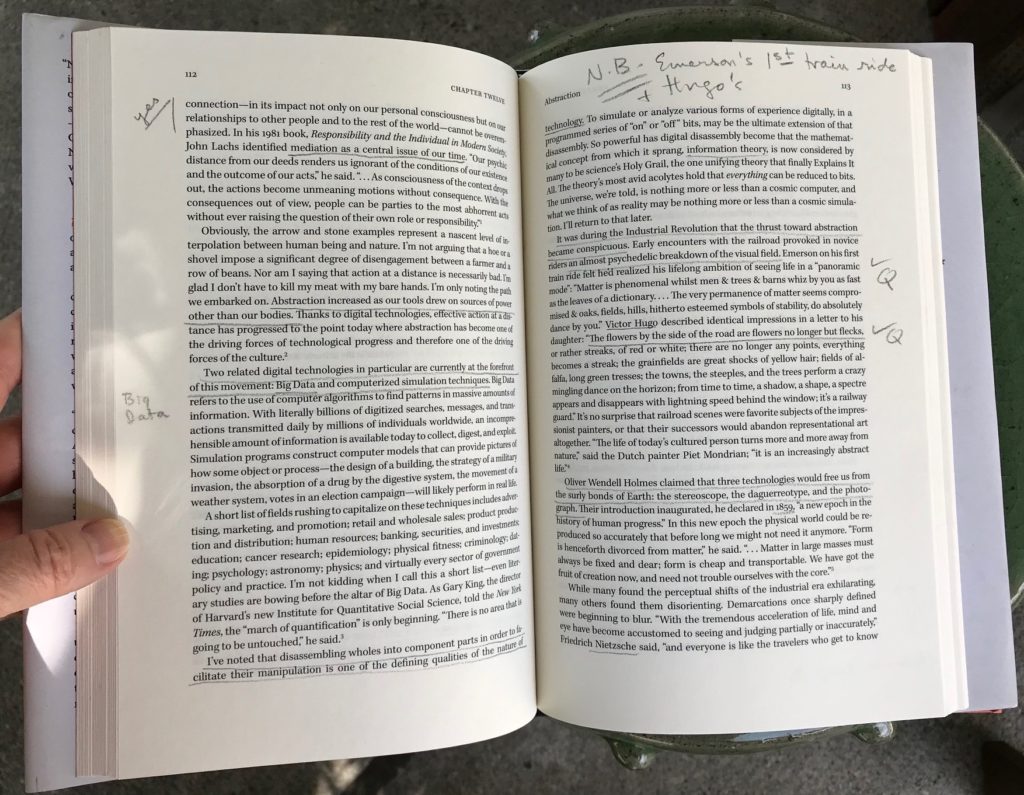
Technology is a topic I often touch on in this blog* because first, it’s directly relevant to my book in-progress on Far West Texas, and second, the digital revolution we’re all living through is so dizzyingly, all-at-once enchanting and consternating. Where is this all taking us? Mars? The Stars? Or, will we all end up like the pudding-like protagonist of E.M. Forster’s eerily prophetic short story “The Machine Stops”? How does this digital revolution connect to / echo with technological change in the past, for example, with the advent of the printed book, the telegraph, radio, telephones, cinema, television? With other technologies, from the railroads to airplanes? Or for that matter, the bow and arrow, or say, or the clock? And how is the digital revolution, in fact, or not in fact, fundamentally different from what has come before? Most importantly, how to live a human life, a good and creative life, say, this writer’s life, that is not hijacked by technological imperatives, above all, the constant pull to the glamor of the screens? (And I mean “glamor” in its original, occult sense.) So many questions… Sometimes some of the literature begins to answer them.

*See for example Notes on Wolfgang Schivelbusch’s The Railway Journey; Jerry Mander’s Ten Arguments for the Elimination of Television; The Typewriter Manifesto by Richard Polt, Plus Cyberflanerie on Technology; Marshall McLuhan (1911-1980): Some Notes ; and Notes on Stephen L. Talbott’s The Future Does Not Compute.

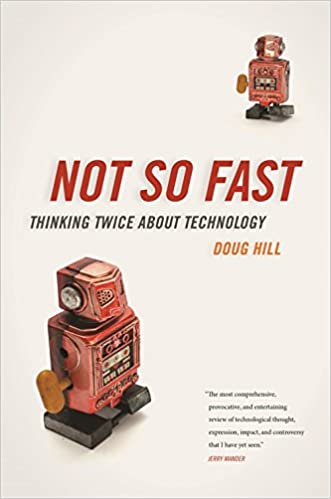
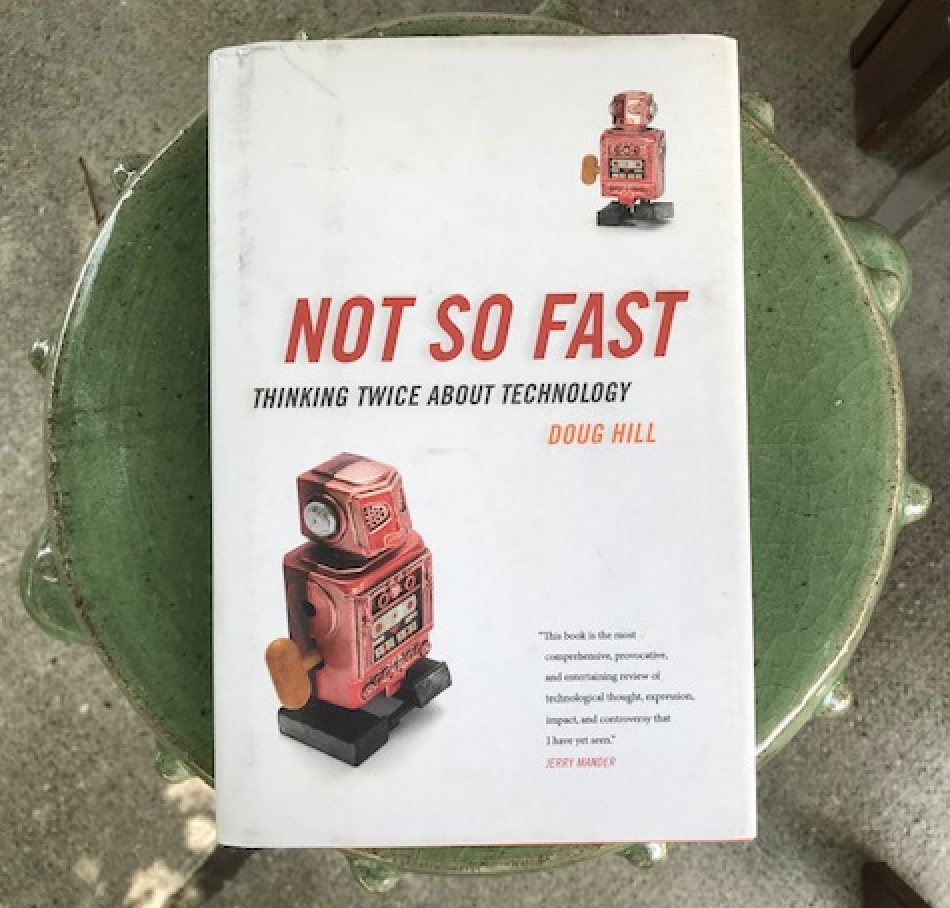
Doug Hill’s Not So Fast: Thinking Twice About Technology

Doug Hill’s Not So Fast: Thinking Twice About Technology. That fuzzy blurb on the cover is from Jerry Mander: “This book is the most comprehensive, provocative, and entertaining review of technological thought, expression, impact, and controversy that I have yet seen.” Yours Truly concurs.

The first and major thing I appreciated about Doug Hill’s Not So Fast is that he provides an up-to-date general overview of the literature on the history and the philosophy of technology. Francis Bacon, Henry James, Martin Heidegger, Aldous Huxley, Marshall McLuhan, Lewis Mumford, Langdon Winner, Norbert Wiener, Jacques Ellul, Ray Kurzweil, Kevin Kelly, Stewart Brand, Steve Jobs–and an army more– they’re all there. Secondly, in engaging, butter-smooth prose throughout, Hill tackles, as he quotes philosopher Albert Borgmann, “the pervasiveness and consistency of [technology’s] pattern.” I mean to say, Hill has accomplished a rare combined literary and intellectual feat.

Here’s the catalog copy for Not So Fast:

There’s a well-known story about an older fish who swims by two younger fish and asks, “How’s the water?” The younger fish are puzzled. “What’s water?” they ask.

Many of us today might ask a similar question: What’s technology? Technology defines the world we live in, yet we’re so immersed in it, so encompassed by it, that we mostly take it for granted. Seldom, if ever, do we stop to ask what technology is. Failing to ask that question, we fail to perceive all the ways it might be shaping us.

Usually when we hear the word “technology,” we automatically think of digital devices and their myriad applications. As revolutionary as smartphones, online shopping, and social networks may seem, however, they fit into long-standing, deeply entrenched patterns of technological thought as well as practice. Generations of skeptics have questioned how well served we are by those patterns of thought and practice, even as generations of enthusiasts have promised that the latest innovations will deliver us, soon, to Paradise. We’re not there yet, but the cyber utopians of Silicon Valley keep telling us it’s right around the corner.

What is technology, and how is it shaping us? In search of answers to those crucial questions, Not So Fast draws on the insights of dozens of scholars and artists who have thought deeply about the meanings of machines. The book explores such dynamics as technological drift, technological momentum, technological disequilibrium, and technological autonomy to help us understand the interconnected, interwoven, and interdependent phenomena of our technological world. In the course of that exploration, Doug Hill poses penetrating questions of his own, among them: Do we have as much control over our machines as we think? And who can we rely on to guide the technological forces that will determine the future of the planet?

P.S. James Howard Kunstler’s podcast interview with Doug Hill about Not So Fast is well worth a listen.

More anon.

Q & A with Sergio Troncoso, Author of 
A Peculiar Kind of Immigrant’s Son

John Bigelow, Jr. in the Journal of Big Bend Studies

“What Happened to the Dog?” A Story About a Typewriter, Actually, 
Typed on a 1967 Hermes 3000

#

Find out more about
C.M. Mayo’s books, articles, podcasts, and more.

The Book As Thoughtform, the Book As Object: A Book Rescued, a Book Attacked, and Katherine Dunn’s Beautiful Book “White Dog” Arrives

This blog posts on Mondays. Second Mondays of the month I devote to my writing workshop students and anyone else interested in creative writing. Welcome!

> For the archive of workshop posts click here.

A BOOK RESCUED

I wish I’d had the foresight to take a photo of what this book looked like before its repair: the spine torn off and hanging to one side by threads. It’s the ninth edition of the “Fannie Farmer” Boston Cooking-School Cook Book published in 1951, not a valuable book in the rare book market, and this specimen less so for its decades-old gravy and butter stains. But it is a tremendously valuable book to me because it was my mother’s. I took it to my local bookbinder and, for about the price of a pair of Keds, voilà:

Restored for use by my local bookbinder.

It strikes me as curious that in all the many writers workshops and conferences I’ve attended over the years I cannot recall anyone ever even mentioning the craft of book binding. But what skill it takes to do it well! And what a difference it makes! With its repaired binding, this dear workhorse of a book has been given the dignity it well deserves.

What has this to do with a writing workshop? Two things.

First, as a writer I’ve come to realize that the quality of the book’s design, paper, and binding is immensely important, for its gives the book its presentation– like a frame for a picture or the dress for a bride– and it also gives it the sturdiness it requires to survive over time.

Second, I’ve come to believe that as a writer it matters why and how I treat my books because respect for them is respect my own endeavor. Generally speaking, I have learned to try to keep them out of the sun, I avoid eating or drinking while reading them, and I take care not to fade, fold, bump or tear any dust jackets. However, that doesn’t mean I’m ever and always fussy about my books. I’ll toss out battered old mass market paperbacks, and I often donate books. And some books I go ahead and give myself liberty to attack! I mean in a good way!

A BOOK ATTACKED (IN A GOOD WAY!)

An age ago I posted about using scissors to cut up Tolstoy’s War and Peace (which, as I explain in that post, enabled me to read it, for I couldn’t otherwise get that brick into my suitcase).

A more recent example: Doug Hill’s superb Not So Fast: Thinking Twice About Technology. When I ordered Not So Fast I guessed it would eventually become an important collector’s item, so I shelled out the clams for the University of Georgia Press first edition hardcover from bookdespository.com. Alas, when it arrived I found that the dust jacket had been badly treated (um, actually it looked like the forklift left greasy tire tracks on it). Translation: as a physical object my copy has little to zero value. Because I was so anxious to read it for my own work-in-progress however, rather than ask bookdepository.com for a replacement, I took this as a welcome opportunity to go ahead and mark it up with my notes. So: maltreated my copy may be, both in the warehouse and by my scribbles, it’s a book that is tremendously valuable to me as a working writer. (And I warmly recommend it to you, dear reader, by the way.)
I ordered the book from bookdepository.com and alas, the dust jacket arrived looking like this….
…so I gave myself permission to go ahead and mark it up. This one stays in my working library.

How do you treat your books? And why? These are questions I didn’t think to ask myself for many years. These may not be trick questions, but they are tricky questions, for they necessitate distinguishing the book as a thoughtform from the book as a physical object, and they also require self-awareness and clarity in one’s intentions, as both a reader and a writer.

WHITE DOG

The other day my copy of visual artist and writer Katherine Dunn’s latest book, White Dog, arrived. So obviously made with love and joy, White Dog is one of the most exquisite books that I have ever seen. Dear writerly readers, it is self-published. And I do not believe that any commercial publisher would have, nor could have, done justice to her vision.

UPDATE: See the Q & A with Katherine Dunn for this blog here.

MORE TO COME ON SELF-PUBLISHING

Those of you who have been following this blog well know that since early 2019 I’ve been migrating selected posts from the old Google platform. I have a batch of posts on self-publishing that I’ll be getting to in the coming weeks.

To be clear, I’m not a champion of self-publishing per se; I sincerely respect and value what a good publisher’s team (editor, copyeditor, book designer, sales reps, publicist, back office) can do. Most of my books have been published by traditional publishers or university presses, and indeed, I aim to place my recently completed collection of essays and my book in-progress with a publisher (wish me luck). But without making much effort to find a publisher (for good reason, which I go into in the relevant blog post) I self-published Metaphysical Odyssey into the Mexican Revolution. In addition I have self-published several Kindles, including this longform essay about the Mexican literary landscape. I remain open to the idea of self-publishing again in the future. In the post-covid economy, where we can expect smaller catalogs and fewer publishers, that may turn out to be the increasingly more realistic route. We shall see. More anon.

P.S. You can find the archive of workshop posts migrated-to-date here. Again, I offer a post for my workshop students and anyone else interested in creative writing on the second Monday of every month.

Q & A with Joanna Hershon on Her New Novel St. Ivo

What Is Writing (Really)? Plus A New Video of Yours Truly Talking About Four Exceedingly Rare Books Essential for Scholars of the Mexican Revolution

Überly Fab Fashion Blogger Melanie Kobayashi’s “Bag and a Beret” 
(Further Notes on Reading as a Writer)

Find out more about
C.M. Mayo’s books, articles, podcasts, and more.

Infinite Potential: The Life and Ideas of David Bohm

I foggily recall first learning about physicist David Bohm’s ideas in an astrophysics course (yea verily, back in the Paleozoic), but my more serious (ironically) introduction to Bohm’s work came many years later when, as I was writing my memoir of Baja California, Miraculous Air, I started to experience strings of synchronicities, including encountering a work on synchronicity which went into some detail about Bohm and his ideas! The key concepts that have stayed with me over the years are the implicate order and nonlocal consciousness. More recently, I encountered Bohm’s writings again when, apropos of my book about Francisco I. Madero’s secret book, I started to to read a ways into the life and work of mystic Jiddu Krishnamurti, who, so it turned out later in his life, became Bohm’s friend and partner in an historic series of televised dialogues exploring the nature of consciousness. All of which is by way of a gravy-wavy introduction to the just-released and superb documentary “Infinite Potential,” which, thanks to the Fetzer Memorial Trust, you can watch in its entirety for free on the film’s official YouTube channel:

My writing assistant, Uliberto Quetzalpugtl, attempts to demonstrate “infinite potential.” He reports that he feels “at one” with the chair.

Daniel Chacón’s “Words on a Wire” Podcast Interview with Yours Truly About Francisco I. Madero’s Secret Book

Notes on Stephen L. Talbott’s The Future Does Not Compute

Remembering Ann L. McLaughlin

Find out more about
C.M. Mayo’s books, articles, podcasts, and more.

Newsletter: C.M. Mayo’s Podcasts, Publications, and Workshops, Plus Cyberflanerie (Extra-Eclectic Edition!)

Welcome to this Monday’s post, dear writerly readers! As of this year, the fifth Monday of the month, when there is one, is for my newsletter, covering my publications, podcasts, selected posts from Madam Mayo, and upcoming workshops. Plus cyberflanerie.

Over the past few months, apart from waiting for the pears to ripen, I’ve mainly been working on my book on Far West Texas, and relatedly, the Marfa Mondays Podcasting Project.

My writing assistants, Uliberto Quetzalpugtl and Washingtoniana Quetzalpugalotl, wondering when the pears will start to drop. So far nobody’s gotten plunked on the noggin.

PODCASTS

The Marfa Mondays Podcast 21: “Great Power in One: Miss Charles Emily Wilson”

Check out the new website for the Marfa Mondays Podcasting Project, where you can listen to in to 21 of the projected 24 podcasts anytime, and find the transcripts as well.

Next up in the series: An interview with Bill Smith about the cactus capital of Sanderson, Texas.

SELECTED MADAM MAYO POSTS

Writing Workshop Posts
(every second Monday of the month):

Frederick Turner’s In the Land of the Temple Caves Recommended, Plus From the Archives: Cal Newport’s Deep Work; Study Hacks Blog; and on Quitting Social Media

Conjecture: The Powerful, Upfront, Fair and Square Technique to Blend Fiction into Your Nonfiction

From the Archives: Five 2 Word Exercises for Practicing Seeing as a Literary Artist in the Airport (or the Mall or the Train Station or the University Campus or the Car Wash, etc.)

Q & A s with a Fellow Writer
(every fourth Monday of the month):

Q & A with Ginger Eager on Her Debut Novel The Nature of Remains

Q & A with Art Taylor on The Boy Detective & The Summer of 74 and Other Tales of Suspense

Q & A with Ellen Prentiss Campbell on Writing Fiction and Her Latest Collection, Known by Heart

Other Selected Posts

From the Archives: A Visit to Las Pozas, Xilitla, San Luis Potosí, Mexico

In Memorium: William C. Gruben and his “Animals in the Arts in Texas”

WRITING WORKSHOP

In order to concentrate on writing my book I’ve taken a break from teaching this year, but I will be offering a one-hour workshop on poetic techniques for writers of fiction and narrative nonfiction at the Women Writing the West annual conference in Colorado Springs, Colorado this fall. If you’re anywhere in the area, and if your work focuses on anywhere / anything/ anyone in the US west of the Mississippi River, this might be a conference for you to consider. In particular, if you take your writing seriously, and if you’re looking to meet other writers, improve your writing skills, and to learn to pitch your work to agents, editors, and above all, help your book find its readers, I can warmly recommend this conference. I’ve participated twice now (you can read my edited transcript of a talk for the conference held in 2016 in Santa Fe here) and found it well worthwhile.

Saturday, October 17, 2020 
9:10-10:10 Poetic Techniques to Power Up– C.M. Mayo

For writers of fiction and narrative nonfiction (whether biography, nature writing, or memoir), award-winning poet and writer C.M. Mayo’s workshop gives you a toolkit of specific poetic techniques you can apply immediately to make your writing more vivid and engaging for your readers. Using handouts, first we’ll cover specificity with reference to the senses, a technique, basic as it may be, that many writers tend to underutilize. Then, in supersonic fashion, we’ll zoom over alliteration; use of imagery; repetition; listing; diction drops and spikes; synesthesia; and crucially, how to work with rhythm and sound to reinforce meaning. The goal is for your writing to take an immediate step up.

Meanwhile, for my students, and anyone else interested in creative writing, I will continue to post on some aspect of craft and/or creative process here at Madam Mayo blog on the second Monday of the month.

> You can always access the archive of Madam Mayo blog workshop posts here.

# # #

CYBERFLANERIE
(INSPIRING, INTERESTING, AND/OR USEFUL GLEANINGS)

Robert Laughlin, Preserver of a Mayan Language, Dies at 85

Rudy Rucker High on Gnarl and Chaos

Richard Cytowic on reading to the rescue (short, important)

Adam Garfinkle on deep literacy (long, thought-provoking)

Paul Graham’s essay on useful essays

Artist Marilee Shapiro who survived five days in the hospital with the covid at age 107— and is still making art

The Zoom thing (oyy) and more on the Zoom thing

Some little-known yet fascinating US history: occultist and independent scholar John Michael Greer’s post from Ecosophia In the Footsteps of High John

An already-oldie but thought-provoking goodie: What was really going on with all that TP (!!)

Tyler Cowan interviews John McWhorter

Kevin Kelly offers a raft of advice, including: “Anything real begins with the fiction of what could be. Imagination is therefore the most potent force in the universe, and a skill you can get better at. It’s the one skill in life that benefits from ignoring what everyone else knows.”

From Robert Giron at Gival Press (back in April, which was Poetry Month):

Take a few minutes away from the trauma of the day and read some poetry. Visit & read the Poetry Month 2020 Special Bilingual (Spanish/English) Edition in ArLiJo Issue No. 135 edited by Luis Alberto Ambroggio. Featuring poets: Lucha Corpi, Raquel Salas Rivera, Naomi Ayala, Orlando Rossardi, Tina Escaja, Daisy Zamora, Isaac Goldemberg, and Luis Alberto Ambroggio. Visit: http://www.ArLiJo.com

#

Stay safe!

#

Primitive Skills guru on “never hurry, never worry”:

#

Just ‘cuz it is so cool:

(Though certainly in English we underutilize clicks, we do use them. Notice how when an American is about to inform you about something, she says, tsk? It’s so quick, it’s easy to miss.)

P.S. I also, very occasionally, send out my newsletter to subscribers via email. If you would like to receive only the emailed newsletter, just zap me an email, I’ll be delighted to add you to my list. If in addition, or instead, you’d like to sign up for the Madam Mayo blog post alerts every Monday via email, just hie on over to the sidebar (or, if you’re on an iPhone, scroll down to the end of this post) for the signup. Welcome!

#

Oscar Wilde in West Point, Honey & Wax in Brooklyn

Notes on Wolfgang Schivelbusch’s The Railway Journey

The StandStand: One Highly Recommended Way
to Keep on Writing While Standing

#

Find out more about
C.M. Mayo’s books, articles, podcasts, and more.

Q & A: Ginger Eager on Her Debut Novel “The Nature of Remains”

“My goal was to write a book with a plot line exciting enough for any fan of gritty Southern fiction to enjoy”
— Ginger Eager

This blog posts on Mondays. Fourth Mondays of the month I devote to a Q & A with a fellow writer.

Ginger Eager’s The Nature of Remains, which won the prestigious AWP Award for the Novel, and comes recommended to me by Ellen Prentiss Campbell, promises to be an excellent read. Here’s the catalog copy:

“In Flyshoals, Georgia, karma is writ small enough to witness. When Doreen Swilley discovers that her boss and lover of thirty years intends to fire her to placate his dying wife, she devises a plan to steal his business from him. Her plan just might work too, if she is not thwarted by a small town’s enmeshed histories and her family’s own dark secrets. Set during the 2009 recession, The Nature of Remains rests at the intersection of class, gender, education and place. Through extended geological metaphor, readers witness the orogeny, crystallization, and weathering of the human soul. Doreen’s journey reveals the ways even a woman’s most precious connections—her children, her grandchildren, her lover—operate within larger social structures capable of challenging her sovereignty.”

C.M. MAYO: What inspired you to write this novel?

GINGER EAGER: I’d gone with a friend to look at a farmhouse for sale. It seemed perfect in the listing, an older home that was both livable and “a handyman’s dream,” on acreage with mature hardwoods and a pond. 

The drive in was gorgeous. It was August, and the hardwoods were thick enough for the road to be mostly in shadow with just a bit of dappled light. We drove through a wide, shallow creek, and I found it terribly romantic to consider living in a place I’d need vehicle clearance to reach. 

The trees thinned as we approached the house. The sun beat down and insects screamed from the overgrown fields. There was no shade, just the inarguable fact of August in the Georgia. My friend parked, turned off her truck off. We heard the roar of an interstate. The house was difficult to reach by vehicle, but if you were on foot it was just a few acres from I-20. 

We stood looking at the house. It needed quite a bit of work. The owner told us there were tenants in the process of moving out. They should be gone, he’d said, and the door’s unlocked. Ours was the only vehicle. We climbed the porch and knocked. 

“Who the f*** is it?” shrieked a woman’s voice from inside. 

“We’re here to see the house,” said my friend. “It’s for sale.” 

The heat-swollen door was forced open just enough for us to see a slice of the woman’s face. I’m not sure when she’d last eaten a decent meal, and her eyes darted about. “My husband is down at the pond.” She scratched at scabs on her arms. “He’ll shoot you if he sees you here. He don’t welcome visitors.” 

We thanked her and left. I don’t know if she had a husband or a gun, but she needed the privacy she asked for. Something mean had her in its grip. 

That afternoon, my friend called the owner, and he confessed that the home was occupied by squatters. He was unable to get them out of the house. 

The theory that there should be no homeless because there are enough homes for all feels morally right to me. But what does this look like in practice? What does this look like in a deeply rural area where the social safety net may be only what your friends and family are able and willing to provide? A home—only a home—is never enough. I kept thinking of that woman, and wondering how she’d ended up in the situation in which we found her.  

The first scene I wrote occurs near the end of the novel. Doreen, the protagonist, goes to help her son who has lost so much he is now squatting in a house much like the one I encountered with my friend. I thought I wrote a short story, but the characters haunted me, and soon I was working backward, writing the story that preceded the event. 

C.M. MAYO: As you were writing, did you have in mind an ideal reader?

GINGER EAGER: Myself at eighteen. 

I was in an abusive relationship from fourteen to twenty. I didn’t find much help for this in my family culture or in the religion of my childhood. I’d long been a bookish kid, and literature became my teacher and advocate. When I was in high school, writers like Toni Morrison, Flannery O’Connor and Harry Crews helped to unveil for me the place and the culture in which I lived. In college I found books like Alice Walker’s The Color Purple and Dorothy Allison’s Bastard Out of Carolina. It took time, but I began to see that what I believed to be true about men and women, about love, about “goodness” and “badness,” simply wasn’t true. Women’s Studies courses helped with this too. Literature and education save lives.  

C.M. MAYO: Now that it has been published, can you describe the ideal reader for this novel as you see him or her now?

GINGER EAGER: My goal was to write a book with a plot line exciting enough for any fan of gritty Southern fiction to enjoy. If you like Daniel Woodrell and David Joy, you’ll like The Nature of Remains. 

C.M. MAYO: Which writers have been the most important influences for you?

GINGER EAGER: I’ve already listed so many, haven’t I? 

I need to add Margaret Atwood to the list. Cat’s Eye is the finest novel about girlhood that I’ve read. I return to it every couple of years, and thus far my opinion remains unchanged. I also return to Atwood’s Oryx and Crake. That these novels were written by the same person stuns me. She’s such a brave and nimble writer. 

Poetry is important to me. Jane Hirshfield, Mary Oliver, Wendell Berry, Kay Ryan. I have works from these folks on a low shelf near my desk and will grab one of their collections when my words start to feel thick and wooden. 

C.M. MAYO: Which writers are you reading now? 

GINGER EAGER: Tap Out, Edgar Kunz’s first poetry collection, is so good. I’ve been returning to it for months. 

My family went to Scotland last year, and in a local bookstore I bought The Wolf Border by Sarah Hall. I fell hard for the protagonist, a biologist from humble roots who discovers she’s pregnant just as she’s leaving a job in Idaho to return, alone, to her hometown in northern England. She becomes a single mother and reintroduces wolves to an earl’s estate all at the same time. I’ve since read two more of Hall’s novels, and each one has been fantastic. 

C.M. MAYO: How has the Digital Revolution affected your writing? Specifically, has it become more challenging to stay focused with the siren calls of email, texting, blogs, online newspapers and magazines, social media, and such? If so, do you have some tips and tricks you might be able to share? 

GINGER EAGER: The Digital Revolution is a blessing and a curse, isn’t it? 

Information—knowledge!—is so much more easily available. There are several podcasts that are like church to me: Buddhist Geeks, Medicine Stories, On Being, DharmaPunx NYC. What did I do before I could listen to things like this while running errands? 

I also love the availability of music. My family has a Spotify subscription, and we share songs and albums and new artists with one another. I remember having to choose between books and cds. I almost never chose cds. I’m catching up now on all sorts of music I missed in my twenties. The flip side of this availability is that musicians now have to tour to make a living. That’s so hard on the body and mind. I think of the Gillian Welch song, “Everything is Free.” 

As much as possible, I make my office a quiet space. I don’t bring my cellphone into my office. On my laptop, I don’t have notifications turned on for emails or text messages or social media, and my cell doesn’t ring through to my laptop. I’ve only ever allowed myself to check social media on my phone, so my brain doesn’t reach for the escape hatch of Instagram when I’m working at the computer. 

Email is the hardest for me. I’ve lost so many good working hours to emails. Someone smart, maybe Glennon Doyle, described email as a to-do list that anyone can add to, and I definitely have this relationship with it. I go through phases where I do a lot of flagging and categorizing, and then I forget to tend to things because they feel complete once they’re flagged and categorized. So then I’ll go through a phase where I try to just answer everything once a day. This doesn’t work either. It’s either noon before I’m settling down to work, or I’m dealing with emails at night, when I’d rather be reading. I need help with email! 

C.M. MAYO: Another question apropos of the Digital Revolution. At what point were you working on paper? Was working on paper necessary for you or problematic?

GINGER EAGER: I keep several journals in composition style notebooks. I have one related to my reading life, one related to my daily tasks and accomplishments, one related to my tracking of the seasons, one for ideas for future novels, one for my moody outbursts—the list goes on. Some fill quickly and others fill over a period of years. I mine these journals for all sorts of information that finds its way into my fiction and nonfiction. 

For any sort of work that isn’t a type of journaling, I work on a laptop. This includes drafting, revision, and editing. I don’t like to draft, revise, or edit in longhand. My process for that type of writing is different—I go fast, and I delete a lot. When I do this on paper, I end up with whole pages of scratch outs, and I sometimes can’t read my own words. It makes me nutty. I’ve never written work I intend for the public on paper. When I began doing more than journaling, I wrote on a word processor. 

C.M. MAYO: For those looking to publish, what would be your most hard-earned piece of advice?

GINGER EAGER: When I was in grad school, the director quoted the movie, Glengarry Glen Ross: “Always be closing.” The idea is that one should be ever on the lookout for new opportunities. One should be making connections, and finishing pieces, and submitting to journals. Network, network, network! I was told that publication is a numbers game, and that she who submits the most publishes the most. Finding an agent is said to be a numbers game too—a friend advised I query three hundred people.  All of this is excellent advice in regards to publishing and building a career as a writer. It’s vital if you want to land (or keep) a full-time job in academia. 

I’m only now able to do many of those things I was advised to do in grad school. The reasons for this are many, but the strongest is personality. “Always be closing” suits best the writers who are fast and bold. I’m neither of these things. In fact, I’m the opposite, slow and anxious. But I’ve kept at it, and doors have opened, and with each door opening I’m able to do a little better the things I know I must. Maybe the only trait you absolutely must possess if you want to publish is stubbornness. I joke that my spirit animal is the pack mule. Pack mules are never the fastest or prettiest ones to reach camp, but they always show up, and they arrive bearing dinner, whiskey, and the tents. 

 C.M. MAYO: If you could travel back in time ten years, what is the most important piece of writerly advice that you give yourself?

GINGER EAGER: There is this Buddhist story about a farmer whose son breaks his leg just before rice harvest. “Bad luck, bad luck,” say all of the villagers. But then, during the harvest, the army whooshes through town on the way to war and conscripts all of the young men. The boy with the broken leg is left behind. “Good luck, good luck,” say the villagers. The story goes on like this, good luck and bad luck unfurling from the same event. 

I’ve just released my debut novel during the global Covid-19 pandemic. It was a virtual event. A virtual release wasn’t the original plan, and there are other events canceled that cannot be replicated. This might seem like bad luck. 

But I had so many people rally behind my book and invite me to be a part of their events—I was able to launch my book as part of the Decatur Book Festival’s online programming. I was able to be part of the Joshilyn Jackson Reads track. Local libraries and the Georgia Center for the Book all promoted the event. A smart and scrappy indie bookstore, Acapella Books, sold books for the event. This not the sort of community and press that a literary debut novelist with a very small press typically encounters. 

And my good luck didn’t end there—during the event itself, so many people I know and love showed up virtually, far more than would have come to an in-person launch. There were almost 250 people in attendance, and I recognized most of the names. It’s permanently mind-altering to feel that supported. It’s permanently mind-altering to experience as much gratitude as I have. 

Who knows what event will unfold next? It might be very bad luck indeed. The point is that nothing is predictable. My advice to myself would be to enjoy the process. We should enjoy writing. We should enjoy our lives. We could be conscripted for war tomorrow. 

C.M. MAYO: What’s next for you?

GINGER EAGER: I’m working on a new novel. I don’t want to say too much about it because I feel that could jinx it. I will say that it’s set on the Altamaha River in coastal Georgia. If anyone is heading that way, reach out to me through my website for the name of an excellent tour guide. 

>>Learn more and read the first chapter at www.gingereager.com

Q & A with Ellen Prentiss Campbell on Writing Fiction
and Her Latest Collection, Known by Heart

Patti Smith’s Just Kids and
David M. Wrobel’s Global West, American Frontier

Literary Travel Writing: 
Notes on Process and the Digital Revolution

Find out more about C.M. Mayo’s books, shorter works, podcasts, and more at www.cmmayo.com.