
Third Monday Convo
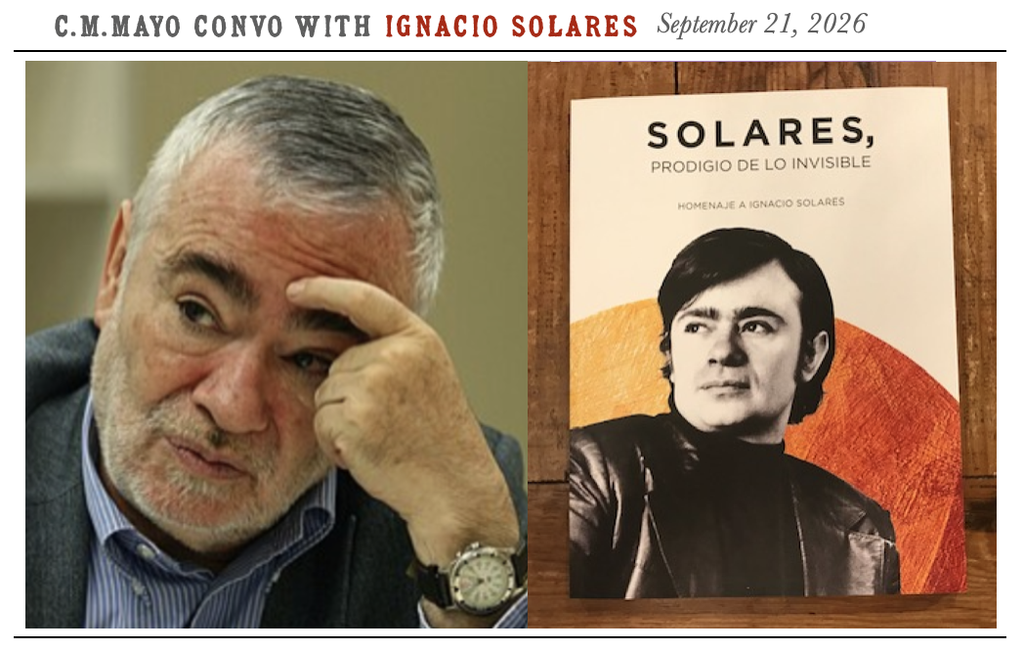
Welcome to this fourth post, the second “convo” upon the re-launch of my blog after its unexpectedly lengthy brumation. Look for “Book Notes” on the first Monday of the month, and a “convo” on the third Monday.
You will find no AI-generated writing here. If I say I wrote it, I wrote it. And precisely because I do a lot of writing I don’t have the wherewithal to wrangle with a comments section. But I do welcome your comments. Write to me directly at pugandbee (at) protonmail (dot) com.
To subscribe, visit the Substack mirror site.
Click here to go directly to this same post on Substack.
CONVERSATIONS WITH IGNACIO SOLARES
This is the English version of an essay that I wrote in Spanish for the anthology Solares, pródigo de lo invisible, Homenaje a Ignacio Solares, Universidad Autónoma de Chihuahua, 2024
ISBN 978-607-536-138-3
A literary friendship is a kind of conversation. Mine with Ignacio Solares began late in life, after I had already been living in Mexico City for some decades, and it was thanks to none other than Francisco I. Madero, our host on the astral plane, which is to say, the imaginal realm, the realm of words and dreams and the magic of books. On the material plane, our conversation began in Chimalistac, Mexico City, with a breakfast, hosted by the Meade family.
Years ago, in my previous incarnation (within this one) as a professor of economics at ITAM, José Meade and his wife Juana Cuevas had been my students; later, José and his father Dionisio worked with my husband. And the Meades also happened to be neighbors of Ignacio and Myrna Solares. That’s Mexico City: a handkerchief. So when, in my current incarnation (within this incarnation), as a literary writer and translator, not long after the publication of my book, Metaphysical Odyssey into the Mexican Revolution, Francisco I. Madero and his Secret Book, Spiritist Manual (which included my English translation of his 1911 Manual espírita), I found myself seated at a lovely breakfast, which purpose was to introduce me to the author of that splendid and iconic novel, Madero, el otro: Ignacio Solares.
That marked the start of a warm friendship— and a deeply and uniquely meaningful one for me, for I had spent many years on my book about Madero, and who better than Ignacio Solares to appreciate that work? Solares comprehended, fully and compassionately, as almost no one else living could, Madero’s metaphysical beliefs. In Madero’s lifetime and for the century after his death, the delicate and complex subject of his beliefs, has more often than not been disdained, even taboo. To this day, it has been my consistent experience that only a very few people are able, never mind willing, to bring their unbiased curiosity and focused attention to it.
I had been exceedingly lucky to be so warmly introduced to Ignacio Solares. I knew that at the time, and I came to appreciate it all the more in the years that followed. And yet, our conversations on the subject of Madero and his beliefs were few, we saw each other seldom, and always at an event, or a dinner with our spouses and others. Somehow (what was I thinking?) I assumed there would come a time when we could talk more about Francisco I. Madero. And isn’t this the oldest mistake in the world? Years went by faster than a pistol shot. I moved to Europe. Then in 2020 came the shadow of the covid catastrophe: eerie silences from all around, and including in the skies. I think of the material-plane conversations I wish I could have had with Ignacio Solares like a shard of darkening sky.
But there was another dimension to our friendship— our conversation—one that was indirect, our words dancing with one another across time. His words, my words, as I see them in my mind, like silvery fish flitting from one pond to another, Spanish to English. I mean to say, I translated two of his short stories.
The first was “Los delirios de Victoriano,” which I translated as “Victoriano’s Delirums” for The Lampeter Review, March 2015. A horror story on par with anything by Edgar Allen Poe, it is about the last, vivdly imagined moments of Victoriano Huerta, that general who had betrayed Madero in the coup d’etat of 1913. By 1916 Huerta, himself overthrown, was dying of liver failure after years of alcoholism and a botched surgery. He took his last breath in a dingy little house in El Paso, Texas. Soon after I had finished that translation, I happened to go to Univerity of Texas El Paso to give a reading from my book on Madero. Having seen the little house so vividly in my mind’s eye, as directed by Ignacio Solares’ story, I wondered if it were still standing. I drove to the address. A 1960s-era apartment buidling stood on the site. I recall a yucca tree on the parking strip of dead grass. I took a photo and emailed it to Ignacio. I would like to imagine that he laughed.
The second story of his that I translated was “La instrucción” as “The Orders” published in Gargoyle Magazine, issue 72, 2021. A captain on a ship must follow orders, or else, but he cannot decipher what he has in hand. I interpreted that story as a philosophical statement on the challenge of coming into a human incarnation. We don’t know what exactly to do, we don’t know where exactly to navigate, nonetheless, gathering our courage, we undertake our journey. In the story, the ship’s captain wonders to himself, “¿Qué otra cosa somos sino verbo incarnado?” What are we, if not the verb incarnate?
After Ignacio left this world, I had a dream that, on the astral, Edith Wharton had sought him out there. An American novelist best known for her sprawling society novels of old New York, Wharton also published stories, many stories, including horror. She died in France in 1937. In her lifetime Edith Wharton had traveled widely in Greece, and wrote books about her forays throughout Italy and Morocco; that she had never seen Mexico was something that, it seems, she belatedly regretted. There on the astral, she gave a teaparty for Ignacio Solares—and Francisco and Sara Madero, too— and I think I glimpsed Zelia Nuttal— with tiny cucumber sandwiches. There too were all her wiggly barky little dogs, the whole jumble of them from her long life: Miza, Jules, Toto, Mimi, Mitou, Nicette, Choumal, Tooty, and her last pekinese, Linky. It was all so noisy and somewhat floaty and blurry and misty, but Edgar Allan Poe haunted the sofa closest to the balcony. Luis Blasio took a cookie. A silken curtain fluttered out into a beautiful day. Verbs adorned the walls like pictures. I woke up with the bright smiling image of Ignacio Solares in the center of all this.
- Ignacio Solares en el Enciclopedia de la Literatura Mexicana
- Ignacio Solares’ “The Orders” in Gargoyle Magazine #72
- Ignacio Solares’ Short Story “Victoriano’s Deliriums” Translated by Yours Truly in the Lampeter Review
© C.M. Mayo, 2026. www.cmmayowriter.com
I welcome your comments directly at pugandbee (at) protonmail (dot) com.