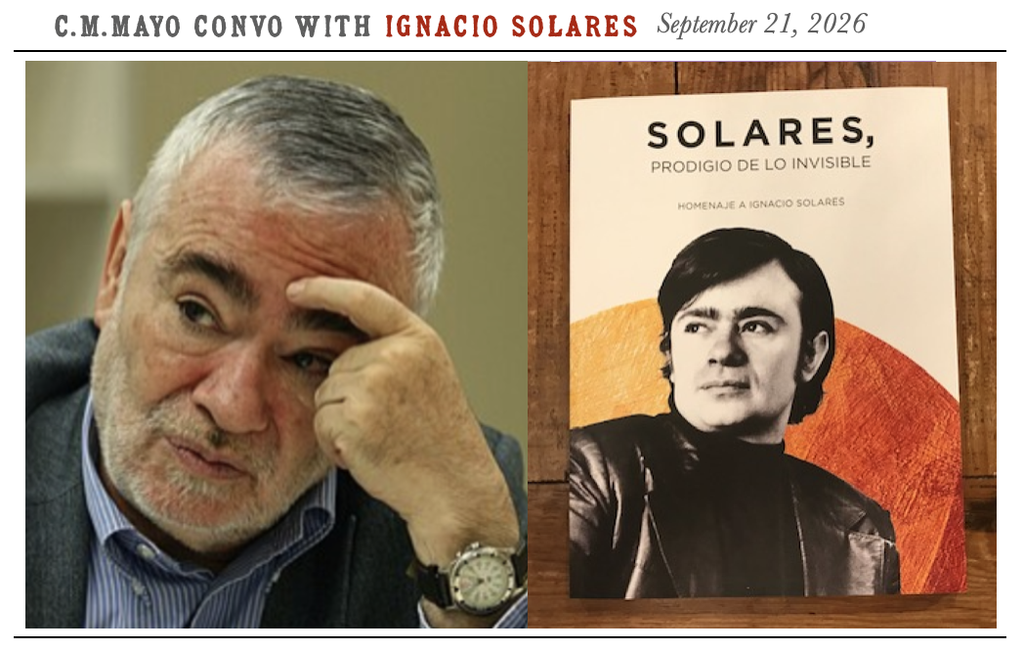
“Conversations with Ignacio Solares,” from PRODIGO DE LO INVISIBLE, HOMENAJE A IGNACIO SOLARES

Third Monday Convo

C.M. Mayo

Welcome to this fourth post, the second “convo” upon the re-launch of my blog after its unexpectedly lengthy brumation. Look for “Book Notes” on the first Monday of the month, and a “convo” on the third Monday.

You will find no AI-generated writing here. If I say I wrote it, I wrote it. And precisely because I do a lot of writing I don’t have the wherewithal to wrangle with a comments section. But I do welcome your comments. Write to me directly at pugandbee (at) protonmail (dot) com.

To subscribe, visit the Substack mirror site.

Click here to go directly to this same post on Substack.


CONVERSATIONS WITH IGNACIO SOLARES

This is the English version of an essay that I wrote in Spanish for the anthology Solares, pródigo de lo invisible, Homenaje a Ignacio Solares, Universidad Autónoma de Chihuahua, 2024
ISBN 978-607-536-138-3

A literary friendship is a kind of conversation. Mine with Ignacio Solares began late in life, after I had already been living in Mexico City for some decades, and it was thanks to none other than Francisco I. Madero, our host on the astral plane, which is to say, the imaginal realm, the realm of words and dreams and the magic of books. On the material plane, our conversation began in Chimalistac, Mexico City, with a breakfast, hosted by the Meade family.
Years ago, in my previous incarnation (within this one) as a professor of economics at ITAM, José Meade and his wife Juana Cuevas had been my students; later, José and his father Dionisio worked with my husband. And the Meades also happened to be neighbors of Ignacio and Myrna Solares. That’s Mexico City: a handkerchief. So when, in my current incarnation (within this incarnation), as a literary writer and translator, not long after the publication of my book, Metaphysical Odyssey into the Mexican Revolution, Francisco I. Madero and his Secret Book, Spiritist Manual (which included my English translation of his 1911 Manual espírita), I found myself seated at a lovely breakfast, which purpose was to introduce me to the author of that splendid and iconic novel, Madero, el otro: Ignacio Solares.

That marked the start of a warm friendship— and a deeply and uniquely meaningful one for me, for I had spent many years on my book about Madero, and who better than Ignacio Solares to appreciate that work? Solares comprehended, fully and compassionately, as almost no one else living could, Madero’s metaphysical beliefs. In Madero’s lifetime and for the century after his death, the delicate and complex subject of his beliefs, has more often than not been disdained, even taboo. To this day, it has been my consistent experience that only a very few people are able, never mind willing, to bring their unbiased curiosity and focused attention to it.

I had been exceedingly lucky to be so warmly introduced to Ignacio Solares. I knew that at the time, and I came to appreciate it all the more in the years that followed. And yet, our conversations on the subject of Madero and his beliefs were few, we saw each other seldom, and always at an event, or a dinner with our spouses and others. Somehow (what was I thinking?) I assumed there would come a time when we could talk more about Francisco I. Madero. And isn’t this the oldest mistake in the world? Years went by faster than a pistol shot. I moved to Europe. Then in 2020 came the shadow of the covid catastrophe: eerie silences from all around, and including in the skies. I think of the material-plane conversations I wish I could have had with Ignacio Solares like a shard of darkening sky.

But there was another dimension to our friendship— our conversation—one that was indirect, our words dancing with one another across time. His words, my words, as I see them in my mind, like silvery fish flitting from one pond to another, Spanish to English. I mean to say, I translated two of his short stories.
The first was “Los delirios de Victoriano,” which I translated as “Victoriano’s Delirums” for The Lampeter Review, March 2015. A horror story on par with anything by Edgar Allen Poe, it is about the last, vivdly imagined moments of Victoriano Huerta, that general who had betrayed Madero in the coup d’etat of 1913. By 1916 Huerta, himself overthrown, was dying of liver failure after years of alcoholism and a botched surgery. He took his last breath in a dingy little house in El Paso, Texas. Soon after I had finished that translation, I happened to go to Univerity of Texas El Paso to give a reading from my book on Madero. Having seen the little house so vividly in my mind’s eye, as directed by Ignacio Solares’ story, I wondered if it were still standing. I drove to the address. A 1960s-era apartment buidling stood on the site. I recall a yucca tree on the parking strip of dead grass. I took a photo and emailed it to Ignacio. I would like to imagine that he laughed.


The second story of his that I translated was “La instrucción” as “The Orders” published in Gargoyle Magazine, issue 72, 2021. A captain on a ship must follow orders, or else, but he cannot decipher what he has in hand. I interpreted that story as a philosophical statement on the challenge of coming into a human incarnation. We don’t know what exactly to do, we don’t know where exactly to navigate, nonetheless, gathering our courage, we undertake our journey. In the story, the ship’s captain wonders to himself, “¿Qué otra cosa somos sino verbo incarnado?” What are we, if not the verb incarnate?

After Ignacio left this world, I had a dream that, on the astral, Edith Wharton had sought him out there. An American novelist best known for her sprawling society novels of old New York, Wharton also published stories, many stories, including horror. She died in France in 1937. In her lifetime Edith Wharton had traveled widely in Greece, and wrote books about her forays throughout Italy and Morocco; that she had never seen Mexico was something that, it seems, she belatedly regretted. There on the astral, she gave a teaparty for Ignacio Solares—and Francisco and Sara Madero, too— and I think I glimpsed Zelia Nuttal— with tiny cucumber sandwiches. There too were all her wiggly barky little dogs, the whole jumble of them from her long life: Miza, Jules, Toto, Mimi, Mitou, Nicette, Choumal, Tooty, and her last pekinese, Linky. It was all so noisy and somewhat floaty and blurry and misty, but Edgar Allan Poe haunted the sofa closest to the balcony. Luis Blasio took a cookie. A silken curtain fluttered out into a beautiful day. Verbs adorned the walls like pictures. I woke up with the bright smiling image of Ignacio Solares in the center of all this.


© C.M. Mayo, 2026. www.cmmayowriter.com

I welcome your comments directly at pugandbee (at) protonmail (dot) com.
To subscribe, visit the Substack mirror site.

HOME = LATEST POST

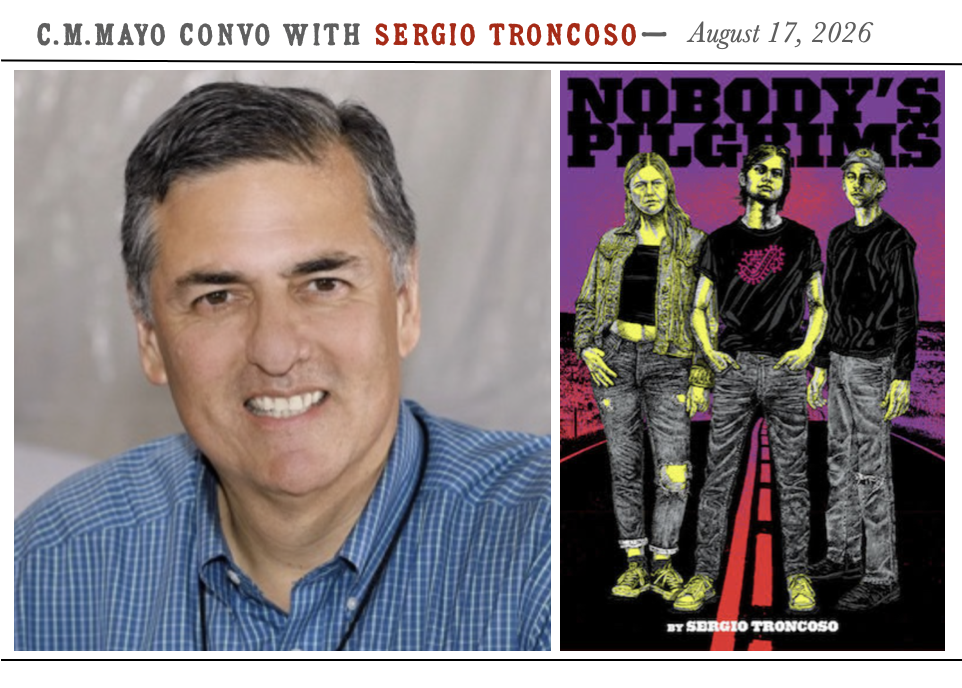
Convo with Sergio Troncoso About His Novel NOBODY’S PILGRIMS

Third Monday Convo

C.M. Mayo


Welcome to this second post, the first “convo” upon the re-launch of my blog after its unexpectedly lengthy brumation. Two weeks ago, on the first Monday of the month, I relaunched with the first “Book Notes”; this post, as on all third Mondays going forward, is for a convo, that is, a conversation, with another writer. 

You will find no AI-generated writing here. If I say I wrote it, I wrote it. And precisely because I do a lot of writing I don’t have the wherewithal to wrangle with a comments section. But I do welcome your comments. Write to me directly at pugandbee (at) protonmail (dot) com.

To subscribe, visit the Substack mirror site.


CONVO: SERGIO TRONCOSO ON NOBODY’S PILGRIM

We’ve crossed paths many a time in our literary careers, and become friends, and perhaps that was destiny, for Sergio Troncoso and I were born in same year and same city: El Paso, Texas. I was living in Mexico City when Troncoso’s passionate and highly original work popped up on my radar. That was maybe 25 years ago. I have since come to appreciate his writing as some of the most important coming out of the Texas borderlands, New York (where he has been living for many years), and the American literary tradition generally. In a word, Troncoso is an heir to Mark Twain— albeit with a very different style and subject matter than our man in white from Missouri.

Nobody’s Pilgrims was published in 2022 and, no surprise, quickly garnered accolades: the Top 10 List in Fiction, Nonfiction, and Social Advocacy of the In the Margins Book Awards; Gold Medal for Best Novel—Adventure or Drama (English) from International Latino Book Awards; Bronze Medal for The Rudolfo Anaya Best Latino-Focused Fiction Book Award (English) from International Latino Book Awards; named one of the Best Books of 2022 from The Texas Observer, and more. 

Nobody’s Pilgrims
by Sergio Troncoso
Lee & Low Books, 2022
ISBN: 1947627414

C.M. MAYO: What inspired you to write Nobody’s Pilgrims?

SERGIO TRONCOSO: I wanted to write an ‘adventure novel,’ which is what I called Nobody’s Pilgrims before it had a title. And I wanted to write a novel about ‘escaping the border,’ rather than primarily staying on the border, like From This Wicked Patch of Dust. I was also interested in a dystopian landscape and in seventeen-year-olds. I wanted to show how they form friendships on the fly, how they create a new community, and how resilient they are in the face of danger. All of these elements were/are in the inspiration. Also, I wanted to write a fast read, a thriller-type book that was action-oriented, suspenseful.

C.M. MAYO: As someone who is deeply familiar with both the US-Mexico borderlands and New England, what do you think are some of the most notable surprises for those coming to New England from the borderlands, and from New England to the borderlands? 

SERGIO TRONCOSO: Well, the first difference is in the landscape. In Ysleta and El Paso, you are in the Chihuahuan Desert, with mountains that rarely have snow on them, and where trees are few and far between. The heat in the desert is also impressive/oppressive. In New England, I was also intrigued, mystified by the forests (even if they are secondary forests), the lush vegetation at least in places like northwest Connecticut, and the heavy snow for months at a time. It’s a ‘cold desert,’ in a way. The second main difference is the people who live in these places. El Paso and Ysleta are populated primarily by Mexican immigrants, Mexican Americans, and a scattering of ‘Anglos,’ which is anybody who is not of Mexican heritage. For me, New England had very few (if any) Mexicans, but even that has begun to change in many communities. New England prided itself in being the origin of the United States, but I always saw the connection to the border, as the ‘renewal’ of the U.S. through the ‘brown pilgrims’ who were coming across today to find their place in a somewhat hostile world. Just as the New England pilgrims struggled to establish themselves, so do the ‘brown pilgrims’ coming from our southern border today. Because of that struggle, people formed tight communities and families. That process is repeating itself today, but with new immigrants. That’s why the characters in Nobody’s Pilgrims experience a gauntlet of evil: for those who survive such travails, they become bonded together forever, and they deeply understand what it is to become ‘American.’ The struggle is what makes you an ‘American,’ not the privileged fact that you or your ancestors were/are already here.

C.M. MAYO: I have always been intrigued by, as best as I recall (I may be misquoting) Douglas Glover, in a long-ago workshop, saying that a good novel boils down to a philosophical statement. Since you are a philosopher, I must ask: Would you agree? And if so, what is the philosophical statement of Nobody’s Pilgrims?

SERGIO TRONCOSO: Working together to survive, when you have nothing, creates a community. This is Aristotle, in a way: to understand community, it’s not very good to take an already formed community and understand it. What you need instead are the hardships those people in that group faced, how they faced them, and how (and whether) they survived: that story is what forms and defines a community. What you have after the gauntlet is simply the endpoint of community. To understand the community, you need to look at the actions it took to reach that endpoint.

C.M. MAYO: As you were writing Nobody’s Pilgrims, did you have in mind an ideal reader? If so, how might you describe that ideal reader?

SERGIO TRONCOSO: My ideal reader is an intelligent, inquisitive person who wants to be entertained, yet knows she also wants more than that, perhaps an exploration into the soul and society as well. Nobody’s Pilgrims is adult fiction.

C.M. MAYO: What was the most challenging aspect of writing this book?

SERGIO TRONCOSO: Well, I always work on a specific part of craft when I’m writing a new book. I wanted to write a fast-paced book that was character-driven. So for me the most important challenge was to know Turi, Molly and Arnulfo very well, as people on the page, so that the action came from them. I was also interested in depicting action, especially action in the face of violence, as a way to reveal character. That’s one of the reasons the book has so many evil people coming after the three teenagers: to understand their grit and character and even luck, you have to experience the gauntlet they go through and survive.

C.M. MAYO: What has most surprised you about its reception?

SERGIO TRONCOSO: I find it interesting that a few people are taken aback by the scenes of violence or that the book is populated by many evil people who are coming after the three teenagers. There seems to be a lower threshold for accepting violence in literature than, say, television, which is much much more violent. But for me, this difficult, sometimes violent world we live in and emphasized in Nobody’s Pilgrims was a way to reveal character and grit. Flannery O’Connor also routinely used violence in her stories to reveal who her characters really were, and I always found her stories very powerful precisely for that reason. I take violence as just another form of action, which reveals character, an Aristotelian viewpoint.

C.M. MAYO: Which writers have been the most important influences for you in general— and also, specifically, when you were writing Nobody’s Pilgrims? 

SERGIO TRONCOSO: Certainly Mark Twain and The Adventures of Huckleberry Finn, both of which play a prominent role in Nobody’s Pilgrims. Turi is a reader, despite his poor upbringing and difficult home life. And he carries a copy of Huckleberry Finn in a crate when he joins Arnulfo on their cross-country adventure. When the two are hiding from the narcos pursuing them, Turi decides to hide in the Mark Twain National Forest in Missouri, because he loves Twain. And that’s where they meet Molly Crump, a poor white teenager who also decides to run away from home with them. Turi and Molly connect and develop their relationship because they love words and word games, and they both love Mark Twain. Finally, both Turi and Molly face a similar dilemma that Huck faces in Huckleberry Finn: should you turn in or abandon your friend, or friends, because an (unjust) society or an (unjust) law requires you to do so? Arnulfo is an undocument immigrant, and Jim is a slave. At different points in my novel, Turi (and Molly) are faced with whether they should ditch Arnulfo, because they have run afoul of the state’s laws. But they don’t, because their friendship with Arnulfo supersedes anything demanded by the society they live in. So many connections to Twain, not the least of which is also the sense of adventure with young people as characters traveling and facing dangers, but also surviving.

C.M. MAYO: If it were to be filmed (and I ask because I think it will be) which actors could you see playing the lead characters?

SERGIO TRONCOSO: That’s a hard question to answer, because Hollywood, of course, is not my world, as you know. My agent, by the way, has gotten me two movie agents who are shopping the novel for a movie option. So you never know. I don’t know a lot of 17-25 year-old actors, but here’s what I would want. Mexican or Mexican American actors for Turi and Arnulfo. A Midwestern actor who knows/appreciates coming from a working class background, for Molly. To me, the authenticity of these characters should somehow be in the actors too. I also loved the casting of S.E. Hinton’s The Outsiders, which had very young actors playing the gritty, complex roles in her novel who later became big stars. But none of these actors were household names when they appeared in The Outsiders. Matt Dillion, Tom Cruise, Patrick Swayze, Ralph Macchio, Diane Lane, Emilio Estevez. That’s exactly the kind of high-quality young actors I would want in a film about Nobody’s Pilgrims.

C.M. MAYO: What’s next for you as a writer?

SERGIO TRONCOSO: I’m planning another novel and perhaps a book of essays. I don’t really like to talk about my work until it is done, or nearly done. But I’m always itching to work on something else, so for me that means writing notes, thinking of possible stories and characters, reading intensely for a purpose, and thinking some more. All of that will eventually coalesce in my brain into ‘something’ I’m excited about. And that something might be my next book or books. So stay tuned!

# # #

Our Lost Border: Essays On Life Amid The Narco-Violence, Arte Público Press, 2013Review by C.M. Mayo, Literal, issue 33, 
Read this same review on my blog, https://madam-mayo.com/texas-books-from-the-archives-a-review-of-sarah-cortez-and-sergio-troncosos-our-lost-border/

To Define Ourselves: Review of Crossing Borders: Personal Essays, Arte Público Press, 2011 & From This Wicked Patch of Dust, University of Arizona Press, 2011.
Review by C.M. Mayo, Literal, issue 28

# # #

© C.M. Mayo, 2026. www.cmmayowriter.com

I welcome your comments directly at pugandbee (at) protonmail (dot) com.

N.B.: The WordPress site is a mirror site of the Substack, and it is the latter that will take care of subscriptions— in other words, if you’re reading this on the WordPress site and you’d like to subscribe, and by the way it’s always free, just tootle on over to the Substack version of this same blog and click on “subscribe.”

HOME = LATEST POST