First Monday Book Notes
Welcome to the first Monday of the month “Book Notes.” For those who are new here, this is the fifth post following this blog’s unexpectedly lengthy brumation. In days of yore, that is circa 2006-2022, this blog was entitled “Madam Mayo.” I’ve revived it on both self-hosted WordPress and Substack with a new name and sharper focus as “C.M. Mayo’s Book Notes + Convos.”
You will find no AI-generated writing here. If I say I wrote it, I wrote it. And precisely because I do a lot of writing I don’t have the wherewithal to wrangle with a comments section. But I do welcome your comments. Write to me directly at pugandbee (at) protonmail (dot) com.
To subscribe, visit the Substack mirror site. http://cmmayo.substack.com
Click here to go directly to this same post on Substack.
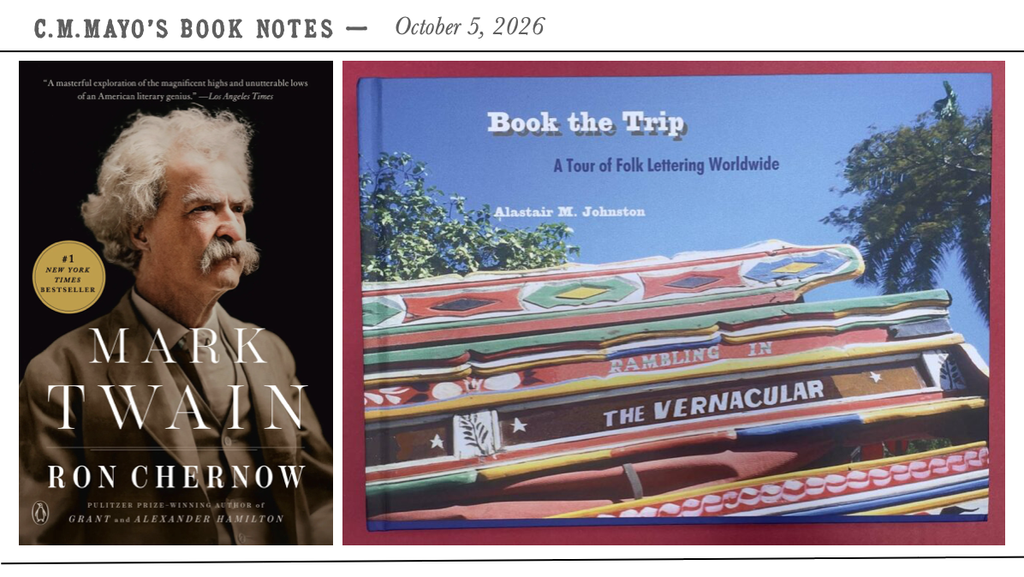
Mark Twain
by Ron Chernow
Penguin Press, 2025
ISBN 9780525561743
“I’ve lived through some terrible things in my life, some of which actually happened,” so my father quoted Mark Twain on many an occasion. For me, Mark Twain brings to mind my father, not because they were alike but because my father so loved Twain’s books. My father came from a long line of avid readers, going back into the misty ancestral past in Ireland. In Brooklyn, my great grandfather, as a small child, was left to roam his parents’ library, that being one and the same room as the dining room, covered wall to wall and floor to ceiling with books. Undoubtedly, that library held works by Mark Twain— I imagine my great grandfather got to those as an adolescent or teenager; he would have turned 12 the year The Adventures of Tom Sawyer appeared. As for my father, the first chance he had, he took the family on a pilgrimage to Hannibal, Missouri. On the bank of the broad brown Mississippi River, that scruffy little farm town surrounded by uncounted miles of cornfields and wilderness had been the hometown of Samuel Clemens, before he vamoosed West to become the world famous author and lecture circuit celebrity Mark Twain.
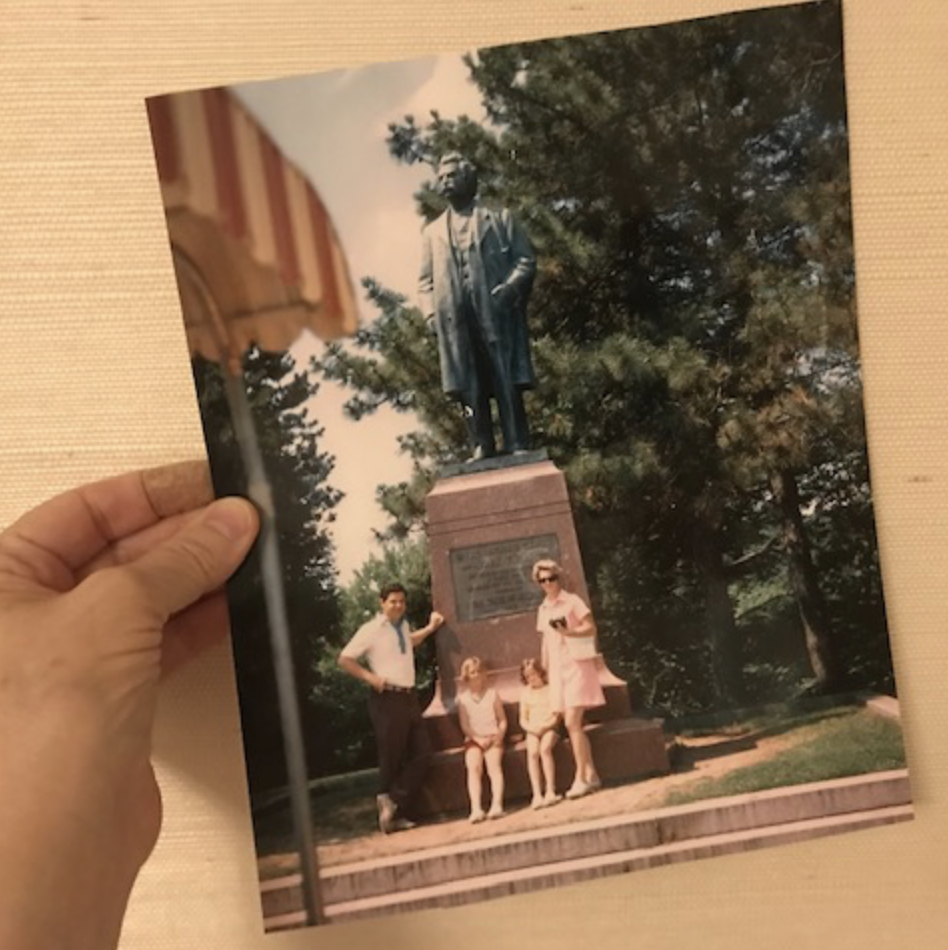
Saint Twain with Pilgrims, Including Yours Truly, circa 1970
Best known among Twain’s many works are The Celebrated Jumping Frog of Calavaras County and Other Sketches (1867), Innocents Abroad (1869), Roughing It (1872), The Adventures of Tom Sawyer (1876), Adventures of Huckleberry Finn (1884), A Connecticut Yankee in King Arthur’s Court (1889), and Following the Equator (1897). My father is no longer with us, but my best guess is, his favorite would have been The Adventures of Tom Sawyer. Mine is Twain’s comic magnum opus of travel writing, Following the Equator. Twain himself preferred one of his least known works, not a comedy, his novel of historical fiction, Personal Recollections of Joan of Arc, by the Sieur Louis de Conte. He said, “I like Joan of Arc best of all my books; and it is the best; I know it perfectly well. And besides, it furnished me seven times the pleasure afforded me by any of the others.”
Twain isn’t read so much today— why that is would be another sticky wicket of an essay. But when I was a child, more than half a century after Twain’s death in 1910, Twain was still widely read and adored— and that is not too strong a word— as the ever-quotable humorist and the first great American author so incomparably gifted at conjuring up unforgettable characters from the American West and the American heartland— what we now call “flyover country.”
Obscure though he may be to younger generations, I don’t think Twain will ever be forgotten, not for as long as we have the English language and a United States of America. Ron Chernow understood this, as did his publisher, and Chernow’s biography of Twain, be it noted, has achieved the ranks of best-seller. Unfortunately, however, Chernow’s Mark Twain clocks in at some 1,200 pages. Nice doorstop, if you need one.
But to the contents. Chernow brings Twain’s literary achievements back into the national spotlight, where they should be. Both expertly and engagingly Chernow narrates the astounding metamorphosis of Samuel Clemens, from a wise-cracking kid from Missouri who became a steamboat captain and, for a couple of weeks, a Confederate soldier, into a Yankee— and an establishment Yankee, no less, for he married a lovely and intelligent New York coal heiress, and for the rest of his life he hobnobbed with many of the industrial and literary elite of the Northeast and Europe. After the war, Twain even became the publisher of the memoirs of Union generals, firstly Ulysses S. Grant, and then Generals McClellan, Sheridan, and Sherman.
To my father, as to so many others, Twain was a bright American hero— funny, charming, wildly successful, and one in love with America itself, for all her flaws and errors, for all her good and wonders. Looking back on Twain from the end of the first quarter the 21st century, however, Twain comes across as what he was: a brilliant writer and entertainer of another time.
Be it underscored, and Chernow underscores it often, retrograde as Twain may oft come across, in his own time he was in the liberal vanguard and his novel Adventures of Huckleberry Finn was a radical artistic achievement. Ah, the “N” word. Yes, in the 19th century the word was used casually and often, and so Twain’s characters, as such folks would have in life, used the “N” word. If that raises your eyebrows, I hope you know to look both ways before crossing the street. That’s the sum of what I would say about that. Chernow, well, it’s his book. Reader be warned.
More importantly, Chernow paints for us a detailed and complex portrait of the author, one who had his inestimable talents but also some injurious personality disorders. Time after time, and time again, Twain fell for pie-in-the-sky investments and, lured on by his own fantasies of tycoon-level wealth, went on shoveling money into a bottomless pit. It was a pattern that ruined his family finances and obliged him and his wife and three daughters to abandon their mansion and well-established social lives in Hartford, Connecticut, to take less expensive quarters in various corners of Europe for many years. But it was a pattern he apparently could not break. Chernow covers instances in this pattern in excruciating detail. It is of course a valid subject for a biography and I for one would rather know about Twain’s personality disorders than not; but too much information on that front I found both unnecessary and tiresome. What interests me are Twain’s literary achievements, and the context in which they were made. For endlessly endless rounds of interpersonal conflict and drama, there are, at the click of the remote, ever and always perfectly serviceable TV soap operas. If one goes for that sort of thing.
As for Twain’s last years, after his wife died in a miserable rented villa in Italy, that is a saga that, while necessary to recount, could have benefitted from an editor’s chainsaw. Dear reader, if you have not experienced some consternating interactions with health-challenged individuals of an advanced age who have, by-the-by, begun to lose their judgment, blessings upon you. In my experience, not unpainfully acquired, indulging in armchair psychoanalysis of the behaviors born of circulatory and/or neurological impairment is akin to scratching down the rabbit hole in search of a giraffe.
Twain himself once said, “A successful book is not made of what is in it, but of what is left out of it.” Chernow’s is a landmark biography of Mark Twain, but one that, alas, could have found more readers had it been whittled down to under 400 pages. By Jupiter, yes! I am saying he could have cut 800 pages. How then, despite Yours Truly’s objections about its appeal to readers, did Chernow’s Mark Twain become a best-seller? Buyers and readers, as publishers well know, are not necessarily one and the same. As an object I cannot but celebrate Chernow’s Mark Twain as one that is wonderfully jumbo, handsome, and suitable for home display. Real estate stagers take note! Twain scholars take note, too— but to grapple with the entire entirety, the whole beef-and-chicken-and-shrimp-and-cheese-and-tofu enchilada of this tome, you will need the patience of Job, the stomach of Jonah’s whale, and a prepper’s supply of your go-to caffeinated beverage. General readers and book clubs? Well, I’d sooner point y’all to Adventures of Huckleberry Finn.
- Ron Chernow’s website
- Buy the book from the publisher (page offers links to buy from the usual suspects)
- Highly recommended: Podcast interview with Chernow by Mark Bazer
Chicago Humanities, The Interview Show
*
Book the Trip: A Tour of Folk Lettering Worldwide
by Alastair M. Johnston
Poltroon Press, 2026
ISBN: 978-0-918395-44-3
From publisher’s description: Printed full-color throughout: 8.5 x 12 inches; 236 pages; Smythe-sewn and casebound so it will open fully & lay flat
Also from publisher’s description:
“This book from Poltroon Press contains over 700 photos taken by author Alastair Johnston on his travels over the past 40 years. Most scholars dismiss folk lettering as naïve, but Johnston embraces the unusual, learning from amateur sign painters and muralists. In 31 succinct chapters he explores different aspects of these artworks that are part of our cultural heritage, from African beauty parlor signs to hundred-year-old fairground stalls, from the early industrial heritage of Britain to its manifestation in signs in former colonies such as Ireland or India, from Haitian buses to African fishing boats, he finds a lot to celebrate.”
A confession: In my many decades I have thought insufficiently about lettering, typefaces, fonts— all that. I have, however, thought a little bit about fonts. I did learn the difference between sans serif and serif, and I became familiar with the fonts which work well for titles, generally san serif, and those, generally serif, easier on the eye for reading blocks of text. It has always seemed to me that, for words the choice of font is like a choice of clothes. Depending on the cut, quality, fit, color, and other aspects of his clothing, a person can appear as sharp, geeky, high-status, edgy, dull-witted, silly, serious, authoritative, childish, slobby, poor, prim, or, say, creepy weird. And so it goes for the title of a book, or the page of text: the very same words, rendered in Gill Sans telegraphs one thing and in Comic Sans another entirely. And with hand-lettering, even more can be communicated, whether intentionally or not— should the mind behind the eye be willing to receive it, and then to parse it.
Inspired by Nicolete Gray’s research on Roman lettering and by James Mosley’s article on English vernacular lettering (Motif, 1963), Alastair Johnston plunged into a years-long globe-trotting adventure in, as he puts it, “contextualizing the work of lettering artists worldwide” and in so doing “approach a better understanding of our own visual literacy.” From hand lettering on Rajastani trucks to Haitian tap-taps, Portugese fishing boats, savings banks, coffee shops, a Catalonian pharmacy, churches from Bisbee Arizona to Newcastle upon Tyne, schools, fireworks stands, Mexico City’s Dulcería Celaya— it’s a dizzying tour.
Of special note: The chapter, “El Pintor relámpago,” about the Ecuardian-born street-sign painter and muralist named Bolivar Córdova (d. 1994) whose work appears throughout San Francisco, California’s Mission District, from La Palma restaurant to a shoe repair, a barbershop, church, taqueria, cheesemonger and many more— 24 full-color images.
For me Book the Trip, with all its wacky jumble of images that I might call curious and beautiful, as well as jarring, even ugly, has been an invitation to sharpen my own eye, and to remember that the world made by hand is, ever and always, a richly interesting place.
- Buy Book the Trip from Poltroon Press
- Book the Trip’s brief, informative and charming trailer.
- Watch Alastair M. Johnston’s lecture for the San Francisco Public Library on San Francisco printer Robert Grabhorn’s rare book collection on printing. (51 minutes)
- Related: a short funny video from modern day typographer Elle Cordova (2026)
- My fave of funny typography videos:
“Trajan is the Movie Font” by Kirby Ferguson (2007)
POSTSCRIPT
- ATTENTION ALL FICTION WRITERS AND TYPEWRITER PEEPS! There’s a call for submissions from Loose Dog Press’s Andrew V. McFeater and typewriter guru Richard Polt: MAINSPRINGS “Tales of Typewriters in the Age of AI.” (You can read my short story typed on an Hermes 3000, “What Happened to the Dog?” which appearsin one of their earlier anthologies, Escapements, 2019.)
- Texas Institute of Letters Awards are now open for submissions.
© C.M. Mayo, 2026. www.cmmayowriter.com
I welcome your comments directly at pugandbee (at) protonmail (dot) com.
To subscribe, visit the Substack mirror site.